

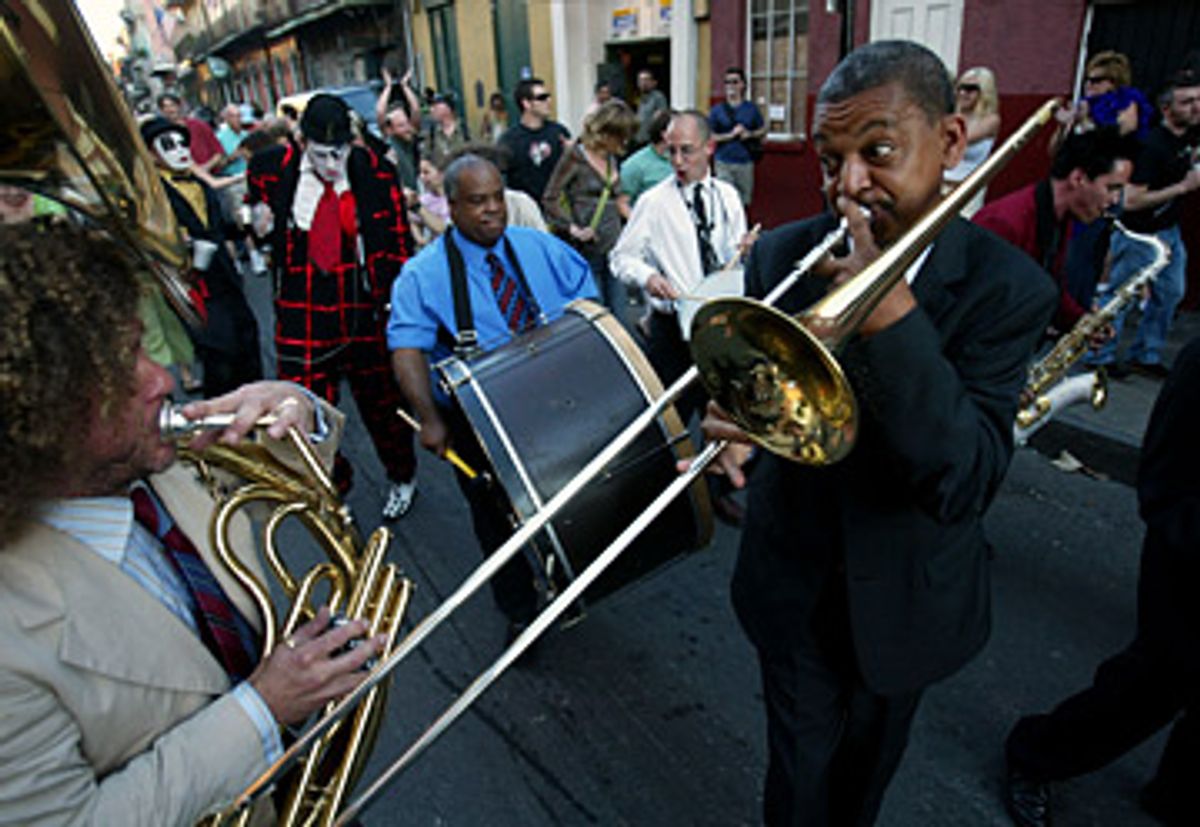
Last Friday, I asked a friend to see the new Katrina documentary, "Trouble the Water," with me.
"Oooh," she said, a sound meant to telegraph temptation but which really meant that I had caught her off-guard. "That sounds really depressing."
I couldn't argue with her. A story about the colossal failures of our government and the needless suffering of others -- what, she had something better to do on a Friday night? Fine, whatever. I went by myself.
It's not as though I didn't understand. I understood all too well. And it's only through a bizarre set of circumstances that I came to be someone who would sit -- alone, tissues in hand -- in that theater in the first place.
Katrina hit New Orleans the week of my 31st birthday, the month I moved to New York City from Texas. When the levees collapsed, I was hung over from a small bash in my honor, and that afternoon, while I watched a "Project Runway" marathon, I occasionally flipped to the surreal parade of anguish that was CNN: a moldy mattress bobbing on the water, an old woman convulsing with grief. It's not that I didn't care. But I quickly began to feel as though I had "Katrina fatigue" before the term had even been coined.
My vague indifference stood in stark contrast to my insatiable hunger for news, any news, in the weeks following 9/11. But while 9/11 was a tragedy that seemed to strike us all -- who will they attack next? where are we safe now? -- Katrina felt like a catastrophe that was specifically someplace else. A place, frankly, I didn't know all that well.
I'd only been to New Orleans twice, quick jaunts through the French Quarter, and what I knew about the city was a bucketful of Cajun clichés. As benefit efforts erupted across the country, as Anderson Cooper grabbed us by the collar and shook us, as celebrities appeared misty-eyed on camera to wax eloquent about the cultural riches of a great American city, I felt a little, I don't know ... left out? Have you ever been at a funeral where you didn't really know the person, but you know you're supposed to grieve? That's what Katrina felt like to me. I'm pretty sure I gave money. There's a T-shirt around here somewhere.
A year after Katrina, I went to New Orleans for a wedding. A friend of mine had grown up there, and her love for the city was more abiding and unshakable than her accent. It turned out to be kind of a funny day. Because that afternoon, I accidentally wandered into a Ray Nagin reelection fundraiser. I met Mayor Nagin and flirted with his press secretary and drank free wine. And later that night, I was hit on the head with a gun and mugged in the French Quarter. And later than that, I fell in love with the detective on the case, and even later than that, I fell in love -- in deep, abiding, unshakable love -- with New Orleans.
So, OK. I was mugged on Royal Street in the French Quarter around 1:30 a.m., walking back to my hotel. New Orleans is a city wracked by violence, but a year after the storm, armed robbery in the French Quarter indicated a chilling audacity. Post-catastrophe New Orleans doesn't want its tourists getting the idea that they can't come to the city, drink themselves into a blackout, and stumble back to their fancy hotel without some thug emerging from the alley, clobbering them over the head and stealing their adorable Dolly Parton tote bag. So maybe that's why my case got so much attention from the people dealing with it. Maybe it didn't get special attention at all. I never really knew.
All I know is that nearly a year later, I was able to identify the kid who mugged me, in a photo lineup after he'd been arrested on similar charges, and I was flown down to New Orleans for a pretrial motion. And it's at the trial that I met Nick, the detective on my case. (Well, technically, I met him the night I was mugged. But, in my defense, I had been pistol-whipped.)
"Come on," he said, escorting me from my miserable and lonely seat outside the courtroom where I waited to testify, "let me buy you a bad cup of coffee."
The story of how we hit it off, became friends and started corresponding -- first by e-mail, then by letters, then with phone calls that sometimes lasted until 3 a.m. or till someone's cellphone ran out of batteries -- is a story for another time. What is important now is that it was through Nick that I began to see a richer, lustier, sadder portrait of New Orleans than the Bourbon Street bacchanalia I had previously known.
Nick loved New Orleans. He loved it in a bone-deep way I don't think I could ever love a city. I grew up in Dallas, wondering how such a fate had befallen me, and the two years I'd lived in New York had given me little but mounting credit card debt and an impatience for public transit. Nick rarely left the borders of his town -- crossing the Causeway Bridge was an adventure for him -- and he'd stuck it out during the storm with the rest of the cops at a base they dubbed "Fort Apache" -- hopelessly besieged -- sleeping at his desk and in his car for two weeks, head shaved because it couldn't be washed, slogging through the muck for days, the fucking stench of it the thing you can never describe. And maybe the moment my Katrina fatigue began to pivot into what has now become a Katrina obsession was the day he sent me 1,600 photos taken by cops during the storm. No card, no note, just a little mini-disk that contained a flipbook of filth and despair. It went on and on and on.
Journalists sometimes feel skeptical of people if they think they are being used as mouthpieces, and the pictures gave me pause. I wondered, however briefly and stupidly, if Nick was using me to get pictures into the paper. Still, it was hard to deny their gravity: cars smashed on top of houses, houses on fire. So I asked Nick if I could pitch the photos as a slide show to a magazine, and he grew uncharacteristically quiet.
"I'd really rather you not," he said. "Those are pretty personal." And that's when I realized the gift he had bestowed on me, the trust I had been given. I had been allowed to see a family's photo album, not because I was press -- but despite that fact. Later, he would tell me he'd never shown those photos to anyone. And how could I not be moved? Not just by the intimacy of the gesture but also by the devastation it laid bare. He had lived through that.
Anyway, about six months after that pretrial motion, the kid who mugged me pleaded guilty and got 15 years. My case was closed. I visited Nick in New Orleans the following week.
I was supposed to stay two days; I stayed five. Had I not been starting a new job, at this magazine, part of me thinks I might still be down there. But I returned to New York, and we continued to date, and I burned up all my vacation time bookended by Jet Blue's nonstop flights, and when Nick's buddies greeted me at the bar, they sometimes embraced me and said, to my endless delight, "Welcome home."
I don't know which part is odder: falling in love with the detective on your case, or falling in love with the city where you were most brutalized. But living in New York had left me craving the slow pace and eccentricities of the South. I had grown tired of the "pageant of ambition," as Tom Wolfe dubbed Manhattan. I had grown tired of the anonymity of the big city, the crush of strangers -- being never alone, but always alone. New Orleans, bruised as the city was, felt like the salve to my wounds. A town where nobody is a stranger. People weren't uptight, weren't stressed about their jobs, about their status. (At least, not where we were, in the charmingly ramshackle confines of the Marigny and the Bywater, the hedonism haven of the Quarter.) I came to understand why this had been a literary hub: People were raucous and damaged and magnificent.
My nightstand began to pile up with books about New Orleans: Tom Piazza's "Why New Orleans Matters"; a hard-boiled fiction collection called "New Orleans Noir"; a true-crime story about a sniper shooting in the early '70s that took place in the hotel where I stayed during the trial. My favorite was a book by Times-Picayune columnist Chris Rose, who self-published his dispatches during the storm with the name "1 Dead in Attic." (Simon & Schuster later bought the rights and, thankfully, republished the book.) Unlike other Katrina books I've read, which sometimes overreach for poetry or significance, Rose's book doesn't try to be more than one man's humane, baffled and often eloquent attempt to make sense of a cunning beast. (And by that I mean both Mother Nature and the U.S. government.) And it was Rose's book in which I first read the sentence that made me realize how my heart throbbed for this broken-down, beautiful city: "[New Orleanians] dance even if there's no radio. We drink at funerals. We talk too much and laugh too loud and live too large and, frankly, we're suspicious of others who don't."
When Nick came home from work that night, I read him the passage. "Baby, I'm a New Orleanian!"
He drew me to him. "Why do you think I fell in love with you?"
But, of course, there are far more sinister things coursing underneath the crashing good times and bustling second lines of New Orleans. Few knew that better than Nick, who had been transferred to homicide not long after we met at the courthouse. That year, like many years before, New Orleans was the murder capital of the country. I would get e-mails that began, "Six bodies dropped this week. It's disgusting."
Maybe the most surprising thing about New Orleans to me was not its resilience or sensuousness but its violence. I don't mean what happened to me; I mean the brutal gangland dramas that unfold in the Tremé and Midcity and the other scarred pockets of the town. Being mugged in New Orleans does not make you special, by the way; after the Kinks' Ray Davies was shot during a robbery there (an experience about which he wrote a song), a doctor at Charity Hospital told him the city was the ideal place to get shot. "They had, he explained, had plenty of practice."
New Orleans history begins with criminals, actually; it was founded in part by convicts and became home during the 19th century to a band of pirates, most famously Jean Lafitte, who gives his name to one of the city's best bars. Sometimes, I think New Orleans is a bit like pirates, a cartoon commodity sold for its quirk and charm, in which nobody remembers all the spilled blood. I mean, there was a time when New Orleans to me was nothing more than a town where you got wasted on dollar shots, slurped up some gumbo and giggled about hookers and voodoo shops. It's like Las Vegas, or Hawaii; I don't think it occurred to me that people actually lived there. But warm and welcoming as the real New Orleans is, it can also be a hellish place. Five people were shot at the most recent Mardi Gras after a fight ended with a spray of bullets. Police were everywhere on that parade route, but some asshole just opened fire anyway.
"This city is evil," Nick told me once. But he meant it in the nicest possible way.
So often I think the indifference to the plight of New Orleans isn't about New Orleans at all; it's about how difficult it is to confront the ugly truths of urban America, the epidemic failures of the system that create that violence and desperation. I don't mean FEMA or George W. Bush or Mayor Nagin; I mean the public education system. I mean the welfare system. I mean all the systems that failed these people and poor people across the country, systems that are damn near impossible to talk about because they are damn near impossible to fix.
It's not as though people didn't care. Volunteers streamed in from all corners of the globe to aid in New Orleans' rebuilding effort. But without strong leadership, without a thorough and specific blueprint for progress, there was something defeated and wrongheaded about even the best-intentioned efforts. Brad Pitt's Make It Right foundation is an outrageously bighearted attempt to rebuild the Lower Ninth Ward. But that's the region most vulnerable to flooding, certain to be wiped out all over again the next time the levees break (and there is a good chance they will).
Mayor Nagin must have tried, but his grandstanding and his poor judgment calls turned him into a punch line for the local media at a time when they needed a hero. The city's homeless became so desperate for his help that, for weeks last winter, 250 of them slept in pup tents outside City Hall in protest, turning the seat of New Orleans government into what one AP reporter dubbed "a colony of despair." One afternoon, Nick and I walked through the camp, which reeked of piss and shit. I couldn't get over it. I couldn't get over what I saw, right there, sprawled out in front of the mayor's office building. Old women passed out on the lawn. Scraggly men popping open a cold one outside their REI sleeper as if it were the most natural thing. As we headed back toward the sidewalk, a woman on the street stopped us.
"What's going on?" she asked.
Nick explained to her.
"This is going on in our city?" It was as though we were witnessing a political awakening. "Why aren't we doing something about it?"
Indeed, I sometimes felt frustration with how easygoing Nick was about the painful belly crawl of progress. "What do you mean the streetcars aren't running yet?" I would rail. "The storm was more than two years ago!" And I think this is part of Katrina fatigue, too. Because shouldn't the place have rebounded by now? Shouldn't the cranes and jackhammers have come and groaned on for months and since disappeared? The country rallied to your side, sent food and money -- wasn't that enough? It's like when someone's loved one dies, and you talk to them two years later only to discover they are still mired in grief. That, still? For real? "This would not be happening in New York," I would say. "If this were New York, every home in the Ninth Ward would have fucking TiVo by now."
Which was a lie. But it made me so mad! Why weren't they screaming? But along with their slow-pour attitude, with their good-natured humor and calm, there was also a joyful fatalism. There is acceptance in a New Orleanian -- of the sweltering summers, of the maddening traffic, of the hurricanes that tear through town and always will. They're used to things never working right. In "Trouble the Water," as her world collapses around her, the protagonist keeps saying calmly, "God will provide." I find myself at once frustrated by, and in awe of, such patience.
Nick and I broke up five months ago. Long-distance relationships are hard, but especially between two people as different as we are. A few days ago, I called him to tell him I was working on this story, and to ask why he thought people had grown tired of hearing about his city and its plight.
"I guess, well, how many times can you tell the same story?" he said. "The same story about government failures again and again?" He thought a bit longer. "But maybe people aren't reporting on New Orleans anymore because there's nothing to say -- because things are getting better finally."
The streetcars started running again in November. Housing projects have been torn down. Nick's homicide team moved out of their temporary building and back into downtown headquarters, where the urinals on the third floor are already broken, just as they always used to be. Two weeks ago, the New York Times Magazine ran the most hopeful story about the city I have read in years. A system of muscular charter schools is revitalizing what had been a public school system steeped in failure. Ironically, wiping the whole thing out may prove to be the best way to save it.
"But that is a story," I tell Nick. "There's a battle for the character of a city, the battle for a city's soul. We've gotten through the tragedy, through the depression that followed. This is the exciting time. This is the rebuilding." What I meant to say, and didn't, was: This is the part of the movie that everybody loves.
Shares