

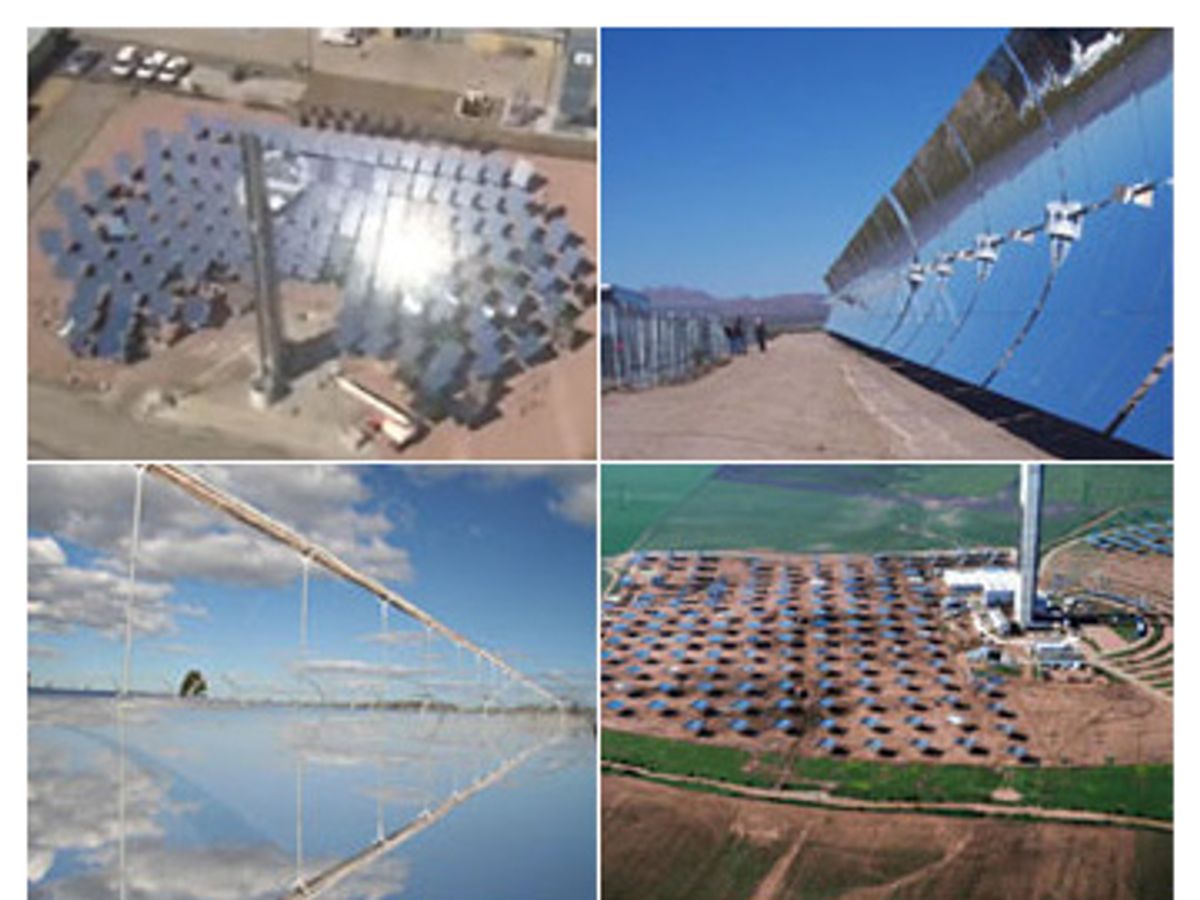
One of oldest forms of energy used by humans -- sunlight concentrated by mirrors -- is poised to make an astonishing comeback. I believe it will be the most important form of carbon-free power in the 21st century. That's because it's the only form of clean electricity that can meet all the demanding requirements of this century.
Certainly we will need many different technologies to stop global warming. They include electric cars and plug-in hybrids, wind turbines and solar photovoltaics, which use sunlight to make electricity from solid-state materials like silicon semiconductors. Yet after speaking with energy experts and seeing countless presentations on all forms of clean power, I believe the one technology closest to being a silver bullet for global warming is the other solar power: solar thermal electric, which concentrates the sun's rays to heat a fluid that drives an electric generator. It is the best source of clean energy to replace coal and sustain economic development. I bet that it will deliver more power every year this century than coal with carbon capture and storage -- for much less money and with far less environmental damage.
Clearly, the world needs a massive amount of carbon-free electricity by 2050 to stabilize greenhouse gas emissions. The industrialized countries need to cut their carbon dioxide emissions from electricity generation by more than 80 percent in four decades. Developing countries need to find a way to raise living standards without increasing electricity emissions in the short term, and then reduce those emissions sharply. And, over the next few decades, the world needs to switch to a ground transportation system whose primary fuel is clean electricity.
This electricity must meet a number of important criteria. It must be affordable: New electricity generation should cost at most about 10 cents per kilowatt hour, a price that would probably beat nuclear power and would certainly beat coal with carbon capture and storage, if the latter even proves practical on a large scale. The electricity cannot be intermittent and hard to store, as is energy from wind power and solar photovoltaics. We need power that either stays constant day and night or, even better, matches electricity demand, which typically rises in the morning, peaks in the late afternoon, and lasts late into the evening.
This carbon-free electricity must provide thousands of gigawatts of power and make use of a low-cost fuel that has huge reserves accessible to both industrialized and developing countries. It should not make use of much freshwater or arable land, which are likely to be scarce in a climate-changed world with 3 billion more people.
Solar electric thermal, also known as concentrated solar power (CSP), meets all these criteria. A technology that has the beauty of simplicity, it has proved effective for generations. As the Web site of CSP company Ausra illustrates, solar thermal has a long and fascinating history.
Back around 700 B.C., the Chinese first used "burning mirrors" to ignite firewood. In 230 B.C., a colleague of Archimedes built a parabolic mirror, which focuses the sun's rays to a single point, also better for starting fires. Around 212 B.C., Archimedes supposedly had Greek soldiers use their bronze shields to concentrate the sunlight on Roman ships and set them on fire.
In the 15th century, the Italians used burning mirrors to solder copper sections of the Santa Maria del Fiore cathedral. Leonardo da Vinci's notebooks contain many designs for solar concentrators, including some for industrial purposes, because he worried about the destruction of the earth's vast forests in humanity's search for fuel.
In the 1860s and 1870s, Augustin Mouchot built the first dish-shaped reflector that ran a heat engine, and he used solar thermal to heat a boiler that ran an ice maker. His assistant demonstrated a printing press running on concentrated solar. But all this work came to naught because of the general lack of direct sunlight in France and the abundance of cheap coal, which became a primary energy source for the Industrial Revolution.
A Swedish immigrant to America, John Ericsson, developed a motor driven by parabolic trough mirrors in 1870. In 1909, H.E. Wilsie added a critical component, a system for storing solar energy for when the sun did not shine. Heat is much easier to store than electricity, a fact that gives CSP a crucial -- maybe the crucial -- advantage over wind and solar photovoltaics.
In 1913, an American, Frank Shuman, installed a 55-kilowatt CSP water-pumping station using parabolic mirrors in Meadi, Egypt. The mirrors focused the sun on tubes whose heated fluid ran an engine to make electricity. This was perhaps the first commercial CSP plant. But it was shut down at the start of WWI, and, as Ausra notes, "the plant was never restarted because of the discovery of cheap oil in the Middle East."
In the 1960s, the Italians developed two of the key CSP designs used today. The first uses a linear mirror to focus the light on a long tube, allowing the mirrors to be flat, cheaper to build and less exposed to the wind. In the second, called a power tower, many mirrors move in two dimensions, focusing on a central tower that holds the engine.
The 1970s oil shocks led to the first commercial developer of U.S. solar thermal electric projects, Luz International. The company built and sold nine solar plants in California's Mojave Desert. The plants circulated oil in pipes, heating it to 700 degrees with long parabolic mirrors; the oil boiled water to drive a steam turbine. Although the technology functioned well, Luz was forced to file for bankruptcy in 1991. The reasons, detailed in this Sandia report, included uncertainty in the market, a delay of federal and state tax breaks, and the lack of economic value derived from environmental benefits.
For more than a decade, those barriers, coupled with low natural-gas prices, kept CSP moribund. The technology got a huge boost in 2004, when Spain approved a guaranteed price, a "feed-in tariff," for CSP. That led to an explosion of Spanish CSP, starting with a power tower near Seville, and a plant outside Granada, the first parabolic trough system in Europe, which should be running later this year.
In this country, soaring gas prices and renewable portfolio standards have sparked a resurgence. In 2006, the Arizona Public Service Co. dedicated the first new CSP plant in the United States in two decades -- a 1-megawatt concentrated solar trough system with an engine used for decades by the geothermal industry. In June 2007, Nevada Solar One, the state's first CSP plant, went online. On 275 acres near Boulder City, it provides 64 MW of electricity from 98 percent solar power and 2 percent natural gas. And in California, PG&E has created deals with three major CSP companies to generate electricity for the Golden State. Another 10 plants are in the advanced planning stages in the Southwest, along with nine plants in countries that include Israel, Mexico and China.
The key attribute of CSP is that it generates primary energy in the form of heat, which can be stored 20 to 100 times more cheaply than electricity -- and with far greater efficiency. Commercial projects have already demonstrated that CSP systems can store energy by heating oil or molten salt, which can retain the heat for hours. Ausra and other companies are working on storing the heat directly with water in the tubes, which would significantly lower cost and avoid the need for heat exchangers.
CSP costs have already begun to decline as production increases. According to a 2008 Sandia National Laboratory presentation, costs are projected to drop to 8 to 10 cents per kilowatt hour when capacity exceeds 3,000 MW. The world will probably have double that capacity by 2013. The price drop will likely occur even if the current high prices for raw materials like steel and concrete continue (prices that also affect the competition, like wind, coal and nuclear power).
Since all three remaining presidential candidates endorse a cap on carbon dioxide emissions coupled with a system for trading emissions permits, carbon dioxide will likely have a significant price within a few years. And that means the economics of carbon-free CSP will only get better. Improvements in manufacturing and design, along with the possibility of higher temperature operation, could easily bring the price down to 6 to 8 cents per kilowatt hour.
CSP makes use of the most abundant and free fuel there is, sunlight, and key countries have a vast resource. Solar thermal plants covering the equivalent of a 92-by-92-mile square grid in the Southwest could generate electricity for the entire United States. Mexico has an equally enormous solar resource. China, India, southern Europe, North Africa, the Middle East and Australia also have huge resources.
CSP plants can also operate with a very small annual water requirement because they can be air-cooled. And CSP has some unique climate-friendly features. It can be used effectively for desalinating brackish water or seawater. That is useful for many developing countries today, and it's a must-have for tens if not hundreds of millions of people if we don't act in time to stop global warming and dry out much of the planet. Such desertification would, ironically, mean even more land ideal for CSP.
The technology has no obvious bottlenecks and uses mostly commodity materials -- steel, concrete and glass. The central component, a standard power system routinely used by the natural gas industry today, would create steam to turn a standard electric generator. Plants can be built rapidly -- in two to three years -- much faster than nuclear plants. It would be straightforward to build CSP systems at whatever rate industry and governments needed, ultimately 50 to 100 gigawatts a year growth or more.
So what do we need to do to ramp up CSP? Interestingly, most CSP executives don't talk much about the need for government R&D. They mostly need policies aimed at creating initial market demand that would help bring down costs quickly over the next several years. One such policy is a so-called national renewable portfolio standard, which would require utilities to get a minimum percentage of their electricity from new renewable forms of power, or purchase such power from other utilities. After that, the typical manufacturing learning curves and economies of scale -- plus a market price for carbon dioxide set by the cap-and-trade system -- should do the rest.
That means Congress and the president must renew the 30 percent solar energy investment tax credit through 2016. After all, it's the least they can do. From 2002 to 2007, fossil fuels received almost $14 billion in electricity-related tax subsides, whereas renewables received under $3 billion. From 1948 to today, nuclear energy R&D exceeded $70 billion, whereas R&D for renewables was about $10 billion.
The United States has already lost the leadership it had in solar photovoltaics and wind, thanks to deep budget cuts by President Reagan and the Newt Gingrich-led Congress. By 2010, China will be the top manufacturer of photovoltaic cells and wind turbines. Must we also abandon our historical leadership in CSP to conservative doctrine? Other countries, particularly Spain but also Israel and Australia, are poised to be dominant. And China, which has already begun importing coal and pursuing CSP projects, will not be far behind. CSP could well be one of the major job-creating industries of the century.
Every other major country aggressively supports clean tech industries with subsidies and mandates. But our Congress and president can't even agree on a requirement for 10 percent of U.S. energy to be from renewable sources -- far less than most European countries and half our own states. We should have a federal standard requiring U.S. utilities to get 20 percent of their power from renewables by 2020.
Another useful incentive would be loan guarantees, a program that could be retired once we have a price for carbon dioxide. CSP has no fuel cost, and low operations and maintenance costs, but it has high upfront capital costs. Loan guarantees can reduce the risks of the first big plants at little or no cost to the taxpayer. The United States should also insist that CSP be a high priority for development projects by the Global Environmental Facility and the World Bank.
Finally, we will need more electric transmission in this country. The good news is that because it matches the load most of the day and has cheap storage, CSP can share power lines with wind farms. When the country gets serious about global warming, we will need to get serious about a building a transmission system for a low-carbon economy.
If we are smart, the United States can be the economic leader here. We can accelerate the deployment of a technology that may be critical to saving humanity from a ruined climate.
You can learn more about concentrated solar power at the National Renewable Energy Laboratory Web site.
Shares