
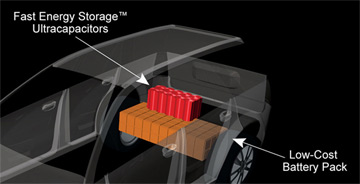

When is someone going to offer a practical and affordable family car that runs on something other than oil and that sharply reduces both greenhouse gas emissions and your fuel bill? A few weeks ago, I test-drove this mythical car of the future, a plug-in hybrid electric vehicle whose mass production might be only a few years away.
The Extreme Hybrid from AFS Trinity was rolled out last week at the Detroit auto show. It can run 40 miles on electricity before reverting to running efficiently on gasoline like a normal hybrid, such as the Toyota Prius. Because the majority of people drive less than 40 miles a day, that car can replace most weekly gasoline use, even if it is charged only once a day. The fuel cost per mile, while running on electricity, is under one-third the current cost of gasoline. A full overnight charge might cost a dollar. The car accelerates like a cheetah, though quietly.
Time is running out on developing a truly energy-efficient car. Accelerated burning of fossil fuels is bringing us closer to the tipping point of irreversible climate catastrophe. We are likely to peak soon in the production of conventional oil — so gasoline prices are inevitably headed higher in the coming decades. Meanwhile, the cars we build today stay on the road more than 15 years, so we have no time to waste.
You can buy a flexible fuel vehicle today that runs on 85 percent ethanol and 15 percent gasoline, and you might even be able to find an E85 station in your city. But corn ethanol is far from a desirable alternative fuel. It doesn’t significantly reduce greenhouse gas emissions, or your fuel bill. That would require low-carbon ethanol from biomass such as switchgrass, so-called cellulosic ethanol, but the country does not have a single commercial cellulosic ethanol facility. It will probably be at least 15 years — and possibly twice that long — before we have large volumes of cellulosic biofuels for sale nationwide at an affordable price.
Hydrogen cars are even farther away from being practical. Carbon-free hydrogen is likely to be more expensive than gasoline for a long time. And the cost of building a carbon-free hydrogen fueling infrastructure is several hundreds of billions, if not more than a trillion, dollars.
Only one zero-carbon alternative fuel is substantially cheaper than gasoline: electricity from renewable sources (or nuclear power). Of course, you’d need a car that runs on electricity, and many people have thought that you would need a technological breakthrough, or at least a major advance in battery technology, to make that practical.
But game-changing breakthroughs in the energy sector are rare indeed. One can wait a lifetime for a major new technology that fundamentally alters the way we use energy. That’s why the Extreme Hybrid, whose electric technology is available today, is so exciting.
We saw all-electric cars in the 1990s, but they failed for a variety of reasons, as explained in the movie “Who Killed the Electric Car?” One problem is that giving an electric car a 200-mile range requires a lot of batteries, which adds weight, takes up space, and increases cost. Plus, it takes hours to fill one up, so if you run out of juice, you are stuck, making it impractical as a primary family car. Ultimately, it lacked support by the very car companies, like General Motors, that built it in the first place.
Everything changed with the success of hybrid-electric cars like the Prius, which combine a gasoline engine with a battery and electric motor. These hybrids charge the battery with energy regenerated during braking or from the gas engine. They prove that a car combining gas and electric drives can be practical and affordable and even desirable. Some groups have been retrofitting Priuses to make them plug-ins, providing the best of both worlds — acting as an electric car for local trips, but keeping the gas tank and engine for long trips and quick refueling.
The key obstacle to building a practical plug-in hybrid has been the battery. Not only do you need a lot more batteries for a plug-in than for a simple hybrid, you need batteries with substantially different capability. Gasoline hybrids mostly need batteries that can provide a lot of power when necessary — such as for accelerating onto a highway — as opposed to batteries that can store a lot of energy, which is what is required to go relatively long distances after a single charging. Designing a single battery that can store a lot of energy and handle power surges is no easy task, especially when that battery must be compact, affordable and safe as it constantly cycles through various uses.
The New York Times describes the problem using this unintentionally amusing mixed metaphor:
“In fact, the problem in a hybrid is not only how much energy the batteries hold, a quality called energy density, but how fast they can deliver it, called power density. The difference between energy density and power density is like the difference between a wine jug and a peanut butter jar — the containers may have the same capacity, but the size of their openings differ greatly.”
Note to NYT: When describing a power battery that can deliver energy in short, quick bursts, “peanut butter” is not the best analogy. A shaken bottle of champagne might be better.
Regular hybrids were made practical by the development of the nickel metal hydride battery, due in large part to a government-funded research consortium. The prototype or demonstration hybrids built to date have tended to use the more expensive, but more powerful and compact, lithium-ion batteries popularized by the electronics industry.
Yet discharging a battery too rapidly, especially the current generation of relatively inexpensive lithium-ion batteries such as are found in laptops and cellphones, can damage it, degrading its lifetime. The question has been: When will we have an affordable, safe, compact and long-lived lithium-ion battery that can deliver both energy (for range) and power (for acceleration) sufficient for a practical car?
The failure to find such a battery is a main reason Toyota and GM have been slow to commit to offering a plug-in to consumers. At the recent Detroit auto show, Toyota said it would offer a plug in by 2010, although at first only to governments and corporations, not to consumers. GM, which for much of the past year has been promising to deliver the plug-in Chevy Volt in commercial quantities in 2010, has recently said that 2010 remains only a goal — no promises.
So how has AFS Trinity bypassed the need for a new lithium-ion battery? Instead of waiting for a battery that can deliver both energy and power cheaply, it uses current lithium-ion batteries for energy, and then adds something called an ultracapacitor for rapid discharge during acceleration.
Ultracaps have 10 to 100 times the power density of typical batteries, but only one-tenth the energy density, so this is a marriage made in heaven, or at least Silicon Valley. The ultracap is the electrical equivalent of the shaken champagne bottle — although even that analogy is flawed since ultracaps do not just discharge quickly, they also charge quickly. That’s another benefit that ultracaps bring to hybrids.
Regular hybrids get much of their efficiency gains from their ability to capture the energy normally lost during braking and convert it to electricity. Current hybrid batteries take up only about half of this electricity, but fast-acting ultracaps can take up much more.
AFS Trinity is not an auto company. It applied its technology to retrofit a Saturn Vue hybrid crossover vehicle, with the help of a leading auto engineering company, Ricardo. It believes that with mass production, an Extreme Hybrid would cost only $9,000 more than an ordinary hybrid, with a payback of the extra cost in fuel savings in under four years at current gas prices. But that will require the company to find a major auto-manufacturing partner willing to commercialize the vehicle.
Of course, like many small companies with great technology that I’ve seen over the years, AFS Trinity may not succeed in achieving mass production or meeting its cost targets. That said, I think the importance of the Extreme Hybrid is that it shows there’s more than one possible strategy for making a practical plug-in, significantly increasing the chances that someone will succeed.
Plug-ins are not a global warming solution by themselves. The current electric grid is half coal power, so when plug-ins are running on conventional grid power, they cut net greenhouse gas emissions by perhaps one-third, compared to a regular hybrid running on gasoline. They would, however, cut emissions by well over half compared to a conventional vehicle.
The big greenhouse gas savings would come about as plug-ins enable a major transition toward clean electricity and away from petroleum-based fuel, which is getting dirtier every year, as unconventional oil, such as Canadian tar sands, becomes more popular.
Unlike petroleum, electricity is poised to get greener in the future, especially as we fight climate change. Indeed, once we have a national cap on carbon emissions, plug-ins will drive even faster growth of the diverse and growing numbers of carbon-free electricity sources, which include solar photovoltaics, solar thermal electric, wind, geothermal, nuclear and, potentially, coal with carbon capture and storage. By providing distributed energy storage to the grid, plug-ins could make intermittent renewables like wind power (mostly available at night) more cost-effective — and ultimately assist renewables in becoming the nation’s primary source of power.
Also, if in a few years you were buying a plug-in hybrid, which might last until 2030, you can safely bet that gasoline prices then are going to be much higher than today’s $3 a gallon. So plug-ins will be the best hedge money can buy against oil shocks. Also, given that most early adopters of plug-ins are likely to be environmentally conscious, I would expect many of them to run their hybrids on 100 percent renewable power, making plug-ins a major carbon reducer from the start.
Preventing catastrophic climate change will require the average U.S. car and SUV to have 80 percent to 90 percent lower carbon dioxide emissions by 2050, compared to current vehicles (the same for trucks, airplanes and ships). Plug-ins could be an essential enabler of such deep reductions. They can easily be made flexible-fuel vehicles, so if low-carbon cellulosic biofuels prove practical and affordable, they can be the primary liquid fuel for longer trips. Absent high-efficiency vehicles like plug-ins, it is unlikely we will have enough spare arable land and water in 2050 for cellulosic biofuels to provide sufficient fuel to achieve such deep reductions across the entire transportation sector.
Another key point is that most of the growth in car use in the coming decades will come in countries where people don’t necessarily drive long distances on a regular basis — and don’t require large SUVs. I believe that an affordable and purely electric car with a range of 200 miles, even one with 100 miles, will be a successful primary car for most people in most other countries. Plug-ins can help enable that transition by reducing the cost of batteries and electronics.
Plug-ins may not suffer from a problem that has plagued so many alternative fuel vehicles — high initial cost. As I told AFS Trinity, I wouldn’t recommend designing the first plug-ins with a 40-mile all-electric range. For many people, including me, that represents a capability they are unlikely to use most days, meaning we would be paying for a lot of unnecessary batteries and other electronics. You could cut the cost of the first plug-ins by thousands of dollars if the cars just had a 20-mile all-electric range.
I expect many early adopters will be able to charge their cars twice: at home during the night and at work during the day. Companies like Google, which aggressively supports the development of plug-ins, will surely give its workers a large incentive to buy a plug-in, powered by a charging station at its headquarters that draws on renewable energy. Utilities will be eager to set up charging stations at public places like malls and parking garages. Yes, you would probably not be able to charge for a couple of hours during peak demand on the hottest summer days, but that would still leave you plenty of opportunity to charge your car during the day as well as the night. That means a plug-in with a 20-mile all-electric range would still allow many commuters to drive 40 miles or more on electricity, again significantly reducing batteries, electronics and cost.
Also, a utility or other intermediary might lease a plug-in hybrid — or at least its battery — to a consumer or business willing to leave the vehicle connected when it was not on the road and to permit the utility to control when the vehicle’s battery was charged (and possibly when it was discharged). This would provide the utility with a new source of revenue and the consumer with a far less expensive car. A related possibility is being pursued by many companies: Plug-in hybrids could be charged at off-peak times and provide power and voltage to the grid when needed. Vehicle owners may be able to get a rebate or revenue stream from electric utilities for this service.
No country has ever delivered a mass-market alternative fuel vehicle without government mandates. Plug-ins will no doubt need initial help, although they probably require less government intervention than other alternative fuels since they don’t require an entirely new fueling infrastructure. To spur their development, Brookings Institution scholar and White House veteran David Sandalow recommends that the federal government buy 30,000 plug-ins at an $8,000 premium. He suggests that the government offer an $8,000 consumer tax credit for purchasers of the first million plug-ins, and a $4,000 rebate for purchasers of the second million.
These steps would speed the day when we have a practical plug-in hybrid. And that now seems closer than ever.
