

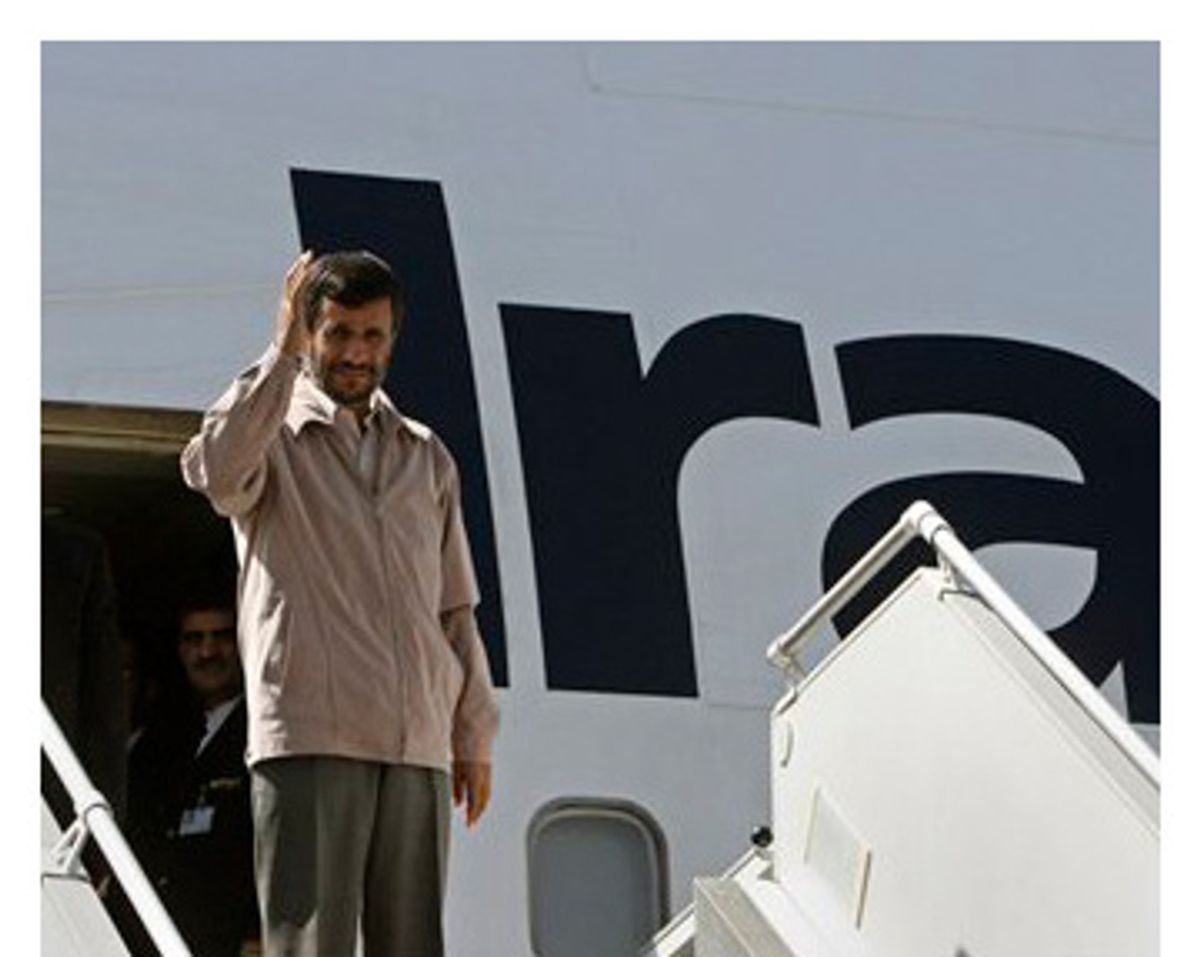
Iranian President Mahmoud Ahmadinejad's visit to New York to address the United Nations General Assembly has become a media circus. But the controversy does not stem from the reasons usually cited.
The media has focused on debating whether he should be allowed to speak at Columbia University on Monday, or whether his request to visit Ground Zero, the site of the Sept. 11 attack in lower Manhattan, should have been honored. His request was rejected, even though Iran expressed sympathy with the United States in the aftermath of those attacks and Iranians held candlelight vigils for the victims. Iran felt that it and other Shiite populations had also suffered at the hands of al-Qaida, and that there might now be an opportunity for a new opening to the United States.
Instead, the U.S. State Department denounced Ahmadinejad as himself little more than a terrorist. Critics have also cited his statements about the Holocaust or his hopes that the Israeli state will collapse. He has been depicted as a Hitler figure intent on killing Israeli Jews, even though he is not commander in chief of the Iranian armed forces, has never invaded any other country, denies he is an anti-Semite, has never called for any Israeli civilians to be killed, and allows Iran's 20,000 Jews to have representation in Parliament.
There is, in fact, remarkably little substance to the debates now raging in the United States about Ahmadinejad. His quirky personality, penchant for outrageous one-liners, and combative populism are hardly serious concerns for foreign policy. Taking potshots at a bantam cock of a populist like Ahmadinejad is actually a way of expressing another, deeper anxiety: fear of Iran's rising position as a regional power and its challenge to the American and Israeli status quo. The real reason his visit is controversial is that the American right has decided the United States needs to go to war against Iran. Ahmadinejad is therefore being configured as an enemy head of state.
The neoconservatives are even claiming that the United States has been at war with Iran since 1979. As Glenn Greenwald points out, this assertion is absurd. In the '80s, the Reagan administration sold substantial numbers of arms to Iran. Some of those beating the war drums most loudly now, like think-tank rat Michael Ledeen, were middlemen in the Reagan administration's unconstitutional weapons sales to Tehran. The sales would have been a form of treason if in fact the United States had been at war with Iran at that time, so Ledeen is apparently accusing himself of treason.
But the right has decided it is at war with Iran, so a routine visit by Iran's ceremonial president to the U.N. General Assembly has generated sparks. The foremost cheerleader for such a view in Congress is Sen. Joseph Lieberman, I-Conn., who recently pressed Gen. David Petraeus on the desirability of bombing Iran in order to forestall weapons smuggling into Iraq from that country (thus cleverly using one war of choice to foment another).
American hawks are beating the war drums loudly because they are increasingly frustrated with the course of events. They are unsatisfied with the lack of enthusiasm among the Europeans and at the United Nations for impeding Tehran's nuclear energy research program. While the Bush administration insists that the program aims at producing a bomb, the Iranian state maintains that it is for peaceful energy purposes. Washington wants tighter sanctions on Iran at the United Nations but is unlikely to get them in the short term because of Russian and Chinese reluctance. The Bush administration may attempt to create a "coalition of the willing" of Iran boycotters outside the U.N. framework.
Washington is also unhappy with Mohammad ElBaradei, head of the International Atomic Energy Agency. He has been unable to find credible evidence that Iran has a weapons program, and he told Italian television this week, "Iran does not constitute a certain and immediate threat for the international community." He stressed that no evidence had been found for underground production sites or hidden radioactive substances, and he urged a three-month waiting period before the U.N. Security Council drew negative conclusions.
ElBaradei intervened to call for calm after French Foreign Minister Bernard Kouchner said last week that if the negotiations over Iran's nuclear research program were unsuccessful, it could lead to war. Kouchner later clarified that he was not calling for an attack on Iran, but his remarks appear to have been taken seriously in Tehran.
Kouchner made the remarks after there had already been substantial speculation in the U.S. press that impatient hawks around U.S. Vice President Dick Cheney were seeking a pretext for a U.S. attack on Iran. Steven Clemons of the New America Foundation probably correctly concluded in Salon last week that President Bush himself has for now decided against launching a war on Iran. But Clemons worries that Cheney and the neoconservatives, with their Israeli allies, are perfectly capable of setting up a provocation that would lead willy-nilly to war.
David Wurmser, until recently a key Cheney advisor on Middle East affairs and the coauthor of the infamous 1996 white paper that urged an Iraq war, revealed to his circle that Cheney had contemplated having Israel strike at Iranian nuclear research facilities and then using the Iranian reaction as a pretext for a U.S. war on that country. Prominent and well-connected Afghanistan specialist Barnett Rubin also revealed that he was told by an administration insider that there would be an "Iran war rollout" by the Cheneyites this fall.
It should also be stressed that some elements in the U.S. officer corps and the Defense Intelligence Agency are clearly spoiling for a fight with Iran because the Iranian-supported Shiite nationalists in Iraq are a major obstacle to U.S. dominance in Iraq. Although very few U.S. troops in Iraq are killed by Shiites, military spokesmen have been attempting to give the impression that Tehran is ordering hits on U.S. troops, a clear casus belli. Disinformation campaigns that accuse Iran of trying to destabilize the Shiite-dominated Iraqi government -- a government Iran actually supports -- could lay the groundwork for a war. Likewise, with the U.S. military now beginning patrols on the Iran-Iraq border, the possibility is enhanced of a hostile incident spinning out of control.
The Iranians have responded to all this bellicosity with some chest-thumping of their own, right up to the final hours before Ahmadinejad's American visit. The Iranian government declared "National Defense Week" on Saturday, kicking it off with a big military parade that showed off Iran's new Qadr-1 missiles, with a range of 1,100 miles. Before he left Iran for New York on Sunday morning, Ahmadinejad inspected three types of Iranian-manufactured jet fighters, noting that it was the anniversary of Iraq's invasion of Iran in 1980 (which the Iranian press attributed to American urging, though that is unlikely).
The display of this military equipment was accompanied by a raft of assurances on the part of the Iranian ayatollahs, politicians and generals that they were entirely prepared to deploy the missiles and planes if they were attacked. A top military advisor to Supreme Jurisprudent Ali Khamenei told the Mehr News Agency on Saturday, "Today, the United States must know that their 200,000 soldiers in Iraq and Afghanistan are within the reach of Iran's fire. When the Americans were beyond our shores, they were not within our reach, but today it is very easy for us to deal them blows." Khamenei, the actual commander in chief of the armed forces, weighed in as well, reiterating that Iran would never attack first but pledging: "Those who make threats should know that attack on Iran in the form of hit and run will not be possible, and if any country invades Iran it will face its very serious consequences."
The threat to target U.S. troops in Iraq and Afghanistan and the unveiling of the Qadr-1 were not aggressive in intent, but designed to make the point that Iran could also play by Richard M. Nixon's "madman" strategy, whereby you act so wildly as to convince your enemy you are capable of anything. Ordinarily a poor non-nuclear third-world country might be expected to be supine before an attack by a superpower. But as Mohammad Reza Bahonar, the Iranian deputy speaker of Parliament, warned: "Any military attack against Iran will send the region up in flames."
In the end, this is hardly the kind of conflagration the United States should be enabling. If a spark catches, it will not advance any of America's four interests in the Middle East: petroleum, markets, Israel and hegemony.
The Middle East has two-thirds of the world's proven petroleum reserves and nearly half its natural gas, and its fields are much deeper than elsewhere in the world, so that its importance will grow for the United States and its allies. Petro-dollars and other wealth make the region an important market for U.S. industry, especially the arms industry. Israel is important both for reasons of domestic politics and because it is a proxy for U.S. power in the region. By "hegemony," I mean the desire of Washington to dominate political and economic outcomes in the region and to forestall rivals such as China from making it their sphere of influence.
The Iranian government (in which Ahmadinejad has a weak role, analogous to that of U.S. vice presidents before Dick Cheney) poses a challenge to the U.S. program in the Middle East. Iran is, unlike most Middle Eastern countries, large. It is geographically four times the size of France, and it has a population of 70 million (more than France or the United Kingdom). As an oil state, it has done very well from the high petroleum prices of recent years. It has been negotiating long-term energy deals with China and India, much to the dismay of Washington. It provides financial support to the Palestinians and to the Lebanese Shiites who vote for the Hezbollah Party in Lebanon. By overthrowing the Afghanistan and Iraq governments and throwing both countries into chaos, the United States has inadvertently enabled Iran to emerge as a potential regional power, which could challenge Israel and Saudi Arabia and project both soft and hard power in the strategic Persian Gulf and the Levant.
And now the American war party, undeterred by the quagmire in Iraq, convinced that their model of New Empire is working, is eager to go on the offensive again. They may yet find a pretext to plunge the United States into another war. Ahmadinejad's visit to New York this year will not include his visit to Ground Zero, because that is hallowed ground for American patriotism and he is being depicted as not just a critic of the United States but as the leader of an enemy state. His visit may, however, be ground zero for the next big military struggle of the United States in the Middle East, one that really will make Iraq look like a cakewalk.
Shares