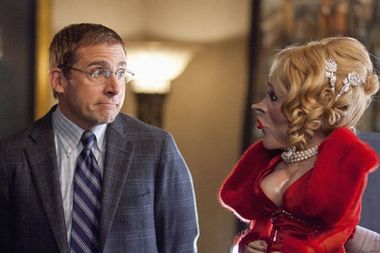
Dinner for Schmucks

What makes Paul Rudd laugh

Comedy's leading straight man talks about his Shakespearean past and the genius of Steve Carell

  • more
    • All Share Services

What makes Paul Rudd laughCast member Paul Rudd, from the movie "I Love You, Man," poses for a portrait in Santa Monica, California March 15, 2009. REUTERS/Mario Anzuoni (UNITED STATES ENTERTAINMENT HEADSHOT)(Credit: © Mario Anzuoni / Reuters)

Allow us to make a modest proposal: Paul Rudd is one of the great comic leading men of his generation. With his boyish charm and unassuming good looks, he could easily have ended up as a romantic-comedy lightweight, following the template laid out by his breakthrough role in “Clueless.” But instead, he’s spent much of the last decade surrounding himself with stand-ups and sketch comics, matching wits with Steve Carell and Seth Rogen in “The 40-Year-Old Virgin” and guesting as an oily Lamaze instructor on “Reno 911.” Although he studied Jacobean drama at Oxford, Rudd’s classical background hasn’t prevented him from improvising alongside club-hardened comics, a talent that serves him mightily well in “Dinner for Schmucks.”

As an ambitious financial analyst whose path to promotion runs through a banquet in which co-workers compete to see who can invite the most hapless specimen of humanity for their clandestine mockery, Rudd is the calm in the middle of a madcap whirlwind. While Steve Carell and Zack Galifianakis do a delirious tap dance on the edge of caricature, Rudd holds down the center, preventing the movie from collapsing in a heap of grotesques. It’s the straight man’s lot to be overlooked, but Rudd doesn’t mind being the secret weapon, especially when the mix is as explosive as it is here.

Your breakthrough role in “Clueless” was a comic part, but you didn’t start doing comedy on a regular basis until 2001, with “Wet Hot American Summer.” Since then, it’s been a mainstay. You’ve done several Judd Apatow movies, you’ve done film and TV projects with alumni of “The State,” and you even lent your voice to an episode of “Robot Chicken.” Was it a conscious choice to do more comedy, or did it just come naturally out of the circles you found yourself in?

To some extent, for sure. I was a comedy fan, always have been. A comedy nerd, I guess. As a kid, I listened to comedy records, and I loved comedians, and I followed sketch comedy and was really into irreverent stuff. I knew “The State.” I remember watching that. But when I was 17, 18 years old and decided I want to be an actor, I didn’t want to pursue that. I wanted to be a legitimate actor.

So to speak.

[Laughs] Definitely so to speak. Classical theater and all that. So I did, and tried to do as much as I could — and loved it, too. It wasn’t that comedy was my first love but this was what I was going to be attempting. I had worked on [Baz Luhrmann's] “Romeo + Juliet,” and I was really excited, because I felt like, “This is in my wheelhouse, for sure. I studied this stuff.” I met Zak Orth on that, became friends with him, and we both lived in New York. So when I came back, I went and saw a play that David Wain and [Joe] Lo Truglio and [Michael] Showalter and those guys were in and had written, called “SEX a.k.a. Wieners and Boobs,” and I met them and hit it off right away. Not that long afterward, they gave me the script for “Wet Hot American Summer,” and David said, “Read this. You like it?” It wasn’t set up anywhere. I read it, and I remember thinking, “This is the funniest script I’ve ever read,” and also thinking this is the first thing that I’ve read that really appealed to my own kind of sensibility. It had a fresh comic voice. It’s the only script that I ever read that I would keep around to reread just because it was so funny.

So eventually, a couple of years later, they were able to make the movie. After that, I think there was a little bit of a tidal shift in the way I was viewed in comedy circles, which before, I really wasn’t. In the sketch world, that movie had an impact. So by the time that I met Adam McKay a few years later, it was like, “Yeah, man. You were hilarious in ‘Wet Hot American Summer.’ That’s a great movie.” I think that probably played a part in me getting the role of Brian Fantana in “Anchorman.” And then after that, it just became, oh, we’ll do “The 40 Year Old Virgin,” and Judd’s like, “You want to do this?” I loved working with these people. I loved working the way they worked, with improvisation and playing around, although there’s very little improvisation in “Wet Hot American Summer.” I liked this style. I had done a movie several years before called “The Château” that was completely improvised, and I thought was funny and really fun, but it was shot for a couple of hundred grand on camcorders. So to incorporate that style of work a little bit, it became really exciting, and things started to change for me.

Also, I think, I started getting older, and less interested in really trying to do [awestruck voice] all of these different things. I’m still interested in all that stuff, but I’m a little more of the mind-set of these are really fun to work on. I had a great time working on a lot of these comedies. I love the people I’ve been working with, and they’re fulfilling in ways that I have not experienced, creatively, in some other endeavors. So I just went, “Screw it. I’m just gonna ride this out until it ends.” That being said, I do feel like it would be nice now to do a play or do something dramatic.

People who aren’t hardcore comedy fans may not realize the depth of the talent in “Dinner for Schmucks.” Even the minor roles are filled with people like David Walliams of “Little Britain” and Chris O’Dowd from “The IT Crowd,” and Flight of the Conchords’ Jemaine Clement almost steals the show as a dazzlingly pretentious artist.

It was pretty exciting. I kept hearing along the way: Chris O’Dowd is going to play the blind swordsman, David Walliams is going to play the Swiss banker. Kristen Schaal, and Jemaine, and then Zack [Galifianakis] — every person that joined up. Steve and I joined pretty much simultaneously. I wanted to work with Steve again, and I also wanted to work with Jay, who I knew but had never worked with before. It was so exciting every week to hear people being added to the cast, and each person they added, I kept thinking, “God, they’re amazing.” I’m so psyched not only to get to work with a lot of these people, but just to meet them, because I’m such a fan of theirs.

Is it difficult being the straight character in the midst of so many great comedians? It seems like everyone gets to have more fun than you.

It was more of a straight-ahead character. I felt I had to do the opposite of whatever Steve was doing to make the whole thing work. I’m not trying to break it down into a straight man thing, although there are definitely elements of that. To do other things, it seemed to me, would be more of a distraction than anything else.

It’s not like everyone got invited to the party but not me. I tend not to feel that way. As a kid, I always liked Abbott. I don’t know what it is. “Serious” isn’t the right word, because I don’t think that being a straight man means not being funny, at all. I like all that stuff. It might not be as flashy, I guess, but I like it.

My whole thing with this was that I didn’t want to be exasperated throughout the whole movie, and just seem two-dimensional, or one-dimensional. I wanted to have enough variation, and focus on the fact that I’m hopefully not a bad guy, but doing something that is a little bit morally reprehensible, and sustain that and see if you can parlay that into a story, a connection with Steve’s character. I was worrying about that, not necessarily worrying about silly jokes and stuff like that, even though I wanted it to be funny. It’s more like, “How is the movie going to be funny on the whole?”

There are actors who feel as if their job is to look after their character, and everything else is the director’s job, and those who feel a responsibility for the film as a whole. It seems like you lean the latter way.

Absolutely I do. When I’m reading the script, I’m reading the whole script, the story and everybody’s character. I’m not just reading my lines. I thought that the movie when I read it was really funny. I love how much craziness there is in the thing, and how many really out-there characters there are. I thought to try and be the reverse of that would maybe be how it could work.

That’s the other thing, too. I don’t know necessarily if I succeeded. There are times where I’ll do something or see something and go, “Well, that worked.” On this one, I wasn’t sure. I still don’t know necessarily. I hope it did, but I really don’t know. [Laughs.]

Was it something in particular about this part that makes you so unsure?

There’s certain things within the realm of who this character is that I would go to that maybe I wouldn’t go to otherwise. It isn’t like “I Love You Man,” where there was so much awkward stuff that he could always kind of default to that. That has some built-in comedy to it. This is a character who isn’t really awkward. So if we are improvising a scene, I’m not thinking of jokes, because it might not work within the world of who that guy is, and in the world of the movie that we’re making. It’s really more just reaction to what’s happening. It was interesting to try and work within those parameters, I guess.

It’s tough, because that kind of sustained exasperation can be really …

Boring. [Laughs.]

Right. Or brittle and hysterical.

And just kind of the same. If you are going to see that kind of attitude in the 10th minute, are you going to see it again in the 50th minute?

Unlike the French movie on which it’s based, “Dinner for Schmucks” includes the actual dinner, which shooting-wise involves having a roomful of great comedians all going at full speed. What was it like to be in the middle of that?

One of the things that I really like about this movie, and that I felt even working on it, is that it’s a farce, in a way that you don’t see in a lot of current comedy. It has a bit of an old-fashioned feel to it. Even working on that dinner scene, which we shot for a long time, it just seemed silly and chaotic, but chaotic in a way that I think it was supposed to. When there’s fire going, and the vulture’s flying around, and people are climbing the walls and fighting each other: It’s a Marx Brothers movie. It ends with this huge set piece. And I thought, “Wow. I don’t remember the last movie that did that.” I liked that. I loved working on the dinner because everyone was doing their thing. They would put the camera on whomever, and they would do their spiel and play around and make up whatever their dialogue was. It was really fun.

That’s another thing that I felt throughout the shoot, which was a feeling of real excitement of watching really, really funny people create stuff right in front of me. People pay a lot of money to go see a Zach Galifianakis show, and he’s one of my favorite comedians, and here I am watching him do all of this stuff. I was watching Steve do different readings and different takes and different jokes, and thinking, “Man, this guy’s a legitimate genius, how he’s coming up with this stuff,” and I’m 10 feet away from it. Jemaine and Chris O’Dowd — hilarious. And even someone like Jeff Dunham, who’s making stuff up with his puppet. Jeff Dunham is, like, the biggest thing in the world. I’m thinking, “Wow. How many people would love to be where I’m at right now,” watching Jeff Dunham go through his thought process on jokes for his puppets. All these different things in that dinner scene. What a cool thing to be in the room.

People who’ve lasted a long time in the film business often come to the conclusion that the most important thing is to put themselves in situations where they’re going to enjoy the making of the film. The idea that it’s worth going through a grueling experience because a good movie might come out of it seems to be a lot less appealing.

It becomes a lot less interesting, or worth it, for me with each year that passes. I also am not a believer that something has to be a struggle to be good, or that for a comedy movie to be funny, you can’t find it funny while you’re making it. I don’t buy it. I think that you can have a great time and laugh a lot working and have it still be funny. You know, movies take months to shoot. Wouldn’t you rather spend that time with people you’re challenged by on material that’s fun to work on, and with a character that you enjoy playing — and laugh, like, every day? I find it to be really exciting and fun to go to work. I don’t know what’s going to happen. There’s a good chance that I’m going to go on a laughing jag where they’re not going to be able to shoot for about 10 minutes, because I can’t stop. That happens to me way too much. It’s weird. I tend not to laugh that hard in life, but I do during takes.

There’s more pressure not to laugh when you’re filming.

And life is super, super hard and can be painful at times. This is a nice way to counter that. 

Sam Adams writes for the Los Angeles Times, the Philadelphia Inquirer, the Onion A.V. Club, and the Philadelphia City Paper. Follow him on Twitter at SamuelAAdams or at his blog, Breaking the Line.

“Dinner for Schmucks”: Steve Carell’s greatest nerd role?

This mismatched buddy comedy may be fake Apatow, but Carell and its dazzling cast get close to the real thing

  • more
    • All Share Services

Steve Carrell in "Dinner for Schmucks."

American movie comedy operates within such narrow limits, most of the time, that even relatively minor innovations — like the nerdy-absurdist sweetness, or nerdy-sweet absurdism, of current comedy king Judd Apatow — can seem like a big deal. One sure sign that Apatow’s shtick is descending into formula is how cannily it can be cloned in a minor but reasonably amusing Hollywood concoction like “Dinner for Schmucks.” Adapted from a 1998 hit by French comedy veteran Francis Veber (released here as “The Dinner Game”) and fueled by a lovable-loser star turn from rubber-faced Steve Carell, “Dinner for Schmucks” may be a more successful Apatow imitation than his last several films as producer or director.

I had to read through the credits carefully a couple of times (where we find both Veber and Sacha Baron Cohen listed as executive producers) to be absolutely sure that “Dinner for Schmucks” wasn’t an Apatow project at some remove. I should have known better. Apatow’s movies fail (when they do) in a different way than this one does, and I’d like to believe that he’d never work with a script that offered such a bland and miscellaneous collection of gags and situations. (Veber’s original screenplay was adapted by David Guion and Michael Handelman.) Now, some of those gags are pretty damn funny, and Carell’s performance as Barry, a socially inept IRS employee and mouse-taxidermy enthusiast targeted by rising financial whiz Tim (Paul Rudd) as his guest for the titular make-fun-of-weirdos dinner, is nothing short of magnificent.

It’s a character we’ve seen before, perhaps dozens of times: the isolated womanless nerd-boy, potentially tragic and dangerous. But Carell never relies on the most obvious forms of shtick: Yes, Barry apparently wears the same nylon windbreaker every day, in an indescribable hue between blue and lavender, but his appearance is only slightly dorkier than average, and you’d pass him on the street without a glance. Carell plays him as a strange admixture of shyness, dignity, naiveté and a total lack of appropriate boundaries, so that every time you start to get sweet on Barry, he does something that makes him seem unmanageable and untrustworthy, like going through Tim’s possessions or answering IMs not addressed to him that involve panty-clad booty photos. 

As is typical of Hollywood comedies, there’s lots of great stuff around the margins, including English Amazon Lucy Punch as Darla, the psycho-stalker babe who’s sending Tim those IMs, and nice turns from Bruce Greenwood, Ron Livingston and Larry Willmore as Tim’s asshole co-workers. Best of all, perhaps, is New Zealand actor Jemaine Clement (of “Flight of the Conchords” and “Eagle vs. Shark”) as Kieran, a smoldering, intensely self-involved artist who paints only giant canvases of himself pursuing various sexual and sensual activities. As Barry observes, when face to face with one of Kieran’s paintings, “A very attractive man! He can fit a whole octopus into his mouth!”

But all that is basically window dressing around the central relationship between Tim and Barry, who meet when the latter is picking up a dead mouse from the street and the former mows him down with his Porsche. That sets the tone: Tim has promised his beautiful art-dealer girlfriend, Julie (a purely decorative role for Stephanie Szostak), that he won’t participate in the dinner-table mockery sessions presided over by Fender (Greenwood), his financial firm’s CEO. But he does want the promotion that’s being dangled, and he didn’t count on fate introducing him to a guy who has constructed diorama reproductions of Leonardo’s “Last Supper” and Munch’s “Scream,” using preserved mice in doll clothing.

In fairness, director Jay Roach (of the “Meet the Parents” and “Austin Powers” series) faces a tough task here: He’s got to balance the audience’s natural identification with Tim, the putatively normal protagonist, with its instinctive pity for lonely and clueless Barry. (Who reacts to the most hackneyed nostrums as if he’s never heard them before. “Everything happens for a reason,” he murmurs after Tim, wonderingly. “Did you come up with that?”) I’m not giving away too much in telling you that the real subject of “Dinner for Schmucks” is not the eponymous dinner — which actually occupies only a few minutes of the film — but the battle over Tim’s soul, into which Barry forges like a destroyer-angel with a flaming sword.

Problem is, Tim basically is a dick, and Rudd’s earnest efforts to un-dick him only go so far. He’s entirely too willing to throw an innocent stranger under the train for the sake of his meaningless career, and he lacks enough interesting texture to serve as the story’s moral center. Sure, Barry turns out to be the hero, in a certain sense, but the movie isn’t really about him or about Kieran or Darla or Therman (Zach Galifianakis), Barry’s bearded IRS colleague and sinister master of mind control — all of whom are way more compelling.

Of course Tim’s sins against Barry are paid back with interest in the form of comic chaos, but it never seems like quite enough pain to make the dude seem likable. Let’s face it: Porsche-packing high-finance dudes who rape and kill “distressed assets” just don’t rate high on the compassion meter these days. Kieran, the octopus-eating, zebra-fisting artist (I’d better not explain that any further), may be unbelievably pompous, but at least he isn’t a soulless corporate fuckwad. When a whole series of Murphy’s Law misunderstandings — culminating, somehow, with Tim on his knees in a fancy restaurant, proposing to nutso Darla with a ring he intended for Julie — leads Julie to run away to the immense sexual metaphor that is Kieran’s goat ranch, I was all like, you go, girl! He’s just not that into you! (Kieran, to Barry: “Have you ever lived among a herd of goats, for months at a time, as one of them?” Barry: “No.” Kieran, mildly: “That surprises me.”)

As that last paragraph suggests, Rudd and Carell have some genuinely insane scenes of involuntary male bonding, but nothing Jim Carrey and Matthew Broderick didn’t already cover in the far superior “Cable Guy” (which hovers over this movie like a leering, spectral ancestor) with a lot more disturbing homoerotic energy. The briefest and fairest way to put it is that “Dinner for Schmucks” has more laughs than your average dumb-ass comedy — it’s roughly 2 million percent funnier than the unwatchable Adam Sandler vehicle “Grown Ups,” e.g. — but that by the time we actually reach the dinner table most of them have been expended. As is customary, all the disorderly or anarchistic possibilities of its premise get channeled back toward a message of symbolic pseudo-redemption, which is what Hollywood movies have to deliver at all costs.

Continue Reading Close