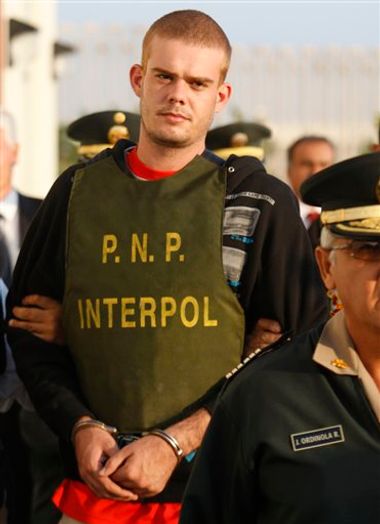
Joran van der Sloot

In love with a serial killer

Joran Van der Sloot boasts of the proposals he's received -- but "serial killer groupies" are not a new phenomenon

  • more
    • All Share Services

In love with a serial killerJoran Van der Sloot

When you hear about a young man receiving loads of love letters, marriage proposals and even a plea from a woman wishing to have his baby, you might first think of a rock star, famous actor or powerful politician — not an accused killer. And yet, it’s Joran Van der Sloot who is making headlines today by bragging to the press about the number of women enamored with him. “One of them even wants me to get her pregnant,” he told the Dutch newspaper De Telegraaf. There is no trusting claims by an admitted liar like Van der Sloot, but feverish female attention isn’t at all unusual in high-profile murder cases — and I called up an expert to better understand why.

Scott Peterson received a marriage proposal during his first day on Death Row. “Night Stalker” Richard Ramirez, a rapist, serial killer and Satanist — and serious catch in some eyes, apparently — was inundated with mail from romantic admirers; and he even married while behind bars. Robert Chambers, the so-called Preppie Killer, is said to have had so many female fans attempting to smuggle him contraband that he had to be transferred to another facility. The attractive and charismatic Ted Bundy — a necrophiliac who confessed to more than 30 murders — was so notoriously popular with women that the rather dubious claim that he received 200 love letters a day still circulates. Even John Wayne Gacy Jr., who raped and murdered 33 young boys, netted significant female attention.

Back to the question of what it is about these murderous men that get some women going: Sheila Isenberg, author of “Women Who Love Men Who Kill,” told Salon that notoriety is a big part of it. Although Van der Sloot hasn’t been convicted in the murder of Stefany Flores Ramirez or  the disappearance of Natalee Holloway, he’s been in the news for so many years now that “he’s almost as notorious as a convicted serial killer like Bundy or Ramirez,” she said. People are often drawn to celebrities, in hopes of soaking up some of their limelight, and the distinction between fame and notoriety seems to become blurrier every day. Not to mention, ”it’s easier to get a date or get attention from Joran than, say, Brad Pitt,” says Isenberg. “Pitt is going to ignore your letter, he’s not going to boast about your letter — but this guy is. He’s probably reading his letters and responding to them, because it puffs him up and raises his status in his own eyes.”

Then there is the excitement factor. These men provide a break from the quotidian — or, as Isenberg puts it, they aren’t the boring husband “who leaves his dirty socks on the floor.” She says that “if the guy’s behind bars, it’s always exciting.” You go to visit him in prison and you’re surrounded by “guards with guns and barbed wire — it’s not dirty socks on the floor.” No, it sure isn’t — in fact, it’s officially known as “hybristophilia,” which is the condition of being sexually aroused by people who have committed horrific crimes. Some of these women want to be violent themselves — often because of abuse in their past — but don’t feel capable of it, so they experience the thrill vicariously. Others are attracted to the safety of the situation — again, often because of abuse in their past: If a man is locked up for a long time, or sitting on Death Row, he doesn’t pose much of a real physical threat. 

Other experts have focused instead on biological imperatives, turning to scenes observed in the animal world: Female orangutans, for example, have demonstrated a sexual preference for the largest, most confrontational and violent males. Murderous men embody perhaps the most extreme presentation of machismo imaginable; they are warriors without rules. “Serial killer groupies,” as they are cringingly nicknamed, “may be equating this sort of violence with masculine strength and then seeking it as a way to bring such a male into their lives, for protection and for producing offspring with a good chance for survival,” writes Katherine Ramsland for TruTV.com. “Thus, they’re responding to a biological drive that they may not even be aware of.”

It’s also true, though, that our culture tends to romanticize and fetishize violence. “We make heroes out of our shooter — whether the shooter is a good guy or a bad guy,” says Isenberg. “And women are turned on by heroes.”

Tracy Clark-Flory

Tracy Clark-Flory is a staff writer at Salon. Follow @tracyclarkflory on Twitter.

Joran van der Sloot won’t talk to trial judge in Peru

Murder suspect retracts his confession, citing police intimidation, and clams up

  • more
    • All Share Services

Murder defendant Joran van der Sloot refused to speak to the Peruvian judge handling his case Monday, while a Dutch newspaper reported that he has retracted his confession.

Superior Court Judge Carlos Morales visited the 22-year-old Dutchman at the maximum-security prison in eastern Lima where Van der Sloot has been held since being charged with first-degree murder in the May 30 killing of a young woman he met playing poker in Peru’s capital.

But Van der Sloot would not talk, citing his lawyer’s petition to declare his confession void in the death of 21-year-old Stephany Flores, the court said in a statement.

The lawyer, Maximo Altez, contends the confession isn’t valid because the defense lawyer present when Van der Sloot made it was state-appointed.

Van der Sloot, who is also the prime suspect in the 2005 disappearance in Aruba of U.S. teen Natalee Holloway, was quoted by the Dutch newspaper De Telegraaf on Monday as saying he signed a confession only because he was intimidated by police.

He said they promised him he would be transferred to the Netherlands if he confessed.

“I was very scared and confused during the interrogations and wanted to get away,” the paper quoted him as saying. “In my blind panic, I signed everything, but didn’t even know what it said.”

In addition to possible involvement in Holloway’s disappearance, for which Van der Sloot has not been charged, he is wanted by the FBI on suspicion of attempting to extort money from the Holloway family.

Peruvian President Alan Garcia has said Van der Sloot will have to be tried in Flores’ death before any extradition request can be considered.

If convicted of killing Flores, Van der Sloot faces from 15 to 35 years in prison in Peru.

Prosecutors allege Van der Sloot killed Flores in his hotel room, where her body was found, with “ferocity and great cruelty.” According to a transcript of the confession, he elbowed the young woman in the nose, strangled her with both hands, threw her to the floor, took off his bloodied shirt and asphyxiated her.

According to the report in De Telegraaf, he now says that is not true.

“I was tricked,” the paper quoted Van der Sloot as saying of Flores’ killing. “I’ll explain later how it all happened.”

A self-avowed compulsive liar, Van der Sloot has several times made and retracted admissions of involvement in Holloway’s disappearance.

He is being held in a segregated block of Castro Castro prison, having asked to be separated from the main prison population out of fear for his life.

For now he has his own 6 1/2-by-11 1/2-foot (2-by-3.5-meter) cell, which is adjacent to that of a reputed Colombian hit man, with whom he shares a television set.

Van der Sloot told De Telegraaf that rats crawl into his cell through the toilet hole at night.

His mother, Anita van der Sloot, said in an interview published by the same newspaper over the weekend that her son suffers from mental problems.

She said she doesn’t believe he killed Holloway. But she said if it turns out he killed Flores, “he’ll have to pay the price,” and she doesn’t plan to visit him in jail.

Altez, the defense lawyer, told The Associated Press on Monday that relatives of Van der Sloot would arrive in Lima next week but did not specify whether his mother would be among them.

Holloway’s father, Dave Holloway, has called on Van der Sloot to reveal anything he knows about the location of Natalee Holloway’s body, which has never been found. Van der Sloot has said he will only talk about the matter with Aruban authorities.

——

Associated Press Writer Toby Sterling in Amsterdam contributed to this report.

Continue Reading Close

Van der Sloot case: Could that have been me?

Stephany Flores' murder inspires irrational what-ifs, victim-blaming and fear-mongering

  • more
    • All Share Services

Van der Sloot case: Could that have been me?Security camera footage of Joran Van der Sloot and Stephany Flores playing poker

Newly released casino security camera footage shows 21-year-old Stephany Flores strolling up to a poker table, introducing herself with a quick shake of the hand and sitting in an empty chair next to accused murderer Joran Van der Sloot. They play, they chat and, ultimately, they slide their chairs back from the table and amble out of the casino together. Previously released footage shows what happened soon after: They walk through the lobby of his hotel and head straight for the 22-year-old’s room. 

We don’t know what the pair actually talked about or why they decided to leave together (according to some reports, Flores was a lesbian) — but it’s easy to project personal experience onto these silent scenes. They seem emblematic of life in your 20s: A chance meeting with a stranger, the small talk and flirtation that ensues, and then the decision to go somewhere a little more comfortable, private. So many of us have been there — only Flores ended up dead.

I watch these videos and think: Could that have been me? I try to imagine the security camera footage of my teens and early 20s. There I am, on vacation in Hawaii at age 15, leaving a brightly-lit hotel lobby for the dark of night with a boy that, even then, I suspected to be many years older than his claimed 15. Off-camera, on a shadowy deserted span of beach, he introduces me to a couple of firsts: Rum, vomiting from too much rum, making out and, when he tries to push things too far, an awareness of my own vulnerability. Things turned out fine — but they so easily could have not. The same could be said for all those ill-advised (and aptly named) Kamikaze shots and drunken walks home alone — and, once or twice, with a stranger — late at night.

Young women are supposed to avoid putting themselves in these situations, we are always to be on-guard and see predators lurking behind every corner. After so many uneventful walks home with your keys laced between your fingers, though, it’s easy to let your guard down. Maybe the world isn’t such a threatening and unfriendly place, after all. Then another story breaks of a young woman being raped or killed after boozing, going home with a guy, or just being a young woman, and again we wonder: Could that have been me? The media is often quick to answer “yes.”

Yahoo’s online women’s magazine, Shine, offered up a list if ways to protect yourself from murderous men while traveling. It includes: ”Do not get into a car, go on a walk, go back to a house or hotel room alone with a man.” Be safe, trust no one! This might all sound “persnickety or over the top,” writes Jessica Ashley, “but I am very sure that Stefany Flores’ and Natalee Holloway’s mothers would say that they would much rather have had their daughters be overly cautious and alive today rather than lost to the night with one man.” In fact, why not just skip the vacation altogether and put that money toward building your own personal panic room. Might sound extreme, but — tsk, tsk — better safe than sorry, girls.

This rule-making and advice-giving allows us to distance ourselves from the victims of senseless crimes. It might be a reasonably healthy mind game for us to play — happiness requires some degree of self-delusion, right? — but it easily veers into victim-blaming territory. ”I can’t help but wonder if Stephany Flores’s parents have been racking their brains wondering why their daughter would exhibit such low standards by entering a hotel room at 5 a.m. (or any time, for that matter) with a man she just met at a casino (or anywhere, for that matter),” writes blogger Jillita Horton. ”Did we not teach her self-respect, self-restraint and morals, they might be wondering.” That’s right, the preposterous thing about this case is that a girl went home with a stranger — not that that stranger allegedly bludgeoned her to death. Horton adds: “Despite this tragic news, women the world over will continue going into hotel rooms with men they just met … a decision that is never intelligent, never rational, never moral.” Chastising murder victims, though? Totally kosher.

It’s no secret that the media seizes on and exploits our fears, and it isn’t just the murder of young women. From kidnappings to shark attacks, anomalous events are turned into teachable, instructive moments. It’s smart to take some precautions, of course, but so many of these worst-case scenarios that make global headlines are not practically preventable, at least not without living in total paralysis — and even still! There are no guarantees in life, aside from death — and that’s a fact that can be either depressing or freeing, you get to choose.

Continue Reading Close
Tracy Clark-Flory

Tracy Clark-Flory is a staff writer at Salon. Follow @tracyclarkflory on Twitter.

Joran van der Sloot in Peruvian prosecutors’ hands

Police chief: "We've practically closed the case"

  • more
    • All Share Services

Police moved Joran van der Sloot to a cell at the prosecutor’s office on Thursday as officials prepared to file charges following what they called a remarkably complete confession in the beating and strangling death of a 21-year-old woman.

“We’ve practically closed the case,” criminal police chief Gen. Cesar Guardia told The Associated Press.

Sheathed in a bulletproof vest, the young Dutchman was driven less than a mile across central Lima during rush hour in a police convoy.

Guardia said Van der Sloot, who also remains the lone suspect in the Natalee Holloway missing-teenager case, “confessed with a wealth of details that have been corroborated through criminal investigative rigor.”

But he said Peruvian interrogators restricted their questioning to the case of Stephany Flores, the daughter of a circus promoter and former race car driver whom he met playing poker at a casino.

They did not question him about Holloway’s disappearance — exactly five years to the day before Flores was killed.

Guardia denied any suggestion that Van der Sloot’s confession was forced. He said a translator assigned by the Dutch Embassy was present, as was a state-appointed defense attorney.

If tried and convicted on murder charges, Van der Sloot would face from 15 to 35 years in prison.

The attorney for the slain girl’s family, Edwar Alvarez, told the AP that prosecutors have until 8 a.m. Friday morning to file charges. Otherwise, Van der Sloot would have to be freed.

Still unresolved is the May 30, 2005 disappearance of Holloway on the Caribbean island of Aruba.

Efforts by the FBI to try to solve it may have inadvertently helped fund the travel that enabled the murder of Flores.

Believing it was closing in on Van der Sloot, the FBI videotaped and allowed him to be paid $25,000 in a sting operation in Aruba last month. But it held off on arresting him, and he took the money and flew to Peru.

Guardia told the AP in an interview Wednesday evening that the 6-foot-3 (190-centimeter-tall) Van der Sloot, 22, impressed investigators with both his intelligence and brutality.

“He grabbed her and smashed her with an elbow,” Guardia said, pointing to his own nose. “A lot of blood spewed out … Then he strangles her and throws her to the floor.”

“He is irascible. He has no self-control,” Guardia said.

The general said Van der Sloot took Flores’ cash, about US$300 worth of Peruvian currency, two credit cards and her national ID card. He apparently also took her Jeep Cherokee, which was found abandoned blocks away in a lower-class neighborhood.

Guardia said Van der Sloot attested in his confession to killing Flores because she found out about the Aruba case by using his laptop without his permission. But he said police didn’t necessarily believe him and think he may have killed Flores before going out and returning to the room with two cups of coffee and rolls.

“This guy is very intelligent but at times has lapses,” said Guardia. “And the truth is that he is not a person in possession of all his senses.”

A psychological examination is pending, he said.

Van der Sloot is also getting plenty to eat, Guardia said. “If he wants a steak we give him a steak … If he wants a cigarette we give him cigarettes.”

The evidence against the Dutchman includes hotel security camera video showing Flores and Van der Sloot entering his hotel room together and the Dutchman leaving alone four hours later.

Security camera video from the Atlantic Casino where the two met shows Flores arriving at a poker table where Van der Sloot is sitting with other players, shaking his hand as if they’d met before and then taking the seat next to him. The two later leave together.

“The incriminatory elements were so powerful that he had to confess,” said Guardia.

Van der Sloot confessed, police say, on his third full day in police custody and a full week after he fled into northern Chile.

He was charged with extortion in the United States on June 2, the day of his arrest in Chile, in a case the commenced after Van der Sloot contacted John Kelly, a New York lawyer for Holloway’s mother Beth Twitty in April, according to an affidavit unsealed on Thursday.

The Dutchman allegedly was seeking $250,000 in exchange for the location of the young woman’s body, how she died and the identity of those involved.

Van der Sloot’s father died in February and he “wanted to come clean, but he also wanted money,” said Bo Dietl, a private investigator who worked with Kelly on the case.

Holloway’s family said they wanted closure and Kelly contacted the FBI. It sent 10 to 12 agents to Aruba who set up a sting operation, added Dietl.

In the operation, Kelly gave Van der Sloot $10,000 in cash — another $15,000 was wired to a bank account in his name — and told he’d get $225,000 once the body was found, the investigator said.

Van der Sloot was secretly videotaped by the FBI in an Aruba hotel telling Kelly he pushed Holloway down, she hit her head on a rock and died, according to the affidavit. He said he then contacted his father, who helped him bury the body.

Kelly and Van der Sloot then went to where the Dutchman said he and his father — in the foundation of a house.

No body has been found and the affidavit, signed by special agent William K. Bryan of the FBI’s Birmingham, Alabama, office, says Van der Sloot admitted in a May 17 e-mail — he was in Peru by then — that he had lied about the location of Holloway’s remains.

The investigation of Van der Sloot in the Holloway case was simply not far enough along to have him arrested, the FBI and the U.S. attorney’s office in Birmingham said Wednesday.

However, Senate Judiciary Committee Chairman Patrick Leahy quickly asked FBI Director Robert Mueller for an explanation of “exactly what happened in this case and the basis for all actions taken by the FBI.”

The affidavit says Twitty wired Van der Sloot $15,000 to his Netherlands bank on May 10.

Van der Sloot was the last person seen with her daughter before the girl vanished on the last night of a high school graduation trip. He was arrested twice but released both times for a lack of evidence.

Flores’ family was asked Wednesday for comment on the fact that Van der Sloot traveled to Peru less than a week after receiving the cash in the extortion sting.

Enrique Flores, one of the slain Peruvian woman’s brothers, said, “My sister is dead, so I can’t accomplish anything by thinking about what might have been.”

“Neither I nor the family are thinking about all the things that could have happened but did not.”

——

Associated Press Writers Samantha Gross in New York City, Pete Yost in Washington, Jay Reeves and Kendal Weaver in Alabama and Mike Melia in San Juan contributed to this report.

Continue Reading Close

FBI paid Joran van der Sloot at least $15,000 in extortion sting

U.S. authorities wired money and delayed arresting him in attempt to build Natalee Holloway murder case

  • more
    • All Share Services

FBI paid Joran van der Sloot at least $15,000 in extortion sting**CORRECTS CAPITALIZATION IN NAME: V IS CAPITALIZED **FILE -- In a June 4, 2010 file photo Dutch citizen Joran Van der Sloot is escorted by police officers outside a Peruvian police station, near the border with Chile in Tacna, Peru. Peruvian police said Tuesday June 7, 2010 Dutchman Joran Van der Sloot has confessed to killing a young woman in his Lima hotel room last week. (AP Photo/Karel Navarro/file)(Credit: AP)

U.S. authorities paid Joran van der Sloot at least $15,000 in a sting operation and delayed arresting him because they were trying to help build a murder case against him in the 5-year-old slaying of Natalee Holloway in Aruba, two federal law enforcement officials said Wednesday.

During that delay, van der Sloot arrived in Lima, Peru, on May 14, and authorities say he has confessed to last week’s killing of a 21-year-old woman in his hotel room there.

The law enforcement officials say the investigation into Holloway’s unsolved murder was revived about six weeks ago when van der Sloot reached out to someone close to Holloway’s mother in Alabama and requested $250,000 in exchange for disclosing the location of Holloway’s body on the island of Aruba.

Aruba authorities have been frustrated in their efforts to prosecute van der Sloot because they have been unable to find her remains.

The officials said that Holloway’s mother, Beth Twitty, contacted law enforcement authorities in Alabama, and the FBI set a sting operation in motion targeting van der Sloot. The agency wired $15,000 to a bank account he controlled, officials added.

Separately, private investigator Bo Dietl said in an interview that in April, shortly after van der Sloot’s father died, van der Sloot contacted an attorney for the Holloway family, John Kelly, and offered to explain how Holloway died in exchange for $250,000 from Holloway’s mother.

Dietl said that at a May 10 meeting in Aruba, Kelly offered van der Sloot $25,000 up front, with the rest to be delivered once the body was found. According to Dietl, he van der Sloot received $10,000 in cash and $15,000 by wire transfer. There was no immediate explanation from government officials for the discrepancy in the amounts of money between their description and Dietl’s.

“He said he pushed Natalee Holloway, her head hit a rock,” Dietl said. He said the father was told the body was buried “near a construction site near their house.” But the information proved to be false, said the private investigator.

“He’s lied so much, we don’t know,” said Dietl, who has been working with Kelly on the Holloway case.

The U.S. government’s payment to van der Sloot was first reported by the New York Post. Law enforcement officials spoke to The Associated Press on condition of anonymity because the murder investigation in Aruba is still under way. In Birmingham, Ala., FBI spokesman Paul Daymond and a spokeswoman for the U.S. attorney’s office, Peggy Sanford, declined to comment.

——

Reeves reported from Birmingham, Ala. AP writers Mike Melia in San Juan, Puerto Rico, and Kendal Weaver in Montgomery, Ala., contributed to this report.

Continue Reading Close

Holloway suspect accused in Alabama extortion

U.S. Attorney says Joran van der Sloot tried to get $250,000 in exchange for location of missing girl's body

  • more
    • All Share Services

A Dutch man suspected in the 2005 disappearance of Natalee Holloway in Aruba has been charged in Alabama with trying to extort $250,000 in return for giving the location of her body.

The criminal complaint against Joran van der Sloot also accuses him of promising to describe the circumstances of Holloway’s death.

The U.S. attorney filed the charge Thursday in federal court in Birmingham.

According to a sworn statement, van der Sloot got a partial payment of $15,000 wired to a Netherlands bank.

The name of the person paying the money was not given. Van der Sloot has long been a suspect in the 18-year-old Alabama woman’s disappearance.

Van der Sloot was arrested Thursday in Chile in the death of a 21-year-old woman from Peru.

Page 1 of 2 in Joran van der Sloot