Alexander Cockburn

The end of evidence

It's hard to determine the goals of 9/11 conspiracists -- but the movement reflects our changing ideas about belief

(This essay appears on the CounterPunch website, edited by Alexander Cockburn and Jeffrey St Clair.)

We’re homing in on the tenth anniversary of the destruction of the Wall Street Trade Towers and the attack on the Pentagon. One in seven Americans and one in four among those aged 16-24 (so a recent poll commissioned by the BBC tells us) believe that there was a vast conspiracy in which the U.S. government was involved. But across those 10 years have the charges that it was an “inside job” — a favored phrase of the self-styled “truthers” — received any serious buttress?

The answer is no.

Did the Trade Towers fall because they were badly built as a consequence of corruption, incompetence, regulatory evasions by the Port Authority, and because they were struck by huge planes loaded with jet fuel. No, shout the conspiracists, they “pancaked” because Dick Cheney’s agents — scores of them — methodically planted demolition charges in the preceding days, inserting the explosives in the relevant floors of three vast buildings (moving day after day among the unsuspecting office workers), then on 9/11 activating the detonators. It was a conspiracy of thousands, all of whom — party to mass murder — have held their tongues ever since.

What has been the goal of the 9/11 conspiracists? They ask questions, yes, but they never answer them. They never put forward an overall scenario of the alleged conspiracy. They say that’s not up to them. So who is it up to? Who do they expect to answer their questions? When answers are put forward, they are dismissed as fabrications or they simply rebound with another question. Like most cultic persuasions they excitedly invoke important converts to their faith and the “1500 architects and engineers in the USA” who say the NIST official report is not thorough and needs another investigation. It’s a tiny proportion of the roughly 3 million members of their professions. At least 80 percent of faculty economists in the United States believe stoutly in long-discredited theories that have blighted the lives of millions around the world for decades. Their numbers don’t equate with intelligence, let alone conclusive analysis.

The 9/11 conspiracists seize on coincidences and force them into sequences they deem to be logical and significant. Their treatment of eyewitness testimony and forensic evidence is whimsical. Apparent anomalies that seem to nourish their theories are brandished excitedly; testimony that undermines their theories — like witnesses of a large plane hitting the Pentagon — is dismissed.

Many conspiracists say it wasn’t a plane but a missile. (Other conspiracists denounce the “no plane” Pentagon as wacko.) Eyewitnesses of a large plane hitting the Pentagon — are contemptuously brushed aside.There are some photos of the impact of the “object” — i.e., the Boeing 757, Flight 77 — that seem to show the sort of hole a missile might make. Ergo, 757 didn’t hit the Pentagon. It was a missile. It wasn’t smoke in some photographs obscuring a larger rupture in the fortified Pentagon wall.


On this last matter, Chuck Spinney, now retired after years of brilliant, defiant government service exposing the Pentagon’s budgetary outrages, tells me that “there are pictures taken of the 757 plane hitting Pentagon — they were taken by the surveillance cameras at Pentagon’s heliport, which was right next to impact point. I have seen them both — stills and moving pictures. I just missed seeing it personally, but the driver of the van I just got out of in South Parking saw it so closely that he could see the terrified faces of passengers in windows. I knew two people who were on the plane. One was ID’d by dental remains found in the Pentagon.”

In fact hundreds of people saw the plane — people who know the difference between a plane and a cruise missile. The wreckage of the plane was hauled out from the site. Why does the obvious have to be proved? Would those who were wounded or who lost friends and colleagues that day assist in the coverup of a missile strike? Why risk using a missile, when you had a plane in the air and — to take one bizarre construct of the conspiracists — had successfully crashed (by remote control!) two into much more difficult targets, the Trade Towers?

This doesn’t faze the conspiracists. They’re immune to any reality check. Spinney “worked for the government.” They switched the dental records. The Boeing 757 was flown to Nebraska for a rendezvous with President Bush, who shot the passengers, burned the bodies on the tarmac and gave Spinney’s friend’s teeth to Dick Cheney to drop through a hole in his trousers amid the debris in the Pentagon.

Of course there are conspiracies. The allegations that Saddam Hussein had WMD amounted to just such a one. I think there is strong evidence that FDR did have knowledge that a Japanese naval force in the north Pacific was going to launch an attack on Pearl Harbor. It’s quite possible Roosevelt thought it would be a relatively mild assault and thought it would be the final green light to get the U.S. into the war.

It’s entirely plausible to assume that the FBI, U.S. military intelligence, and the CIA — as has just been rather convincingly claimed again in the latter instance — had penetrated the al-Qaida team planning the 9/11 attacks; intelligence reports piled up in various Washington bureaucracies pointing to the impending onslaught and even the manner in which it might be carried out.
The history of intelligence operations is profuse with example of successful intelligence collection, but also fatal slowness to act on the intelligence, along with eagerness not to compromise the security and future usefulness of the informant, who has to prove his own credentials by even pressing for prompt action by the plotters. Sometime an undercover agent will actually propose an action, either to deflect efforts away from some graver threat, or to put the plotters in a position where they can be caught red-handed.

There is not the slightest need to postulate pre-placed explosive charges to explain why the towers collapsed at near free-fall speeds. As Pierre Sprey, a former plane and weapons designer who knows a great deal about explosions, told me:

“1. Any demolitions expert concocting a plan to hit a tall building with an airplane and then use pre-placed explosives to undetectably ensure the collapse of the building would never place the explosives 20, 30 and 60 floors below the impact point. Obviously, he would put the explosives on one or more floors as close as possible to the planned impact level.

“2. It is inconceivable that our demolitions expert would time his surreptitious explosions to occur hours after the aircraft impact. He couldn’t possibly be absolutely certain that the impact fires would even last an hour. Quite the opposite: to mask the booster explosions, he’d time them to follow right on the heels of the impact.

“3. To ensure collapse of a major building requires very sizable demolition charges, charges that are large enough to do a lot more than emit the ‘puffs of smoke’ cited as evidence for the explosives hypothesis. I’ve seen both live and filmed explosive building demolitions. Each explosion is accompanied by a very visible shower of heavy rubble and a dense cloud of smoke and dust. Just that fact alone makes the explosives hypothesis untenable; no demolitions expert in the world would be willing to promise his client that he could bring down a tall building with explosions guaranteed to be indistinguishable from the effects of an aircraft impact.”

Herman Soifer, a retired structural engineer, summarized the collapse of Buildings 1 and 2 succinctly, in a letter to me, remarking that since he had followed the plans and engineering of the Towers during construction he was able to explain the collapses to his wife a few hours after the buildings went down.

“The towers were basically tubes, essentially hollow. Tubes can be very efficient structures, strong and economical. The Trade Center tubes effectively resisted vertical loads, wind loads and vibrations and could probably have done very well against earthquakes. However, the relatively thin skin of the hollow tube must be braced at intervals to prevent local buckling of the skin under various possible loads, otherwise the tube itself can go out of shape and lose its strength.

“For their interior bracing, the thin-walled tubes of the Trade Center towers depended primarily on the interior floors being tied to the outer wall shells. These floor beam structures were basically open web joists, adequate for the floor loads normally to be expected. These joist ends rested on steel angle clips attached to the outer walls.

“As the floors at the level of airplane impact caught fire, the open web joists, which could not be expected to resist such fires, softened under the heat, sagged and pulled away from their attachments to the walls. Their weight, and the loads they were carrying, caused them to drop onto the next lower floor, which was then carrying double loads also becoming exposed to the heat. Then that floor collapsed, and so it went. But as the floors dropped, they no longer served as bracing for the thin-walled main tubes.

This loss of bracing permitted the walls to buckle outward in successive sections and thus the house of cards effect.”

High-grade steel can bend disastrously under extreme heat. The types of steel used in the WTC Towers (plain carbon, and vanadium) lose half their strength when heated to about 570 C , and even more as temperatures rise, as they did in WTC 1 and 2, to 1100 C.

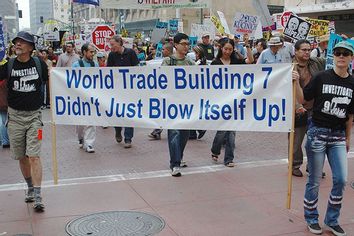
The conspiracists’ last card is the collapse of WTC building number 7 some hours after the morning attacks. But here again, as with the other two buildings, the explanations offered by the U.S. government’s National Institute of Standards and Technology (NIST) are more than adequate. Collapse was caused by the rupturing of the building’s metal framework due to the thermal expansion of its floor beams, which were heated by uncontrolled fires because the water main that supplied the building’s fire suppression system had been cut by the collapse of WTC 1.

As discussed in Wayne Barrett and Dan Collin’s excellent book “Grand Illusion,” about Rudy Giuliani and 9/11, helicopter pilots radioed warnings nine minutes before the final collapse that the South Tower might well go down and, repeatedly, as much as 25 minutes before the North Tower’s fall.

What Barrett and Collins brilliantly showed are the actual corrupt conspiracies on Giuliani’s watch: the favoritism to Motorola that saddled the firemen with radios that didn’t work; the ability of the Port Authority to skimp on fire protection; the mayor’s catastrophic failure in the years before 9/11/2001 to organize an effective unified emergency command that would have meant that cops and firemen could have communicated; that many firemen wouldn’t have unnecessarily entered the Towers; that people in the Towers wouldn’t have been told by 911 emergency operators to stay in place; and that firemen could have heard the helicopter warnings and the final Mayday messages that prompted most of the NYPD men to flee the Towers.

That’s the real political world, in which Giuliani and others have never been held accountable. The conspiracists disdained the real world because they wanted to promote Bush, Cheney and the neocons to an elevated status as the Arch Demons of American history, instead of being just one more team running the American empire, a team of more than usual stupidity and incompetence (characteristics I personally favor in imperial leaders).

Actually, what Bush and Cheney never demonstrated was the slightest degree of competence to pull anything like this off. They couldn’t even manufacture weapons of mass destruction after U.S. troops had invaded Iraq, and when any box labeled “WMD” would have been happily photographed by the embedded U.S. press as conclusive testimony. Arch-demon Cheney and his retinue of neocons couldn’t even contrive a provocation sufficient to justify his aim of waging war on Iran or giving Israel the green light to do so. Each day he gnashed his teeth as Bush, Condoleezza Rice and the Joint Chiefs of Staff foiled his machinations.

At least what Obama may have done is remind the left — at least those not forever besotted — that Bush and Cheney are not that much different from the politicians and overlords of U.S. foreign policy who preceded them or followed them.

9/11 conspiracism, perhaps at last somewhat on the wane, penetrated deep into the American left. It has also been widespread on the libertarian and populist right, but that is scarcely surprising, since the American populist right instinctively mistrusts government to a far greater degree than the left, and matches conspiracies to its demon of preference, whether the Internal Revenue Service, the Federal Emergency Management Agency, Black Helicopters or the Jews and now Muslims.

These days a dwindling number of leftists learn their political economy from Marx. Into the theoretical and strategic void has crept a diffuse, peripatetic conspiracist view of the world that tends to locate ruling class devilry not in the crises of capital accumulation, or the falling rate of profit, or inter-imperial competition, but in locale (the Bohemian Grove, Bilderberg, Ditchley, Davos) or supposedly “rogue” agencies, with the CIA still at the head of the list. The 9/11 “conspiracy,” or “inside job,” is the Summa of all this foolishness.

One trips over a fundamental idiocy of the 9/11 conspiracists in the first paragraph of the opening page of the book by one of their high priests, David Ray Griffin, “The New Pearl Harbor.” “In many respects,” Griffin writes, “the strongest evidence provided by critics of the official account involves the events of 9/11 itself. In light of standard procedures for dealing with hijacked airplanes not one of these planes should have reached its target, let alone all three of them.”

 The operative word here is “should.” A central characteristic of the conspiracists is that they have a devout, albeit preposterous belief in American efficiency. Many of them start with the racist premise — frequently voiced in as many words in their writings — that “Arabs in caves” weren’t capable of the mission. They believe that military systems should work the way Pentagon press flacks and aerospace salesmen say they should work. They believe that at 8.14 am, when AA flight 11 switched off its radio and transponder, an FAA flight controller should have called the National Military Command center and NORAD. They believe, citing reverently (this is high priest Griffin, who has written no less than 10 books on 9/11) “the US Air Force’s own website,” that an F-15 could have intercepted AA flight 11 “by 8.24, and certainly no later than 8.30.”

 They appear to have read no military history, which is too bad because if they did they’d know that minutely planned operations — let alone by-the-book responses to an unprecedented emergency — screw up with monotonous regularity, by reason of stupidity, cowardice, venality and all the other failings, not excepting sudden changes in the weather.

Michael Neumann, a philosopher, and CounterPunch contributor, at the University of Trent, in Ontario, remarked in a note to me:

“I think the problem of conspiracy nuttery has got worse, and is part of a general trend. There really were serious questions about the Kennedy assassination, an unusual number of them, and it wasn’t too crazy to come to the wrong conclusion. There wasn’t a single serious question about 9-11. The main engine of the 9-11 conspiracy cult is nothing political; it’s the death of any conception of evidence.

“This probably comes from the decline of Western power. Deep down, almost everyone, across the political spectrum, is locked in a bigotry which can only attribute that decline to some irrational or supernatural power. The result is the ascendency of magic over common sense, let alone reason.”

Yet some have discovered a silver lining in the 9/11 conspiracism. A politically sophisticated leftist in Washington, D.C., wrote to me, agreeing with my ridiculing of the “inside job” scenarios, but adding, “To me the most interesting thing (in the US) is how many people are willing to believe that Bush either masterminded it [the 9/11 attacks] or knew in advance and let it happen. If that number or anything close to that is true, that’s a huge base of people that are more than deeply cynical about their elected officials. That would be the real news story that the media is missing, and it’s a big one.”

“I’m not sure I see the silver lining about cynicism re government,” I answered. “People used to say the same thing about the JFK conspiracy buffs and disbelief in the Warren Commission. Actually, it seems to demobilize people from useful political activity. If the alleged perpetrators are so efficiently devilish in their plots, all resistance is futile. 9/11 conspiracism stemmed from despair and political infantilism. There’s no worthwhile energy to transfer from such kookery. It’s like saying some lunatic shouting to himself on a street corner has the capacity to be a great orator.

Anyone who ever looked at the JFK assassination will know that there are endless anomalies and loose ends. Eyewitness testimony is conflicting, forensic evidence possibly misconstrued, mishandled or just missing. But in my view, the Warren Commission had it right and Oswald fired the fatal shots from the Schoolbook Depository. The evidentiary chain for his guilt is persuasive, and the cumulative scenarios of the conspiracists entirely unconvincing. But of course — as the years roll by, and even though no persuasive deathbed confession has ever buttressed those vast, CIA-related scenarios — the conspiracists keep on toiling away, their obsessions as unflagging as ever.

Richard Aldrich’s book on British intelligence, “The Hidden Hand” (2002), describes how a report for the Pentagon on declassification recommended that “interesting declassified material” such as information about the JFK assassination “could be released and even posted on the Internet, as a ‘diversion,’” and used to “reduce the unrestrained public appetite for ‘secrets’ by providing good faith distraction material.” Aldrich adds, “If investigative journalists and contemporary historians were absorbed with the vexatious, but rather tired, debates over the grassy knoll, they would not be busy probing into areas where they were unwelcome.”

The conspiracists have combined to produce a huge distraction, just as Danny Sheehan did with his Complaint, that mesmerized and distracted much of the Nicaraguan Solidarity Movement in the 1980s, and which finally collapsed in a Florida courtroom almost as quickly as the Towers.

There are plenty of real conspiracies in America. Why make up fake ones? 

Newsreal: Clinton: His nine lives aren't used up yet

The president's latest "end" is greatly exaggerated.

It’s always been “the end of the Clinton presidency” for as long as I can remember. Certainly it was over at least three times before Bill even got into the White House. Maybe four. It’s hard to keep count.

The first official “end” came in 1988, with young Clinton’s keynoter at the Dukakis convention in Atlanta. The speech was meant to establish him as a man of vision and promise, but it was so boring and so interminable Clinton became a national joke. He hung in there, took the punishment and thus was still on his feet by March 1992, all fresh for his second End, when the Gennifer Flowers scandal broke in the middle of the New Hampshire primary.

At the time this looked like the End to all Endings. Flowers was obviously telling the truth. Bill looked as guilty as sin. But Hillary carried him through.

By now the Ends were coming thick and furious: pot smoking, draft dodging, the first delicious fragrance of Whitewater. The Clinton presidency was, as a thing of bright promise, over by the time of the Democratic Convention in the summer of 1992.

There’s nothing unusual here. American presidencies seldom coincide with the precise four-year terms that march reassuringly down the quadrennial calendar. By the official measure, Jimmy Carter’s administration stretched from 1977 through the end of 1980. But the liberal arc actually extended from Richard Nixon’s ouster in mid-1974 to the successful counterattack of the right in 1979. The Clinton presidency began with the budget compromise of 1990, when President Bush abandoned his party’s right wing and agreed to raise taxes.

But appearances have to be maintained. Though his presidency was actually over, Clinton moved into the White House in January 1993, running a kind of caretaker regime until the official inauguration of President Newt Gingrich in 1994. He still kept those Ends coming all the same out of sheer force of habit; starting with Troopergate, the health-care fiasco, Travelgate, Filegate, Campaign Fundgate, on and on.

The American people don’t mind Bill and the reason is, they know he’s not really president, never has been president, so why get hot under the collar? They know the country is in the hands of Alan Greenspan. From this realistic point of view, there’s something positively endearing about Bill, going through the motions, making little speeches on the White House Lawn, looking solemn at funerals, getting to host Barbra Streisand in the Lincoln Bedroom.

Will he be impeached? people ask. Certainly, the Republicans are drawing up the Articles. Special prosecutor Kenneth Starr has those tapes and Bill’s messages to Monica Lewinsky. I doubt it will come to that. Remember the agonies of those House reps back in 1974, pondering whether to impeach Nixon, one of the big political criminals of our century? They’re not going to impeach Bill for sneaking young Monica into the White House at 2 a.m. and then asking her to fib to Kenneth Starr about it.

Besides, why would any Republican truly want the official End of “President” Bill right now? So Al Gore could get two years’ exposure in the White House and pardon Bill into the bargain? That’s why Newt sat on the tapes for a month. It looks like endless Ends through to the end of Clinton’s term. At least the man’s consistent.

Continue Reading Close

Media Circus: the ethics of photojournalism

Everybody's trashing the paparazzi. But for even legendary photojournalists, moral ambiguity comes with the territory.

The ethics … Let’s stop right there. The moment I realized that the coupling of the noun “ethics” with the noun “photojournalism” was an exercise best reserved for the more innocent journalism schools came in Northern Ireland sometime in the mid-1970s. A photojournalist had been apprised that a package left in a public place contained a time bomb. He was waiting, his telephoto lens carefully focused, for someone to approach the package and get blown to pieces. The only question on his mind was whether he would be quick enough to get the moment of detonation, and not the smoke-covered aftermath.

All journalists are familiar with the process of psychic hardening: the first time you have to interview the bereaved and try to wheedle the high school yearbook out of them, the first time a subject doesn’t exactly realize that he has not really and truly placed his confidences off the record. A decent journalist will try to resist this process, for the good reason that a conscienceless hack won’t produce much that is truly worth reading.

Photographers go through the same sort of process, only at a more drastic and exacting level. They don’t merely need to ask the mother for that yearbook photo, they want the mother to cry as she hands it over. A photojournalist needs emotion on the far side of the lens, the more raw the better. To capture and thus exploit rawness is not an activity that necessarily encourages ethical behavior.

Those Diana-chasing paparazzi in the tunnel alongside the Pont d’Alma have been getting a hammering for their brutish behavior. But what about those war photographers who get paid to go on snapping as people die? Photographs of the starving in Ethiopia regularly win prizes without people angrily protesting that the emaciated child would probably have preferred a glass of water and a biscuit than a Nikon or Leica shoved in its face.

There are other, subtler ethical decisions. Take the matter of background. How many photojournalists clicking away in front of the austere priest might try for an angle that permits a pin-up or perhaps a movie poster of a woman in the background? Of course they don’t tell the priest, they merely hope he won’t notice. I used to work with a professional whose specialty was to pose people in such a way that in the finished photographs they would look silly, or guilty. It might be a matter of having them twist their torsos as the photographer shot them from the side, or of telling them to hold their faces still, but look to the left, or of putting them under a light, creating pools under their eyes. But time after time editors rejoiced in his photographs while the victims seethed at their unethical treatment.

There’s been a huge fuss lately about one of the most famous photographs ever to have come out of the Bosnian-Serbian catastrophe: that gaunt row of men staring through wire, seemingly in the first Serbian concentration camp holding Bosnian Muslim prisoners. The photograph went around the world. But later it was suggested that perhaps there was less to the wire than the photo claimed, that it might not even have been part of an encircling fence, that the Bosnian Muslims were not in anything approaching a concentration camp.

The row is still boiling, but it raises the powerful question: What else is shown in the photos on the contact sheet that did not get enlarged? The most famous picture ever to come out of the Spanish Civil War was Robert Capa’s photograph “Death in Action,” which showed a man falling backward with his rifle springing loose of his outstretched hand. By the late 1970s, the British reporter Philip Knightley was raising the possibility, angrily denied by the photo agency Magnum (which was set up by Robert Capa and later run by his brother Cornel), that this was not a death in action, but in fact a snapshot of a man falling down on a training exercise. There was no possibility of asking Robert Capa. He’d been killed stepping on a land mine in Vietnam. The row continues, with fierce examination of the contact sheets still filed at Magnum.

A photograph is by definition a moment seized from time, and the seizure can remove context in a way that might not exactly be unethical, but does damage the truth. Photographers tend, alas, to think in clichis. Refugees must never laugh. Hungry children must never smile. Someone once told me that Walker Evans’ famous black and white photographs of Alabama sharecroppers, printed in James Agee’s “Let Us Now Praise Famous Men,” didn’t exactly do justice to the humanity of these Okies, shown by Evans as invariably grim. The contact sheets apparently showed laughter as well as tears, exuberance as well as despair.

Photography is almost always manipulation. The patron saints of photojournalism all manipulated grossly. Take that famous photo of young love in Paris, the boy and his girl kissing with abandon. Turns out it was a set-up. Or take Henri Cartier-Bresson’s equally famous picture of the batty old woman waving a flag somewhere in the Northeast on July 4. Turns out Henri set her up with the flag. So the picture was a lie. Unethical? Most assuredly. That’s the nature of the beast.
Sept. 4, 1997

Alexander Cockburn’s books include “Washington Babylon” and “The Golden Age Is in Us.” He writes the “Beat the Devil” column for the Nation.


MAKING BOOK
ON DIANA

Publishers scramble to capitalize on the public’s insatiable demand for prose about the princess.


BY DWIGHT GARNER

While magazine editors continue to scramble to fill the almost insatiable desire for Di copy — among other things, the New Yorker will arrive three days early this week, on Friday, with essays by Salman Rushdie and editor Tina Brown — the book industry hasn’t been sitting on its hands.

Salon has learned that at least one major New York literary agency is already shopping a book about Diana and her tragic demise, the first of what are certain to be dozens. The book is to be written by the celebrity biographer Donald Spoto, who is no stranger to the royal beat — he published a tome titled “The Decline and Fall of the House of Windsor” in 1995. Spoto is being represented by the Elaine Markson Agency, which confirmed that it is taking bids on the proposal.

No other details were forthcoming, but there’s little doubt that Spoto will be able to lash something together on deadline. He’s a veritable factory. Spoto has published “major” biographies of Marilyn Monroe, Elizabeth Taylor, James Dean, Stanley Kramer, Tennessee Williams, Alfred Hitchcock, Preston Sturges, Marlene Dietrich, Laurence Olivier and Ingrid Bergman — and that’s just since 1990. His new bio of Marlon Brando, “Wild One,” will be published later this year.

Well before Spoto’s investigation sees print, and even before the inevitable mass market quickie books about Diana hit the checkout racks, many publishers are planning to revise and reprint earlier titles. USA Today reported yesterday that, among other things, Simon & Schuster will publish a new hardcover edition of “Diana: Her True Story,” Andrew Morton’s 1992 bestseller, with a new introduction and new photographs; Pocket Books will release 500,000 softcover copies of Morton’s original book, plus 250,000 copies of its sequel, “Diana: Her New Life”; and St. Martin’s is reissuing its 1995 volume “Diana: Her Life in Photographs” as “Diana 1961-1997: A Tribute in Photographs.”

On the other hand, readers whose tastes run to affectionate satire may want to pick up a copy of Peter Lefcourt’s charming 1994 novel, “Di and I,” in which the princess-with-the-common-touch marries a nice-guy Hollywood screenwriter, moves to Rancho Cucamonga, Calif., and opens a McDonald’s franchise. (The screenwriter woos her by composing an epic poem called “The Dianiad,” which he runs on the front page of a local newspaper.)

More eagerly awaited than reissued titles, by devoted royal watchers anyway, is the snarky biographer Kitty Kelly’s forthcoming book, “The Royals,” due from Warner Books on Sept. 23. No additions to the book are expected, since nearly half its 1 million copies have already been printed. “Kelly may update future editions of the book,” said Camille McDuffy, the book’s publicist. “But we’re confident that no other quickie book will have anything near the scope that her book has.” Among the expected revelations in “The Royals,” Christopher Hitchens has written in Vanity Fair, is that it took “embarrassing sessions of artificial insemination” to produce the present queen and her sister Margaret.

“This is clearly just the beginning,” said Sue Carswell, an editor at Crown Books, a division of Random House. “Most of the journalists who will submit book proposals are still busy covering the story. We are still very early in this process, and most houses are still busy thinking up ideas.” Carswell declined to comment on any specific projects Crown is pursuing, but said that “things are definitely in the works.”

“How can publishers not be interested in publishing books about Diana?” she continued. “The public interest in her life is nearly as great as the interest was, and is, in John F. Kennedy and Elvis. Diana’s grace and beauty and charity touched a lot of people, and she is one of those public figures people may never get too much of.”

Continue Reading Close

The People's Pit Bull

Pat Buchanan is moving into the void left by liberals' failure to address the issue of economic injustice

All of a sudden the mainstream press has developed teeth and is busy sinking them into the leg of Patrick Buchanan. In the wake of the new Hampshire primary you can catch the unmistakable tang of panic among the pundits at the sight of a wild man at the gates. So now Buchanan is being depicted as the patron saint of racists, and himself a closet Nazi.

Buchanan is hard-edged in his rhetoric against abortion, same-sex marriages and kindred social
issues. But the panic of the elite derives more from his economic views. Hitherto, a consensus lay over the presidential race like a moist blanket. Between Bill Clinton, Bob Dole, Lamar Alexander and Steve Forbes there was an amiable agreement on the central political-economic issue — free trade. Like most mainstream pundits, they regard it as an absolute virtue.

Buchanan does not. And for that reason — far more than his snarls about gays — he is regarded as dangerous. “Economists tend to hold Pat Buchanan’s anti-NAFTA views with the sort of scorn biologists have for creationism, or the contempt doctors have for the theory that HIV is unrelated to AIDS,” sneered reporter Paul Blustein in the Washington Post.

But many people in New Hampshire clearly didn’t feel that way. He got the bulk of his votes from those making less than $50,000 a year; 50 percent who went for Buchanan said trade was the most important issue. They are living on the economic downside of the high-tech global economy, and they don’t think NAFTA or GATT has done them any good at all. NAFTA, in fact, has been a time bomb in American politics, as Buchanan realized. His bigotry on certain social issues is distressing, but his popularity is based on more than declamations against gays, immigrants and pro-choice activists. He is the populist standard-bearer in 1996; his political advance is entirely understandable and to a considerable extent deserved.


Neither is he the first contemporary populist whose message has been warmly received by regular citizens while being derided by the elites. In 1984 and 1988 it was Jesse Jackson; in 1992 Jerry Brown.

Those bids, including Buchanan’s, are reactions to a political bankruptcy at the national level — which is as dire amongst Democrats as Republicans. Bill Clinton is in reality a moderate Republican, who shares the same general outlook, for all practical purposes, as Sen. Bob Dole. Yet Clinton faces no challenge from liberals, unless you count Ralph Nader running on the Green Party ticket in California. The only calls for economic justice, and opposition to Fortune 500 business as usual, comes from Buchanan.

Recently, Dennis Rivera, the aggressive leader of the hospital workers union in New York, said the most important labor project in decades is the re-election of Bill Clinton. Likewise, new AFL-CIO leaders John Sweeney and Richard Trumka are scrambling to get out the vote for the man conservative commentator Kevin Phillips described as “the 20th century’s most actively anti-labor president.”

So much for the new face of the labor movement. Its leaders will work for Clinton, contenting themselves with such crumbs as his State of the Union pledge of a small hike in the minimum wage (even though he did nothing about it in his first two years in office, when he had a Democratic Congress.) As Bill Becker, president of the Arkansas AFL-CIO, once so memorably put it: “He’ll pat you on the back and piss down your leg.” It is no wonder that Buchanan has emerged as the only champion for many in the rank and file.

In online chat rooms and bulletin boards where the computerized liberal-left gather to ponder the great issues of the day, there’s already lively discussion as to whether Buchanan is a fascist. But it wasn’t Buchanan who presided over the largest number of civilian deaths resulting from an operation by U.S. law enforcement (Waco). And Buchanan didn’t write the Terrorism Bill, which contains appalling encroachments on constitutional protections, and is due to come up in the House in March, with Justice Department and White House encouragement.

Rather than cheering on Bill Clinton, the “lesser of two evils,” while trembling before Patrick Buchanan, the “fascist menace,” progressives especially should ask themselves how they allowed things to come to such a pass — that the only presidential candidate raising basic issues of economic justice should be a man like Buchanan.

On the Republican side, one of the funnier sights of the primary campaign so far has been Bob Dole — in panicky response to the rise of Buchanan — suddenly expressing concern about corporate layoffs that seem to accompany super profits. This as he dismounts from one corporate jet lent him by Carl Lindner, the banana king, and mounts another, provided by a tobacco company, or by Midwest corn king, Dwayne Andreas.

If Dole’s wounds in New Hampshire prove fatal, expect the elite pundits and editorial writers to muster behind “moderate” Lamar Alexander, the quiet former governor from Tennessee who has advanced the most radical ideas of any of the candidates for cutting down the federal government. But he’s not “dangerous,” like Buchanan, whose great crime has been to desecrate that political holy of holies, free trade.

Continue Reading Close
www.salon.com/writer/alexander_cockburn/index.html