Andrew Keen

“Turing’s Cathedral”: Gods of the digital universe

A new book tells the story of the pioneering scientific minds behind the world's first computer

  • more
    • All Share Services

This article appears courtesy of The Barnes & Noble Review.

In early 1947, Jack Rosenberg, a bored researcher in Princeton University’s Physics Department, heard about an intriguing new job opportunity. As he told George Dyson, the author of “Turing’s Cathedral: The Origins of the Digital Universe:” “I was informed that at the Institute for Advanced Study, a famous scientist was looking for an engineer to develop an electronic machine of a sort no one but he understood.”

Barnes & Noble ReviewThat “famous scientist” was a Hungarian émigré mathematician called John von Neumann, and the electronic machine he was developing at Princeton’s Institute for Advanced Study (IAS) was, of course, the computer, the central product of today’s networked society. And it’s this story, of von Neumann’s attempt to assemble a team of the world’s most brilliant 20th-century scientists at IAS, that forms the central narrative in this sparkling new book by one of America’s most talented historians of technology.

The book’s title refers to the profoundly simple quotation by the English mathematician Alan Turing. “It is possible to invent a single machine which can be used to compute any computational sequence,” the then 24-year-old Turing wrote in 1936. And “Turing’s Cathedral” is the story of the pioneering efforts at IAS to build this “single machine,” one that, as David Rosenberg notes, only von Neumann “understood.”

As digital devices are woven into our lives with increasing ubiquity, we take for granted the elegant interconnection of our networked electronics. But, of course, that overall structure — the seamless architecture of computer hardware, operating system, and software — had to be invented. That’s the “cathedral” von Neumann and his IAS team helped construct. And Dyson’s book is both a lucid and accessible story of how that cathedral got built as well as being a kind of cathedral of its own in honor of its architects.

But the greatest strength of “Turing’s Cathedral” lies in its luscious wealth of anecdotal details about von Neumann and his band of scientific geniuses at IAS. Dyson himself is the son of Freeman Dyson, one of America’s greatest 20th-century physicists and an IAS member from 1948 onward, and so “Turing’s Cathedral” is, in part, Dyson’s attempt to make both moral and intellectual sense of his father’s glittering and yet severely compromised scientific generation.

Dyson leaves us with a memorable portrait of John von Neumann (known as Johnny to friends and family), a scion of a wealthy Catholic Budapest family, who came to America in the 1930s and who, in spite of his love of fast cars, gambling, and women, always remained an enigma. “If a mentally superhuman race ever develops, its members will resemble Johnny von Neumann,” says IAS member Edward Teller, the father of the hydrogen bomb, who credits a “neural superconductivity” with Neumann’s unique genius.

Neumann’s genius, Dyson explains, was in many ways an ability to recognize the genius in others. And “Turing’s Cathedral” is in large part constructed of the vivid stories of those other scientists whom von Neumann brought to Princeton in the 1930s and 1940s and assembled as an all-star team of scientific missionaries. There’s the amateur aviator and computer engineer Julian Bigelow, for example, who stored aircraft engines in the living room of his house, a former blacksmith’s shop in central Princeton. Then there’s the Austrian émigré mathematician Kurt Gödel, who was so “eccentric” that, as a young man, he developed a fear of being poisoned and would only eat food provided by his family. Even the woman who wrote the menus at the IAS cafeteria, Bernetta Miller, had been one of the first female pilots and had demonstrated monoplanes for the U.S. Army.

Best of all, though, is Dyson’s portrait of von Neumann’s closest friend and intellectual collaborator, the brilliant mathematician Stan Ulam, a Polish Jew from a wealthy Lwów family who fled to the United States in the summer of 1939. Dyson is excellent in not only describing what he calls “Ulam’s demons” but also in charting the special friendship and working relationship between Ulam and von Neumann, two aristocrats from a disappearing world whose unique intellects would reinvent the new world.

It’s a pleasure to marvel at these remarkable minds and the great changes they set in motion. But the reverse of the story is sobering. Dyson shows that von Neumann’s government-funded invention of the computer was inextricably linked to the development of both the atomic and hydrogen bombs. You see, the mathematics that made possible the architecture of computers was also the mathematics that would simulate the consequences of thermonuclear fusion. The moral costs then, Dyson estimates, of IAS’s discovery of our digital universe are as enigmatic as Johnny von Neumann himself, a mentally superhuman mathematician who died at the age of only 54. The cause was bone cancer, which, some speculate, was derived from his attendance at the 1951 Bikini nuclear tests.

Do we need a third industrial revolution?

A new book argues that there's only one way to save life on Earth: Remake our economy

  • more
    • All Share Services

Do we need a third industrial revolution?
This article appears courtesy of the Barnes & Noble Review.

Books about saving the world are always a two-part confidence game. First comes the story of a calamitous decline and fall, and then the corresponding road to redemption is unveiled. For this type of book to work, its narrative picture must be painted in a chiaroscuro style — bathed in both darkness and light.

Barnes & Noble ReviewJeremy Rifkin’s “The Third Industrial Revolution: How Lateral Power Is Transforming Energy, the Economy and the World” is a classic example of this type of work. Rikfin’s Manichaean narrative is simple, sometimes perhaps a little too simple. Over the last century, we have been “fossil fuel people” of the “carbon era,” according to Rifkin. But America, he argues, is now in the death throes of this second industrial revolution. It has become a “failed economy,” and we are “sleep walking” into the “deceleration” of the “environmental catastrophe” and the “extinction of life on the planet.”

That’s the dark part. The bright bit is inevitably biblical in its promise of salvation. F. Scott Fitzgerald famously warned that there are no second acts in American life. But for Rifkin it’s America’s second act — the destructive carbon revolution of the 20th century — that’s the problem. And it’s America’s third act, he says, that will save life on our planet from the catastrophe of extinction. The early 21st century’s third industrial revolution of green energy and the “lateral power” of the network, Rifkin promises us, offer a more democratic and “distributed” alternative to the hierarchical structures of traditional economic and political institutions. It’s in what he calls the “marriage” of energy and communications that our salvation as both a nation and as a species lies.

“The Third Industrial Revolution” is sobering reading. Writing with urgency and authority, Rifkin skewers President Obama for failing to strategically confront the fundamental decline of industrial America, arguing that Obama lacks a “narrative” to unleash the third industrial revolution. Rifkin is provocative, too, relating the global revolt against government and corporations that now links the streets of London and Greece to today’s populist uprising on Wall Street to the crisis of top-down institutions struggling to maintain their authority in the face of the breakdown of the old industrial order.

In contrast with Barack Obama, however, Jeremy Rifkin does have a story to tell about how to save the planet. In what he calls “the five pillars,” he lays out a comprehensive plan to realize the third industrial revolution. Rifkin’s “new narrative,” borrowing from the very high-level consultancy work he has been doing for the European Union, is truly revolutionary and comprises the most confident part of the book. Turning the old hierarchies of the industrial revolution on their head, Rifkin argues in favor of a complete shift to renewable energy (wind, solar, and garbage) in which we can turn all our homes into “micro-power plants” that will then be shared on a grid via the Internet. “Renewable energies are everywhere,” he explains as he charts the European ambition to make all of its citizens into new energy moguls by creating 190 million power plants in the Union.

“The Third Industrial Revolution” is a big, brash, bold book in keeping with Rifkin’s 40-year career as an anti-corporate gadfly. So should we believe in it? “The economy is always a confidence game,” Rifkin argues — and so, I’ve already argued, is this type of book. But for all its vigor and erudition, it’s undermined by one fatal flaw. The heart of Rifkin’s critique of industrial civilization lies in its top-down hierarchies, which, he says, have become anachronistic in the face of the “distributed,” collaborative nature of today’s Internet world. And yet Rifkin — who seems to be “friends” with everyone from European prime ministers like Angela Merkel and David Cameron to European royalty like Prince Albert of Monaco — is a classic example of a top-down technocrat who is anything but “distributed” in his glamorous, Davos-friendly lifestyle.

No, there’s nothing “lateral” about Jeremy Rifkin or his green manifesto. Ironically, he’s as top-down as they come, a classic example of a mandarin from the second industrial revolution, more Auguste Comte than Jimmy Wales, who implements change on behalf of everyone else. And “The Third Industrial Revolution” is a pretty conventional top-down 20th-century text, too, written without the kind of interactivity or textual innovation that one might expect of a prophet of lateral power.

“Drill baby drill,” is the Tea Party mantra for solving today’s industrial crisis in America. Rifkin, of course, disagrees. “Drilling for oil won’t get us out of the crisis because the crisis is oil,” he argues. But the crisis, as he explains, goes way beyond oil, to the roots of an American democracy in which mandarin technocrats like Jeremy Rifkin are dismissed as “elitists.” Perhaps that’s why he has more confidence in Europe, rather than America, to realize the third industrial revolution. And that may be why, I suspect, “The Third Industrial Revolution” will evoke more confidence in top-down Europe than in bottom-up America.

Continue Reading Close

“Alone Together”: Is technology ruining our ability to be alone?

A new book looks at the ways social networking is warping our sense of independence -- and ability to interact

  • more
    • All Share Services

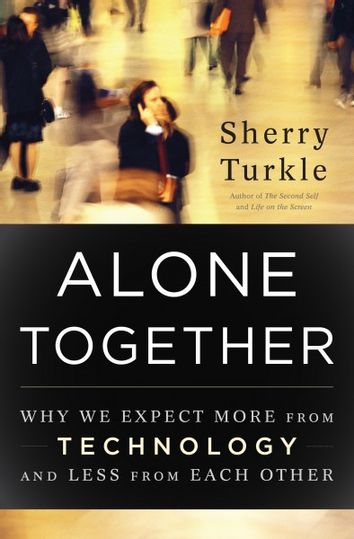
"Alone Together" by Sherry Turkle

Sherry Turkle’s new book, “Alone Together,” ends in mourning. In October 2009, the author, an MIT professor of the social studies of science and technology, went to her local synagogue for Yiskor, the special Yom Kippur service that remembers the dead. There she heard the rabbi deliver a sermon about the importance of talking to the deceased and communicating four messages to them: “I’m sorry. Thank you. I forgive you. I love you.”

Barnes & Noble Review“That is what makes us human, over time, over distance,” Turkle says of our ability to talk sincerely to other human beings, whether they belong to our past or our present. Our “knowledge of mortality” and our “experience of the life cycle” is conveyed in just such simple messages: “I’m sorry. Thank you. I forgive you. I love you.” They are the most intimate words we can say to another. Without them, she suggests, we are machines akin to the robots in Philip K. Dick’s “Do Androids Dream of Electric Sheep?” which imagines a future in which robots and humans are indistinguishable.

Dick’s classic story was adapted for the movies by Ridley Scott as “Blade Runner.” But in this age of Facebook, Twitter and increasingly “intelligent” robots with names like Kismet and Paro, Turkle tells us, “Blade Runner” has been adapted by all of us: We are being herded toward what she ominously calls “the robotic moment,” a place in which we will rely on machines to shape our regret, gratitude, forgiveness and love.

“People disappoint; robots will not” — so she explains the great seduction of devices that behave like human beings. Today, she warns us, we are becoming so “immersed in technology that we ignore what we know about life.” Indeed, this epochal robotic moment may have already arrived while an increasingly wired human race has been too busy texting, tweeting and friending to notice.

As “Alone Together,” based on interviews with hundreds of subjects over 15 years of research, illustrates, this ignorance about the creeping mechanical translation of our human instincts is afflicting old and young alike. When Turkle introduces 76-year-old Andy to “My Real Baby,” a simulated human infant, he is delighted: “Now I have something to do when I have nothing to do,” Andy confesses. Seven-year-old Brooke yearns to talk to a robot called Cog so that she can become the machine’s dedicated tutor. And Turkle considers the robot-makers, too — from Norbert Weiner, the inventor of cybernetics who believed it was “conceptually possible” to send a person over an electric wire, to Aaron Edsinger, the inventor of a device called “Domo,” which, according to Turkle, “really can have a conversation.”

But is the nature of conversation itself being altered by its new forms? Turkle talks to high school students who are sending 6,000 text messages a day, thereby predicating their whole identity on electronic communications. “If Facebook were deleted, I’d be deleted,” one 16-year-old student confesses to Turkle. Such fascination with social media is fostering what Turkle — a psychoanalytically trained psychologist — calls a “hyper-otherdirectedness” in its proponents, a “collaborative self” that no longer has the ability to be alone and privately reflect on its emotions.

As an elegy for the death of intimacy, “Alone Together” — for all its noble intentions — fails, for the most part, to establish a really close relationship with the reader, in part because of its medium. The 348-page, richly footnoted tome has the form of a conventional academic book, but its message belongs to a deeply layered piece of philosophy or even fiction. So while I loved Turkle’s introduction, her conclusion and, in particular, her deeply moving epilogue, the rest of the occasionally repetitive and unstructured narrative could have done with a bit more rabbi and a bit less academic psychologist.

But that’s a quibble. “Alone Together” is a major empirical and theoretical work that illuminates the crisis of humanity at the dawn of the digital century. Turkle has laid down a gauntlet for the rest of us to pick up. One can only hope that rabbis, novelists and other engineers of the human soul will do so, translating Turkle’s vitally important message into more urgent and intimate forms.

Continue Reading Close

Can the Internet save the book?

Online luminary Clay Shirky explains the new digital literary revolution -- and how the Web will change reading

  • more
    • All Share Services

Can the Internet save the book?

(With additional questions from James Mustich, editor in chief of the Barnes & Noble Review).

According to media columnist Michael Wolff, the name Clay Shirky is “now uttered in technology circles with the kind of reverence with which left-wingers used to say, ‘Herbert Marcuse’.” Wolff is right. Shirky has emerged as a luminary of the new digital intelligentsia, a daringly eclectic thinker as comfortable discussing 15th-century publishing technology as he is making political sense of 21st-century social media.

Barnes & Noble ReviewIn his 2008 book, “Here Comes Everybody,” Shirky imagined a world without traditional economic or political organizations. Two years later and Shirky has a new book, “Cognitive Surplus,” which imagines something even more daring — a world without television. To celebrate the appearance of the revered futurist’s latest volume, we’re delighted to share a February discussion between Shirky, Barnes & Noble Review editor in chief James Mustich, and BNR contributor Andrew Keen. What follows is an edited transcript of their conversation about the future of the book, of the reader and the writer, and, most intriguingly, the future of intimacy.

James Mustich: Clay, I was very taken with that post you wrote about the early days of the Gutenberg revolution.

Clay Shirky: Oh, yes. Eisenstein’s book.

JM: Right. It had a very insightful historical perspective that’s generally lacking in conversations about today’s publishing turmoil. You also had an interesting piece at edge.org recently, about how publishing is the new literacy. You said, “It is our misfortune to live through the largest increase in expressive capability in the history of the human race — a misfortune because surplus always breaks more things than scarcity.”

Andrew Keen: This idea of publishing as “the new literacy” sounds like a sexy, kind of Twitter remark, but what actually does that mean?

CS: We have this whole complex of words, “publish,” “publisher,” “publicity,” “publicist,” that all refer to either jobs or the work of making things public. Because it used to be incredibly difficult, complicated, and expensive to simply put material into the public sphere, and now it’s not. So I’m comparing it to literacy — literacy used to be reserved for a specialist class prior to the printing press, and, much more importantly, prior to the spread of publishers and the rise of a real publishing industry.

AK: What do you mean by “reserved”?

CS: That it was reserved for a professional class. There was no point in educating people to read and write who weren’t also going to have access to books, and the people who had access to books were generally in centers of learning or churches. You couldn’t have mass literacy without also mass availability of things to read, which didn’t happen until after Gutenberg. So literacy went through this curious transition where it became more critical to society, and you could no longer make a living just by the ability to read and write.

So when I say “publishing is the new literacy,” I don’t mean there’s no role for curation, for improving material, for editing material, for fact-checking material. I mean literally, the act of putting something out in public used to be reserved in the same way. You used to have to own a radio tower or television tower or printing press. Now all you have to have is access to an Internet cafe or a public library, and you can put your thoughts out in public.

So what happened to literacy in the 1600s, 1700s and 1800s is that it went from being reserved for a specialist class to being a general feature of the middle class. The same thing is happening to publishing — the ability to put something out in public is becoming more important to society, but the delta between “I can put something out in public” and “I can’t put something out in public” is no longer so great that you can automatically make money simply by having access to the means of publication.

AK: Is that change technological or cultural?

CS: Well, it’s a technological change whose ramifications are mostly cultural, and culture is I think lagging the technology, as it often does, because the raw capability isn’t what changes society. As I put it in “Here Comes Everybody,” “society doesn’t change when people adopt new tools; it changes when people adopt new behaviors.” So in the 1990s, we had a population of some tens of millions of people in this country who had access to online material, but that wasn’t yet the majority of the population. More importantly, those people hadn’t yet fully formed behaviors around what was possible digitally. Now, having gone through the first decade in which digital freedom was a normal part of life for more than half the country, we’re seeing the cultural change that comes about as a result of the technological change. So the ability to publish, the ability to put things in public no matter who you are, as long as you have access to, again, a public library or an Internet cafe — that’s a technological change. But the change in perception and reaction to what gets published and why, that’s the cultural change.

JM: What interests me in what you wrote about the printing press, and the immediate changes its advent provoked, is how unclear the effect of its influence was to those subject to it at the time. Today, in the throes of another massive technological change, we’re trying to see very clearly what’s happening, and part of the point of your piece is that we can’t see it either, because we don’t know what the behaviors are going to be that are engendered by the technology. But as a book guy, what I have often looked at is how much the book publishing industry defines the situation only in the context of its very recent history …

CS: Yes, right. Absolutely.

JM: … which makes them think of content in terms of these finished products, books; that’s the only way people get information, or the only way creative work gets to people. But those products in that form are really consequences of industrial organization, or management decisions made in the very recent past. If you look back to the 19th century or before that, printed creative work was much more dynamic. It came about in pieces, then it was collected in books. Very few people were sitting down and writing books the way they do now.

CS: A whole book, right. Dickens was paid by the word in newspapers, and then “Pickwick Papers” came out of the assembly of that work.

JM: Exactly. It seems to me that what we’re seeing is, in some ways, that technology is allowing us to go backward to a more dynamic kind of form of communication of these works. I’m wondering if you’ve given any thought to that, and what that thought might be.

CS: One of the problems with any kind of talking about the media landscape is that we’ve just been through an unusually stable period in which, for 50 years, English language media was centered in three cities — London, New York and Los Angeles — around a very stable group of people working in a relatively stable set of media. This is the media landscape where getting your television in through a wire rather than through the air constitutes a revolution. That was a really big deal. Cable was supposed to be a huge change. And indeed it was, within the context of television, a large change. It’s just that now we’re actually dealing with a change that’s a shock across the whole environment.

I have this theory. I call it the Russia-Poland Theory. Which is: one of the reasons Poland did better than Russia after the collapse of Communism is they’d only had one generation under the Communists, so there were still people who could remember that it had been different. Whereas, under Russia, no one alive remembered what life was like in 1916. When people go through two generations of stability, it’s easy enough to adopt an attitude that it has always been this way. So for somebody entering the book publishing business in, say, the year 2000, some 23-year-old just out of school, it has always been this way. No one in the publishing industry has known anything but the postwar landscape. What you get when a situation like that happens is that one word comes to stand in for a business, a production method, a product, a cultural signifier — the whole range of it is all compacted into that single thing.

You can see it really clearly with television. You go to the store to buy a television, and then you come home and you watch some television. But the television you buy isn’t the television you watch, and the television you watch isn’t the television you buy. We use the same word to refer to the object and the content flow, and nobody gets confused because we all know what television is. Now all of a sudden, we have video spilling out of phones and personal computers, and the question “Is that television?” becomes really complicated.

To books specifically: Books are a considered form of long-form writing. They’re a physical product, and then, as you say as “a book guy” — there are book guys, right? There are people who live their whole lives in the context of producing this long-form writing and turning it into those physical objects. And all that stuff is coming apart.

AK: But books are Russia. Not Poland.

CS: Yes, books are Russia, not Poland. That’s exactly right.

AK: Whereas you could argue television or the music business is more like Poland. They’re all relatively new. Whereas the book business is much older.

CS: You’re right. The book business is, in this metaphor, Russia, which is to say the stability of the book business predates the Second World War. In fact, you read all this stuff about the rise of paperbacks, mass market paperbacks in the 1950s — people were freaking out that it didn’t have a hard cover. That constituted a revolution in books.

But what we’re dealing with now, I think, is the ramification of having long-form writing not necessarily meaning physical objects, not necessarily meaning commissioning editors and publishers in the manner of making those physical objects, and not meaning any of the sales channels or the preexisting ways of producing cultural focus. This is really clear to me as someone who writes and publishes both on a weblog and books. There are certain channels of conversation in this society that you can only get into if you have written a book. Terry Gross has never met anyone in her life who has not just published a book. Right?

JM: [LAUGHS] Right.

CS: It’s like every judge thinking that criminals dress in blue suits all day long. Terry Gross’ experience is only talking to people who have just written books.

AK: Why does Terry Gross only talk to the traditional author?

CS: I think because the cost of writing a book is very large. Someone has committed a lot of time to it. They’ve put a lot of their thinking into it. But also, a whole bunch of other people who have significant amounts of capital on the line have said, “This is worth publishing.” They’ve either said it in the context of the academic press, which says, “This will redound to our credit,” or they’ve said it in the context of the commercial press, which says, “Revenues will exceed expenses.” We use the phrase “self-published author” to mean “vaguely suspect.” Right? Or take painters. Anyone can be a painter, but the question is then, “Have you ever had a show; have you ever had a solo show?” People are always looking for these high-cost signals from other people that this is worthwhile.

That I think is one of the big changes in book culture, that it used to be a pretty safe way to say, “I’m talking to the people who I should be talking to if I’m talking to the people who’ve written books about the subject,” and now that is less the case for two reasons. For one, the book world is opening up–the maw of production of the book world is opening up–the iUniverses and so forth of the world. Getting a physical object no longer means somebody else took a big economic flyer on it. At the same time, more thoughtful long-form writing is happening outside of the traditional publishing industry. So the old rough-and-ready, “I’m vetting for quality by only talking to authors of books” model is suddenly up in the air. Books are less valuable as signifiers, and people who you ought to be talking to, some of them don’t write books.

AK: One example of this type of new author is Andrew Sullivan. He is a classic 19th-century guy who now is in the 21st century, who has decided that the long-form world doesn’t work. But he is a star of both the old and the new world. He actually proves that the arguments about elitism of the old world are in some ways just as relevant in the new world.

CS: You said to me on Twitter the other day, “Oh, you’re secretly an elitist.” I remember thinking I’m actually, I think, kind of openly an elitist.

AK: You’ve said it now. That’s the end of your career (LAUGHS)

CS: That’s the end, right (LAUGHS). I’ve always adopted the Bill Burroughs mantra, which is, “If a thing is worth doing, it’s worth doing badly.” Which is to say that if there is any intrinsic value in writing or expressing yourself or taking a photo, it’s worth doing even if the results are mediocre. Whenever the production maw has opened more widely, whether it’s cheap photography or it’s weblogs, the average quality falls. The average quality of a piece of writing is now lower because the denominator has exploded. The question becomes how do you find the good stuff in this much larger group. I am not somebody who believes everyone is equally talented; talent remains unequally distributed. What’s interesting now is that the old gatekeepers for identifying, anointing, and promoting talent are different in this generation than they were previously.

There’s an interesting natural experiment going on around this very question of elitism with Nick Denton’s Gawker empire. Denton is the person who discovers Elizabeth Spiers. Denton hires Anna Marie Cox. He finds this great group of early writers, who then all get picked up by traditional media and switch jobs, because whatever else you can say about the platform for Gawker weblogs, they don’t pay that well. So all of a sudden, Nick is now the recruiter for traditional media. And the question becomes: is there a large enough, an unlimited enough talent pool that Nick can do that 100 times in a row? It doesn’t matter how many times mainstream media recruits these people away from him, because he can always find somebody else — or, is he going to run out of the talent pool, and end up just being a recruiter. We don’t know how widely distributed the talent that he relies on is; if there are only ten writers as good as Cox, he’s got a problem. If there’s a hundred writers as good as that on that subject, then instead it’s the mass media that has a problem. If it turns out that the medium can’t employ everyone who’s talented, the supply and demand equation switches, and the premium you get for talent actually turns out to be a premium for talent plus happening to have the microphone in your hand. We don’t know yet. Plainly, supply is larger than the current available slots in the mass media. But we don’t know if it’s 10 times larger, at which point we see a rebalancing, or if it’s 100 times larger, at which point we really see a restructuring.

AK: Can we go back to the book? It occurs to me that one of the reasons the traditional book lasted so long — one of the reasons it was Russia — is that the form and the function went very well together, and the book was a great way of tracking talent. Take the birth of the 19th-century novel, which is the classic way of putting together a finished product, which then the Industrial Revolution was able to polish and distribute. So when Poland went, it wasn’t so dramatic. But when Russia goes, it’s going to be really dramatic. We haven’t even seen the beginning in the book revolution, have we?

CS: I think we are literally just seeing the beginning now. Just yesterday, Google says, “Our negotiating position vis-a-vis the publishers has changed dramatically in the last 30 days.” Google has been doing this stuff quietly, one way or another, since 2005 — Google Scholar, Google Books, digitization, negotiating digital rights, and so forth. It was because they were essentially going to be the second entrant in a monopolistic environment largely dominated by Amazon. The rise of the iPad and the at least not completely accidental renegotiation of the MacMillan-Amazon relationship at the same time has meant that supply and demand are more nearly balanced now, and that the publishers have greater leverage to use that platform.

That is a two-edged sword, which is to say that the ability to engage in price competition with one another cuts both ways in a digital environment because the marginal cost of distribution is still zero. But I think that the last 60 days are the beginning of the real change.

I’ve got a book coming out in June. The first one, I signed — I started the proposal in 2005, started to work on it in 2006, finished it in 2007, it came out at the beginning of 2008. So I’m sitting down at the beginning of 2010, almost two years to the day since the previous one came out…well, it’s actually 2½ years since I was having these kinds of conversations, and in that 2½ years the eBook has gone from being an afterthought, “let’s try it if we can,” to an absolutely normal part of the process.

AK: What is the book, and who is publishing it?

CS: Oh, it’s Penguin Group. It’s currently called “Cognitive Surplus,” and it’s about being able to treat people’s free time as an aggregate rather than as a series of individual silos.

AK: OK. But digitizing a book doesn’t change anything about it in grand historical terms, does it?

CS: I think it does, because it puts it into an ecosystem where more people have access to more books. The digitizing of a book adds to searchability, it adds to portability, it adds to…

AK: Searchability?

CS: Search is essentially the current model of information-finding, where the old model of was you go to the library and they tell you that you have to know what database you’re looking in before you look. That’s fine when there are 500 databases, maybe, and someone can help me decide. But when there’s an unlimited number of data sources, search becomes the intellectual model of the age. I remember knowing when I’d switched over to thinking digitally when I picked up a copy of “Naked Lunch,” and I wanted to find a little passage called “Hauser and O’Brien,” about two cops in New York City. I realized, “I can’t search for that.” I had to remember that it was about three-quarters of the way through the book, and I can kind of vaguely remember it was midway on the right-hand page or something. That experience of not being able to recapture what you’ve done before is one of the great infelicities of the book world, and I think it’s especially frustrating to people with nonfiction when there is a particular point they want to go back to.

The other thing it does, though — which is good or bad, depending on your taste — is it encourages the ability to skip ahead to the parts they want to read. I mean, nonfiction books are going to be transformed, I think, much more dramatically than fiction, precisely because their utility means that people are going to essentially disassemble them mentally even if they’re sold as a single package. So to your point about Dickens being assembled in the book after having been created in this disassembled way, we may potentially be seeing something like that on the demand side, which is: I’d like to be able to take this nonfiction book and take it apart again, and preserve or flag the parts I’m going to refer to continually.

JM: That’s an interesting idea for me, because we’re not just talking about the object, Because the book shaped our model of knowledge: when the index was invented in the 12th century, that made a book a certain kind or ordered thing, and it led to three centuries of Scholasticism — the whole university system where knowledge was contained in these ordered things and could be found in these books by looking a certain way. And all the content to come was shaped by this intellectual etiquette, if you will. What’s important about digitalization, when the model is search instead of an alphabetical index, is that it changes what one’s model of knowledge is.

CS: Right.

JM: Which is really the subtext of “Here Comes Everybody” — that there is a different way of apprehending the world now because of this.

CS: Yes. I think one of the ways of apprehending the world that’s actually showing up already in the academy is the so-called “one-box search,” where you don’t have to say, “This is the database I’m looking in.” One-box search privileges interdisciplinary work. Because if I search for a particular string or phrase, I am suddenly getting back results from psychology, sociology, economics, political science — all in the same search query. Disciplinary boundaries are just assaulted, rather than doubled down; if I have to know the database before I search it, then to become a good political scientist I have to know which journals are relevant.

AK: Do you think that that’s one of the reasons why you’ve been intellectually successful, because you cross boundaries so naturally? You started life as a creative artist. You’ve been a technologist, a theorist…

CS: I’m not sure that I’ve gotten to the level of theory. In the academy, there’s a pretty rigid definition.

AK: But, in a recent Vanity Fair piece, Michael Wolff referred to you as the Marcuse of the early 21st century.

CS: [LAUGHS] That’s on my to-read list. I haven’t read it yet.

AK: So you’re in high company now. You’re the Frankfurt School 2.0.

CS: I will tell my wife, who is a political philosopher. She’ll be tickled. But certainly, there are revolutions in which people’s principal skill is not being afraid of what they don’t understand. These people do well in revolutionary times. I jumped into this not because I was good at it, but because I didn’t have much to lose. That will give way–in fact, it even is giving way now. I started doing this in a day when you had to understand something about how the Internet works just to use it. Literally. There was no web, there was no graphic interface or anything like that. You had to understand something about the plumbing just to go to the bathroom. It’s like having to know how your car started to own a car. Those days are long gone. In fact, some of the interesting commentary on the iPad considers it as a new model for how little you have to know about your computer in order to get it to do what you want to do.

AK: Which is why the techies don’t like it.

CS: Exactly! But I do think that early on in any revolution, people who are comfortable operating without strong disciplinary boundaries are liable to do well, just because nobody knows where the next good idea is going to come from. Louis Menand just put four of his essays in a very interesting book on higher education. It’s clear that disciplinary boundaries are a response to the profusion of knowledge; that response says, “This is where psychology ends and sociology begins, and if you cross the hall, you’re operating in their discipline and not ours, and they have different choices.”

These kinds of boundaries become really significant in two different areas. They become significant intellectually, and they also become significant for the development of things like tenure. So the really mundane–”This is how the profession works, recognizes quality and promotes itself”–and also–”This is the intellectual output that’s consumed by society and shapes people’s ideas” and so forth–all get bound together tightly, and nobody inside the system can really imagine a change.

I think one of the other questions right now arises because we’ve plainly lowered the threshold of disciplinary boundaries in the early days of this change, because there are so many inputs. There are people who are willing to dive in and try stuff and are getting things done. But as people get better at things, we are starting to see the return of some kind of discipline–people specializing in different aspects of the service. At Google there are people who do nothing but optimize the file system all day long. So it’s not just service side and client side. It’s really, really specialized.

But are the disciplinary models of the new medium going to be more like a network or are they going to be more like a series of silos? I’m going to bet on the network model, which is to say it’s likelier that disciplines in the world we’re entering are going to have not so much a canon that says, “This is the edge of what’s important,” so much as, “This is the core of what we’re interested in wherever the currents come from.” There is still going to be a strong difference between psychology and sociology at the center of those two professions–a concentration on individual thinking versus a concentration on group dynamics. But I think there’s going to be less of a sharp edge between them, and I think there will be more people–or really, probably, more pairs or groups of people–who are doing and publishing research that crosses that boundary back and forth.

AK: When it comes to books, though, one of the big traditional boundaries is between fiction and nonfiction. Do you think that that’s done away with?

CS: Ah. The James Frey problem.

AK: Yes. But as the book becomes alive, and the novelists can write more factually…

JM: I’m not sure that this concern isn’t a very recent development as well, created by the industry to shelve books in bookstores and to disseminate books in the trade, and then inflated to another kind of discussion…

CS: Look at the difference between how a library shelves books, how serious fiction as a category exists in bookstores but not in libraries.

JM: If we go back to Dickens again, there’s a combination journalistic and storytelling impulses. Our obsession with whether a memoir is true or a novel is based on real events — in any interview you hear with a novelist, the interviewer is general asking again and again the same question of the author: “Did this really happen to you?” We don’t–we can’t–observe those boundaries in our imaginative lives as clearly as the industry or the media does, or wants to.

CS: There was this moment when Oprah got called out on the James Frey thing–in what must in retrospect have been a moment of absent-mindedness, she told her audience the truth, and she said something like, Look, if it’s out in the public eye, it’s been massaged. Anyone telling a story is telling a story. There is no such thing as unmediated expression, there is no direct access to truth. Those weren’t the words she used, but that was the message, in which she said, essentially, the Frey made you feel something, and your feelings were real, and don’t get so hung up on this. Her audience went berserk. And because they went berserk in an age where they could amplify one another’s anger using all the tools we’re used to, there was a public relations shitstorm–she was called to task for possibly the only time in her career, or certainly for the most public time in her whole career.

If I want to talk about the border between fiction and nonfiction getting erased, I point to Oprah’s audience. For the mass of the population, I don’t think that we are going to quickly enter a new world in which the truth or falsehood of an assertion is ever thought of in complicated and subtle ways. This may be truer here than it is in Europe. The U.S. is unusual in a lot of cultural ways. People want to know if this really happened to the author. The radio interviewers ask that question over and over again, because the demand for there to be an uncomplicated answer to that question is in no way assuaged by telling them that there isn’t an uncomplicated answer.

AK: It’s no coincidence that technology enables this kind of intimacy.

CS: Yes, exactly. The ability to invent a persona whose signature can be so managed is possible because there’s less face-to-face contact on the Internet, and even less telephone contact, much more digital traces of leaving websites. People didn’t just love the Frey memoir because they thought it was true. They loved his memoir because it seemed impossible that it was true, and they were still being told it was true. Augusten Burroughs, same thing. For as long as memoir culture is in its current mode, there’s always going to be a premium on a kind of faking it, because those are the books that sell well. It’s the stuff that’s right on the edge.

I remember years ago, a guy I worked with in the theater found a ten-year-old bottle of moonshine in his basement in North Carolina. He said, “I don’t know if I should drink this or not.” So he called up a friend of his who knew a little bit more about moonshine than he did, and he said, “I found this moonshine; can I drink this?” His friend said, “I’ll tell you what. Just pour out a little capsule of it and set it on fire, and if it burns blue, it’s fine — drink it. If it burns yellow, don’t drink it. If it burns blue with a yellow tip, I’ll pay you ten dollars for a glass.” That’s the memoir, right? If it burns blue with a yellow tip… You can’t even believe it’s true, but also it’s just barely palatable to consume. That’s what James Frey and J.T. Leroy and Augusten Burroughs write, these impossible crushing circumstances of their life, after which they acquire a kind of literary ability to tell it as a story.

The demand for that is going to remain there. So I think while the line between fiction and nonfiction may be increasingly blurred in practice, I think the public’s demand to be told there’s a sharp line is unlikely to shift quickly.

AK: Actually, I don’t agree with what you said earlier, Clay. I think technology has caught up with culture, rather than the other way around. In this sense, technology now is feeding our appetite for intimacy.

CS: Yeah, that’s right. I will agree with Andrew here.

AK: Not for the first time.

CS: Not for the first time. [LAUGHS] One of the things that freaks me out about the music scene is that hip-hop preceded the digital encoding of music. They were doing sampling and remixing and intercutting and mashups–call it whatever you want–with turntables and a microphone. When you hear what Kool DJ Herc or Double Dee and Steinski were doing–insane! Insane stuff you would never try and do with only analog equipment, except that that was all they had. So when digital music came on, it was like gasoline on the fire, because all of a sudden, all the stuff that they’d just barely been able to hold together with two tables and a microphone turned into something that was able to be cut-and-pasted.

I guess what I’m saying about technology preceding culture versus culture preceding technology is: when there’s deep change, it takes a long time for the culture to catch up. But deep changes never happen without some precursor. Take, for example, the early history of the book. Scholastic culture arose around the book as an object, and it was the automation of the production of that object that Gutenberg was responsible for, not the fact of the original intuition that folded and cut pages were better than rolled parchments.

TV, weirdly, created a grid of intimacy among 10 million. You would not think that a medium that reaches 10 million people would have intimacy as its core virtue.

AK: That’s why the most valuable TV guys were the late-night talk show hosts whose whole premise, whose whole value was building intimacy with their audience.

CS: There’s was a really interesting article in the “Atlantic” about George Noory, the guy who does a late night show called “Coast to Coast”, and about exactly this–that late night is when you’re reaching people. QVC–Quality Value Convenience–I think that was the original home shopping network. QVC has this long training course to be a phone sales person, because you don’t get on, make the sale, and get off. You get on, you talk to the person, you compliment the person. Because what do you know about the caller? That this is a person who is sitting alone at 3:00am. So it’s very clear what the value of a phone call is at that point, and it’s not just reflected in the transactional value.

So I think that Andrew is right in that the desire for intimacy in a largely dissociated environment, coinciding with the decline of social capital, created a demand that made the Internet, again, like gasoline on the fire.

AK: We’ve talked a little bit about what new books are or might be, but to me a more interesting question is who or what the new author is. Do you want to say something about that?

CS: This is the literacy question again.

JM: It circles back to why it’s important that publishing is the new literacy. What strikes me is that, if you look at other periods of great cross-disciplinary ferment, the early years the Enlightenment, say, you had people who found ways to communicate across disciplines effectively–through pamphlets and international newsletters then, rather than the Internet.

CS: Right.

JM: Your piece, for instance, on Eisenstein, which we got on the web, because you could publish it there easily, is not that different from what Diderot or Melchior Grimm were doing in sending these newsletters back and forth between Germany and France. It’s just easier now, and everybody can do it. That’s what I was trying to say before about writing being free of the book for a long time before the modern commodity of the book contained it. I’m not talking about the history of the codex and Gutenberg, but of the act of setting something on paper and sending it out into the world without imprisoning it in the book. Self-publishing–publishing as the new literacy–allows that on a massive scale.

CS: Yes. Putting something on paper used to be a way of increasing the number of copies in circulation, and now it’s a way of decreasing the number of copies in circulation, by comparison to the digital media.

It’s interesting. From my point of view, I am a writer but not an author, which is to say I am a person who writes. My introduction to this medium was on Usenet, a medium with no graphic capabilities, and so to have a presence, literally to be there at all, was to write all the time. And I write in a very conversational style. It’s not the same style as an essay style. But nevertheless, it’s where I learned to write. I should have learned it in college, but alas, instead I learned it on Usenet.

There are still people in this city–I went to school with many of them–for whom the kind of Algonquin Club energy of authorship and being a writer and so forth is the aspiration. My sense is there are fewer of them now, fewer 23-year-olds.

AK: You went to Yale, right?

CS: I went to Yale.

AK: Are you saying that you didn’t learn to write at Yale? You did theater studies at Yale, right?

CS: Yes.

AK: [LAUGHING] You must have been semi-literate to get in.

CS: [LAUGHS] I was not illiterate prior to applying.

AK: So what do you mean when you say you learned to write on Usenet, having been a Yale grad?

CS: What I mean is that what I wrote at Yale was for an audience of a single person, my professor, and that it was intended to convince him that I knew what I was talking about so he would give me a good grade, rather than being intended to communicate something to him that would convince them to change him mind, or trying to give him a framework for thinking about something. In a way, writing a college paper in its current structure is almost custom-designed to crush in the student the idea of writing as a communicative act, because it feels like a long, highly structured interoffice memo rather than an address to the world.

I’ll tell you two things I’ve done here at NYU with the writing my students do for me. One, I assign them write for each other. So they think, “My peers are going to read this and also my professor is going to read this.” You’d think they’d be more concerned about me reading it, but the quality goes up when they know their friends are going to read it.

The other thing I do, with some of their stuff, is publish it online. I took a whole bunch of papers by my students from a class we did on the effect of the Internet on the 2008 Presidential election, and I just put them in a big folder and put them online. People’s reaction to this was: “Oh, I may actually be communicating something; I’d better get it together here.”

I never had that experience at Yale, not because Yale was not good at teaching writing. In fact, famously, the Daily Themes course is a boot camp for writers essentially. But in my ordinary classes, my experience of writing was that it wasn’t a communicative act to people I didn’t know.

AK: You’re basically saying that the disappearance of privacy might be a good thing for writers. Although I think Proust or certain other confessional writers might disagree with what you say.

CS: Right. The Saint Augustines of the world are always going to need to remove themselves from this. But writing is a big tent. The kind of writing I do has always been designed either to elicit a conversation or to provide some framework for thinking about a problem, and you do that better if you’re dealing with people whom you don’t know in advance and who may not be inclined to agree with you. Usenet is a much better environment for that, frankly, than the Yale campus.

AK: Let’s say some of these kids at NYU grow up to be 21st-century professional authors. Given the kind of training they’re getting and the media they’re growing up surrounded by, why would they be different as authors from you or me?

CS: First of all, I think we will see fewer authors and more writers. There’s this long, long, lonely gap between the 8,000-word New Yorker article and the 80,000-word book. And there are a bunch of interesting things that are about 20,000 words long. In fact, it’s gotten to the point where, if you’re reviewing a nonfiction book, it’s commonplace, if you like it, to assure the readers of the review that this is not just a magazine article inflated to 80,000 words so that it can be sold on the shelves at the bookstore. Which, in a way, is saying there’s a bunch of stuff that actually would be better at 20,000 or 25,000 words than at 80,000 words.

If that stretch opens up, then I think one of the things we’ll see is that an enormous amount of long-form writing that was kind of just pushed past the finish line of 80,000 words is going to revert to 40,000, or 20,000. If I could read an 80,000-word essay by a science writer about a particular branch of science, or a series of 20,000-word essays from scientists working in different disciplines, for anybody except for the best science writers–the people who are actually adding their own thoughts to the mix rather than just concatenating–I’d rather read the essays. The big question for me isn’t so much what happens to writers (although I think it’s an interesting question), but rather, what happens to the support writers typically get from the publisher?

The hard question, I think, is: long-form writing benefits enormously from a second set of eyes, or a second-third-fourth-fifth-sixth set of eyes–a copy editor, proofreader, etc. When I do a book manuscript and hand it over to Penguin, the amount it improves after I’m nominally done with it is astonishing. I can handle a process of going over it and over it and over it to get a 2,500-word essay, like the Eisenstein one, into that sort of form. I can’t do it for a book-length manuscript. Yet, once the book moves away from the bottleneck that allows the publisher to charge for the scarcity, which is where the copy editor’s fee comes from in the first place, I don’t know how writers of the future, at whatever length, take advantage of those capabilities.

People often ask me, “Why are you writing a book, given that it gets folded between the pages of dead trees?” And so on. My response to this has been, from the beginning, that I’m not getting edited and copy-edited and fact-checked and legally checked as the price I pay for having my name on the spine of the book–that has really never been a goal of mine. I didn’t grow up with that sort of Algonquin Club energy. It’s the other way around. Right now, the way you get other people to look at your book and comb through it for inconsistencies and talk about more felicitous phrasing is to agree to publish it. If there was some way to support that ecosystem–the ecosystem of “we are going to make long-form writing better by treating the question of quality and accuracy and felicity as a group effort”–that would work for weblogs, I’d be all over it. I think a lot of people would.

One of the things I noticed doing the first book is that you learn a lot of things doing a book that are lessons you can only apply to doing another book. They are really specialized things you do that aren’t about the argument you’re making, but about being part of the publishing industry. In a way, the notion of authorship retains it power in part because that hazing ritual is still high enough that, once you’re on the far side of it, doing another book is the most cost-effective use of your time, because you’ve already mastered these somewhat arcane skills. To the degree that writing–long-form writing in particular–becomes more broadly produced, I think the question will be reversed: how can we make the skills that publishers have mastered now flow outwards to new forms of long-form writing? That requires new business models that are yet to be on the horizon. And I’m not the business model guy.

That to me is the interesting part–not so much what the writers of tomorrow will be like, but rather, what’s the ecosystem for improving writing going to be like? Because right now, you’re basically either self-published and there’s no ecosystem, or you’re published by a publisher, and then you get copy-edited and legally edited, and all the rest of it. It’s that second set of values that are, in fact, more at risk than the writing itself in the current environment.

AK: Tell us about the new book, “Cognitive Surplus.” What’s it about?

CS: It’s about the idea of treating people’s free time as an aggregate resource that’s used for joint collaborative projects, Wikipedia and Open Source being the two most famous ones. But I’m also interested in things like environmental groups, ride-sharing, the responsible citizens who are a group of kids in Pakistan cleaning up market streets to try to create a broader civic culture–all of these ways of trying to use our new tools to create collective and not just personal value. Whereas the last book, “Here Comes Everybody”, was just “How did we get here?”, “Cognitive Surplus” is: “We’ve got this set of capabilities, where are we going?”

What’s different I think about “Cognitive Surplus” is saying that the cultural norms that we set now will determine the difference between how much of what we’re doing online is essentially self-amusement (mutually created value, and so you get something funny to look at on your coffee break or whatever) versus stuff that really throws off a lot of significant public and civic value. I like lol-cats as much as the next guy, and actually maybe more. But the precious end of the scale, and the end of the scale that’s hardest to get going, is the civic value. The book is essentially about why that civic value matters and how to foster it.

Continue Reading Close