Annie M. Paul

“Half Empty, Half Full”

While optimism may seem a sunny subject, full of hearts and flowers, it's a weapon in Susan Vaughan's hands.

  • more
    • All Share Services

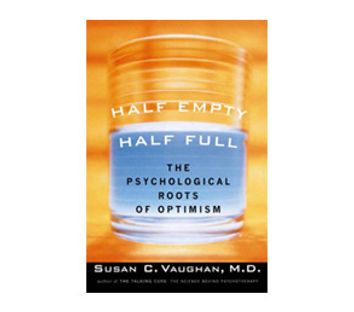
Half Empty, Half Full: The Psychological Roots of Optimism
By Susan Vaughan
Harcourt, 240 pages

Dr. Susan Vaughan’s new book, “Half Empty, Half Full: The Psychological Roots of Optimism,” left me with some lingering questions. Such as: If I were an optimist, would I have thought this was a good book? Given a more optimistic outlook, would I still regret the several hours I spent reading it? Is it evidence of my incorrigible pessimism that I find this book so useless?

I’ll put aside these musings for the moment, and attempt to review the book as objectively as possible (an endeavor Vaughan would regard as futile, but more on that later). As far as my hopelessly clouded vision allows me to see, Vaughan appears unwilling or incapable of making a sustained argument, something she did to great effect in her excellent 1997 book, “The Talking Cure: The Science Behind Psychotherapy.” In her new work, however, she sidles up to an argument, shies away and then approaches again without ever posing a question, let alone reasoning her way to an answer.

That’s unfortunate, since there’s much to be said about our infatuation with genetics and how it’s distracting us from good, gray environmental influences, less sexy these days, but still crucial to the development of traits like optimism or pessimism.

But this and all the rest of the book’s flaws — its painfully mixed metaphors, its phony case studies, a font so enormous and ideas so puny it resembles a large-print Reader’s Digest — recede next to its utter lack of a moral sense. Though optimism might seem a sunny subject, full of hearts and flowers, it’s a weapon in Vaughan’s hands: optimism by any means necessary. These means include overpraising yourself for your successes, shirking responsibility for your failures and comparing yourself to others less fortunate in order to feel superior. “Although those with a so-called optimistic style are clearly distorting reality,” she concedes, they are doing so “in the service of maximizing their sense of well-being, bolstering their self-esteem and enhancing their illusions of control.”

Oh, so it’s OK, then. As voiced by Vaughan, there’s really only one problem with mental habits like “downward comparison”: “If I constantly look for others who are worse off and use their misery to bolster my sense of self,” she asks ingenuously, “how do I keep from feeling guilty?”

Aside from these exercises in self-indulgence, there’s little here that psychologist Martin Seligman didn’t say better, and earlier, in his 1991 book “Learned Optimism.” Much of her report on optimism research has a half-hearted feel, as if the author, an assistant professor of psychiatry at Columbia University’s College of Physicians and Surgeons, could not interest even herself in what is largely a retread of familiar work.

Vaughan borrows shamelessly from Seligman and others, in fact, all while promoting what she calls “my” new theory of optimism. Her looting reaches criminal proportions in Chapter 8, which hijacks Jean-Dominique Bauby’s book “The Diving Bell and the Butterfly” — ostensibly to show “a master illusionist in action” but really, it seems, to quote long passages and thus save the author some exertion. The scheme backfires, as Bauby’s beautiful prose only calls attention to Vaughan’s lazy writing and ham-handed analysis. (We got a sense of her critical faculties earlier in the book, when she asserted that optimism allows people “to do remarkable things, like the musicians on the Titanic who played while the ship sank, neither minimizing the very real danger that they faced nor succumbing to inner terror.” Any therapist who thinks those doomed musicians were motivated by optimism should have her license revoked immediately.)

For sheer fatuousness, however, these sections can’t compare to the ones concerning Vaughan’s “patients.” I use quotes because I — unlike, presumably, most readers of “Half Empty, Half Full” — bothered to read the acknowledgements page, with its confession that the case studies discussed herein are “fictional.” I suppose we should be grateful that Vaughan made this admission in an early, albeit little-read, section of the book; in Susie Orbach’s latest, “The Impossibility of Sex,” the author saves the same disclosure for the very end.

Apart from the dubious ethics of inventing figures in a nonfiction book (can we get someone from Brill’s Content on this, please?), the real problem is that these characters are so miserably colorless and contrived. Michael, Robert, Jill: Not a single detail sticks to them, not a single utterance rings true. This falseness is especially apparent in their “dreams,” which are patently the product of a conscious, and none too imaginative, mind.

My favorite concerns “a Danish hair conditioner that was made with beer,” which “Isabel,” a recovering alcoholic, dreams that she tries to purchase at a drugstore, even though the bottle is only half-full. The cashier won’t sell it to her without I.D., and instead advises her to make it at home.

Enter Vaughan, triumphantly connecting the dots she drew herself: Isabel feels empty inside, and is searching for a substance that will make her whole. “She did use beer as a kind of internal mood conditioner for years,” Vaughan sagely observes. “And now she has given it up, but there’s nothing yet to replace it. So her inner state feels tangled and snarled.” The patient can’t smooth out her emotional problems without I.D. (i.e., a strong sense of identity), and that’s something that she can’t buy, but must create for herself. Get it?

Vaughan soon ushers “Isabel” and the others into the world of the aggressive optimist, where personal comfort is placed above all other values and virtues and the rest of humanity is a mere foil for our state of mind. We should all learn “to harness other people’s emotional reactions in a manner that positively affects our moods,” Vaughan advises, “as when we bounce a smile or a friendly attitude to them and, most often, they return it, sometimes magnified, to us.” But this exchange “works in both directions,” she warns, and “that means that you may want to think twice before cursing at that cab driver and unleashing his stream of abusive and angry comments, with its ability to adversely affect your mood.”

Another real bummer, according to Vaughan, is thinking too much about life and death and stuff. Since the contemplation of “our fundamental helplessness and lack of control in the face of an indifferent universe, our elemental aloneness, our failure to achieve successes that can change the basic parameters of our mortality,” may lead to “despair, depression, even suicide,” it’s much better to maintain the illusion that we’re totally in control of a faultlessly happy life that will go on forever. (Sardonic humor, good Scotch and Samuel Beckett are not mentioned as alternative coping strategies.)

Having neatly summarized our existential dilemma, Vaughan hurries on to more pressing topics, like the effect of optimism on basketball games won and insurance policies sold. And in truth, it does seem clear that an optimistic mindset — as upbeat as temperament or events will allow — is the best way to get through day-to-day life. As the basis of a philosophy or a worldview, however, optimism is absurdly inadequate, as Vaughan’s final chapters reveal.

In her ultimate formulation, our state of mind doesn’t just determine how we perceive things. It determines how things actually are. “There is no ‘real’ reality,” Vaughan assures us, “just the one that our minds construct by percolating the experiences we have through the lens of our mood of the moment.” Pessimistic people have one “reality,” optimistic people another — and given the choice, wouldn’t you pick the latter?

Here it is, the cosmology of the unthinking optimist: Other people are distant planets or reflecting moons; reality lacks any gravitational pull; and in the center spins the self, the blinding sun around which all else revolves.

It’s a nice place to visit, but I wouldn’t want to live there.

It’s a nice place to visit, but I wouldn’t want to live there.

Future Smart

Seventeen years ago, a Harvard psychologist proposed seven types of intelligences. His new book argues for eight and a half.

  • more
    • All Share Services

Future Smart

My students have often asked me whether there is a cooking
intelligence, a humor intelligence or a sexual intelligence,” Howard
Gardner dryly relates. “They have concluded that I can recognize only
the intelligences that I myself possess.” Whatever faculties he may be
lacking, the many intelligences Gardner can claim are on full display in
his newest book, “Intelligence Reframed: Multiple Intelligences For the
21st Century” (Basic Books, $27.50).

It’s been almost 17 years since the Harvard psychologist published the
groundbreaking “Frames of Mind,” which argued that intelligence doesn’t
come in a single flavor, but in several — seven, in fact. He contended
that our test-obsessed, hierarchy-happy culture has elevated logical and
linguistic intelligence above the musical, spatial, bodily-kinesthetic,
intra- and inter-personal intelligences. In other words, we value the
capacity to turn a phrase or solve a problem more than the ability to
execute a pirouette, exhibit perfect pitch or make a new friend,
although the latter activities are just as cognitively challenging.

Gardner’s theory was a huge hit in education circles, and its precepts
have been applied in hundreds of classrooms and school districts around
the world. The idea has also entered the public discourse, influencing
our debates on school curriculums and standardized tests. Now Gardner
has returned to stake a claim for multiple intelligences in the coming
century — a time, he says, when we’ll need all the brainpower we can
muster. “Intelligence Reframed” is a progress report on how we’ve
assimilated the concept of multiple intelligences.

Sitting in his publisher’s Manhattan office, the cordial, slightly
rumpled professor spoke with Salon about why IQ tests are inadequate,
why he doubts there’s a spiritual or a moral intelligence and why we may radically change our thinking about the
kind of people we consider intelligent.

Much of your latest book is devoted to explaining and defending the
theory of multiple intelligences. Has it become a kind of Frankenstein,
a monster that you have to spend all your time managing and controlling?

I don’t spend all my time managing and controlling it, and I give
myself some points for that. No academic ever expects to be taken
seriously by more than three other people, because really, we write for
three other people in our field. So when you suddenly find the world
catching on to something you did, it’s tempting to devote yourself to it
and be afraid to change your mind about it because you’ll lose your
industry.

I’ve tried very hard not to commodify multiple intelligences. There are
hundreds of products such as CD-ROMs and summer camps based on the idea
out there, but I don’t endorse any of them. And I avoid singling out
people whose work I don’t like — with one exception. In Australia, they
had an educational program in which they linked each of the
intelligences to a particular ethnic group. I thought that was heinous,
and I went on television and said so.

Most academics are naive in thinking that their ideas won’t be noticed,
and if they are noticed, they’ll be understood correctly. Boy, have I
been disabused of that notion. One of the purposes of the book is to
address some myths that have proliferated around multiple intelligences,
such as a single “approved” educational approach based on multiple
intelligences theory. In some cases, the myths are ones that I
propagated. In the naive view, a theory is something that’s created at
one time in one space, and remains static. In fact, the theory has
changed enormously in terms of my own understanding of it.

The big news in this book is that you’ve added an intelligence to the
list, one that you call the “naturalist intelligence,” the ability to
recognize and classify features of the environment. What led to that
decision?

I was giving a speech to specialists in the history of science at
Harvard, and one of them said, “You’ll never explain Darwin with your
theory.” And he was right. So I spent the next several years reading
about how people recognize patterns in nature, how they discriminate
among living things and things that are inorganic but natural, like
rocks or clouds. All of the intelligences have to be traced back to life
on the savanna a couple hundred thousand years ago, because we evolved
for a very different kind of world than the one we live in now. We had
to decide what to eat and what to avoid because it was poisonous, what
to chase and what to run from. If we couldn’t make fine distinctions in
the natural world, we’d be done for.

One speculation I make in the book is that our current consumer culture
may be based upon the naturalist intelligence. A consumer culture
assumes that we can tell one sneaker from another, the taste of one kind
of coffee from another — and if we didn’t have a naturalist
intelligence, we couldn’t do that.

You considered adding a spiritual intelligence, but ultimately
decided against it. Why?

The more I investigated spirituality as it’s used in our society, the
more I became convinced that even if it’s terribly important, it’s not
an intelligence. Spirituality is just a mess intellectually. If you go
into a bookstore and look at all the titles labeled “spiritual,” they
range from total nonsense to very serious literature about religion and
contemplation.

The study of spirituality does bring up an interesting phenomenological
issue: What does it mean to be in a spiritual state? Many people would
say that what’s important about spirituality is the feeling that comes
with it. The problem is that we don’t know how to measure people’s
feelings because they’re not quantifiable.

In mathematical intelligence, for example, we’re interested in how well
people can compute. How they’re feeling at the time is irrelevant. They
could be feeling lousy or wonderful — it’s how well they compute that
matters. When you start making a subjective feeling part of the
definition, it gets very slippery. Can people be spiritual only if they
feel a certain way? If David Koresh feels that way, does that make him
spiritual? If the pope doesn’t, does that make him unspiritual? So it’s
very hard to find dry land, and scientists are looking for dry land.

But you think that one aspect of spirituality — the contemplation of
existential matters — may qualify as an intelligence?

Existential intelligence denotes our capacity to ask very big
questions about the meaning of life and death. We know that people all
over the world ask these questions, and art, religion, philosophy,
mythology are all efforts to deal with them. Even kids ask them,
sometimes directly, sometimes through storytelling and play. Most of the
intelligences are linked to tangibles like objects or other people, but
existential intelligence deals with intangibles.

When I reviewed existentiality in terms of my criteria for an
intelligence, the one point on which I was dissatisfied is that we
haven’t found a part of the brain dedicated to dealing with these
questions. So I say that I think there are “eight and a half”
intelligences.

Can you think of an example of existential intelligence in action?

In my earlier writings about leaders, I emphasized the importance of
linguistic intelligence and personal intelligence, and the relative
insignificance of logical intelligence. That’s why someone like Reagan
can be a very effective leader, although no one ever accused him of
being logical. To those, I would now add existential intelligence,
because people like leaders who can help them make sense of what’s
happening in the world. The leaders we admire most are ones who give
answers to big questions. When you think about who’s running for
president, it’s a pretty sorry lot in that regard.

You also rejected the possibility of a moral intelligence. Why?

Morality involves value judgments, and I want my intelligences to be
value-neutral. Yet I’m very interested in how intelligences can be used
for moral ends. It’s important that people keep a sense of calling at a
time when things are changing very quickly; the market is very powerful,
and technology is revamping our whole sense of space and time. Young
people entering a profession need to find or invent the institutions
that will allow them to do what they think is really important, and not
let the current practices dictate their actions. I think journalism is
more at risk than any other profession. It’s caught between the tastes
of the public, which are capricious at best, and the pressures of
shareholders, who don’t say, “Oh, what a wonderful editorial,” but
rather, “Did we make more money than last quarter?” It’s extremely
difficult for journalists to do what they claim they want to do, which
is to tell the truth, to be as objective as they can and to report on
the things that people should know about, rather than the things they
want to know about. A journalist recently said to me, “The media are an
early warning sign. What you see happening in the media is going to
happen in every other profession.” And I think he’s absolutely right.

Does the value placed on particular intelligences vary among
different cultures and eras?

Yes, absolutely. A hundred and fifty years ago, if you went to
Harvard, Yale or Princeton, you were going to a place where you would
study Greek, Latin and Hebrew. And I’m absolutely certain that people
who could learn Latin, Greek and Hebrew then are not the same as the
people who nowadays would do well on the SAT. In China, as part of the
extensive classical examination system, scholars wrote intricate essays
that had to conform to a schema that was described as “eight-legged.”
Whereas in Western Europe, cultural literacy was very important, and you
had to know about the paintings of a particular culture and so on.

My work is very critical of what I call “the dipstick theory,” which is the
notion that everybody is born with a certain amount of intelligence and
it doesn’t matter where or when you live, how much stuff you have will
show. So if you were smart in the Paleolithic era, you’d be smart today,
and if you were smart in the Middle Ages, you’ll be smart in the year
2050. I think that’s nonsense. I think we’re built with different kinds
of potentials, and whether they get realized depends on what’s available
in society.

When something like a computer, or a printing press, or
telecommunications gets invented, there is always a shakeup of which
intelligences are valued and nurtured. As new technologies develop, it’s
completely unpredictable which intelligences will come to the fore. For
example, the arts have had a very hard time in American education for
the last 30 or 40 years. But one can easily imagine a scenario in which
computers become smarter than us, and the only people left who can do
anything of worth to other people will be the artists.

How will our ideas about intelligence change in coming years?

The biggest change I foresee will be the extent to which we will want
to know about the intelligences of each person and how we will utilize
that information. As long as we rely on a universal yardstick such as
the SAT or the IQ, we dismiss individual differences. In the future,
computers will make it easier to ascertain individual intelligences and
implement different ways of learning.

Those companies and educational institutions that figure out how to
learn about an individual’s intelligences profile and use it profitably
will have a tremendous advantage. The notion that there’s only one way
to teach and one way to learn and one way to assess ability will look
increasingly silly. My work with multiple intelligences is not about
accepting what is, but envisioning a different view of human nature and
human potential. We’re living in a time that is impatient with subtlety
and complexity, and we would like to say: This is the test that will
measure intelligence, this is the kind of intelligence we value and this
is the ultimate curriculum. But I’m convinced that in 50 or 100 years,
we will laugh at any teacher who thinks there’s only one way to teach
something.

How might measures like the SAT or the IQ test be changed to
reflect an appreciation for multiple intelligences?

The best way to find out what people can do is not to test for some
essence by asking a series of questions, but rather to put them into a
situation that mirrors the one they will encounter in real life, and see
how they handle it. I call these intelligence-fair assessments, and I
think it’s no longer fantasy to think that we could do simulations like
that.

We should go right for the retail, rather than thinking there’s some
kind of wholesale quantity that will simplify the problem for us. If I
were an admissions officer, I’d want to know: Is this a student who’s
going to be able to participate in class in a way that’s critical, but
not nasty? Is this somebody who can not only find flaws in an argument,
but say how they would improve that argument? We should make our
theories of intelligence adequate to the complexity of human thought and
accomplishment, rather than try to take all that and squeeze it into one
very narrow slot.

Continue Reading Close

One mean Renaissance man

As Machiavelli becomes the poster prince for a new kind of power-hungry self-help genre, scholars are using the 16th century political philosopher as a litmus test for human behavior.

  • more
    • All Share Services

No doubt about it — this writer is hot. His works inspire countless knockoffs and imitations. His imprimatur gilds the covers of other authors’ books like Oprah’s golden O. His name has even entered the language as an adjective. But you won’t see him signing books at Barnes & Noble or trying to talk over Charlie Rose. No doubt he’d relish the attention, but he’s been dead for almost 500 years.

These days, Niccolo Machiavelli is generating a volume of buzz Tina Brown would envy. In the past couple of years, he’s been the subject of more than 20 books, including Dick Morris’ “The New Prince: Machiavelli Updated for the Twenty-First Century,” “The New Machiavelli: The Art of Politics in Business” and “Machiavelli on Modern Leadership: Why Machiavelli’s Iron Rules Are as Timely and Important Today as Five Centuries Ago.” For the fairer (but no less devious) sex, there’s “The Princessa: Machiavelli for Women” and for those mischievous little tykes, “A Child’s Machiavelli: A Primer on Power.”

Of course, the buzz around Machiavelli has never really died down. Since his guide to getting and keeping power, “The Prince,” was published in 1532, Machiavelli’s matter-of-fact instruction that rulers must be prepared to lie, cheat and steal to hang on to their thrones — all the while acting the part of the benevolent leader — has not lost its razor edge. Even in this era of cynicism, Machiavelli’s view of humanity as greedy and self-seeking or stupid and easily tricked still seems remarkably dark — and to some, remarkably relevant. The little Italian excites so much passion because his works divide readers into two hostile camps: those who admire his clear-sighted pragmatism and those who are repelled by his casual amorality.

His polarizing presence isn’t limited to light reading, either. Now Machiavelli is making an appearance in a loftier realm: the speculations of sociobiology. In “Machiavellian Intelligence: Social Expertise and the Evolution of Intellect in Monkeys, Apes, and Humans” (Oxford University Press, 1988) and “Machiavellian Intelligence II: Extensions and Evaluations” (Cambridge University Press, 1997), two scientists make a startling claim: Machiavellian behavior helped our early ancestors survive, and even drove the evolution of their brains. In other words, it made us human.

Andrew Whiten and Richard Byrne, both professors of biology at Scotland’s St. Andrews University, apply the word “Machiavellian” to artful manipulation that serves one’s own interests. In the communal living situations of our early forbears, they explain, those who could make the biggest grab for resources without getting kicked out of the group altogether — that is, those who were most effectively underhanded and guileful — were the ones who lived to pass on their (Machiavellian) genes. The competition to be the craftiest of them all created an “evolutionary arms race,” write Whiten and Byrne, “leading to spiraling increases in intelligence.”

Their supposition grows out of what’s known as the “social intelligence hypothesis”: the idea that it’s not the world of objects that demands superior smarts, but our complicated and nuanced web of relationships. Sounds sensible enough — but earlier theories had tied the development of human intelligence to the use of tools and weapons. (That dealing with relationships is the more cognitively complex activity will surprise no one who’s seen modern-day man prefer a session with his power tools to a long talk with his wife.)

Machiavelli’s survival-of-the-shrewdest philosophy has obvious parallels to evolutionary theory (were he writing today, he might thank, fawningly of course, Charles Darwin and Richard Dawkins in his acknowledgements), and the researchers have embraced him as a sage. “Machiavelli seems to me to have been a realist, who accepted that self-interest was ultimately what drove people, and emphasized that the best way to achieve one’s personal ends was usually through social, cooperative and generous behavior — provided that the costs are never allowed to outweigh the ultimate benefits to oneself,” says Byrne. Though the biologists’ work doesn’t draw directly on Machiavelli’s texts, his steel-fisted, velvet-gloved approach provides the perfect model for the behavior they describe.

Evolutionary biology isn’t the only academic discipline to borrow from Machiavelli: Psychology got there first. Almost 50 years ago, a Stanford psychologist named Richard Christie set out to ascertain just how many modern-day adherents Machiavelli had, and how they differed from those who disavow his ideas. Christie created a personality test based on statements taken from “The Prince”: “Most people forget more easily the death of their parents than the loss of their property,” for example, and “The biggest difference between most criminals and other people is that the criminals are stupid enough to get caught.” Test-takers were asked to rate how strongly they agreed with Machiavelli’s acid observations. Those who endorsed Machiavelli’s opinions Christie dubbed high Machs; those who rejected them out of hand were low Machs. Most people fall somewhere in the middle, but there’s a significant minority at either extreme.

The unusual origins of Christie’s test set it apart from the carefully constructed instruments psychologists ordinarily use. The survey itself measures only one thing — whether the test-taker subscribes to the ideas of a 16th century Italian political philosopher. But here’s the rub: In subsequent experiments in his lab, Christie found that our reactions to Machiavelli act as a kind of litmus test, delineating differences in temperament that he confirmed with more traditional personality inventories. High Machs, he determined, constitute a distinct type: charming, confident and glib, but also arrogant, calculating and cynical, prone to manipulate and exploit. (Think Rupert Murdoch, or if your politics permit it, Bill Clinton.)

Christie and his collaborator, Florence Geis, had deeply mixed feelings about high Machs, especially after watching them trounce other players in games the psychologists set up and observed in their lab. “Initially, our image of the high Mach was a negative one, associated with shadowy and unsavory manipulations,” they wrote in their 1970 classic, “Studies in Machiavellianism” (Academic Press). “However, after watching subjects in laboratory experiments, we found ourselves having a perverse admiration for the high Mach’s ability to outdo others in experimental situations.” Almost against their will, they were impressed by the high Machs: “Their greater willingness to admit socially undesirable traits compared to low Machs hinted at a possibly greater insight into and honesty about themselves.”

One of the many psychologists who have contributed to the now-substantial literature on Machiavellianism is John McHoskey, of Eastern Michigan University. In a major paper published last year in the Journal of Personality and Social Psychology, he made the case that Machiavellianism is, in fact, a mild form of mental illness. The tendency to exploit and manipulate others, he says, can be placed on a continuum that runs from Mother Teresa to Ted Bundy. “People who are way out on the far end are the crazed Hannibal Lecter psychopaths,” he explains. “But in the middle, there’s still a lot of room for differences, and the people who score on the high end you can think of as Machiavellian.” (Of course, do-gooders like Mother Teresa might actually be engaging in a less blatant and therefore more sophisticated form of Machiavellianism. As Byrne notes, the ultimate Machiavellian bargain may be the one made with God.)

McHoskey’s article argued that high Machs possess, to a greater or lesser degree, the qualities associated with classic psychopaths: a lack of remorse, pathological lying, glibness and superficial charm, a grandiose sense of self-worth. Even so, he refuses to denounce Machiavellians outright, however, cautioning that it all depends on context. We want our spies and sometimes our diplomats to be devious in the nation’s service. Elected officials and other administrators must be at least a little Machiavellian to get anything done. A degree of impersonality toward human life is essential in a doctor performing bypass surgery, or a soldier engaged in warfare. Plus, McHoskey points out, true low Machs are kind of sucky. “They’re the extreme opposite of someone who’s Machiavellian: dependent, submissive, socially inept, shy,” he says. In other words, be sure to invite a high Mach or two to your next dinner party.

Psychologists’ emphasis on these individual differences in Machiavellianism sits uneasily alongside Byrne and Whiten’s focus on the universal processes of selection and adaptation. According to the biologists’ theory, every human is the end result of evolution’s preference for the sly and cunning. (Byrne and Whiten don’t make distinctions between good and bad intentions but instead focus on the means we use to achieve them.) Does that mean we’re all Machiavellians? “Well, yes, to some degree,” Whiten says. “For example, young children, from the ages of about 3 to 4, have been observed to attempt deceptions and to manipulate social situations to their own benefit. This seems natural to humans, and begins early.”

Yet such universal theories on the mercenary motivations of human behavior create a kind of circular reasoning. It’s impossible to disprove that we’re all Machiavellian because any successful human endeavor — whether it’s feeding the poor or taking care of a loved one — can be reinterpreted through the lens of selfishness.

After decades circling around this point, some sociobiologists are beginning to form other evolutionary theories that concur with the psychological vision that individual personalities engage in varying levels of selfishness and altruism and use a variety of methods to achieve their ends. David Sloan Wilson, of SUNY-Binghamton, believes that Machiavellianism is just one wrench in the tactical toolbox that humans have evolved over the eons — and not one that all of us choose to use. “There’s more than one way to succeed in social life,” he notes. “There are exploitative ways, and there are cooperative ways.”

In a 1996 Psychological Bulletin paper, Wilson proposed his “multiple-niche” theory which didn’t exactly refute his colleagues’ work on Machiavellian behavior but refused to allow it to claim credit for all human success. Some people do get ahead by being slick, Wilson suggested, but others prosper using more straightforward or altruistic approaches. (Wilson is also the co-author of a recent book on altruism, “Unto Others: The Evolution and Psychology of Unselfish Behavior” (Harvard University Press, 1998)).

“There are wolves,” says Wilson grimly, “and there are sheep.” He doesn’t hide his visceral reaction to the former. “It’s kind of scary when you appreciate that human life is like a predator-prey relationship, in which both are members of the same species,” he says. Wilson describes the unsettling feeling of looking out over a class to whom he has administered Christie’s test of Machiavellianism, knowing that a certain number of his students are hard-core manipulators. “We grow up thinking that we have to have this presumption of niceness” about other people, he muses, “and there’s something startling about the fact that that’s just not true.”

But Wilson’s message is ultimately an optimistic one: cooperative strategies can work as well as, and sometimes better than, exploitative ones. After all, Machiavellianism sometimes backfires: Its proponents may scheme and manipulate even when a show of submissiveness or an offer to share might more easily get them what they want, and they always run the risk of being found out and then sanctioned or expelled by their communities. As McHoskey notes, Machiavellians therefore do best in highly mobile societies, in which individuals are free to make their own fortunes and the expression of greed or self-interest is encouraged or at least accepted.

Sound familiar? Forget 16th century Italian city states — 20th century America is a land of would-be Princes, a place where the grifter, the con man and the wheeler-dealer are both celebrated archetypes and real-life heroes. Perhaps that’s why now, as the gospel of global capitalism spreads unhindered by other philosophies and Americans reflexively interpret politicians’ words and deeds as motivated solely by strategic self-interest, Machiavelli is experiencing a popular revival. Whatever timeless truths he may have to offer, his message is perfectly pitched to this high-flying, high-rolling cultural moment, when image means everything and power is purchased at any cost.

Were he on the scene today, Machiavelli would no doubt revel in his continuing popularity, though he would likely have little use for the academic debates he inspires (students of literature and political science still argue if his advice to the Medicis was satire, all a monstrous joke). “It seems to me better to concentrate on what really happens,” he coolly pronounced in “The Prince,” “rather than on theories or speculations.”

Continue Reading Close