Anthony Bourdain

Watching Beirut die

We went to Beirut to film a TV show about the city's newly vibrant culinary and cultural scene. Then the bombs started falling, and we could only stand on the barricades of our hotel balcony and watch it all disappear -- again.

  • more
    • All Share Services

Watching Beirut die

From where I’m sitting, poolside, I can see the airport burning — the last of the jet fuel cooking off like a dying can of sterno. There’s a large, black plume of smoke coming from the south of the city — just over the rise, where the most recent airstrikes have been targeting the Shiite neighborhoods and what are, presumably, Hezbollah-associated structures. My camera crew and I missed it the first time they hit the airport. Slept right through it. Woke up in our snug hotel sheets to the news that we wouldn’t be making television in Beirut (not the show we came to do anyway), and that we wouldn’t be getting out of here anytime soon.

Any hopes of runway repair followed by a flight out disappeared two nights ago, when we watched from the balcony of my hotel room as missiles, fired from offshore, twinkled brightly for a few long seconds in the air, then dropped in lazy parabolic arcs onto the fuel tanks.

We knew by that time what was happening in the south: Hezbollah rocketing Israel, the Israeli army mobilizing along — and even crossing — the border, firing artillery, reserves being called up. Frightened visitors from other Gulf states and the Lebanese — including our local fixer — had headed for Syria, but planes had been hitting that route out repeatedly, making the already unattractive option of camera-bearing Americans crossing into that unwelcoming country even less attractive. An exit by sea was out of the question in light of a total naval blockade. We were stuck. The other American guests — at first secure in their “This doesn’t concern us” and “They won’t target us” and “We’re just waiting for word” mode, were now visibly worried.

Everything had begun so beautifully. Our fixer, Lena, was bursting with enthusiasm when she met us at the airport. After months of preproduction, finally we were here! Finally, the American television crew had arrived — to show the world how beautiful her country was, how lovingly restored, how hip and forward thinking in the years since the bloody civil war. On the first day of filming, we’d had a sensational early lunch of hummus, kibbe, stewed lamb and yogurt at Le Chef, a local, family-style joint in a charming neighborhood. The customers at the tables around us in the tiny, worn-looking dining area chattered away in Arabic, French and English. Stomachs full, my crew and I headed over to Martyr’s Square and the Rafik Hariri memorial; a few blocks away, our fixer and friends pointing out old scars and new construction, trying to explain how much Beirut and Lebanon had changed since the man’s death in 2005. They spoke effusively of the calm, the peace, the relative tolerance that had followed the galvanizing effects of Hariri’s assassination. Each smiled and pointed at the giant photographic mural of the million-person demonstration that had led to Syria’s withdrawal from their country; Ali, our unofficial tough-guy escort, pointed at a tiny dot among the hundreds of thousands in the photo and joked, “That’s me!”

They were so proud of how far they’d come, how much they’d survived, how different and sophisticated Beirut was now. They spoke of all the things they had to show us, the people we had to meet. Significantly, the word “Syria” was still spoken in slightly hushed tones. Speaking too long, too loud or too harshly of their former occupier, it was suggested, could still get you killed. (An outcome not without precedent.) We walked along the road leading to a cordoned-off area by the St. George Hotel, where Bardot, Monroe and Kim Philby had once played — back when Beirut was called the “Paris of the Orient” without a hint of irony. The buildings in the area were still in ruins, a roof torn off, the old hotel — under construction when the targeted blast that killed Hariri occurred — still empty. The Phoenician, across the street, which had also been destroyed, had recently been completely rebuilt. A modern hotel like any other, but they were proud of that too. Because, like Beirut, it was still there. It was back.

Then, in the blink of an eye, everything went sideways: Relaxed smiles froze and disappeared. Suddenly, there was the sound of automatic weapons firing randomly in the air from a nearby neighborhood. And fireworks. Then cars — a few of them — teenage kids, women and adults, some leaning out the windows and waving Hezbollah flags and flashing the “V” for victory sign, celebrating what we were told, after a few quick cellphone calls, was the grabbing of two Israeli soldiers. Our fixer, a Sunni; Ali, a Shiite; and “Marwan,” a Christian, who’d just minutes ago been pointing proudly at the mural — all three looked down in embarrassment, a look of sorrow, shame and then resignation on their faces. Someone muttered “assholes” bitterly. They knew — right away — what was going to happen next.

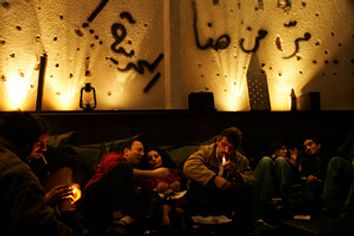
Not that that stopped the party — initially anyway. Beirutis like to tell you (true or not) that they partied right through the civil war. That it wasn’t “cool” to seek shelter during an airstrike. That we “shouldn’t worry. All the nightclubs have their own generators.” That night, we continued to shoot (and drink heavily) at the opening party for the newly relocated Sky Bar, a rooftop nightclub with a view of the Mediterranean. Moneyed Beirutis — all of them, it seemed, young, sexy and ridiculously beautiful — drank vodka and Red Bull, and swayed (if not exactly danced) while Israeli jets flew menacingly low overhead. Were it not for the warplanes, it could have been Los Angeles or South Beach, Fla. The crowd was English speaking — with the kind of West Coast, television accents you hear on sitcoms. Many were Lebanese Americans, returned to the country of their parents, or émigrés to America and Britain who’d left during the civil war and only just come back. I met and talked with Ramsay Short, the young editor of the newly launched Time Out Beirut, and he bragged effusively about their recent “Sex Issue,” its cover depicting a woman’s bare legs, panties bunched around the ankles. The issue — provocative, to say the least, in a largely Muslim country — had sailed through without censorship or even major complaint. Ramsay was happy about that. As he was happy that his town had rated its own edition of the snarky, urbane city guide. “There are only 15 cities in the world with a Time Out,” he told me happily, “and Beirut is now one of them!” He did not look up at the planes. Later, we hit Barbar, a late-night post-nightclub shawarma joint where his mood became more pensive. Even then, before the first airstrikes, I think he too knew what was coming.

Any pretense that the “party never stops in Beirut” was gone by the next morning when the airport was hit with what would be the first of many strikes. A naval blockade precluded any escape by boat. For those who could, the road to Damascus was the only option — and Lena, and Ali, urged us to take it. But the network and our production company were reluctant to sign off on what — even then — seemed a dodgy undertaking.

We found ourselves in my hotel room, watching the airport get hit again: Me, camera people Tracey, Todd and Jerry, field producer Diane, our fixer — and Ali. Our fixer, at the urging of her father in Syria, tearfully agreed to join him there. Our driver, an hour earlier waiting outside, gassed up and ready to go, disappeared. Ali alone remained. Refused to leave us. “I am with you,” he said. But after observing numerous calls to and from his family in South Beirut, and seeing the way he was working the prayer beads between his fingers, the sword tattoo on his arm flexing and slackening nervously, we insisted he join them. (We later heard his house was flattened.) We were left to ourselves, emptying my mini-bar and trying to keep a stiff upper lip, telling stupid jokes, while the orange glow from the airport flared and subsided and finally died.

After a series of very worried calls from the States, we are told to “stand by for ‘the Cleaner,’” a “security expert,” “like the Harvey Keitel guy in ‘Pulp Fiction,’” the man who will “get us out,” take us to a “safe house,” a “secure location,” “exfiltrate us” to safety. We are told to be packed, to be ready. To expect a call from “Mr. Wolfe.”

At 3 a.m. I get the call. Shortly after, I meet the man in the lobby. I’d been expecting an ex-Green Beret — somebody with a thick neck, steel grey eyes, a tattoo saying “He Who Dares Wins,” an aged Dolph Lundgren type, all business and mysterious past. We’re expecting a midnight drive in a flatbed truck, maybe hidden under a tarp. Bribes at the border. A next-day rendezvous with a blacked-out helicopter. The man I meet is a short, nebbishy type — he looks like someone you’d meet at an office supply convention. He has two cars out front — his, and another driven by a woman associate. We load out quickly and race through empty streets, blowing through traffic lights — no directionals, last-minute turns — to the other side of town, to Le Royale, a mammoth hotel on a hill in the Christian section, fairly close to the American embassy. This, as it turns out, will be our home for the next week.

Nearly a week later, they’ve brought in a polka band to play in the dining room of the “Mexican”-themed restaurant at Le Royale. Outside, on the pool deck, though the bar is unattended, they keep the radio cranked up to drown out the sounds of bombing — so as not to scare the kiddies. We wake up to molar-vibrating percussions and go to sleep to distant thunder. Afternoons, we watch as Beirut is dismantled. Bit by bit. First the sound of unseen jets flying overhead. Then silence. Then a “Boom!” Then a distant plume of smoke. Black, brown, white … the whole city south of us slowly growing more indistinct in the midday light under a constant, smoglike haze.

It’s called “Kwik-Clot,” Mr. Wolfe tells us. And in case of arterial bleeding, it’s essential gear. He’s thinking of issuing us some — in case one of us should catch a bullet or shrapnel to the femoral artery. Mr. Wolfe has lived in Fucked-Up Country One and done work in Fucked-Up Countries Two and Three. He lives in the Most Legendarily Fucked-Up area of Lebanon — where they have a Hezbollah gift shop, for chrissakes. So we take him seriously — though this is not the kind of morale-boosting patter we want to hear. “Just pour in wound!” he tells us cheerily. It’s not, however, that harsh a segue from the “Know Your Exits” lecture, in which we are advised to “casually” explore all the nooks and crannies and “avenues of egress” from all points in the hotel.

Or the “Vary Your Routines” briefing, where we are instructed to use a different elevator or service stairway when going to breakfast or meetings or heading to the pool. We are to eat, drink, swim at unpredictable times as we wait for news. “It takes three days of planning and surveillance to set up a kidnapping” says Mr. Wolfe, lowering his voice suddenly when a lone gentleman in casual clothes enters our area of the balcony and sits at a nearby table. “Amateur,” says Mr. Wolfe. “Look at how he’s got his face pointed straight out at sea, his ear cocked in our direction. Clumsy. Obvious.” Sure enough, the guy does seem suddenly suspicious, the way he moves closer to snap a few panoramic vistas with his cellphone camera. “Probably ISF,” sneers Mr. Wolfe. “Local boys.” Mr. Wolfe’s amusement — and pleasure in scaring the living shit out of us — rises in direct proportion to our paranoia. A room has been reserved for armed security — should we need it, he assures us. And our own rooms moved around so as to be close to each other — with one of them designated as a meeting point should we have to assemble at short notice. “We don’t want to be meeting in the lobby with everybody else.” We’ve practiced running down and through a rabbit warren of service exits, stairwells and passageways to Mr. Wolf’s “vehicles” in a sub-level of the parking lot. A security guard has been taken care of so as to lift the gate of a back entrance should circumstances require our fleeing through a back way. We are to stay close together — and be on time for meetings and briefings. There’s even a pop quiz: Mr. Wolfe hands out photographs of various design features and landmarks in the hotel and challenges us to tell him where, exactly, those locations are, and how we might exit from each. When Mr. Wolfe is not within shouting distance, his female associate keeps a close eye on us — even when we’re by the pool.

And we’re by the pool a lot. We sit. We play cards. We tell the same dick jokes — halfheartedly, for sure. But by now, that’s all that keeps us from going crazy or bursting into tears. Our irregular “intel” (Mr. Wolfe’s favorite word) consists of printed analysis from a faraway corporate security company (useless speculation), BBC News (pretty good), local TV (excellent — though in Arabic), the Hizballah Channel (scary), Sky News (shockingly up-to-date and thorough), Some Guy From the Pool (almost always on target. He accurately predicts locations and times of airstrikes and seems to know which countries’ citizens are getting out and when), Somebody’s Mom Back in the States (excellent source), and Mr. Wolfe’s printouts from the AOL News Web site (always discouraging). We’ve heard the Israeli prime minister talk of knocking back Lebanon 20 years. And we believe him. We hear of pleasure boats filled with European nationals being turned back by Israeli ships. We call the embassy day after day and get no response. Nothing. Officially — after days of war — the State Department advice is to visit its Web site. Which contains nothing of use.

We watch the city we’d barely begun to know — and yet already started to love — destroyed, seemingly (from where we’re sitting) without sense or reason. We watch Blackhawk helicopters fly in and out of the embassy and hear panicked rumors that they’re evacuating the ambassador (false) and “non-essential personnel” (true, I believe). Around the pool, the increasingly frustrated, mostly Lebanese Americans exchange rumors and information gleaned from never-ending cellphone conversations with we don’t know who: relatives in the south, friends back in America, people who’ve already made it out. Friends who’ve spoken to their congressman. Guys who work at CNN. The list goes on. The news maddening, incomplete, incorrect — alternately hopeful, terrifying and dismaying.

The hotel empties and fills and empties again. We hear:

“The Italians got out!”
“The fucking Romanians got out!”
“The French are gone!”

What is clear — as far as we’re concerned — from all sources is that there is no official, announced plan. No real advice, or information, or public exit strategy or timetable. The news clip of President Bush, chawing open-mouthed on a buttered roll, then grabbing at another while Tony Blair tries to get him to focus on Lebanon — plays over and over on the TV, crushing our spirits and dampening all hope with every glassy-eyed mouthful. He seems intent on enjoying his food; Lebanon a tiny, annoying blip on an otherwise blank screen. I can’t tell you how depressing that innocuous bit of footage is to watch. That one, innocent, momentary preoccupation with a roll has a devastating effect on us that is out of all proportion. We’re looking for signs. And this, sadly, is all we have.

And every day we hear worse. Cellphone towers, power stations, land lines are being targeted, says Mr. Wolfe. And we’re frankly terrified of the seemingly imminent moment when we can no longer stay in touch with the outside world, make or receive calls to the States — or more important, be notified by the embassy (should that ever happen). They’ve run out of bread and food in downtown stores.

And yet, at the hotel, still safe and fed and liquored up in Bizarro World, we sit by the pool and watch the war. And wait, impotently — shamefacedly. As the hotel empties again — and only a few of us are left. Expectations fade and then die. Just bitterness and a sense of disgust remain. What to expect anymore? One hopes only for the little things: that they’ll fire up the pizza oven today. That they’ll open the bar early. That we might just maybe get an English language newspaper or magazine — or even a French one.

A few miles away, of course, hopes are similarly downscaled — yet far, far more urgent:

Will there be bread?
Will there be water?
Will the power come back on?
Is my family OK?
Will I die today?

They’ve hit the little lighthouse by the port. While on one hand insisting that the Lebanese government do “something” about Hezbollah, they’ve shelled an army base, the main bridges and roads. The last roads out to Syria, says Some Guy by the Pool. An end or a pause is too much to hope for. Of that we are certain. And certainty — however terrible the truth — is something we cling to, an all too rare commodity. It’s uncertainty that’s the enemy, the thing we know will make us all crazy.

In the end we are among the lucky ones. The privileged, the fortunate, the relatively untouched. Unlike the Lebanese Americans who make it out, we don’t leave homes and loved ones behind, we will get out and return to business as usual. To unbroken homes, intact families, friends and jobs. After a hideously disorganized cluster fuck at the eventual “assembly point” — a barely under control mob scene of fainting old people, crying babies, desperate families waving pink and white slips of paper, trying to get the attention of a few understaffed, underprepared and seemingly annoyed embassy personnel in baseball caps and casual clothes — we are put in the charge of the sailors and Marines of the USS Nashville who’ve hauled ass from Jordan on short notice to undertake a mission for which they are unrehearsed and inexperienced. Yet they perform brilliantly. The moment we pass through the last checkpoint into their control, all are treated with a kindness and humanity we can scarcely believe. Squared away, efficient, organized and caringly sensitive, the Marines break the crowd into sensibly spaced groups, give them shade and water, lead them single file to an open-ended landing craft at the water’s edge. They carry babies, children, heat-stroke victims, luggage. They are soft-spoken, casually friendly. They give out treats and fruit and water. They reassure us with their ease and professionalism.

On the flight deck of the USS Nashville they’ve set up a refugee camp. I wake up on my folding cot and look around. With every group of traumatized evacuees — with every family, every group of children, there’s a Marine or two, chatting, exchanging stories, listening. They open their ship to us. They look so young. All of them. None looks over 17. “Where you from?” one asks me. I say, “New York” — and he tells me, “I ain’t ever been there. I’d like to.” His friends agree. They’ve never seen New York either. The mess serves tuna noodle casserole and mac and cheese and corn dogs. A sailor or Marine in a bright green dragon suit entertains children. We are kept informed. We are reassured. We are spoken to like adults. On the smoking deck, a Marine shows off a Reuter’s cover photo — taken only a few hours earlier — of himself, nuzzling two babies as he carries them through the surf to the landing craft. His buddies are razzing him, busting his balls for how intolerably big-headed he’s going to be — now that he’s “famous.” He looks at the picture and says, “You don’t know what it felt like, man.” His eyes well up.

The last group from the beach is unloaded from the landing craft into the belly of the Nashville, and we’re off to Cyprus. Two battleships — including the USS Cole escorting us. A Lebanon I never got to know, a Beirut I didn’t get to show the world disappears slowly over the horizon — a beautiful dream turned nightmare. It’s not what I saw happen in Beirut that I feel like talking about, though that’s what I’m doing, isn’t it? It’s not about what happened to me that remains an unfinished show, a not fully fleshed out story, or even a particularly interesting one. It feels shameful even writing this. It’s the story I didn’t get to tell. The Beirut I saw for two short days. The possibilities. The hope. Now only a dream.

Kitchen god

Anthony Bourdain remembers the sexy, voyeuristic moment he decided to become a chef.

  • more
    • All Share Services

Kitchen god

In 1973, unhappily in love, I graduated high school a year early so I could chase the object of my desire to Vassar College — the less said about that part of my life, the better, believe me. Let it suffice to say that by age eighteen I was a thoroughly undisciplined young man, blithely flunking or fading out of college (I couldn’t be bothered to attend classes). I was angry at myself and at everyone else. Essentially, I treated the world as my ashtray. I spent most of my waking hours drinking, smoking pot, scheming, and doing my best to amuse, outrage, impress and penetrate anyone silly enough to find me entertaining. I was — to be frank — a spoiled, miserable, narcissistic, self-destructive and thoughtless young lout, badly in need of a good ass-kicking. Rudderless and unhappy, I went in with some friends on a summer share in Provincetown, Cape Cod. It was what my friends were doing and that was enough for me.

Provincetown was (and is) essentially a small Portuguese fishing village all the way out on the fish-hooked tip of the Cape. During the summer months, however, it became Times Square/Christopher Street-by-the-Sea. This was the ’70s, remember, so factor that in when you conjure up the image of a once quaint New England port town, clogged with tourists, daytrippers, hippies, drifters, lobster poachers, slutty chicks, dopers, refugees from Key West, and thousands upon thousands of energetically cruising gay men. For a rootless young man with sensualist inclinations, it was the perfect getaway.

Unfortunately, I needed money. My on-again-off-again girlfriend spun pizza for a living. My room-mates, who had summered in P-town before, had jobs waiting for them. They cooked, washed dishes, waited tables — usually at night — so we all went to the beaches and ponds each morning, smoked pot, sniffed a little coke, dropped acid and sunbathed nude, as well as indulging in other healthy teenage activities.

Tired of my drain on the household finances, one annoyed and practical room-mate hooked me up with a dishwashing gig at the restaurant where she waited tables. Dishwashers (sudbusters, aka pearl divers) were the most transient breed in the seasonal restaurant business, so when one goofball failed to show up for work for two days, I was in. It was my introduction to the life — and at first, I did not go happily.

Scrubbing pots and pans, scraping plates and peeling mountains of potatoes, tearing the little beards off mussels, picking scallops and cleaning shrimp did not sound or look attractive to me. But it was from these humble beginnings that I began my strange climb to chefdom. Taking that one job, as dishwasher at the Dreadnaught, essentially pushed me down the path I still walk to this day.

The Dreadnaught was — well, you’ve eaten there, or someplace like it: a big, old, ramshackle driftwood pile, built out over the water on ancient wooden pylons. In bad weather, the waves would roll under the dining-room floor and thud loudly against the sea wall. Grey wood shingles, bay windows, and inside, the classic Olde New Englande/Rusty Scupper/Aye Matey/Cap’n Whats’s decor: hanging fishnets, hurricane lamps, buoys, nautical bric-a-brac, the bars fashioned from halved lifeboats. Call it Early Driftwood.

We served fried clams, fried shrimp, fried flounder, fried scallops, French fries, steamed lobsters, a few grilled and broiled steaks, chops and fish fillets to the mobs of tourists who’d pour into town each week between the 4th of July and Labor Day.

I was surprisingly happy in my work. The Dreadnaught management were an aged, retiring and boozy lot who stayed attractive and cheerful, free with drinks for the kitchen and with their favors as well.

And the cooks?

The cooks ruled.

There was Bobby, the chef, a well-toasted, late-thirtyish ex-hippie who, like a lot of people in P-town, had come for vacation years back and stayed. He lived there year-round, cheffing in the summer, doing roofing and carpentry and house-sitting during the off-season. There was Lydia, a half-mad, matronly Portuguese divorcee with a teenage daughter. Lydia made the clam chowder for which we were somewhat famous, and during service dished out the vegetables and side dishes. She drank a lot. There was Tommy, the fry cook, a perpetually moving surfer dude with electric blue eyes, who even when there was nothing to do, rocked back and forth like an elephant to “keep up the momentum.” There was Mike, an ex-con and part-time methadone dealer, who worked salad station.

In the kitchen, they were like gods. They dressed like pirates: chef’s coats with the arms slashed off, blue jeans, ragged and faded headbands, gore-covered aprons, gold hoop earrings, wrist cuffs, turquoise necklaces and chokers, rings of scrimshaw and ivory, tattoos — all the decorative detritus of the long-past Summer of Love.

They had style and swagger, and they seemed afraid of nothing. They drank everything in sight, stole whatever wasn’t nailed down, and screwed their way through floor staff, bar customers and casual visitors like nothing I’d ever seen or imagined. They carried big, bad-ass knives, which they kept honed and sharpened to a razor’s edge. They hurled dirty sauté pans and pots across the kitchen and into my pot sink with casual accuracy. They spoke their own peculiar dialect, an unbelievably profane patois of countercultural jargon and local Portugee slang, delivered with ironic inflection, calling each other, for instance, “Paaahd” for “Partner” or “Daahlin” for “Darling.” They looted the place for everything it was worth, stocking up well in advance for the lean months of the off-season. A couple of nights a week, the chef would back his Volkswagen van up to the kitchen door and load whole sirloin strips, boxes of frozen shrimp, cases of beer, sides of bacon into the cargo area. The speed racks over each station — containing bottles of cooking wine, oil, etc. for easy access during service — were always loaded with at least two highball glasses per cook; Lydia liked to call them “summertime coolers,” usually strong Cape Codders, Sea Breezes or Greyhounds. Joints were smoked in the downstairs walk-in, and cocaine — always available, though in those days very expensive and still considered a rich man’s drug — was everywhere. On payday everyone in the kitchen handed money back and forth in a Byzantine rondelay of transactions as the cooks settled up the previous week’s drug debts, loans and wagers.

I saw a lot of bad behavior that first year in P-town. I was impressed. These guys were master criminals, sexual athletes, compared to my pitiful college hijinks. Highwaymen rogues, buccaneers, cut-throats, they were like young princes to me, still only a lowly dishwasher. The life of the cook was a life of adventure, looting, pillaging and rock-and-rolling through life with a carefree disregard for all conventional morality. It looked pretty damn good to me on the other side of the line.

But if there was one moment where I saw clearly what I wanted, it was at the end of that summer.

I’d moved up a bit by now. Mike had gone missing on a meth jag and I had been promoted to the salad station plating shrimp cocktails, cracking oysters and cherrystone clams, mixing canned lobster meat with mayonnaise and filling champagne glasses with strawberries and whipped cream.

The Dreadnaught line was a long, narrow affair: a cold station by the exit door to the parking lot, a double-decker lobster steamer where we’d kill off the one-and-a-half and 2-pounders by the dozen, stacking them up like cordwood before slamming shut the heavy metal doors and turning the wheel, giving them the steam. Then came a row of deep-fryers, a range, a big Garland pull-out broiler, a few more burners, and finally a brick hearth for charcoal grilling, all of this bordered by the usual pass-through on the other side — wooden cutting board/counter with sunken steam table, and below that, the low-boy reach-in refrigerators for reserve supplies. By the far-end open hearth, where Bobby, the chef, worked, was a Dutch door, the top half kept open so incoming tourists could get a peek at some lobsters or steaks grilling as they entered and get in the mood.

One weekday, a large wedding party arrived, fresh from the ceremony: bride, groom, ushers, family and friends. Married up-Cape, the happy couple and party had come down to P-town for the celebratory dinner following, presumably, a reception. They were high when they arrived. From the salad station at the other end of the line, I saw a brief, slurry exchange between Bobby and some of the guests. I noticed particularly the bride, who at one point leaned into the kitchen and inquired if any of us “had any hash.” When the party moved on into the dining room, I pretty much forgot about them.

We banged out meals for a while, Lydia amusing us with her usual patter, Tommy dunking clams and shrimp into hot grease, the usual ebb and flow of a busy kitchen. Then the bride reappeared at the open Dutch door. She was blonde and good-looking in her virginal wedding white, and she spoke closely with the chef for a few seconds; Bobby suddenly grinned from ear to ear, the sunburned crow’s-feet at the corners of his eyes growing more pronounced. A few moments later she was gone again, but Bobby, visibly trembling, suddenly said, “Tony! Watch my station,” and promptly scooted out the back door.

Ordinarily, this alone would have been a momentous event. To be allowed to work the busy broiler station, to take the helm — even for a few minutes — was a dream come true. But curiosity got the better of all of us remaining in the kitchen. We had to look.

There was a fenced-off garbage stockade right outside the window by the dishwasher, that concealed the stacked trash and cans of edible waste the restaurant sold to a pig farm up-Cape, from the cars in the parking lot. Soon, all of us — Tommy, Lydia, the new dishwasher and I — were peering through the window, where in full view of his assembled crew, Bobby was noisily rear-ending the bride. She was bent obligingly over a 55-gallon drum, her gown hiked up over her hips. Bobby’s apron was up, resting over her back as he pumped away furiously, the young woman’s eyes rolled up into her head, mouth whispering, “Yess, yess … good … good …”

While her new groom and family chawed happily on their flounder fillets and deep-fried scallops just a few yards away in the Dreadnaught dining room, here was the blushing bride, getting an impromptu send-off from a total stranger.

And I knew then, dear reader, for the first time: I wanted to be a chef.

Continue Reading Close