Arthur Max
Greenhouse gas emissions hitting record highs
Specter of global climate change looms large as 180 countries prepare for conference in Germany in two weeks
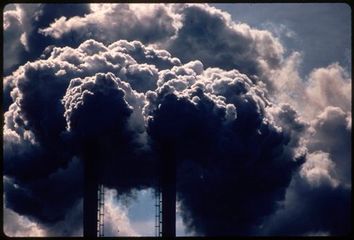
In this July 1972 photo provided by the U.S. National Archives entitled "Burning Discarded Automobile Batteries," black clouds billow from smokestacks in Houston, Texas. The photo is part of Documerica, an EPA project during the 1970s in which the agency hired dozens of freelance photographers to capture thousands of images related to the environment and everyday life in America. Modeled after Documerica, the agency has embarked on a massive effort to collect photographs from across the United States and around the world over the next year that depict everything from nature's beauty to humanity's impact, both good and bad. (AP Photo/U.S. National Archives, Marc St. Gil)(Credit: AP) Despite 20 years of effort, greenhouse gas emissions are going up instead of down, hitting record highs as climate negotiators gather to debate a new global warming accord.
The new report by the International Energy Agency showing high emissions from fossil fuels is one of several pieces of bad news facing delegates from about 180 countries heading to Bonn, Germany, for two weeks of talks beginning Monday.
Another: The tsunami-triggered nuclear disaster in March apparently has sidelined Japan’s aggressive policies to combat climate change and prompted countries like Germany to hasten the decommissioning of nuclear power stations which, regardless of other drawbacks, have nearly zero carbon emissions.
“Japan’s energy future is in limbo,” says analyst Endre Tvinnereim of the consultancy firm Point Carbon. The fallout from the catastrophe has “put climate policy further down the priority list,” and the short-term effect in Japan — one of the world’s most carbon-efficient countries — will be more burning of fossil fuels, he said.
And despite the expansion of renewable energy around the world, the Paris-based IEA’s report said energy-related carbon emissions last year topped 30 gigatons, 5 percent more than the previous record in 2008. With energy investments locked into coal- and oil-fueled infrastructure, that situation will change little over the next decade, it said.
Fatih Birol, the IEA’s chief economist, says the energy trend should be “a wake-up call.” The figures are “a serious setback” to hopes of limiting the rise in the Earth’s average temperature to 2 degrees Celsius (3.8 F) above preindustrial levels, he said.
Any rise beyond that, scientists believe, could lead to catastrophic climate shifts affecting water supplies and global agriculture, setting off more frequent and fierce storms and causing a rise in sea levels that would endanger coastlines.
The June 6-17 discussions in Bonn are to prepare for the annual year-end decision-making U.N. conference, which this year is in Durban, South Africa. Even more than previous conferences, Durban could be the forum for a major showdown between wealthy countries and the developing world.
Poor countries say the wealthy West, whose industries overloaded the atmosphere with carbon dioxide and other climate-changing gases over the last 200 years, is not doing enough to cut future pollution.
A study released Sunday supports that view.
The report, based on an analysis by the Stockholm Environment Institute commissioned and released by Oxfam, evaluated national pledges to cut carbon emissions submitted after the 2009 Copenhagen climate summit. It found that developing countries account for 60 percent of the promised reductions.
The analysis is complicated because countries use different yardsticks and baseline years for measuring reductions.
But the study calculated that China, which has pledged to reduce emissions in relation to economic output by 40-45 percent, will cut its carbon output twice as much as the United States by 2020.
“It’s time for governments from Europe and the U.S. to stand up to the fossil fuel lobbyists,” said Tim Gore, a climate analyst for Oxfam, the international aid agency.
Another keynote battle in Bonn will be the fate of the Kyoto Protocol, the 1997 accord whose provisions capping emissions by industrial countries expire in 2012.
Wealthy countries falling under the protocol’s mandate are resisting demands to extend their commitments beyond 2012 and set new legally binding emissions targets unless powerful emerging economies like China, India and Brazil accept similar mandatory caps.
“The Kyoto Protocol uncertainty is casting even a bigger shadow over the negotiations than in years past, and is going to come to a head,” said Jake Schmidt of the New York-based Natural Resources Defense Council.
Negotiators also must prepare options for the Durban conference on how to raise $100 billion a year for the Green Climate Fund created last December to help countries cope with global warming. One source under discussion is a levy on international aviation and shipping, said Oxfam’s Gore.
“South African negotiators are hoping a deal on sources for long-term finance will be Durban’s legacy issue,” he said.
Human Rights report slams Iran for harassing gays
Some estimate that thousands have been sentenced to death for same-sex relationships since 1979
Iranians convicted for same-sex activities are on death row and awaiting hanging, including several who were minors when arrested, Human Rights Watch said Wednesday.
A report by the nonprofit organization documented cases of arbitrary arrests, invasions of homes, mistreatment of detainees and the denial of due legal process to people suspected of nonconformist sexual activity.
Thousands of people are believed to have been condemned to death for homosexual activity since the 1979 Iranian revolution, and the public hanging of two men — one of them a minor — in 2005 for having consensual sex drew international attention.
Continue Reading CloseFrustrations show as climate talks resume
This is the first major U.N. meeting to discuss climate change since last year's disappointing Copenhagen summit
Frustrated at past failures, climate negotiators began a critical two-week conference Monday with a call from Mexico’s president to think beyond their nations’ borders and consider all humanity as they bargain over an agreement to fight global warming.
“The atmosphere is indifferent to the sovereignty of states,” President Felipe Calderon said in the keynote speech opening the conference in this well-guarded coastal resort.
“It would be a tragedy if our inability to see beyond our personal interests, our group or national interests makes us fail,” Calderon said in a speech to 15,000 delegates, business leaders, activists and journalists.
Continue Reading CloseAnti-whaling talks break down, policy reform fails
Japan, Norway and Iceland can continue to hunt, killing close to 1,500 animals a year
An international effort to truly limit whale hunting collapsed Wednesday, leaving Japan, Norway and Iceland free to keep killing hundreds of mammals a year, even raiding a marine sanctuary in Antarctic waters unchecked.
The breakdown put diplomatic efforts on ice for at least a year, raised the possibility that South Korea might join the whaling nations and raised questions about the global drive to prevent the extinction of the most endangered whale species.
It also revived doubts about the effectiveness and future of the International Whaling Commission. The agency was created after World War II to oversee the hunting of tens of thousands of whales a year but gradually evolved into a body at least partly dedicated to keeping whales from vanishing from the Earth’s oceans.
Continue Reading CloseTop UN climate official resigning
After watching governments fail to agree on new global warming deal for four years, de Boer announces resignation
Top U.N. climate change official Yvo de Boer told The Associated Press on Thursday that he was resigning after nearly four years, a period when governments struggled without success to agree on a new global warming deal.
His departure takes effect July 1, five months before 193 nations are due to reconvene in Mexico for another attempt to reach a binding worldwide accord on controlling greenhouse gases. De Boer’s resignation adds to the uncertainty that a full treaty can be finalized there.
De Boer is known to be deeply disappointed with the outcome of the last summit in Copenhagen, which drew 120 world leaders but failed to reach more than a vague promise by several countries to limit carbon emissions — and even that deal fell short of consensus.
Continue Reading CloseU.S. seeks global security stepup
Wants more stringent security on foreign-based flights
Airline passengers across Europe faced body searches and new limits on hand luggage Saturday after U.S. authorities requested tighter security in response to an attempt to bomb an airliner in Detroit.
U.S.-bound travelers were undergoing body searches at Amsterdam’s airport, where authorities say Umar Farouk Abdul Mutallab of Nigeria boarded Northwest Airlines Flight 253 and tried to set off an incendiary device as the plane was descending to its destination.
“The extra measures apply worldwide on all flights to the U.S. as of now and for an indefinite period,” says Judith Sluiter, spokeswoman for the Dutch National Coordinator for Counterterrorism.
Continue Reading Close