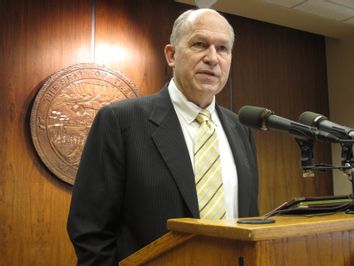
JUNEAU, Alaska (AP) — Oil long has been king in Alaska, but the state’s Republican governor is having trouble finding support for a tax break he believes is critical to ensuring it remains so.
With a stunning defeat in the state Legislature this week, Gov. Sean Parnell has failed twice since last year to reduce production taxes on oil companies, a strategy he believes is crucial to bringing in new companies and ensuring those already here invest more and boost North Slope production. That would ensure Alaska’s financial lifeline remains healthy for years to come.
Oil accounts for roughly 90 percent of unrestricted state revenue in the resource-rich state. It has helped make possible yearly dividend checks that Alaskans get just for living in the state. And recent flush years have created budget surpluses.
What’s unusual in Parnell’s defeats is that lawmakers from both parties, particularly this year, showed little stomach for his plans, albeit for differing reasons. Some saw the recent tax-cut plan as a corporate giveaway or unneeded by oil companies that consistently post huge profits; others, including some in his own party, say Parnell’s bill was ill-conceived or poorly explained.
The latest setback came Wednesday, when Parnell abruptly announced in a rare statewide televised news conference that he was removing his oil tax bill from consideration by lawmakers. The surprise move — unprecedented in Alaska — came just eight days into a special legislative session that he had sought mainly to deal with the issue.
He blamed the bipartisan-controlled Senate, which he said appeared incapable of passing “comprehensive oil tax reform.”
After sometimes combative hearings, especially in the Senate, lawmakers in both chambers said the administration hadn’t made their case. To many, it remained unclear, for example, how many barrels of new oil the state would see produced under Parnell’s plan, or when Alaska might break even on any tax breaks it gives.
While the bill was aimed at boosting oil production over time, the near-term impact on the state’s economy also came into play. While Alaskans have enjoyed a healthy state budget in recent years, due in part to the high price of oil, Parnell’s budget director said the state could find itself in a deficit as early as next fiscal year under his plan, and would need to dig into its reserves to maintain a certain level of spending. A legislative consultant said Parnell’s approach would wind up giving oil companies “quite a lot” of money for projects that are profitable to do today.
Anchorage Republican Sen. Lesil McGuire said she agrees philosophically with Parnell on the need to make Alaska a more competitive place for industry investment, but in a hearing called his plan “half-baked” and predicted the special session would end in a “train wreck.”
In an interview, Parnell said he still believes strongly in the need for tax changes but decided to pull oil taxes from the special session call “to give folks a breather and let calmer heads prevail across some more time and make the case again down the road.”
When asked how much time, he said he didn’t know.
“We need to change some minds or change some people, either way,” he said. Nearly all legislative seats are up for election this year.
Oil’s relatively high price has helped to mask a decades-long decline in production. An average of 609,000 barrels a day has coursed through the trans-Alaska pipeline this year, just over a quarter of what flowed through it during the 800-mile line’s heyday in the late 1980s.
It likely would take billions of dollars in additional investment a year by oil companies just to begin to stem the decline curve, and officials from the North Slope’s three major players say Alaska’s current tax structure discourages new investment.
The system, a legacy of former Gov. Sarah Palin, features a 25 percent base tax rate and a progressive rate triggered when a company’s production tax value hits $30 a barrel. The idea behind it was that the state would help oil companies on the front end with things such as tax credits and share profits on the back end when oil flowed and prices were high. But companies say the surcharge eats too deeply into profits.
Sen. Bill Wielechowski, D-Anchorage, pointed to a recent earnings report from ConocoPhillips, one of the Big Three, that he said showed Alaska to be a “highly profitable place to produce oil.” The company reported $616 million in earnings in the state during the first quarter of 2012. That’s $7 million a day, and “blows a hole” in Parnell’s argument to lower taxes on existing producers, Wielechowski said.
ConocoPhillips acknowledged it makes money in Alaska, but said it also paid the equivalent of $13 million a day in taxes and royalties to the state for the quarter.
“Our current profits are from significant investments we made in the past where we took the risk,” spokeswoman Natalie Lowman said.
The Senate spent two months during the regular session delving into the oil tax issue but an overhaul of Alaska’s tax structure stalled in the Senate’s bipartisan majority during the last days. A major stumbling block was how best to address legacy fields like Prudhoe Bay and Kuparuk, the mainstays of Alaska’s oil industry, where production has been declining.
One of the concerns was with giving too much money to oil companies, particularly for oil they would have produced anyway.
Senators instead put forth a bill providing a tax break on oil production from new fields, saying it would lead to a rush of independent companies to Alaska.
Parnell borrowed from that in crafting his new plan but also included tax cuts on existing fields, where much of the oil and money is — provisions more in line with a bill he pushed last year that stalled in the Senate. He insisted he wanted a “comprehensive” approach, even though the best the Senate had been able to come up with dealt only with new fields.
While industry spoke in favor of Parnell’s proposals, saying they represented meaningful change that would lead to potentially billions of dollars in new investment, that position was viewed warily by some senators who said they would expect industry to support the lowest-tax possible and that there’s no way the companies can guarantee they’ll invest more here.
Despite the defeat, Parnell maintains that the “economic issue of our time is declining oil production and what we do about it.”
“I will not stop sounding the warning bell of declining oil production and what that means for lost opportunities for Alaskans, nor will I stop looking for solutions that Alaskans can agree on,” he said.
JUNEAU, Alaska (AP) — An Alaska state representative who made national headlines last year for refusing an airport security pat-down plans to run for the state’s lone U.S. House seat.
Sharon Cissna says she wants to take her fight against the Transportation Security Administration to Washington, D.C., and also advocate for more economic opportunities.
The 70-year-old Democrat has a tough road, not only in challenging Rep. Don Young, who is seeking his 21st term, but also in campaigning.
Cissna has tried to avoid air travel when she must go through TSA checkpoints since last year refusing a security pat-down at a Seattle-area airport. Cissna, a breast cancer survivor, has said she considers pat-downs abuse and won’t subject herself to it.
She says she and her husband plan to travel the state using a car, a motorhome, the ferry system and even a canoe. Small planes are also an option.
JUNEAU, Alaska (AP) — The U.S. Coast Guard on Tuesday dismissed negligent homicide and other charges against the sole survivor of a 2010 helicopter crash off the Washington coast.
The decision in the case of Lt. Lance Leone was in line with the recommendations of an investigating officer, who oversaw a three-day military hearing in December. Leone was the co-pilot of the MH-60 Jayhawk helicopter flying from Astoria, Ore., to the crew’s base in Sitka, Alaska, when it crashed off the Washington coast in July 2010.
Leone, upon hearing the news at work, “started cheering and was extremely happy for this long-awaited day,” his attorney, John Smith, told The Associated Press. Leone also said he needed to tell his wife, who is expecting the couple’s third child.
Leone was charged with negligent homicide, dereliction of duty and destruction of government property stemming from the crash, which killed pilot Sean Krueger, of Connecticut, and crewmen Brett Banks, of Wyoming, and Adam C. Hoke, of Montana. The negligent homicide charges were related to Banks and Hoke.
The decision to charge Leone stunned Leone’s family and friends, as well as some relatives of the victims.
Leone, who has earned a long list of Coast Guard awards and accolades, was the sole survivor. He had recovered from his injuries and been cleared for flight re-training when he was charged last year.
The charge sheet alleged Leone failed to properly navigate the helicopter to avoid charted hazards and that he negligently failed to ensure it was flying at a higher altitude. It also alleges that he did “without proper authority, through neglect, destroy by causing the crash of CG-6017,” an aircraft valued at $18.3 million.
Leone was accused of not actively navigating or challenging Krueger’s decision to drop in altitude seconds before the helicopter hit the 1,900-foot span of wires and crashed.
The wires, which were the site of at least two other accidents, were the responsibility of the Coast Guard, and sloped from 190 feet to about 36 feet. At the time of the 2010 crash, marking balls were pooled near a pole, above land at the low point, not along the span. The helicopter hit at about 114 feet, according to testimony and the court record.
One of the prosecutors, Cmdr. Matthew Fay, said there was no requirement the lines be marked because they were below 200 feet. The crash’s lead investigator called the lines a contributing factor but said there was no reason for the aircraft to be flying so low.
Smith said in December that Leone programmed the helicopter on a track that would have missed the wires, but Krueger deviated from that, dropping in altitude as he flew over a Coast Guard vessel in the channel. Seconds later, the aircraft struck the wires.
The lawyer called it a “costly human error,” caused by “the trap” set by the Coast Guard.
In January, the investigating officer who presided over the three-day military hearing, Capt. Andrew Norris, recommended the charges be dismissed.
He said he didn’t conclude that Leone was faultless but said the charges focus on alleged navigational failures by Leone and tie those to the destruction of a helicopter and death of two crew members.
“It is in this focus, and in making this tie, that I believe the charged offenses fail,” he wrote.
Norris also investigated whether Leone was derelict in his duty for not advising Krueger that they were flying too low at certain points in the flight and recommending a rise in altitude. The allegation arose from the hearing, and prosecutors said they didn’t seek it.
Norris said he believed there were “reasonable grounds” to believe that Leone had “committed the crime of negligent dereliction of duty” for not questioning or speaking up about the altitude. But he said proving that required speculation as to what Krueger may have done if Leone had spoken up, and he said he did not believe the government could prove this link “to a reasonable fact-finder.”
Norris said he didn’t believe disciplinary action was warranted in that instance but said it could be addressed through training and other “non-punitive measures.”
Rear Admiral Thomas Ostebo was not bound by Norris’ recommendations.
“The military justice system provides the surest means to fairly determine when and how its people should be held accountable for their actions,” Ostebo said in a prepared statement. “In this case, based on my review of evidence produced by the Article 32 investigation, I decided that Leone’s actions did not merit a court martial.”
Smith said the Coast Guard must close its original investigation into the crash, which could result in administrative actions.
He said Leone, whose duties since being charged have included working as a safety officer, is in line for a promotion in the coming months, and his defense team is working to get him flight retraining and a new assignment.
Smith said that “after an ordeal like this, one needs a fresh start, and when an officer is given that fresh start, he is expected to perform as any other officer would.”
____
Becky Bohrer can be reached at http://twitter.com/bbohrer.
Continue Reading
Close
JUNEAU, Alaska (AP) — The U.S. Coast Guard on Tuesday dismissed negligent homicide and other charges against the sole survivor of a 2010 helicopter crash off the Washington coast.
The decision in the case of Lt. Lance Leone was in line with the recommendations of an investigating officer, who oversaw a three-day military hearing in December. Leone was the co-pilot of the MH-60 Jayhawk helicopter flying from Astoria, Ore., to the crew’s base in Sitka, Alaska, when it crashed off the Washington coast in July 2010.
Leone, upon hearing the news at work, “started cheering and was extremely happy for this long-awaited day,” his attorney, John Smith, told The Associated Press. Leone also said he needed to tell his wife, who is expecting the couple’s third child.
Leone was charged with negligent homicide, dereliction of duty and destruction of government property stemming from the crash, which killed pilot Sean Krueger, of Connecticut, and crewmen Brett Banks, of Wyoming, and Adam C. Hoke, of Montana. The negligent homicide charges were related to Banks and Hoke.
The decision to charge Leone stunned Leone’s family and friends, as well as some relatives of the victims.
Leone, who has earned a long list of Coast Guard awards and accolades, was the sole survivor. He had recovered from his injuries and been cleared for flight re-training when he was charged last year.
The charge sheet alleged Leone failed to properly navigate the helicopter to avoid charted hazards and that he negligently failed to ensure it was flying at a higher altitude. It also alleges that he did “without proper authority, through neglect, destroy by causing the crash of CG-6017,” an aircraft valued at $18.3 million.
Leone was accused of not actively navigating or challenging Krueger’s decision to drop in altitude seconds before the helicopter hit the 1,900-foot span of wires and crashed.
The wires, which were the site of at least two other accidents, were the responsibility of the Coast Guard, and sloped from 190 feet to about 36 feet. At the time of the 2010 crash, marking balls were pooled near a pole, above land at the low point, not along the span. The helicopter hit at about 114 feet, according to testimony and the court record.
One of the prosecutors, Cmdr. Matthew Fay, said there was no requirement the lines be marked because they were below 200 feet. The crash’s lead investigator called the lines a contributing factor but said there was no reason for the aircraft to be flying so low.
Smith said in December that Leone programmed the helicopter on a track that would have missed the wires, but Krueger deviated from that, dropping in altitude as he flew over a Coast Guard vessel in the channel. Seconds later, the aircraft struck the wires.
The lawyer called it a “costly human error,” caused by “the trap” set by the Coast Guard.
In January, the investigating officer who presided over the three-day military hearing, Capt. Andrew Norris, recommended the charges be dismissed.
He said he didn’t conclude that Leone was faultless but said the charges focus on alleged navigational failures by Leone and tie those to the destruction of a helicopter and death of two crew members.
“It is in this focus, and in making this tie, that I believe the charged offenses fail,” he wrote.
Norris also investigated whether Leone was derelict in his duty for not advising Krueger that they were flying too low at certain points in the flight and recommending a rise in altitude. The allegation arose from the hearing, and prosecutors said they didn’t seek it.
Norris said he believed there were “reasonable grounds” to believe that Leone had “committed the crime of negligent dereliction of duty” for not questioning or speaking up about the altitude. But he said proving that required speculation as to what Krueger may have done if Leone had spoken up, and he said he did not believe the government could prove this link “to a reasonable fact-finder.”
Norris said he didn’t believe disciplinary action was warranted in that instance but said it could be addressed through training and other “non-punitive measures.”
Rear Admiral Thomas Ostebo was not bound by Norris’ recommendations.
“The military justice system provides the surest means to fairly determine when and how its people should be held accountable for their actions,” Ostebo said in a prepared statement. “In this case, based on my review of evidence produced by the Article 32 investigation, I decided that Leone’s actions did not merit a court martial.”
Smith said the Coast Guard must close its original investigation into the crash, which could result in administrative actions.
He said Leone, whose duties since being charged have included working as a safety officer, is in line for a promotion in the coming months, and his defense team is working to get him flight retraining and a new assignment.
Smith said that “after an ordeal like this, one needs a fresh start, and when an officer is given that fresh start, he is expected to perform as any other officer would.”
____
Becky Bohrer can be reached at http://twitter.com/bbohrer.
Continue Reading
Close
JUNEAU, Alaska (AP) — The U.S. Coast Guard on Tuesday dismissed negligent homicide and other charges against the sole survivor of a 2010 helicopter crash off the Washington coast.
The decision in the case of Lt. Lance Leone was in line with the recommendations of an investigating officer, who oversaw a three-day military hearing in December. Leone was the co-pilot of the MH-60 Jayhawk helicopter flying from Astoria, Ore., to the crew’s base in Sitka, Alaska, when it crashed off the Washington coast in July 2010.
Leone, upon hearing the news at work, “started cheering and was extremely happy for this long-awaited day,” his attorney, John Smith, told The Associated Press. Leone also said he needed to tell his wife, who is expecting the couple’s third child.
Leone was charged with negligent homicide, dereliction of duty and destruction of government property stemming from the crash, which killed pilot Sean Krueger, of Connecticut, and crewmen Brett Banks, of Wyoming, and Adam C. Hoke, of Montana. The negligent homicide charges were related to Banks and Hoke.
The decision to charge Leone stunned Leone’s family and friends, as well as some relatives of the victims.
Leone, who has earned a long list of Coast Guard awards and accolades, was the sole survivor. He had recovered from his injuries and been cleared for flight re-training when he was charged last year.
The charge sheet alleged Leone failed to properly navigate the helicopter to avoid charted hazards and that he negligently failed to ensure it was flying at a higher altitude. It also alleges that he did “without proper authority, through neglect, destroy by causing the crash of CG-6017,” an aircraft valued at $18.3 million.
Leone was accused of not actively navigating or challenging Krueger’s decision to drop in altitude seconds before the helicopter hit the 1,900-foot span of wires and crashed.
The wires, which were the site of at least two other accidents, were the responsibility of the Coast Guard, and sloped from 190 feet to about 36 feet. At the time of the 2010 crash, marking balls were pooled near a pole, above land at the low point, not along the span. The helicopter hit at about 114 feet, according to testimony and the court record.
One of the prosecutors, Cmdr. Matthew Fay, said there was no requirement the lines be marked because they were below 200 feet. The crash’s lead investigator called the lines a contributing factor but said there was no reason for the aircraft to be flying so low.
Smith said in December that Leone programmed the helicopter on a track that would have missed the wires, but Krueger deviated from that, dropping in altitude as he flew over a Coast Guard vessel in the channel. Seconds later, the aircraft struck the wires.
The lawyer called it a “costly human error,” caused by “the trap” set by the Coast Guard.
In January, the investigating officer who presided over the three-day military hearing, Capt. Andrew Norris, recommended the charges be dismissed.
He said he didn’t conclude that Leone was faultless but said the charges focus on alleged navigational failures by Leone and tie those to the destruction of a helicopter and death of two crew members.
“It is in this focus, and in making this tie, that I believe the charged offenses fail,” he wrote.
Norris also investigated whether Leone was derelict in his duty for not advising Krueger that they were flying too low at certain points in the flight and recommending a rise in altitude. The allegation arose from the hearing, and prosecutors said they didn’t seek it.
Norris said he believed there were “reasonable grounds” to believe that Leone had “committed the crime of negligent dereliction of duty” for not questioning or speaking up about the altitude. But he said proving that required speculation as to what Krueger may have done if Leone had spoken up, and he said he did not believe the government could prove this link “to a reasonable fact-finder.”
Norris said he didn’t believe disciplinary action was warranted in that instance but said it could be addressed through training and other “non-punitive measures.”
Rear Admiral Thomas Ostebo was not bound by Norris’ recommendations.
Smith said the Coast Guard must close its original investigation into the crash, which could result in administrative actions.
He said Leone, whose duties since being charged have included working as a safety officer, is in line for a promotion in the coming months, and his defense team is working to get him flight retraining and a new assignment.
Smith said that “after an ordeal like this, one needs a fresh start, and when an officer is given that fresh start, he is expected to perform as any other officer would.”
____
Becky Bohrer can be reached at http://twitter.com/bbohrer.
Continue Reading
Close
JUNEAU, Alaska (AP) — The U.S. Coast Guard on Tuesday dismissed negligent homicide and other charges against the sole survivor of a 2010 helicopter crash off the Washington coast.
The decision in the case of Lt. Lance Leone was in line with the recommendations of an investigating officer, who oversaw a three-day military hearing in December. Leone was the co-pilot of the MH-60 Jayhawk helicopter flying from Astoria, Ore., to the crew’s base in Sitka, Alaska, when it crashed off the Washington coast in July 2010.
He was charged with negligent homicide, dereliction of duty and destruction of government property stemming from the crash, which killed pilot Sean Krueger and crewmen Brett Banks and Adam C. Hoke. The negligent homicide charges were related to Banks and Hoke.
Leone, who has earned a long list of Coast Guard awards and accolades, was the sole survivor. He recovered from injuries and had been cleared for flight re-training when he was charged.
The charge sheet alleged Leone failed to properly navigate the helicopter to avoid charted hazards and that he negligently failed to ensure it was flying at a higher altitude. It also alleges that he did “without proper authority, through neglect, destroy by causing the crash of CG-6017,” an aircraft valued at $18.3 million.
In January, the investigating officer who presided over a three-day military hearing, Capt. Andrew Norris, recommended the charges be dismissed.
He said he didn’t conclude that Leone was faultless but said the charges focus on alleged navigational failures by Leone and tie those to the destruction of a helicopter and death of two crew members.
“It is in this focus, and in making this tie, that I believe the charged offenses fail,” he wrote.
Norris also investigated whether Leone was derelict in his duty for not advising Krueger that they were flying too low at certain points in the flight and recommending a rise in altitude.
This charge arose from the hearing, and prosecutors said they didn’t seek it Norris, in his report, said he believed “reasonable grounds” existed to believe that Leone had “committed the crime of negligent dereliction of duty” for not questioning or speaking up about the altitude. But he said proving that required speculation as to what Krueger may have done if Leone had spoken up, and he said he doesn’t the government could prove this link “to a reasonable fact-finder.”
Norris said he didn’t believe disciplinary action was warranted in that instance but said it could be addressed through training and other “non-punitive measures.”
Rear Admiral Thomas Ostebo was not bound by the recommendations.
Continue Reading
Close