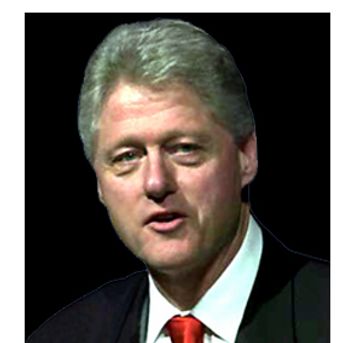
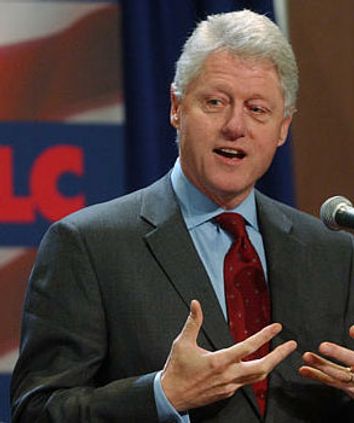
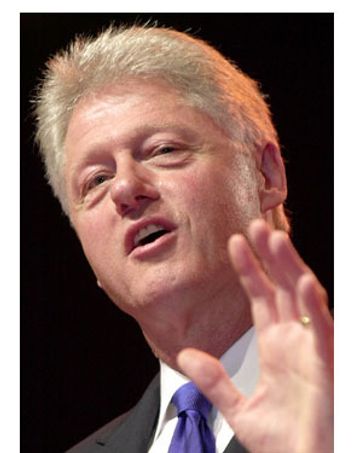
Bill Clinton

Why America needs the world

From the U.N.-led battle against SARS to the French-German-U.S. military mission in Afghanistan, global realities cry out for cooperation.

I am well aware that my speech is the only thing that stands between you and your diploma. Thirty-five years ago, when I was a senior at Georgetown, we used to have commencements outside. Our commencement speaker was Washington, D.C., Mayor Walter Washington. Just as the mayor got up to speak, a huge storm cloud came over. The mayor looked up, and this was the speech he gave, verbatim: “Ladies and gentlemen, if we don’t get out of here, we’re all going to drown. I will send you a printed copy of my remarks. Congratulations and good luck.” Our class loved Mayor Washington, and I will try to remember his example here today.

I’ve been touched in many ways by this city and this great university. I have been grilled extensively by Ted Koppel, Class of 1960. I have watched sports called by Bob Costas, Class of ’74. I have danced to a lot of music played by the ageless Dick Clark, Class of ’51. That’s unbelievable. [Audience laughter.] Something in the water in Lake Onondaga. I love this city. I come to the state fair every year with Hillary. I’ve vacationed in Skaneateles. I have eaten more Dinosaur barbecue than any person who does not live in the city of Syracuse.

And as a longtime and utterly fanatic basketball fan, I watched with awe as Syracuse rolled through the NCAA tournament. I got to shake hands with Coach Boeheim today, and I was thinking how remarkable it is that he came here in 1962 as a freshman when President Kennedy was in office, then was co-captain of his college team with the great Dave Bing in 1966. He stuck with you for a very long time. Coach, congratulations on a job well done, and thanks to you and the team for the gifts of a lifetime for all of us basketball fans who will never forget what happened.

The world you enter today in 2003 may seem very different from the world you left when you embraced the confines of Syracuse in 1999. In 1999, the economy was strong; the world was making progress toward peace in Northern Ireland and the Middle East, Bosnia and Kosovo. Science and technology seemed to offer limitless possibilities for progress and prosperity. Since you came here in that year, you have seen a close presidential election resolved in the Supreme Court; a lethal attack on the United States in New York, Pennsylvania and Washington; conflicts in Afghanistan and Iraq; the continuing war on terror; the failure of many high-tech companies; and the reversal of economic progress.

Here’s what I want to say to you as you go out with your education. There’s a big difference between the trend lines and the headlines, and one of the things that you need to be able to do as you leave here is to draw that distinction: to understand when you see a headline, if it’s troubling or good, whether it’s consistent with the trend line. And to know that it is your job as citizens, either of our country or of some 70 other nations from which you come, to try to build your trend lines. For the world of 1999 and the world of 2003 are actually not so very different. In 1999, we had the dangers of terror and weapons of mass destruction — it’s just that they weren’t in the headlines because they hadn’t happened here. But we were working hard to deal with them.

And in 2003, I think of all the things that have happened that are good in the four years you’ve been here. An international consortium of scientists sequenced the human genome, opening the prospects that those of you who are students here, when you bring your babies home from the hospital, they’ll have little gene cards that will tell you what their strengths and weaknesses are, and how to raise them so their life expectancy soon will be about 90 years. Raising the prospect that, along with advances in nanotechnology, all cancers will someday be curable because you will identify tumors at submicroscopic level, before they can metastasize. Our great adversaries in the Cold War, China and Russia, have largely been reconciled to the West. And you don’t worry about a nuclear explosion destroying all of humanity, as I did when I was your age. America is reaching out to Africa and the Caribbean in trade; the president is supposed to triple America’s AIDS efforts to help people deal with HIV and AIDS. The rich countries of the world gave an unprecedented amount of debt relief to the poorest countries if they would agree to put their money into healthcare, education and economic development. That, too, happened while you were here.

So what I want to say is, whether in 1999 or 2003, you live in a world full of positive and negative developments, and they are related to each other. In 1988, when Pan Am 103 went down in Scotland, and those wonderful students from Syracuse perished, it marked the beginning of America’s clear vulnerability to global terror, although we had lost people in the ’70s and early ’80s too. On September 11, 2001, we lost people from 70 nations in our country. But today, we will give diplomas to people from 70 nations.

So there are good headlines and bad headlines. The trend line is, we are growing more interdependent. We cannot escape each other. We reap enormous benefits and assume greater risks. Your job, as a citizen of this country or some other, as a citizen of the world, is to spread the benefits and reduce the risks, to move us from an age of interdependence to a global community where we share values and benefits and responsibilities. That is the trend line.

You can’t stop the bad headlines, and even if you ignore them, there’ll always be good headlines. But I want the trend lines to be right for you. Therefore, even though I disagree with the position France took in the recent conflict over Iraq, I think too much has been made of it. Because the trend line is toward cooperation. Did you know that there are only two groups of soldiers in Afghanistan today, where the people live who caused September 11, who are training the new Afghanistan army — French soldiers and American soldiers, working side by side. That is the trend line. There are German and Canadian soldiers in Afghanistan. All the people who thought we were making a mistake on the timing and substance of Iraq supported us after we lost all those people on 9/11. That is the trend line, and that is what we should think about.

Let me give you another example. About a week before the NCAA tournament began, a little less than two months ago on March 15, the World Health Organization issued a global alert warning of a new virus in southern China. Scientists now believe the epidemic was spread by a single sneeze or cough at Hong Kong’s Metropolitan Hotel on February 21. That’s the disease we now call SARS. It came amazingly quickly, about the time the military conflict in Iraq started, but it is very different. First, no army can fight a microbe, even the best military in the world. Night-vision goggles don’t protect you against a sneeze. And how can you seal off a border like America’s border with Canada? The last invasion from the north came in the War of 1812. Syracuse students cross this border all the time. And that puts you on the front lines of the North American battle against SARS.

Now, how was SARS fought? Here’s the trend line, not the headline — although in this case, they’re pretty similar. It was fought by international cooperation. In particular, by the World Health Organization, an arm of the now-reviled United Nations. The WHO alerted the world to the emerging danger of SARS. It pressured the Chinese government to be more open and give more information for the benefit of its own people and trading and travel partners. And it was a 46-year-old doctor from WHO, Dr. Carlo Urbani, who first identified SARS, first warned the world, and became one of SARS’ first victims. That U.N. employee gave his life so that you could be more safe.

I say this because we have to remember the trend line. We have lots of problems with infectious diseases. Only about 435 people have died from SARS, although it is extremely virulent. During the same period, every single day, 8,000 kids have died from preventable childhood diseases. Every single day. One in four people [who will die] in the world this year will die from AIDS, TB, malaria and infections related to diarrhea. Last year, three million people died from tuberculosis, and over a million from malaria. Forty-two million people are infected with the HIV virus. That’s one of the reasons that I spend as much time as I do in Africa and the Caribbean, trying to roll back the infection rate, because if we don’t deal with infectious diseases, they will have not only bad human consequences, but also bad economic effects and bad political effects.

The same arguments apply to global warming and poverty. So here’s my argument: We need a strong security policy. We should have a strong military. Sometimes we have to use it. But over the long run, the trend line will require us to make a safer world by cooperating with others. Therefore, I think America should be just as determined to lead the world against the threat of infectious diseases, the threat of poverty and ignorance, the threat of global warming, as we are about leading the world against the threat of terrorism.

I applaud President Bush for proposing to triple funding from America to combat HIV and AIDS, including providing greater treatment to those with the disease in 14 poor nations in Africa and the Caribbean. I hope this money will not come at the expense of other global assistance and that more of it will go through the Global Fund for AIDS, TB and Malaria, so that we can help all the nations that need it. But make no mistake about it. This is a big first step. This amounts to a 20 percent increase in our overall commitment to foreign assistance.

However, as wonderful as it is, it’s just a beginning. Because America gives a smaller percent of its budget to proven assistance programs than any other rich country in the world. We rank 22nd out of 22. We could double our foreign assistance for fighting infectious diseases, ignorance, poverty and global warming. If you believe America should have a strong defense against terror, then it has to have a defense against these other threats and has to build a world with more partners and fewer terrorists.

You have an education — go out and tell people you know that we should continue to build on President Bush’s AIDS initiative until we have doubled our foreign assistance and we are doing our fair share to build a world with more partners and fewer terrorists.

I want to close with a very specific request. First, I hope that more of you will personally serve in the Peace Corps, AmeriCorps or tutoring or, even on modest salaries when you leave here, contributing to other people who do that. Not all the work of the world can be done by governments. Second, I hope that all of you will vote and will get involved in politics. Your generation, to be fair, has gotten a bum rap. You do more community service than any previous generation of young Americans, and you should get credit for it. But whether it is because you’re turned off by the press coverage or by the insurmountable nature of the problems, you are less likely to vote and participate in politics than previous generations of young Americans. And that’s a big mistake, because it does make a difference.

President Kennedy spoke here in 1957 and reminded the graduates, “The duty of the scholar, particularly in a republic such as ours, is to contribute objective views and a sense of liberty to the affairs of the state and nation.” I can honestly say to you that after all the fights I’ve had, and I had some pretty good ones in the eight years I was president, on the day I walked out of the White House for the last time, I was more hopeful and more idealistic — about the ability of free people to solve their problems and meet their challenges, and the ability of our system to change, survive, to improve, to form a more perfect union — than I was on the day I walked in.

What I worry about is whether those of you who are willing to make those kind of sacrifices, who don’t want power for power’s sake, who aren’t interested in defending some vested interest — I wonder whether you are willing to make the sacrifice and undertake the burdens of public service and public participation. But I can tell you, don’t you ever believe it doesn’t make a difference. It does, and you must increase your involvement in American public affairs if you want the kind of world I have talked about today.

Now I want to make this one last point. I know you’ve got reasons to be scared — people were scared after 9/11, so they quit flying around on airplanes for a while. People were scared about SARS and now, believe it or not, Hillary had to go down to Chinatown in lower Manhattan the other day to do an event at the restaurants because their economy has been devastated — as if you’re Chinese anywhere, you might be carrying SARS. There’s a Japanese restaurant near my house where the business has fallen off just because people are generally afraid.

I want to say something about that. Fear is not a stupid emotion, and people who live without any fear are often stupid. But people who are paralyzed by fear are unfailingly miserable and unsuccessful.

The late Sen. Daniel Patrick Moynihan, who taught here between ’59 and ’61 and came back here to the Maxwell School after he left office, wrote an amazing article in the Washington Post not long before he died, calling for “a return to the power of openness.” By that he meant something very specific. Moynihan was upset that so many beautiful government buildings in Washington are closed to the general public because of fears about attacks. He said if the people who paid for them can’t get in to see them, what good are they in the first place?

He also was making a larger point. If we’re afraid to open our buildings or fly on airplanes or go to conventions or walk up the steps into meetings and speak our minds, then we have already given the terrorists and infectious diseases a victory. If we live in fear and reaction only, we have already consigned ourselves at least to a partial defeat. Moynihan was urging us not to respond to terror and fear in a way that compromises the character of our country or the future of our children.

So, of course, we have to stand against the bad things of the world, and, of course, we have to be afraid where it’s appropriate. We only know how to deal with SARS, for example, through quarantining. But the genius of America, and a free and knowledgeable people of good will everywhere, is to work together to make a greater tomorrow — not only to react in fear but to act in the hope and conviction and belief that for all the differences in this world we have, which make our lives much more interesting, our common humanity matters more.

All of human history can be seen in part as a race between the forces of the builders and the forces of the wreckers — those who believe they have the total truth and they can only rise if someone else is falling. And every single time, since people first rose out of the African savannah a hundred thousand years ago, when it came down to it, the builders have prevailed. The people who believed in our interdependence have prevailed, the people who believed in our common humanity have prevailed. I want you to use your education to make sure that in the 21st century, we prevail.

Thank you, and God bless you.

Clinton: Democrats “were missing in action”

In a major political address this week, former President Bill Clinton bluntly dissected the Democrats' recent electoral losses. Moving to the left, he said, is not a solution -- but fighting back is.

Former President Clinton minced no words in a speech he delivered Tuesday at NYU dissecting his party’s serious losses in the midterm elections. “Democrats have to have ideas to win,” he said. “We were missing in action in national security and we had no positive plan for America’s domestic future.” To get the party back on its feet, he says, hard changes need to be made — but moving to the left is not one of them.

The following is the full text of his speech to the Democratic Leadership Council.

Thank you very much and good afternoon. Mayor O’Malley, congratulations on being the Esquire cover boy. I hope it’s just the beginning of greater things to come. Senator Bayh, Senator Carper, Representative Tauscher, Representative Meeks; John Sexton and the NYU family, which now includes two of my former administration members, Jack Lew and Cheryl Mills; and all the others here who were part of our team, Mack McLarty, my first chief of staff and special envoy to Latin America, Don Baer and Tom Freedman; Al From, Bruce Reed, Will Marshall and all the DLC family: I thank you for welcoming me back. I may have to take my glasses out this morning to read my handwritten notes. When you’re not the president anymore, one nice thing is you don’t have to say what anybody else wants you to say. So, I wrote this speech out this morning after coming back late from Mexico last night and I may or may not be able to read it without my glasses.

I am enormously proud to be a member of the DLC, to have been there at the beginning, to have done the work that we did between 1984 and 1992, work based on a vision of America at the turn of the century with opportunity for all, responsibility from all, and a community of all our people. We also wanted America to be the world’s leading force for peace and freedom, prosperity and security. We had a strategy rooted in new ideas and on the oldest of America’s missions: to constantly form a more perfect union. We implemented those ideas: AmeriCorps, the Empowerment Zones, community policing, charter schools, welfare reform, always going beyond false choices. We believed that we could have fiscal responsibility and social investment; that we could be good for labor and business; that we could grow the economy and clean the environment; that we could prevent and punish crime.

It turns out we were right. In 1995, Thomas Patterson, a highly regarded scholar of the presidency, said that although I had made more and more specific commitments when I ran for president in ’92 than any previous candidate, I had already kept a higher percentage of those commitments than the previous five presidents. Something, I might say, you would never have known by reading the press, but Patterson, after all, was a scholar interested in evidence, not ideology. I say that because I want to give the DLC a lot of the credit. Because we worked for years and years on these ideas together, and because a lot of the governors with whom I served, including then-governors Evan Bayh and Tom Carper, used the states as laboratories of democracy to test them. So we didn’t have to wake up the morning after the election and wonder what we were going to do. We knew what we wanted to do and we set about doing it.

We had remarkable support from the Democrats in Congress, but even after the Republicans won a majority, we were still able to enact most of our initiatives, thanks in no small measure to the wonderful work that was done by the members of my staff and cabinet and our allies in the Congress.

Democrats have to have ideas to win. Republicans will always have more powerful interest groups and the fervor of right wing emotions, as we saw with the Confederate flag issue in Georgia and South Carolina in this recent election. They have an increasingly right wing and bellicose conservative press, with the editorial page of the Wall Street Journal emboldened by the last election, to urge that what we should really be doing is raising taxes on lower income working people so they will come to hate the government just as much as the editors of the Wall Street Journal do. And we have an increasingly docile establishment press, to be fair, partly because of the enormous trauma of September 11th and its aftermath.

On the other hand, the cultural bases of the two parties are more or less even, about 45 percent of America each, and we win on the issues when we put them out in a balanced and fair way and people can hear what we have to say. We have to find a way that brings people together across party and income, racial and religious lines. In the recent election I was honored to do what little I could, mostly to keep our candidates from being even more badly outspent than they were going to be anyway. In the future, that will be done by others, especially as the presidential campaign takes over. I beg to differ with those who think we don’t have leaders of today and tomorrow who can do that. I think we have a lot of very, very good and able and articulate people in the House and the Senate and in other areas of public life. I think the most important thing is that we have to get the ideas out there. The work I do most of the time on most days is connected with my foundation and it’s also tied to the ideas that we developed in the DLC. I work on economic opportunity, community service and education at home and around the world, on fighting AIDS and building democracy.

But I still care a lot about my party and I care even more about my country. And I still believe ideas and results matter when people can hear evidence over ideology. The evidence shows that our approach worked. We had 22 and a half million new jobs, the most ever in any eight-year period. The longest economic expansion, the highest home ownership and the lowest minority unemployment ever recorded. The largest increase in college aid in 50 years, thanks to the Hope Scholarship, another New Democrat idea. The largest increase in health insurance for children in 35 years. The first three surpluses in 70 years. Eighty million people protected by the patients’ bill of rights by executive order. Thirty-five million people taking advantage of family leave, a bill that was vetoed during the previous Republican administration.

Almost 8 million people moved out of poverty in those eight years, 100 times as many as moved out of poverty in the Reagan recovery. We had more millionaires and more billionaires than they did and we moved more people out of poverty.

So, if evidence triumphs over ideology, there’s got to be an audience for our ideas. We had the lowest crime rate in 27 years. The lowest welfare rolls in 35 years. The largest land protection program in the lower 48 states in 100 years since Theodore Roosevelt; 43 million more Americans were breathing clean air when we left than when we started. We had nearly 300 trade agreements and they accounted for about 30 percent of our growth in those remarkable years. We ended ethnic cleansing in Bosnia and Kosovo, made peace in Northern Ireland, had seven years of peace in the Middle East until Mr. Arafat made the disastrous mistake of turning down the peace offer that we made in December of 2000. China and Russia were integrated more closely with the West with the World Trade Organization, partnerships with NATO and other cooperative endeavors. The Global Debt Relief Initiative was the most innovative international approach in decades, giving debt relief to 25, soon to be 32 nations, but only if they could prove they put all the money into health education or economic development. And we proved that diversity and excellence go hand in hand with appointments throughout the government and to our judgeships. We pursued a vision of America and the world based on American values and new ideas, and we had a strategy to make it all work.

“I’ve read all the people who say that the Democratic Party is dead. But I respectfully disagree.” I first said that on May 6th, 1991. I believed it then and I believe it today. Now, in the last two years, we’ve lost two elections. Well, we sort of lost in 2000 but we really did lose in 2002. I don’t want to dwell on the past because politics is best understood through the prism of the future. But I would like to offer a few thoughts.

First of all, I don’t think you can underestimate the impact of the psychological toll of September 11th on the American people. We long to be united and we long to be strong. Secondly, the Republicans won on message, money and turnout. The money couldn’t be helped. We did the best we could. And let’s not forget that in 1998, they outspent us by 100 million dollars and we gained seats in the House of Representatives when they thought they’d win 30. We lost no seats in the Senate, when they thought they’d win five. It was the first time since 1822 that the president’s party had won seats in the House in the 6th year of a presidency and in 1822, we were a one-party country. So, in fact, it had never happened before.

Let’s talk about the other things. The problem with our message was that to Democrats and Independents, we were missing in action in national security and we had no positive plan for America’s domestic future.

It’s not fair to say we were missing in action on national security. The Democrats supported the president against terror; they overwhelmingly supported the defense increases. Most of them supported the administration on Iraq. It was amazing that they were able to make such a big deal over the Homeland Security bill, a bill that was Senator Lieberman’s proposal, which the administration opposed for seven months before finally deciding that it was the only wedge issue they had because they didn’t have Iraq or terrorism anymore. But it’s our fault that we let it happen. Now because of the national security issue and because we had no positive plan on the economy and other domestic issues, we had no access to a large majority of voters who were otherwise predisposed to vote for Democrats for two reasons: one, they thought by 20 points that the administration had given insufficient attention to the economy and other domestic issues; and second, they thought by 23 points that other things being equal, it would be better to have more Democrats in Congress to restrain the extreme impulses of the Republicans on the environment and other special interest issues.

The turnout problem was related to the message problem, but not entirely. In Georgia, where Governor Barnes was 9 points ahead in the polls on the Saturday before the election, and where Senator Cleland was still ahead, they lost in part because for the first time in the history of that state, white men in 2002 voted in exactly the same numbers in which they voted in the 2000 presidential election. In North Carolina, Erskine Bowles was only 2 or 3 points behind on the Saturday before the election in the polls and gaining. He lost by 9 points in spite of the fact that he got more votes in 2002 than John Edwards did when he won in 1998. Why? Because the white turnout was 10 percent higher than the African-American turnout. In Georgia and South and North Carolina, we won all of our big elections in ’98 because the turnouts of African-Americans and white voters were identical.

Now, we have hope in this election because of what happened to South Dakota. Let me remind you about South Dakota. It was about the only place in America they couldn’t demonize Tom Daschle because the people of South Dakota knew him. And it was the only place in America where we successfully nationalized the election because there was no way to avoid it. In South Dakota, the president came five times, the Republican candidate John Thune is an articulate, attractive man, who looks right out of central casting. But we had money, message, and turnout too. They have a 50 to 37 registration advantage over us in South Dakota yet we won, which shows you that if we have a national message and we’re willing to compete, we can win even under adverse circumstances.

So, what do we draw from all this? Well without a national message that says where we agree, where we disagree, a message that defends our record and has positive proposals for the future, we can’t win a midterm election and we sure can’t win a presidential election. With one, we can.

Where are we now? Well the Republicans have what they want — the White House and the Congress — so presumably, they’ll finally have to stop playing the blame game and take some responsibility, and the American people can determine whether they agree with what they wish to do. Meanwhile, we have a heavy responsibility to cooperate in uniting this country on security issues and also to come up with better ideas across the board. We don’t have to be more liberal but we do have to be more relevant in a progressive way. We have to have a clear and strong national security stand. We have to compare the results of their efforts and ours. And we have to be tough and disciplined. We cannot wilt in the face of higher negative ratings for our leaders. They have a destruction machine, we don’t. Somebody has got to lead the Democrats in the House, in the Senate and in running for president, and the rest of us have got to stand up for them and stand with them when they’re subject to these attacks. They cannot be avoided. That’s what the other party and their allies are organized to do and they get rewarded for it if we wilt. So we abandon our leaders at our peril.

Now, most Americans don’t care about what politicians say about each other and don’t care about what happens to politicians unless it affects them, their children or their future. But they do have their ears and eyes open at election time. So we have to be firm and clear and strong and positive and prepared to defend our positions and those who are brave enough to stick their necks out to take them.

What should the positions be? First, on national security, the facts are that the majority of the Democrats have been clear and virtually unanimous in the fight against terror, and in supporting defense increases. The majority of us stood up and said, yes, we do have to have unlimited and unambiguous inspections in Iraq and the ability to use force, if necessary, if those inspections and the mandate of the UN are not honored. That’s what we wanted all along, exactly what has been done. We need to make that clear. We now have a homeland security department and that’s fine. It’ll probably do more good than harm.

But it’s not nearly enough. What should our security position be? First of all, we ought to listen to Senator Graham. Al-Qaida should be our top priority, Iraq is important but the terrorist network is more urgent in terms of its threat to our immediate security as we have seen recently in the attacks in Kenya and in Bali. There was a report in the press recently that the number two man in the al-Qaida organization, Dr. al-Zawahiri is hiding out in Bangladesh. If he is, we ought to find him and get him. He’s as smart at bin Laden, not quite as charismatic, but equally ruthless. He heads the Egyptian Terrorist Network that murdered Anwar Sadat over 20 years ago.

Secondly, we have to have real accountability if we’re going to have this reorganization. Who’s going to be held accountable to make sure all this intelligence is shared and what happens if it isn’t?

Somebody has to be accountable for law enforcement following up on the leads they do have. After all, one FBI agent in July and another in August called the central office of the FBI and said, hey, there are people here training, flying airplanes and they’re not taking them off, they’re not landing them. They just want to know how to fly them. There are a couple of thousand flight schools in America. It wouldn’t have been that hard to check them all. You can reorganize all you want and you can’t supplant that.

Someone also has to be accountable for making sure that we modernize information technology. Before we go round up all these people and profile them because they’re Muslims or Arabs or wear turbans, it’d be good to know that the government has the same information, checked it on a weekly basis, that’s already in the computers of every mass mailing company in the country on the rest of us. We’re all in somebody’s computer. They know where we live, they know where we pay our utility bills, they know how many credit cards we have. They know what our debt is. Mark is laughing because the biggest one of these companies is in Arkansas. My best childhood friend works for this company. He called me a couple of days after September 11th and said, we got four FBI agents here and we’ve already found five of these terrorists in our computers. Well you say, that’s fine but could they have known before September 11th? You tell me. One of the men, who flew an airplane into the World Trade Center, had 30 credit cards, a quarter of a million of dollars in debt and a consolidated payout schedule of $9,800 a month. Now, since this information is already available on all of us, you could scan that once a week. If somebody if has been in this country for two years or less and they already have 30 credit cards and a quarter a million dollars in debt, they’re either really rich or up to no good and it shouldn’t be that hard to figure out which.

Mohammed Atta, the ring leader, had 12 addresses, two places he lived and 10 safe houses, under the names Mohammed Atta, Mohammed J. Atta, J. Atta, and his middle initials spelled out. So if somebody has been here a couple years or less and they have 12 homes, they’re either really rich or up to no good. It shouldn’t be that hard to figure out which. That’s more important than all that reorganization. That’s what we ought to advocate. We ought to drive it home, that ought to be our homeland security position. It’s a legitimate issue.

We also ought to do more on weapons on mass destruction. I approve of what’s being done in Iraq now and the way it’s being done, but it’s not enough. We spent a lot of your tax money when I was president getting all the nuclear weapons out of the other nations of the former Soviet Union and getting them all into Russia and then reducing the number of nuclear weapons and destroying the many of them. We agreed with the Russians to destroy 50 tons of plutonium each and to do other things that would minimize the nuclear threat.

The Russians also have the biggest stock in the world of biological weapons and stocks of component parts. The Indians and the Pakistanis have nuclear weapons. There are lots of biological and chemical stocks around the world. For many years, during our administration, we paid the salaries of 20,000 of the 40,000 Russian scientists involved in nuclear, chemical or biological work, so they could be doing good positive things with us instead of being tempted, after some of them literally went six months without a paycheck to go to work for somebody that would do harm to us or to our friends and allies. We ought to do more of that. That’s a big security issue and the United States ought to be in forefront of making this whole effort that started before I became president with the bipartisan effort of Senator Lugar and Senator Nunn, one of the founders of the DLC.

Then, we ought to get to real homeland security, to matters more important than that department. The Democrats have a stronger position here than the Republicans, as Senator Landrieu has been pointing out in Louisiana in the last two weeks. You can reorganize all you want, but what are you doing to protect the tunnels, the bridges, the water systems, the utility systems, to provide for adequate first responders, police and fire and people, to respond if there’s an anthrax attack or a chemical release? The Democrats have pushed and pushed and pushed, against constant resistance from the Republicans, to provide adequate funding for these things. That’s a national security issue, a homeland security issue that matters a lot more than where bureaucratic boxes are. We didn’t say it in the last election and if we had, it would have made a difference in some of these races.

But it’s not important for political reasons, it’s important because people’s lives are at stake here. I believe it and I believe we’ll prevail if we stay together and advocate it.

We need to have a new energy policy. If we ever needed a reason to know we need more energy independence, more energy conservation, more alternative sources of energy, as a national security measure, here it is. We could also use some more oil from other places like the West Coast of Africa. It makes the pipeline deal I made for the Caspian Sea oil even more important. So, we need a comprehensive energy policy consistent with our national security.

Finally in the area of security, we need a positive agenda. We should never forget the reason most of you who, like me, are baby boomers, were able to grow up in the world we grew up in: the Marshall Plan and the rebuilding of Japan. When George Marshall and Truman, who had been through World War I and World War II and seen the world nearly destroyed, said you know, we ought to take a little bit of money and build a world with more partners and fewer enemies and try to win the Cold War and not to have World War III.

Look at the world we grew up in. I’m the oldest of the baby boomers. I was able to be the first person in my family to go to college. I was able to raise a child without having to worry about whether she was going to be blown up in a nuclear explosion. I was able to live the life of my dreams because George Marshall and Harry Truman understood that security was about more than scaring your enemies, that we needed to take a little money to build more friends and fewer enemies.

We need to do that today. We know how to do it. We know how to do foreign aid, we know how to do debt relief. We know how to get the 130 million kids in the world, who aren’t in school, to go. I’ll just give you one example. I recently went to Ghana with the great Peruvian economist Hernando de Soto. We set up an institute for working capital for the poor in Ghana to do there what he did in Peru, to move poor people’s assets into the legal system, so they could use them as collateral for credit and grow their economy internally. It was very exciting. I was walking to the airplane to leave when this women comes running up to me, waving a package. And she said, I work in a factory with 400 people, where we make shirts, and export them to the United States because you signed that bill opening America’s markets to Africa and the Caribbean. So there are 400 people that have jobs because of that. Here’s your shirt. And because I’m not subject to all these disclosure laws anymore, I took the shirt! I looked at it last night before I came.

You know what? Those 400 people don’t want to plant bombs in America. They don’t want their kids fighting in African tribal wars. They’re not mad at us. They like us. They don’t resent our wealth, our success or anything else because they think we want them to have it too.

We spent money in this debt relief initiative to help Honduras go from six to nine years of mandatory schooling. Every year of schooling in a developing country adds 10 to 15 percent to the annual income of a boy or a girl, for life. every year. They’re not mad at us in Honduras. In Uganda, they doubled primary school enrollment and lowered class size. They’re not mad at us. And they don’t want their kids to be in African tribal wars either. We spend 10 billion dollars total in this kind of assistance, by far the smallest percentage of any country in the world. They say we’re going up to 15 billion depending on how you count the money over the next couple of years. You know, it sounds like a 50 percent increase, big deal. I think Congress approved something on the order of 60 billion dollars in increases in homeland security and defense in one year. Well, positive assistance ought to be part of our security strategy, too, and the American people will buy it if you explain it to them in terms of the Marshall Plan.

If we don’t have a security strategy, as long as the American people are in their present frame of mind, they will not hear us on these other issues.

Now that brings me to the economy. Our policy was simple. We wanted economic growth for everybody. We had almost 8 million people moved out of poverty as compared to 70,000 in the Reagan recovery; 100 times as many. We also had more millionaires and billionaires than ever before. Every time I see one of my Republican friends, I always remind them that they did better under us too. We are an equal opportunity prosperity people, we Democrats.

A guy came up to me at a multiple sclerosis banquet the other night. The guy was twice as big as me and he said, I’m a Republican and I voted against you twice. Then he said, I’d sure like to have you back now. It was funny. My point is, what do people in upper-income brackets need? We want low inflation, low interest rates, a good stock market with good investment opportunities. Then we ought to have enough sense to do something with the money we have. Now this tax cut that was adopted by the administration and the Congress was done before we knew what our income was going to be, what our expenses were going to be and what our emergencies were going to be. It turned out or income was down, our expenses were up, and we had one heck of an emergency. So, now we need to spend more money on defense and to stimulate the economy The problem with this tax cut is that too little stimulus in the short run and it’s too little responsibility in the long run. It’s going to give us a long term permanent deficit without juicing the economy now.

I can only tell you what I think and I realize it’s easy for me to say because I don’t have to run for anything. But I think we ought to freeze at least the top rate, 400,000 and above, which affects one half of one percent of us and raise the ceiling on the estate tax but not get rid of it. If you did that, you could save 1.4 trillion dollars over the next two decades. If you freeze the top two rates, that’s 200,000 – 400,000 dollars, you could save two trillion dollars and make up over half the shortfall in Social Security. Now, let me remind you that if you froze it, people in upper income levels would already get a 10,000 dollar tax cut, which is more than ten times as much as the average person is going to get when the whole thing is phased in completely. No Democrat is talking about repealing the tax cut or raising anybody’s taxes.

I think it is amazing that we have a situation here, where we’re not stimulating a distressed economy, and we’re creating long term fiscal irresponsibility, which is bad for rich people because it means interest rates are going to be higher down the road. In this environment, where everybody wants to be asked to sacrifice, the poor are being asked to give up after school programs and training programs. Working people are being told we can’t extend unemployment insurance and oh, by the way, we’re going to deplete Social Security and Medicare trust funds, yet most of us in this room, who can afford to support the DCL, are being told our sacrifice is to expend the energy necessary to open the envelope containing our tax cut. Now that’s bad ethics, bad policy and horrible economics. Too many people are scared that we can’t explain that to average people, but we’re not taking anything away from anybody. Even I get to keep my ten grand.

Instead, this money should go, in my opinion, to stimulate tax cuts that will help the economy in the short run; to investment incentives that Senator Lieberman and a lot of other Democrats have called for them; to progressive rebates to people who will spend the money and juice the economy, to some incentives to help people who really feel insecure about their retirement in light of all that’s happened over last two years; to have access to 401-K like plans; to incentives to build the energy security we need for people to develop alternative energy sources, energy conservation, technologies and to encourage people to buy them.

That’s what I think we ought to do. We could be spending more money now to juice this economy and have longer term fiscal responsibility and every wealthy person in America, who would give up the rest of this tax cut, would make it back many times over the next decade in a stronger stock market and a more stable economy.

I also think we ought to regenerate our trade efforts. The president now has fast track authority. I think we ought to conclude this free trade agreement with Latin America. I think we should be much more active than we were in the Argentine crisis in trying to help avoid these kinds of crises. You know people made fun of me over and over again because I helped Mexico, Brazil, and other countries. All I know is it paid off big time. We made friends, we had stable trading partners. We had more economic growth. I was just down in Mexico. It reminded me of the day I agreed to loan Mexico 13 and a half billion dollars and put together a 50 billion dollar emergency package for them from international sources. There was a poll in the paper that said people were against it 81 to 15. Some people thought I had lost my mind, especially when the Republican Congressional leaders saw the poll and said, “We can’t support you anymore.”

But Mexico paid the loan back three years early with over 500 million dollars in interest. And the position of America there and what we avoided in terms of more narco-trafficking, more illegal immigration, more tensions on our borders, is light years different now. We need to be much more active in understanding the relationship of international economic problems, especially in our own backyard in Latin America, in trying to make good things happen there. A lot of our growth in the early years came from the fact that our trade with Latin America was exploding. For most of the years I was president, that’s where most of our trade expansion came. So, I think we need to reinvigorate these efforts.

We should give more serious thought to what kinds of research we should be targeting with all the government research dollars. For example, we spent probably over a billion dollars of your tax money in my presidency investing in nano-technology, super micro-technology. There’s no doubt in my mind that the sequencing of the human genome, coupled with this diagnostic capacities of nano-technology, will bring us to the point where, in the next few years, we’ll be able to diagnose most tumors that are presently undiagnosable. We’ll be able to save thousands, hundreds of thousands, maybe even millions of lives over a decade in a way that would be enormously beneficial to the American economy.

We need to identify these new technology investment opportunities that the private sector cannot afford to adequately invest in now, as we tried to do every year I was president and invest in them big time because we always get more than our money back.

Let me just mention a couple of other things. I think we need real corporate accountability. We have this bill that the Congress passed that the Democrats initiated on corporate accountability that all the Republicans opposed until the public opinion had moved so far, they turned on a dime and voted for it.

I admire that really. They had a lot of political discipline to pull themselves out of that hole they were in. But now they’re holding back the money necessary to implement the bill. So, the Democrats ought to be demanding the release of the implementing funds. At the same time, we, especially the DLC, ought to be talking about not killing the goose that laid the golden egg. A lot of good things happened in the ’90s. A lot of these companies did a good job, including with their stock options. But there’s more than one way to do it. What if a company gives stock options that you have to exercise over a long period of time to build employee loyalty and the strength of the company? That’s very different than somebody just taking the money and running because they knew something about the company that the other shareholders and the employees don’t, leaving everybody else high and dry. So, we’ve got to be pro business and pro accountability. We’ve got to be pro growth for business and for the people, who work and invest in these companies.

So, we need to say what we’re after is the abuses but we want to hold up the entrepreneurial giants that made this economy go in the 1990s. And we can do it in a balanced way that 90 percent of the American people will approve of and will generate a lot of support for the Democratic Party. Most people out there in business are good honest people and they’re more horrified than most of the rest of us are by some of the things that were done. I know people in Silicon Valley, who started companies, who ate their losses knowingly because they couldn’t bear to think that they’d walk off with the money that they could have gotten because they knew their companies were getting in trouble and they would never have gotten in any hot water with the SEC. They ate their losses because they believed in what they were doing. They thought their companies would come back and they would not abandon their employees and their other stockholders. So, we need to hold these people up, even as we’re demanding more accountability.

One other thing. I think there needs to be a serious analysis of the impact of this economic downturn on the way welfare reform works. And we need to ask ourselves, do we need to provide more incentives than we are presently providing to help poor people, who fall into the cracks? Is there something we should do to give them some bridging support? The DLC supported welfare reform. We believed in it. It has worked superbly but we all said the real test of welfare reform would be the first economic downturn.

So, we need an honest analysis. What’s happened to poor people in this downturn? Who lost their welfare benefits in this downturn? Is there something else we should be doing? And if there is, we ought to do it. Nobody will object to it as long as it’s fair and it’s still focused on work and the objective of giving the dignity of work to poor families.

Beyond the security and the economic issues, I think we need to get back to invigorating our work and family agenda. The thing that made the Democratic Party’s program effective, with a lot of middle class and people in the new economy of the 1990s was that we said, we’re the party that’s pro-family and pro-work. We know most parents are working. That’s why we’re for family leave. That’s why we were for the children’s health insurance program. I think we ought to look at ways we can expand family leave, ways that we can help support flex times for all these mothers and fathers who work in office parks. I think we ought to look at whether there are things we can do to make certain basic health insurance packages more affordable with all these people who are losing their health insurance. And there are lots of other issues there.

This is an opportunity and a responsibility I think the DLC ought to shoulder. I still have more people come up to me and talk to me about the family leave law than anything else I did as president. If you really talk to people about what they’re worried about, most of them are worried that their kids will have to support them in retirement and won’t be able to support their grandkids. That’s a whole subject we could talk about for an hour. This is something that the DLC and the Democratic party ought to be in the forefront of. You cannot have a successful society if people don’t think they can work and raise their children and do a good job of both. And there are a whole range of issues we need to be working on there.

The next point I’d like to make is that I think we have to face honestly some long-term reform issues. Maybe there ought to be a special commission the Democrats put together with people beyond our elected officials. When I left office, there was enough money to keep Social Security going till 2053, enough money to keep Medicare going till 2027, through half the life of the baby boomers. I don’t know what the latest numbers are going to show but they won’t be good. If we don’t modify the tax cut to have more tax cuts now but we reinstate fiscal responsibility over the long run, we’re going to be in real trouble there. So, what’s our option? If you don’t like privatizing Social Security and I don’t like it very much, but you want to do something to try to increase the rate of return, what are your options? Well one thing you could do is to give people one or two percent of the payroll tax, with the same options that Federal employees have with their retirement accounts; where you have three mutual funds that almost always perform as well or better than the market and a fourth option to buy government bonds, so you get the guaranteed Social Security return and a hundred percent safety just like you have with Social Security.

You can’t just attack the other guy’s ideas unless you have something to say. The same thing is true with health care. You know, the victors always get to write history, so they performed reverse plastic surgery on my health care proposal. The real thing that was wrong with health care is I should have resisted the people in my party, who said we had to present a plan and I should have given some general principles and let Congress write one because the Republicans had the filibuster and we were never going to pass any health care plan. Senator Dole said, no go ahead and send a plan and then we’ll write one together. Then somebody told him that was no way to get elected president, so we never got anything done. But it I would remind you when I proposed my plan, most of the experts said, it’s not too complicated and it’s a moderate plan. Then the health insurance companies didn’t like it, so by the time they got through advertising against it, it was really an ugly thing.

The fundamental thing I tried to deal with is this: we spent over 14 percent of our GDP on healthcare. You can’t provide the quality health care we provide with all the technology if you don’t spend about 11 percent. Even the Canadians spend ten and they’ve got backups. So, we have to spend that much. The problem is we spent over 3 percent of that 14 percent of our GDP on administrative costs. It’s a huge amount of money. Administrative costs of Medicare by comparison are 1 percent. Two percent of our gross domestic product is a huge amount of money. If we could figure out how to reconcile the various interests in America and free up some of that money, we could provide health insurance to uninsured people at a cost we could support without gagging.

That’s a discussion for another day, but we Democrats and especially the DLC ought to be on the side of thinking about ways to stop all these people from losing their health insurance because in times like this, employers on the margin find it more and more impossible to pay health insurance premiums. We got all the savings we could out of managed care, then natural inflation sort of took over again. So you got a lot of people left out in the cold again. We have a responsibility here. The last point I’d like to make, one I was glad to see made in Al and Bruce’s memo, is that we have to do some more things to support a spirit of community in America. Let me just mention a couple. One is the president says that he wants more people to work in communities to strengthen homeland security. Senator Bayh has got a proposal on that. We ought to take the president up on it and do it. That’s our deal.

The Democrats ought to have a proposal that gets Americans of all ages involved in serving in our communities. We also could expand the Peace Corps again. We could do a lot of things consistent with our security interests that would give more people a chance to serve. I think we should challenge everybody to give something. I don’t want to attack people who have a lot of money. I think we ought to hold up all the people who are in the maximum income group, who would tell us it’s a bad idea to continue this tax cut for us. And who would tell us it would be a terrible thing for philanthropy in America if we got rid of the estate tax completely?

You know it’s interesting. Bill Gates, who has given away more money and got more than anybody I know, is against repealing the estate tax. Warren Buffet is against repealing the estate tax. We ought to do this in a positive way and say, look, we need more philanthropy, more people investing in health clinics in America, investing in helping our schools modernize their equipment, investing in these kinds of things.

Another thing I would say is sort of heresy. I would like to see the DLC initiate a dialogue with conservatives all across America who aren’t interested in the politics of personal destruction. Most conservatives are conservative in theory but operationally progressive if they know and understand what the issue is and they don’t feel like it’s a threat to their values. And I think we ought to have conversations, not screaming matches on radio and television talk shows, conversations about why the Brady Bill is not a threat to the right of people to go hunting, about why being pro choice is not the same thing as thinking there ought to be more abortions in America, about why being for basic civil rights for gay people is in the best American tradition and doesn’t have anything to do with somebody’s religious or personal convictions. We ought to talk and, and we ought to listen. Look, the agents of change lose when there’s no dialogue. When people are screaming at each other and they’re mad and they’re scared, we lose. When people are talking and listening and thinking, we win. And I think we ought to reach out and have a genuine organized, disciplined dialogue.

The last point I want to make is we’ve got to be strong. When we look weak in a time where people feel insecure, we lose. When people feel uncertain, they’d rather have somebody who’s strong and wrong than somebody, who’s weak and right. When I went in to Bosnia or Kosovo, and some Republican leader criticized me, if I had run ads in his state against him, the Republicans would have shut down the operations of the Senate until we stopped. What was done to Tom Daschle was unconscionable, but our refusal to stand up and defend him in a disciplined way was worse. We should not demonize them. That’s not who we are. Are we comfortable with that? But we should defend ourselves. You just remember that when people are insecure, they’d rather have somebody who’s strong and wrong than somebody who’s weak and right.

Finally, a word about the basic things. We win with vision, values and ideas. What should our vision of the 21st century be? A global community of people committed to people and prosperity, freedom and security. What’s the basic value? Our differences are interesting but in an interdependent world, our common humanity matters more. Everybody counts, everybody deserves a chance, everybody has got a responsible role to play; we all do better when we work together. What’s the strategy? Just what I said: a security strategy; a positive strategy to make a world with more friends and fewer enemies; institutional cooperation through the U.N., the World Trade Organization, and I believe, cooperation against climate change, for a comprehensive nuclear test ban, for a biological weapons convention. I’m even satisfied that the criminal court presents no threat to our soldiers.

So, I’m for all that and I don’t think you can just ask people to cooperate when it suits you. There were times when the World Trade Organization issued decisions I thought were nuts. But I thought we were better off in than out. If people only cooperated when it suited them, there would be no marriages. There were would be no sports teams. There would be no successful business partnerships. There would be no nothing. We live in an interdependent world. In the ’90s, we got the benefits of it. On September the 11th, it hit us right upside the head. In both cases, the same forces were at work: open borders, easy travel, access to information and technology, what’s the difference? The downside happens in an interdependent world when people don’t have shared values, shared benefits, and shared responsibilities. That’s the world we’ve got to make.

To do it, we have to keep making America better. That’s our job. I think you ought to be optimistic. And I think you ought to be strong. Of course it is hard. Machiavelli said there is nothing so difficult in human affairs as to change the established order of things. The people who have fought throughout history for peace and progress have had a hard time. It cost Lincoln his life. FDR, destroyed his health. Gandhi, President Kennedy, Robert Kennedy, Martin Luther King, all killed. Sadat and Rabin died in the Middle East, killed by their own people, who were against the kind of progress and peace they sought to achieve. Mandela spent 27 years in jail because he thought the majority ought to have something to say about how the people of South Africa lived and ordered their affairs. Look, this is hard.

Martin Luther King said the arc of history is long, but it bends toward justice. The people, who want to be the benders toward justice have the harder burden. You chose to be Democrats. Nobody made you. You made this decision. And most of us are still here because we like being here. So we lost a couple of elections. Big deal. Compared to the sacrifices others have made to be agents of constructive change, so what? So I say, take a deep breath. Decide what you believe. Rear back and go on.

Thank you very much.

Continue Reading Close

What should the world do about Saddam?

Bill Clinton electrifies a British Labor Party conference with a more sweeping vision for global peace and progress than the current president has been able to muster.
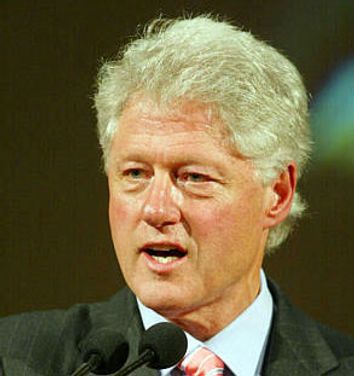
Editor’s note: Former President Bill Clinton delivered the following remarks before the Labor Party Conference in Blackpool, England, on Wednesday. The speech, which ranged from Africa to Iraq to his differences with Bush conservatism, was hailed in the Guardian as the work “of a true political master … At times, it was as if Mr. Clinton was calling on Mr. Blair to rescue America from Bushism … What a speech. What a pro. And what a loss to the leadership of America and the world.” The Mirror was even more exuberant: “It was a magnificent speech from a man who is rapidly becoming the greatest figure in world politics, second only, perhaps, to Nelson Mandela.”

- – - – - – - – - – - -
By Bill Clinton

Oct. 3, 2002  |  I am trying to imagine what in the world I am doing here. I have never been to Blackpool before, I had never been to the McDonald’s in Blackpool before. I like the city, I like the weather, and I understand I may have brought it; if so I will take credit for any good thing I can these days. I accepted when Prime Minister Blair asked me to come because he and Cherie are old friends, because I love this country and feel deeply indebted to it. It gave me two of the best years of my life and I think my daughter is getting two of the best years of her life here as well. (Applause).

I am sort of getting used to being the spouse of an election official instead of one, but it is flattering when someone who no longer has a shred of power is asked what he thinks, so I thought I would show up and say it. It is also fun to be in a place where our crowd is still in office and I am glad to be here. (Applause). But the real reason I came here today is because politics matters. It matters to the people whom you represent, and because we live in an interdependent world and what you do here matters to all of us across the globe.

I have just come here from a trip to Africa which provided me with all kinds of fresh evidence of the importance of politics. I spent a week working on issues that are central to the mission I follow now that I am no longer in office and to the future of Africa; increasing economic opportunity for the continent’s poor, fighting HIV and AIDS, building bridges of reconciliation between races, tribes and religions, supporting still new democracies. Time and again I was reminded of the importance of politics to the lives of ordinary people.

(I visited) Ghana where a new president is working with a great Peruvian economist, Hernando De Soto, to bring the assets of poor people — their houses, farms, businesses — into the legal system so they can be collateral for loans and they can grow their own families’ incomes and the nation’s income. I met a woman there who gave me a shirt made in a factory of 400 Ghanaians that came into being because of the trade bill I signed in 2000 in Nigeria, where decades of corruption and poverty amidst all that oil wealth had led some of the states in desperation to adopt Shariya law, under which a young mother of three was recently sentenced to death by stoning for bearing her last child out of wedlock — and where I pled for her life.

(I also visited) Rwanda, where the government has established a reconciliation village and welcomed me with amazing evidence of new beginnings in the aftermath of the terrible genocide just eight years ago which claimed the lives of over 10 per cent of the country’s population. I met a Tutsi widow in that village whose husband died in the slaughter, standing right next to her neighbor, a Hutu woman whose husband is in prison awaiting trial for participating in the slaughter. I saw Hutu and Tutsi children dancing together in a ceremonial dance for me, for what the governor said was the very first time since 1994. These kids were smiling again, they were young again, they were beginning to trust each other again because of a decision made by the government to establish a village and to welcome them all to come and live together.

In Mozambique I saw the president, Mr. Chissano, who is struggling to fight AIDS, overcome the effects of massive flooding and build a modern economy. In South Africa I met with university students who are looking past all their problems with confidence towards a multi-racial democratic future. I saw President Mbeki leading the continent to adopt Africa’s very first home- grown economic plan called NEPAD: it is a third-way document because it calls on the developed world and Africa to work in genuine partnership and assume mutual responsibilities; and I saw Nelson Mandela, 84 years young, still getting me to do things he wants me to do. (Applause)

On this particular day he got me involved in his effort to challenge young people to take personal responsibility for reversing the AIDS epidemic through prevention and engaging in more citizen service. So politics matters, and even if you are a former president there are some things that we can accomplish for the common good only through the common instrument of our elected officials.

It was a wonderful trip and I had such a good time, I asked one of my traveling companions to come with me today, Kevin Spacey, who is over here. (Applause).

Since humanity came out of Africa eons ago, the whole history of our species has been marked by human beings’ attempts to meet their needs and fulfill their hopes, confront their dangers and fears, through both conflict and cooperation. We have come to define the meaning of our lives in relationship to other people. We derive positive meanings through positive associations with our groups and we give ourselves importance also by negative reference to those who are not part of us. There has never been a person in any age, and I bet it applies to everyone in this room, who has not said at least once in your life to yourself if not out loud, “Well, I may not be perfect but thank God I am not one of them.” That has basically been the pattern of life. But since people first came out of caves and clans, we have grown ever more steadily inter- dependent and wider and wider in our circle of relations. And that has required us constantly to redefine the notion of who was “us” and who is “them.”

Yet the prospect for a truly global community of people working together in peace with shared responsibilities for a shared future was not institutionalized until a little less than 60 years ago with the creation of the United Nations and the issuance of the universal declaration of human rights. Such a community did not even become a possibility until the Berlin Wall fell in 1989.

The history of civilization as we know it — with writing and urban life — is just a little over 6,000 years old. Human beings have been on the planet, depending on how you read the evidence, somewhere between 50,000 and 100,000 years. I say that to begin on a note of optimism. The world has a whole lot of problems, but we have not had a chance to bring it together for very long. You should be upbeat and grateful that your party is in power at a time that you have a chance to make all the difference in the world. (Applause).

So, here we are in this interdependent world of open borders, easy travel, mass migration, universal access to information and technology, drenched in global media. I will just give you a stunning example that occurred to me on the way over here. When Kevin and I walked over to the hotel and got into our van to ride here, his cellphone rang and two friends of ours were calling from Paris to say they had just watched us walk out of the hotel in Blackpool, and how nice we looked. So I said, “Well, it’s a slow day for news in Paris,” but it is a good example of our interdependent world.

This world has brought great benefits to the British people and the American people and to people everywhere who are prepared to make the most of it and have the right values, the right vision and do the right things. But there is a big problem with our interdependent world; it does not include a lot of us yet.

Half the world’s people live on less than $2 a day, a million people live on less than a dollar a day, including people in three of the five nations I visited on my recent trip to Africa.

A billion people are hungry every night, a billion and a half people never have any clean water, 130 million kids never go to school, 10 million children die every year of preventable childhood diseases, even though overall life expectancy is up and infant mortality down, even in the developing world.

One in four people this year who perish will die of AIDS, TB, malaria and infections related to diarrhea. And it is not just the economic, health and education divides; there are large numbers of people who simply do not have the values and vision necessary to be part of an interdependent world because they think their differences — whether they are religious or political or racial or tribal or ethnic — are more important than our common humanity. They believe the truth they have justifies their imposition of that truth on other people, even if it means the death of innocents.

What happened to us in September 2001, is a microcosmic but painful and powerful example of the fact that we live in an interdependent world that is not yet an integrated global community — which means that people who do not share the same values and vision and interests still have access to open borders, easy travel, technology and information that the al-Qaida network used to murder 3,100 people in the United States, including over several hundred Muslims and over 200 British citizens, among those from over 70 countries who perished.

It would be boring if we were all the same. Britain and America are more interesting countries than they were 30 years ago because they are more diverse. But the only way we can really live together is if we say that the celebration of our differences requires us to say that our common humanity matters more. (Applause)

There are a lot of obstacles in the road towards that kind of world. There are terrorists, there are tyrants, there are weapons of mass destruction, there are all these people who are not part of our prosperity — and there are a lot of people on our side who think that we can for ever claim for ourselves what we deny to others. There are a lot of obstacles in the way. But let us be realistic; none of you believe that we will ever be completely defeated by terrorists. We will not allow ourselves to be defeated by tyrants with weapons of mass destruction; that will not happen. But we could reduce the future that we can build for our children if we respond to the challenges in the wrong way.

Yes, we have to care for the security of our nation. This means, among other things, of course that we have to fight terrorists. But we also have to build a world with more partners and fewer terrorists. Of course we have to stand against weapons of mass destruction — but if we can, we have to do it in the context of building the international institutions that in the end we will have to depend upon to guarantee the peace and security of the world and the human rights of all people everywhere. (Applause).

You clapped when I made that comment about the United Nations and I am glad you did, but one of the challenges we face today is that all the international institutions in which we place such hope are still becoming, they are still forming. We have only really had a chance to make them work for a little over a decade. The European Union is not what most people think — and at least I hope — it will be in five, 10 or 20 years; it is becoming. The United Nations is not what I hope it will be in five, 10 or 20 years. There are still people who vote in the United Nations based on the sort of old-fashioned national self-interest views they held in the cold war or even long before, so that not every vote reflects the clear and present interests of the world and the direction we are going.

I take it almost everybody in this room supports what Prime Minister Blair and I did in Kosovo. (Applause). It was a clear and present emergency; you had a million people being driven from their homes. But in the end, even though we had all the Muslim world for it and most of the developing nations for it, all of NATO for it, we could not get a U.N. resolution because of the historic ties of the Serbs to the Russians. So we went in anyway and as soon as the conflict was over, the Russians came in and did a very responsible job participating with the United States in an international U.N. peacekeeping environment. Why? Why did that happen? Because the U.N. is still becoming.

You also see the same thing when we, the United States, do not contribute in my view as much as we should to international institutions. (Applause) You know I have a difference in opinion with the Republicans about whether we should be involved in the Kyoto protocol, the comprehensive test ban treaty, the international criminal court, and all these things, but these things stand for something larger which is our larger obligation to create an integrated world. You cannot have an integrated world and have your say all the time. And America can lead the world towards that, but we cannot dominate and run the world in that direction. There is a big difference. (Applause)

So, having said that, do we want to strengthen these institutions? Yes. Why? Because they contribute to an integrated global community. But if we cannot solve all the problems, what else do we do? One thing we know is that whenever possible the outcome is likely to be better if Great Britain and the United States — and if the United States and Europe — are working together. We have half a century of evidence to support that.

I am profoundly grateful for the partnership that we enjoyed in the years when I served as president — in Bosnia, in Kosovo, in the Middle East, in Africa, in East Timor; in bringing China into the World Trade Organization and the community of nations; in trying to build alliances with Russia between the United States and Europe; all of the things we did together for global debt relief, and a hundred other issues; whenever we were working together the outcome was likely to be better.

I am profoundly grateful for Britain’s involvement with the United States and with others in diplomatic efforts and where necessary in military ones. You were there when we turned back Slobodan Milosevic and the tide of ethnic cleansing which threatened every dream people had of a Europe united, democratic and at peace for the first time in history.

You were there in 1991 when the United States and the global alliance turned back Saddam Hussein’s invasion of Kuwait. When Saddam Hussein threw the weapons inspectors out in 1998 and we attacked Iraq, you were there. And when you were working towards peace in Northern Ireland, we were there. (Applause).

Whatever America did for Britain and Northern Ireland in the Irish peace process, you repaid 100 fold in the aftermath of September 11. Prime Minister Blair’s firm determined voice bolstered our own resolve, his calm and caring manner soothed our aching hearts; and the British people pierced our darkness with the light of your friendship. In the aftermath of September 11th, we went to work against terror in a world rudely awakened to its universal threat, and much more willing to support the actions necessary to prevail.

I still believe our most pressing security challenge is to finish the job against al Qaida and its leaders in Afghanistan and any other place that they might hide. I would support even committing war forces to that. We have only about half as many forces in Afghanistan today that we had in Bosnia after the conflict was over and we were keeping the peace. I applaud Britain’s commitment to finish the job in not only the conflict but to winning the peace, to staying in Afghanistan with an international force and with the kind of support necessary to make sure that we do not have the disaster that occurred when the West walked away from them 20 years ago. (Applause).

A few words about Iraq. I support the efforts of the prime minister and President Bush to get tougher with Saddam Hussein. I strongly support the prime minister’s determination, if at all possible, to act through the UN. We need a strong new resolution calling for unrestricted inspections. The restrictions imposed in 1998 are not acceptable and will not do the job. There should be a deadline and no lack of clarity about what Iraq must do. There is no doubt that Saddam Hussein’s regime poses a threat to his people, his neighbors and the world at large because of his biological and chemical weapons and his nuclear program. They admitted to vast stores of biological and chemical stocks in 1995. In 1998, as the prime minister’s speech a few days ago made clear, even more were documented. But I think it is also important to remember that Britain and the United States made real progress with our international allies through the U.N. with the inspection program in the 1990s. The inspectors discovered and destroyed far more weapons of mass destruction and constituent parts with the inspection program than were destroyed in the Gulf War — far more — including 40,000 chemical weapons, 100,000 gallons of chemicals used to make weapons, 48 missiles, 30 armed warheads and a massive biological weapons facility equipped to produce anthrax and other bio-weapons. In other words, the inspections were working even when he was trying to thwart them.

In December of 1998, after the inspectors were kicked out, along with the support of Prime Minister Blair and the British military we launched Operation Desert Fox for four days. An air assault on those weapons of mass destruction, the air defense and regime protection forces. This campaign had scores of targets and successfully degraded both the conventional and non-conventional arsenal. It diminished Iraq’s threat to the region and it demonstrated the price to be paid for violating the Security Council’s resolutions. It was the right thing to do, and it is one reason why I still believe we have to stay at this business until we get all those biological and chemical weapons out of there. (Applause).

What has happened in the last four years? No inspectors, a fresh opportunity to rebuild the biological and chemical weapons program and to try and develop some sort of nuclear capacity. Because of the sanctions, Saddam Hussein is much weaker militarily than he was in 1990, while we are stronger — but that probably has given him even more incentive to try and amass weapons of mass destruction. I agree with many Republicans and Democrats in America and many here in Britain who want to go through the United Nations to bring the weight of world opinion together, to bring us all together, to offer one more chance to the inspections.

President Bush and Secretary Powell say they want a U.N. resolution too and are willing to give the inspectors another chance. Saddam Hussein, as usual, is bobbing and weaving. We should call his bluff. The United Nations should scrap the 1998 restrictions and call for a complete and unrestricted set of inspections with a new resolution. If the inspections go forward, and I hope they will, perhaps we can avoid a conflict. In any case the world ought to show up and say we meant it in 1991 when we said this man should not have a biological, chemical and nuclear weapons program. And we can do that through the UN. The prospect of a resolution actually offers us the chance to integrate the world, to make the United Nations a more meaningful, more powerful, more effective institution. And that’s why I appreciate what the prime minister is trying to do, in trying to bring America and the rest of the world to a common position. If he was not there to do this, I doubt if anyone else could, so I am very very grateful. (Applause)

If the inspections go forward, I believe we should still work for a regime change in Iraq in non-military ways, through support of the Iraqi opposition and in trying to strengthen it. Iraq has not always been a tyrannical dictatorship. Saddam Hussein was once a part of a government which came to power through more legitimate means.

The West has a lot to answer for in Iraq. Before the Gulf War — when Saddam Hussein gassed the Kurds and the Iranians — there was hardly a peep in the West because he was (fighting) Iran. Evidence has now come to light that in the early 1980s the United States may have even supplied him with the materials necessary to start the bio-weapons program. And in the Gulf War the Shi’ites in the southeast of Iraq were urged to rise up and then were cruelly abandoned to their fate as he came in and killed large numbers of them, drained the marshes and largely destroyed their culture and way of life. We cannot walk away from them or the proven evidence that they are capable of self-government and entitled to a decent life. We do not necessarily have to go to war to give it to them, but we cannot forget that we are not blameless in the misery under which they suffer and we must continue to support them (Applause).

This is a difficult issue. Military action should always be a last resort, for three reasons; because today Saddam Hussein has all the incentive in the world not to use or give these weapons away, but with certain defeat he would have all the incentive to do just that. Because a preemptive action today, however well justified, may come back with unwelcome consequences in the future. And because I have done this, I have ordered these kinds of actions. I do not care how precise your bombs and your weapons are — when you set them off, innocent people will die. (Applause).

Weighing the risks and making the calls are what we elect leaders to do, and I can tell you that as an American, and a citizen of the world, I am glad that Tony Blair will be central to weighing the risks and making the call. (Applause). For the moment the rest of us should support his efforts in the United Nations and until they fail we do not have to cross bridges we would prefer not to cross.

Now, let me just say a couple of other things. This is a delicate matter, but I think this whole Iraq issue is made more difficult for some of you because of the differences you have with the conservatives in America over other matters, over the criminal court and the Kyoto Treaty and the comprehensive test ban treaty. I don’t agree with (their positions) either — plus I disagree with them on nearly everything: on budget policy, (laughter) tax policy (applause), on education policy, (applause), on environmental policy, on health care policy. I have a world of disagreements with them. But we cannot lose sight of the bigger issue. To build the world we want, America will have to be involved and the best likelihood comes when America and Britain, when America and Europe, are working together. I cannot believe that we cannot reach across party and philosophical lines to find common ground on issues fundamental to our security and the way we organize ourselves as free people. That is what Tony Blair could not walk away from, what he should not have walked away from and what we are all trying to work through in the present day. I ask you to support him as he makes that effort. (Applause).

If you will permit me, even though I am a retired politician (laughter), I would like to say just a word about domestic politics. United States and Britain cannot do good around the world unless we are good and getting better at home. You think about it. Much of the power that we can have grows out of the power of our example. We can’t tell people to make a more integrated world unless they think we are making more integrated societies. Unless all of our children have a chance to get a decent education; unless we have balanced the demands for freedom and security; unless we have absorbed our immigrants in a way that is consistent with our values, and the elemental obligations we have for equal opportunity. We cannot do good abroad unless we are good at home. (Applause).

The ultimate case for the third way is that it works — good values, good vision, good policies. We have eight years of evidence in the United States and now five years of evidence here that it works. (Applause). Opportunity for all, responsibility for all, a community of all people, good values. A vision where everyone has the chance to live up to his or her dreams, where we are growing together, not growing apart, where we are a force in the world for peace and freedom and security and prosperity. Where we shed ideas that don’t work and embrace those that do — and most of all go beyond the false choices that paralyze and make boring political debate. Going beyond neglect and entitlement to empowerment. Refusing to be told we have to choose between what’s good for labor and good for business and say the best thing is if both do well. Refusing to be told that crime policy has to be about prevention or punishment and saying what works is both. That education has to be about excellence or equity; that health care has to be about access or quality; that environmental protection can only come at the expense of economic growth. All these things are factually untrue, but they dominate, control and paralyze the politics of countries all over the world. You have said no to that. The third way has said no to that and you got good results for doing it. (Applause).

If I might say, it worked pretty well in America too (laughter). We had a 30-year low on unemployment, we had a 32-year low in welfare roles, we had a 27-year low in the crime rate, all directly tied to policies we adopted. We had three years of surpluses in the budget for the first time in 70 years and the biggest increase in aid to university students in 50 years. And the thing that means the most to me is the comparison of our economic recovery with the Republican recovery of the 1980s. They had 14 million jobs and only 70,000 families move out of poverty. We had 22 million jobs — 50 percent more — but 7 million moved out of poverty, 100 times as many. (Applause).

That is the importance of politics of choices. I understand now that your Tories are calling themselves “compassionate conservatives.” (Laughter). I admire a good phrase. (Laughter). I respect as a matter of professional art adroit rhetoric, and I know that all politics is a combination of rhetoric and reality. Here is what I want you to know. The rhetoric is compassionate, the conservative is the reality. (Applause).

Let me be serious a minute. Our politics are based on ideas — a desire to increase opportunity and to strengthen community. And we know we are not always right, even though everybody hates to admit that, we are not. So we have to operate on the basis of evidence, and be open to argument. Their politics is based on ideology and power, and they don’t like evidence and argument very much. My wife, the junior senator from New York, says that Washington sometimes seems to have become an evidence-free zone. They operate by attack. But at some point you’ve (got) to look at the evidence.

In my country evidence shows that their ideology drove them to adopt an enormous tax cut heavily tilted to wealthy Americans. I ought to be happy, I am one of them now! (Laughter) But I am not. Why? Because we adopted a tax cut in America before we had a budget, before we knew what our income was going to be, before we knew what our expenses were going to be, before we knew what our emergencies were going to be — and Sept. 11 turned out to be quite an emergency. So we went from a decade-long projected $5 trillion-plus surplus to having it go away. We went from having the money when I left office to take care of the Social Security retirement cost of the baby boom generation, and half of the medical costs of them, to having it go away and using those trust funds to pay for tax cuts for people in my income group. Did the evidence support it? No. But the ideology did.

They declared war on all my environmental regulations, they even tried to relax the standard on how much arsenic we could have in the water. The Democrats stopped them, and besides, there was a very small constituency for more arsenic in the water in America! (Laughter and applause). So then they went on to other things. To try to make the deficit look smaller, they tried to refigure the accounting and requirements to raise the cost of student loans at a time when college scholarships were going up. The Democrats stopped them and besides they found that even among conservatives there was hardly anybody who thought that college ought to be more expensive in America. But their ideology drove them to it and I could give you example after example after example.

I say this because you should be proud that you have stayed with what works, and you should stay with it. You should know that you have to fight every day to explain what you are doing. You have to always keep your ears and eyes open to find the errors that you make, and you must always be the party of change. But you have to keep going, because the rest of the world looks to you. When people are insecure, they often turn to the right because of the rhetoric, because of the ideological certainty, because if we show feeling sometimes people confuse compassion with weakness — a mistake that the prime minister has taken great care to avoid here, and I appreciate that. So we have these election reversals in Europe. And the election was so close in America that they won it fair and square — 5 to 4 at the Supreme Court. (Laughter).

We should actually be glad, though, because there were seven Republicans and only two Democrats on the Supreme Court — and two of those Republicans (God bless them, they will be rewarded in heaven), they actually took the decision that we should count votes when the American people vote, and I appreciate that. (Applause). A lot of the retrenchment, the fear of voting, was understandable in Europe but now it is beginning to come back: Prime Minister Persen in Sweden re-elected, Chancellor Schroeder reelected in Germany. But all over the world constitutional democracies are now teetering on a 50:50 basis. In every place one party has become the repository of hopes and the other has been the responder to fears.

New Labor, this government, has not allowed that dichotomy to occur in Great Britain. Don’t you ever do it; keep working for change and keep telling people strength and compassion are two sides of the same coin, not opposite. (Applause).

I would like to close with this simple idea. All of the hopes that I have for my daughter’s generation, for the grandchildren I hope to have, for all of you who are younger than me and, unlike me, still have most of your lives ahead of you, rest upon our ability to get the world to embrace a simple set of ideas — that we must move from interdependence to integration because our common humanity matters more than our interesting differences and makes the expression of those differences possible; because every child deserves a chance, every adult has a role to play and we all do better when we work together.

That is why we must build the institutions that will help us to integrate, that is why we must stand against the threats, whether they are from weapons of mass destruction, terrorists, tyrants, AIDS, climate change, poverty, ignorance and disease which would tatter this world and prevent us ever from coming together as one.

That is why we must never forget people at home, even as we work for those around the world; why we must want the same things for the children of Britain and America; of the Greeks and the Turks in Cyprus; the children of the Hutus and Tutsis in Rwanda; the Colombian children so beleaguered by the narco traffickers and the terrorists there; the children of the East Timorese and the Indonesians in the Pacific; the children of the Muslims, the Hindus and the Sikhs in Kashmir and Gujurat; and maybe some day even for the children of the Palestinians and the Israelis in the Middle East. (Applause)

I ask you to think of this work as the true and ultimate third way, going beyond the exclusive claims of old opponents to a future we can all share; going beyond the fears and the grudges, the fights and the failures of yesterday’s demons to a truth we can all embrace. The third way in the end must lift our adversaries as well as our friends, the children we must never see because they are too far away, as well as those just under our feet. If we do it, the 21st century will be the brightest time the world has ever known, and if we do it, it will be in no small measure because when you were called to meet the great challenge of the new millennium, you responded. Thank you, and God bless you. (Applause).

Continue Reading Close

The path to peace

The only way to beat terrorism is for the U.S. to unite the world, not divide it.

The central reality of the 21st century world, as the spread of terrorism and the vulnerability of the United States to it demonstrate, is that our era is globally interdependent but far from integrated. We learned on Sept. 11 that the very forces of globalization we helped to create — open borders and commerce, easy travel, instant communications, instant transfers and widened access to information and technology — can be used to build or destroy, to unite or divide.

At the same time, old confrontations have taken on frightening urgency, especially the India-Pakistan conflict over Kashmir and the violent stalemate in the Middle East. Progress on these and other global challenges requires us to develop a larger strategy for American foreign policy, rooted in a fundamental commitment to move the world from interdependence to an integrated global community committed to peace and prosperity, freedom and security.

At the heart of all these struggles is a global battle of ideas, especially in the Islamic world, where fundamentalist rivalries have twisted religion to justify suicide assassination of innocents as a legitimate political tool blessed by Allah. This epic battle revolves around three very old and fundamental questions: Can we have inclusive communities or must they be exclusive? Can we have a shared future or must our futures be separate? Can we possess the whole truth or must we join others in searching for it?

These dilemmas present perhaps the most enduring conundrum of human history: Can people derive their identity primarily by positive association or does life’s meaning also require negative comparison to others? From the time people came out of caves and formed clans, their identities were rooted both in positive associations with their own kind and negative views of those who were outside their community. This kind of self-definition has dominated human societies for most of the 6,000-plus years of organized civilization.

For all the progress of the past, we nearly destroyed the planet in the first half of the 20th century. The idea of a global community of cooperating members was not institutionalized until the United Nations was founded in 1945. Achieving it was not a practical possibility until China decided in the 1970s to move toward the rest of the world and the Berlin Wall fell in 1989. Since then, the world has been consumed with religious, racial, ethnic and tribal conflict.

Clearly, hostility and violence among different peoples are not genetically ordained. People may be mutually suspicious of “the other,” but they have to be taught and led to kill. Our challenge is to figure out how people can enjoy the benefits and identity of their discrete communities and still successfully be part of larger communities. The European Union is a shining example of how former enemies can retain national identity and still become close allies.

An idea of community requires belief in a shared, not a separate, future, one in which everybody counts, everybody has a role to play and we all do better when we help each other. Belief in a shared future requires rejecting the radical fundamentalist claim to possess the whole truth in favor of the belief that life is a journey in search of the truth and that we all have something to contribute. That leads us to the core of what we value in the integrated global community: Our differences are important, but our common humanity matters more.

The challenge of Islamic radicals embodies all of these fundamental issues. People who support Osama bin Laden and believe in his vision of the world want exclusive, not inclusive, communities. They insist on a separate future based on their version of the truth. These elements are all at the root of the India-Pakistan conflict and the divide between Palestinians and Israelis. The violent groups with exclusive claims to a separate future are active in Indonesia, the Philippines, Colombia and elsewhere.

The political and ideological world needs to do what the economic world has already done — develop a global consciousness that allows for inclusion, a shared future, a cooperative search for truth.

This is not, as some have asserted, a Western concept. The fastest growing economy in the Middle East is Dubai, a Muslim country actually seeking residents from other nations and quietly integrating with the modern world. The leaders of Dubai have chosen a shared future rooted in tomorrow’s possibilities.

Turning these ideas into action will take time and will require more than talk. We must fight the terrorism and violence that threaten to destabilize the world with an aggressive security and foreign policy designed to produce more partners and fewer terrorists.

Our security policy should include five major elements:

First, we should support President Bush and our military in finishing the job of getting Osama bin Laden and the other al-Qaida leaders out of Afghanistan.

Second, we must do everything we can to end the North Korean nuclear missile program. This is a very big deal: The North Koreans may not be able to grow enough food to feed their people, but they are world-class missile builders and they sell missiles to our adversaries.

During my administration, we succeeded in ending North Korea’s nuclear program and its testing of long-range missiles. At the end of my second term, we came close to an agreement to end its missile program entirely. The key to the final agreement was to be a presidential visit to North Korea. I was willing to go, but in the last few weeks of my administration we had to focus all our energies on the apparent chance to achieve a Middle East peace agreement. I decided not to risk this chance by taking a trip that would have had to include South Africa, China, and Japan.

I remain convinced that an end can be negotiated to the North Korean program if the Bush administration makes it a high priority.

Third, we must constrain the production and distribution of chemical, biological and small-scale nuclear weapons. We know that Saddam Hussein is a continuing concern because his laboratories are busy. His military is much weaker than it was at the time of the Persian Gulf War, but the threat of his labs is real. It is not as immediate as the need to restart the Middle East peace process and stop the violence there, and it may not require an invasion, but it must be addressed.

Fourth, we should increase the capacity of our friends to deal with terror. I support what President Bush is doing to help President Gloria Arroyo in the Philippines. I also believe Bush is right to broaden the uses of our aid to Colombia, in order to save the oldest democracy in Latin America from the Revolutionary Armed Forces of Colombia, or FARC. The FARC are, in fact, terrorists in the service of drug traffickers who are trying to make Colombia the world’s first narco-state.

We should also support our friends in Africa who are trying to organize themselves into coherent societies. One of the best ways is to continue funding the Africa Crisis Response Initiative. Launched during my administration, this program provides U.S. support for a mixed African military force that can go wherever it is needed, so that Africans can be their own peacekeepers and deal with their own terrorists and tribal conflicts. I hope the Bush administration will not cut funding for this program.

Fifth, we have to improve domestic defenses and cooperation. I support the creation of a new Department of Homeland Security as long as it has the authority to keep all the related agencies in close cooperation and it has immediate access to all intelligence.

More partners, fewer terrorists. In addition to these five defensive steps, it is critical to our new foreign and security policy framework that we have a vision, as our predecessors did after the Second World War, for building a better world with more partners and fewer terrorists.

The guiding principle of this reordered world comes directly from the Third Way philosophy: Empowerment, opportunity and responsibility.

The first step is to have more, and more effective, international institutions. We already see the success of the North American Free Trade Agreement and the World Trade Organization. We see the wisdom of bringing China into the WTO. Our commitment to the Free Trade Area of the Americas and free trade are sound. We were right to ratify the Chemical Weapons Convention, expand Nato and support the growth of the European Union.

On the other hand, I think the Republican-controlled Senate was wrong to reject the Comprehensive Test Ban Treaty that my administration negotiated, a decision with which the Bush administration unfortunately agrees. I believe the administration was wrong to walk away from the Kyoto agreement and the International Criminal Court protocol that we signed. Rejecting the Kyoto agreement will make it harder for us to fight the scourge of environmental degradation, especially global warming and the related deterioration of the oceans.

The second pillar of this strategy should be to provide more targeted debt relief for the world’s poor nations. The debt relief that we promoted in 2000 has already produced some stunning results because it was based on the requirement that all of the savings go into education, health care and development, providing opportunity while demanding responsibility. This initiative received broad international support and had great bipartisan backing in the US Congress. We should continue it with a new round that includes countries that have incomes above today’s eligibility limit but also have high and debilitating rates of Aids and HIV.

Third, we should increase investment in foreign assistance. America spends a smaller percentage of its income on foreign assistance than any other developed nation. President Bush took a good first step last March at the foreign aid summit in Monterrey, Mexico, when he pledged to increase our foreign assistance by $10 billion to $15 billion annually. But that will still leave us 20 percent, as a percentage of national income, below the last budget written by a Democratic Congress in 1994.

United Nations secretary general Kofi Annan has asked for $10 billion a year to fight AIDS and other infectious diseases. We should pay our share. More than 10 million children in poor countries are not in school. In 2000, we allocated $300 million to pay for one good meal a day for poor children if they would go to school to get it. Impressive enrollment increases resulted. We should do more of this.

Fourth, we should intensify our efforts to bring peace in the world’s most troubled places: the Middle East and the Indian subcontinent.

With a strong security policy, a vigorous effort to create more partners and fewer terrorists, and an unrelenting struggle to win the battle of ideas, America can do a great deal to move the world from interdependence to integration in a global community that builds a fitting world for all our children.

Continue Reading Close
www.salon.com/writer/bill_clinton/index.html