Brad Wieners

Do androids dream of First Amendment rights?

A Net-controlled robot reporter from MIT may be headed for Afghanistan.

  • more
    • All Share Services

Do androids dream of First Amendment rights?

“Have you seen Rambo III?” Chris Csikszentmihalyi asks over the phone from his office at the Massachusetts Institute of Technology. “I went to Blockbuster to see what movies they had on Afghanistan, and it was the only one I could find. It’s amazing to watch now. The mujahedin are portrayed as Western cowboys, and the gist is that Afghanistan is this peaceful, freedom-loving country, and we should give them all the weapons they want.”

Csikszentmihalyi (pronounced “Chick-sent-me-hi-yee”) is digressing from the topic at hand, which is his explanation of why he has built a satellite-linked, Net-operated robot that he intends to send into a combat zone ASAP. Since the invasion of Grenada, he notes, the U.S. Armed Forces have limited journalists’ access to areas where fighting is taking place, and he finds this troubling, to say the least. He thinks the “pre-censored” war coverage on CNN is as one-sided as Rambo III, and he’s especially terrified by the recent news that an unmanned Predator drone fired upon and killed three men who may turn out to be Afghan civilians — a sure sign, he says, that we need to expand public discussion of the use of unmanned war machines.

“It will always be better if a human journalist is able to move freely,” Csikszentmihalyi says. “But since they’re not, I thought, If the military can have drones, why can’t we?”

To answer his own question and drive forward the broader debate about remote-controlled drones, the 33-year-old engineer, artist and director of MIT Media Lab’s Computing Culture Group began last December to create the first nonmilitary, nonhuman roving war correspondent, dubbed the Afghan Explorer. The Explorer completed several tests on the streets of Somerville, Mass., in mid-February.

“This is not a media virus,” Csikszentmihalyi says, well aware that similar, provocative projects have been proposed, but rarely completed. “We’re doing this.”

No stranger to computer automation, Csikszentmihalyi previously helped invent a robotic disk jockey — the “DJ I, Robot.” Essentially little more than three turntables and a PC, it can randomly access a beat or sound anywhere on a record, as well as spin a platter at up to 800 rpm (although skipping gets frequent at 350 rpm). The robot DJ has even gone head-to-head with human DJs, Kasparov vs. Deep Blue-style, at electronic arts festivals and nightclubs. (It last preformed in Stuttgart, Germany, in January.) At present, he and co-creators Jonathan Girroir and Jeremi Sudol are adding a motion-capture device so the DJ I, Robot can mimic the way human DJs scratch. In a lighthearted mood, he writes of the robotic DJ, “I can’t believe I’m paid to do this stuff. I’m as filled with wonder as a 22-year-old in a dot-com circa ’99.”

Csikszentmihalyi wanted to get the Explorer done in a hurry, so he relied on off-the-shelf parts, and modeled it on the Mars Pathfinder. Three feet long, 2 feet wide and moving on 14-inch diameter wheels, the Explorer has a video screen and a microphone on a “neck” pole that extends up 4 feet, so it can interview standing adults. “It’s a teleconference on wheels,” its inventor says.

Csikszentmihalyi’s droid has some distinct advantages over its human counterparts. It needn’t stop for food or nature’s calls, and the delivery from its speakers may actually improve on Wolf Blitzer. On the other hand, it needs more sleep (only a strong sun can keep the solar-powered go-cart going), requires more prompting from the newsroom and there’s always a chance it’ll get stuck in a corner somewhere.

“I really like the idea of a robo-reporter,” says Natalie Jeremijenko, an engineering professor at Yale, and a New York techno-artist. “It comes down to a question of who gets to generate the facts,” she says. Too often, she contends, artists are called upon “to congeal the sentiment, rather than engage and understand the political crisis. Whether Chris succeeds or not, he’s making a great point — that for most Americans, Afghanistan might as well be Mars.”

A somewhat notorious provocateur, Jeremijenko has been known to work with the Bureau of Inverse Technologies, a cabal of high-I.Q. artists with decidedly dissident impulses. The BIT once flew an unmanned spy plane over Silicon Valley’s secretive research parks. They also placed audio sensors and microphones that locals maintained in war-torn Kosovo. Called BANG!BANG! radio, these devices came on when they detected gunfire or explosions, indicating on a Web site when and where this violence was taking place. But as much as she favors Csikszentmihalyi’s robo-reporter, she cautions that it may not get very far.

“Robots require four orders of magnitude more care than the littlest kitten,” she notes. “Even the most robust industrial robots require constant maintenance, and the terrain in Afghanistan will be difficult.” Nevertheless, she adds, “What could be interesting is if the Afghan people take an interest in Chris’ machine. If they repair it. Send it on its way.”

“The social aspects are always the most interesting part of robotics,” reflects U.C. Berkeley robotics specialist Ken Goldberg. “Seeing how people interact with each other and the person or robot on the other side. That’s why I’ll be interested to see not only where the robot can go in Afghanistan, but who drives — and how they react to what it ‘sees’”

Even before its deployment, Goldberg says the Explorer is just the latest project to signal a second coming of Net robots, a trend anticipated in the recently published primer “Beyond Web Cams: An Introduction to Online Robots,” which he co-edited. In the bright orange anthology, Goldberg and Ronald Siegwart gather what engineers have learned from the first wave of Net robots, circa 1994-’97. These include the University of Southern California’s Mercury Project, the first robot controlled over the Web, in 1994; U.C. Berkeley Ph.D. Eric Paulos’ memorable Net blimp and other probes; and the Net-based ground operation systems for the 1997 Mars Polar Lander and Rover Missions.

“Remote presence will be one of the next big applications of the Internet,” predicts Rodney Brooks, director of MIT’s Artificial Intelligence lab and chairman of iRobot, in Somerville, Mass. Or at least Brooks has good reason to hope so. IRobot’s Coworker — one of the first programmable and Web-accessible robots intended for widespread commercial use — goes on sale this fall.

But by the time it completes its “boot camp,” the Afghan Explorer may need to be renamed the Iraqi- or Gaza Explorer, Csikszentmihalyi admits. As flesh-and-blood journalists gain greater access to Afghan battlegrounds, it may make more sense to send it to some new hot spot to make his twin points about access and the unreliability of unmanned missions. He also acknowledges that compared with building the robot, delivering it into a contested region may be the far greater challenge.

“Our plan is to work with artists groups here and in Afghanistan or wherever, to script messages to tell the people what it is, what they can do with it,” Csikszentmihalyi says. “Probably it’ll get shot on the first day and sold for parts,” he gives a little laugh. “But it will have been an attempt.” And if it gets a scoop? Who knows, he jokes, maybe “this could turn out to be the Pentagon Papers of robots.”

California scheming

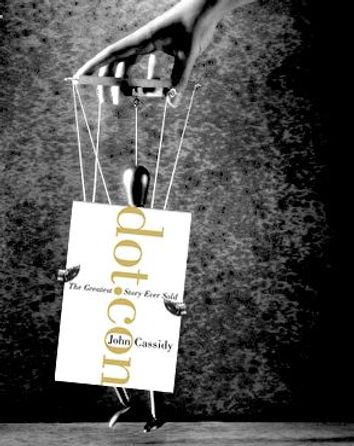
"Dot.con: The Greatest Story Ever Sold" is the first good book about one of capitalism's most embarrassing debacles.

  • more
    • All Share Services

California scheming

The latest crop of diarists of that great and distant epoch, the Digital Age, have yet to score a hit, and frankly, this has come as a relief. We’re at war, after all, and “Whatever happened to those Baby Moguls?” has been a less-than-pressing concern. Recently, however, feeling guilty of too short an attention span, I took a couple of memoirs — J. David Kuo’s “dot.bomb” and Stephan Paternot’s “A Very Public Offering” — out for a spin. And while I don’t recommend you do the same, I was surprised to find the books left me hungry for more on the subject. They raise anew questions that, even now, have to count among the most important of our time, and might help us comprehend how fanciful — and hateful — notions catch on.

Such as? Such as how, exactly, America’s best and brightest came to prize disastrous start-ups over entire, established industries? More to the point: Were stratospheric dot-coms like Paternot’s TheGlobe.com accidental beneficiaries of a mass delusion, or, as Tom Frank argues in “One Market Under God,” cynical, high-tech scams? (And you have to admit, the Internet boom as heist movie holds a certain appeal. “Ocean’s 11″ set not in Vegas, but on Sand Hill Road. George Clooney in the Jim Clark role? Brad Pitt as John Doerr? Matt Damon as Marc Andreessen? Julia Roberts as Mary Meeker? At the very least, it would give the guileless Paternots of the world a dash of retroactive panache).

To get at the answers, we can now thankfully turn to John Cassidy’s “Dot.Con: The Greatest Story Ever Sold” — serialized this week in The New Yorker. In contrast to Kuo’s dull insider, or Michael Wolff’s wise-ass insider (his 1998 book “Burn Rate” is still the one to beat in the “what I saw of the Internet revolution” category), Cassidy did not live the Web dream, nor assume a fake job, but had season tickets to the show as a financial reporter. If newspapers are the first draft of history, and film documentaries like “Startup.com” comprise a second, Cassidy has given us a polished third draft, a popular history of the digital bubble, as the dust jacket says, “in the tradition of John Kenneth Galbraith’s ‘The Great Crash.’”

Though the title recalls the author’s stint as deputy editor of the New York Post, those unfamiliar with Cassidy’s work at the New Yorker, where he is a staff writer, should be aware that he was formerly at the Economist. His strengths are what I consider the best of that magazine. He’s a great synthesizer of facts and figures, a facile stylist and a droll humorist.

Right in those moments when Tom Wolfe could be counted on to have a punctuation seizure, Cassidy opts instead for stinging understatement. Critical of Amazon.com’s founder, Jeff Bezos, for suggesting his firm had stopped bleeding cash in February 2000, Cassidy notes, “For all Bezos’ protestations to the contrary, the numbers showed that his company was still subject to what might be called Amazon’s Law: the more money it took in, the more money it lost.”

Of Bezos’ fame, he notes, “Newspaper and magazine editors were desperate to put a human face on the Internet story, and writing about Bezos was an obvious way to do it. With baby features and an infectious cackle, he could all too easily be portrayed as the goofy boy next door. Most of them focused on his discovery of the World Wide Web, his fateful drive cross-country, and the origins of Amazon.com in a Bellevue garage. Few mentioned that he was ordered to research Internet e-commerce, that he flew from New York to Texas, and that he rented a house with a garage precisely so he could later say that Amazon.com started out in one.”

Despite the title, Cassidy does not argue that the flowering and wilting of dot-coms represents a vast conspiracy — right-wing or otherwise — but more a confluence of several vectors that went unchecked by those who knew better. These include the Internet’s becoming mainstream (and being widely used to trade stocks); an ever-widening inner circle of business executives who believed their own bullshit; a pop culture obsessed with young “rebels”; a libertarian-savant central banker; and, most of all, “a massive restructuring of American capitalism” brought on by that humble innovation, the mutual fund.

You may beg to differ with Cassidy’s assertion that “the stock market’s sustained ascent was the central and dominant fact of American history in the 1980s and 1990s” — what about Michael? Madonna? Britney? — but it’s hard to argue with this: “In 1983, the wealthiest one percent of American households owned 90 percent of all stocks. The vast majority of households — about three out of four — owned no stocks at all. Most of these families, if they had any surplus income, kept it in the bank. Fifteen years later in 1998 … almost half of all American households owned stocks, either through individual shareholdings or through mutual funds.”

Cassidy is persuasive that 401Ks and IRAs had as much a role in setting the stage for the digital bubble as the Netscape browser. During 1996-97 alone, Americans poured $170 billion into stock funds. “It’s no accident that the bull market and the development of the mutual fund industry coincided,” he writes. “Rising stock prices drew more money into mutual funds, and mutual funds poured money into the stock market.” Of course, this seemingly virtuous cycle can work in reverse — and later did.

At the same time, to suss out how so many developed so extravagant a crush on the Internet, Cassidy traces the origins of the network of networks to visionary engineers who transformed a failsafe, military technology into something of broader social value. As much as anyone, these pioneers were astonished by how rapidly the Internet grew, and that model of exponential growth was fixed in minds as a PowerPoint slide with a “hockey stick”-shaped curve on a graph, with the clear implication being that revenues would follow a similar, upward trajectory.

From there, Cassidy covers what was a sort of dress rehearsal for the bubble — the hype about the “information superhighway” and “interactive TV,” circa 1993-95. He then proceeds to tell how the Internet eclipsed ITV and, thanks to the phenomenal IPO of Netscape, in August 1995, caught the attention of Wall Street — in particular, a handful of investment bankers and analysts such as Frank Quattrone, Henry Blodget and Mary Meeker. These three — Meeker, above all, with her February 1996 Internet Report — convinced their peers that there was much more cash to be made on dot-coms. With Meeker in mind, Cassidy writes, “On Wall Street, financial success corrupts, and absolute financial success corrupts absolutely. The corruption is not necessarily venal: it affects people’s judgment rather than their probity.”

Once it became possible to float a profitless company on the NASDAQ and, with the proceeds, buy your way to respectability (as AOL did most spectacularly in its purchase of Time Warner), you might feel like a loser for not trying yourself. This dread of being left out, the rise of online trading — especially day trading — and “The Greater Fool theory of investment,” Cassidy contends, became the essential drivers of dot-com mania. (The “greater fool” theory of investments holds that what matters is not the earnings, or performance, of the company you hold stock in, but simply that you can resell its stock to a sucker for a more ridiculous markup than you paid).

As for signs that the end was near, Cassidy ferrets these out with aplomb. He’s on to That Darned Barron’s Piece, of course, the one by Jack Willoughby on March 18, 2000 that indicated that more than 200 dot-coms would go broke by year’s end. But he also points to the Fed’s interest-rate hikes early in 2000; founders selling off stock in their own companies; and indicators only an economist might notice: the level of margin debt at brokerages reaching a 60-year high, and household debt rivaling that seen in Japan’s credit-driven bubble of the 1980s.

For as credible and sweeping a history as Cassidy manages, however, I finished “Dot.con” with some misgivings, and they all come down to this: He didn’t get enough California in his book. While he nails how Alan Greenspan’s supervision of the Fed paced, if not fueled, the boom, and explores the intellectual influences on the Fed chairman (Ayn Rand, most prominently), Cassidy never fully understands the hackers and bankers in the 415 and 650 area codes whose ideas and desires the era also reflected. For example, he understandably chides Kevin Kelly, author of “New Rules for a New Economy,” for predicting “ultra-prosperity” in Wired on the eve of dot-com destruction, but makes no attempt, as he did with Greenspan, to understand where Kelly was coming from.

Had Cassidy spent as much time in San Francisco’s South Park as he did at Manhattan’s 50 Broad Street, he’d have been able to give a more complete sketch of the enthusiasm for the Net that was, in many ways, betrayed by its commercial exploitation. He’d have heard from those who took juvenile delight in watching as huge corporations wasted millions on new media pipe dreams. And he’d have reckoned further with those who, well before the lure of fast money, Foosball at the office and the fear of missing out, were drunk on the sense that no one on Earth was better prepared to do what they were doing just then, for the simple reason than no one had ever built a World Wide Web before.

Continue Reading Close

Time warp

In "Cyberselfish," Paulina Borsook denounces high-tech culture as pitiless, egotistical and libertarian. She was right in 1996.

  • more
    • All Share Services

Time warp

Only after I’d read well into Paulina Borsook’s “Cyberselfish” and grown quite grumpy with it (the entire time I was reading, I felt trapped in late 1996) did it occur to me that most of the readers of this spirited book-length essay might not experience this time warp — not as severely, anyway. Nor would they likely know or care about the circumstances that contributed to its being dated-on-arrival. Some readers, I realized, might even pick it up without a predisposition toward its author. This was an astonishing thought.

Whether you were at the center or periphery of the San Francisco/South Park and Silicon Valley office park circles Borsook chronicles in “Cyberselfish,” it’s almost assured you met her or read one of her rants, including the essay for Mother Jones that launched this book. For those who didn’t, Borsook is a lively, well-read, sarcastic writer who’s infamous for pissing on the inside for all to see (mostly while as a contributor to Wired magazine, where — full disclosure — I worked) and for getting some things said that are on a lot of minds, but that are not getting said.

She’s especially talented at sketching caricatures and does so throughout “Cyberselfish,” where we meet a host of cypherpunks and nerverts (nerds who indulge in unusual sex), ravers and gilders, entrepreneurial newts and programming flamingos. Her sketches are true enough that you nod and think, yeah, I know the type. Indeed, at its best, “Cyberselfish” reads like the “Radical Chic” of mid-1990s San Francisco.

Problem is, this strength also highlights the book’s flaw: Her sketches are snapshots of a moment that has come and gone. A large part of the reason for this involves the book’s rocky publishing history. “Cyberselfish” was originally set to be published three years ago by Hardwired, the now-defunct imprint of Wired Ventures, but the book bounced to Broadway Books when Borsook had a falling-out with Wired, and then to Public Affairs, a new division of Perseus Books, after a falling-out with Broadway. But a lot has changed since 1996.

How very long ago it seems that Phil Zimmerman, facing jail for distributing Pretty Good Privacy’s encryption software, was the poster boy for the Internet. (Many of today’s dot-commies probably don’t even know who he is.) Today, it’s all about Steve Case, Jeff Bezos and Meg Whitman. And now, rather than heroic defiance of government, some of these players are inviting the government to regulate their industries. Had Borsook recast her book as a portrait of the early, heady days of the Web, she might have had something — the next hot “anti-memoir.” Instead she overstates her case with stale evidence.

Borsook contends that “the default political culture of high tech” is small-l libertarian, and because high-tech players are amassing so much wealth and power, their technolibertarianism poses a threat to civil society and all-American ideals like good public schools. According to Borsook, technolibertarianism ranges from “classic eighteenth century liberal philosophy of that-which-governs-best-governs-least [and] love of laissez-faire free market economics to social Darwinism, anarcho-capitalism, and beyond.” It manifests itself in an embarrassing lack of philanthropy and “rebel-outsider” posturing such as the “crypto wars” (the ongoing debate between technologists and the federal government over how best to encrypt digital data and therefore protect the privacy of computer users).

The “ravingly anti-government” rhetoric of the attendees of CFP (the Computers, Freedom and Privacy Conference) also strikes Borsook as appallingly ironic since the Internet, like so many technologies that underlie the recent economic boom, was subsidized and cultivated by government agencies.

“Much as there are two forms of the plague — bubonic (less contagious and not necessarily lethal) and pneumonic (violently infectious and almost always fatal), technolibertarianism manifests in two forms: political and philosophical,” she writes. The political strain, she says, is mostly just “convenient obliviousness” to the need for governance and giving back. It is often latent, or even denied. “I can’t count the number of times,” Borsook writes, “I’ve gotten into a discussion with a thoughtful, sweet high-tech guy about something where he will snort disdainfully about how he’s not a libertarian … and then will come right out with a classic libertarian statement about the el stewpido government or the wonders of market disciplines or whatever. It’s rather like women who say, ‘I’m not a feminist but I do believe in equal pay for equal work.’”

Philosophical technolibertarianism, Borsook argues, is the pneumonic strain. It’s “psychologically brittle, prepolitical autism,” she warns. “It bespeaks a lack of human connection and a discomfort with the core of what many consider to be human. It’s an inability to reconcile the demands of being individual with the demands of participating in society, which coincides beautifully with a preference for, and glorification of, being the solo commander of one’s computer.” Momma, don’t let your babies grow up to be John Perry Barlow!

In the chapters that follow, she takes us to the incubators and hot zones of this plague. She attends the since-discontinued bionomics conferences; examines Wired during its first five years; takes us inside the cypherpunk subculture. Then she discusses the prospects for “cybergenerosity,” explores the origins of technolibertariansim, and concludes with a bit of “what then must we do?”

As you might gather from her plague metaphor, Borsook is not much in favor of technolibertarianism. Elsewhere she calls it a conspiracy (with a parenthetical wink) and a demon. Since I am essentially a small-l liberal, it didn’t bother me that she presumes that right-leaning technolibertarianism is frightful, but others will understandably balk at this. There are a number of thoughtful arguments that can be made to support the contention that free markets have done more to relieve poverty than anything a government ever has, and Borsook doesn’t address herself to these at all. Rather, she argues that unchecked technolibertarianism threatens ill, if not catastrophic, consequences. We must read her book, she implies, to inoculate ourselves.

Well. Some problems present themselves even before she really gets started. For one thing, by “high tech,” Paulina really means Silicon Valley — even more specifically, those involved in the San Francisco Bay Area high-tech field who participated actively in online forums during the first years of the Web (1993-1998). In little more than a paragraph she acknowledges that technolibertarianism is not as much of a pox in and around Boston’s Route 128, nor is it leading to sick days at Microsoft — a corporate culture too “feudal,” in Borsook’s estimation, to promote virulent dissent.

The brevity with which she deals with Microsoft is doubly frustrating. First, because the Justice Department vs. Microsoft is the most visible and profound contest between free market values in high tech and the government, and second because she neglects to explore the complicated feelings anti-Microsoft technolibertarians have about the proceedings. Generalizing, of course, most Silicon Valley machers are pleased to see Gates taking it on the chin, and yet you won’t catch them saying so on the record — there’d be too much hubris in that.

Many CEOs know in their hearts that they would have done what Gates did to build and secure his market share. Many are also aware that they operate, albeit on a much smaller scale, just as Microsoft does. They too make aggressive acquisitions and bundle previously independent software applications to add value to their product suites. In fact, this was even true of Netscape, the company Microsoft crushed and that put Justice on to Microsoft.

An even greater problem is that Borsook has us spend too much time coloring in a map of yesterday that does not correspond to today’s territory. For instance, she’s right that bionomics — using biological metaphors in business strategy, economy as ecology — has become more pervasive. But it has not gone mainstream merely as a way to justify winners and losers in the new economy, in cold-blooded survival-of-the-fittest fashion. In fact, perhaps the most mainstream book on this theme to date, Jane Jacob’s “The Nature of Economies,” is primarily concerned with the ethics of the bionomics worldview.

The best part of Borsook’s book is her hilarious treatment of cypherpunks. These “radical pro-privacy activists,” she writes, view the government as “peopled only by the unprincipled, the dull-witted, the corrupt, and the power tripping. It is an angry adolescent’s view of all authority as the Pig Parent, uniformly cretinous and bad and oppressive.” Ha! And I couldn’t agree with her more that cypherpunks ought to concern themselves more with the invasive tendencies of corporations and their one-to-one marketing schemes. And yet, for as often as she points out that the cypherpunk worldview is essentially adolescent, she doesn’t give these heroes-of-their-own-space-operas hope of ever growing up. Why?

Borsook also undercuts her own thesis by raising the possibility that the “crypto wars” were a “charming excess of the recent past.” She dismisses the idea, but I’d contend that’s exactly right, and that the crypto fervor of ’94-’96 is akin to day-trading now. Many get caught up in it for awhile, but all but a few burn out on it soon enough. Meanwhile, we now have companies as high profile as eBay voluntarily banning the sale of firearms from their service.

By far the most problematic chapter for me is her third, where Borsook is at risk of becoming the Renata Adler of Wired. (My strong reaction to this section was predictable. I was an editor at Wired before and after its sale to Condi Nast in the spring of 1998. I left the magazine in December 1999.) Borsook does not go in for the personal attacks Adler advanced on her former New Yorker colleagues, but she seems to yearn for the early Wired even as she disparages it.

In its “glory years,” she writes, Wired was “mostly libertarian, largely in denial that there could be anything wrong with high tech, and dismal with women.” In short, Wired broke her heart, and discovering why helped her to see the magazine as Patient Zero of the technolibertarian plague. She doesn’t have to work too hard to make her case that Wired, circa 1994 (when she was at her most active as a contributor), espoused libertarian ideas and values. It did. While its founding editor, Louis Rossetto, is too singular a political creature to absolutely pigeonhole (he did, for example, refuse to run any tobacco advertising in Wired), he definitely thought governments were backward, sclerotic institutions that needed some reverse engineering. So Rossetto could be called a libertarian certainly, and sometimes even a vociferous one.

But it’s 2000 now, and even though Borsook acknowledges three or more times that Wired is no longer the technolibertarian typhoon it once was, she’d have us believe that it is still thought of as such and so we can ignore the particulars or significance of how it has evolved. This is not only lazy, but misleading — and the only real explanation I can think of for her reluctance “to go to the text” of Wired in the last two years is that it would so thoroughly contradict her thesis.

Not only are Wired’s editor in chief and managing editor now women, so, too, is its chief political correspondent. None are especially dismal with women. I can confirm that many Wired readers were fed up with the magazine’s over-the-top libertarianism before Rossetto departed and Wired sold to Condi Nast — and the magazine was listening to their feedback. And as imperfect a mirror of Silicon Valley mores as Wired may be, it has since reflected more of the very concerns Borsook first raised four years ago, including high tech’s record on philanthropy and efforts to improve it. Even more remarkably, Wired now publishes essays by technologists like Bill Joy that openly question our faith in progress.

- – - – - – - – - – - -

“High tech’s animosity toward government and regulation,” Borsook asserts early on, “goes beyond the animosity that exists in most of the general population, and is stridently opposed to other views.” This may be true, but she never comes to close to making a convincing argument for her case.

I now live in Santa Fe, N.M. Hang with a Santa Fean in an off-the-grid “earth ship” (a house made of rammed dirt and used tires, heated with solar panels), drive around in a bashed-and-dinged Subaru with an eco-nut who lobbied to reintroduce wolves to the Southwestern desert, or sit down for a beer next to a guy who shot elk last weekend and whose pickup sports a “My President is Charlton Heston” bumper sticker, and you could quickly develop a sense that New Mexico is overrun with ravingly anti-government libertarians at both ends of the political spectrum. And the government is the leading employer here. (Well, maybe there’s your explanation.)

Of course, this assessment is based only on a few first impressions. Still, the contrast between New Mexico monkey-wrenchers and rednecks who really do seem to hold libertarian views, and the high-tech workers who don’t, led me to think about what broader trends Borsook overlooked. And here’s what I came to: She fails to take into account just how young the people who staff the Internet industry really are and how fleeting their libertarian convictions really are. At least as an all-encompassing set of political ideals, technolibertarianism, in my experience, is mostly a phase young dot-commies go through. The market has made them loaded overnight and technolibertarian rhetoric becomes their way of justifying their bank account and saying, how do you like me now that I’m money?

Remember: The kids who bum-rushed San Francisco’s high-tech start-ups in the last five to 10 years (many of whom are my peers; I’m 32), graduated college cynical about the Reagan and Milken years and smack into the middle of the Bush recession (1990-92). The Web had not yet become the Full Employment Act it soon became for MBAs and “liberal arts flakes” alike.

Then, quite suddenly, my friends and I went from being told we’d never improve on our parents’ standard of living, that we were a generational bad apple, to playing moguls-in-the-wings, pundits on TV. Friends who marched with me against the Gulf War were suddenly clad in biz-dev blue and tone-on-tone ties and sporting new suits from Ann Taylor, pulling 100K plus options.

Material success — and we got to act like mavericks, too. It went to our heads, and then we got head-hunted. We popped off like we had no one to thank but ourselves — like silver-spoon libertarians, even — after all, everyone had been telling us what slackers we were.

Now, I’m not saying there aren’t some certifiable militia-ready technolibertarian assholes out there among my peers — there may be some who even claim Charlton Heston as their prez. But too many of the swing votes, the ones that could really turn technolibertarianism into an epidemic, are my sort of “make the world a better place for all” guilty yuppie bohos. We weren’t actually born with silver spoons in our mouths, and we’ll come around.

It’s been a few years, sure, since we volunteered at the Haight Ashbury free clinic, but many of my peers wrote me e-mails about the WTO protests in Seattle full of misgivings and surprisingly pleased that Clinton scuttled the talks. They are constantly self-assessing. As they start families (and they are, too, like bunnies), I’m confident their mid- to late-30s will reveal them as, at the very least, bigger and bigger technolibertarian hypocrites; sniping about what idiots elected officials are and how they can’t be trusted to grok and regulate high tech, even as they rely more on, and, crucially, begin to pay for improved community services. I’d even bet Borsook some underwater IPO shares that they start carping less about public key cryptography, and more about the quality of the local public elementary school.

Continue Reading Close

“The Distance to the Moon”

A writer offers his own take on the literature of the road: the cross-country trip as midlife crisis.

  • more
    • All Share Services

The treads on the tires of the road memoir appear to be going bald — at least if you judge by James Morgan’s “The Distance to the Moon.” Inspired by the vibrant literature of the American road — a body of work that has included tales of wide-eyed, proto-slacker escapism (“On the Road”), of mysticism and self-discovery (“Zen and the Art of Motorcycle Maintenance”), of drug-addled catharsis (“Fear and Loathing in Las Vegas”), of recovery from divorce (“Blue Highways”) and even of canine friendship (“Travels With Charley”) — Morgan hit the interstates for 47 days to type up his own take: the road trip as midlife crisis.

Morgan’s situation is contrived but full of possibility. He’s 51 when the book begins, an accomplished magazine editor and the author of “If These Walls Had Ears: The Biography of a House,” as well as the hired pen on “Leading With My Heart,” the autobiography of Virginia Kelley, President Clinton’s mom. He’s also settled in Little Rock, Ark., with a wife and kids. But he’s restless, and he finds himself yearning to peel out in the dream car of his teens, the silver Porsche Spyder that James Dean died in. To top it off, he’s been reading cultural critics who blame the automobile for hollowing out the American city and diminishing our sense of community. So he gives himself an assignment: Get a Porsche (the car company sets him up with a loaner — a pre-release silver Boxster); drive across the USA (he departs from Miami, heads northwest to the Pacific, then turns south on Highway 1, ending up in Torrance, Calif.); learn what you can about Americans and their cars; and write about it.

A sharp reporter, Morgan makes sure to take in such odd, eerie roadside attractions as Carhenge, in Northport, Neb., a re-creation of Stonehenge with trashed autos stuck in the earth. And he digs up plenty of great trivia, including some about early attempts at motoring safety. (Soon after Ford rolled out the Model T, he reports, city folk in Michigan, “resenting the scaring of horses and danger to pedestrians, passed ridiculous ordinances, such as one  requiring ‘every self-propelled vehicle moving on the highway to be preceded by “a man of mature age,” walking not less than ten rods or not more than twenty rods in advance.’”) Tracking down Francis C. “Frank” Turner, one of the leaders of the interstate highway project in the 1950s, proves rewarding, too. Turner, it turns out, ended up with a home on the most heavily traveled road in Arlington, Va. “We had a good laugh at the irony,” Morgan writes. “‘I can’t complain about traffic,’ Turner said. ‘I put triple windows on my house. The noise doesn’t bother me anymore.’”

For all these amusing bits, however, the book is wildly uneven and ultimately unsatisfying. The biggest problem is that Morgan has a penchant for introducing themes he doesn’t follow up on. He tells us, for example, of fights he’s having with his wife, and he notes the tension that this trip in a “pussy machine” is putting on their marriage. Not only is that revealing too much not to follow through; the author doesn’t even seem to realize that he has turned the survival of his marriage into one of the book’s principal sources of suspense.

Worse, his analysis of car culture, which often amounts to clumsy summaries of other books, doesn’t offer much that’s new, and it feels forced — as if he’d kept thinking, “What this chapter lacks is a passage about what it all means.” As a result, too many passages come across sounding like someone explaining a joke. Most annoying of all is Morgan’s habit of tying up each chapter with a profound little verbal bow that hits the ear like a voice-over in an old newsreel. (“But despite our lofty expectations, the fact is that the road is long and not always smooth. A lot can go wrong in the distance to the moon.”)

Some readers, especially baby boomers, may forgive his exposition and smile over his tales of the family Rambler (the “Beige Bed”) and other such nostalgia. And at least one reminiscence, Morgan’s own “American Graffiti” moment, shows him capable of stirring prose. He probably wrote the book too fast — an irony that he may, like Frank Turner, come to have a good laugh about someday. More than once, he returns to novelist Milan Kundera’s contention that all of us speed — in our cars and in our lives — in order to forget.

Continue Reading Close

Salon: Sharps and Flats

  • more
    • All Share Services

At 17, our high school commencement tassels hanging from the rear view mirror, three buddies and I set out by Buick Estate Wagon to discover the “real” America. We clocked more than 11,000 miles in six weeks, woke up most mornings fully clothed and had ourselves a beer. Seven years later, I wrote a stage play about the trip. It stank. And the reason wasn’t difficult to suss: I couldn’t make something new that was, even as it was happening, a reenactment. The four of us were living out every road movie, book, or advertisement we’d ever taken in, set to car-stereo rock ‘n’ roll.

The trip and its failed creative output came back to me flashback-vivid as I listened to the uneven, digital radio play of Hunter S. Thompson’s classic “Fear and Loathing in Las Vegas,” an adaptation by Lou Stein on Margaritaville Records. A reverential “audio valentine” to Thompson on the 25th anniversary of the book’s publication, the CD contains a faithful reading of the book’s “very ominous assignment” — to report the American Dream — complete with its catch-phrase familiar drug binges, Circus-Circus hallucinations and theme of self-destruction as transcendence.

Maury Chaykin and Jim Jarsmuch read Gonzo and Duke, respectively, but it is the narration of the weary-voiced Harry Dean Stanton that got me through two listenings. Oh, and there is some Robert Altman-esque typecasting, too: Jann Wenner as a Rolling Stone editor, Joan Cusack as Lucy and Jimmy Buffett as the motorcycle cop who collects a beer can — the infamous “evidence bomb” — from the Duke’s front seat, and lets him off anyway.

Overall, however, the adaptation falls flat, lacking the true grit of its characters, lacking, in fact, in both the Fear and Loathing Departments. Maybe it’s that the readers like their lines too much; imagine erasing the menace from Ralph Steadman’s illustrations, and you’ll have an inkling of the effect.

I can see those who can afford whimsical purchases picking this up for a nostalgic late night, sitting around with some old friends on floor pillows and passing a roach (does anyone do this anymore?). I can imagine, too, recording snippets of it on party mix tapes. (“The Circus-Circus is what the whole hep world would be doing on Saturday night if the Nazis had won the war. This is the Sixth Reich.”) I can even imagine popping it in the car stereo as you head across some dark, North American plain. But even then — or especially then — its tales of drug hysteria are likely to get tired fast and leave you feeling as I did driving the states at 17 — like you’ve somehow seen it all before.

Continue Reading Close

You Say You Want a Revolution? (Better Feed Your Mind Instead)

Middle management gets the rock star treatment

  • more
    • All Share Services

If you’re going to launch a major magazine today, it’s no longer enough to
inform, entertain, and sell ad space. Your mandate
is to make a revolution visible.

We are witnessing the rise of the Magazine as Document of the Revolution. And no magazine better exemplifies the MDR than Fast Company,
the new offering from Mortimer Zuckerman and Co., publishers of U.S.
News & World Report. If imitation is the truest form of
flattery, then Louis Rossetto and Jane Metcalfe, publisher and
president of Wired respectively, must feel like buttered popcorn — or
Fast Company takes the Wired model and applies it not to
technology, but business.

In a letter from the editors, they report that during their launch, the
“immortal words of Hunter S. Thompson hovered over us on a large white board
near the front of world headquarters: ‘Faster, faster! Until the thrill of
speed overcomes the fear of death.’”

What Fast Company is all about, in case you’ve yet to see it, is giving
corporate managers the rock star treatment. The magazine should have Jann Wenner gloating, too: it
was Wenner’s Rolling Stone, after all, that first gave
rock stars the glossy treatment, just as Wired now glossies geeks and Fast
Company glossies Neo-Organization Perns. In fact, Fast Company’s typefaces and page
layout unabashedly rip off RS — to the point that after two issues they were
already referring to themselves as FC.

Fast Company seems designed to give those with an allergy to pop-cultural appropriation the hives. In its pages, “The Wizard of Oz” is
best understood as a fable of how to build a better boss. It’s also chock-full of neologisms and novel usages: Sifting through its pages you’ll find references to “wet
blankets,” “techno-troubadours” and “change agents,” not to mention the
curious verb form “to magazine.”
Or check the icon that illustrates the “Neo-Leisure” department of the
magazine: a guy diving through a circus ring of fire. What can this mean but that
for Fast Company guys and gals, leisure time is spent on activities that
test you and make you more effective on the job? Get thee to a ropes course
and come back a better team leader.

We have apparently arrived at a point at which a magazine that makes MBAs the height of glamour — call it the “job porn” niche — not only finds an audience, but thrives. For Fast
Company is only the most egregious example of a recent orgy of job porn.
Look and you’ll find “Dream Jobs,” a channel on HotWired;
Currency/Doubleday, a new book series that includes Art Kleiner’s “The Age
of Heretics”; an annual round-up of “jobs that don’t suck” in POV magazine,
a bi-monthly, Gen X Esquire; and the profiles of comers in the New York
Times business section, their computers and cars of choice carefully
reported.

Now, there’s nothing wrong with seeking
self-fulfillment in work. But Fast Company’s
vision of self-discovery is simply too narrow: it leaves the impression that self-discovery is only possible in the
workplace. Indeed, its chief accomplishment is to gather the kinds of
“ideas before they’re safe” that might make a person leave the world of
business permanently and convert them into the latest motivational seminar
exhortations, the manifestos and lingua franca of “the new economy.”

If the true revolutionaries of our time are corporate VPs, maybe we need a new revolution.

Continue Reading Close