Dalton Conley

All hail the SAT snafu!

The latest scoring screw-up offers a golden opportunity to find out just how predictive -- or biased -- the controversial test really is.

For thousands of high school students, the recent news that there were scoring errors in thousands of this year’s Scholastic Assessment Test scores is the stuff that nightmares are made of — particularly in this nervous time of envelopes arriving with colleges’ rejections and acceptances. And the number of students affected isn’t minimal. The College Board now admits that about 4,600 students — or almost 1 percent of the 495,000 who took the October 2005 test — had received erroneous scores as a result of answer sheets expanded by moisture, as well as other problems. While not trying to minimize the anxiety and pain of these college aspirants, I must confess that for a social scientist such as myself, these scoring errors — particularly ones from years past, which we must assume also exist in significant numbers — are a dream come true because they afford an opportunity to finally subject the controversial test to an important experiment.

I have long fantasized about persuading New York University (where I work) or some other selective college to let me into the admissions office in the middle of the night. I wouldn’t steal anything. I would merely swap about 50 random applications in the acceptance pile with 50 in the rejection pile — altering the educational trajectories of my poor research subjects forever (assuming NYU was their top choice). Then I would secretly follow these 100 students to see how they turned out several years later. Was not getting into NYU really so bad for those who “deserved” it? Did it hurt their long-term earning power? Likewise, I might ask: How good was our admissions office at picking winners? Did the “losers” secretly swapped into the acceptance pile fare worse than those who “truly” merited admission? This, by extension, would reveal a lot about how good the SAT — on which NYU and most other selective schools still rely heavily — is at predicting academic success.

Of course, I’d probably have an easier time getting approval to shock these undergraduates in some basement psychology lab than to mess with their (and NYU’s) futures by altering their admission results. And for good reason.

Yet the latest SAT scoring errors present a wonderful natural experiment. By going back to previous years and rescoring exams to detect any scoring errors, one could essentially perform the same experiment with no intentional harm done. Did the kids who had artificially low scores, thereby getting into their second or third choice for college, rather than their first, do worse in their later outcomes? Or did they perform better at these schools than would have been predicted by the (false) test results? If the answer is “yes,” that suggests that the “true” score has some validity, but if it is “no,” then we are left to wonder if more schools should follow the route of some universities in California, Texas and other states, and deemphasize the importance of the SAT in admissions.

And surely there must be plenty of students who benefited from errors in years past by receiving higher scores than they should have. These lucky ones make for experimental fodder as well: Did they end up performing just as well as their “fake score” predicted? If so, then either the test is broken, or it has a large Pygmalion effect — the name given to a devious experiment that showed that faux test scores, when communicated to grade school teachers, affected their perceptions of students’ abilities and thereby ended up affecting their “true” abilities. Either way, the results would offer another argument for getting rid of the SAT.

Then there is the perennial issue of racial, class or gender biases in the test, which evidence from bread and butter social science points to, though by no means proves. There is, for example, a substantial economic gradient, with each additional $10,000 of family income predictive of an increased SAT score of between seven and 44 points (depending on where you are on the income curve). And there are well-documented racial differences. For instance, in research published in the Harvard Education Review, Roy O. Freedle compared race differences in responses to easy vs. hard questions and found that the differences were much greater among the easier items. His interpretation was that easier items — those using more common words that can have multiple interpretations across cultural subgroups — are more reflective of bias than hard items would be. Likewise, SAT questions measuring reading comprehension showed less “bias” than vocabulary-based questions.

On the other hand, math items showed the same easy-hard dichotomy, which raises the possibility that the differences are a result of subpopulations within racial groups performing differentially well. That is, it could be that the gap between low-performing whites and low-performing blacks is greater all around than the gap between high-performing whites and high-performing blacks. This would suggest stratification within the black community rather than test bias per se.

And then there is the issue of “stereotype threat.” When psychologists Claude Steele and Joshua Aronson primed college students with negative racial stereotypes before administering achievement tests, they found significantly worse-than-predicted scores for minority students (as predicted, incidentally, by their SAT scores). This suggests that perhaps it is not the tests that are biased, but the entire culture.

But the data are far from conclusive on the subject. In the book “The Shape of the River: Long-Term Consequences of Considering Race in College and University Admissions,” authors William G. Bowen and Derek Bok (former presidents of Princeton and Harvard, respectively) show that minority students admitted to elite colleges with lower SAT scores than their white counterparts go on to perform equally well post-graduation on a variety of measures, including professional achievement and community service. On the other hand, these students do not fare as well in other important measures, such as income.

The proposed experiment with SAT scoring errors would certainly shed light on the issue of race, class or gender bias as well. If the error-induced score gaps were equally predictive of later success for specific groups, then they would suggest little bias in the SAT. If they were more predictive for nonwhites — that is, if the “true” scores were less valid — then they would suggest significant bias. And, of course, we must be open to the counterintuitive possibility that such results would show that the test in its current form actually helps minority students. (In fact, this was the original, lofty dream of the SAT — to counteract the old-boy, networked admissions game for elite schools with a universal, meritocratic standard.)

Oh how I would love to get my hands on these data!

And before you call me completely selfish, I must say that, just maybe, the news for this year’s seniors isn’t all bad. If you get a rejection letter from your dream school, you can always blame it on a scoring mistake — you might have been Yale-bound, if it weren’t for the darn College Board tests. At least, that’s what you can now tell your parents as they pack you off to state college. Sometimes, even in the world of education, ignorance is bliss.

This story has been changed since it was first published.

The Afghan handshake

Nearly a decade ago in Peshawar, a holy warrior tried to warn me where radical Islam was heading -- then gave me his watch.

Almost a decade ago, while candidate Bill Clinton was in the midst of promising information superhighways, high-velocity trains and German-engineered interstates, I was a 22-year-old freelance reporter promising that very same America to an Algerian I had come to know as Abdul Aziz. I called him Abdul Aziz as everyone else I know did, but we all knew, and he freely admitted, that this was a nom de guerre and that he could not share his real name with us. He had a nom de guerre because we were in Peshawar, Pakistan, just across the border from Afghanistan, where he had come to help wage holy war against the Russians three years earlier.

“When I was your age,” he began to tell me, “I could think of nothing but Afghanistan. Every day in Algiers I ate, drank, slept Afghanistan.” I found myself with something of an older brother. It didn’t matter that he looked nothing like me with his black beard, olive skin and the pajama-like salwar kameez clothing he wore. We were driving to the tribal areas of Pakistan’s Northwest Frontier Province, right at the lip of the Khyber Pass and the Afghan border. The tribal areas are a true free market. Once you had passed the last police checkpoint, you weren’t really anymore in Pakistan, but you weren’t quite in Afghanistan. You could hire an assassin (the rates for killing started at $80 a head and went up from there for particularly famous or powerful targets), buy automatic weapons, opium or hashish — but only by the kilo. My desires were simpler. I wanted to get a duty-free shortwave radio to catch up on the American presidential campaign.

“The first time I tried to come to Afghanistan through London, and the British sent me home after a week in jail,” Aziz continued. “The second time I went through Istanbul and made it.” He went on to explain that when his family received a letter with a postmark from Peshawar, the staging ground for most of the Arab and American war efforts, they were arrested. His father had been detained in southern Algeria for almost a year, and his brother, who also wore a beard that mimicked the prophet Mohammed’s — required fashion among fundamentalists — remained imprisoned in the Saharan desert to the day. Aziz could not return to his Algerian homeland except to face sure execution: Anyone who had come to Afghanistan — the breeding ground of jihadi warriors — was sure to mean trouble for the secular, authoritarian government, and having been in Peshawar meant a death sentence if Aziz returned.

Over the course of our friendship, Aziz explained to me that he still believed in the righteousness of an Islamic state but had since renounced violence as a means. He thought that such a government would only be truly Islamic if democratically elected. He told me of his new dream, to return to Algeria with his message of Islamic democracy.

“The Sharia [Islamic law] cannot be imposed on people who do not want it,” he said — a reversal rarely seen in one-time holy warriors. Jews and Christians, he added, retained a special place in such a society as people of the book — monotheists in the Judeo-Christian tradition from which Islam arose. He said such minority religious groups would still be allowed to practice. “The harshness of Islam here among the Pashtun is not because of Islam, it is because this is a tribal society.”

“Would Jewish and Christian women have to wear the chador?” I asked him. “Would I be able to drink?”

“Everyone has to obey Muslim law, but they can still practice their own religion.”

“What if there were inherent conflicts between the practices?” I asked. “What about atheists, Hindus, others? What is the role of the press in such a society?” I had so many questions, and my doubts about his vision were like a creeping black cloud.

“How much for these in New York City?” he asked back, ignoring my barrage and pointing to the Ray Ban Wayfarers he wore. We parked the car, and he handed a 10 rupee note to an old man with a turban, a white beard and a Kalashnikov rifle as payment for guarding the vehicle while we did our shopping.

“I don’t know how much they cost,” I said impatiently. I always bought my sunglasses for $5 on Canal Street, but I knew this wasn’t the answer he was looking for. “Maybe $40?” I wanted to give a price that made America seem slightly more reasonable to the rest of the world, that seemed possible and full of hope, not the daunting $150 I actually suspected real Ray Bans cost at the time.

“Here in the tribal areas,” he said, “$8.” He smiled proudly. Every electronic item we passed, he asked for an American quote from me. I had no idea how much most things cost and raised and lowered my prices along with Aziz’s dark eyebrows, which went up and down in expressions of shock or relief at the various figures I offered.

He had introduced me to other devout Muslims who’d become disillusioned with the Muslim Brotherhood and Salafi, the two main organizations that backed Arab fighters in Afghanistan at the time. Underneath stadium bleachers, young men showed me the scars of torture they had endured at the hands of their former colleagues. “You see,” Aziz explained to me, “I cannot stay here either; since I have left the Brotherhood, they will kill me eventually.” As I stared at his friend’s blistered legs, my mind flashed to the pornographic magazines I had found under Aziz’s cot one evening. What about porn in your Islamic state? I wondered now. The struggle between fundamentalism and decadence was not just between civilizations; it was within each of us. I was staring at the visible scars of this struggle, but there were just as many invisible, mental scars that I felt around me.

With the Russians defeated and the Afghan mujahedin groups fighting amongst themselves, most of the Arabs were going off to do battle elsewhere. They were either crossing the border into Indian Kashmir or Chinese Turkmenistan or shuttling through Sudan, getting false documents there, and then heading to other destinations in the Middle East or even the U.S. He told me there were Muslim rebels as far east as the Philippines and as far west as Los Angeles.

Aziz explained how the financing worked, that rich Saudis and other Gulf Arabs paid a lot of money to come to training camps in Pakistan and Afghanistan, to learn how to play war for a couple weeks. Between this and money that the Saudi government paid to keep the fundamentalist troublemakers occupied elsewhere, they had no shortage of funding. He claimed that the musician Cat Stevens — by then Yousef Islam — also supported the exportation of the jihad through a puppet relief organization. (Islam has denied this.)

It all seemed logical when he told me, so I went ahead and wrote up a story query and a draft of an article on the Muslim war machine; I promised Aziz half of whatever money I got from the endeavor. “I do not want money,” he explained to me. “I just saw a movie last night, ‘The Killing Fields,’ about an American journalist that helps a Cambodian out of his country. That is what would be more important to me, getting out of here alive.”

Sometimes, we would plan his escape to America. I told him maybe I could find a woman who would marry him; he was willing to forsake the mail-order bride he had imported from Tunisia, who was even more conservative than he. I told him that if we could just get him a tourist visa, he could petition for political asylum when he arrived. Together, we even fantasized about going to Mexico and then crossing the border along with the thousands of fruit pickers and other migrant laborers.

After we found my radio, he turned to me and undid his watch. He handed me the Russian timepiece, with its iridescent olive-green face and Cyrillic writing, tachometer and even a compass. I had never asked whether he had killed anyone during his time across the border in the jihad, and he never mentioned it one way or the other. He handed me the watch, ostensibly as a souvenir of my time there, but more likely a reminder not to forget him and the grand plans we had made for his entry into the U.S. When I silently took the Red Army officer’s watch and fastened it on my own wrist, I wondered if it came from a soldier he had killed or merely from some shop there in the tribal areas, where it seemed that all of the former Soviet Union was on special in the biggest fire sale the world had witnessed. When I had fastened its leather strap, he shook my hand and looked me in the eye deeper than ever before. His grip tightened.

A couple months after I had been back in the States, a mutual friend of Aziz’s and mine came through town. He told me that Aziz had been arrested by the Pakistanis on the charge of murder, but that he was being framed. It all seemed so unreal to me. I had started graduate school and an all-consuming love relationship. I even began to doubt the veracity of the Islamic jihad network Aziz had meticulously described to me over many cups of bitter green tea. Time magazine had bought my story but never ran it. I gave our mutual friend a check for half the money I had received for the reporting. Since I did not know Aziz’s real name and was certain he did not have a bank account, I wrote the check out to the friend and asked him to pass the cash onto Aziz. “It will help him out in his legal battle,” he said and folded it into his breast pocket.

I followed Aziz’s legal tribulations by phone through other mutual acquaintances. He was eventually released, and I lost track of him; or rather, I never made any further attempts to keep up with him. A little while after that, I received my canceled check along with a bank statement. It had gone through several financial institutions, ranging from BCCI to Barclay’s in London. Around the same time, the 1993 World Trade Center bombing occurred. The newly elected President Clinton mourned the dead and vowed swift justice. I had been working in the next building over that day, and while I did not feel the explosion itself, I felt a jolt when I found out about it, thinking: Maybe he was right about everything he told me, maybe it’s time to wake up. When I got home that day, I took off the watch and put it in a drawer. Over the next few years, I read articles here and there that suggested a lot of what Aziz had told me was true. Then on Sept. 11, 2001, almost nine years to the day since I last saw Aziz, I knew everything he told me was fact. I only wish I could find him again. He is just the type of person America — not to mention Afghanistan and the Arab world — needs right now.

Continue Reading Close

How to widen the black-white wealth gap

Ignore the claims of rich, black estate-tax foes. The tax is good for African-Americans.

On Wednesday, 49 prominent black business executives, led by Black Entertainment Television founder Robert L. Johnson, took out full-page ads in major U.S. newspapers calling for the repeal of the estate tax. A pointed rejoinder to February’s pro-estate-tax ads sponsored by Warren Buffett, Bill Gates Sr. and several Rockefellers, Johnson’s ad claimed the estate tax helps widen the gap between whites and blacks in net worth, and abolishing it “will help close the wealth gap in this nation between African-American families and white families.”

Nothing could be farther from the truth. The federal estate tax, which has been in place since 1916, affects only the richest 1.4 percent of the deceased, and there are only a relative handful of African-Americans in that group. As the law currently stands, the first $675,000 of individuals’ net estate value is exempt from tax. It’s $1.35 million for couples. A 1997 change in the law will gradually increase the exemption until it reaches $1 million for individuals and $2 million for couples in 2006. Exemptions are even higher for businesses and small farms.

The number of African-Americans who would benefit from estate-tax repeal is infinitesimally small. But repeal would be a windfall for the wealthiest whites in America. It would only exacerbate the black-white asset gap.

If one statistic captures the persistence of racial inequity in the United States, it is net worth, also called wealth, equity or assets. If you want to know your net worth, add up everything you own and then subtract your total amount of outstanding debt. When we do this for white and minority households across America, incredible differences emerge.

Overall, the typical white family enjoys a net worth more than seven times higher than its non-white counterpart. (Latinos, a very diverse group, fare slightly better than African-Americans, but still fall far short of whites on this indicator. So do Asians.) This disparity is far greater than racial differences in education, employment or income. To make matters worse, this “equity inequity” between blacks and whites has grown in the decades since the civil rights triumphs of the 1960s.

That is because differential earnings alone cannot explain racial differences in wealth levels. In every income bracket, blacks own less wealth than whites. The typical black family earning $50,000 per year owns less than half the assets of its white counterparts. Among the wealthiest Americans, BET’s Johnson and Oprah Winfrey and are the only African-Americans on the Forbes annual list of the 400 richest people in the United States, and they are both at the lower end of the list.

This equity inequity is, in part, the result of the head start that whites have enjoyed in accumulating and passing on assets. Simply put, it takes money to make money. Whites not only earn more now, they have always earned more than African-Americans — a lot more. Wealth differences, in turn, feed upon these long-term income differences. Some researchers estimate that up to 80 percent of lifetime wealth accumulation results from family gifts in one form or another passed down from generation to generation.

These gifts range from a down payment on a first home to a free college education to a bequest upon the death of a parent. Over the long run, small initial differences in wealth holdings spin out of control. Estate and gift taxes are about the only social policies left that act as a small restraint on the runaway train of wealth inequality. Doing away with the estate tax would widen, not narrow, the gap between blacks and whites.

If legislators really want to promote the classic American values of savings, thrift and equal opportunity for blacks and whites, there are better policy options. One idea would be to loosen the asset restrictions currently built into the welfare system. If welfare recipients were able to save without being penalized for their asset accumulation, public assistance might truly become a safety net instead of a way of life. Millionaires don’t need any more incentives to save; poor folks do. Likewise, by selling public housing to its residents in a program not unlike the VA or FHA programs instituted after World War II, the government could create a whole new class of urban homeowners with a stake in the American dream.

Finally, there is the Savings for Working Families Act of 2001, which President Bush claims to support. This bill provides government matching funds to foster savings among the poor. If programs such as these target individuals and communities that are both income- and asset-deprived, they will inevitably chip away at the racial wealth gap while being ostensibly colorblind. And since it is generally agreed that stakeholders — those with something to lose — make better citizens, everyone would benefit.

Sixty-four years ago, W.E.B. DuBois claimed that if freed slaves had been provided with the “40 acres and a mule” they had been promised, it would have made for the basis of a real democracy, a republic of property owners. He is still right today. Robert Johnson is dead wrong: Doing away with the estate tax would benefit a tiny number of very wealthy African-Americans, and at the same time hurt many more by leading to cuts in social programs. It’s a prescription for greater inequity, not less.

Continue Reading Close

What you lookin’ at?

Three writers talk about growing up white in a black neighborhood.

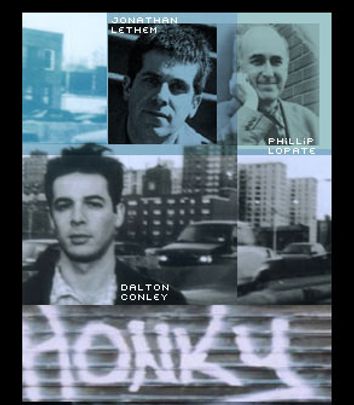
I was lucky to be sent a copy of Dalton Conley’s “Honky” in galleys six months ago. Lucky because it’s a wonderful book but also because, as a memoir describing Conley’s experiences growing up in 1970s New York as a white kid in a largely poor black and Hispanic neighborhood, it confirmed some of the strangest parts of my own childhood experience. I’d just been searching for a way to give some of this material a voice in a new novel, and Conley’s book helped.

Conley is a trained sociologist and a career academic teaching at New York University. His book raises his own anecdotal experiences into a sociological light, making it a kind of memoir-plus. Yet it seemed to me the book ultimately comes down on the side of the personal, and on those terms it’s a triumph. Like any novelist arraying himself with inspiration for a long voyage into unknown territory, I took it as a hopeful sign.

A month or so later, I was lucky again, in coming across Phillip Lopate’s essay “The Countess’s Tutor” in the fifth anniversary issue of Doubletake magazine. Lopate’s description of his family’s move from Williamsburg, a Jewish neighborhood in Brooklyn, N.Y., into largely black Fort Greene echoed Conley’s experiences, and my own, uncannily. It was all the more striking for the way certain rituals that had seemed so particular to my 1970s experience were already evident in the mid-’50s. Just like Conley and me, Lopate had been repeatedly posed an inexplicable and unanswerable question by the black and Hispanic kids on the streets where we lived: “What you lookin’ at?”

The three of us met in Brooklyn over coffee, cookies and a tape recorder in November to talk about it.

— Jonathan Lethem

Phillip Lopate: I really liked [Dalton's] book. It’s not easy to do the adult voice but keep the child psychology. And you got a plotline going in spite of this choppy episodic stuff that can happen when you’re talking about your childhood: “Then we did this, then we went around doing that.” There’s humor and perspective. Fortunately, Dalton did so many bad things when he was a kid that you didn’t have the problem of a goody-goody character. You had an embarrassment of riches.

One of the hardest things in writing about the kind of background we’ve had — being a white kid in a minority neighborhood — is that there’s a tendency to hero-worship the blacks or Hispanics and, underneath that, to patronize them and not, on some level, to be honest. You showed how attractive, for all kinds of reasons, black culture and Hispanic culture were for you, but you also showed that character putting a knife to your head.

I remember when I was much younger, and read an essay by Gregory Corso in Esquire where he talked about being white and being beaten up by black kids. It was the first time I’d ever read anything like that. You don’t know where to go with those feelings. What are you going to say? “I was oppressed too.” “Um … my oppression to me is the same as your oppression.” That’s why I think your tone of irony is so important.

Dalton Conley: Who actually knows why you got the crap beat out of you? I mean, all kids beat each other up. I’m sure I would be a very different person if I’d been 6-foot-5 and 220 pounds of muscle. The whole dynamic would have changed then, because toughness would have been on my side, regardless of race. It’s hard to know what went on, because I was a skinny white kid. In some ways I regret the way I titled the book. I wanted a punchy, quick title. But it makes people who haven’t read it think it’s “Oh, poor white boy complaining about reverse racism and being singled out and called ‘honky’ all the time,” and that’s not what I wanted to get across at all.

Lopate: No. But it’s not a bad title for a book.

Jonathan Lethem: This is exactly what I’m wrestling with: the difference between ordinary bullying and bullying with racial overtones. And then this — call it reverse racist bullying, for lack of a better term.

In those moments the wider context — that my tormentors were powerless in society and that I was a representative of the powerful majority — was right there with us, even at age 10, 12, 13. The impossibility of ever claiming racism as an issue was something I felt. If I pointed out what was going on I was automatically a racist. That silenced me.

Lopate: It often shocked me that I was not being bullied. I was the only white kid at summer camp, and nobody picked on me. Why would they be even remotely threatened? There was no reason to pick on me. I felt a little bit ignored. It was their world. I experienced this confusion — feeling scared and threatened and wondering why there wasn’t more tension. And since I’m Jewish, I was threatened as many, if not more, times by the Irish kids, who waited outside Hebrew school, as by the black kids.

Conley: When you would go to, say, a different black neighborhood, to Harlem or to a different area of Brooklyn that was predominantly black, did you immediately feel a different dynamic? I know that when I would go to, say, Spanish Harlem — which is almost demographically the same as the Lower East Side — just because it was unfamiliar, and because I didn’t see the same faces hanging outside of the Puerto Rican social clubs as I did in my neighborhood, I did feel threatened in that way, which is sometimes remarkably absent in your own home area.

Lopate: I know what you mean, because where I grew up, in a black neighborhood, I definitely felt that people knew who I was, that I belonged. But a friend of mine who went up to Harlem one day was robbed, because everyone knew he didn’t belong there.

Lethem: I think there are invisible zones in neighborhoods. I knew when I was moving from the terrain that was dominated by the kids from Wyckoff Housing Project, as opposed to the kids from the Gowanus houses, because they had different turfs, and some of them knew you and nearly had an investment in protecting you. You were OK because you were recognized. Those invisible codes were at work.

When I first lived in this neighborhood, in the early ’70s, it was before there was an absolutely racial divide inside public housing. I had a couple of white friends inside the Wyckoff houses.

I knew a Jewish kid who lived there with his older brothers and his parents. The oldest of the brothers wasn’t tough, just older, a big chubby Jewish kid, and when I visited he would walk me out of the housing project. He knew he had to. He had his turf and he could escort me back home.

But it strikes me that before those codes are in place, there’s a degree of teaching that goes on. In Phillip’s essay where he writes about that question: “What you looking at? What you looking at?” I felt such recognition. I remembered how I felt I was being initiated into codes of deference — that until I’d learned how to move through the streets, I was going to be confronted.

Lopate: By the way, what is the solution to that question, “What you looking at?”

Lethem: Well, it’s by definition an unanswerable question. That’s the trick to it. You caught that beautifully in your essay: “How am I supposed to answer? What if I were looking at you, what would it mean? Why do I have to try to answer this question that has no answer?”

Conley: When you’re alone, or in that sort of street-level interaction, somehow the societal-level paradigm always gets flipped. I don’t know if it’s because when you’re poor and a minority in the United States that you’ve got nothing to lose, so just growing up that way makes you tougher. But it’s likely going to be the person who’s in the dominant group of society as a whole who acts very scraping and deferential in that kind of situation and says, “Nothing” when they’re asked, “What are you looking at?”

Lopate: You know, it was absurd, because I got so involved with jazz and blues, and I would walk down the street thinking, “I’ll tell them that I like jazz and blues.” And I had an almost scholarly relationship to the jazz and blues and I had a lot of black friends in high school, and they’d come over to the house, and I’d play them these things like the Five Blind Boys of Mississippi and they’d be so embarrassed. They’d say, “That’s the stuff my grandmother listens to.” And even when I was playing Charlie Parker, they had moved on. They were listening to organ and saxophone combos that were playing in Harlem. They weren’t listening to this. I had become a “Ph.D. in spadeology,” as they used to say.

The thing about power, though — I had an experience when I was about 13, 14 where my parents had a camera store near Myrtle Avenue, which was right by a big, black public housing project.

And they would send me in to try to collect, with these packets of photographs that had not been picked up — because people would send their pictures in, but then they didn’t have the money to collect them. So I’d knock on the door, and I’d hear the sound of pure terror. “It’s the man!” And I could have been 6-foot-5, I could have been the landlord, as far as they were concerned. They were behind closed doors, scurrying around saying, “Don’t open it!” and “What are we going to do?” In that situation it was very clear who was in the power seat.

Conley: I think sometimes it could break either way, in the sense that, for example, being called “honky” or any sort of racial epithet doesn’t work. It just sort of falls flat, like a bad pitch, compared to the reverse.

Something I talk about in “Honky” is the issue of “cultural capital” — a term sociologists use, which describes how my parents had a certain middle-class status no matter how little money they had. For example, when my local school got so bad, they might not be able send me to private school, but they could get a friend of theirs on the West Side of town to get me into the Greenwich Village school by lying about our address.

Coming from a family of artists, I knew all these totally useless references, in terms of any objective standard. But if I were to go to college, the fact that I knew who Jackson Pollock was would help me out in the interview. And so on.

Ironically, I think I was also advantaged because I sucked off the cultural capital of the neighborhood, in the sense that thinking of a quick retort to “What are you looking at?” or “Your mother’s so stupid she tried to alphabetize the M&M’s” was the perfect training for being an academic, for being a professor. That’s what we do. We sit around snapping on each other.

Lopate: I think in a way what you’re talking about, and again I identify with this, was your parents were bohemians. And it’s a strange class.

Lethem: I think it stands outside class …

Lopate: It pretends to be outside class. There’s no such thing as outside class, but it pretends to be, and there’s a kind of reverse snobbism. Just like my parents said, “Well, we’re living in the ghetto, but we’ve got the Bach records, and we know who Jackson Pollock is … We’re more sensitive.”

Lethem: Right, sure. Our parents cultivated an aesthetic of renouncing the things that were seen as middle class. I didn’t understand that we were as poor as the people in the neighborhood around us, but we were. I was insulated from that understanding by the book-lined walls and the people who would come over for dinner, the things that connected us to the world.

In fact, it was an enormous advantage when I finally got to college and met my ostensible peers, who were from the middle class but were often much more culturally deprived than I was.

Lopate: When I got to college, I went to Columbia, and I could not stop talking about the ghetto. And they would say, “Come on, Lopate, relax, you’re not there anymore.” Meaning, “You don’t have to be scared.” I wasn’t scared, I was boasting. And I felt like they didn’t understand something that was so important, that was reality. So I kept bringing the ghetto along with me.

Conley: I think you were more self-aware as a kid. Because for me it was quite the opposite. I longed for the lawns, the middle class, and when I came back from college after the first year at Berkeley, I asked my mother, “How could you ever raise your kids in a place like this without even grass and trees and a backyard? You’re so selfish.”

Now, of course, I would never have traded it for the world. I could never leave New York. I’m trapped here because of this experience, I think. And in some ways it’s very limiting. I’m envious of people who can feel comfortable in the malls and the backyards of suburban America.

Lethem: I grew up in a sort of hippie-Utopian atmosphere where my parents taught me to be oblivious to race. What I couldn’t have been prepared for was the way the community around me insisted that I learn to see myself as white. Even though I wasn’t insisting on their racial identity, they insisted that I understand mine. And they named it. I was the white boy. And I could never have produced the words “black boy.” I’d been trained it to feel it was unsayable.

Lopate: What’s your religion?

Lethem: My mother was Jewish and my father is a WASP from the Midwest.

Conley: Exactly the same.

Lopate: I gotta say, both my parents are Jewish, and I never thought of myself as white, I thought of myself as Jewish.

Conley: I never thought of myself as Jewish, I always thought of myself as white. Race so trumped any differences between ethnic groups within the white population.

Lethem: I think I bridge your two experiences. In Phillip’s essay there’s this older idea that there were many ethnic zones — Italian, Jewish, Irish, Puerto Rican, black, Polish. Then there’s Dalton’s experience, which is essentially being in a neighborhood where the only issue is skin tone anymore.

In my childhood, by chance, I moved from one to the other. From first to third grade I was at a school where there were only blacks, Puerto Ricans and a scattering of motley hippie kids, like myself, who were white. That was Dalton’s reality, where the only question was, “Oh, I’ve got white skin.”

Then, for fourth grade, I moved to Carroll Gardens, an old Italian enclave [in Brooklyn]. There I was no longer in the minority by skin tone. But I was met with this very self-aware, self-defining majority of Italian kids, who didn’t welcome me either. They introduced me to those finer distinctions that belonged to the older Brooklyn, to Phillip’s childhood. “Oh, you’re Irish, you’re Italian or you’re a Jewish kid. Or we can’t help you if you don’t know what you are.” Which was sort of my problem.

Later I realized that the kids from the black housing project on the edge of the Italian neighborhood recognized the difference, too. My brother tells a story of being on Court Street and being surrounded by a bunch of black kids, who were ready to shake him down but weren’t certain he wasn’t Italian. And they said, “Hey, you a white boy or you Italian?” And my brother’s response was, “Well, wait a minute. What do you mean? Those Italian guys are white, too! If you’re going to take my money, take their money, too.” But the black kids didn’t see it that way.

Lopate: Oh, sure, they’d come after them with baseball bats.

Lethem: Yeah. Whereas you and I, Dalton, as the Jewish bohemian kids, whatever we were, there was no team with baseball bats to take vengeance for us.

Lopate: It definitely is quasi-generational. I was born in ’43, I came up in the ’50s, at a time when Jews were still very black identified. There was all this “Let my people go,” and my parents had the Paul Robeson records. There was this feeling that the Exodus story and civil rights were connected. There was a whole involvement in the NAACP, etc. And this was before the big falling out occurred in about ’64.

So if my parents taught me anything, it was to mistrust other whites a lot, and blacks somewhat, but not as much as other whites.

Lethem: My parents, who are about 10 years older than you, Phillip, had the same instinct, but perhaps it had just then become obsolete. Certainly the blacks in the neighborhood we moved into didn’t honor it.

Lopate: I don’t think the blacks honored it in my neighborhood, either. As Baldwin says in his essay about uptown, “Blacks see the Jews as a frontline of bill collectors.” But culturally, we felt a warmth. It didn’t last forever, but it was part of the scene.

Conley: Mine are about five years older than Phillip. And I think that in some ways, they probably had some of the same attitudes, but didn’t know at the time what they were getting themselves into, moving into a project. In fact, my father was horrified by moving into a cookie-cutter apartment. He thought it was the urban equivalent of tract housing. It wasn’t bohemian enough. But how could they know the overblown cultural symbolism the word “project” would take on over the course of the next generation? Now, partly because of the success of rap music, it’s become a certain badge of honor.

Lethem: Another generational difference is the enormous advance in Jewish assimilation in the years between Phillip’s childhood years and ours.

Conley: I totally agree. I didn’t even think about being Jewish until I went to California and I realized that I was in a stigmatized group. And then I reread my past. I literally read my high school yearbook and realized, “My god! All these people are Jewish!” Andy Epstein, who was tall and blond and blue-eyed and good looking — I would have never guessed that [he was] Jewish. I didn’t even think, “Epstein, of course he’s Jewish.”

That’s something new to our generation. The other kids, they probably thought I wasn’t Jewish. And the kids that I thought weren’t Jewish because they also had Irish names, they were Jewish too.

Lopate: You know, I want to talk about the issues of writing about this stuff, because I think we can only go so far with sociology, even though we have a sociologist here. I think that it’s still something that takes a certain courage to write about. It feels like a minefield. It feels dangerous. At least it did to me when I wrote “The Countess’s Tutor.” I felt like, “I’m going to get in trouble, but I’m just going to put this stuff out.”

I think one reason Dalton’s book is a triumph is that he does so well with the Dalton character. But every once in a while I would feel like you were trying too hard to understand. That is, I would feel that you were trying to explain that whites still had the power, so there were very good reasons for blacks to be responding in this way. Sometimes I would be grateful for those passages; I would think, “Well, he’s trying to get at a larger understanding.” And sometimes I would be not grateful for them and think, “Well, this is mucking up the prose.”

Conley: You’ve put your finger on one of the most difficult parts of writing a thematic memoir, which is not, like “The Liars’ Club,” so individualized. I’m trying to speak to larger issues. And it was a tightrope to walk. I can’t tell you how many more explanations I crossed out at the last minute. Now sometimes there are a couple of things I wish I did say, because it’s such a sensitive issue, and almost presumptuous for me to write, as a white guy. In some instances I violated the cardinal rule of “show, don’t tell.” Sometimes I put a sentence here or there that would nudge the reader in the right direction. But I hope those were far and few between.

Lopate: They were. It’s a near-perfect book. Really. But there’s a kind of cover-your-ass statement that we all know about, you know, like “Oh my god, I don’t want them to think that I’m a racist because this black kid beat the shit out of me.” But, you know, maybe at that moment you were a racist. And I felt like there was possibly even a certain anger that you weren’t putting in.

I feel that in nonfiction we have to tell as well as show. But it’s a question really of the kind of telling, and how to get a perspective which doesn’t feel like damage control.

Lethem: Damage control’s a great word for it. When you add race to those pure childhood experiences of fear or violence you create a confusion that has no good name. And so you’re afraid the only name for it is racism. To open your mouth at all is to make a mistake.

Lopate: I think it has to do with the Other, on the deepest possible level — that moment when the Other appears to us as nonhuman, or certainly not as fully human as we experience ourselves to be. And whether that’s the way a man feels about a woman, or whether that’s the way a white feels about a black or a black feels about a white, it is this issue of otherness. And I think that part of what political correctness has made us do is to jump and flinch. And what I’d like to see is just a little bit more sitting in the mud of confusion and saying, “You’re absolutely right. We all are fully complex human beings, but let’s not exaggerate our ability to be compassionate with everybody. Let’s recognize how hard compassion really is. Let’s not oversimplify.” You look like you want to disagree.

Conley: I don’t want to disagree with your assessment. I wonder, though, about the way it actually plays out in the sort of constant verbal abuse and constant jostling for position — how many roaches you had in your apartment, how old and dirty your sneakers were, whether your mom was a whore. There are things that would be so easy to say when anger is boiling. How does a kid who’s 9 already know that he can’t say something about how black the other kid is, if you’re white?

It’s always the sensitive issues that can’t be named. I don’t think it’s anything particular to race. If a kid is fat, kids will say so, immediately. Nothing’s stopping them. But picking on somebody about race or about class — even among young kids they’re already socialized that you never do this. If it was only being fat or being tall or short, a physical characteristic, we wouldn’t be so scared to say it. We could say, “Your mother’s so dark.” And then the person would just come back with, “Your mother’s so pale.” Somehow racism is different.

Lopate: I agree that racism is fundamental and important. What I’m really talking about is not what it’s like to be a kid, but our job as writers. And how do we touch explosive material without hedging too much?

Lethem: I want to throw your question back to you, Phillip. In writing that essay, do you feel that you unearthed anger in yourself?

Lopate: Well, I think I’ve certainly got fear. But you know, when I wrote “The Countess’s Tutor,” I was just as nervous saying that the woman I called the Countess was fat. When I described the kid who beat up my brother and compared him to a panther, I thought, “This is going to get me in trouble, this is stupid, don’t do this.” And I thought, “Well, but at that moment, the physicality is what impressed me.” And so this is the question: How do you describe people, knowing that you’re not going to take them on fully and walk in their shoes?

In Dalton’s book, there are clearly people whom he’s going to treat as basically loose cannons, who are totally scary — like the kid who put the knife to your head — and who are not really entered into that much. And then there are the friends, who are given much more reality. It’s funny, this may seem unfair to say, but in a way you’ve benefited from one of your friends being shot and paralyzed. It gave an arc to the story.

Lethem: This is interesting, because the writer’s guilt at using life stories is recapitulated, in this case, in the white kid’s guilt at surviving experiences which the black kid couldn’t. He ends up in jail for them; the white kid ends up in college in California. So similar to that “getting away with it,” which can be an aspect of the writer’s experience. “Oh, we’re all traumatized, but I’m the one who’s got the material afterwards.”

Conley: In some ways I still feel probably more racist than somebody who grew up in lily-white Indiana or somewhere. I tell a story in the book about how in Pennsylvania, where we went for the summer, my sister had a sleepover, and a girl told a ghost story about “the big nigger in the woods” with a complete lack of self-consciousness, just like a story about Bigfoot. In certain ways that’s more innocent, and less racist than I’m capable of being in my head at certain times because of my intimate knowledge of surviving these invisible racial and class wars on a daily basis for my entire childhood.

It’s sort of like being a spy — although I wasn’t a very good one because of my skin color. Your allegiances are compromised. Your knowledge of the “enemy” or the Other is so intimate that you become confused about where you’re coming from and what you feel.

Lopate: You asked me if I was still angry, and I think the answer that immediately came to mind was that most of the anger was at myself. And I think part of what happens when you cross those lines is that you end up internalizing both groups and you can’t help but take it out on yourself.

Conley: I take it out on others, in my head at least. I feel like when I’m with whites, I get so angry and so bitter, as if I practically identify myself as the secret black. Then, when I’m in an African-American or a Latino community, I still can’t resist the behavioral explanations of poverty. Like, look at my old neighborhood. It’s still got garbage and graffiti over it. People don’t clean it up themselves; it’s their own fault. I start getting angry and conservative and sounding worse than George Bush. If you averaged those two, I’m probably average, in terms of my racial attitude. But they’re really nowhere in the middle. They’re very extreme.

What the experience gave me was not any hard insight, but more emotionality about it. I’ve devoted my entire career to these issues because I’m still trying to figure out these contradictory emotions in some rational or scientific manner through sociology — as if I’m going to uncover the magic bullet, though I know I’m not.

Lethem: The book becomes an argument for literature as the only method for dealing with the experience.

Lopate: Yeah, but there are so many bad memoirs. It’s unusual to be able to laugh at oneself and have a sense of perspective, even if you haven’t solved the confusion. The chances of creating literature are very small.

Listening to you, I still think I get angry at myself, and I think the reason is partly a kind of self-distrust that comes from having been too many people. I can no longer trust that I am one thing and one person. I’ve created a chameleon personality that can actually get along with almost everybody. But I guess in some ways I see myself as an actor. That’s the training you get on the streets.

Lethem: Sure. By the time I got to college I could already tell that I was more a chameleon than any of the upper-middle-class or middle-class kids around me. I could haul out the ghetto moves for their entertainment, but I knew I was playing. I could also slide into their social context, but I knew I was playing at that.

Conley: I still feel totally uncomfortable in a white working-class context. Probably there’s where I feel the least comfortable, and next would be a minority context of any class. I’m most comfortable, increasingly comfortable, in white intelligentsia. But I think it’s related to a feeling of a lack of authenticity that is perhaps common to all writers, or to all people who are trying to spin reality.

Lethem: Among writers or academics you can look through anyone’s mask and know that it’s constructed. You know, as you become credentialized, as you publish a few things, you realize, “Oh, we’ve all manufactured this identity. No one was born to it. So here’s where I can be as natural, at least, as everyone else in the room.”

Continue Reading Close

A free market election failure

Iowa economists gambled that they could predict the presidential election. They lost.

If there were ever a time when the country needed a better way to predict elections, it is now.

For a while, it seemed like economists had the answer: create a futures market for political candidates. A decade ago, the University of Iowa received a special waiver to allow gambling on U.S. elections. And so the Iowa Electronic Markets were born to test an economic theory: the efficient markets hypothesis.

The theory is simple. It states that the current price of any commodity in an exchange market reflects the total amount of information available at the time; in other words, it’s the “correct” price or the best possible prediction.

In terms of politics and predicting elections, the implication is that free markets are smarter than polls or pundits. However, it seems that for the time being at least, economists will have to go back to the drawing board with the rest of us, for the futures markets performed as badly, if not worse, than astrology, sports superstitions and every other method for handicapping the presidential race.

There are actually two presidential markets in Iowa. The more popular version is called the winner-take-all market, in which investors buy futures contracts that pay $1 each on Nov. 10 if your chosen candidate wins the popular vote as reported by the New York Times that morning.

The other market is called the vote-share market; it pays out $1 multiplied by the proportion of the popular vote received by that candidate on the same day. So if you bought Bush vote share futures at 40 cents apiece, and then he garnered 48 percent of the popular vote, you’ll walk off with 8 cents for each contract you owned.

This year, both methods failed. As Bush and Gore quibble over who will claim the presidency, the Iowa Election Markets seem to mimic the confusion, delivering two contradictory results.

Iowa’s winner-take-all market pegged Bush as the clear winner, with confidence in a Bush win soaring in the days before the election. But on Election Day, the market swung wildly and finally flipped to favor Gore. The ambivalence held: Even as late as Nov. 10, the day the market closed, Gore futures were selling for 96.9 cents, not the full dollar they should have cost, given the payout. The vote-share market was more stable, but closed at an anomalous pricing of 49.1 cents for Bush and 48.1 cents for Gore.

At first blush, the efficient markets theory seems a reasonable way to predict elections. Think about it: If a pollster calls you up and asks you who you plan to vote for or who you think will win, you have little incentive to carefully consider your answer. Maybe you say you’ll vote for Bush or Gore, but when Election Day comes around, you never make it to the voting booth. Maybe you aren’t a very representative voter. These are the intangibles that have driven generations of political scientists crazy.

But if you, the respondent, has to put your money where your mouth is, it’s a different story altogether.

Regardless of your political affiliation, you’ll make the prudent bet — placing your money on the candidate you think will actually win. It’s a bet based on the belief that the true odds of a particular candidate winning — according to you — are greater than the odds determined by the market, that is, that you know something everyone else does not. This is called arbitrage. Of course, as soon as you put in a buy order for Bush, the equilibrium price goes up, reflecting the impact of your “bet.”

Hence the notion that the market perfectly reflects the future as suggested by the present.

In a recent paper, professors Steve Kou and Michael Sobel of Columbia University claim that, all else being equal, “when market participants have access to poll results, the market forecast is superior” to preelection polls. Market forecasts should be able to predict elections for the same reason that agricultural futures like pork bellies and cotton do a better job of predicting the climate than the National Weather Service: The numbers reflect the informed judgment of people who have money on the line.

But why were the Iowa Electronic Markets so erratic in predicting this year’s election? Perhaps the simplest explanation of why both markets performed poorly and converged to different results is that the they were too small.

Officials who manage the Iowa Electronic Markets report that the total capitalization at the close of the winner-take-all market was about $70,000, with a meager $6,500 for the vote-shares market. The lower the betting pools — that is, the amounts at stake — the more room there is for market imperfections. Smaller sample sizes yield less accurate statistics. Prices should converge to their “true” value as the number of traders and the amount capital in the market increases.

It is entirely possible that, had the markets been better publicized and attracted a lot more capital, they would have performed better. But there are a number of reasons to be suspicious of this facile explanation when it comes to politics.

First of all, politics pollutes markets. Perhaps people who are passionate about their candidate bet money on him in order to show support even though all available information spelled failure. In other words, maybe betting in an election market is more like making a political donation: Knowing that others watch the price of the Bush and Gore futures as an indicator, perhaps some investors spend money like a political advertisement to promote the inevitability of their favored candidate. Possibly, Bush supporters are more strategic or more committed in this way. They put their mouth where their money is.

Secondly, inequality matters. On average, Bush supporters are wealthier than Gore supporters. Therefore, they can afford to be less risk-averse than the Gore camp.

Think about it this way: If you support Gore, but only earn $20,000 a year, you might think twice before you bet $100 of your precious cash on Gore. If you’re a millionaire Bush supporter, betting $100 or even $1,000 in an election market is no big deal.

This stems from another economic theory: the declining marginal utility of money. If you already have $1 million, one additional dollar means a lot less to you than if you have only $10 to your name, when it makes up 10 percent of your total net worth. So the value of money may be different to Bush and Gore supporters.

Another reason why the Iowa markets failed relates to the use of futures to hedge risk. Stocks, commodity futures, options and even insurance were all once forbidden by anti-gambling laws. Now they’re a socially acceptable way to make a living or to protect one’s assets from risk.

When viewed as a way to hedge risk, election futures make sense: After all, the elections have enormous impacts on stocks, bonds and the value of other financial instruments both here and abroad. Futures are all about hedging risk, so why shouldn’t we hedge our political risk as well? If I’m one of the top 1 percent of American earners who stands to gain enormously from a Bush election, I may want to insure myself against his loss by purchasing Gore futures. This would suggest that investors would bet against their preferences and/or predictions.

Whichever way the election turns out, economists should take note. Markets are not all-knowing or all-powerful. There is a constant battle between the passions and the interests — and sometimes the passions win. Markets cannot be universally relied on to predict the future any more than religion, astrology or genetics can.

Continue Reading Close
www.salon.com/writer/dalton_conley/index.html