David Hill

Sharps & Flats

Woody Guthrie's "Dust Bowl Ballads" drew the road map for Bob Dylan and Ramblin' Jack. A reissue recaptures the parched glory.

  • more
    • All Share Services

“On the 14th day of April of 1935/There struck the worst of dust storms that ever filled the sky.”

So begins “Dust Bowl Ballads,” Woody Guthrie’s great song cycle, recorded (most of it, anyway) on a single day in April 1940 at RCA Victor’s Camden, N.J., studio. For his efforts, Guthrie was paid $300, which he used as a down payment on a car. “This bunch of songs ain’t about me,” he wrote in the album’s original liner notes — but of course they were. “They are ‘Oakie’ songs, ‘Dust Bowl’ songs, ‘Migratious’ songs, about my folks and my relatives, about a jillion of ‘em, that got hit by the drouth, the dust, the wind, the banker, and the landlord, and the police, all at the same time.”

Guthrie, himself an Okie, was living in New York when his friend Alan Lomax, the folklorist, persuaded RCA to produce a 12-song, two-volume collection of the folk singer’s Dust Bowl songs. The label liked the idea and arranged for Guthrie to take the train down to Camden. “I don’t usually write ballads to order,” Guthrie told Pete Seeger, “but Victor wants me to do a whole album of Dust Bowl songs, and they say they want one about Tom Joad in ‘The Grapes of Wrath.’” Guthrie meant John Ford’s movie version, not John Steinbeck’s book, which had been published in 1939. (He claimed not to have read it.) Guthrie went to see the picture one evening, then he stayed up all night swigging from a jug of wine and writing “Tom Joad.” Sung to the tune of “John Hardy,” an outlaw ballad, he finished a trenchant, six-minute summary of Ford’s movie. “Wherever little children are hungry and cry,” Guthrie sings in his rough, twangy voice, paraphrasing Henry Fonda’s famous lines, “Wherever people ain’t free/Wherever men are fightin’ for their rights/That’s where I’m a-gonna be, Ma/That’s where I’m a-gonna be.”

The other songs are just as powerful. There’s “The Great Dust Storm (Dust Storm Disaster),” the opening number, about the defining moment of the Dust Bowl, when a black wall of dust blew across the plains. It was an event Guthrie witnessed while living in Pampa, Texas. There’s “Pretty Boy Floyd,” about the famous bank robber, recast by Guthrie as a Depression-era Robin Hood who leaves $1,000 bills under the napkins of starving farmers. There’s “Dust Bowl Blues,” Guthrie’s take on a Jimmie Rodgers-style country blues melody. There’s “Vigilante Man,” an eerie portrait of the goons who terrorized the migrant farmers searching for work. (“Tell me what is a vigilante man?/Has he got a gun and a club in his hand?/Is that a vigilante man?”) There’s “Do Re Mi,” one of Guthrie’s most famous songs, a lighthearted reality check for the poor souls dreaming of milk and honey as they headed for California, the Promised Land. On all of them, Guthrie plays guitar — perhaps it was the one with “This Machine Kills Fascists” scrawled on it — and harmonica. The sound is spare, the aural equivalent of Dorothea Lange’s famous black-and-white photographs of poor migrant families.

“Dust Bowl Ballads” didn’t cause much of a stir when it was released, though some reviews were favorable. One writer in particular, Howard Taubman of the New York Times, seemed to understand what Guthrie was trying to achieve with his music: “These albums are not a summer sedative. They make you think; they may even make you uncomfortable.” But as Guthrie became more famous, so did “Dust Bowl Ballads.” By the time it was reissued in 1950, it was widely considered a landmark recording. In the 1960s, it served as a musical road map for folkies like Bob Dylan and Ramblin’ Jack Elliot. More recently, Bruce Springsteen fell under its powerful sway, particularly on “Nebraska” and “The Ghost of Tom Joad.”

“This Land Is Your Land” may be Guthrie’s most famous song, but “Dust Bowl Ballads” is his masterpiece, an American classic that deserves to be placed alongside “Huckleberry Finn,” Elvis Presley’s Sun sessions or, for that matter, both versions of “The Grapes of Wrath.” It’s that good.

Rounder Records released “Dust Bowl Ballads” as a CD in 1988, but that version has been out of print for several years. Buddha Records has brought it back. The latest reissue contains just one previously unreleased song — an alternate version of “Talking Dust Bowl Blues” — but the sound is far superior to Rounder’s disc, so much better, in fact, that it renders that earlier CD obsolete. Buddha also had the good sense to restore Guthrie’s wonderful liner notes. They were, as usual, characteristically understated and humble. “This bunch of songs are really just one song, ’cause I used the same notes,” he wrote. “Just fixed ‘em a little different, that’s all. Same old notes as ever.”

Sharps & Flats

Versatile country and blues player Doug Sahm goes out with an album of songs dedicated to love -- and Texas.

  • more
    • All Share Services

Doug Sahm
“The Return of Wayne Douglas”
Tornado Records If ever there was a performer who defied labels, it was the late, great Doug Sahm, who died of a heart attack in November in a Taos, N.M., motel room, at 58. Throughout his long career as a singer and guitarist he played rhythm and blues, rock, blues, country rock, Tex-Mex — you name it. He probably played damn good polka, too.

A musical child prodigy, “Little Doug” Sahm was playing steel guitar when most kids were playing cowboys and Indians. At 9, he was a featured performer on San Antonio radio shows, backing up local and national Western swing bands. When Hank Williams came to town, the boy got his picture taken sitting on the master’s lap. The pull of rock ‘n’ roll was strong, however, and soon a teenage Sahm was fronting his own combos — the Knights, the Pharaohs, the Twisters, the Mar-Kays, the Dell Kings and others — and playing passable rhythm-and-blues music. (The highlights from Sahm’s earliest period can be heard on the recent release “San Antonio Rock: The Harlem Recordings, 1957-1961,” on Norton Records.)

Sahm would go on to form the Sir Douglas Quintet — the name was a producer’s ploy to pass the band off as British Invaders — recording such ’60s AM radio classics as “She’s About a Mover” and “Mendocino.” Signed to Atlantic Records in 1973 by Jerry Wexler, he recorded two fine (but poor-selling) albums for the label, “Doug Sahm and Friends” and “Texas Tornado.” Tall and lean, with long blond hair, mutton-chop sideburns and granny glasses, he was the original hippie cowboy, a Lone Star hipster who palled around with Dylan and Janis and the Grateful Dead.

Sahm’s subsequent work was all over the map, as sprawling as the wide-open Texas landscape. In his adopted hometown of Austin, Sahm was a legend, the patron saint of Texas music. When he died, the Austin Chronicle put Sahm on the cover and dubbed him the “State Musician of Texas.”

For what would turn out to be his last record, Sahm went back to his country roots, recording a superb collection of songs with a crack band, including son Shawn on background vocals, longtime cohort Augie Meyers on organ, Bill Kirchen on electric guitar, Tommy Detamore on steel guitar and Bobby Flores on fiddle. (The latter two, in particular, are featured prominently.) You won’t be hearing any of it on country radio, though. “The Return of Wayne Douglas” — the title comes from one of the aliases Sahm used when he played country gigs around Austin — is as fresh as a just-opened, ice-cold bottle of Shiner Bock, but its sound is closer in spirit to Buck Owens than, say, Tim McGraw. “I’m a real country fan, son,” he sings in “Oh No, Not Another One,” a stinging critique of current C&W fare. “When country changed to pop, they had a laugh/As the real country fans got the shaft.” “The Return of Wayne Douglas” is for country fans who like their music hard.

Naturally, the album’s 12 songs are mostly about love: the love of women and the love of Texas. In “Cowboy Peyton Place,” Sahm walks into a bar for a beer and winds up falling in love “with the steel guitar player’s wife.” Soap opera ensues. In “I Can’t Go Back to Austin,” a lover’s boyfriend threatens to punch him out if he shows his face around town. “Huggin’ Thin Air” finds Sahm doing just that as he wakes up in the morning to find his lover has up and gone.

In “Beautiful Texas Sunshine,” a standout track that features some excellent pedal steel work by Detamore, Sahm muses on the joys of hanging out and doing nothing — and then moving on. “Texas Me,” which closes the album, is an ode to Sahm’s beloved state, written in California more than 30 years ago during a bout of homesickness. “I wonder what happened to that man inside,” Sahm moans in his soulful, gravelly voice, “the real old Texas me.”

Two covers — Dylan’s “Love Minus Zero/No Limit” and Leon Payne’s “They’ll Never Take Her Love From Me” — demonstrate that Sahm was just as good singing other people’s songs as he was singing his own. Too bad he never recorded an all-Dylan album; it would have been great.

At the end of “They’ll Never Take Her Love From Me,” Sahm tells a little story about the time he and his daddy visited Payne, who was known as “The Blind Balladeer,” at his home in Bandera, Texas. Little Doug was amazed at how easily Payne could get around inside his house without stumbling. “It just blew my mind,” he says. “And my daddy told me that some people, they’ve got this inner sight. They just can feel and see things that other people can’t see.”

Doug Sahm had a similar gift. The songs on “The Return of Wayne Douglas” may be about earthly matters, but Sahm infuses them lots of Texas soul, elevating them to heavenly heights. Sahm’s final recording is one of his best, a fitting end to the brilliant career of a true American original.

Continue Reading Close

Sharps & Flats

Steve Earle, once dubbed the "hillbilly Springsteen," learns that back roads "never carry you where you want 'em to."

  • more
    • All Share Services

“I ain’t ever satisfied,” Steve Earle sang on his second album, “Exit 0,” released in 1987. Thirteen years later, he’s still restless as hell, desperate for love and happiness but ready to hit the highway at a moment’s notice. Trouble is, as Earle confesses on the title track of his superb new album, the “backroads never carry you where you want ‘em to/They leave you standin’ there with them ol’ transcendental blues.”

When you consider that Earle, 45, defines transcendence as “being still enough long enough to know when it’s time to move on,” his ramblin’ ways seem inevitable. The boy can’t help it. Born in Virginia but raised in Texas, Earle made a big splash in 1986 with “Guitar Town,” his acclaimed debut album. “The hillbilly Bruce Springsteen,” he was called, not altogether inaccurately. His early albums were more rock than country, and his gritty songs, mostly about rebels and outcasts, had some of the same anthemic quality as “Born to Run”-era Springsteen.

In 1990, however, when his fourth album, “The Hard Way,” failed to sell, the good times came to a crashing halt. Dropped by his label, Earle descended into four years of cocaine and heroin addiction, funded by a steady stream of royalty checks. In 1994, he was busted for buying a tenth of a gram of heroin and spent a month in rehab. The treatment worked, and so began the second coming of Steve Earle. The singer-songwriter has produced one stellar disc after another: the roots-rockish “I Feel Alright,” the eclectic “El Corazsn” and the bluegrass-oriented “The Mountain” (recorded with the Del McCoury Band). “Transcendental Blues” continues the string.

Bob Dylan had a similar run in the mid-1960s, starting with “Bringing It All Back Home.” So, of course, did the Beatles. But in today’s world of disposable pop music, such an achievement is practically unheard of. On “Train a Comin’,” Earle recorded a great hillbilly version of Lennon-McCartney’s “I’m Looking Through You.” (“This is the stuff I cut my teeth on,” he wrote in the liner notes. “Middle Class White Boy Roots Music.”) This time around, he forgoes any covers, but the influence of “Rubber Soul” and “Revolver” is obvious on “Transcendental Blues.” Earle even plays a synthesizer on the title cut and tacks a strange little reprise onto the end of “Everyone’s in Love With You,” ` la “Strawberry Fields Forever.”

He doesn’t push the psychedelia too far, though. Earle and his band, the Dukes (guitarist David Steele, bassist Kelley Looney and drummer Will Rigby), along with assorted guest musicians, mix things up, dipping into Dylanesque folk rock (“Another Town”), Irish string-band music (“The Galway Girl”), bluegrass (“Until the Day I Die”) and flat-out rock ‘n’ roll (“All of My Life”). “I have spent most of my life (like most people) avoiding transcendence at all costs,” Earle writes in the liner notes, “mainly because the shit hurts.”

And it’s true: “Transcendental Blues” is a deeply personal album steeped in pain and loneliness. Nearly every song contains the word “lonesome,” “alone” or “lonely.” One is even titled “Lonelier Than This.” (“It doesn’t get any lonelier than this/I believe my heart’ll break/Tonight I prayed I’d die before I wake.”) “Wherever I Go” finds Earle “all alone,” with “a hurtin’ deep down in my soul.” Rejected, dejected, he promises to move on to another town, with his past behind him and his future bright. At the same time, he’s “thinkin’ ’bout givin’ up this ramblin’ ’round/Hangin’ up my highway shoes/Lately when I walk they make a hollow sound” (“Steve’s Last Ramble”). He longs for someone to ease the pain, to make life bearable, to catch him when he falls.

To keep things in perspective, Earle ends the album with the poignant “Over Yonder (Jonathan’s Song),” inspired, no doubt, by his experience as a witness to the execution of Jonathan Nobles, a convicted murderer who spent 12 years on death row in a Huntsville, Texas, prison. Earle, a passionate death penalty opponent, refrains from preaching, focusing instead on the prisoner’s thoughts as he prepares to die: “I am going up over yonder/Where no ghost can follow me/There’s another place beyond here/Where I’ll be free, I believe.” If a soon-to-die convict can be at peace with himself, Earle seems to be saying, so can I.

Continue Reading Close

Sharps & Flats

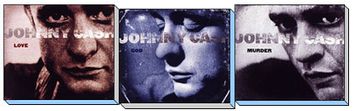
Johnny Cash never killed a man just to watch him die, but he forged a career of love, God and murder.

  • more
    • All Share Services

Sharps & Flats

In the summer of 1955, Johnny Cash, a gaunt 23-year-old singer from Arkansas, stepped up to the microphone in Sam Phillips’ tiny studio on Union Avenue in Memphis and recorded “Folsom Prison Blues,” with its irresistible twangy guitar intro and these now-famous (and still shocking) words: “When I was just a baby/My momma told me, ‘Son/Always be a good boy/Don’t ever play with guns’/But I shot a man in Reno/Just to watch him die.” He was so cool and convincing that to this day, there are people who assume Cash was singing about himself.

Unlike Merle Haggard, who served time in San Quentin State Prison for armed robbery, Cash, even in his hard-livin’, motel-trashin’ younger days, was never more than a small-time offender. According to Nicholas Dawidoff’s authoritative “In the Country of Country,” Cash was jailed on seven different occasions, each time for just one night. Once, he got thrown in the slammer in El Paso, Texas, after trying to smuggle amphetamines across the border from Mexico. (Cash’s early self-destructive habits are legendary and well-documented.)

But Cash is no murderer. Still, he has always identified with those who step outside of the law, and he has probably recorded more murder songs than just about any other singer alive — and that includes Tupac. Sixteen of them, including “Folsom Prison Blues,” can be found on the third CD of “Love God Murder,” a three-disc set of songs selected by the Man in Black himself. (Each disc is also available separately.)

With liner notes written by Cash, his wife June Carter Cash, U2′s Bono and, oddly enough, director Quentin Tarantino, the collection is surely intended to further cement Cash’s reputation as an American musical legend. (As if that’s necessary.) Trouble is, Cash’s long recording career has nearly as many peaks and valleys as Elvis Presley’s. “Love God Murder” contains some of Cash’s best (and best-known) songs, but it also includes too many forgettable ones.

“Murder,” for instance, kicks off (naturally) with “Folsom Prison,” followed by the chilling “Delia’s Gone,” from his acclaimed 1994 comeback album “American Recordings.” The two songs are joined at the hip. Cash, practically bragging about his bloody deed, sings, “First time I shot her/I shot her in the side/Hard to watch her suffer/But with the second shot she died/Delia’s gone, one more round, Delia’s gone.”

Those songs are hard to follow. By comparison, “Mister Garfield,” from 1965, and “When It’s Springtime in Alaska,” from 1964, are garden-variety murder ballads. Only when Cash sings in the first person — as he does on “Cocaine Blues,” “The Long Black Veil” and Bruce Springsteen’s “Highway Patrolman” — does he approach the brilliance of “Folsom” and “Delia.”

“God,” which contains 16 of Cash’s sacred songs, holds up better. One standout is “Belshazzar,” a revved-up rockabilly number from 1957 that Cash sang when he first auditioned for Phillips at Sun Records. (Cash pitched himself as a gospel singer, but Phillips convinced him to stick to secular material.) After Cash moved to Columbia Records in 1958, his producer, Don Law, allowed him to record “Hymns by Johnny Cash,” his second album for the label. “God” features three great songs from that effort: “It Was Jesus (Who Was It?),” “The Old Account” and “Swing Low Sweet Chariot.” Unfortunately, “God” contains a few numbers that never should have been resurrected, particularly “The Greatest Cowboy of All.” That would be Jesus, who, according to Cash, “loves all his little dogies/He speaks to them kind and gently/And he’ll lift up any maverick who falls.” Yee-haw!

“Love” is the standout disc of this collection. (It’s the one to buy if you don’t want the entire anthology.) To understand why, read Cash’s revealing liner notes. “I remember when I fell into June’s ‘Ring of Fire,’” he writes. “There was a lot of showing it as well as saying it. Never has there been a deeper love than my love for her. At times it was painful, but we shared the pain, so it was just half painful. Now, even though it [has] mellowed out, the flame of our love still burns, and it burns, burns, burns.”

The song, of course, is “Ring of Fire,” which June Carter wrote in the early 1960s after falling hard for Cash. “I felt like I was falling into a pit of fire and I was literally burning alive,” she has said. That’s a recipe for great love songs, and “Ring of Fire” is one of them. It’s here, of course, along with “I Walk The Line,” “All Over Again” and “I Still Miss Someone.” But many of the selections are little-known gems, like “A Little at a Time” (1962), in which a heartbroken Cash moans, “Hurt me, a little at a time/Turn me away, a little at a time/Walk away slow like you don’t want to go/Leave me, a little at a time.” Then there’s “Happiness Is You” (1965), a simple ode to the love of his life: “No more chasing moonbeams or catching falling stars,” he sings with contentment. “I know now my pot of gold is anywhere you are.”

Cash is now 68 and suffering from Shy-Drager Syndrome, a rare degenerative neurological disorder. Naturally, that adds a certain poignancy to “Love God Murder.” Is this Cash’s swan song? Don’t bet on it. Lately, he’s been recording a new batch of songs for a third Rick Rubin-produced album, to be released sometime later this year. He may even play a few shows here and there. It’s a touching footnote to a blessed career. As Cash muses in the notes, “God likes a Southern accent and He tolerates country music and quite a bit of guitar.”

Continue Reading Close

Sharps & Flats

Former Lonesome Stranger Randy Weeks' thin, wobbly voice conveys the pain and emotion of a grown-up cowpunk.

  • more
    • All Share Services

Sharps & Flats

The Lonesome Strangers were one of the great cowpunk bands to emerge from the same 1980s Los Angeles scene that produced acts like Dwight Yoakam, X and the Blasters. Jeff Rymes and Randy Weeks, the band’s core members, were known for their close country harmonies, which evoked the work of legendary duos such as the Delmore Brothers and the Everly Brothers. The Lonesome Strangers recorded three critically acclaimed albums, and they even managed to crack the Top 40 with a remake of “Goodbye Lonesome, Hello Baby Doll,” an old Johnny Horton number. But two years ago, shortly after the appearance of a fine album called “Land of Opportunity,” Rymes and Weeks went their separate ways.

For his strong debut solo album, “Madeline” (HighTone), Weeks hasn’t entirely abandoned his country roots, but he has added a healthy dose of soul and blues to the mix, with help from guitarist Tony Gilkyson (X, Lone Justice) and organist Skip Edwards (Dwight Yoakam). If Robbie Fulks and Tony Joe White (“Polk Salad Annie”) were somehow merged into one person, Weeks might be the result. He has the boyish, nasally voice of the former and the soulful attitude of the latter. An odd combination, perhaps, but it works.

Together, the 12 songs on “Madeline” — Weeks wrote nearly all of them — paint a dark, sometimes disturbing image of love gone bad. It may the best breakup album since Chris Isaak’s “Forever Blue.”

“Motor City,” the opening cut, with its driving, garage-band groove, finds the singer holed up in the bitter cold of Detroit, making plans to “take a little trip out West” to get over a soured romance. “Can’t Let Go,” which Lucinda Williams recorded on her “Car Wheels on a Gravel Road” album, makes it painfully clear just how hard that is to do.

In “Baby You Got to Choose,” Weeks pleads for lost affection: “I’m comin’ through your kitchen door/I’ll bring you biscuits baby, and so much more/First you got to choose/I want to show my good side to you.” When that fails, he takes a more direct approach. “I’m gonna tear your dress,” Weeks sings in a creepy monotone on the title track. “I’m gonna leave you with your hair a mess … I’m gonna muscle in/To all your hidin’ places/When I can.” It’s “I Just Want to Make Love to You” with twang.

Like Gram Parsons, Weeks has a thin, wobbly voice that at first listening seems utterly incapable of conveying the pain and emotion of his songs. But its very imperfection turns out to be its strength — think of Bob Dylan, say, or Howlin’ Wolf — and it’s the reason why long after the “Madeline” disc is back in the jewel case, the songs just keep playing.

Continue Reading Close

Sharps & Flats

Never before released on CD, "Country Favorites -- Willie Nelson Style" introduces the quirky singer before he became the Red Headed Stranger.

  • more
    • All Share Services

Sharps & Flats

Its hard to imagine, but there was a time when Willie Nelson — who will be honored with a lifetime achievement Grammy award on Feb. 23 — was just a funny looking songwriter struggling to make it as a singer and a performer. “I guess Nashville was the roughest,” a soon-to-be outlaw Nelson sang in 1971, near the end of his frustrating seven-year stint at RCA Victor.

As a writer, Nelson had already proved himself, having penned such classics as “Crazy,” “Night Life” and “Funny How Time Slips Away.” But fame as a recording artist was more elusive. His producer at RCA, legendary guitarist and Nashville Sound architect Chet Atkins, couldnt quite figure out what to do with the chubby fellow from Texas with the quirky vocal phrasing. Sometimes Atkins had the good sense to keep things simple, but too often he laid the syrupy strings and the mushy background vocals on a little too thick. Of the dozen or so albums Nelson recorded for the label, a few are superb, particularly the first, “Country Willie — His Own Songs” (1965), recently reissued on Buddha, and “Yesterdays Wine” (1971). Most, however, are pretty forgettable — and long out of print. None sold very well.

“Country Favorites — Willie Nelson Style,” from 1966, is a little-known gem from this period that deserves to be called a classic. (Its available on CD for the first time.) Recorded in just two days with members of the legendary Texas Troubadours, Ernest Tubbs band, the album is a showcase for Nelsons relaxed, jazzy singing style, which apparently baffled many Nashville regulars. The Troubadours, however, play with polished ease as Nelson alternates between upbeat Western swing numbers (“My Window Faces the South,” “Home in San Antone”) and tear-stained ballads (“Seasons of My Heart,” “Go On Home”), all of which had been made famous by other singers. (None of the songs on the album were written by Nelson.)

Nelsons now-famous habit of holding onto notes a little bit longer than your average country singer is especially evident on the swing numbers. On “San Antonio Rose,” the Bob Wills song, he gets downright abstract as he cheerfully adds an extra syllable here and stretches a phrase there. Wade Ray, whose incendiary fiddle playing can be heard on the uptempo numbers, once said, “Ive heard musicians say Willie sang out of meter. He did not sing out of meter. He phrased. He sang in front of the beat, behind the beat, and just came out at the end.” Well put.

“Country Favorites” spent 17 weeks on Billboards country chart, peaking at No. 9 — not bad, but it didnt make Nelson a superstar. “Red Headed Stranger” (1975) did that. “Country Favorites,” however, showed that Nelson was a first-rate singer and an interpreter of great American songs. Nelson made this abundantly clear in 1978, when he recorded “Stardust,” his collection of pop standards. But “Country Favorites” is where it all began.

Continue Reading Close

Page 1 of 2 in David Hill