Fearing more clashes between racist hooligans and mostly Muslim ethnic minorities, police detained more than 1,000 people in Moscow and several other Russian cities Wednesday, after weekend rioting in the capital left dozens injured.
Hundreds of riot police outside the Kievsky station in central Moscow hauled into police vans mostly young men and teenagers who were shouting racist slogans and raising their hands in Nazi salutes. Some were lined up against buses and searched by police. Officers confiscated an arsenal of weapons, including traumatic guns, knives and metal bars, police spokesman Viktor Biryukov said.
Police rounded up about 60 protesters in St. Petersburg, where radical groups also planned a gathering Wednesday.
Riot police prevented clashes in Krasnodar and Rostov-on-Don, southern Russian cities with large non-Slavic populations where ethnic clashes have been frequent in recent years, officials said. Dozens of mostly young men have been detained in central Russia and Siberia, Russian news agencies reported.
Resentment has been rising among Slavic Russians over the growing presence in Moscow and elsewhere of people from the southern Caucasus region, most of them Muslims. People from other parts of the former Soviet Union, including Central Asia, Armenia and Azerbaijan, also face ethnic discrimination and are frequent victims of hate crimes.
While ethnic Russians amount to about four-fifths of Russia’s population of 142 million, the country is also home to some 180 ethnic groups. The Caucasus region with its mountainous terrain and isolated valleys is home to at least 100 ethnicities including Chechens, who waged two separatist wars against Moscow after the collapse of the Soviet Union.
Analysts say it was the Chechen conflict, with atrocities and killings of civilians committed by both Russian federal forces and militant Islamists, that triggered the rise of xenophobia and neo-Nazism in Russia — and the growing resentment of Caucasus natives to ethnic Russians and Moscow’s rule.
Despite poverty and instability, the Caucasus region has Russia’s highest birth rate, and tens of thousands of young people flee home for central Russia and Siberian oil towns in search of jobs and a better future.
The Kievsky train station, where most of the detentions took place, is popular with street merchants from the Caucasus. The majority of those detained were Slavic Russians, although some ethnic minorities from the Caucasus were also taken into custody.
Police declined immediate comment on when those detained would be released or whether they would face charges.
An expert on hate crimes predicted, however, that most of them would be released shortly.
“Police will ride them around town and let them go; they won’t find enough place for them in police stations,” Alexander Verkhovsky of the Sova center told the Gazeta.ru online daily.
Moscow mayor Sergei Sobyanin said no injuries were reported.
“Police will severely punish any provocations and violence,” he said in televised remarks.
Authorities sought to prevent the kind of rioting that took place outside the Kremlin on Saturday, when mainly soccer fans chanted “Russia for Russians!” during clashes in which dozens of people were injured. Many soccer fans are linked with neo-Nazis and other radical racist groups that mushroomed in Russia after the 1991 Soviet collapse.
The violence over the weekend had raised new doubts about the government’s ability to control the rising tide of xenophobia, which poses a serious threat to Russia’s existence as a multiethnic state. It also embarrassed the Kremlin just days after FIFA awarded the 2018 World Cup to Russia, and raised questions about Russia’s ability to safely stage international sporting events, including the 2014 Winter Games in Sochi.
The weekend rally began as a protest against the killing of a member of the Spartak Moscow soccer team’s fan club, who was shot with rubber bullets during clashes with Caucasus natives at a bus stop earlier this month. Spartak fans claimed corrupt policemen detained one suspected killer following the fight, but released others because they had powerful backers in the Caucasus.
Moscow police chief Vladimir Kolokoltsev acknowledged Monday that investigators had made a mistake and said three more suspects have been arrested.
Russian media have been abuzz with rumors that some people from the Caucasus could try to take revenge for Saturday’s riots, even as community leaders described the allegations as a provocation and called for calm.
Anxieties about what would happen Wednesday were palpable hours before protesters starting gathering. A shopping mall just outside the train station shut down hours ahead of schedule, and most stands at a nearby flower market — operated mostly by people from the Caucasus — were closed. Authorities towed cars in anticipation of possible clashes and helmeted police were on standby on a square and around the mall early in the morning.
A video in which anti-Caucasus slogans were interlaced with footage of ethnic minorities from southern Russia beating up policemen and Slavic men was posted on the website of the Spartak fan club Wednesday.
“They don’t respect our traditions,” the slogans said in reference to the Caucasus natives. “Now is the time to show them who’s in charge. They went too far.”
On Monday, President Dmitry Medvedev urged police not to hesitate to use force to put down riots, saying that leaving hate crimes unpunished would jeopardize stability.
Hate attacks in Russia peaked in 2008, when 115 people were killed and nearly 500 wounded, according to Sova, an independent watchdog.
Some Russia experts noted links between nationalist groups and some part of officialdom. Opposition groups claim that pro-Kremlin youth organizations have hired soccer fans and racists to carry out attacks on Kremlin critics.
——
Mansur Mirovalev in Moscow, Sergei Venyavsky in Krasnodar and Irina Titova in St. Petersburg contributed to this report.
The largest Russia-U.S. spy swap since the Cold War appeared to be in motion Thursday, with a Russian convicted of spying for the United States reportedly plucked from a Moscow prison and flown to Vienna. Defense lawyers in New York say they expect an immediate resolution for their 10 clients charged with spying in the United States.
A swap would have significant consequences for efforts between Washington and Moscow to repair ties chilled by a deepening atmosphere of suspicion.
Ten people accused of spying for Russia were set to go before a New York judge later Thursday at a hearing in federal court. An 11th person charged in the case is a fugitive after jumping bail in Cyprus.
Igor Sutyagin, a Russian arms control analyst serving a 14-year sentenced for spying for the United States, had told his relatives he was going to be one of 11 convicted spies in Russia who would be freed in exchange for 11 people charged in the United States with being Russian agents. They said he was going to be sent to Vienna, then London.
In Moscow, his lawyer, Anna Stavitskaya, said a journalist called Igor Sutyagin’s family to inform them that Sutyagin was seen walking off a plane in Vienna on Thursday. However, she told The Associated Press she couldn’t get confirmation of that claim from Russian authorities.
Russian and U.S. officials have refused to comment on any possible swap.
Special riot police had beefed up security around Moscow’s Lefortovo prison early Thursday and a gaggle of TV cameras and photographers jostled for the best position to see what was going on. A convoy of armored vehicles arrived at the prison, thought to be the central gathering point for people convicted of spying for the West, including Sutyagin.
Police cars and prison trucks left the prison all morning but it was unclear if they carried any passengers.
“A swap seems very much on the cards. There is political will on both sides, and actually by even moving it as far as they have, Moscow has de facto acknowledged that these guys were spies,” intelligence analyst Pavel Felgenhauer said Thursday.
Five suspects charged with spying in the U.S. were hurriedly ordered to New York on Wednesday, joining five others already behind bars there, after Sutyagin was transferred from a forlorn penal colony near the Arctic Circle and spilled the news of the swap.
Dmitry Sutyagin said his brother remembered only one other person on the Russian list of spies to be exchanged — Sergei Skripal, a colonel in Russian military intelligence who in 2006 was sentenced to 13 years on charges of spying for Britain.
A spokesman for British Prime Minister David Cameron would not confirm or deny a possible London tie to the spy swap. “This is primarily an issue for the U.S. authorities,” spokesman Steve Field said.
But defense lawyers in Moscow and New York have expressed confidence that their clients’ fates would be settled very soon.
In a federal indictment unsealed Wednesday, the ten suspects in New York and an 11th person, who was released on bail by a court in Cyprus and is now a fugitive, were formally charged.
The indictment charged all with conspiring to act as secret agents and charged nine of them with conspiracy to commit money laundering. It demanded that those accused of money laundering return any assets used in the offense.
Attorney Robert Baum, who represents defendant Anna Chapman, said the case might be settled when she and the other nine people arrested in the United States appear Thursday for arraignment on the indictment, raising the possibility of guilty pleas to the lowest charges and deportation from the U.S..
“Of certain events tomorrow that might occur, the fact the indictment is minimal makes perfect sense. This is a crazy situation,” said Robert J. Krakow, an attorney for defendant Juan Lazaro.
Prosecutors released a copy of the indictment as federal judges in Boston and Alexandria, Virginia, signed orders directing that five defendants arrested in Massachusetts and Virginia be transferred to New York. All were charged in Manhattan.
The defendants were accused of living seemingly ordinary lives in America while they acted as unregistered agents for the Russian government, sending secret messages and carrying out orders they received from their Russian contacts.
All are in U.S. custody except for a man identified as Christopher R. Metsos, who is charged with being the spy ring’s paymaster. Metsos, traveling on a forged Canadian passport, jumped bail last week after being arrested in Cyprus.
Sutyagin, who worked as an arms control and military analyst at the Moscow-based U.S.A. and Canada Institute, a think tank, was arrested in 1999 and convicted in 2004 on charges of passing information on nuclear submarines and other weapons to a British company that investigators claimed was a CIA cover. Sutyagin has all along denied that he was spying, saying the information he provided was available from open sources.
His case was one of several incidents of Russian academics and scientists being targeted by Russia’s Federal Security Service and accused of misusing classified information, revealing state secrets or, in some cases, espionage.
——
AP writers Misha Japaridze, Vladimir Isachenkov, Jim Heintz and Khristina Narizhnaya in Moscow, Calvin Woodward, Pete Yost and Matt Lee in Washington, Matt Barakat in Alexandria, Va., Denise Lavoie in Boston, Larry Neumeister and Tom Hays in New York, and David Stringer in London contributed to this report.
Continue Reading
Close
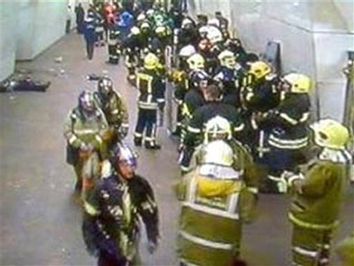
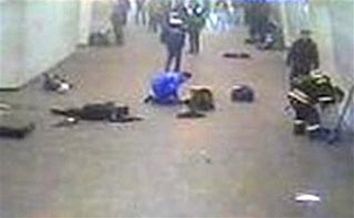
Two female suicide bombers blew themselves up Monday in twin attacks on Moscow subway stations jam-packed with rush-hour passengers, killing at least 38 people and wounding more than 60, officials said. They blamed the carnage on rebels from the Caucasus region.
The blasts come six years after Islamic separatists from the southern Russian region carried out a pair of deadly Moscow subway strikes and raise concerns that the war has once again come to the capital, amid militants’ warnings of a renewed determination to push their fight.
Chechen rebels claimed responsibility for a deadly bombing late last year on a passenger train en route from Moscow to St. Petersburg. Last month, Chechen rebel leader Doku Umarov warned in an interview on a rebel-affiliated Web site that “the war is coming to their cities.”
The first explosion took place just before 8 a.m. at the Lubyanka station in central Moscow. The station is underneath the building that houses the main offices of the Federal Security Service, the KGB’s main successor agency, a symbol of power under Vladimir Putin.
About 45 minutes later, a second explosion hit the Park Kultury station, which is near the renowned Gorky Park. In both cases, the bombs were detonated as the trains pulled into the stations and the doors were opening.
“I heard a bang, turned my head and smoke was everywhere. People ran for the exits screaming,” said 24-year-old Alexander Vakulov, who was on a train on the platform opposite the targeted train at Park Kultury.
“I saw a dead person for the first time in my life,” said Valentin Popov, 19, who had just arrived at the station from the opposite direction.
Prime Minister Putin, who built much of his political capital by directing a fierce war with Chechen separatists a decade ago, vowed Monday that “terrorists will be destroyed.”
Moscow is unlikely to hit back at the rebels with massive firepower: the Kremlin has installed loyal leaders in the areas where the militants operate, making bombing campaigns of the kind used in the 1990s Chechen wars out of the question.
The Kremlin is already engaged in a huge escalation of its operations to smash the rebels, and it is difficult to see what more it could do.
The iconic Moscow subway system is the world’s second-busiest after Tokyo’s, carrying around 7 million passengers on an average workday, and is a key element in running the sprawling and traffic-choked city.
Russian TV showed amateur video from inside the Lubyanka station of wounded and possibly dead victims sitting and lying on the floor. The train platform was filled with smoke. The LifeNews.ru site showed gruesome photos of dead passengers sprawled inside a mangled subway car and a bloody leg lying on a station platform.
Outside both stations, passengers flooded out, many of them crying and making frantic calls on their cell phones. The wounded were loaded into ambulances and helicopters, some with their heads wrapped in bloody bandages, as sirens wailed.
The last confirmed terrorist attack in Moscow was in August 2004, when a suicide bomber blew herself up outside a subway station, killing 10 people. Responsibility for that blast was claimed by Chechen rebels.
A more devastating attack took place in February of that year, when a suicide bomber from the North Caucasus set off explosives during morning rush hour as it traveled between stations. More than 40 people were killed and more than 100 wounded.
Russian police have killed several Islamic militant leaders in the North Caucasus recently, including one last week in the Kabardino-Balkariya region, which have raised fears of retaliatory strikes by the militants.
The militants receive moral and perhaps financial support from al-Qaida. Dozens of contributors to three Web sites affiliated with al-Qaida wrote comments in praise of Monday’s attacks.
One site opened a special page to “receive congratulations” for the Chechen rebels who “started the dark tunnel attacks in the apostate countries,” and all wished for God to accept the two sisters as martyrs.
“Don’t forget Russia’s crimes of genocide in the Caucasus and Chechnya,” said one writer. “The battle has been shifted to the heart of Moscow,” another wrote.
In a televised meeting with President Dmitry Medvedev, Federal Security Service head Alexander Bortnikov said body fragments of the two bombers pointed to a Caucasus connection. The bombers have not been identified and Bortnikov did not elaborate.
“We will continue the fight against terrorism unswervingly and to the end,” Medvedev said.
Neither he nor Putin, who was on an official trip in Siberia, announced specific measures and it was not clear if Russia has new strategies to unleash in the Caucasus, where violent separatism has spread from Chechnya into neighboring republics.
Although the Russian army battered Chechen rebels in massive assaults a decade ago, the separatists continue to move through the region’s mountains and forests with comparative ease and launch frequent small attacks.
New York’s transit system beefed up security as a precaution following the Moscow bombings. A spokesman for New York’s Metropolitan Transportation Authority, Kevin Ortiz, said the agency has a “heightened security presence,” but declined further comment.
The agency is in charge of New York City buses and subways, as well as suburban trains, and bridges and tunnels. In London and Madrid, two other cities that have suffered transit system terror attacks, officials said there were no immediate plans to tighten security.
——
Associated Press Writers Jim Heintz, Lynn Berry and Mansur Mirovalev in Moscow contributed to this report.
Continue Reading
Close
Two female suicide bombers blew themselves up Monday in twin attacks on Moscow subway stations jam-packed with rush-hour passengers, killing at least 37 people and wounding 102, officials said. They blamed the carnage on rebels from the Caucasus region.
The blasts come six years after Caucasus Islamic separatists carried out a pair of deadly Moscow subway strikes and raise concerns that the war has once again come to Russia’s capital, amid militants’ warnings of a renewed determination to push their fight.
Chechen rebels claimed responsibility for a deadly bombing late last year on a passenger train en route from Moscow to St. Petersburg.
Prime Minister Vladimir Putin, who built much of his political capital by directing a fierce war with Chechen separatists a decade ago, vowed Monday that “terrorists will be destroyed.”
The first explosion took place just before 8 a.m. at the Lubyanka station in central Moscow. The station is underneath the building that houses the main offices of the Federal Security Service, or FSB, the KGB’s main successor agency.
A second explosion hit the Park Kultury station about 45 minutes later.
“I heard a bang, turned my head and smoke was everywhere. People ran for the exits screaming,” said 24-year-old Alexander Vakulov, who said he was on a train on the platform opposite the targeted train at Park Kultury.
“I saw a dead person for the first time in my life,” said 19-year-old Valentin Popov, who had just arrived at the station from the opposite direction.
The iconic Moscow subway system is one of the world’s busiest, carrying around 7 million passengers on an average workday, and is a key element in running the sprawling and traffic-choked city.
Russian TV showed amateur video from inside the Lubyanka station of wounded and possibly dead victims sitting and lying on the floor. The train platform was filled with smoke.
Outside both stations, passengers flooded out, many of them crying and making frantic calls on their cell phones. The wounded were loaded into ambulances and helicopters, some with their heads wrapped in bloody bandages, as sirens wailed.
The last confirmed terrorist attack in Moscow was in August 2004, when a suicide bomber blew herself up outside a city subway station, killing 10 people. Responsibility for that blast was claimed by Chechen rebels.
Russian police have killed several Islamic militant leaders in the North Caucasus recently, including one last week in the Kabardino-Balkariya region. The killing of Anzor Astemirov was mourned by contributors to two al-Qaida-affiliated Web sites.
The killings have raised fears of retaliatory strikes by the militants.
In February, Chechen rebel leader Doku Umarov warned in an interview on a rebel-affiliated Web site that “the zone of military operations will be extended to the territory of Russia … the war is coming to their cities.”
Umarov also claimed his fighters were responsible for the November bombing of the Nevsky Express passenger train that killed 26 people en route from Moscow to St. Petersburg.
Emergency Minister Sergei Shoigu said the toll was 37 killed and 102 injured, but he did not give a breakdown of casualties at each station.
In a televised meeting with President Dmitry Medvedev, Federal Security Service head Alexander Bortnikov said body fragments of the two bombers pointed to a Caucasus connection. He did not elaborate.
“We will continue the fight against terrorism unswervingly and to the end,” Medvedev said.
Neither he nor Putin, who was on an official trip in Siberia, announced specific measures and it was not clear if Russia has new strategies to unleash in the Caucasus, where violent separatism has spread from Chechnya into neighboring republics.
Although the Russian army battered Chechen rebels in massive assaults a decade ago, the separatists continue to move through the region’s mountains and forests with comparative ease and launch frequent small attacks.
New York’s transit system beefed up security as a precaution following the Moscow bombings. A spokesman for New York’s Metropolitan Transportation Authority, Kevin Ortiz, said the agency has a “heightened security presence,” but declined further comment.
The agency is in charge of New York City buses and subways, as well as suburban trains, and bridges and tunnels.
The Moscow blasts practically paralyzed movement in the city center as emergency vehicles sped to the stations.
In the Park Kultury blast, the bomber was wearing a belt packed with plastic explosive and set it off as the train’s doors opened, said Vladimir Markin, a spokesman for Russia’s top investigative body. The woman has not been identified, he told reporters.
A woman who sells newspapers outside the Lubyanka station, Ludmila Famokatova, said there appeared to be no panic, but that many of the people who streamed out were distraught.
“One man was weeping, crossing himself, saying ‘thank God I survived’,” she said.
——
Associated Press Writers Jim Heintz, Lynn Berry and Mansur Mirovalev in Moscow contributed to this report.
Continue Reading
Close
The head of the Russian Olympic Committee resigned on Wednesday in the wake of the nation’s worst performance at the Winter Games, news agencies said, citing the committee’s spokesman.
When contacted by The Associated Press, however, the spokesman said only “that information is not confirmed,” before hanging up. He did not deny making the statements to the Russian media or say the information was incorrect.
Leonid Tyagachev, a former sports minister, took over as head of the Russian Olympic Committee in 2001. In the wake of the Vancouver Games, President Dmitry Medvedev has warned that sports officials would be fired if they failed to resign voluntarily.
The news agencies Interfax and ITAR-Tass cited Gennady Shvets as saying that Tyagachev had tendered his resignation. “This obviously concerns the Russian athletes’ performance at the Vancouver Olympic Games,” Interfax quoted the spokesman as saying.
Russia won just 15 medals in Vancouver — and only three golds — two fewer than its previous low in Salt Lake City in 2002. Officials said before the Olympics that 30 medals and a top-three finish in the medal standings were the targets.
Russia placed 11th for golds and sixth in the overall medal count, results which proved particularly embarrassing as the country takes the torch for the next Winter Olympics at its Black Sea resort of Sochi in 2014.
Tyagachev, 63, helped Russia win hosting rights to the Sochi Games. He is a personal friend and, according to some Russian news reports, a former ski instructor of Prime Minister Vladimir Putin.
There was no word on any replacement.
Sports Minister Vitaly Mutko said on Tuesday in televised comments that he would “calmly leave” his post if Medvedev’s warnings were directed at him. Mutko — who has so far resisted calls to resign from a wide array of Russian politicians — on Monday blamed several factors for the Vancouver flop. He said the team was unlucky, that no one in Russia takes new winter sports such as freestyle skiing seriously, and that doping bans had deprived Russia of several leading medal contenders.
Continue Reading
Close