Emily Wise Miller

Not my cup of tea

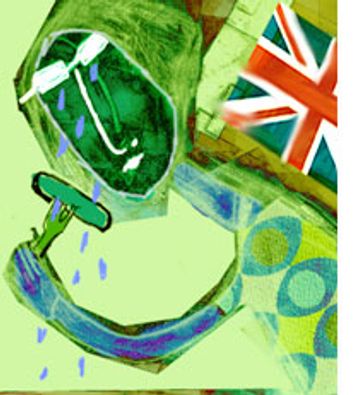
Complaining about British food may be old hat, but, well, it's just so awful.

Spotted dick. Bangers and mash.
Clotted cream. Blood pudding. Leave it
to
the Brits to invent menu items that
sound more like terminal diseases. If I
were in a foul mood I would say that the
term “bad British food” is
redundant. Well, I am in a foul mood,
because I’ve been thinking back on the
time I spent as a travel writer in
southern England.

I went to England for the first time in
1994 as a writer for the Berkeley
Guides, a student-oriented offshoot of
Fodor’s travel guides. My assignment
was to navigate through the region for
six weeks and update a guide to Great
Britain. I had a decent daily stipend –
enough to cover hostels, inexpensive
B&Bs, tourist sites and cheap food –
and a bright yellow and purple
backpack.

My culinary misadventures began in the
town of Dorset. Dorset is Thomas
Hardy country, as the tourist bureau
will endlessly remind you. Happily the
town itself is a lot more cheery than
your average Hardy novel. I made my
way to a nice-looking restaurant with a
sandwich board out front advertising
the soup of the day: split pea. I
naively thought to myself, if they have
a
soup of the day, it must be made fresh.
I sat down and ordered the split pea
soup. What showed up was thick and
green, with a congealed top layer and
the unmistakable taste of canned soup.

How is this possible? I thought. How can
you offer a soup of the day and
then shamelessly heat up a can and serve
it? I looked down at the chartreuse
liquid and became so angry, so
frustrated, I actually started to cry
right
into the offending substance. Finally a
waitress approached my table. “That
wasn’t really what you wanted, was it?”
she diplomatically asked. I started
to stutter something about “soup of the
day … can … don’t understand.” I
managed to ask her for some bread and
butter.

A week or so later I took a bus to the
town of Rye. I arrived late at my B&B,
cold, hungry and dead tired. The
friendly innkeeper pointed me toward a
pub
about a half-mile down the road. It must
have been about 10 p.m. as I walked
in the direction of the pub. No one was
around and it was foggy and
desolate. American Werewolf in Rye, I
thought to myself, just waiting for a
hairy lupine creature to come careening
out of the woods and make a few
undead jokes before devouring me. But
soon I saw lights coming from a
building up the road. The pub was still
open. My spirits perked up and my
stomach lurched to attention, with the
feeling that it might soon be fed.

The inside of the pub did a little to
alleviate my monster-movie fantasies.
A few people were standing around the
bar and chatting. They seemed like
relatives of the pub owner, with a baby
in a stroller. I examined the menu
scribbled on a little chalkboard. Beef
burger with fries, sausage, fisherman’s
pie. Thank God for food, I thought.

I had been in England long enough to
sense that the kitchen of this pub was
not buzzing with trained chefs. There
were few customers and even fewer were
eating. In fact, no one was eating. But
I was starving and I figured I had no
choice but to take my chances. I took
what I thought was the safest route,
ordering a burger with fries and mushy
peas and a beer to wash it down.

I sat down at a table, arranged the
napkin on my lap and sipped my beer. I
had a feeling of well-being that comes
from sitting somewhere warm and dry and
knowing you will soon be fed.

Soon a plate arrived at my table, but
something was not quite right. I
sampled a fry. Clearly it was of the
Ore-Ida frozen-and-microwaved variety,
but it was edible. Next, the mushy peas.
Well, I didn’t expect a lot from
the peas so they weren’t much of a
disappointment. I picked up the “burger”
and took a bite. The patty was grayish
with brown specks. Its consistency
was that of a shoe pad. The taste was
not of meat, yet it was strangely
familiar. It took me a while to place
it: This was the same burger I’d eaten
in the elementary school cafeteria. For
50 cents, growing 8-year-olds
were subjected to these patties –
seemingly made of soy and meat refuse –
plus a little Styrofoam cup of red Jello
and a carton of chocolate milk. No
wonder I never grew past 5 feet!

Though I was fairly disgusted by my
meal, which was hardly cheap at five
pounds (around $8), I was starving and
intent on finishing it. But several more
bites into the burger, I felt
overwhelmed by emotions. I was alone, in
a foreign country evidently populated by
barbarians. How could anyone in
good conscience charge real legal tender
and with a straight face
serve this refuse to a customer? Have
they ever heard of ground beef? And
these were the days before Mad Cow, so
they had no public health excuse.

What’s more, why would anyone open a
restaurant who hasn’t the slightest idea
of how to cook? This riddle
irked me during my entire trip. In the
minds of many Brits, it seems, a
restaurant is simply a business, like a
hardware store, with no specialized
knowledge required.

I sat mulling over what lashing words I
would use with the pub
owner. I was incredibly hungry, and yet
the burger was too bad to
eat. My dejection must have been all
over my face as I stared at the flabby
bun, because the pub owner’s wife
approached my table.

“Are you all right, darling?” she asked. I
had a list of invectives prepared,
but instead I said, lamely, “The food
here … it’s different.”

“I understand completely,” she said, not
understanding at all. “I’m from
Ireland and the food’s much different
there. I know how you feel right now.
You’re just homesick. You’re very far
from home.” She was extremely kind,
and she went on to explain about her own
homesickness. She talked to me for about
half an hour about how she’d
had to run away from her abusive husband
in Ireland and how much she missed
her home. I listened to her story, asked
questions and tried to make
her feel better. I was glad I hadn’t
screamed at her. Clearly she meant
well and would never knowingly try to
poison someone with hideous food. She
just had no idea what a burger was
supposed to be. Plus, talking about her
problems took my mind off the mushy
peas.

For the rest of my trip I developed a
strategy. Though at home I would
enter a McDonald’s only on a road trip
– and even then it wasn’t my first
choice — in England the Golden Arches
became my beacon. It was
often the cheapest and most accessible
meal in town — certainly winning out
over microwaved jacket potatoes from a
gloomy tea shop. I also started
hoarding Cadbury bars in my backpack and
eating a few for dinner when
desperate. I began to understand why the
British have such problems with
their teeth.

Finally I arrived in London, where I
feasted on Indian food from morning
till night. Glorious, deliriously good
Indian food. Thank you, tikka masala.
Bless you, biriani.

I understand that British food has
vastly improved since I was there, with
the rise of the gastropub and some truly
world-class restaurants in London. But
towns outside London just don’t have
much of a restaurant culture. They
possess a practical attitude that says,
“Why should I go to a restaurant when I
have a perfectly good kitchen right
here?” Eating out is something done
while on holiday. Even in London, social
life after work and on weekends often
revolves more around drinking than
eating. If you insist on ordering
expensive pub food with your pint, your
friends might look at you askance and
ask if you’re trying to be posh.

Maybe I’ll have to go back soon and
check out some of these new restaurants.
This time, though, I think I’ll pack an
extra suitcase full of PowerBars.

Passing in reverse

She was down with the cause, but they didn't know she was a white girl.

The years 1988 to 1993 were a strange time to be an undergraduate at
UC-Berkeley. We protested when a minority faculty member didn’t get
tenure. We objected when the football team played in the Copper Bowl in
Arizona, a state that didn’t recognize MLK’s birthday as a holiday. A
professor tried to get people to drop his crowded philosophy class by
reminding students that they would be studying only dead white males
(Descartes through Kant).

At the same time, the Loma Prieta earthquake, the Oakland hills
fire, a hostage-taking and shooting at a popular Berkeley bar and the unsolved stabbing
of a Filipina student on campus lent a dark backdrop to our increasingly
ordered understanding of racial and social injustice –
throwing everyone a little off balance and constantly reminding us of our
own mortality.

I silently congratulated myself when I was arrested after
dramatically protesting the Rodney King verdict. Yet I went to Italy for my
junior year, not Nicaragua; I studied Italian, art and literature. I wasn’t
following any strict PC party line. I was also hanging out with a group of
friends that resembled a haphazardly assembled rainbow coalition. At
Berkeley, back in the days of affirmative action, diversity wasn’t just a
buzzword — I met people of every conceivable origin. Half Chinese/half Mexican and half Russian/half Nigerian were two of the more
interesting combinations. Whites either were or seemed like a minority in
the dorms.

It was also a time of serious racial tension. Identity — that catch-all
term for the non-individual selves we inherited at birth — became the
lightning rod for much of our intellectual and social strife. White males
were often put on the defensive in class, just for being
born part of the “patriarchal hegemony.” People of mixed race were often
asked, “How do you identify? What do you consider yourself?” Light-skinned
blacks wore T-shirts emblazoned “It’s a black thang — You wouldn’t
understand” in order to clear up any confusion.

In my sophomore year, I was eager to spend my free time on some kind
of meaningful extracurricular activity. Many people in my group of friends
worked for Smell This, a new student-run art-and-literature magazine for
and about women of color. I asked my acquaintance Rosa Flanagan (half
Mexican/half Irish), who worked with the mag, if you had to be “of color” to
join. She said, “No, just down with the cause.”

I felt I was pretty down with the cause, which in my mind was a stew
of notions about racial and sexual equality. Academically, socially and
politically I felt immersed in issues of race. I had also always felt
somewhat “of color” and ethnic myself, especially as a short, dark Jewish
girl at my WASPy high school. In addition, I was into both art and
literature — a perfect fit, I thought.

So I joined, along with my friend Erika, who is African-American. At
first it was fun and interesting. Erika and I were on the art staff. Once a
week, we’d meet, look at students’ submissions and decide what was good
enough to make it in. After several meetings, however, I started to feel a
little uncomfortable.

For one thing, looking around me at the meeting, I didn’t see any
other white women who were just “down with the cause.” Everyone was (at
least half) “of color.” In addition, the primary discussions were less about
collective sexual and racial inequality and more about how each of us had
been victimized and oppressed, disrespected and discriminated against.

I don’t know why it surprised me, but my experiences
didn’t correspond with the rest of the group. To say I felt victimized and
oppressed would have been untrue. But I also tremendously admired the
magazine’s founders and frankly envied their zeal and conviction.

It was already halfway through the semester when I began to feel
like I really might not belong. I knew I would soon be leaving for my year
abroad, so I figured I’d work for Smell This until I left. In the
meantime, I was an active contributor. I tended bar at fund-raising parties
and recruited works from (woman-of-color) artists in my drawing classes. I
sometimes wondered if Rosa Flanagan had been wrong about the “just down with
the cause” thing, but I wasn’t sure. No one had ever questioned my presence
at the meetings, so I had no reason to think white women were officially
excluded.

In mid-March, Erika and I went to the usual Wednesday night meeting.
This time, there was something in particular the managing editor wanted to
discuss. A group of Jewish women had come to the heads of Smell This and
asked to be involved. The question for us, then, was whether or not to admit
Jewish women.

This unleashed a barrage of heated polemics from all sides of the
room. One very serious Chicana woman thought we should definitely not admit
Jewish women, as it would make her Palestinian friend very uncomfortable –
should this friend ever decide to join. She also pointed out that a slumlord
in her neighborhood was Jewish and he was a terrible man.

An African-American woman across the room strongly disagreed. Her
Jewish friends were among the most “ethnic” she knew, she reasoned. They
went to synagogue, followed strange rituals and certainly did not identify
as white. “Not to mention oppression, ” she went on. “Don’t tell me Jews
haven’t been oppressed.”

“But what about Irish-Americans,” someone else piped in. “Are we
going to admit them because they were once oppressed? I don’t think
oppression is the issue.”

“And some Jewish women are darker than you are,” someone else
yelped.

“That’s not the point. I don’t think we can decide strictly based on
color.”

“That’s right, ’cause otherwise you wouldn’t be here, girlfriend.”
And on it went.

Erika and I turned to each other in wide-eyed silence. It was
suddenly clear to us that something wasn’t right. No one turned to me and
asked what I thought about the Jewish issue. We realized they had no idea
what I was.

Erika and I had been good friends since eighth grade,
when we had both felt like something “other” next to the volleyball-playing
preppies at our school. I had painstakingly unbraided the extensions from
her hair. We had joked about the fact that her light-skinned black/Native
American grandmother looked a lot like my olive-skinned Ashkenazi Jewish
grandmother — were we actually related, way back on the family tree? I also
knew, of course, that Erika had had to deal with racism in a way I never
would, and that in truth we were not regarded as equally different from the
mainstream.

That week I had a nightmare that I was uncovered by an enemy as a
double agent and thrown over a cliff. I didn’t need Jung to interpret that
one. At the end of the next meeting I approached the managing editor. “Um,
I’m not sure what you guys think I am,” I started. “But I’m Jewish. And
that’s it.”

“Oh,” she said. She was almost at a loss for words. “Really. I’m
really surprised.”

At the beginning of the next meeting, she announced to the art
staff, “It has come to our attention that Emily …” she looked over in my
direction, “is Jewish.”

All eyes were on me. I smiled weakly. After a beat of silence, the
invectives
started flying. The serious Chicana, whose mother had worked a lifetime as a
maid so her daughter might go to Berkeley, turned to me: “I feel betrayed.
All this time I thought you were Chicana. I looked over to you when we were
talking about things because I thought you understood. I can’t believe
this.”

“Yeah, we all thought you were Latina,” some others chimed in.

I was taken aback. I had never pretended to be anything I wasn’t. I
didn’t even speak Spanish, and my last name is Miller, for crying out loud.
Without knowing it, I had been passing. With my curly black hair and brown
eyes, I had been passing as a woman of color in Berkeley’s strange world of
identity politics.

I decided not to attend the next couple of meetings. Meanwhile,
people I hardly knew would approach me on campus to tell me how I’d really
gotten those Smell This girls in a fix. I heard that the core staff was
having special meetings to talk about the “Emily situation.” On the one
hand, they appreciated that I had been an active member of the staff; on the
other hand, some felt that I had been disingenuous. I think they were also
embarrassed; they had looked at me and all-too-easily mistaken me for being
“of color,” throwing their whole mandate into question.

I had also set a bad precedent. If they let me stay, they would have
to open the floodgates to every odd member of the master race, the theory
went. And soon enough Smell This would be overtaken by liberal white
feminists. I decided to make things easier for them by resigning.

My white male friends at school were appalled by what happened,
calling the women reverse racists. But I empathized with their need
to have their own voice on campus, and I didn’t feel too much bitterness
toward them. After all, I, too, had felt that I didn’t quite belong there.

Nonetheless, it was strange for me to momentarily be caught in the
middle of the shifting realities of an unanswerable question: What makes
someone “of color” anyway? Skin color is hardly foolproof. Verbal
arm-wrestling over whose holocaust was bigger is an ugly — not to mention
unreliable — way to determine such a thing. When we look at the ethnic
Albanians in Kosovo, I think many of us are struck by how “like us” they
look. More specifically, they look white. If they were in America, they
would assimilate into the dominant culture as soon as their language skills
were up to par — or at least by the next generation. But in Europe,
centuries pass with the same ethnic hatreds still in place. Interestingly,
in Europe, the fulcrum of oppression is not what someone looks like, but
what someone is.

But in America, color counts. Color, not religion, is what people take you
for, what you can’t get away with pretending you’re not. Passing is the
exception; it’s what happens out on the border of identity, where what you
look like and what you are might not correspond. As the melting pot
continues to simmer and the world starts looking like one big Berkeley
campus (circa 1992), it will happily become harder and harder to identify
who’s what on the basis of looks.

The women of Smell This had taken society’s label of “color” and proudly
coopted it as their own, ` la Queer Nation. Their only problem was that they
still hadn’t figured out how to define it themselves. “I know it when I see it,” seemed to be their solution, but in my case this proved incorrect. For me, it was a difficult lesson to learn: that to certain hard-liners, a white girl
couldn’t have anything useful to say about women of color. It was their
thang, and I just didn’t understand.

Continue Reading Close
www.salon.com/writer/emily_wise_miller/index.html