Gale Holland

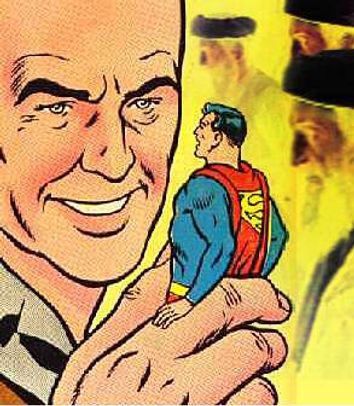
Bin Laden as Lex Luthor

There's something hauntingly familiar about the world's latest personification of evil, something with deep resonance in U.S. mythology.

  • more
    • All Share Services

Bin Laden as Lex Luthor

For weeks we’ve been hearing about Osama bin Laden, the Saudi sultan of suicide terror attacks, a Geppetto whose wish awakens sleeper cells from Jakarta to Dar es Salaam, a silky-tongued avenger in a turban with a mike in his hand. His language, robes and other trappings may be foreign, but there’s something hauntingly familiar about this character, something with deep resonance in U.S. mythology. Bin Laden has been compared to Hitler and Stalin, but his closest model is a home-grown villain. “Arch-foe,” “evil genius,” “criminal mastermind” — bin Laden is the rightful heir to the comic book legend, Superman’s nemesis, Lex Luthor.

Like bin Laden, Luthor is an ultramillionaire whose aim, we are told, is nothing short of the defeat of the civilized world and/or the enslavement of mankind (or, in the diabolical Saudi’s case, women). His loathing for Superman is personal: According to DC comics lore, Luthor went bad as a teenager when Superboy, rescuing him from a scientific experiment gone awry, inadvertently caused him to go bald. Similarly, the U.S. rescued bin Laden and the other mujahedin during the Afghanistan War, but then emasculated him by persuading the Saudis to take in our troops instead of his during the Gulf War.

Between capers, Luthor holes up in various underground lairs; bin Laden retreats to his caves in Afghanistan. In the old comics, Superman would respond to a hurricane or other disaster, only to find out that it was a cover for a robbery or other heinous act by Luthor’s men. Similarly, we are now told that a string of terrorist attacks once thought of as discrete acts were covers for bin Laden’s nefarious master plan. U.S. soldiers dragged through the streets of Somalia? Bin Laden. Deadly bombing attacks on U.S. embassies? Bin Laden. The first World Trade Center explosion? You guessed it. Lately, even the old rumblings about Timothy McVeigh’s Middle Eastern connections have gained new currency. (McVeigh’s partner in the Oklahoma City bombing, Terry Nichols, made several flights to the Philippines, where bin Laden allegedly funds terrorist training camps.)

Every archfiend must have his preposterously named criminal organization — al-Qaida or “the Base” — and allies from other criminal gangs, in bin Laden’s case, Ayman Zawahri, leader of Egypt’s Islamic Jihad. And don’t forget the sneering henchmen. Last Tuesday, we watched a television tape of al-Qaida spokesman Suleiman Abu Ghaith telling us that the suicide hijackers did “a good deed” when they killed some 6,000 innocent American people, and that their young Islamic recruits “look forward to dying the way Americans look forward to living.”

Even bin Laden’s choice of targets — the symbolically potent landmarks of the World Trade Center and the Pentagon — comes straight out of the “Arch-Villains for Dummies” playbook, says television and comic book writer Mark Evanier, author of “Groo the Wanderer.” “A few years ago, there were 11 comic books out with attacks on the Empire State Building,” says Evanier.

Like bin Laden, Luthor is a master of the media, and while hated by many, is seen as a hero to some. In a 1960 story line, Luthor travels to old Krypton and fakes TV tapes while posing as “Luthor the hero.” Just after U.S. bombs started falling on Kabul, bin Laden — seated under a rocky outcropping, his trusty Kalishnakov at his side — appeared on TV to taunt the U.S.: “God has blessed a group of vanguard Muslims to destroy America … and may God bless them and allot them a supreme place in heaven.” It was all I could do to stop myself from running outside to see if Commissioner Gordon had thrown the Bat Signal up in the evening sky. (Note to non-cartoon fans: Batman and Superman now fight together.)

Late last week, we hear from the FBI that, despite the wrath of most of the world, and five days of U.S. bombings, more attacks “within the United States and against U.S. interests overseas over the next several days” are imminent. Well, that certainly narrows it down.

Of course, the Lex Luthor/bin Laden Separated-at-Birth analogy has a short half-life. The bulk of history’s real villains, not to mention film counterparts from James Bonds’ Goldfinger to Austin Powers’ Dr. Evil, fit a similar profile. The point is, most of us have never experienced the stark calculus of evil that bin Laden supposedly represents except in old comic books or films.

In the cultural upheaval of the ’60s, comic artists such as Jack Kirby (creator of the characters Darkseid and Dr. Doom, on whom Darth Vader was said to be based) began to invest villains with moral ambiguity, Evanier says. “Jack was a liberal Democrat who did not completely buy the concept that a villain is always just plain rotten,” says Evanier, who has penned a Superman book or two himself. “He tried to invest characters with a certain amount of motive that made us understand — not forgive, but understand — because if you divided everybody into pure good and pure evil, there was no analogy to the world he saw around him.”

Now, much of that complexity has vanished in a single day.

“As a buff, a historian, I used to look at old World War II cartoon serials with all the flags and patriotism and wonder what it was like,” said cartoon historian Jerry Beck. “But we’re living that right now.”

The big difference is, Luthor never killed much of anybody. Where is Superman when we need him?

Logo wars

For the 24/7 news channels drunk on tragedy, vivid labels are increasingly important.

  • more
    • All Share Services

Within an hour of hearing that a balding white man had opened fire on children at a Los Angeles Jewish Community Center day camp, Fox News Channel had slapped a logo on the air to graphically anchor the cable station’s extensive coverage of the attack.

“L.A. Shooting Rampage,” the logo shrieked against a background image of a gun scope. “We used a generic animation of the scope to let people know there was an assault or gunfire,” said assistant art director Brian Matthews. “Generally to the public, a scope does portray there has been a shooting.”

Duh. Such logos, also known as titles, have become a fixture in the celebrity, death and violence megastories, lasting days or even weeks, that increasingly seem to be capturing the attention of TV news. Never mind that the titles often rely on clichi, inflate events (do five woundings a rampage or shooting spree make?) and trivialize suffering by tying it up in a tidy slogan. The so-called 24/7s — the cable-news channels — experience 200 and 300 percent ratings jumps when an all-day tragedy hits the screen; many local stations have followed their example in trying to capitalize with blanket coverage. In an age when viewers zap through the dial looking for an arresting image, the logo, however cheesy or tarted up, is an essential tool to grab ratings, says longtime news executive Av Weston.

“It’s form of brand marketing,” said Westin, a longtime CBS and ABC news executive currently ensconced as a Freedom Forum fellow in New York. “The stations benefit dramatically when there is a story of continuing coverage, and each tries to brand it with a logo that’s intriguing and attractive.”

The shrill tone of Fox News Channel’s logo was picked up by many of the L.A. stations: “Terror in the Valley”, brayed KTLA; “Children Under Fire,” intoned KCAL. Local network affiliate KNBC went with “Shooting Spree” over an image of an automatic weapon. KCBS used “Granada Hills Rampage” (reflecting the L.A. suburb where the center was located).

An exception was KABC in Los Angeles, which adopted the relatively deadpan “Jewish Center Shooting.” “It was a very brief attack, over in a matter of seconds — not like Columbine, where gunmen went door-to-door and spent time doing it,” said KABC’s Cheryl Fair during a telephone interview Wednesday. “The events were sensational enough all by themselves. They didn’t need us to make bigger than it was.”

Other 24/7 stations were more circumspect than Fox News. “Community Center Shooting” was the dispassionate choice of both CNN and MSNBC, perhaps stung by criticism of their relentless wallpaper coverage of the deaths of John F. Kennedy Jr., his wife and her sister.

Executives at the channels, however, said this had nothing to do with their subdued logos. MSNBC media spokesman Cory Shields said his station has a policy of selecting generic logos — the tag for the Columbine High shootings, for example, was “Tragedy in Littleton” — and then getting more specific in the bottom-right caption, also called a chyron. “Everyone’s fighting to come up with a look to grab viewers,” agreed CNN graphic art supervisor Warren Dent. “There’s a lot involved.”

“In some newsrooms there has been a concern that the story was running past the journalism,” Westin noted. “Those news directors probably decided, Let’s play this a little more calmly.” A strange twist in the TV logo wars was how the stations handled the religious affiliation of the school. Many stations chose “Community Center” over “Jewish Community Center” or even “Jewish center.” Clearly, space wasn’t the issue. And it’s difficult to imagine the religious affiliation being dropped were it “Islamic” rather than Jewish. Of course, the alleged anti-Semitic admissions and emerging ties of suspect Buford Oneal Furrow to white supremacists make the omission appear more significant than it was at the time. With hate crimes spewing forth from every corner of the U.S., there may have been a reluctance to jump the gun on a snippet of evidence when the attack could as easily have erupted out of a domestic or employment conflict. Shields says using the word “Jewish” just never came up at MSNBC.

However, several media critics don’t buy those arguments. “They don’t want to encourage anti-Semitic groups, and there is some fear of copycat crimes, but the media always dramatizes whatever it can to get ratings,” said Ben Bagdikian, former dean of the graduate school of journalism at the University of California at Berkeley.

Again, KABC was the sole station, L.A. or national, that used the word Jewish in its logo. “It was important for us to get Jewish in, in that it was a Jewish Community Center, and there was a possibility this had some religious implications,” Fair said. “The fact that it was a Jewish Community Center was an integral part of the story, even if it had been random,” agreed Bagdikian. “It’s always a matter of suspicion; some of the wildest militias and Aryan groups are very anti-Semitic.”

Continue Reading Close