Glen Johnson

Storm strands buses, planes, trains on East Coast

Thousands stranded for second day. Officials urge people to stay off roads

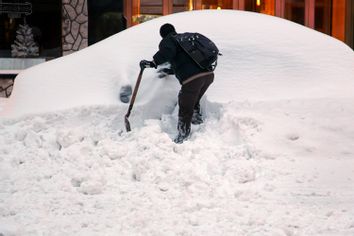
A powerful East Coast blizzard marooned thousands of would-be air, rail and road travelers Monday, shutting down major airports and rail lines for a second day, stranding buses on buried highways, and forcing New York City subway riders to spend a cold night in unheated trains.

Officials urged anyone who did not have to drive to stay off roads in the region, where high winds pushed snow into deep drifts across streets, railroads and runways. More than two feet of snow had fallen in some areas by Monday morning.

The New York area took the brunt of a storm that meandered across the country over the Christmas weekend before plowing up the East Coast. States of emergency were declared in at least six states from the Carolinas on north. Jets got snowed in on the tarmac or never left the gate.

“People are exhausted. … They want to get home,” said Eric Schorr, 22, who was trying to get from New York City to Tel Aviv on Sunday night but ended up spending about nine hours stuck on the tarmac at Kennedy Airport, finally ending back in the airport around 3 a.m. His flight was rescheduled for 7 p.m.

Similar delays have produced outrage in the past, but Schorr said he and his fellow travelers were “as comfortable as you can be on a plane,” with the crew passing out drinks and serving dinner.

Authorities had to rescue hundreds of motorists across the region, including about 100 people trying to get back to New York from a gambling trip to Atlantic City, some of them diabetic or elderly. As 5-foot drifts piled up on the road, state troopers took water and food to passengers who were feeling ill.

“Most of the people are pretty calm, but they are getting antsy,” state trooper Chris Menello, who raided his personal stash of food for the gamblers, said early Monday as the rescues unfolded in Monmouth County.

Wind gusts as high as 80 mph knocked out power to thousands. Airlines scrambled to rebook passengers on thousands of canceled flights but said they didn’t expect normal service to resume until later in the week. Amtrak service was trickling back after being knocked out from New York to Boston.

Hundreds of cold, hungry and tired air passengers spent the night at Kennedy, LaGuardia and Newark Liberty airports. Officials said they were provided blankets and cots, but some travelers were not allowed to retrieve their checked luggage, leaving them with no extra clothing or toiletries.

Jason Cochran, of Manhattan, boarded his flight to London at 6 p.m. Sunday at Kennedy, but it missed its takeoff window as high winds set in, he said. Passengers were told they would be sent to hotels but were given only food vouchers — and then vendors began running out of provisions.

An airport McDonald’s ran out of food, and he spent more than an hour in line at a KFC on an hour’s sleep, he said.

“When people start to get hungry, you’re going to see tempers flare,” Cochran said.

Tall snowdrifts covered the landing gear of jets parked at the Newark airport. A truck with a snowplow moved across the tarmac, digging out a British Airways plane as passengers watched from the terminal.

In a baggage claim area, two pigeons walked among the sleeping passengers on the floor, looking for crumbs. Dozens of people lay on the floor of the concourse, leaning their heads against their luggage as they waited for ticket counters to open.

Not even New York City’s subway system — usually a reliable workhorse during a snow storm — could withstand the blizzard. Some subway passengers were stranded for hours on trains that broke down overnight in Queens and finally pulled into a station by midday Monday.

Christopher Mullen, stranded aboard one train since 1 a.m., said conditions were frustrating.

“No food, no water. Cold. That’s the main thing that’s bothering everyone,” Christopher Mullen told local cable news channel NY1.

At Jamaica Station on the Long Island Rail Road, the nation’s largest commuter rail system, hundreds of people dozed in train cars frozen at the platform. Others lay like refugees at the entrance to the train link to Kennedy and stood helpless at the ticket office, waiting in vain for good news to flash on the schedule screens. Hours went by without a single train leaving with passengers.

Buses were knocked out, cabs were little more than a myth and those who tried walking out of the station were assailed with a hard, frigid wind that made snowflakes sting like needles.

“They tried, but they can’t do much with this snow. It’s just not stopping,” said Sharray Jones, 20, headed home to Long Island after visiting friends.

A blizzard warning, issued when snow is accompanied by winds higher than 35 mph for three hours, was in effect early Monday from Delaware to Maine. Though some areas saw only a few inches, almost 30 inches had fallen in New Jersey’s Bergen County by Monday morning, and 20 inches was reported in New York’s Central Park.

States of emergency, which generally endow government officials with special powers to expedite storm recovery, were declared in states including North Carolina, Virginia, Maryland, New Jersey, Maine and Massachusetts.

In coastal Scituate, Mass., several seaside homes were flooded overnight by storm-driven waves, and two later caught fire. Firefighters rescued occupants of the burning homes by boat, said John Danehey, who is on the town’s board of selectmen. No injuries were reported.

New England commuters appeared to be heeding the call to stay off the roads. In greater Boston, highways into the city were nearly abandoned early Monday as many workers were given the day off and others were on vacation for the holiday week.

In Philadelphia, cab driver Farid Senoussaoui, 33, described navigating the slippery conditions as “like a video game.” Senoussaoui had worked overnight during the storm and said passengers were universally grateful when he would stop to pick them up.

In Wells, Maine, police say a 59-year-old man died several hours after his pickup crashed into a tree during whiteout conditions Sunday night.

——

Johnson reported from Haverhill, Mass. Contributing to this report were Associated Press writers David Sharp in Portland, Maine; Leon Drouin-Keith in New York; Eric Tucker in Providence, R.I.; Kathy Matheson in Philadelphia; Stephanie Reitz in Glastonbury, Conn.; Deepti Hajela in Fort Lee, N.J.; and Bruce Shipkowski in Trenton, N.J.

Blizzard stalls NYC, East Coast

Slide show: A North-bound snowstorm brings snow to Atlanta and blitzes the East Coast

A New Jersey state trooper arrives to assist people after their cars collided in a heavy snowfall Sunday, Dec. 26, 2010, on Rt.295 near Columbus, N.J. (AP Photo/Mel Evans)

View the slide show

A powerful East Coast blizzard menaced would-be travelers by air, rail and highway Monday, leaving thousands without a way to get home after the holidays and shutting down major airports and rail lines for a second day.

Officials urged anyone who did not have to drive to stay off roads in the region, where high winds pushed snow into deep drifts across streets, railroads and runways. More than two feet of snow had fallen in some areas by Monday morning.

In Monmouth County, N.J., state troopers carried water and food to diabetics marooned on two passenger buses carrying about 50 people on the Garden State Parkway, where stranded cars cluttering ramps stymied snow plows and ambulances, state police spokesman Steve Jones told NBC’s “Today” show. One bus was freed by 7 a.m. and the other was expected to be out soon, he said.

“Most of the people are pretty calm, but they are getting antsy,” said New Jersey State Police Trooper Chris Menello, who along with his fellow troopers raided their personal stash of food to bring to the passengers.

Menello said the traffic jam started around 5 p.m. Sunday evening with a woman who went into labor.

“She and her husband had three small children in the car all under the age of 5,” he said.

An ambulance was able to reach her and bring her to a nearby hospital, but by then the Parkway became a parking lot, with accumulating snow preventing people from digging out.

In New York City, hundreds of passengers were stranded at John F. Kennedy, LaGuardia and Newark Liberty airports. Port Authority of New York and New Jersey spokesman Steve Coleman said they were being provided blankets and cots.

Hundreds of travelers dozed Monday in Long Island Rail Road train cars frozen at the platform. Others lay like refugees at the entrance to the train link to Kennedy Airport and stood helpless at the ticket office, waiting in vain for good news to flash on the schedule screens. Hours went by without a single train leaving with passengers.

Buses were knocked out as well, cabs were little more than a myth and those who tried walking out of the station were assailed with a hard, frigid wind that made snowflakes sting like needles.

“They tried, but they can’t do much with this snow. It’s just not stopping,” said Sharray Jones, 20, headed home to Long Island after visiting friends.

A blizzard warning, which is issued when snow is accompanied by sustained winds or gusts over 35 mph for three hours, was in effect early Monday from Delaware to the far northern tip of Maine. The storm was expected to bring its heaviest snowfall in the pre-dawn hours Monday, sometimes dumping 2 to 4 inches an hour. A total of 12 to 16 inches was expected across nearly all of Rhode Island, Connecticut and eastern Massachusetts, though forecasters said winds of 50 mph could create much deeper snow drifts.

Almost 30 inches of snow fell in Bergen County, N.J., by Monday morning, and 20 inches was reported in New York City’s Central Park early Monday.

States of emergency were declared in North Carolina, Virginia, Maryland, New Jersey, Maine and Massachusetts, where Gov. Deval Patrick urged people who did not have to be on the roads to stay home, to ensure their safety and that of work crews. Nonessential state workers were told to stay home Monday.

The Manchester Boston Regional Airport outside Manchester, N.H., was near-deserted Monday morning.

Sitting alone at a table in the food court was Alicia Kinney, a 25-year-old mission worker from Columbus, Ohio. Her flight to Newark, N.J., was cancelled, and she could not get a confirmed seat until Wednesday. Kinney slept overnight on benches in the baggage claim area before moving up to the food court for a soda in the morning.

“I came at 4 p.m. (Sunday) and got a standby seat to Cleveland, but at the last minute, that flight was cancelled. By then, it was too bad outside for my friends to come back and get me,” Kinney said. “It’s a funny situation. I’m trying to stay positive.”

In Philadelphia, cab driver Farid Senoussaoui, 33, described navigating the slippery conditions as “like a video game.” Senoussaoui had worked overnight during the storm and said passengers were universally grateful when he would stop to pick them up.

In New England, many commuters appeared to be heeding the call to stay off the roads. In greater Boston, highways into the city were nearly abandoned early Monday as many workers were given the day off and others were on vacation for the holiday week.

The blizzard-like conditions wreaked havoc on travelers from the Carolinas to Maine.

Airlines scrambled to rebook passengers on thousands of canceled flights — more than 1,400 out of the New York City area’s three major airports alone — but said they didn’t expect normal service to resume until Tuesday. Amtrak canceled train service from New York to Boston after doing the same earlier for several trains in Virginia.

The Long Island Rail Road, the nation’s largest commuter rail system, also suspended service. Bus companies canceled routes up and down the East Coast, and drivers faced hazardous travel conditions — sometimes with close to zero visibility.

A spokesman said Boston’s Logan International Airport could take days to get back to normal.

Wind gusts of up to 80 mph knocked out power to thousands. Utilities reported about 30,000 customers were out in Rhode Island and Massachusetts, mostly on Cape Cod and south of Boston.

In Wells, Maine, police say a 59-year-old man died several hours after his pickup crashed into a tree during whiteout conditions Sunday night.

In Connecticut, Allie Campbell discovered her mother had taken a critical fuse out of her car Sunday night to ensure her daughter’s safety.

“She texted me and said, ‘You don’t pay for the insurance, you’re not driving,’” Campbell said Monday, laughing, as she reported to her job at Katz ACE Hardware in Glastonbury — after her mother surrendered the fuse.

Peter Iarossi, a train conductor for MBCR, which operates commuter rail trains for the Massachusetts Bay Transportation Authority, saw his normal 15-minute commute stretch to an hour because of the blizzard conditions.

He woke up extra early and was sitting in his idling car at the railyard an hour before his 6:45 a.m. train was to leave to start its run to Boston.

“You’re here to bring the people to Boston,” Iarossi said. “You don’t have an option. People count on you — especially in bad weather.”

The monster storm is the result of a low pressure system off the North Carolina coast and strengthened as it moved northeast, the National Weather Service said. Because of it, parts of the South had their first white Christmas since records have been kept.

View the slide show

Continue Reading Close

Poll: Nearly 6 in 10 oppose war in Afghanistan

As thousands more troops ship off, only 38 percent of Americans support the 9-year-old fight

A majority of Americans see no end in sight in Afghanistan, and nearly six in 10 oppose the nine-year-old war as President Barack Obama sends tens of thousands more troops to the fight, according to a new Associated Press-GfK poll.

With just over 10 weeks before nationwide elections that could define the remainder of Obama’s first term, only 38 percent say they support his expanded war effort in Afghanistan — a drop from 46 percent in March. Just 19 percent expect the situation to improve during the next year, while 29 percent think it will get worse. Some 49 percent think it will remain the same.

The numbers could be ominous for the president and his Democratic Party, already feeling the heat for high unemployment, a slow economic recovery and a $1.3 trillion federal deficit. Strong dissent — 58 percent oppose the war — could depress Democratic turnout when the party desperately needs to energize its supporters for midterm congressional elections.

A majority of Americans do welcome Obama’s decision to end combat operations in Iraq. Some 68 percent approve, a number unchanged from earlier this year. The last American combat brigade began leaving Iraq on Thursday, ahead of Obama’s Aug. 31 deadline for ending the U.S. combat role there.

Seven years after that conflict began, 65 percent oppose the war in Iraq and just 31 percent favor it.

The growing frustration with the Afghanistan war was evident in Massachusetts’ 5th Congressional District, not far from Concord where Minutemen fought for a new nation in 1775. In Lawrence, whose textile mills once relied on the roaring Merrimack River, exasperation with the war in Afghanistan is evident.

“If they could resolve the issue, stabilize the government, that would be good. But we can’t do this forever and lose more lives,” said Terry Landers, 53, an electrician from North Andover.

U.S. troops have suffered more than 1,100 deaths in Afghanistan since fighting began in October 2001, including a monthly record of 66 in July. Last fall, Obama authorized an increase in the force in Afghanistan by 30,000 to 100,000 troops — triple the level from 2008. Many in Congress are increasingly doubtful that the military effort can succeed without a tough campaign against bribery and graft that have eroded the Afghan people’s trust in their government.

Opinions in the poll — and among those interviewed — were more positive about Iraq as Obama’s deadline for the exit of U.S. combat forces approached.

“I think we really need to give them an opportunity to economically, socially grow,” said Mary Campbell, 56, a Lawrence city worker. “I think it’s more helpful if we’re not in their face all the time, so the deadline is, I think, a good thing, to see how stable they are.”

The congressional seat is held by Rep. Niki Tsongas, a Democrat who is the widow of a former senator and one of the party’s 1992 presidential contenders, Paul Tsongas. Four Republicans and one independent are seeking to oust her in November, with the primary next month.

Lawrence has lost two sons in Iraq of the more than 4,400 Americans killed since fighting began in March 2003. Obama ran for president in part on a pledge to pull out of Iraq and divert U.S. resources to Afghanistan, and that shift has been accompanied by a changing death toll in each country.

The war views expressed in a Lawrence diner, in a park across from City Hall and at an Essex Street hot dog cart, were echoed by poll participants across the country.

Bea Boynton, 57, of Marysville, Pa., said she is less supportive of the wars than when Obama took office.

“I just think it’s not going well. Too many of our men and women are being killed,” she said of Afghanistan in particular.

Boynton, a registered Democrat who voted for Republican John McCain in 2008, added: “I don’t think what we initially set out to do has been done. I mean, we still don’t have (Osama) bin Laden.”

Erika Hickert, 68, a retired school teacher in Maricopa, Ariz., said she is an independent who voted for Obama in 2008 and would do so again if given the chance. She felt the same about the wars.

“I’m just tired of taking care of the world,” Hickert said. “They need to learn to take care of themselves, and war isn’t the way to teach them.”

She also doesn’t distinguish between Iraq and Afghanistan, even with the conflict winding down in one while ramping up in the other.

“I think of them as one big conflict,” said Hickert. “We’re militarily supporting both of them.”

Landers, the electrician, was among those with split opinions about Afghanistan in particular.

A registered Republican who voted for McCain, Landers said he did not favor pulling out of Afghanistan despite his concern about the mounting death toll and his opposition to a long-term combat role.

“I think we need to get the government stabilized before we get out of there. I don’t know how we can do that, though,” he said.

Campbell, the city worker, is a Democrat who voted for Obama. She has a son-in-law in the Marine Reserves who has already made one tour of Iraq and is slated to head back to the Middle East next year.

“I think it’s important that, as citizen of the United States, where we live in a free country … that we help support the mission of bringing along peace,” she said.

Another poll respondent, Jeff Foust, 60, a retired public defender in Springfield, Ill., was more sanguine.

“All we can do is continue to provide some support but I think that we can’t stay in either country for a long term with large numbers of troops,” said Foust, a Democrat who voted for Obama in 2008 and said he would again. “We’ve been there long enough in both places that winning is up to the people that live there.”

The AP-GfK Poll was conducted August 11-16 by GfK Roper Public Affairs and Corporate Communications. It involved landline and cell phone interviews with 1,007 adults nationwide, and has a margin of sampling error of plus or minus 4.5 percentage points.

——

Associated Press Polling Director Trevor Tompson, AP News Survey Specialist Dennis Junius and AP writers Lauren Sausser and Ileana Morales in Washington contributed to this report.

——

Online:

AP-GfK Poll: http://www.ap-gfkpoll.com.

Continue Reading Close

New FBI docs show Kennedy death threats

The FBI releases previously secret files concerning death threats against the late Sen. Edward Kennedy

Most of the secret FBI files on the late Sen. Edward Kennedy being released Monday concern death threats against the longtime senator.

Alex Brown of the FBI’s records management division said the FBI would post some 2,000 pages of previously secret pages about the Massachusetts Democrat on the agency’s website.

The release of the documents has been highly anticipated by historians, scholars and others interested in the life and long public career of one of America’s most prominent and powerful politicians.

The Associated Press and other media organizations requested the documents through Freedom of Information Act requests.

Kennedy faced death threats when he ran for president in 1980 and before that in the years following the assassinations of his older brothers.

President John F. Kennedy was assassinated in Dallas on Nov. 22, 1963. U.S. Sen. Robert F. Kennedy was slain in Los Angeles on June 6, 1968.

The deaths of his two older brothers cast a long shadow on Kennedy’s life, and prompted fears he too would be targeted by an assassin’s bullet.

After his brothers’ assassinations, Kennedy wrote in his memoir “True Compass” released last year, that he was easily startled at loud sounds, and would hit the deck whenever a car backfired.

Kennedy, who served in the Senate for nearly half a century, died in August 2009 after a yearlong struggle with brain cancer. He was 77 and the last surviving brother of the famed political family.

——

Online:

http://foia.fbi.gov/hottopics.htm

Continue Reading Close

Gun taken from angry JetBlue pilot before flight

Authorities confront him after he threatens to harm himself in e-mail. Man not charged, but taken to hospital

A JetBlue pilot who threatened to “harm himself in spectacular fashion” surrendered a gun to authorities in Massachusetts after they confronted him just before he boarded a flight at Logan International Airport, law enforcement authorities said Friday.

The pilot was not charged with illegal possession of a firearm, and the gun was taken by federal authorities, suggesting he might be a member of the Federal Flight Deck Officer program.

The post-9/11 program screens, trains, arms and deputizes pilots as a last line of aircraft security. There are reportedly 10,000 pilots carrying handguns under the program.

The conflict occurred Thursday, and the pilot was immediately taken to Massachusetts General Hospital for evaluation. The airline refused to identify him and issued a statement saying he was removed from duty “for health-related reasons.”

JetBlue also said no passengers were harmed, nor was any flight in jeopardy. The airline did not respond to a request for information about the specific flight the pilot had been slated to work.

George Naccara, who oversees Logan’s security for the federal Transportation Security Administration, said the distraught pilot made the threat in an e-mail to a flight attendant who was a former girlfriend. Seven Massachusetts State Police troopers confronted the pilot at a crew lounge about an hour before takeoff.

He had been slated to serve as first officer, meaning he would have been second in command to the captain.

“The person was so distraught that he was threatening to harm himself in spectacular fashion,” Naccara said in an interview with WBZ-TV. “Never did he threaten the aircraft or the passengers or anybody involved with the plane itself.”

Naccara added: “It was described in the e-mail it was probably going to happen during an overnight. So, my guess would have been someplace other than in the airport or an airplane.”

Massachusetts State Police spokesman David Procopio could not say whether the pilot threatened to misuse the gun itself.

Procopio told The Associated Press that three troopers, quickly backed up by four more, confronted the pilot after a federal air marshal relayed the concerns of the flight attendant.

“The subject was in possession of a firearm, which has been seized. The investigation is ongoing,” Procopio said.

Asked whether the pilot was a member of the Flight Deck Officer program, Procopio said: “He was not charged with firearm possession.” He also said federal authorities took possession of the gun.

The TSA refused to confirm whether the pilot was a member of the program, citing security concerns.

“We have an investigation ongoing, and when that is finished, we will release more details,” spokesman Nelson Minerly said.

The Flight Deck Officer program is run by the Federal Air Marshal Service, which itself puts armed agents on select airline flights.

The program was instituted after the Sept. 11, 2001, terrorist attacks, in which hijackers armed with box cutters seized control of four airliner cockpits. They crashed planes into the World Trade Center and the Pentagon, as well as one into a Pennsylvania field as hijackers apparently tried to reach Washington.

Under the program, flight crew members are deputized as federal law enforcement officers. They are allowed to use a gun to defend against a crime or potential hijacking.

Initially limited to commercial flight pilots, flight engineers or navigators, the program was later expanded to include cargo pilots and certain other crew members. The participants do not receive additional compensation for carrying a weapon.

Another high-profile problem involving the program occurred in March 2008, when a gun carried by a US Airways pilot accidentally discharged during a flight from Denver to Charlotte. The bullet went through the floor of the cockpit and pierced the aircraft’s skin, but the flight landed safely and no passengers were hurt.

The pilot later said the gun discharged as he was stowing it. The Department of Homeland Security subsequently complained about the holsters used to carry the .40-caliber guns issued under the program.

Continue Reading Close
www.salon.com/writer/glen_johnson/index.html