Gregor Peter Schmitz
Al Gore: “I am optimistic”

In an interview, the Nobel winner and former vice-president talks about how to save the world

  • more
    • All Share Services

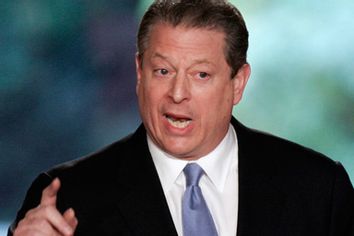
Al Gore: Former Vice President Al Gore

Mr. Vice President, you write in your new book, “Our Choice,” that we have at our fingertips all of the tools that we need to solve the climate crisis. The only missing ingredient would be collective will. What makes it so hard for governments to implement change even though most people know what needs to be done?

As human beings, we are vulnerable to confusing the unprecedented with the improbable. In our everyday experience, if something has never happened before, we are generally safe in assuming it is not going to happen in the future, but the exceptions can kill you and climate change is one of those exceptions. Neuroscientists point out that we are inherently better able to respond quickly to the kinds of threats that our evolutionary ancestors survived — like other humans with weapons, snakes and spiders or fire. Also, there is a real-time lag between the causes of the climate crisis and its full manifestation. That makes it seem less urgent to many people.

But America always took pride in being faster and more flexible than other nations. Does that no longer apply?

America’s political system has evolved over the last 50 years in ways that have enhanced the power of business lobbies. The power of television and of money has grown exponentially. Eighty percent of the campaign contributions that candidates and officials running for reelection raise and spend go to TV ads, so they are required to raise enormous amounts of money, mainly from business lobbies. In a way, that has “re-feudalized” the political power and it gave much more power to established interests. When Obama was elected, I said: “What an exciting moment in our history.” But his election did not cure all of the problems in the American system.

Seventeen years ago you, a young senator from Tennessee, and Bill Clinton, a young governor from Arkansas, moved into the White House on the promise of change. Clinton played the saxophone and there was a feeling of spring in the air. Why has it been so much tougher for Barack Obama?

It was hard for us, too. Just remember the resistance to our healthcare reform bill. Obama’s progress on healthcare has already surpassed what we were able to do on healthcare. He will get a climate change bill adopted. So I am optimistic. These are still the early days of the Obama presidency. He had a bad summer, but he is having a good fall.

Isn’t it getting harder and harder to remain an optimist?

I think there is a realistic basis for optimism. The Internet empowers individuals to play a more active role in the political process, as Obama’s campaign has manifested. They felt shut out of the conversation of democracy during the television age, but they are coming back. It is not an accident that virtually every progressive reform movement in the world is now based on the Internet. There are more than 1 million, perhaps as many as 2 million grass-roots organizations that have been established worldwide on the issue of the climate crisis, most of them on the Internet.

Obama’s political opponents also rely on the Internet, though. Could the reason for the resistance to his government be his skin color? Former President Jimmy Carter said many Americans still have a problem with a black man in the White House.

There is no doubt that the issue of race is always present in American politics and in the politics of any multiracial society. There is also no doubt that for some people it is an element in the manifested hostility to Obama. But I don’t think it is the major theme at all. Obama is right when he reminds people: By the way, I was black before the election.

Perhaps the aggressive reactions can be explained by the fact that he, you and large parts of the Democratic Party misinterpreted the will of voters. Perhaps the last election had less to do with a desire among voters to implement transformational change than just getting rid of Bush.

Isn’t that all related? The Bush-Cheney administration had betrayed some basic American values. So there was hunger for change. The difficulties the new government has encountered are in the Congress, and they are connected to the growing influence of business lobbies and people who are simply afraid of government.

Is that a new phenomenon?

People in Congress listen less to each other. The Senate chamber, for example, is now commonly empty when speeches are made. That was different in the past and I know why it has changed. The chamber is empty now because the senators have to be at cocktail parties and fundraisers to raise money. They feel as if they have to spend virtually all their time raising money.

“It is realistic to expect a treaty”

Isn’t Obama’s plate too full? He conducts war in Iraq and Afghanistan, he wants to close Guantánamo, he is trying to reform the healthcare system, he is promising progress on climate change and wants to strengthen, almost in passing, the rights of trade unions and homosexuals. Isn’t that too much change for a rather conservative country like the United States?

I disagree with that criticism. After eight years of retrogression, Obama would have been more bitterly criticized if he had chosen only one priority and had not tried to address the many challenges that need to be undertaken. So I do think there is a grain of truth to it, but I also know that his mandate was and is strongest at the beginning of his term.

But Obama hasn’t achieved much so far — most of the reforms he announced still haven’t been implemented. Many people already call him a sweet talker — all talk, but little action.

One of the tools that a president has is to command the attention of the American people. It has to be used judiciously. There is such a thing as overexposure when a president depreciates the welcome. I think it is too early to make that judgment. There have been times when I thought that President Obama maybe got close to that line — for instance, with regard to his television interviews. But it is the most powerful tool he has to make his direct presentation to the people.

The financial crisis hasn’t made the president’s job any easier. Are times of material want fundamentally bad for reform politicians?

The climate, financial and national security crises are all connected. They share the same cause: Our absurd dependency on foreign oil. As long as we need to spend billions of dollars each year to buy foreign oil from state-run oil companies in the Persian Gulf, our problems of a trade deficit, a budget deficit and a climate crisis will persist. Therefore, more and more Americans begin to realize that the right response to the climate challenge will also help with the economy and a more balanced budget.

German Chancellor Angela Merkel was less optimistic after the G-20 summit in Pittsburgh. She did not believe there would be a majority for a U.S. climate change law in Congress before the world climate summit in Copenhagen in December.

I am more optimistic. I do not think that we will have the final enactment of the Conference Committee Report in Congress before Copenhagen. But if President Obama is able to go to Copenhagen having passed legislation in the House and having passed it in the Senate, it will be inevitable that the legislation comes out even if the Conference Committee is still pending.

What are your expectations for Copenhagen ?

I think it is realistic to expect a treaty. It will not be as strong as I would like it to be. But it will put a price on carbon and change the forward planning of businesses and cities and states, provinces and nations. In 1986, when the first crisis of the global atmosphere emerged with the discovery of the ozone hole above Antarctica, one year later the nations of the world passed the Montreal Protocol. It was bitterly criticized by environmentalists as being too weak and insufficient. But then it was toughened and toughened, and it is working quite well, and we are on our way to solving that crisis. I am expecting a similar process for Copenhagen. We will produce a treaty that launches the beginning of a huge transformation process.

The U.S. is expecting more commitment from China. Should Obama use his upcoming Asia trip to increase pressure on Beijing?

They have to accept binding provisions. Many developing nations are still thinking that the wealthier countries will take binding obligations, and the developing countries will have non-binding provisions. That is not a formula for success. In an I.T.-empowered outsourcing world it is very easy to replicate the technological basis for production in low-wage countries. Workers in Germany and the United States and other wealthy nations fear for their jobs. We can’t tell them: “We are going to have these binding obligations, but the places that have already gotten some of your jobs are going to have no obligations at all.” That wouldn’t work.

Isn’t that even more of an incentive for developing nations not to accept any binding emission caps?

They are starting to feel the consequences of such a policy. India now faces the prospect of black carbon emissions greatly accelerating the melting of ice that forms the source of the majority of the water in the Indus, the Ganges and the Brahmaputra rivers. They must cut back on black carbon for their own survival.

Do you see indications of a shift in awareness in China, which is the second greatest polluter in the world after the U.S.?

China has been changing fairly dramatically on this issue. While they are still opening a new coal-fired generating plant every eight or nine days, they will soon be the No. 1 power in wind and the No. 1 power in solar. In each of the last several years, they have planted two and a half times as many trees as the rest of the world put together. They are building an 800-kilovolt supergrid that, by 2020, will be the most advanced in the world. They have revised their new five-year plan, beginning a little over a year from now, to adapt the formula by which all bureaucrats and officials are evaluated for advancement or not. They have placed their success in reducing CO2 as one of the principal factors by which they pursue their career successfully or not. These are significant changes.

Will Obama travel to Copenhagen ?

He hasn’t told me that he will, and no one representing him has told me that he will. But I see the calendar, I see unfolding of events and I feel certain he will go.

The White House is currently dampening expectations, because if the American president travels to Copenhagen for the summit, the rest of the world will expect a binding agreement from the United States on emissions caps.

Yes, of course. President Obama has already enacted a binding set of regulations that require a cut in emissions. But the big difference will be whether or not the Senate legislation on climate change passes or not. I believe that the draft bill introduced by Sen. John Kerry and Sen. Barbara Boxer really does open up very new prospects. They are likely to add a title to the draft that expands support for nuclear energy. I also think they will add some provisions accelerating the substitution of gas for coal. Gas has only half the CO2 emissions of coal and two-thirds of that from oil. I think that will also generate more support and split the energy lobbies somehow. Therefore, I think there is a very real prospect that the legislation will pass, and that as a result, Obama will have the ability to go to Copenhagen with a more substantive position.

How do you see your own role in this process?

Sometimes the language of Yiddish is the most expressive. I want to be a “nudge” in Copenhagen. Someone who is pushing for action.

The most effective way to “nudge” people into action is to be president of the United States of America. Will you ever run for this office again?

Well, I am trying to recover from politics. But of course there is always a danger of a relapse when you are in recovery.

Mr. Vice President, we thank you for this interview.

“Obama is average”

In an interview, a leading voice of America's conservative intellectuals discusses Barack Obama's failures

  • more
    • All Share Services

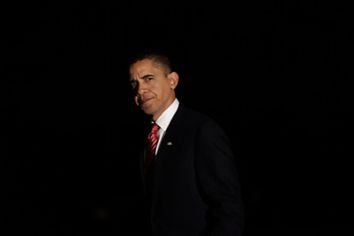
President Barack Obama walks across the South Lawn of the White House during his arrival on Marine One helicopter in Washington, Tuesday, Oct. 20, 2009.

Mr. Krauthammer, did the Nobel Commitee in Oslo honor or doom the Obama presidency by awarding him the Peace Prize?

Charles Krauthammer: It is so comical. Absurd. Any prize that goes to Kellogg and Briand, Le Duc Tho and Arafat, and Rigoberta Menchú, and ends up with Obama, tells you all you need to know. For Obama it’s not very good because it reaffirms the stereotypes about him as the empty celebrity.

Why does it?

He is a man of perpetual promise. There used to be a cruel joke that said Brazil is the country of the future, and always will be; Obama is the Brazil of today’s politicians. He has obviously achieved nothing. And in the American context, to be the hero of five Norwegian leftists, is not exactly politically positive.

It hardly makes sense to blame him for losing the Olympic bid in one week, and then for winning the Nobel Prize the next.

He should have simply said: “This is very nice, I appreciate the gesture, but I haven’t achieved what I want to achieve.” But he is not the kind of man that does that.

Should he have turned down the prize?

He would never turn that down. The presidency is all about him. Just think about the speech he gave in Berlin. There is something so preposterous about a presidential candidate speaking in Berlin. And it was replete with all these universalist clichés, which is basically what he’s been giving us for nine months.

Why do Europeans react so positively to him?

Because Europe, for very understandable reasons, has been chafing for 60 years under the protection, but also the subtle or not so subtle domination of America. Europeans like to see the big guy cut down to size, it’s a natural reaction. You know, Europe ran the world for 400 or 500 years until the civilizational suicide of the two World Wars. And then America emerged as the world hegemon, with no competition and unchallenged. The irony is America is the only hegemonic power that never sought hegemony, unlike, for example, Napoleonic France. Americans are not intrinsically imperial, but we ended up dominant by default: Europe disappeared after the Second World War, the Soviet Union disappeared in 1991, so here we are. Of course Europeans like to see the hegemon diminished, and Obama is the perfect man to do that.

Maybe Europeans want to just see a different America, one they can admire again.

Admire? Look at Obama’s speech at the U.N. General Assembly: “No one nation can or should try to dominate another nation.” Take the first half of that sentence: No nation can dominate another. There is no 8-year-old who would say that — it’s so absurd. And the second half? That is adolescent utopianism. Obama talks in platitudes, but offers a vision to the world of America diminished or constrained, and willing to share leadership in a way that no other presidency and no other great power would. Could you imagine if the Russians were hegemonic, or the Chinese, or the Germans — that they would speak like this?

Is America’s power not already diminished?

Relative to what?

To emerging powers.

The Chinese are rising, the Indians have a very long way to go. But I’m old enough to remember the late 1980s, “The Rise and Fall of the Great Powers” by Paul Kennedy and the prevailing view that America was in decline and Japan was the rising power. The fashion now is that the Chinese will overtake the United States. As with the great Japan panic, there are all kinds of reasons why that will not happen.

Look, eventually American hegemony will fade. In time, yes. But now? Economically we now have serious problems, creating huge amounts of debt that we cannot afford and that could bring down the dollar and even cause hyperinflation. But nothing is inevitable. If we make the right choices, if we keep our economic house in order, we can avert an economic collapse. We can choose to decline or to stay strong.

Do you really believe that Obama deliberately wants to weaken the U.S.?

The liberal vision of America is that it should be less arrogant, less unilateral, more internationalist. In Obama’s view, America would subsume itself under a fuzzy internationalism in which the international community, which I think is a fiction, governs itself through the U.N.

A nightmare?

Worse than that: an absurdity. I can’t even imagine serious people would believe it, but I think Obama does. There is a way America will decline — if we choose first to wreck our economy and then to constrain our freedom of action through subordinating ourselves to international institutions which are 90 percent worthless and 10 percent harmful.

And there is not even 1 percent that is constructive?

No. The U.N. is worse than disaster. The U.N. creates conflicts. Look at the disgraceful U.N. Human Rights Council: It transmits norms which are harmful, anti-liberty and anti-Semitic among other things. The world would be better off in its absence.

And Obama is, in your eyes …

He’s becoming ordinary. In the course of his presidency, Obama has gone from an almost magical charismatic figure to an ordinary politician. Ordinary. Average. His approval ratings are roughly equal to what the last five presidents’ were at the same time in their first term. Other people have already said he’s done and finished because his healthcare plans ran into trouble; but I say they’re wrong. He’s going to come back, he will pass something on healthcare, there’s no question. He will have a blip, be somewhat rehabilitated politically, but he won’t be able to pass anything on climate change. He will not be the great transformer he imagines himself to be. A president like others — with successes and failures.

Every incoming president to the White House has to confront reality and disappoint voters.

True. But what made Obama unique was that he was the ultimate charismatic politician — the most unknown stranger ever to achieve the presidency in the United States. No one knew who he was, he came out of nowhere, he had this incredible persona that floated him above the fray, destroyed Hillary, took over the Democratic Party and became president. This is truly unprecedented: a young unknown with no history, no paper trail, no well-known associates, self-created.

There was tremendous goodwill, even I was thrilled on Election Day, even though I had voted against him and argued against him.

What moved you that day?

It’s redemptive for a country that began in the sin of slavery to see the day, I didn’t think I would live to see the day, when a black president would be elected.

Now he was not my candidate. I would have preferred the first black president to have been somebody ideologically congenial to me, say, Colin Powell (whom I encouraged to run in 2000) or Condoleezza Rice. But I felt truly proud to be an American as I saw him sworn in. I remain proud of this historic achievement.

What major mistakes has Obama made?

I don’t know whether I should call it a mistake, but it turns out he is a left-liberal, not center-right the way Bill Clinton was. The analogy I give is that in America we play the game between the 40-yard lines, in Europe you go all the way from goal line to goal line. You have communist parties, you have fascist parties, we don’t have that, we have very centrist parties.

So Obama wants to push us to the 30-yard line, which for America is pretty far. Right after he was elected, he gave an address to Congress and promised to basically remake the basic pillars of American society — education , energy and healthcare. All this would move America toward a social democratic European-style state. It is outside of the norm of America.

Yet, he had promised these reforms during the campaign.

Hardly. He’s now pushing a cap-and-trade energy reform. During the campaign he said that would cause skyrocketing utility rates. On healthcare, the reason he’s had such resistance is because he promised reform, not a radical remaking of the whole system.

So he didn’t see the massive resistance coming?

Obama misread his mandate. He was elected six weeks after a financial collapse unlike any seen in 60 years; after eight years of a presidency which had tired the country; in the middle of two wars that made the country opposed to the Republican government that involved us in the wars; and against a completely inept opponent, John McCain. Nevertheless, Obama still only won by 7 points. But he thought it was a great sweeping mandate and he could implement his social democratic agenda.

Part of the problem when it comes to healthcare is the lack of solidarity in the American way of thinking. Can a president change a country?

Yes. Franklin D. Roosevelt did it. Back then, we didn’t have a welfare state, we didn’t have old-age pensions, we didn’t have unemployment insurance. This country was the Wild West until FDR. Yes, you can change the spirit of America.

If Obama is so radical, why is the left wing of the Democratic Party so unhappy with him?

They are disillusioned because he has ignored some of their social agenda, such as gay rights; continued some of the Bush policies he had once denounced, such as the detention without trial for terrorists; and on his large agenda for education and energy, where he has had no success.

How could Obama still win Republican support for healthcare reform?

He should finally realize that we need to reform our insane malpractice system. The U.S. is spending between $60 billion  and $200 billion a year on protection against lawsuits. I used to be a doctor, I know how much is wasted on defensive medicine. Everybody I practiced with spends hours and enormous amounts of money on wasted tests, diagnostic and procedures — all to avoid lawsuits. The Democrats will not touch it. When Howard Dean was asked why, he said honestly and explicitly that Democrats don’t want to antagonize the trial lawyers who donate huge amounts of money to the Democrats.

What would be your solution?

I would make Americans pay half a percent tax on their health insurance and create a pool to socialize the cost of medical errors. That would save hundreds of billions of dollars that could be used to insure the uninsured. And second, I would abolish the absurd prohibition against buying health insurance in another state — that reduces competition and keeps health insurance rates artificially high.

But you also need to cut back on healthcare expenses.

It is absolutely crazy that in America employees receive health insurance from their employers — and at the same time a tax break for this from the federal government. It’s a $250 billion a year loophole in the government’s budget. If you taxed healthcare benefits, you would have enough revenue for the government to give back to the individual to purchase their own insurance. If you did those two reforms alone, you would have the basis for affordable health insurance in America.

What the Democrats seem to be aiming for, however, is something somewhat different: the government gets control of the healthcare system by proxy; you heavily regulate the insurance companies, you subsidize the uninsured. That kind of reform would also work, but less efficiently — and because of its unsustainable costs, we would, in the end, have to go to a system of rationing, the way the British do, the way the Canadians do, there is no other way. Obama can’t say any of that, the word rationing is too unpopular.

Mr. Krauthammer, can a Nobel Peace Prize winner send more troops to Afghanistan?

Sure, I don’t see why not. The prize could have two contrary effects. It could give him an incentive to send more troops to show his own people that he is not an instrument of five Norwegian leftists. Or it can work the other way where in order not to lose the popularity he obviously feels from Europe, he would be less inclined. I think whatever impulses come out of those considerations neutralize each other. The prize will have zero effect on his decision.

Part 2: “What the Obama administration pretends is realism is naïve nonsense”

You have called him a “young Hamlet” over his hesitation about making a decision on Afghanistan. However, he’s just carefully considering the options after Bush shot so often from the hip.

No. The strategy he’s revising is not the Bush strategy, it’s the Obama strategy. On March 27, he stood there with a background of flags, Secretary of State Hillary Clinton on one side and Secretary of Defense Robert Gates on the other, and said: “Today, I’m announcing a comprehensive, new strategy for Afghanistan and Pakistan.” So don’t tell me this is revising eight years of Bush, he’s not. For all these weeks and months he’s been revising his own strategy, and that’s OK, you’re allowed to do that. But if you’re president and you’re commander in chief, and your guys are getting shot and killed in the field, and you think “maybe the strategy I myself announced with great fanfare six months ago needs to be revised,” do it in quiet. Don’t show the world that you’re utterly at sea and have no idea what to do! Your European allies already are skittish and reluctant, and wondering whether they ought to go ahead. It’s your own strategy, if it’s not working, then you revise it and fix it. You just don’t demoralize your allies.

Is Afghanistan still a war of necessity, still a strategic interest?

The phrase “war of necessity and war of choice” is a phrase that came out of a different context. Milan Kundera once wrote, “a small country is a country that can disappear and knows it.” He was thinking of prewar Czechoslovakia. Israel is a country that can disappear and knows it. America, Germany, France, Britain are not countries that can disappear. They can be defeated but they cannot disappear. For the great powers, and especially for the world superpower, very few wars are wars of necessity. In theory, America could adopt a foreign policy of isolationism and survive. We could fight nowhere, withdraw from everywhere — South Korea, Germany, Japan, NATO, the United Nations — if we so chose. From that perspective, every war since World War II has been a war of choice.

So using those categories — wars of necessity, wars of choice — is unhelpful in thinking through contemporary American intervention. In Afghanistan the question is: Do the dangers of leaving exceed the dangers of staying.

Gen. Stanley McCrystal is asking for more troops. Is that really the right strategy?

Gen. Stanley McCrystal is the world expert on counterterrorism. For five years he ran the most successful counterterrorism operation probably in the history of the world: His guys went after the bad guys in Iraq, they ran special ops, they used the Predators and they killed thousands of jihadists that we don’t even know about, it was all under the radar. And now this same general tells Obama that the counterterrorism strategy in Afghanistan will fail, you have to do counterinsurgency, population protection. That would seem an extremely persuasive case that counterterrorism would not work.

You famously coined the term “Reagan Doctrine” to describe Ronald Reagan’s foreign policy. What is the “Obama Doctrine”?

I would say his vision of the world appears to me to be so naive that I am not even sure he’s able to develop a doctrine. He has a view of the world as regulated by self-enforcing international norms, where the peace is kept by some kind of vague international consensus, something called the international community, which to me is a fiction, acting through obviously inadequate and worthless international agencies. I wouldn’t elevate that kind of thinking to a doctrine because I have too much respect for the word “doctrine.”

Are you saying that diplomacy always fails?

No, foolishness does. Perhaps when he gets nowhere on Iran, nowhere with North Korea, when he gets nothing from the Russians in return for what he did to the Poles and the Czechs, gets nowhere in the Middle East peace talks — maybe at that point he’ll begin to rethink whether the world really runs by international norms, consensus, and sweetness and light, or whether it rests on the foundation of American and Western power that, in the final analysis, guarantees peace.

That is the cynical approach.

The realist approach. Henry Kissinger once said that peace can be achieved only one of two ways: hegemony or balance of power. Now that is real realism. What the Obama administration pretends is realism is naive nonsense.

How do you solve problems like climate change if international institutions are failing?

It’s not the institution that does it, it’s the confluence of interests. Where there is a confluence of interests among nations, as, for example, the swine flu or polio, you can get well-functioning international institutions like the World Health Organization. And you can act. Climate change is different, because the science remains hypothetical and the potential costs staggering.

You think it’s a speculative theory?

My own view is that there is man-made warming. On several occasions I have written that I don’t think you can pump carbon dioxide into the atmosphere indefinitely and not have a reaction. But there are great scientists such as Freeman Dyson, one of the greatest physicists of the last hundred years, who has studied the question, who believes quite the opposite. The reason transnational action is so difficult is because the major problem with climate change is, A) that there is no consensus, and, B) that the economic cost is simply staggering. Reversing it completely might mean undoing the modern industrial economy.

I’m not against international institutions that would try to tackle it. But the way to go, at least in the short run, is to go to nuclear power. It’s amazing to me that people who are so alarmed about global warming are so reluctant to adopt the obvious short-term solution — the bridge until the day when we have affordable renewable energy — of nuclear power. It seems to me intellectually dishonest. Nuclear is obviously not the final answer because it produces its own waste — but you have a choice. There’s no free lunch. If you want an industrial economy, you need energy. If you want energy, it will produce pollution. You can have it in two forms. You can have it dissipated in the atmosphere — like carbon dioxide — which then you cannot recover, or you can have the waste concentrated in one small space like nuclear. That is far easier to deal with. The idea that you can be able to create renewable energy at a price anywhere near the current price for oil or gas or coal is a fantasy.

Do you basically think Obama is going to be a one-term president?

No, I think he has a very good chance of being reelected. For two reasons. First, there’s no real candidate on the other side, and you can’t beat something with nothing. Secondly, it’ll depend on the economy — and just from American history, in the normal economic cycles, presidents who have their recessions at the beginning of their first term get reelected (Reagan, Clinton, the second Bush), and presidents who have them at the end of their first term don’t (Carter, the first Bush). Obama will lose a lot of seats in next year’s congressional election, but the economy should be on the upswing in 2012.

Is the conservative movement in the United States in decline?

When George W. Bush won in 2004, there was lots of stuff written about the end of liberalism and the death of the Democratic Party. Look where we are now.

A Democrat is back in the White House, the party also controls Congress.

Exactly. We see the usual overreading of history whenever one side loses. Look, there are cycles in American politics. U.S. cycles are even more pronounced because we Americans have a totally entrepreneurial residential system. We don’t have parliamentary opposition parties with a shadow prime minister and shadow cabinets. Every four years, the opposition reinvents itself. We have no idea who will be the Republican nominee in 2012. The party structures are very fluid. We have a history of political parties being thrown out of the White House after two terms — as has happened every single time with only one exception (Ronald Reagan) since World War II. The idea that one party is done in the U.S. is silly. The Republicans got killed in 2006 and 2008, but they will be back.

The party lacks a strong, intelligent leader.

Yes. And if the Republicans don’t have one by 2012, they’ll lose and they’ll have to wait till 2016. It could take eight years to develop. You know, people say — the White House was pushing this idea — that the radio talk show host Rush Limbaugh is the leader of the opposition because there’s no other leader. Well, ask yourself, in 2001 and 2002 and 2003, who was the leader of the Democratic Party? There was none. We don’t have a parliamentary system in which opposition leaders are designated.

Some people say you’re that leader.

I’m just getting to an age where a lot of my contemporaries are retiring or dying. So I’m on default a voice of authority. I don’t attribute very much to that. 

Who will be the next leader of the Republican Party?

Some presidential candidates from last year will return in 2012. Sarah Palin is not a serious contender, but somebody like Mitt Romney will be. He is a serious guy, he understands the economy. There will also be some young people many haven’t yet heard about, such as Rep. Paul Ryan or Gov. Tim Pawlenty. Or outsiders like the mastermind behind the surge in Iraq, Gen. David Petraeus, who might retire from the military and run for president on the Republican ticket.

Many people, however, currently think the Republicans are the party of “no.”

That perception is a serious problem for them.

At the end of Bush’s second term, he granted you a long interview. Afterward, you wrote that history would judge Bush kindly. Why?

Basically I think Bush will have the same historical rehabilitation that Harry Truman did.

And why is that?

Truman left in the middle of an unpopular war, to use your phrase, a war of choice. Truman didn’t have to go into South Korea. And he was reviled and ridiculed for the stalemate that resulted. Now, he’s seen as one of the great presidents of the 20th century.

I think Bush actually handled the Iraq war better than Truman handled the Korean War. For one thing, the number of losses is about one-tenth. Secondly, he made the right decision with the surge. Thirdly, if Iraq turns out well, meaning becomes a country fairly self-sufficient and fairly friendly to the West, it will have a more important effect on the West than having a non-communist South Korea. The Middle East is strategically a far more important region.

Bush’s worst mistake was the conduct of the Iraq war in the middle years — 2004-2006 — and the attempt to win on the cheap, with a light footprint.

On the other hand, I think he did exactly the right thing after 9/11. Look at the Patriot Act, which revolutionized how we deal with domestic terrorism, passed within six weeks of 9/11 in the fury of the moment. Testimony to how well Bush got it right is that Democrats, who now control Congress and had been highly critical of it, are now after eight years reauthorizing it with almost no significant changes.

Afghanistan is more problematic. Our success in overthrowing the Taliban in 100 days was remarkable. It’s one of the great military achievements of all time. On the other hand, holding Afghanistan is a lot harder than taking it, and to this day we are not sure how to do it. But the initial success in 2001-2002 did decimate and scatter al-Qaida. It is no accident that we have not suffered a second attack — something no one who lived in Washington on Sept. 11 thought possible.

I’m sure he will be rehabilitated in the long term.

Clare Booth Luce once said that every president is remembered for one thing, and that’s what Bush will be remembered for. He kept us safe.

Is it too early to foresee what Obama will be remembered for?

It is quite early. It could be his election.

Mr. Krauthammer, we thank you for this interview. 

Continue Reading Close

“Afghanistan is Mr. Obama’s war of choice”

Foreign relations expert Richard Haass says in an interview that Afghanistan is no longer a necessary war

  • more
    • All Share Services

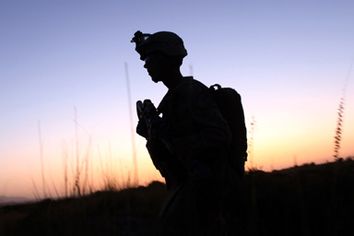
A U.S Marine from Delta Company of 2nd Light Armored Reconnaissance Battalion patrols near the town of Khan Neshin in Rig district of Helmand province, southern Afghanistan September 10, 2009.

Richard Haass, the president of the influential Council on Foreign Relations, talks about new approaches to the Afghanistan war, the country’s decreasing significance in the war on terror and why Pakistan is more important to American interests.

A memo written by the U.S. commander in Afghanistan, Stanley McChrystal, was recently leaked in which he asks the American people for more patience and President Barack Obama for more troops. Isn’t it rather unusual for U.S. generals to put so much pressure on the president?

It is fine for generals and civilians to ask for more resources. One of their responsibilities is to speak truth to power if they think they need more resources to accomplish the mission. To do that in public is not appropriate, though. The president deserves to have these issues debated in private. Whoever leaked Gen. McChrystal’s memorandum acted unfairly and unprofessionally.

But should Obama follow this advice?

It would be premature to follow it at the moment. First, we need to be more confident that doing more militarily in Afghanistan will produce more results. It is not clear that will be the case. Secondly, we need to challenge the assumption that what happens in Afghanistan is critical for the global effort against terrorism.

Isn’t that effort doomed if Afghanistan remains a safe haven for terrorists? That is why the West invaded the country, after all.

That is not clear either. Even if terrorists were to be denied Afghanistan, they could operate out of other countries. We should also reconsider whether what happens in Afghanistan is essential for the future in Pakistan, which, frankly, matters more to the United States. Pakistan’s internal dynamics will count for more when it comes to determining Pakistan’s trajectory. I believe the president is right to slow down the decision process.

Obama already announced a new Afghanistan strategy in March, which appeared to include more U.S. troops. Now there are calls for that to be reconsidered. What has changed since then?

Today, things are looking even bleaker in Afghanistan. It is not at all obvious that Afghans can overcome ethnic and tribal loyalties, corruption and personal rivalries. The presidential election in August was deeply flawed. No matter who is ultimately declared the winner, this election is almost certain to leave the country even more divided.

Some administration officials have suggested that the U.S. should step up its military operations against terrorists in Pakistan, rather than sending more troops to Afghanistan.

I am sympathetic to the idea. Pakistan is more vital to the U.S. and we are starting to see progress there. There should be a greater level of economic and military support in Pakistan. Carrying out more airstrikes there is an attractive idea as long as the chance of collateral damage is minimized.

President Obama often calls the war in Afghanistan a “war of necessity.” It’s a term he lifted from one of your books…

Please, you are getting me into trouble.

But you no longer call it a war of necessity. Why?

It was a war of necessity after the attacks of 9/11 when you had a hostile government led by Taliban in Afghanistan. Now you have an essentially friendly government in Kabul and al-Qaida has reestablished itself in Pakistan. So I am no longer sure what happens in Afghanistan is still essential to the war on terrorism. Afghanistan is thus a war of choice — Mr. Obama’s war of choice. There needs to be a limit to what the United States does in Afghanistan and how long it is prepared to do it.

What options does the president have?

We have alternatives to an even bigger troop increase. That is another reason why this is no longer a war of necessity. The choice is not between pulling out and increasing resources. We can reduce our troops’ ground-combat operations but emphasize drone attacks on terrorists, the training of Afghan soldiers and police officers, and development aid and diplomacy to fracture the Taliban. Nobody is talking about or should be talking about abandoning Afghanistan.

But we are talking about fewer U.S. troops.

The risk of ending our military effort in Afghanistan is that Kabul could be overrun and the government might fall. The risk of the current approach — or one that involves dispatching 10,000 or 20,000 soldiers more — is that it might produce the same result in the end, but at a much higher human, military and economic cost. But if the U.S. does decide to increase troop levels, it should condition any such decision on specific Afghan commitments and reforms.


This article has been provided by Der Spiegel through a special arrangement with Salon. For more from Europe’s most-read newsmagazine, visit Spiegel Online or subscribe to the daily newsletter.

Continue Reading Close

“It is pointless to talk to al-Qaida”

Joseph Nye talks about Obama's use of hard and soft power in Afghanistan, and what he learned from Henry Kissinger

  • more
    • All Share Services

Monday, President Obama spoke about his commitment to the ongoing U.S. missions in Iraq and Afghanistan. Obama has shown far more willingness to engage in diplomacy than his predecessor, George W. Bush, but Obama has also continued to expand military operations in Afghanistan. So which is more effective in countering terrorism, so-called hard power that relies on military might or soft power that depends upon diplomacy? In this interview, Harvard professor Joseph Nye talks about America’s role in the world, the change of strategy under President Obama and how Nye’s concept of soft power can be used to solve tough conflicts.

Professor Nye, the Taliban are advancing in Afghanistan and Pakistan, North Korea has a nuclear bomb, Iran is developing one. Isn’t it time for hard power, the use of military force?

Every American president has three options. He can use force — in other words, hard power — to assert his interests, he can invest money or he can lead by attraction. The latter I call soft power, the appeal of American cultural values. I have never argued that the so-called hard-power instruments of a superpower — the military, the intelligence services or economic sanctions — can be replaced. It is all about the right mix of hard and soft power.

And right now military force would be more effective?

It is, of course, pointless to talk to al-Qaida. Their leaders cannot be attracted by American values. But the young people that Osama bin Laden wants to recruit for new terrorist attacks can be reached. That is where the soft power comes in.

How can they be reached? By the speech President Obama gave in Cairo in which he showed respect for the Muslim world, for example?

This speech was impressive. An America that listens, adheres to its own values and respects the values of other cultures makes the recruiting effort of the terrorists much more difficult. So, soft power can also be effective in a conflict that is largely dominated by the use of hard power.

Is there a historical example where a milder form of power politics was really effective?

Think of the end of the Cold War. Not a single shot was fired. For decades, the American military was necessary to deter Soviet aggression and expansion. But it was mainly the soft-power elements that penetrated the Iron Curtain and made the people on the other side lose faith in their system.

What are the sources of soft power?

It comes from three main sources: One is the culture of a country — in the case of America, that ranges from Harvard to Hollywood. Second, political values can be very attractive for other countries, from democracy to freedom of speech to opportunity. And the third one is the legitimacy of a country’s foreign policy — meaning that if your foreign policy is considered to be legitimate by other nations, you are more persuasive. Conversely, a foreign policy that is seen as illegitimate, as was the case under George W. Bush, destroys the power of values and culture.

Former Defense Secretary Donald Rumsfeld reacted with annoyance when asked about your concept. He once said that he did not understand the meaning of soft power.

That was the mind-set of the Bush administration, at least during its first term. They did not understand the potential of soft power and could not use it. They had to learn the hard way that hard power alone was not sufficient to achieve their foreign policy objectives.

Obama uses hard power in Afghanistan and Pakistan, in a way that is not very different from his predecessor. The Pentagon is sending an additional 21,000 troops to Afghanistan in a bid to defeat the Taliban.

We should not play off the hard strategies against the soft strategies. We must restore a certain degree of security in Afghanistan before schools and clinics can be built. Violence must cease before civil aid can be given. In this case, hard power comes before soft power. Recently, U.S. Secretary of State Hillary Clinton described the strategy in her testimony before the U.S. Senate as the “three D’s”: defense, diplomacy, development — in that order.

Has President Obama really changed the strategic goals of U.S. foreign policy?

He is in the process of doing that. Clinton has now created the job of a second under-secretary of state whose primary job will be to oversee development, not just in Afghanistan. Our foreign policy has been over-militarized. Even Secretary of Defense Robert Gates criticized that most resources went straight to the Pentagon.

President Obama speaks with empathy and wisdom. Is that already a policy?

His speeches are helpful, but he needs to follow them up with concrete policy steps. It is not enough to have an attractive person at the top if his policy is not attractive.

So the hard part is still ahead of the president?

Yes, and that is normal. Every new administration first needs to define where it stands and what its goals are. Then the work really begins.

Does the economic crisis not inevitably weaken America’s attractiveness to the world?

There is no doubt that the crisis of the capitalist system weakens the soft-power possibilities of the United States. Wall Street is currently not very popular in the rest of the world. Now it is important for the U.S. government to master this crisis and make the necessary reforms to prevent it from happening again. That is the right way to strengthen our attractiveness. Should our policies fail, America will be weaker.

You emphasize the importance of a combination of hard and soft power in foreign policy. But does the use of one not sometimes handicap the use of the other? In Pakistan, even the Obama administration is still deploying unmanned drones to target and kill Taliban commanders. There is often collateral damage and many civilians are getting killed. This undermines America’s reputation in that region because such a cruel use of force is seen as illegitimate by the people there.

Too much hard power can be counter-productive. The new U.S. commander in Afghanistan, General Stanley McChrystal, has talked about investigating these instances. He promised to avoid civilian casualties in future. Both steps are necessary because such incidents hurt the legitimacy of U.S. policy.

Does Osama bin Laden not have an attractive message for many people in that region of the world?

Sure, he has a lot of soft power. He proved this when he brought down the Twin Towers. Bin Laden did not hold a gun to the heads of the people who flew the planes. He did not pay them either. They did it because they were attracted by his convictions.

Has bin Laden’s soft power increased or decreased since?

I think that his soft power was greater in 2001 than it is today. His excessive use of terror, including numerous attacks that indiscriminately killed many women and children, and of course many Muslims, has hurt the attractiveness of his message.

President Obama has not been able to celebrate any major foreign policy breakthroughs so far — which of course is not all that easy. How, for example, should the United States deal with North Korea? By relying more heavily on hard power?

Yes. But when it comes to North Korea, Chinese hard power is needed. Beijing provides the majority of food and fuel for North Korea. It would be important to persuade the Chinese to actually do more with their hard power. To achieve that, America will have to employ subtle diplomacy. We need to quietly assure the Chinese that we won’t be sending U.S. troops to North Korea. That will alleviate some of the Chinese fears about the consequences of a North Korean collapse.

What strategy would you recommend to Obama for dealing with Iran?

The question with Iran is whether it will be possible to persuade them that they would be better off following the example of Japan. The Japanese have the technology to build a nuclear weapon. But they decided it is too costly to be a nuclear power and not very useful for enhancing prosperity.

And you truly believe that the mullahs will forgo their nuclear ambitions for economic considerations?

We won’t know until we have negotiations. Obama wants to explore the diplomatic options to determine what is possible and what is not. I think he is right about that.

How can a politician learn soft power?

Every politician just has to remember how he got his position in the first place. A young candidate running for Congress or any outsider interested in public office could only achieve his goals by relying on soft power. They could not force anyone to vote for them. They needed to convince their potential voters, they needed to do fundraising, they needed to be attractive candidates. Democracy is the best school to learn soft power.

Is Obama too soft?

If you have grown up in Chicago politics, you understand hard power versus soft power. Obama can be hard and soft.

Henry Kissinger, the doyen of American global policy, would object that foreign policy is not about hard or soft power, but about interests. Isn’t your soft-power concept a contradiction of his realpolitik?

Kissinger was my professor when I was a graduate student at Harvard. There are differences to a degree, but we are not far apart. The key question is how you define the national interest. Was it in America’s interest to go into Iraq? I think not. Was it in America’s interest to go into Afghanistan? I think yes. I partly agree with Henry: It is about interests. It’s the definition of America’s national interest we sometimes disagree on.

How would you define the current national interest of the U.S., the world’s only remaining superpower?

I don’t think that the national interest is predetermined by geopolitics or the history of a country. Important political leaders never just followed their interests — they were concerned about the interests of their people. Take Nelson Mandela: He decided that reconciliation would be more important for South Africa than revenge. Or look at Helmut Kohl: He put the goal of German reunification at the top of his political agenda and was less concerned about the German exchange rate or the effects on the West German economy at that time.

What is the priority of U.S. foreign policy right now?

I think that America should find its interests in ways that are more consistent with the interests of other countries, which are things that are good for us but also good for others. That will make Americans exporters of hope again, not exporters of fear.

Hillary Clinton wanted to make you ambassador to Japan. The White House intervened and appointed a major donor to the Obama campaign instead. Are you disappointed?

Well, the State Department can only recommend a person, but, frankly, the White House has the final say. As you know, there is a long tradition in the United States that about a third of the ambassadors are political appointments.

Should that be changed?

Money and donations are an important part of our political system. They are hard power. I would much rather have Obama spend his political capital on the big issues and not the small issues.


This article has been provided by Der Spiegel through a special arrangement with Salon. For more from Europe’s most-read newsmagazine, visit Spiegel Online or subscribe to the daily newsletter.

Continue Reading Close

“Khamenei has never seen a crisis like this”

This week's protests in Iran are truly unprecedented, says Iran expert Afshin Molavi

  • more
    • All Share Services

This week’s protests in Iran are truly unprecedented, says Iran expert Afshin Molavi in the following interview. The demonstrators come from all walks of life and from across the country. Discontent with Tehran’s hardline leadership is widespread.

Afshin Molavi is an Iran expert with the New America Foundation in Washington D.C. A former reporter for Reuters in Dubai, Molavi has written extensively about Iran, including the book “Persian Pilgrimages: Journeys Across Iran” which was published by Norton in 2002. Molavi was born in Tehran but grew up in the West and once held a job at the World Bank.

On Thursday, a million people demonstrated in the streets of Tehran. Are we witnessing a revolution in Iran?

What we are witnessing on the streets is truly unprecedented in the history of the Islamic Republic. We have seen protests in Iran over the past years, such as student protests or teacher strikes. The world only sees the demonstrations in Tehran but they are taking place all over the country.

Who are the demonstrators? What part of society do they come from?

We are witnessing the return of the Iranian middle class to the political space. This middle class is vibrant, modern, wired, eager to engage with the outside world, hungry for more social and political freedoms, and for better economic management. Many members of Iran’s urban middle class — and its important to remember that Iran is 70 percent urbanized — chose not to vote in the 2005 election, disillusioned with the failures of the reform movement led by (former Iranian president) Mohammad Khatami. They are returning in full after four years of Ahmadinejad and demanding that their votes be counted…

…because they feel cheated. Were they?

That is the main reason people went out onto the streets. They felt that they were a victim of massive fraud — that their vote did not count. They did not go to the streets for a revolution. The case for a massive fraud is overwhelming. Let’s make no mistake: Mahmoud Ahmadinejad has a base. But on election day, the results of 40 million ballots were announced within an hour of polls closing. Hand counting 40 million ballots? In addition, security services surrounded the offices of Ahmadinejad’s main opponent Mir Hossein Mousavi. They shut down Mousavi Web sites. They jailed hundreds of Mousavi supporters the next day. However, as the crowds grow, so do the demands, and what started out as protest with the slogan “where is my vote?” has morphed into something larger, reflecting a generalized discontent with the order of things.

It also seems as though it is no longer just like a battle of the people against the regime, but also a battle within the regime itself.

The analysis in Tehran is that this was a coup perpetrated by supporters of the “new guard” of revolutionary elite, many of whom hail from the security and intelligence services. Over the past four years, Ahmadinejad has appointed former Revolutionary Guard members and former security officials to key positions. Facing them is the “old guard,” consisting of influential figures like former President Ali Akbar Rafsanjani, Khatami, and Mousavi. The clerics are divided, too. Rafsanjani already went to talk to the major clerics and likely warned them that the current turmoil is highly dangerous for the country and for them personally. The interesting thing is: Rafsanjani is also chairman of the Assembly of Experts, 83 clerics theoretically authorized to appoint or remove the Supreme Leader Ayatollah Ali Khamenei, who holds a strong grip on power. This internal struggle is the most serious ever faced by the Islamic Republic.

How does Mir Hossein Mousavi fit in to all of this?

Pre-election Mousavi was seen by many as the “anybody but Ahmadinejad” candidate. He is not a man of great political charisma, nor a bonafide reformer. Post-election Mousavi, however, is an entirely different character. Before the election, he was largely just an interesting candidate for voters who wanted to avoid four more years of Ahmadinejad at any price. Now he has become a political martyr, a hero to many Iranians. That is why Barack Obama’s statement on Tuesday evening (Eds. note: In which he said “the difference between Ahmadinejad and Mousavi in terms of their actual policies may not be as great as has been advertised”) failed to appreciate the reality on the ground. Mousavi is by now not just a leader, he is also being led by the Iranian people.

But the power in Iran still resides with the Supreme Leader Khamenei. So far, he has declared Ahmadinejad the winner of the election. Will he change his mind?

The Supreme Leader likes to have power without accountability, as Karim Sadjadpour of the Carnegie Endowment for International Peace points out. He likes to cultivate this image where he stays above the fray of politics, and he will only intervene in times of crisis. The idea of a bold, ambitious coup as apparently orchestrated by Ahmadinejad’s people is uncharacteristic of him. There are questions whether he was even told about it. Then again, Khamenei tends to side with the conservatives — but he has also never seen a crisis like this.

Does that mean that he might even call for new elections should the protests not subside?

It would be an enormous U-turn if he called for new elections as the Mousavi camp is demanding. That would be a real blow to his credibility. There is also the fear that the authorities are preparing a Tiananmen Square-style crackdown. That is why they are shutting down Web sites and throwing out the foreign journalists. They don’t want to do it in front of the world public. My only hope is: As the crowds get larger, it is getting harder to clamp down on the protesters.

U.S. President Barack Obama has remained largely silent thus far. Is that a politically intelligent move or rather cold-hearted?

I think the Obama administration should not actively take a political side in the internal struggle. However, it should speak out against egregious human rights violations. Their initial reaction has been a little too tepid. But in my view, it is not just about Obama: I get the sense from Iranian cyberspace that they are very keen on hearing from global civil society. They want people around the world to stand in solidarity with them. One idea floating around is that people from Berlin, Paris, London, Cairo, or Washington, or wherever in the world, do one simple thing: wear green, which was the color of Mousavi’s campaign, and has become the color of justice for Iranians. I think global civil society will have a far bigger impact than Obama could.


This article has been provided by Der Spiegel through a special arrangement with Salon. For more from Europe’s most-read newsmagazine, visit Spiegel Online or subscribe to the daily newsletter.

Continue Reading Close

Obama hopes to go where JFK went before

Barack Obama wants to hold a keynote speech on transatlantic relations in front of Berlin's Brandenburg Gate. But don't call him a "European."

  • more
    • All Share Services

Barack Obama wants to hold a keynote speech on transatlantic relations in front of Berlin’s Brandenburg Gate during his visit later this month. Spiegel Online has learned that he plans to outline a new foreign policy that consults partners more, but also makes clear demands on Europe.

When is he coming, who will he meet and, more importantly, what will he say? For days now, Berlin has been abuzz with speculation over plans for Barack Obama’s first trip to Europe as the presumptive Democratic presidential candidate. A July 24 date has been set by the campaign for a Berlin visit and more details are gradually emerging. During his visit to the German capital, Obama plans to hold a keynote address on transatlantic relations.

“During this campaign, Senator Obama has been criticized for his lack of interest in Europe,” an Obama campaign advisor with knowledge of the planning for the trip told Spiegel. “This trip is partly a response to this, and I am sure he wants to address the issue of transatlantic relations.”

The possibility has not been ruled out that the speech could instead be given in Paris or London — the other planned stops on Obama’s short Europe trip. But Obama’s team likes the location of Berlin and the Brandenburg Gate. “The setting would be great,” the advisor said. “The memory of John F. Kennedy’s famous Berlin speech is still alive. Berlin is a bridge between East and West, and the German-American relationship is very strong,” said the advisor.

President Kennedy was given a rousing reception by the people of West Berlin during his visit in 1963, when he held his famous “Ich bin ein Berliner” speech in front of the town hall in Berlin’s Schöneberg district — which lies several miles from the Brandenburg Gate.

The German government has already announced that it would give Obama a warm welcome but has also voiced concern that an Obama speech in front of the Brandenburg Gate might be misinterpreted as German interference with the U.S. election campaign.

However, the decision on whether the Democratic candidate will be able to hold a speech at that location is up to the Berlin City Council, not the German government. “We hope it will work out,” said the advisor.

So far only the outlines of Obama’s speech have been decided. But it’s clear that he will attempt a difficult balancing act between promising a new era of closer transatlantic ties while not appearing too “European” at the same time.

“Obama wants to signal to the Europeans that he will reach out much more to the transatlantic partners than George W. Bush did. You will hear the words ‘I can listen’ frequently in his speech,” said the advisor.

The message will also be directed at voters back home because it will signal that America’s reputation in Europe would improve drastically under a President Obama, the advisor said. “TV pictures of 100,000 cheering people in Berlin can drive home that point.”

At the same time, the senator from Illinois must take care not to seem overly pro-European. Many Democrats still recall how presidential candidate John Kerry four years ago gushed about his good reputation in Europe only to be successfully and pejoratively labeled as “European” by the Republicans as a result.

“We are aware of that risk,” said the advisor. “A voter in North Dakota doesn’t care much for the transatlantic agenda. He would rather ask: What is Obama planning to do for me?”

It’s therefore unlikely that Obama will wax lyrical about Europe’s leadership on combating climate change or health insurance. But he won’t shy away from some “tough love” in his speech, said the advisor, noting that he would spell out clearly that Europe needs to assume more international responsibility, especially in Afghanistan and perhaps in Iraq as well.

The Democrat may also urge the European Union not to get caught up in internal problems in the wake of Ireland’s rejection of the E.U. reform treaty. Obama will spend one day in Berlin at the very most.

The senator may combine his Europe visit not only with stops in Israel and Jordan but also with his planned trip to Iraq and Afghanistan. The latter two stops are far more important for the U.S. election campaign than his Germany visit.

However brief his stopover in Berlin may be, Obama will meet with Chancellor Angela Merkel. His advisors are also trying to make time for a meeting with Foreign Minister Frank-Walter Steinmeier, partly to get a better understanding of both camps in Germany’s grand coalition government — Merkel being a conservative Christian Democrat and Steinmeier a center-left Social Democrat.

The German government is treading carefully. Merkel and Steinmeier want nice pictures with the Democrat, who is highly popular in Germany. But they can’t take sides too openly in the U.S. election campaign, which is why Berlin has misgivings about giving Obama the grand symbolic stage of the Brandenburg Gate.

Merkel’s office on Monday diplomatically declared that it was greatly looking forward to Obama’s visit. But, it added, Republican contender John McCain was of course most welcome any time as well.


This article has been provided by Der Spiegel through a special arrangement with Salon.

Continue Reading Close

Page 1 of 2 in Gregor Peter Schmitz