Helena Cobban

Why Washington is so blind on Egypt

Pro-Israeli groups and their allies have marginalized those who seek to understand the Arab world on their own

  • more
    • All Share Services

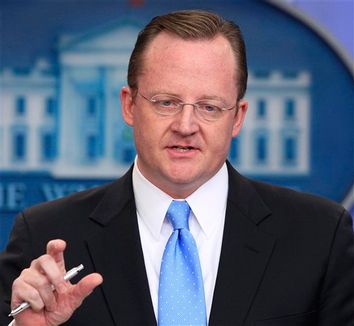
Why Washington is so blind on EgyptWhite House Press Secretary Robert Gibbs answers questions on Egypt during his daily news briefing at the White House in Washington, Friday, Jan. 28, 2011. (AP Photo/Carolyn Kaster)(Credit: AP)

As Egypt’s vast protest enters its seventh day, it is clear that the people on the streets — young and old, secular and religious, men and more than a few women — have already started to change the strategic geography of the whole Middle East. Egypt’s 83 million people and its strategic location make it the most politically weighty country in the Arab world. And ever since 1974, when Nixon and Kissinger started incorporating Egypt into the pro-U.S. network in the region, it has been a linchpin of that network. The fall of Iran’s shah in 1978 and Egypt’s conclusion of a peace agreement with Israel the following year further cemented its position as a key to U.S.-led regional order.

Now, the anti-regime protesters are challenging not only Egypt’s president of 31 years, Hosni Mubarak, but also this regional order. The large military and repressive apparatus that Mubarak has maintained in the country — with the help of generous arms transfers, financing and training from Washington — is proving incapable of keeping him in power. In Washington, as the Daily Beast’s John Barry has chronicled, Obama administration officials were taken completely by surprise by the scope of the popular uprising and have felt almost powerless to intervene.

The sense of official Washington’s perplexity and powerlessness that radiates out of Barry’s reporting is quite justified. There are many objective reasons why Washington has been unable to intervene to prop up its longtime ally. What, after all, could Washington have hoped to do? It has no strike force of its own capable of swooping in and beating back the protesters, in the way that the British or French empires might have attempted in similar circumstances 100 years ago. And in an era in which protesters can immediately hold up for the cameras of the global media tear gas shells or rubber-coated steel bullets that clearly signal “Made in the USA,” there is not a lot of indirect help Washington could have given Mubarak’s security forces, either.

In fact, Mubarak’s long-bloated “security” forces have themselves ruptured over how to deal with the demonstrators. The elite Central Security forces have tried to beat the demonstrators back from key locations in Cairo, and in many other cities (though not Cairo) police or gendarmerie units have shot live ammo into several crowds, reportedly killing more than 100 people so far. (Most of these shootings took place far from any TV cameras.) In many places, the regular police units seem to have splintered completely; and there have been numerous reports of policemen in or out of uniform looting, setting fires or engaging in other forms of mayhem. There have been political arrests and many common jails have opened.

Regarding the military, meanwhile, large tanks from the army’s ground forces have entered public spaces in Cairo, with their commanders expressing a desire only to “restore calm” as they engage in face-to-face dialogue with protest leaders. But air force commanders have sent U.S.-made jets and helicopters roaring low over Cairo, in an apparent attempt to intimidate.

So the picture is very murky. Clearly, one of the main political “dialogues” in Cairo right now is the one being conducted among the commanders of all these parts of the country’s security apparatus. And equally clearly, despite the long links between Egypt’s security apparatus (including those parts of it that have conducted torture against accused terrorists under contract from the U.S. military) and various organs of the U.S. government, Washington currently has few levers with which it can determine the outcome.

The other important dialogue going on in Cairo is among the leaders of the various security forces, the leaders of the movements taking part in the protests, and other political figures, like the evident “president-in-waiting,” Mohamed ElBaradei.

ElBaradei is a key figure marked principally by his political independence and his advocacy of an effective and decent form of constitutionalism in the country. The main movements taking part in the protests have been the largely secular Kifaya (“Enough”) and April 6 Youth movements — and the venerable Islamists of the country’s Muslim Brotherhood (MB).

Of these, the MB is far and away the weightiest. Its leadership has been savvy and intentionally non-confrontational. Many of the MB’s nationally known leaders were arrested on Friday morning. (Some may since then, like Mandela back in 1990, have been hauled in by their captors to engage in preliminary political negotiations.) But the MB had anyway decided, as the Washington Post’s Will Englund reported Monday, to keep a deliberately low profile in the protest movement. Englund quotes former MB head Mahdi Akef: “If we had led, they would have massacred us … All we want is freedom for all the people. Freedom would give us space for movement.”

Englund reports that the groups organizing the demonstrations have established a committee of 10 people to deal with the government — and the MB is definitely included. (The MB has expressed support for ElBaradei becoming president.) This group of 10 is, presumably, hoping to negotiate as peaceful as possible a transition of power — a goal that many in the regular army and also, certainly, many in Egypt’s large business-owning class can be expected to sympathize with.

But in the deliberations among the group of 10, Washington is, again, almost powerless to intervene. While the U.S. embassy in Cairo has had some cautious dealings with the Kifaya movement, it has had none for many years now with the MB. The whole hideous concrete edifice of the U.S. embassy essentially has no eyes or ears on the real politics of the country.

At a different level, Washington itself is blind (or, rather, self-blinded) regarding political trends in Egypt or much of the rest of the Middle East. This self-blinding occurred as a result of the lengthy campaign — waged enthusiastically under Presidents Clinton and George W. Bush, and still maintained under Obama — against the incorporation into policymaking circles of anyone who wanted to listen as closely to the non-Israelis who make up the vast majority of the region’s people, as they do to the far less numerous Israelis.

Pro-Israeli groups and individuals in Congress and the rest of the American political elite have worked hard, for decades now, to demean and marginalize the work of anyone who seeks to understand trends in the Arab world on their own terms. They sowed the wind of our government’s current, stunningly evident impotence regarding events in Egypt. Now we are reaping the whirlwind.

Actually, as the now-inevitable successor government takes over in Egypt — and this may take a few months yet to settle down — the whirlwind will probably not be so bad for most Americans as some fear. A successor government in Cairo will most likely want to have good relations with Washington, as with all other governments around the world. It may well be prepared to live with all the legal terms of the Egyptian-Israeli peace treaty. But most likely, if it is to mark the “clean break” with Mubarakism that is the only source for stability inside Egypt, it will not perform the many other “special services” that Mubarak always seemed so happy to offer to Washington — and to Israel. That is: No more “torture on demand” for the U.S. Special Forces; no more collaborating with Israel to keep the people of Gaza imprisoned; no more covering up for Israel’s gross violations of international law in the occupied territories; no more being a useful U.S. cat’s-paw in the region.

I’m hoping for a relatively peaceful change of power in Cairo. There are many indications — though still no certainty — that this can happen. If it does, it will send forth a broad ripple of geopolitical changes that will transform the whole Middle East in many ways, most of them for the better.

And that small country of some 7 million souls that perches just above Egypt’s northeast tip? For many years now, the interests of that country, Israel, have always been front and center in any American discussion about the Middle East. Israel was always seen as a crucial ally in the region, one with a special capacity to understand and give advice about its affairs. What has Israel’s role been this past week?

Well, on Wednesday — the day after Egypt saw the large-scale first protest, on Jan. 25 — the head of Israel’s military intelligence was assuring a Knesset committee that “There are currently no doubts about the stability of the regime in Egypt.” By Sunday, Prime Minister Benjamin Netanyahu and other Israeli officials were clearly terrified. Desperately running behind the curve, they ordered their diplomats around the world to urge leaders to keep Mubarak in power.

Israel, in short, has been of no use whatsoever to President Obama as he has tried to figure out how to respond to this fast-moving uprising that is far and away the most significant development in the geopolitics of the Middle East since Bush’s invasion of Iraq. But Israel’s situation is now revealed as worse than that. It is not just that it is of no use to Washington. Its actions over the past 40 years, and those of its many cheerleaders inside the U.S. body politic, are now clearly revealed as having undercut our country’s ability to pursue a reasonable, peaceable and rights-based policy throughout the region.

And without having an Egyptian president who is ready and able to act as Israel’s shield and spear, both Israel and the United States are now going to have to look at the whole of the remaining “Arab-Israeli question” in a completely new way.

The incredible shrinking U.S.

Despite the death of Zarqawi, Bush's huge gamble in Iraq has failed. As a result, the U.S. is weaker everywhere in the world -- and that's not all bad.

  • more
    • All Share Services

The incredible shrinking U.S.

The Bush administration has just received two pieces of welcome news from Iraq. It learned first that a U.S. attack plane had killed Abu Musab al-Zarqawi, the long-hunted leader of al-Qaida in Iraq, and then that Iraqi Prime Minister Nuri al-Maliki was finally able to name designees for the three security posts in his government. The new ministers were sworn in within hours.

However, the longer-term trends within Iraq remain grim for the administration. Zarqawi’s killing might dent but certainly promises no quick end to the insurgency among Sunni Arabs in the west and center of Iraq. And though it was good for Maliki to be able — almost six months after the parliamentary elections of last December — to complete his government, still, even these new ministers would find it no easier than their colleagues to actually implement policies they might agree on in their offices in Baghdad’s heavily fortified Green Zone.

Three years after the beginning of the U.S. project to rebuild a working government in Iraq, this project remains mired in corruption, internecine factionalism, and administrative chaos. Despite the appearance of some intra-Iraqi political agreement, several crucial political decisions — including those concerning the status of the U.S. forces inside the country — remain to be addressed. And most worrying of all for U.S. Ambassador Zalmay Khalilzad and his military counterparts: The events of the past six months have shown that they are capable of affecting the important developments in Iraq only slightly, at the margins.

We can see now, indeed, that none of the optimistic scenarios that President Bush and his advisors have spun for Iraq in the past 39 months can be realized within any kind of politically feasible time frame. The White House will likely try to reduce the U.S. troop numbers to below 100,000 before the November midterms, but the tortured security situation inside Iraq is unlikely to improve. (And there are also many scenarios in which developments in Iraq could spin out of control very rapidly indeed.)

Conservatives and liberal hawks like Thomas Friedman and George Packer claim that it is too soon to call Bush’s Iraq adventure a failure. Taking the long view, they argue that only history will judge whether Iraq, and the region, will in the end benefit from the forcible removal of Saddam Hussein. I disagree. We have had three years of that “history” already, and what it has brought has been a steady deterioration in the conditions of life for Iraq’s citizens in areas such as: the provision of very basic services like public security, electric power and safe drinking water; increasing casualty tolls from political violence and unchecked crime; the flight of massive new waves of Iraqis from homes in unsafe neighborhoods; the proliferation of partisan militias; and the deep rooting of institutional corruption.

And there is currently no prospect that this deterioration can even be slowed, let alone reversed. The last political trick the Bush administration had up its sleeve was the holding of the Iraqi parliamentary election of last December. That election was largely successful at the procedural level, but it completely failed to usher in the promised era of political harmony and governmental competence. Indeed, the worsening of the situation has accelerated sharply since December.

Waiting for any more of this “history” to unfold, as we await some theoretically different “final verdict” on Bush’s Iraq project, would only give new force to John Maynard Keynes’ famous dictum that “in the long run we are all dead.” (Though given the present killing rates inside Iraq, for Iraqis that “run” may not even be particularly long.)

But President Bush’s decision to invade Iraq was never just about Iraq, anyway. The intellectual authors of the decision — Dick Cheney, Donald Rumsfeld and his civilian aides in the Pentagon, and the powerful neoconservatives outside government — intended the invasion of Iraq to send powerful messages throughout the Middle East and the world. For these men, the invasion was a high-stakes roll of the dice in a strategic game of global proportions. In the arenas of the broader Persian Gulf, the Israeli-Arab theater, the campaign against terrorism, and the worldwide relationship with other existing and emerging powers, the invasion of Iraq was intended to decisively reverse what the neocons had seen as a worrying erosion of U.S. power and influence.

Unfortunately for the dice-rollers, they miscalculated their chances of success. They were right about two things, though: the size of the stakes in Iraq and the strategic linkage they had asserted between the situation there and those other theaters around the world. So while it is perhaps possible that if they had “won” inside Iraq, that might indeed have strengthened their position in the other theaters, that proposition will never be tested. For instead of winning in Iraq, the Bushites are now — as I and others had predicted all along — losing there, very fast. Accordingly, in terms of Washington’s relations with powers as disparate as the mullahs’ Iran, Putin’s Russia, the rising powers of China and India, or Hugo Chavez’s Venezuela, we now see unfolding exactly the kind of erosion of U.S. power that the neocons once warned against.

Let us consider the fallout we can already see in just three non-Iraqi theaters — Iran, the campaign against al-Qaida and its allies, and the Israeli-Palestinian conflict — from the failure of Bush’s project in Iraq.

Iran

The most evident effects of the administration’s failure in Iraq are those on the balance of coercive power between Washington and Tehran. Back in 2002, hard-liners in and close to the Bush administration warned volubly that subduing Iraq would not be sufficient for them; once they had “won” there they intended to use the U.S. military deployment there as a bludgeon with which — whether through further military action, or through force-backed coercive diplomacy — they could bend to their will both Iran and Syria. As a senior Bush official infamously said, “Anyone can go to Baghdad. Real men go to Tehran.” In May 2003, in the immediate aftermath of the invasion of Iraq (with its attendant display of “shock and awe”), the Iranians were apparently terrified they would be next. Iran at that point found itself with large numbers of U.S. troops, weapons and onward power-projection capabilities deployed along its borders with both Iraq, to the west, and Afghanistan, to the east.

In May 2003, then-President Mohammad Khatami reached out with a letter proposing the first direct talks between Tehran and Washington since 1979. Bush brushed that overture aside. Over the two years that followed the administration and a zealously anti-Iranian Congress kept up the pressure on Tehran. In an eerie replay of the lead-up to the invasion of Iraq, Congress allocated massive funding to Iranian oppositionists to help destabilize and ultimately replace the regime in Tehran, while the administration worked hard to pull together an international coalition dedicated to regime change there (“by all means necessary,” as the standard euphemism for allowing the use of military force puts it).

Three years passed. Along the way the Iranians — many of whom were reacting very strongly against Washington’s heavy-handed intervention in their domestic political affairs — voted in a more hard-line president, Mahmoud Ahmadinejad, whose defiant anti-U.S. and anti-Israeli rhetoric and open pursuit of nuclear power stood in notable contrast to the less strident political posture adopted by Khatami.

At the beginning of May this year, Ahmadinejad sent a second Iranian letter to Washington. Bush and his people shrugged that one off, too. But on May 31 Secretary of State Condoleezza Rice announced a diplomatic riposte of her own: If Iran would suspend its recently resumed enrichment of uranium, then the U.S. would join the Europeans in holding talks with Iran and would offer it a package “containing both benefits, if Iran makes the right choice, and costs, if it does not.”

It remains to be seen whether this move from Washington represents a good-faith attempt to de-escalate the tensions with Tehran and find a way to resolve the many differences between the two countries peaceably, or whether, like Colin Powell’s infamous appearance at the Security Council in February 2003, it is intended merely as diplomatic window dressing that aims to satisfy key international allies that Washington has indeed exhausted all the diplomatic options before it resumes an already predetermined rush toward war.

The latter is surely a more accurate depiction of Washington’s attitude. But the chances that the U.S. will actually attack Iran are far lower now than they were three years ago, because the balance of power between Washington and Tehran has altered drastically since May 2003. The swaggeringly militaristic threats issued by Bush administration people in midsummer 2003 are now nowhere to be heard. What has changed? Most crucially, the U.S. military, which looked so capable of threatening Iran in 2003, is these days engulfed in an Iraqi political situation in which Tehran now has considerably more political influence than Washington. Today, the 133,000 U.S. soldiers and Marines deployed throughout Iraq look more like 133,000 sitting ducks than any kind of strike force poised for attack. (Back in 1980, the presence of just 52 U.S. hostages in Iran lost Jimmy Carter his bid for reelection. But now, the Bush administration has 133,000 U.S. government employees sitting as hostages to fortune in Iraq. Will the reaction of the U.S. voters be commensurate?)

Flowing from that reality in Iraq, two other crucial dimensions of the Washington-Tehran strategic balance have also changed considerably. Internationally, Washington is nowadays perceived — quite rightly — as far less powerful than it was in 2003. In 2003, though popular opinion around the world was overwhelmingly opposed to the invasion of Iraq, Bush still managed to persuade some 30 governments to give at least token support to the “coalition of the willing.” (Britain’s support was more than token: Prime Minister Tony Blair committed 11,000 troops and considerable political prestige to the project.) Nowadays, the number of states ready to give even token support to the coalition in Iraq has shrunk considerably. And every single major world leader has warned Washington strongly against launching any kind of unprovoked military attack against Iran. The only exception to this is Israel, a fact that brings significant complications of its own.

Inside the United States, meanwhile, the enthusiasm (or, more minimally, the level of permissiveness) with which the U.S. public and even Congress view the possibility of attacking Iran has cooled a lot since the summer of 2003. Back then, still raw from the wounds of 9/11 and flush with the bravado of having just bested Saddam’s armies, many U.S. citizens could still dream of having a follow-up “cakewalk” in Iran. Now, 2,476 American body bags and billions of federal dollars later, no such cakewalk looks remotely realizable — in either Iraq or Iran. There may be some political operatives around Bush who think a “wag the dog” scenario might be a good idea in the run-up to the coming midterms. But I do not see that any rational politician would follow that advice.

Richard Haass, the head of the Council on Foreign Relations, told the New York Times May 31 that the conditions for opening a dialogue with Tehran “are significantly different than they were four or five years ago, but candidly they are not as favorable now for the United States.” That is putting it very mildly. (Which is not surprising, since Haass ran the State Department’s policy planning during Bush’s first term in office.)

Terrorism

Terrorist violence concerns me greatly. Back in the ’70s I covered (and barely missed being killed by) a number of explosives-packed car bombs in Beirut, Lebanon. Since then, I’ve traveled around both Israel and London on public buses and trains. I have friends who work on U.S. airliners, and in office buildings in Washington and New York. So of course it was shocking after Sept. 11, 2001, to realize that in the years since the U.S.-sponsored “victory” over the Soviets in Afghanistan, we had allowed that impoverished state to fail so thoroughly that it had become a supportive incubator for some extremely anti-humane, ambitious and technically capable global terrorists.

But you would have thought that in November 2001, after the U.S. and its allies yet again won a military victory in Afghanistan, this time around they would see the importance of working hard to convert the military victory they had won into a lasting political victory — for Afghanistan’s 31 million people, for their neighbors, and the world — by bringing serious, long-term socioeconomic stabilization to the country.

They did not. Instead of doing that, within days of the fall of the Taliban regime in Kabul, Defense Secretary Donald Rumsfeld was already talking to Bush about how to start planning the invasion of Iraq. Opening a second front is always a risky strategy in any war, and it proved catastrophic in this one, since the Iraq campaign quite predictably turned from the set-piece affair that the Pentagon war-gamed for into a vicious, unwinnable counterinsurgency. And in the years since 2003, the quagmire in Iraq has eaten up much greater quantities of U.S. and allied military manpower, international aid dollars, and focused political attention than Afghanistan. (Some figures: Afghanistan has a population of 31 million and an area of 647,000 square kilometers. It currently has some 26,000 U.S. and allied forces deployed, and received aid pledges for 2004-2009 totaling $8.9 billion. Iraq has a population of 27 million and an area of 437,000 square kilometers. It has 140,000 U.S. and allied forces, and received aid pledges for 2004-2007 totaling $33 billion.)

Iraq, which before March 2003 hosted almost no international terrorists, has become a magnet for thousands of them (in the same way Afghanistan was, when there was a Soviet occupation there to fight). And in today’s Afghanistan, large portions of the country have now reverted to Taliban influence or even Taliban rule.

As I noted above, Bush’s decision to invade Iraq was a big roll of the geopolitical dice. It failed. So long as U.S. troops remain in Iraq the consequences of Washington’s failure there will continue to play out to the benefit of the Islamist terrorists — in Iraq, in Afghanistan, and everywhere else where now, in reaction to the U.S. brutality in Iraq, they find populations prepared to help them.

Palestine and Israel

The invasion of Iraq, some of its apologists promised, would help bring a reasonable and final resolution of the Palestinian-Israeli dispute. Actually, they made two distinctly different arguments in this regard. One was that Saddam’s financial aid had been such a strong factor fueling Palestinian violence that overthrowing Saddam would deal the Palestinian extremists a body blow; and then a more flexible Palestinian leadership would agree to most of the concessions that Israel had demanded, and reaching an agreement would be easy. The other (and quite contradictory) argument held that in launching the invasion of Iraq Bush would be so dependent on the support of political allies like Tony Blair and Egypt’s President Hosni Mubarak that once the invasion was over Bush would be obliged to accede to the long-standing demands of those allies that he weigh in on the Israeli-Palestinian diplomacy in a way that would give the Palestinians something like an acceptable deal.

Neither of these arguments was borne out by events. Israel has won some respite from terrorist violence in recent years. But this has been the result far more of the Palestinians’ unilateral tahdi’eh (cease-fire) and of the retreat of Israeli troops and settlers from Gaza and behind high concrete and steel barriers in the West Bank, than it has been of Saddam’s overthrow. In 2005, after Saddam and his erstwhile Palestinian ally Yasser Arafat were no longer on the political scene, the Israelis were still unwilling to negotiate with the much more moderate Palestinian leader Mahmoud Abbas. Then, as Abbas’ credibility with Palestinians fell, Hamas’ political stock rose. None of these was linked in any way with the overthrow of Saddam.

As for the argument (made by the Middle East expert Fred Halliday, among others) that Bush would be so grateful to Tony Blair on Iraq that he would then take Blair’s advice on Palestine, well, dream on! Despite all Blair’s pleadings on this score (and frankly, they haven’t been anywhere near as strong as they could have been) Bush and the U.S. Congress have continued to give generous financial and political aid to an Israel that, under Sharon and Olmert, has persisted in the construction of the land-grabbing West Bank barrier, in the ethnic cleansing of wide swathes of East Jerusalem, and in thumbing its nose at the very meek little “road map for peace” that Bush laid out back in June 2002.

So in neither of these two ways proposed has it been proven that “the road to peace in Jerusalem lies through Baghdad.” Instead, the world has become accustomed to seeing on its TV screens startlingly similar images from both occupations: heavy tanks rumbling through palm-fringed cities and towns; Arab men rounded up and forced to sit for hours with heads bowed and wrists cuffed painfully behind their backs; towns surrounded by razor wire; young soldiers controlling the slow passage of civilians through endless checkpoints. The similarities are not surprising, given that the U.S. military imported many of its tactics (and even much of its ammunition)from Israel. But these similarities have made the U.S. appear around the world even more as a close ally and patsy of Israel than it looked like before; and they have thus further fueled the active resentment or the more mute incomprehension with which much of the world now views U.S. foreign policy.

So how do I feel about the failure of the Bush project inside Iraq? Vindicated, at one level, I guess, since in my columns in the Christian Science Monitor and elsewhere I did all I could before March 2003 to warn against the reckless folly of the threatened invasion. And just about all the specific bad outcomes I warned about then have subsequently come to pass. But this kind of vindication is a very bitter dish to swallow.

The United States, which is now my country, has many great attributes. But I have always been disturbed by the arrogance and militarism with which it deals with the rest of the world. Perhaps this is because I grew up in a Britain in which it seemed, back in the late 1950s and 1960s, that every two weeks another portion of the British Empire was peeling off and gaining its political independence. The broad narrative of decolonization that dominated those years seemed to me to be fundamentally good and just. It still does. Even though we all know plenty about the instances of malfeasance and political decay in some post-colonial countries, I cannot imagine that a continuation of colonial control would have been any better for the colonized peoples. Certainly, it would have been deeply anti-democratic and unjust.

The U.S. invasion of Iraq was not, on the face of it, an overtly “colonial” venture. But it has had many of the attributes of colonialism, including two key ones: The U.S. administration in Iraq sought to remake the governance of Iraq according to its own plans, and to subordinate Iraq’s economy to the desires of U.S.-based corporations. And when Washington encountered Iraqi resistance to these moves, it resorted to many of the same tactics of counterinsurgency used by colonial powers throughout history: divide and rule, mass incarcerations, intrusive policies of population control, torture and abuse.

I believe that the domestic and global factors now pushing Washington toward undertaking a complete (or near-complete) retreat from Iraq are now so powerful that this retreat will take place before the end of the Bush presidency. But the U.S. will not merely be retreating to the position it occupied on March 18, 2003; the shrinkage of U.S. power around the globe will be much broader than that. There is one very simple reason for this: The U.S. will need the cooperation of other powers if the pullout from Iraq is to be orderly. But why should Russia, China or other world powers give Washington this cooperation if they had any fear that Washington would then just redirect its hegemonistic impulses elsewhere — perhaps toward them? So as the major powers help Washington to extricate itself from Iraq, they will almost certainly require a price to be paid. It may well be demanded in two currencies: some form of stronger guarantee that Washington will not again undertake any recklessly “preventive” war like the highly destabilizing and destructive military action it launched in 2003; and some seriously stronger role for the non-U.S. powers in the always globally sensitive Israeli-Arab negotiations.

In this latter regard, I think Fred Halliday got it wrong. Going into Iraq, the Bush people did not feel they “needed” the support of Tony Blair (or anyone else) badly enough that they needed to cede their monopolistic position in Arab-Israeli diplomacy or their one-sided support for the Israeli government of the day in order to win it. Coming out of Iraq, the balance of power between Washington and the rest of the world will likely be quite different.

So as the U.S. withdraws from Iraq, there may be some developments in international politics that will strengthen global stability. The U.S. may lose the ability it has had for so long to block any resolution of the Palestinian-Israeli dispute that does not conform to Israel’s wishes. The U.S. and the other world powers may finally get serious about trying to stabilize Afghanistan (and other long-neglected parts of the world like Somalia, the Democratic Republic of Congo, and Darfur), rather than leaving them to fester and thus incubate new al-Qaidas or other, as-yet-unseen networks of stakeless international troublemakers. And crucially, the gross power imbalance between the U.S.’s 300 million people and the 6 billion humans who are not U.S. citizens may finally shift toward a more egalitarian, and therefore more just and stable, position. But alongside these possible “gains” from the point of view of building a more just world, we also need to tally up the losses inflicted by the whole brutal Bush project in Iraq: primarily, the massive losses inflicted on Iraq’s people, but also the losses of American lives and treasure.

I realize there are many Americans who are not as ready as I am to welcome the prospect of a diminishment (or, as I would say, a rectification) of the disproportionate amount of power our nation has been able to wield in world affairs over the past 60 years. Many Americans today — like many British or French citizens 80 years ago — think it is somehow “natural” that their nation intervene in the doings of other nations around the world and act as the crucial arbiter in international affairs. (And yes, throughout history nearly all such interventions have always come dressed in “salvationist” garb: Very few nations ever knowingly undertake a war or any other foreign intervention that its people clearly understand to be unjust at the time. If such understanding comes at all, it does so only later.)

Why does U.S. hegemonism in the world seem “natural” to so many Americans? Plumbing the roots of that particular wrinkle on the broader conceit of American exceptionalism would take a long time! Suffice it to note here that after 9/11 the attacks of that day laid their own potent overlay of shock, fear and anger onto the bedrock of those older American attitudes. For roughly 30 months after 9/11, feelings of vengefulness, and of the righteousness of American anger (and of all the actions that flowed therefrom), seemed still to dominate the consciousness of a broad political elite in the U.S. It was only after the revelations of Abu Ghraib in April 2004 that the country’s mainstream discourse on the war, and on what their vengefulness had caused the U.S. to become, became more self-aware and open to self-criticism.

Today, a clear majority of Americans judge that invading Iraq was the wrong thing to do. A similarly clear majority say the administration should set a timetable for withdrawal. This willingness to challenge the Bush people’s spin on the situation in Iraq is a welcome sign of increased public understanding, but it does not signal any automatic readiness to challenge the principle of U.S. exceptionalism more broadly. Grappling with that issue is, I believe, our next great challenge as a citizenry; and it is a challenge that the events of the next few years will almost certainly force us to confront head-on.

Continue Reading Close

Sisterhood of Hamas

Women fueled the rise of the Islamist party through their work in schools and hospitals that serve the Palestinian people.

  • more
    • All Share Services

Sisterhood of Hamas

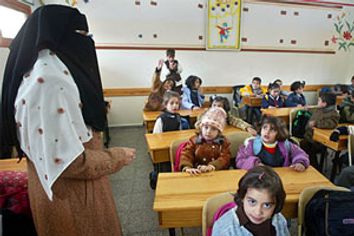
The preschool’s iron gate clangs behind us, shutting out the dust and concrete-block ugliness of Jabaliya, the largest Palestinian refugee camp in the world (population 120,000). In here, around the paved schoolyard, everything is clean, freshly painted and orderly. An energetic young woman in full Islamic coverup is leading two dozen 4-year-olds in some vigorous phys ed. Tiny voices echo out through the open classroom windows.

In one room, a dozen kids are working on computers, “coloring” the national flag of Palestine on their screens. In another, two teachers behind an ingenious puppet theater have puppets act out an interactive skit about the virtues of brushing your teeth. In a third room, it’s time for English instruction. “Where is the orange?” the teacher asks as 22 kids look at objects arrayed on a table. “This is the orange!” some overachievers yell as they race to grab it.

Forget about old-fashioned Islamic madrasas and rote learning. This is an Islamic preschool, Hamas-style. It is part of a dense network of social-service institutions that Hamas and its precursor organizations have built up over the past 30 years in the Israeli-occupied territories of Gaza and the West Bank. These institutions have provided some much-needed humanitarian aid to the hard-pressed Palestinian population. They have also served a number of political purposes.

First and foremost, they helped increase the ability of the Palestinians to withstand the many collective punishments that Israel has imposed on them. Second, they have kept alive a generally (but not completely) maximalist view of how the Palestinian-Israeli conflict should be resolved. Third, they have incubated the development of a broad range of professional and management skills among the Palestinians who have run them. Finally, in the Palestinians’ legislative elections of Jan. 25, these institutions, with their track record of effectively delivering vital services, provided the springboard for Hamas’ surprise victory over the secular Fatah Party.

Today, a large proportion of the staffs, affiliated with Hamas, that run the health centers, social-work departments, preschools and emergency food banks are women. And many of the beneficiaries of the services are women — women trying to raise families in trying conditions in the refugee camps, towns and villages of the occupied territories. Indeed, one of the secrets of the Hamas electoral win that has gone largely unrecognized in the West is the strength of Hamas’ well-organized networks of empowered and politically engaged women.

During my recent 20-day reporting trip to Israel, the West Bank and Gaza, several people in Gaza even told me that one reason Hamas won so strongly on Jan. 25 was that in many families where the husband voted for Fatah, his wife voted for Hamas. Gaza journalist Laila El-Haddad covered the elections quite closely. “The Hamas women made sure the women voters understood that their votes would be secret,” she says. “They assured them their husbands could never find out how they’d voted. I saw it happening.”

It’s not clear how widespread this phenomenon was. But women freeing themselves from the traditional expectations of patriarchy are now clearly shaping Palestinian society. Tough and well-disciplined, these women espouse political views that are often to the hard-line end of Hamas’ (admittedly narrow) political spectrum. As participants and leaders in Palestine’s social networks and organizations, this engaged sisterhood represents a women’s activism that few of the world’s Islamist movements have seen.

In Jabaliya, I am accompanied by Sister Maha, head of women’s affairs for the Jabaliya Islamic Society, and Sister Samah, the vivacious, 24-year-old head of the local Young Muslim Women’s Association. The women routinely call each other “sister” and it feels quite familiar to me to do so too. Their large head scarves, drawn in tight around their faces with no wisp of hair showing, and their plain-colored, shapeless, full-length coats make them look eerily similar to the wimpled Anglican nuns I once studied under.

We look in on a meeting of the Islamic Society’s (women) social workers as they discuss the cases of some of the 800 fatherless children whom they help support. “Yes,” says Sister Maha, “some of these kids’ fathers were our fighters who were killed, or who died in martyrdom operations [suicide bombings]. But some are children whose fathers just died, or were killed by the Israelis.”

We also visit a family where two brothers had died in suicide bombings, and a woman whose husband has been in an Israeli jail since 1991. Sister Maha makes these kinds of home visits frequently. As we enter each home, she carefully peels off the black cotton gloves that, in a mark of particular piety, she always wears when she’s in the street. To mark the end of the visit, she starts putting them on again.

When we visit the prisoner’s wife, Sister Samah and Sister Maha each use our hostess’s prayer rug to say their noon prayers. Each perform the kneeling, bowing and low-voiced praying of the ritual in an unself-conscious way in one part of the room, while the rest of us continue our conversation a few feet away.

At the preschool, Sister Asmahan, the tall, impressively articulate director, sits with us in her office to talk about the program. She says that she and her team provide four hours of preschool education to 160 children each day. She brings out a pile of notebooks and shows me how the teachers, without a copier, painstakingly create fun and engaging workbooks for the kids. The bright, well-decorated classrooms and the activities attest to the technical excellence of the program and the strong preparation of the teachers.

We talk mainly about the school, but Sister Asmahan also wants to talk about politics. She tells me firmly that all the Palestinian refugees should be allowed to return to the homes their forefathers had left, or been forced to leave, in 1948. “And the Jews who are there now should go back to where they came from,” she says.

This is one of seven preschools run by the Islamic Society in Jabaliya. These preschools are important in preparing children to enter schools the United Nations runs for the refugees who make up 75 percent of the Gaza Strip’s 1.4 million people. The Islamic preschools, where the average class size is around 24, educate children ages 4 and 5. The U.N.’s schools do not take children in until age 6 — and there, the average class size is 50. If a child has not learned to read and write before getting into the U.N’.s classrooms, there is little chance she will a get a chance to do so there.

The day before my tour of Jabaliya, I sat down in a corner of a busy office in the Gaza “satellite” seat of the Palestinian parliament with two of the six women legislators who were elected on the Hamas list. Most of these women are professionals; three are from Gaza and three from the West Bank.

Jamila Shanty is a robust, good-natured woman with a well-defined, expressive face who bustles into our meeting toting a large, tattered briefcase. Formerly a professor of psychology and philosophy at Gaza Islamic University, she relishes her new role in the parliament where, she tells me, she hopes to sit on the political and legal-affairs committees.

“We need to strengthen our internal front and restore some discipline to Palestinian society,” she says of Hamas’ imminent priorities. “We must not give Israel the chance to come in here and bomb. We had an ambitious election platform that we now need to implement. Our economy is very difficult, our social conditions are very difficult. So many things need to be done! And we need to protect this project. Everyone is asking us about recognizing Israel. But this is not our focus right now.”

In describing how she became involved in Hamas-related activities, Shanty says she was inspired mainly by Sheik Ahmed Yassin. In 1973, Yassin founded the key Hamas precursor organization — the Gaza-based “Islamic Center,” which focused on educational and social-work activities — and then, in 1987, Hamas itself. He was one of many Hamas leaders assassinated in 2004.

“Sheikh Yassin always paid such a lot of attention to women’s affairs!” Shanty says. “He made sure the mosques all provided enough space for the women to pray in, and that they offered lectures and other activities for women. He told us that the work we do in our homes is important because it has real political value. But he also strongly encouraged women to become engaged in causes outside the home. Whenever he visited a mosque he would make sure to have a meeting with the women there, and he would urge all the women to finish their education and contribute what they could to society. He was an example not just to Palestinians but all Muslims.”

As we talk, we are joined by Shanty’s controversial colleague, Mariam Farhat. Farhat is a pale-faced, demure, older woman who is the mother of three young men who engaged (and lost their lives) in suicide operations against Israelis, killing maybe 10 Israelis in total. I ask her how she feels about her sons’ activities. She says she had encouraged the young men to sign up for the “martyrdom operations.”

“Even though I’m a mother and I love them so much, still there is a priority which is to fight for our rights,” she says. “So though it was painful when they died, still I also felt happy because I am convinced both that they went to heaven and would have a life so much better than our life here, and that their sacrifice helped our Muslim cause. Anyway, how do American mothers feel when they send their boys off to fight and perhaps die as they launch attack operations in Iraq — or Israeli mothers when they send their sons against us here?”

Farhat’s firm, if demurely stated, defiance of Israeli power has made her famous in Palestinian society. Hamas’ politically savvy campaign managers even put her face — along with those of Ahmed Yassin and a couple of other well-known Hamas male leaders — onto the main election posters the party used in the election. A woman of insistent piety, she spends some time during our interview trying to convert me to Islam, saying that because she loves me she wants to “save me from the fire.” I resist her entreaties.

The participation of Farhat, Shanty and their Hamas colleagues in January’s parliamentary election marks the latest phase in a long and slow transformation of Hamas into a national political organization, albeit one that has a 5,000-man militia force that is still dedicated to “resisting the Israeli occupation.” Hamas did not participate in the first round of elections to the legislative and executive branches of the Palestinian Authority back in January 1996. At that point, and until recently, they criticized the P.A. project as an offshoot of the 1993 Oslo accord, which they judged a sellout of Palestinian interests. But by mid-2003, Hamas leaders felt the time had come to enter the P.A.-related political arena.

A first attempt to enter into a P.A. “national unity government” under then-Prime Minister Mahmoud Abbas was blocked when an ever-vindictive Yasser Arafat nixed the plan. After Arafat died in late 2004, Hamas negotiated a new agreement with Abbas, who was elected as new P.A. president in January 2005. Under this deal, Hamas and Fatah agreed to abstain for one year from undertaking any military operations inside Israel. In return for Hamas’ cooperation with the cease-fire, Abbas agreed to allow them to enter the next round of legislative elections. Hamas has stuck to the cease-fire, with only one exception, and has agreed to its continuation — for now. Some small Fatah offshoots have refused to observe it.

Hamas’ first step into electoral politics came when it competed in the three rounds of long-overdue municipal elections that the P.A. organized in late 2004 and early 2005. “We got good practice in campaigning during those elections,” veteran Hamas leader Mahmoud Zahhar tells me. And the Hamas candidates did much better than expected, winning control of many of the new local councils.

One of the new municipal bosses to emerge was Ahmed Kurd, elected as mayor of the central-Gaza city of Deir al-Balah (population 35,000) in late January 2005. His history illustrates the long campaign that Yassin’s followers pursued to build grass-roots social-service organizations, and indicates how, when the Hamas people entered the political arena, they used the management and professional expertise they had acquired in those projects in their new tasks of governance.

Before Kurd ran for mayor, he worked for many years to establish and run a number of well-respected social-service projects. A genial, bespectacled man in his late 50s, he takes me on an after-hours tour in Deir al-Balah. We visit a brace of side-by-side Islamic schools — one for girls and one for boys — each of which now educates 500 children, grades 5 to 12.

As with the Jabaliya preschool, there is a strong contrast between the dust and chaos outside the school walls and the calm and order inside them. On the girls’ campus, immaculately manicured gardens edge a broad concrete sports “field,” beside which rises a long set of high-rise bleachers. Along two sides of the campus are three-story buildings housing airy, bright-looking classrooms and at one end stands an imposing building containing the girls’ cafeteria, mosque and library. The boys’ campus is broadly similar.

Kurd says he has worked as a teacher in the U.N.’s school system for 35 years. For many of those years, he worked with his Islamist friends to establish the charity that would build these schools, which serve orphans and children from low-income families throughout the Gaza Strip. The Salah Benevolent Society (as it is called) finally opened the schools in 1999.

We drive along the area’s prodigiously rutted and untarred streets. They jerk us between areas dotted with date palms and market gardens that speak to the area’s long past as a center of cultivation — Deir al-Balah means “Date-palm Monastery.” Other roads are jammed with two-, three- and four-story buildings built according to no apparent plan.

The next philanthropic project we visit is a compact, five-story hospital called the Jaffa Medical Center, located next to a mosque. The bottom three floors are devoted to various outpatient clinics. In the women’s dental room, I find a long-gowned female dentist saying goodbye to a patient, filling out a payment voucher for her, and telling her where to take it for settlement. She tells me in excellent English that she had trained in Pakistan.

Kurd proudly shows us around the lab, the X-ray room and five or six of the outpatient departments. Upstairs, on the top two floors, surgical and medical wards are being prepared, along with two impressively equipped operating rooms. About one-third of the staff members I see in the hospital are women.

When Kurd and his Hamas colleagues took over the city council a year ago, he says, “there was no system of administration in place at all. There were some capable employees but no one to supervise and organize their work. Our first tasks were to put in place such a supervisory system and to rebuild the trust of the citizens in the city council. Our operations are financed mainly through user fees, and people had become so angry with the old council that they had simply stopped paying. We had a big budget crisis to resolve, and we’ve made a little progress.”

Now, just one year after Hamas got its first taste of governance by winning two dozen Palestinian municipalities, it is on the brink of taking over the national government. It still faces a tough political road before it can use its parliamentary majority to form a government. It cannot afford to get into a complete showdown with Fatah, whose leader, President Abbas, is the P.A.’s main channel to the international community on which the whole P.A. project is completely dependent; and so far, both Abbas and the Hamas bosses have shown themselves to be tough negotiators. The government-formation negotiations may — in Palestine, as in Iraq — prove to be a long, drawn-out process.

Regarding external politics, there is a parallel standoff between Hamas and the international community; all the members of the diplomatic “quartet” — the United States, United Nations, European Union and Russia — still insist that Hamas recognize Israel, renounce violence, and promise to continue compliance with the P.A.’s previous international agreements, while Hamas refuses to meet these demands. That puts both sides in a tough bind. Hamas leaders feel they cannot summarily turn their back on their political base, even if they want to.

For the international community, the destruction of the Palestinian economy of the West Bank and Gaza, as a result of nearly 39 years of Israeli military occupation, has left 3.6 million Palestinians the wards of that community. As a result, it cannot allow the humanitarian situation to deteriorate any further. It must provide basic relief and economic development services.

Whether this aid is delivered through the institutions of the quasi-governmental P.A. or non-governmental groups, the fact remains that nearly all of the Palestinians who have the experience, skills and organization to deliver these services are people and groups associated with Hamas. Fatah and its secular allies had a decade to show what they could do. But it was their long record of inefficiency and corruption while in power that — just as much as the notable lack of success, from the Palestinian viewpoint, of their peace diplomacy — persuaded so many Palestinians to vote for Hamas in January.

One way or another, then, the networks of grass-roots activists that fueled Hamas’ recently established political machine will continue to be important. And many of them are staffed and led by women. “We are not afraid,” Jamila Shanty says. “Our religion supports us. Our people support us. The Arab people support us. And all the world supports democracy.”

Continue Reading Close

Who is the real Hamas?

Now that it's in power, will the militant Palestinian group accept Israel's legitimacy in exchange for land? Or is it hiding a dedication to the Jewish state's destruction behind media-savvy spin?

  • more
    • All Share Services

Who is the real Hamas?

The decisive victory of the militant Islamic group Hamas in the Palestinians’ Jan. 25 elections stunned just about everyone involved in Palestinian affairs and the Palestinian-Israeli conflict. Hamas’ victory raises a host of questions, but it is clearly one of the most significant developments in decades in this debilitating and frequently lethal conflict, which even more than the war in Iraq remains the greatest source of anger and misunderstanding between the U.S. and the Arab/Muslim world. As a long-standing observer of the Israeli-Palestinian conflict, with many close contacts among players on both sides, I wanted to see for myself how Hamas’ triumph was playing out. To find out, I embarked on a 20-day reporting trip to Israel, the West Bank and Gaza.

For Palestinians and Israelis alike, Hamas’ victory has been likened to an earthquake. Some Palestinians are apprehensive about the rise of the hard-line group, but many more applaud the fact that they will now be represented by negotiators who are as tough as the Israelis. For Israelis, the Hamas victory has created fear and uncertainty. Most Israelis see Hamas as a murderous group of religious zealots who refuse to recognize the Israeli state, want to see it destroyed and are willing to be very patient in seeking its doom. For them, the triumph of Hamas confirms their worst fears about Palestinian attitudes and intentions. And nothing that any of the Hamas leaders can say — short of immediately recognizing Israel and unconditionally renouncing violence — would reassure them.

The U.S. pressed for the elections that brought Hamas to power, but now it largely shares the Israeli position. The Bush administration has worked furiously hard to try to isolate the Palestinian Authority’s emerging Hamas-led government — even before that government has been formed. (The U.S. apparently differs with Israel on whether it is still worth working with Palestinian President Mahmoud Abbas or not.) But though Washington has had some success with the Europeans in its campaign to isolate Hamas, it has had far less success to date with its Arab allies.

Some have proposed — and I am among them — that the advent of Hamas need not necessarily be viewed as a threat, but that the organization’s long reputation for internal discipline and its solid nationalist credentials could potentially be viewed as an asset in the crafting of a stable peace in the region. An interview I conducted on Feb. 25 with a senior Hamas official provided further evidence for this assessment. Mahmoud Ramahi, the chief whip of the new 74-seat Hamas bloc in the Palestinian Legislative Council, strongly indicated that Hamas was prepared to cease hostilities with Israel if it returned to its 1967 borders. Ramahi, an Italian-trained anesthesiologist, also said that Hamas is pursuing a plan to allow the Fatah-dominated Palestine Liberation Organization to conduct the Palestinians’ foreign affairs, including its ever-sensitive negotiations with Israel, while the new Hamas “government” of the Palestinian Authority would concentrate on internal economic and social affairs. Such a position would avoid an immediate collision between Israel and Hamas, by using Abbas, who is president of both the PLO and the P.A., as a crucial intermediary.

For Israelis like Dore Gold, who was Benjamin Netanyahu’s ambassador to the United Nations in the 1990s, Ramahi’s moderate-sounding words are meaningless. Speaking to me in the lovely stone mansion on West Jerusalem’s Tel Hai Street that houses the think tank he now heads, Gold scoffed at the idea that Hamas might be persuaded to undergo any meaningful political transformation. “The Brits love to lecture on this point. They talk to us endlessly about how they transformed the IRA through the Good Friday Agreement. But even that didn’t work!” he said. “Hamas’ goal is to replace the whole of Israel with an Islamic state.”

The Qalandiya crossing point between Israeli-controlled East Jerusalem and the Ramallah District, which is administered by the P.A., is just six miles north of downtown Jerusalem , but it feels like a completely different universe. At Qalandiya, Israeli soldiers perched atop ugly enclosed watchtowers peer down over a bizarre, lunar landscape where two looping segments of the shockingly high, still-under-construction concrete wall come close together without touching — and Palestinians wishing to cross between Jerusalem and Ramallah have to shuffle through a series of Israeli-controlled cattle pens, one-way gates, and waiting sheds in the desolate, dust-clogged space between them. The anger of people forced to bear this treatment for, now, 10 years is pervasive, deep and often only barely suppressed. The Israeli army units stationed here and in the other heavily defended forts that ring Ramallah continue to undertake some missions inside that city, but their main job is to exercise tight control over all movements of Palestinian people and goods between Ramallah and Israeli-controlled Jerusalem.

The 220,000 Palestinians who live in and around Ramallah are deeply concerned about how Hamas’ victory will affect the relationship with Israel that dominates their every daily transaction. I heard a few expressions of fear that relations with Israel might worsen, but more expressions of satisfaction that at last a Palestinian political force had emerged that had shown it was ready to stand up straightforwardly for the Palestinians’ basic demands. This is in strong contrast to P.A. President Abbas, whom many Palestinians view as far too compliant with Israel’s ever-escalating demands and also quite unsuccessful in winning any Israeli reward for his continuing flexibility.

But Palestinians in Ramallah and elsewhere are also very concerned with how the transition of their own administration from one dominated by Abbas’ Fatah movement to one dominated by Hamas will proceed. After all, the peaceful hand-over of power from one party to another is a key test for any emerging democracy. Most Palestinians are keenly aware, in addition, that their very vulnerable society cannot afford to be wracked by more internal fighting. Most such fighting to date has been between the different factions of Fatah, or has involved splinter groups of Fatah taking various lawless actions against foreigners, especially in Gaza. Very, very little of it has involved Hamas. But there has been some fear of how the ill-organized Fatah factions might respond to the imminent displacement of their ill-organized party from power. A few incidents right after Jan. 25 further stoked that fear.

When I went to the PLC’s seat in Ramallah on Feb. 25 I found it much more peaceful than I had expected. At the suggestion of an old friend who knows the Hamas luminaries well, I simply walked into the nicely appointed, stone-faced office building where the parliamentarians have their offices and asked to see the new PLC speaker, Aziz Dweik, and the Hamas chief whip, Mahmoud Ramahi.

(Hamas’ designee for the premiership, Ismail Haniyeh, lives in Gaza. Like all other Gazans, he is forbidden to travel to Ramallah. Indeed, nowadays “Palestine” is oddly bicephalous, with one head in Ramallah and one in Gaza. When the new PLC held its first session on Feb. 18, roughly half of the parliamentarians convened in Ramallah, and the other half took part via a video link from a public hall in Gaza. And then, there were the dozen-plus elected members who are still held in Israeli jails; they could not participate at all.)

Security in the PLC office building was almost nonexistent, and parliamentarians from Fatah and Hamas were visiting each other’s offices in apparent amity. Dweik’s people said he was busy, but Ramahi agreed to see me. He was polite and welcoming. As a female I was ready — after many experiences with Islamists in Lebanon, Iran, etc., over the years — not to shake a male hand but to do the old hand-over-the-heart thing on greeting Ramahi. But he walked out from behind his desk with his hand extended for a handshake. (And for what it’s worth, he has no beard.) But he, too, turned out to be busy, so we made an appointment to meet later in the afternoon.

When we finally did sit down together, we spoke for about half an hour. He answered all my questions in nearly impeccable English.

My first question was whether Hamas had been surprised by the extent of its victory. Ramahi said that Hamas had expected its “Change and Reform” list to get around 50 percent of the new PLC’s seats, but “getting 60 percent was a surprise!”

I asked how Hamas now planned to proceed with its mandate to run the Palestinians’ affairs. He told me Hamas had started a dialogue with all other factions represented in the PLC with a view to establishing a government of national unity. He said that Islamic Jihad was the only faction that had refused point-blank to join such a government, “though they said they wouldn’t be an obstacle to our forming it. All the others are still in dialogue with us.” He said that in Hamas’ view, the first thing to establish was the common program on which the national unity government would be based — and only after that would come discussion of division of the various portfolios.

In fact, under the Palestinian Basic Law that was adopted in 2002, Hamas has no need whatsoever for a coalition government, since the confirmation of a prime minister and government and the passage of most daily legislation can be achieved with a simple majority. Only amendments to the Basic Law require a two-thirds majority — and by attracting just 15 allies from non-Hamas parties, which is quite possible, Hamas could even do this. But evidently Hamas prefers to bring allies from other parties, especially Fatah, into the government — whether to share the political risk, or to split the badly wounded Fatah down the middle, is not clear. Ramahi told me the coalition talks were “going positively. We’re hopeful that reaching a compromise is possible.”

I had earlier heard an intriguing report that Hamas might be prepared to let President Abbas handle the P.A.’s foreign affairs, and I asked Ramahi if that was correct. He clarified for me that it was not Mahmoud Abbas in his capacity as president of the P.A. to whom the Hamas leaders were considering handing the foreign affairs portfolio, but rather Mahmoud Abbas as president of the PLO.

He explained, “When the Oslo Accords were concluded, it was originally agreed there that the Palestinian Authority would not handle foreign affairs. Remember that the Oslo Accords were concluded between Israel and the PLO. So the arrangement at that point was that the PLO would continue to handle negotiation affairs and the P.A. would handle only domestic affairs. But then Fatah reversed that. We’re suggesting a return to the original idea. And that fits in with an initiative from [the PLO's foreign-affairs chief] Farouq Qaddoumi.”

Ramahi said that as far as he knew there were differences inside Fatah, which dominates the PLO, over how to respond. He said his information was that Qaddoumi, Abbas, and Fatah’s chief whip in the PLC, Azzam Ahmed, were all inclined to accept the Hamas proposal, while previous P.A. chief negotiator Saeb Erekat and security bosses Mohamed Dahlan and Jibril Rajoub all favored rejecting it.

(Shortly after I talked with Ramahi, Abbas left Ramallah on a trip to Yemen, the United Arab Emirates and Qatar. This trip would allow him to confer further with Qaddoumi and other figures in the PLO’s exile wing — many of whom have been strongly opposed to his negotiating stance with Israel in the past.)

I asked Ramahi about the very important portfolio of security affairs. How would these be handled under the new government?

“The Palestinian law says there are two parts of our security apparatus,” he replied. “Some bodies report to the president, like the intelligence agency and the Presidential Security. Others, like the police and the Preventive Security (amn wiqa’i), should be under the Ministry of the Interior.

“For our internal security problems, we certainly need to reach a strong agreement. Right now there are so many separate little bodies, some of which I’m sorry to say seem to act more like mafias.”

How about the proposal to fold Hamas’ own militia, the Izzeddine Qassam Brigades, into the government’s security forces?

Here, he was adamant. “No. The Qassam Brigades should not be part of the authority’s police forces, because the Qassam Brigades need to continue fighting the occupation. The demand to dismantle the Qassam Brigades is not acceptable. International law gives us the right to fight occupation.”

I asked about the tahdi’eh (truce) with Israel that Hamas has stuck to — with one exception — since March of last year. The tahdi’eh was the result of an agreement that all the major Palestinian organizations, though notably not some of the smaller component factions of Fatah, had agreed to among themselves during intensive meetings in Cairo. Israel never reciprocated the initiative, in either word or deed.

Ramahi said, “Until now, we have respected the tahdi’eh. Abu Mazen has asked for internal dialogue on continuing it. So we expect there would be a joint decision on this after we have formed the government.”

As we spoke, the Palestinian areas were coming to the end of a five-day period in which the Israeli forces had killed some eight to 10 Palestinians, some of them armed, some not armed. Ramahi warned, “If the Israelis continue their present aggressions we’ll find it hard to restrain some of our youngsters. We are certainly worried that the Israelis might launch a further escalation as their election campaign progresses.”

I asked how he would characterize Hamas’ vision of the long-term relationship between Israel and Palestine. He replied, “We have said clearly that Israel is a state that exists and is recognized by many countries in the world. But the side that needs recognition is Palestine! And the Israelis should recognize our right to have our state in all the land occupied in 1967. After that it should be easy to reach agreement.

“They ask us to recognize Israel without telling us what borders they’re talking about! First, let us discuss borders, and then we will discuss recognition.”

What did Hamas plan to do about the fact that it is considered a terrorist organization by the U.S. and the E.U.?

He almost shrugged. “The U.S. and E.U. need to resolve their own problem there. It’s not our problem. We have said we’re against terrorism. The Israelis didn’t accept to stop killing civilians. For one year we haven’t done any suicide bombings — but the Israelis have continued to kill our civilians.

“You remember when they assassinated Saleh Shehadeh? They said afterwards that they had known there were 40 civilians in that house — but they went ahead with dropping that big bomb, anyway.

“Yes, we’d like to have a reciprocal agreement to save the lives of all civilians.

“You know that of the 3,500 Palestinians killed in the last intifada, more than 2,000 were civilians? Yet the Israelis lost only 1,000 people in all — between soldiers and civilians.

“Right now, regarding our relations with the U.S. and Europe, Hamas and the other Islamic groups here say they are ready to sit down with them to agree on the future. But they refuse to sit with us. But they should know: If they make us fail, they won’t find anyone else at all to talk with. We are the moderates in the Islamic movement. We condemned the al-Qaida actions in the U.S. and London and Madrid. We could have acted outside the area of Palestine, but we never did. We’re the only group here that never did kidnappings or other undisciplined attacks like that.”

(In a piece in the Feb. 27 New Yorker, David Remnick quotes Aziz Dweik, the new PLC speaker who was too busy to see me, as saying, “Bin Laden is a fighter for the cause of Islam, and this man has his way of serving his God. He has offered the West a truce many times, saying that he will put down his arms if the West stops interfering in our affairs. We have no right to hate bin Laden. We respect him. Hiding this fact does not serve the truth.”)

Finally, I asked Ramahi about Hamas’ social agenda. He tried to dispel any fears that Hamas was about to impose strict Islamic norms on Palestinian society: “We aren’t planning to make an Islamic state. We aren’t planning to impose anything like that on our people. We’ll make our state first, and then see what people want. We want to convince people of the Islamic way, not impose it.”

Ramallah is a historically Christian city and has numerous restaurants and stores that sell alcoholic beverages. There, as well as in its Muslim “parent-city,” al-Bireh, around half of the women seen in public don’t wear head coverings. Some of my friends there had made rueful jokes about the imminent arrival of new Islamic norms. (One veteran Palestinian politician told me that Hamas had suffered at the most recent polls in the northern town of Qalqiliya, where they had been running the municipality for some months but had raised some ire by canceling a much-loved cultural festival. “The Hamas vote there went down from 10,000 in the municipal elections to less than 8,000 in January,” he said.)

Some people had expressed particular concern about what Hamas might do with the education system that the P.A. has set up, quite successfully, over the past decade. I asked Ramahi if Hamas had any particular plans for that.

“We don’t want to change it, basically, but we do need to have more in it about Palestinian history. Under the Oslo Accords, they cut that part of the education system rather short. We need to have a full history that also includes the history of the Palestinians inside Israel.”

Ramahi, like all the dozen or so Hamas people whom I’ve interviewed in the past, seemed like a serious, sober and determined individual. I noted that he used the terms “Israel” and “suicide bombings” quite openly and easily. (As opposed to, for example, “Zionist entity” and “martyrdom operations,” respectively.) And he left open the distinct possibility that once Israel has withdrawn to the pre-1967 borders Hamas might consider the Palestinian-Israeli conflict to be finished. He notably did not refer to the post-withdrawal phase as being merely one of prolonged hudna, or cease-fire, as many other Hamas leaders do.

For his part, Dore Gold remained adamant that it would be useless to hope for any moderation either of Hamas’ actions or of its views. According to him, Hamas in 2006 is in a stronger strategic position than the PLO was in 1993, when it accepted the Oslo Accords. “Hamas has two external patrons: the Sunni extremist networks in Egypt and elsewhere, and Iran operating as a minority Shii power. This external environment is not supportive of political transformation.” He argued that, by comparison, the PLO of 1993 was very weak. “Back then, the PLO had lost its superpower patron [the USSR] and it had lost Iraq as a useful regional support. So it was very vulnerable to pressure for political transformation from the West. Not Hamas.”

Gold bases his distrust of Hamas on its belief system. “I take Hamas’ ideology very seriously, even if most Israelis view it as not so different from Fatah. They are an offshoot of the Muslim Brotherhood, which has produced so many different kinds of offshoots including Khaled Sheikh Muhammad, Ayman al-Zuwahiri and the worst one of all, Abdullah al-Azzam, who was Osama bin Laden’s mentor. There’s a supermarket of Islamism out there, but I’m most concerned with the extremist ones.” He told me that in 2003, the Israel Defense Forces raided a Hamas training school in Gaza and found training materials that included texts from Wahhabist clerics. For Gold, Hamas’ electoral victory means it could become a bridgehead for al-Qaida right on Israel’s borders.

He did not even seem to see any value in securing a prolongation of the tahdi’eh, or truce, that Hamas and most other Palestinian factions have stuck to since March 2005. Such a seeming period of calm, in his view, would simply allow Hamas to rearm and bide its time while waiting for Iran to acquire nuclear arms. “All these groups that have their origins in the Muslim Brotherhood have a strategy that includes two phases: first daawa [long-term education and preparation] and then jihad. You know that prior to 1987 Israel actually helped the Muslim Brotherhood people because we saw them as not politically active. But they were doing daawa, and then in 1987 they transformed themselves into Hamas. Those transformations can happen at any time. So perhaps you’d have a tahdi’eh for five years — but then they would bring in weapons and be acting under an Iranian nuclear umbrella. Yes, a Hamas with a long-term cease-fire could certainly continue with daawa and with bringing in weapons.”

As for the effect on Israeli’s political scene, with crucial elections looming on March 28, Gold said, “The Hamas victory has thrown everything off-kilter.” He said that both the parties of the Israeli left and the new centrist bloc, Kadima, had had their plans thrown completely off-kilter by Hamas’ victory. “The idea of a negotiated solution becomes just a pretty theory. The idea of further unilateral disengagements, as espoused by Kadima, has become complicated. Before, disengagement was conceivable because you would have an ineffectual P.A. left in charge on the other side. But now, we would have an active enemy there, and one which moreover would be further empowered by any further disengagement. So it’s very complicated! So only the Likud position stays more or less the same: simply to emphasize the things that we need to retain in terms of land and topography, and to maximize Israel’s strength.”

Gold is on the right side of the political spectrum in Israel. Like Hamas, Gold and his former boss, Netanyahu, have nearly always been vociferously opposed to Oslo. When Netanyahu was Israel’s prime minister from 1996 to 1999, he cooperated with Israel ‘s obligations under Oslo only very reluctantly and minimally. Then, after he was voted out of office in 1999, he reverted to a strident opposition to the Accords — a position that he retains as head of the Likud Party today.

Gold’s dark views of Hamas are shared by many Israelis, even some on the left. But not all of them. Moshe Ma’oz, a retired Hebrew University professor and specialist on regional affairs, told me that if, after an Israeli withdrawal from the occupied territories, the Palestinian side wanted to call the resulting arrangement a hudna, and the Israelis wanted to call it a “peace,” that would be fine by him.

So which is the “real” Hamas? Is it a party of apparent pragmatists like Ramahi, who seem prepared to accept Israel’s de facto presence and perhaps also its de jure legitimacy — provided that Israel gives up the territories it occupied in 1967? Or is it a party of true believers, still dedicated to the furtherance of regionwide Islamist goals and concealing a dedication to Israel’s destruction behind media-savvy spin?

For now, it is far too early to answer this question. Hamas has always had a strong “civilian” agenda and a strong internal discipline. But it only set aside its 17-year recourse to suicide bombings in March 2003, and the fact that the size of its victory at the polls came as such a surprise means that even some weeks after the January election its exile-based leadership is still scrambling to figure out how to use the mandate that it won.

But the “real” intentions of Hamas can most certainly be tested — and I agree with former President Jimmy Carter that this testing should occur by looking at the Hamas leaders’ deeds rather than, in the first instance, at the content of some of their worrying earlier public declarations. Remember that from 1990 on, the De Klerk government in South Africa conducted peace negotiations not only with the cuddly Nelson Mandela but also with another party — the Pan-Africanist Congress — whose slogan was still, “One settler, one bullet!” Decolonizing governments throughout the modern era have acted similarly — to the benefit of the whole of humankind. The basic lesson there is that for parties that are weaker in the elements of hard power, words and declarations are often the only form of power they feel they can cling to, so they become the very last “weapons” to be laid down.

But at the level of deeds, the fact that for nearly all of the past year the Hamas leaders have stuck to their sometimes unpopular commitments under the tahdi’eh should be recognized, and the contribution they thereby made to the general peaceableness of Israel over the past year should be publicly acknowledged. The fact that these leaders seem prepared (for now) to give up responsibility for the conduct of Palestinian foreign affairs and many aspects of Palestinian security affairs should likewise be recognized and welcomed. Beyond that, outsiders sincerely committed to the establishment of a sustainable final peace agreement between Israel and Palestine should surely seek to open sincere channels of communication with this significant force in the Palestinian body politic, rather than engaging in a doomed attempt to try to isolate and marginalize it. At the end of the day the Israelis, like all other peoples (including the Palestinians), need to understand that peace needs to be made with your enemies.

So far, though, a U.S. government that is attuned to the needs of only one party to the Israeli-Palestinian conflict has taken the darker view of Hamas. There is no domestic opposition to Bush’s policies in this regard (indeed, Congress and the Democrats have shamefully staked out positions to Bush’s right on Israel and Palestine), but the international balance has turned significantly against the neoconservative hard-liners — and nowhere more so than within the extremely volatile Middle East. The downward spiral in Iraq and the rise of Iran have weakened the Bush administration’s strategic position, and made Washington more dependent than ever on the goodwill of Jordan, Egypt and other Arab states. With the Israelis mired in their election campaign, these broader regional realities probably give the Palestinians a small breathing space in which they can, at least, hope to effect a smooth transition from the Fatah-dominated P.A. government to the Hamas-led body that will follow it. If the Palestinians can achieve that, that will be no small victory for the democratic process. And it will allow the P.A. and the PLO and whatever other Palestinian bodies are involved to plan for whatever follows Israel’s elections.

More on the post-Sharon political upheavals in Israel in my next piece.

Continue Reading Close