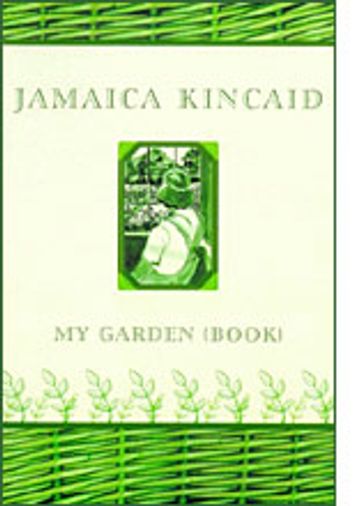
The protagonist of Jamaica Kincaid’s 1985 novel “Annie John” remembers her mother in Antigua this way: “Sometimes she might call out to me to go and get some thyme or basil or some other herb for her, for she grew all her herbs in little pots that she kept in a corner of our little garden. Sometimes when I gave her the herbs, she might stoop down and kiss me on my lips and then on my neck. It was in such a paradise that I lived.” The remembrance of that paradise lost is at the core of just about all the fiction and memoirs Kincaid has written. With her new collection of essays, “My Garden (Book):,” the author pays, perhaps inadvertently, her most heartfelt homage to the Caribbean island where she was born and from which she exiled herself to become a writer.
“My Garden (Book):” assembles the pieces on gardening and gardens that Kincaid has published in the New Yorker and elsewhere. This is not a how-to volume, but rather a series of meditations on the joys and frustrations of gardening. It is a book for anyone who loves looking at plants and gardens — a breed, Kincaid reminds us, who are often not the same as gardeners.
Connoisseurs of delectable prose will find much to savor here, though a few of the pieces do not fully crystallize. One in particular, about Monet’s garden, offers little insight about Monet, his garden or even Kincaid’s psyche. Furthermore, Kincaid’s dashing style, with its mixture of Katherine Mansfield’s delicacy, Virginia Woolf’s lyricism and Gertrude Stein’s melodious repetitiveness, is sometimes too precious; its girlishness (the way “What to do?” becomes a ritornello in “Wisteria”) can sound affected. Because these essays were written over several years, information is sometimes repeated (that Kincaid was born in Antigua; that once she and her father were ill at the same time, she with a tenacious case of hookworm). Yet these are minor quibbles about a book that affords many pleasures — not the least of which are Jill Fox’s eloquent drawings, which suggest stories and feelings in their own right.
And most of “My Garden (Book):” is prime Kincaid. “To Name Is to Possess” is a revealing meditation on colonialism and the erasure of identity that it imposes on the conquered: “It is not surprising that when people have felt themselves prey to it (conquest), among their first acts of liberation is to change their names.” Later, aware of the poignant irony of her own situation, the woman who renamed herself Jamaica Kincaid writes, “I have joined the conquering class.” In “What Joseph Banks Wrought,” Kincaid astutely pinpoints the relationship of colonized people to flower gardens: “It seems so clear to me, then, that a group of people who have had such a horrible historical association with growing things would try to make any relationship to it dignified (agriculture) and useful.” Coming as she does from a society and a class that planted gardens for food, the irony of having a garden of inedible things is not lost on her.
The collection is rich in vignettes about gardeners and neighbors, and one piece, “The House” — an extended profile of Robert Woodworth, the gentleman who built the Vermont house where Kincaid and her family live — is an affectionate and perceptive reflection on Yankee tradition. There are also startling portraits of the workers who toil in her garden and her traveling companions on a trip to China. Kincaid paints with quick brush strokes, showing these characters with intensity and clarity, their quirks rendering them fully alive.
The “lady writer” who emerges from these pages makes me think of a female E.B. White. Reading her, I feel as though I am lying in a hammock on a balmy summer day, surrounded by a garden of lovely colors and intoxicating fragrances. My favorites pieces are the ones in which Kincaid unleashes the closeted poet within: “Spring,” an enraptured psalm to the month of May; the humorous and sensual “The Season Past”; and the marvelous “The Garden in Winter,” a fable about racism that is also an elegiac and tender mood piece illuminated by the author’s intelligence.
I’ve long admired Jamaica Kincaid, yet her work has seldom elicited my love. Her chilly-hearted adult narrators, often so full of rage and sometimes even hatred, can be off-putting. Here and there, these essays contain misanthropic flare-ups in that mode. More often though, the writer who emerges is a brilliant and complex woman whose company we enjoy. “My Garden (Book):” is Kincaid’s most companionable book — the work of a writer to whom we gladly give our ear, the way we listen to friends whose wisdom is all the more appealing for the gentle way they deliver it.
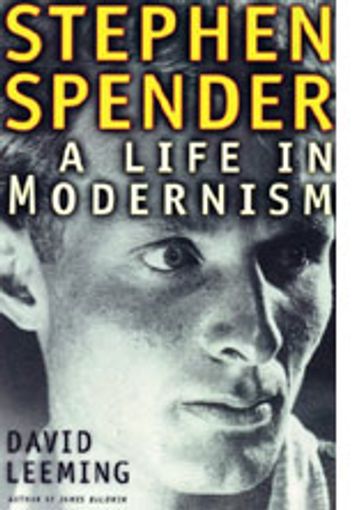
By the end of Sir Stephen Spender’s lengthy life, he had become one of that near-extinct species, the man of letters. So when David Leavitt “borrowed” materials from Spender’s autobiographical “World Within World” for his novel “While England Sleeps,” it seemed almost like a case of necrophilia — a vampiristic author filching from the undead.
In the ensuing scandal, many people sympathized with Leavitt, arguing that Spender had taken legal action because he did not want his homosexuality broadcast after he had become an English monument. This scenario is unlikely, because until the end of his life Spender, though committed to his wife, Natasha, was uncloseted about his attraction to men. A more likely possibility is that Leavitt failed to grasp that for Spender — who had written novels, plays, memoirs and many volumes of poetry and essays — “World Within World” was his narrative as well as his greatest achievement.
Spender was famous for his intimacy with the literary giants of his age. Virginia Woolf and T.S. Eliot were his surrogate parents, and they lionized him; W.H. Auden and Christopher Isherwood served as his substitute older brothers. From his days at Oxford in the late ’20s, where he was a young man of immense charm and beauty, until his death in 1996, Spender made the pursuit of “the great” the focus of his life. Yet the company of the great, which gave glamour to his life, obscured, and then dwarfed, his achievements.
David Leeming has written a biography that is more interested in Spender the socialite — the collector of the great — than in Spender the writer. (The comments on modernism to which the subtitle alludes are perfunctory and not really central to any discussion of the book.) Leeming does write a clean, chatty prose, and he has kept his book free of academic jargon; reflecting its subject, it is refreshingly unpretentious. But an accumulation of facts does not add up to a satisfying biography, and early on I got tired of reading the litany of events that filled Spender’s social calendar. The Queen Mother and Jacqueline Onassis, for example, make gratuitous cameo appearances merely to add more marquee names to the cast of notables.
Are we to believe that Spender was merely a star-fucker and a literary dilettante? Fortunately, Leeming quotes copiously from “World Within World” to dissipate this notion. And if this biography serves no other purpose than to lead readers — as it did me — to Spender’s masterwork, that’s enough.
Spender thought of himself as an autobiographer. Marianne Moore described him as a discerner “of the core of a writer’s intentions,” and Virginia Woolf praised “his large generous sensitivity.” Perhaps Reynolds Price said it best when he called Spender “a brilliantly generous connoisseur of beauty.” In “World Within World,” all these qualities shine. The book is a masterpiece: a major philosophical and aesthetic attempt to encompass the cosmos of Europe during the first three decades of the century. It is memorable for its portraits of Woolf, Eliot, Auden and Isherwood, which have the psychological depth of Rembrandt and the elegance of Velazquez. It contains Spender’s dazzling comments on German architecture and his keen insights into the street life of prewar Berlin and the scapegoat-hunting paranoia of the economically desperate German middle class. And it was one of the first books in which a prominent intellectual drew the parallels between communism and fascism.
“World Within World” is a symphonic elegy to a dying way of life. It was Spender’s misfortune to have written it when he was barely 40 years old. Afterwards he lacked what he termed “the stillness of attention necessary for creative work.” His life became a series of literary luncheons, teas and weekends at the estates of the powerful.
Spender admitted in his most famous verse, “I think continually of those who were truly great.” It must have been poignant for him to realize that although he was capable of greatness, he preferred being a contented gentleman. He certainly had his regrets about the life he chose (as Leeming often reminds us); but he was wise enough to realize that any man who in his 70s finds love with a 20-year-old boy hasn’t exactly wasted his life. Auden, under whose shadow Spender lived much of life, was the greater artist, but Spender was the happier man. Of Isherwood, Spender wrote, “He was on the side of the forces which make a work of art, even more than he was interested in art itself.” The same might be said of this brilliant and fascinating 20th century humanist and gentleman.
Continue Reading
Close
Adversity, which can destroy people, often fertilizes the ground for artists. It has certainly done that for Mark Doty. His first two volumes of poetry, “Bethlehem in Broad Daylight” (1987) and “Turtle, Swan” (1991), introduced us to a promising poet. In his third volume, “My Alexandria” (1993), Doty — responding to the dreadful losses of the AIDS epidemic — had breakthroughs both in range and in artistic maturity. In that collection, the poem “With Animals,” a relentless lament on the need of all creatures to cling to life even under the most horrifying circumstances (and surely one of the finest poems written in our time), demonstrated the poet’s flair for dramatic narrative; it wasn’t hard to imagine him eventually trying his hand at fiction or memoir.
Since “My Alexandria,” Doty has published two books of poems that are increasingly masterful in formal terms yet are overly preoccupied with word stitchery and are often lacking in a sense of urgency. Recently he has been stronger as a memoirist. In 1996, he published “Heaven’s Coast,” a much-acclaimed account of the death of his lover from AIDS. With “Firebird,” his new memoir, he has written his most satisfying book.
“Firebird” tells two overlapping stories. The first is a fairly conventional portrait of the artist as a young man, with the added twist that Doty had to come to terms with his homosexuality at a time when there were few role models and when attitudes were more hostile than they are today. I warmed slowly to this part of the story, since his narrative of his early life in Tennessee, teeming though it is with telling and lovely details about the South, is territory that Truman Capote, Harper Lee, Katherine Anne Porter, Eudora Welty and Carson McCullers have covered much more successfully. Doty writes at considerable length about things that would have been better dealt with at a glance.
“Firebird” comes into sharper focus after Mark and his parents move to Tucson, Ariz. His older sister, Sally, gets married and stays behind. Later she makes a memorable re-entrance as a divorcie and ex-convict who turns tricks to make a buck. Doty’s lyrical re-creation of the Southwest’s parched landscape is one of the book’s enormous pleasures: The city of Tucson, with its creosote-scented twilights, dry arroyos and dust storms, becomes another character.
It is in Tucson that the unforgettable story of the author’s mother, which forms the core of the memoir, begins to emerge. A woman with an artistic temperament, Ruth Doty signs up for painting and watercolor lessons and flourishes with new friends who share her interests. But her husband, who works on building projects for the government, can’t stand still; the family moves frequently (to Florida, to California, back to Tucson) because he keeps getting into trouble with his supervisors. As Mark grows older, wrestles with his sexuality and explores the world of art — dance, music, painting, crafts and, later, poetry — a kind of rigor mortis sets in to his parents’ marriage, and his mother’s drinking problem escalates until she loses her sanity. Ruth’s Gothic behavior brings to mind Blanche DuBois’ plunge into madness in “A Streetcar Named Desire” and Mary Tyrone’s drug-ravaged dementia in “Long Day’s Journey Into Night.” The harrowing last chapters of “Firebird,” leading to the final deracinated days when Ruth lies dying of cirrhosis in a hospital ward, are painful to read, yet they are rendered without any trace of sentimentality or self-indulgence.
In these pages, Doty’s writing surpasses anything he’s ever attempted before and achieves a depth and a clear-eyed splendor that left me bereft and exalted at the same time. What had begun as an oft-told story becomes an authentic tragedy. It’s been a while since a book has moved me so, or since a book’s appalling beauty has brought to mind the power of great writing to make us feel as if (to paraphrase Emily Dickinson) the top of our head had been taken off. In “Firebird,” Mark Doty has elevated the story of his troubled family to the stature of myth, and in the process he has written an American classic.
Continue Reading
Close
In the pantheon of iconic martyrs, the figure of Spanish writer Federico Garcma Lorca burns bright. Lorca was 38 years old in 1936 when he was assassinated by a fascist firing squad during the Spanish Civil War. In his short life, he composed an original and profoundly influential body of work that includes plays, poetry and essays. But what made him into an icon, tragic and disturbing, was his gruesome murder: Reportedly, Franco’s troops finished him off with a gunshot to the rectum.
It’s no wonder, then, that more has been written about Lorca than just about any other 20th century writer. (Probably the only author in our century who rivals him in fame is Ernest Hemingway.) The subject of plays, novels, movies, hundreds of elegies, scores of memoirs and countless academic works, Lorca was most memorably brought to life in Ian Gibson’s 1989 biography “Federico Garcma Lorca: A Life.” Gibson did a wonderful job of rescuing his subject from the fortress of respectability that Lorca’s family and friends had built around him. Gibson’s biography, coy as it was in offering substantial information about Lorca’s homosexuality, was a riveting and often moving work.
But I for one impatiently awaited the day when a more revealing biography would deliver Lorca from the Hispanic heterosexist establishment that has embraced the writer but de-sexed the man. Thus Lorca’s social activism has been played up in order to leave as little room as possible for the exploration of his homosexuality, which was in fact the primary cause of the aesthetic and philosophical breakthroughs in his best works.
Leslie Stainton adds much new information about Lorca and his world, and she succeeds in making Lorca leap off the pages of her biography. That, I’m sorry to report, is the best that can be said about “Lorca: A Dream of Life.” Lorca is a mirage and a trap for any biographer. He was such an enchanting creature, such a dazzling and magnetic presence (painter, pianist, composer, lecturer, theater director — a veritable renaissance man) that most writers who approach him become bedazzled by the man whom filmmaker Luis Buquel called “his own masterpiece.” A great deal of Stainton’s biography is concerned with mapping out the rise of Lorca’s celebrity in his short life, and the book ends up reading like an extended profile in People magazine — gossipy but lacking in substance. Which is too bad, because on a couple of occasions (her reading of “Lament for Ignacio Sanchez Mejmas,” her perceptive and original interpretation of “The Audience”) Stainton demonstrates that she has a fine critical mind.
Unfortunately, she seldom uses it. Why do we still care about Lorca? What are his true achievements as a writer? Stainton is seldom interested in answering these questions. Yet the best of Lorca’s revolutionary dramas (“The Audience,” “Once Five Years Pass” and the stark, visionary tragedy “The House of Bernarda Alba”) are ripe for new appraisal. Stainton passes over the Lorca who has much to say about the dire effects of sexual repression and who is as insightful an interpreter of the female psyche as Henrik Ibsen, Tennessee Williams and D.H. Lawrence in favor of Lorca the hyperkinetic performer, spinning in a vortex like a Nijinsky on too much caffeine. (Another much-written-about and misunderstood writer often came to mind as I read this book: Oscar Wilde, whom W.H. Auden blindly dismissed as essentially a performer, an artist always in need of an audience.) Lorca needs a homosexual biographer with more awareness and understanding of the sexual psychodrama that provides his best work with the fascination it still holds.
I am told that last year, on the occasion of Lorca’s centennial, legions of admirers made pilgrimages to his birthplace, the Lorca house in Granada, and to the spot where he was killed. All manner of Lorca mementos were for sale — Lorca mugs, Lorca photographs, Lorca postcards, Lorca T-shirts, Lorca fans, Lorca CDs, Lorca stationery, Lorca pens. Apparently even his books were for sale. Stainton’s biography, though well researched and readable, is another contribution to the continuing fetishization of the poet — one more item to be sold with all the other memorabilia.
Continue Reading
Close