Jaime Weinman

Mary Tyler less

As cable stations and networks chop up classic television shows, viewers are seeing less than ever.

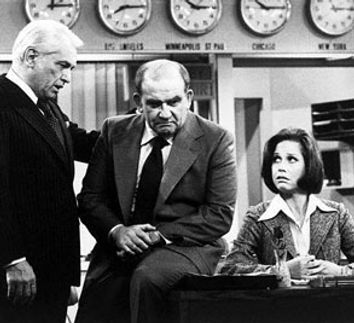
In a “Mary Tyler Moore Show” episode titled “The Dinner Party” there’s a famous scene where Mary Richards nervously berates Lou Grant for taking three of the six available portions of food at her latest disastrous party (“Mr. Grant, you’ve got to put two of those back!”). The scene is often regarded as one of the funniest in the whole series. But if you watched this episode on the cable network TV Land, you didn’t see that scene at all; it was cut to make room for more commercials.

That older programs are heavily cut in syndication or on cable is hardly a secret, but it might as well be for all the coverage it gets: TV critics routinely announce the latest acquisition by Nick at Nite or the Sci-Fi Network without bothering to mention, or even check, how heavily it will be edited. Older shows that ran three to six minutes longer than today’s shows suffer the most; a 25-minute episode of “Mary Tyler Moore” is usually cut to 21 or 22 minutes in reruns.

Such cuts are bad enough when shows appear in local syndication, but at least there is a legitimate — if irritating — reason for such cuts: Local broadcasters depend entirely on advertising for revenue so they need to squeeze in as many commercials as possible. Cable stations, on the other hand, have no such excuse; a good part of their revenue comes directly out of the viewers’ pockets in the form of cable fees. So why can’t a cable service like TV Land - which calls itself “a network created by TV fans for TV fans” - take shorter commercial breaks and show classic programs as they were meant to be seen?

“The economics of television have changed,” says Paul Ward, senior vice president of communications for Nick at Nite and TV Land. “In the old days, a show could have a title sponsor … and the show could run 28 or 29 minutes, without any commercials.”

Ward’s explanation fails to account for why Nick at Nite cuts some sitcoms to 20 minutes. Or why Comedy Central cuts “Sports Night,” which only ran about 22 minutes per episode in the first place. The way stations work makes it look as if they’ll cut anything in syndication no matter how long or short the episodes. In a 1994 Newsday article, a programming executive for TNT summed it up by saying: “Time’s gotta come out. That’s the key.”

As for Nick at Nite and TV Land, every show on their regular schedules is edited in some fashion. There has been one notable exception: Until 1995, Nick at Nite showed “I Love Lucy” in its uncut, 25-minute version. Why did the station start running an edited version? “I can’t remember the particulars as to why,” Ward says.

Cable networks don’t seem to make fewer cuts than local stations that syndicate. Ward says that he hasn’t compared the length of programs on cable to programs in syndication, but a quick comparison suggests that cable stations might cut even more. When “WKRP in Cincinnati” ran on Nick at Nite and later on another Viacom-owned network, TNN, viewer complaints mainly focused on the disfiguring music changes - not mentioned by a single newspaper TV critic - but those money-saving changes were made by the distributor and not the broadcasters.

Some cuts were even more gratuitous. In the episode “Les on a Ledge,” a farcical subplot grows out of a scene where one character convinces another that Jennifer (the sexy receptionist) used to be a man. This entire four-minute scene, which was intact in older syndicated reruns, was eliminated on TNN, rendering the rest of the episode incomprehensible. The irony is that the syndication versions of shows like “Mary Tyler Moore” and “WKRP in Cincinnati” were in many cases less brutally cut than the versions now seen on cable - which means that viewers are paying extra to see less of their favorite programs.

What takes the place of the material that’s been cut? Very often it’s promotional spots for the network itself. That means you might be seeing less “I Dream of Jeannie” just to hear that “Gilligan’s Island” reruns have moved to a new time slot.

By showing only paid advertisements it would theoretically be possible to make fewer cuts in a program without losing advertising revenue. Is this something Nick at Nite or TV Land would consider? “Probably not,” Ward says. “In the cluttered programming environment today, you have a responsibility to brand the network, to let people know what they’re watching.”

To spread the blame around a bit, it should be noted that cuts aren’t invariably the fault of the broadcasters; in some cases, distributors don’t even bother to make the uncut version of a show available. For years, Paramount offered only cut versions of many original “Star Trek” episodes (though the uncut versions were usually available on “Trek” videocassettes). But when the uncut series was finally remastered a couple of years ago, and broadcasters could choose between the original and edited versions, it was interesting to note the differences between the Sci-Fi Channel in the United States and its Canadian counterpart, SPACE. For a short time, the Sci-Fi channel did indeed show the uncut “Trek,” in a special 90-minute slot filled out with documentary material (and with plenty of “extra” commercial breaks in the middle of acts). A few months later, however, Sci-Fi switched to a version that in some cases was shorter than the old syndication version. SPACE, on the other hand, continues to show uncut episodes of “Trek” every day in a regular one-hour time slot.

Many (though not all) Canadian cable networks show older programs uncut whenever possible. Paul Gratton, vice president and general manager of SPACE, explains: “Canadian viewers tend to be a little fanatical when it comes to editing, especially on cable … Editing is seen as being akin to censorship on Canadian television, and people perceive that they are paying a premium to access cable programming uncut.”

Unlike “Star Trek,” most older shows don’t get released complete on home video; instead, viewers have to settle for what the broadcasters choose to show. Many viewers, raised on syndication versions of older shows, have no way of knowing how much material has been cut from the shows they’re watching, which makes it hard to complain to the cable networks about the cutting of scenes that haven’t been shown in years. With relatively few viewer complaints coming in, cable networks have no real need to do anything differently.

It’s frustrating that no one even seems to consider the possibility that it doesn’t have to be this way. A cable network such as American Movie Classics allows viewers to watch movies without editing or interruption, yet no one has taken the step of creating a similar service for classic television. Why not 24 hours a day of older television programs, in their original, unedited form? Why not an American Television Classics network, dedicated - unlike TV Land - to the proposition that a good television episode deserves to be seen as its creators intended?

There’s an episode of “The Mary Tyler Moore Show” where Murray becomes furious upon discovering that the station manager has cut the best joke out of a Marx Brothers movie to make room for more commercials. If cable channels keep slicing out bits and pieces of classic shows, we might not ever see that scene again.

Pitching a big tent

Can "Blair Witch 2" overcome suspicious fans and everyone who hated the first one?

For a moment in the summer of 1999, “The Blair Witch Project” was the movie everyone was talking about. We all heard the story of how a little horror movie, shot for $30,000 on wobbly cameras held by unknown actors, was bought for $1 million and spurred on to a $141 million box-office success by the astute, Internet-based marketing tactics of distributor Artisan Entertainment. It was the kind of movie that makes huge money, generates a thousand parodies and gets everyone talking about a revolution in marketing; it was a phenomenon. With “Blair Witch 2,” due out Friday, the question is the same one asked with every sequel to every phenomenon movie: When the phenomenon is over, what’s left?

It’s almost impossible to recreate an entertainment phenomenon. To become talked-about and written-about, a movie needs to have, or at least seem to have, something new and surprising; sequels by their nature have no novelty and few surprises. What you usually end up with is something like “Jaws 2″ — an original formula rehashed in the vain hope that it’ll still be fun even after it’s become familiar. “Blair Witch 2″ obviously faces the problem of the novelty having worn off, but there’s another problem: the unusually strong backlash that developed against the original film after its initial success. Signs of this backlash can still be seen on Internet message boards and in chat sessions; the early, enthusiastic posts about the movie soon gave way to comments like this one, posted on the Internet discussion group alt.horror in a thread about bad horror movies: “There are worse films in theory, but the hype attached to this garbage pushed it clear of the rest!”

This backlash was at least partly due to the nature of the movie itself. Unlike previous hit horror movies like “Psycho” or “The Exorcist” — traditional, well-made movies that used a variety of cinematic devices to scare the viewers — “The Blair Witch Project” was a deliberately crude piece of work that looked like what it was: footage shot by and of a bunch of people in their 20s in the woods. The film looked like it could be real, and some viewers even assumed it was — especially after being duped by Artisan’s marketing tactics, which deliberately tried to blur the line between reality and fiction. (For example, Artisan pushed the directors into interviews, but tried to keep the three lead actors — who supposedly had disappeared in the movie — out of magazines and off of television.)

But the lack of technique also meant that after the shock of a first viewing, there wasn’t much to grip an audience the second time. Moreover, once the plot of the film had become national news, the element of surprise was lost and some viewers who expected to be scared were disappointed.

Another factor creating backlash was a resentment of the distributor’s much-discussed marketing tactics, which were in some ways a bigger part of the news stories than the movie itself. The “Blair Witch” Web site offered phony newscasts and an entire mythology built around the film. And a fake documentary about the fake documentary ran on the Sci-Fi Channel. The movie became so closely associated with its advertising that it became hard to tell which was which.

In marketing “Blair Witch 2,” Artisan seems aware that the success of the first campaign — like the success of the movie it was built around — can’t be duplicated. “Artisan is taking a more straightforward approach with the sequel,” says Amorette Jones, Artisan’s vice president of worldwide theatrical marketing. “We’re not even trying to catch lightning in a bottle again. The Internet campaign is still central to the marketing strategy, but it is now being supported by a full-scale offline push.”

The offline push consists of the usual round of posters (a cracked, yellowish image of what appears to be someone screaming, superimposed over tree rings) and promos, while the Internet component has been centered around the “Blair Witch Webfest,” which ran from Oct. 18 to Oct. 20. Jones calls it “a cross between a traditional fan convention and an online Lollapalooza,” but it looked a lot more like a central site with simultaneous features on Amazon.com (a merchandise auction) and a section on Hollywood Stock Exchange.

The original Blair Witch site still exists, but that homespun site and its once-successful emphasis on the bogus Blair Witch mythology seem almost to have been pushed to one side by the webfest. This was a much more conventional promotional campaign, with more traditional fun and games, giveaways, clips and online chats with everyone from the film’s director to the head of the Church of Satan. There was a certain sense, during the webfest, that Artisan no longer had to do much to sell viewers on Blair Witch. Whereas the original, deceptively low-key campaign was designed to fascinate and intrigue people who came upon it, the webfest was founded on the assumption that people who were already fascinated and intrigued would want to celebrate that fact in a blitz of chats and graphics.

It’s doubtful that the webfest was as popular as it was intended to be — a search for the keyword “webfest” on Usenet discussion groups reveals that the event was mentioned in only 30 or so messages on all the groups combined — but it certainly offered a reminder of the multimillion-dollar franchise Blair Witch has become, as opposed to the low-budget experiment the franchise started out with.

Of course, even with a series so closely associated with the way it’s marketed, the main thing is the movie itself, and whether the sequel can inject some freshness into a now well-known premise. With nearly all-new characters, a different director (the original directors were busy with another project) and a different storytelling style, “Blair Witch 2″ is straying so far from the original premise that one alt.horror poster mused that it seems to be shaping up as a movie for those who hated the original. “The only real similarities between the two films,” says Jones, “are the core ‘Blair Witch’ mythology and the way in which they blur the lines between what is real and what is fiction.” Even the famous blurring of fact and fiction, though, is less prominent than it was; the new film isn’t trying to pass itself off as student footage (some of the publicity for the sequel has emphasized that the movie was shot using cameras mounted on tripods, which should come as a relief to all those who complained about the wobbly camerawork in “The Blair Witch Project”) and the new publicity campaign more clearly treats “Blair Witch 2″ as a work of fiction. There’s even a hint of self-parody in the sequel’s premise: The main character organizes “Blair Witch Tours” to capitalize on the notoriety of the Blair Witch myth, which has the potential to comment indirectly on the perception of hype and hucksterism that is sometimes associated, fairly or unfairly, with the original.

Part of what might help to give “Blair Witch 2″ its own identity is director Joe Berlinger. Unlike the two young unknowns who created the original film, Berlinger is a veteran filmmaker, and he has been primarily associated not with gimmicky horror movies but with acclaimed documentaries like “Brother’s Keeper” (1992) and “Paradise Lost: The Child Murders at Robin Hood Hills” (1996), both of which he co-directed. (He’s also directed episodes of the fictional TV series “Homicide: Life on the Street” and “D.C.”)

The official site of “Blair Witch 2″ notes that Berlinger’s experience with documentaries will allow for a “blurring of truth and fiction that is such a part of the ‘Blair Witch’ series.” But the presence of a noted director making his first nondocumentary feature (who recently participated a little bit in the backlash by telling Premiere magazine that he didn’t think the original film was all that scary) also has the potential to lend the sequel an air of filmmaking skill and conscious structure that the original didn’t always have. If the clever but deliberately crude “Blair Witch Project” was primarily a phenomenon, then “Blair Witch 2″ has the potential to differentiate itself from its predecessor by establishing itself first and foremost as a movie.

Still, the main goal of “Blair Witch 2″ is what a horror movie’s goal should be: to deliver some shocks and make the viewers nervous. And if it’s as successful as Artisan has reason to hope it will be, the company can then turn its attention to dealing with a new set of publicity problems — and maybe even a new, different backlash — for “Blair Witch 3.”

Continue Reading Close

What’s up, Chuck?

The legacy of Chuck Jones, the most celebrated director in cartoon history, is as overinflated as an Acme balloon.

Bugs Bunny spins around. A table and a nail file materialize out of thin air, and Bugs mugs at a huge, orange creature who has been chasing the rabbit through a mad scientist’s lair. Instead of trying to escape from the creature — who wears sneakers — Bugs leans in with the nail file and starts to give him a manicure. “My, I’ll bet you monsters lead interesting lives,” he says in a high, effeminate voice. The monster is, of course, disarmed. The fast, unexpected and hilarious sequence belongs to the Warner Bros. cartoon “Hair-Raising Hare” (1946), one of the funniest of the hundreds of Bugs Bunny cartoons.

The man behind the cartoon was the celebrated Chuck Jones, the director of great WB animated shorts and the creator of the Road Runner, Wile E. Coyote, Pepe Le Pew and that now-ubiquitous singing amphibian, Michigan J. Frog. Though only one of several people who directed cartoons for WB in its 1940s and ’50s golden age, Jones has become so genial and likable a representative of Looney Tunes — in interviews and in two entertaining books of memoirs, “Chuck Amuck” and “Chuck Reducks” — that now he is routinely talked about as though he were the only representative of that great cartoon tradition. Jones, in fact, is the only WB cartoon director to receive a special Academy Award for his work (in 1997), and no cartoon director has more famous or influential fans: Steven Spielberg, for one, wrote the foreword for “Chuck Amuck.” There have also been laudatory essays on Jones by well-known film critics; Time’s Richard Schickel singled out “a genius named Chuck Jones” as the greatest figure in WB cartoon history.

But what hasn’t been mentioned by such critics is that Jones receives a disproportionate amount of the acclaim for WB’s finest moments. Jones had a golden decade at WB ending in the mid-’50s, but the rest of his career never lived up to that period. Further, his early cartoons were mostly mediocre Disney imitations, and other directors did far more than he to invent the style of WB cartoons. Finally, his accounts of WB cartoon history, especially about director Bob Clampett, have not always been strictly accurate. Chuck Jones undoubtedly created some of the finest cartoons ever made, but his spotty legacy deserves another look. Could the most celebrated director in cartoon history be as overinflated as an Acme balloon? It’s a funny business.

Jones’ career as a cartoon director started in 1939 with “The Night Watchman,” a short, sappy film about a terrified kitten put in charge of patrolling for mice. Jones spent the next three years making some of the dullest cartoons at the studio, full of cute little characters doing cute little things. At the time, WB cartoons were pulling ahead of the more sedate shorts of Disney and the less disciplined work of Max and Dave Fleischer. Tex Avery had created Bugs Bunny in “A Wild Hare”; Bob Clampett was making bizarre and brilliant cartoons like “Porky in Wackyland”; and Friz Freleng created the landmark animation/live-action combination “You Ought to Be in Pictures.” Jones’ main contribution to WB in this era was Sniffles, the wide-eyed, inexpressibly annoying little mouse whose warmhearted adventures ruined many a child’s Saturday morning (and who has recently returned in an MCI commercial to torment a whole new generation).

Even at their best, Jones’ early cartoons were low-budget Disney; at their worst, they could be as slow and ponderous as “Good Night Elmer” (1940), where Elmer Fudd spent an animated eternity trying to blow out a candle. Jerry Beck and Will Friedwald, in “Looney Tunes and Merrie Melodies: A Complete Illustrated Guide to the Warner Bros. Cartoons,” call this “one of the most irritating cartoons ever made,” though it has competition from anything starring Jones’ other early creation, Conrad Cat.

In 1942 Jones pulled himself out of his rut — he “finally saw the light,” as Tex Avery recalled — and started to make consistently funny cartoons. His one-of-a-kind masterpiece “The Dover Boys” (1942) featured stylized character and background designs and an all-human cast that influenced the later cartoons of Columbia’s UPA studio (“Mr. Magoo”). Yet except for that one piece, Jones was not an innovator but a consumer of other people’s innovations. The faster pace, the violent gags, the topical references, the standard catchphrases — all of these elements had already been developed by Avery, Clampett and Freleng before Jones got around to using them.

In the late ’40s, and especially after forming a full-time partnership with gag man Michael Maltese, Jones hit his stride as a director. There was some indication in the early ’50s that his well would dry up — he retired some of his funniest characters, like the scheming mice Hubie and Bertie, to concentrate on the most formulaic characters (Pepe Le Pew, the Road Runner) — but on the whole, his cartoons earned all the praise they’ve received. The trouble is that the brilliant period didn’t last very long; a definite decline began in the mid-’50s. The turning point probably came in 1955, when the WB cartoon studio opened again after having been shut down for a few months. Though most of his old crew eventually came back, including Maltese, Jones’ work started a gradual but clear shift toward some form of what it had been when he started: slow, cute and not all that funny.

The changes in Jones’ style can be most clearly seen by looking at the changes in his treatment of WB’s biggest cartoon star. From 1943 to 1954 Jones made some of the best Bugs Bunny cartoons, including “Hare Tonic” (1945), “Rabbit of Seville” (1950) and “Bully for Bugs” (1953). Jones’ trick was to keep a two-dimensional character three-dimensional: In “Bully for Bugs,” for example, Bugs slapped a ferocious bull in the face, shouting: “Stop steamin’ up my tail! Whaddya tryin’ to do, wrinkle it?” It’s Bugs’ hotheaded emotional reaction that’s the key to the scene; he may be in a good mood when he pops out of his rabbit hole, but when someone tries to push him around, no matter how big and fearsome that someone is, he’s going to get angry.

Starting in 1955, most of the variety (and much of the appeal) was gone from Jones’ Bugs. Writing about Jones’ “To Hare Is Human” (1956) in his book “Hollywood Cartoons,” Michael Barrier comments that Bugs in this cartoon is “too pleased with himself,” and that’s true of Jones’ post-1955 Bugs in general. The new Bugs was no longer a brash wisecracker but a calm, reflective type who rarely got angry. He could, however, offer instead a gentle smile and a thoughtful comment on a situation that he didn’t take very seriously. (Jones plays a similar role in interviews.)

While Jones in his prime had usually been careful not to let Bugs heckle anyone without sufficient provocation (“Without such threats,” he wrote, “Bugs is far too capable a rabbit to evoke the necessary sympathy”), he would also let Bugs inflict a lot of hilarious, gleeful damage once provoked. In “Homeless Hare” (1950), Bugs politely asked a construction worker not to dig up his rabbit hole. When the worker refused, he got a not-so-polite telegram from Bugs (“OK, Hercules, you asked for it”), instantly followed by a perfectly timed steel beam to the head.

But after 1955, Jones doesn’t seem to let Bugs do anything, violent or not. In 1955′s “Knight-Mare Hare,” Bugs spends most of the film not acting but talking, making cute asides to the audience or making tired “nobility” jokes about jazz musicians (“Earl of Hines, Duke of Ellington, Count of Basie”). His only violent action is to stick out his foot and trip someone.

Or compare Jones’ “Hare-Way to the Stars,” (1948) with his “Hare-Way to the Stars” (1958). Both of them have the same basic story: Bugs was blasted into outer space, where he stopped Marvin the Martian from blowing up the Earth. The first cartoon allowed Bugs a wide variety of funny emotional reactions, like fear (“No, I don’t wanna go!” he whimpered while being taken to the spaceship, “I’m too young to fly!”) and shock (realizing that the Earth was in danger, he did a double-take and shouted, “WHOA!”). In the remake, Bugs walked around the stylized backgrounds with a bored smirk on his face; Marvin’s plans provoke nothing but another stylized pose.

Jones’ later WB cartoons also have a problem with character design. While the backgrounds of these cartoons (conceived by Jones’ favorite layout artist, Maurice Noble) look spectacular, the characters look all wrong. Jones never stopped loving huge eyes and exaggeratedly cute characters. The bane of his early cartoons resurfaced when he redesigned several WB characters to look wide-eyed and flabby.

Even the Road Runner series, which, as Barrier notes, was less affected than the others by the changes in Jones’ style (perhaps because a cartoon about the Coyote’s failures had to be bleak and violent, which prevented Jones from getting too sweet), was eventually weakened by these changes in design; the Coyote, once a classic combination of evil predator and pathetic screw-up, became so wide-eyed and cute by 1960 or so that he was only pathetic, constantly looking toward the audience for sympathy and losing the villainous edge to his character. It didn’t help that after Maltese left the studio in 1960, Jones started coming up with his own story material for the Road Runner cartoons, and his gags tended to be slow and drawn-out rather than the rapid-fire twists that Maltese wrote.

This tendency to slow down was another early problem that had already crept back into Jones’ cartoons by the late ’50s. All the WB cartoon directors were running out of ideas at the time, yet Jones’ cartoons seemed unusually obvious in their attempts to milk jokes for every ounce of comedy; there was so much pausing, eye-rolling and lip-quivering that every gag seemed to take twice as long as it should. In “Ali Baba Bunny” (1957) Jones had a character split a hair on Daffy Duck’s head with a sword. Jones started with a slow setup, then followed the split with a long pause, a Daffy whimper and another pause before the duck finally ran away. A joke that took about two seconds in most cartoons was needlessly stretched out, and the unpretentious wit and speed of the best WB cartoons was replaced by a tendency to dissect and analyze.

No post-1955 Jones cartoon is more analytical than “What’s Opera, Doc?” (1957), often named as the greatest cartoon ever made. I once attended a screening of old Warner Bros. cartoons that ended, as so many of these programs do, with “What’s Opera, Doc?” After the wild laughter and applause that had greeted most of the other cartoons shown that evening (including many by Jones), the audience reaction to Jones’ acclaimed Wagner spoof was surprisingly lukewarm, the laughter sporadic and the applause merely polite. As I was leaving the theater, I overheard a man: “But it’s not funny,” he said. And he was right.

“What’s Opera, Doc?” is sort of a masterpiece, and its combination of lowbrow and highbrow art forms makes it a pop-culture critic’s dream. But it’s also a one-joke cartoon: Bugs and Elmer are doing the same stuff they always do, but they’re singing it! Compare Freleng’s 1945 cartoon “Herr Meets Hare” (Bugs vs. Hermann Goering), which used the same Bugs-as-Brunhild routine, complete with oversized horse and Wagner’s “Tannhauser” on the soundtrack. This version is less strikingly designed and staged than Jones’, but it’s also funnier, reveling in the absurdity of Bugs’ drag routine and his adversary’s Siegfried costume. Jones, by contrast, almost seems to take the whole thing seriously. “What’s Opera Doc?” has been described as the apotheosis of Looney Tunedom, but in many ways it’s the antithesis of the Looney Tunes style: a big, lush, beautiful production where the audience is invited to sit up and marvel rather than laugh. Positively Disneyesque.

After the WB cartoon studio folded in 1963, Jones went to MGM. His time there is remembered for one Oscar-winning short, “The Dot and the Line,” and one successful TV special: “How the Grinch Stole Christmas,” where Jones’ preference for slow, formalized movement and wide-eyed facial expressions seemed to suit the character of the Grinch. But most of Jones’ other work at MGM has the faults of his late-period WB cartoons without the saving grace of the old WB characters; for example, his other Dr. Seuss adaptation, “Horton Hears a Who,” was slow and lumbering. Worst of all was the series of terribly unfunny Tom and Jerry cartoons that Jones was hired to direct in the ’60s.

Perhaps Jones’ most disappointing project from the MGM period was his 1971 TV special based on Walt Kelly’s great comic strip, “Pogo.” Kelly’s work, with its combination of satire and slapstick, seemed ideal for animation, and the Chuck Jones of 1950 might have been perfect for the project. The Chuck Jones of 1971 was another matter, and even though Kelly was credited with the script and some of the voice work, he was reportedly displeased with Jones’ finished product. Ward Kimball, a Disney animator and friend of Kelly (himself a former Disney staffer), recalled in an interview that his last meeting with Kelly was “after the Pogo half-hour TV show that Chuck Jones directed, which was a disaster … I asked him, ‘How did you ever OK Chuck’s Pogo story?’ He said, ‘I didn’t, for God’s sake! The son of a bitch changed it after our last meeting … He took all the sharpness out of it and put in that sweet, saccharine stuff that Chuck Jones always thinks is Disney, but isn’t.’”

Most of Jones’ work after leaving MGM has consisted of unsuccessful shorts and specials with the old WB characters. But as his work became even less successful, Jones emerged as a highly successful publicist for his own history, creating a lovable persona in interviews, giving insights and recounting many enjoyable anecdotes. Less enjoyable, perhaps, has been Jones’ attempt to spread misconceptions about Clampett, who became a director a year before Jones did. Clampett’s early cartoons, unlike Jones’, were assured and hilarious; cartoons like “Porky and Daffy” and “The Daffy Doc” helped to define their characters, and their unprecedented pacing almost certainly influenced older directors like Avery and Freleng. Before leaving the studio, Clampett would create Tweety, as well as directing some of WB’s best-loved cartoons (like Daffy Duck’s stint as “Duck Twacy” in “The Great Piggy Bank Robbery,” and the famous adaptation of Dr. Seuss’ “Horton Hatches the Egg”).

Clampett left the studio in 1946, after less than a decade of directing cartoons, but there’s no denying his importance to WB cartoons. But Jones has certainly tried, reportedly resenting what he saw as the tendency of Clampett, in his own way as skillful a self-promoter as Jones, to claim a role in the creation of just about every WB character. The most infamous attempt came in Jones’ 1979 compilation film “The Bugs Bunny/Road Runner Movie” (which mixed great clips from Jones’ classic cartoons with tiresomely twee linking material in the later Jones manner). Near the beginning of the film, Bugs shows a portrait gallery of the directors who contributed the most to his creation. The gallery contains Avery, Freleng, Jones, Robert McKimson … but not Clampett. It was a startlingly ungenerous gesture; even worse, it was a falsification of animation history, an attempt to erase Clampett from the story of WB cartoons.

Jones hasn’t stopped trying to minimize Clampett’s contributions to the studio. In “Chuck Amuck” he doesn’t mention Clampett once; in “Chuck Reducks” he deigns to mention the name exactly once (“Clampett’s Bugs was funny”). And in a 1998 interview with Mania magazine, he said: “As far as I’m concerned the one who mattered the least was Bob Clampett,” adding, perhaps in response to the continued popularity of Clampett’s cartoons, “Honestly, I think Bob is right in line with today … Bob was the one who liked all that ‘Three Stooges’ stuff.”

Jones’ disinformation campaign certainly hasn’t reached the public, which continues to enjoy Clampett’s cartoons alongside the equally great work of Jones, Freleng and others; nor does it detract from the enjoyment of Jones’ best work. It does, however, suggest that Jones isn’t always lovable. And that like his work from the late 1950s on, he isn’t very funny, either.

Continue Reading Close