Jennifer Hanawald

“The Dark Side” by Mark Schreiber

A study of crime -- from kidnapping and cannibalism to mass murder -- in the land of the Rising Sun challenges the stereotype of a safe, orderly society.

Kidnapping, cannibalism and mass murder — not commonly associated with Asia’s most prosperous people. But author Mark Schreiber eschews the “ridiculous two-dimensional cardboard characters” that foreigners writing about Japan have a tendency to deliver, and his latest work, “The Dark Side,” affirms that there is a lot more to this country than Sony PlayStations, rampant consumerism and the meticulous cultivation of small trees. In fact, the book — a compilation of the writer’s weekly crime columns published in the Mainichi Daily newpaper — could give Hollywood plenty to draw upon.

Take Aum Shinrikyo, for example. Schreiber details the religious cult’s rise to prominence, which escalated from brainwashing and robbing its followers to bullying the government, intimidating and murdering those seeking to check its power. Its misdeeds culminated in the 1995 sarin gas attack carried out on the Tokyo subway, an act of terrorism that killed 12 and injured thousands. Even as Aum enjoyed tax-preferential status and protection from state interference as a religious organization, its members experimented with anthrax as a means of mass destruction. At one point, according to Schreiber’s account, karate and medical experts were dispatched by Aum leaders to murder and mangle beyond recognition the family of a lawyer who was representing plaintiffs against the cult.

Although the book’s more heinous scenes are the stuff of horror movies — there is, for example, the detailed description of a botched decapitation (it took multiple chops and some hacking) and the ashes of a vanished 4-year-old girl that appeared on her family’s doorstep — it’s more than one grim tale after another. The crimes are shocking, but Schreiber does not sensationalize them. “Victims are to be pitied, and sometimes perpetrators too. [The crimes] might have happened decades or centuries ago, but human life is not something which I make light of, and while the stories themselves may incorporate some wacky aspects, we should not forget, while we enjoy reading these old accounts, that people suffered and died too.”

Schreiber’s latest effort, along with his “Shocking Crimes of Postwar Japan,” is one of a few recent releases that have increased access to Japanese criminal history for non-Japanese speakers. There is also Robert Whiting’s absorbing account of the postwar development of mafia and racketeering activities, “Tokyo Underworld.” Although in the English-speaking world there may be a sense that Schreiber has unearthed some dirty truths — especially given the stereotype of Japan as a safe haven from crime — the author is quick to point out that, with the help of an 18th-century dictionary, much of the information he uses is readily available. When he first began writing about crime in the mid-’80s, Schreiber found that Japan had “extensive historical records of crime related topics — up until now not in English.”

Although crime is regularly covered by the mass media in Japan, “the majority of Japanese people have a strongly held belief that this country is safe — a place where women can walk home alone from the subway in the dark,” says Yuko Kawanishi, a sociologist at Temple University in Japan. That’s especially true when compared to how the Japanese perceive the United States, which, she says, is seen as an exceptionally dangerous place, to mythic proportions.

Kawanishi notes that due to increased publicity about violent attacks by strangers — crimes that have no clear motive — this feeling of security is beginning to slip. These crimes, she says, threaten people because they see no rationale behind them. They leave people puzzled and scared because unlike “classic” crimes, where, for example, someone is seeking revenge, people feel they have no control over whether they might be the next victim.

Regardless of new trends in crime, however, as “The Dark Side” illustrates, this country has a long history of criminal activity, and its reputation as a place where bad things don’t happen has always been a myth. Because the book covers 400 years, the selection of crimes is just a smattering of what happened over the period. But Schreiber’s choices include a fascinating and carefully selected array of incidents, offering a wealth of cultural as well as criminal intrigue, thanks to detailed and entertaining background information. There are clever criminals with political and religious motives, downtrodden individuals resisting the system, insights into the position of women and foreigners in society and details about the legal system’s development.

In “A Man With a Grudge,” Schreiber recounts the tale of a Japanese-born Korean man, who in 1968 shot and killed two Japanese gangsters and took 13 hostages. He gained a national audience, demanding an apology from the police for their “humiliating” treatment of Koreans (the apology was later actually delivered on a major TV network). He told reporters who’d gathered at the hot springs where he held his hostages: “I’m risking my life to fight against Japanese persecution. This is a problem that every Japanese has to take responsibility for.”

Non-Japanese may find the sociological implications in some of the stories rather baffling. For instance, there’s the story of a man who abducted a schoolgirl and kept her in his bedroom at his mother’s house — for nine years. His mother claimed she’d never seen the girl, having been banned from her son’s room for the past 10 years and busy working much of the day. Although this claim attracted skepticism here, it is more believable in the context of family relations in Japan than in the U.S., where it would seem preposterous. On a lighter note, there is the story of a man who posed as a police officer and pulled over a Nissan laden with over $800,000 in Toshiba staffers’ bonuses, telling the bank employees driving it that there was a bomb planted in their vehicle. As they fled, he escaped with the car, poignantly illustrating the respect for authority and the quirky cash-based society that persist in Japan today.

In this sense, although this is ostensibly a book about crime, it also serves as an altogether agreeable window into Japanese culture. Even though Schreiber adheres to journalistic style, the stories he’s chosen and his detailed descriptions of social interactions that take place in them drive home many key cultural themes in Japan. His accounts articulately demonstrate the country’s rigid social structure, which historically assigns certain roles according to gender, class and race. That said, Schreiber is also careful to choose examples that show that exceptions do occur.

This is one instance in which being a foreigner — Schreiber is American born but has spent 37 years in Japan — has arguably worked in the author’s favor. Schreiber doesn’t treat his subjects as exotic, but he draws other foreigners into the material by giving cultural clues and context. One way he does this is by tossing in idiosyncrasies of language. For example, in “The Woeful Fate of a Poisonous Wife,” he notes: “Poison is so associated with women who kill that Japanese commonly refer to a murderess with the sobriquet dokufu (poisonous wife).”

Schreiber believes that being foreign aided him in his research. “When I approached experts on the subject of crime, they were delighted to meet me. I think the sheer novelty of a foreigner digging through [Japan's true crime literature] so energetically sort of piqued many people’s curiosity.”

Schreiber’s legwork makes what could be quite dry material from hundreds of years ago feel remarkably relevant. For instance, in one story he cites the tombstone engraving of a man believed to have been murdered in 1896, commenting on how the slightly altered version of a Tennyson poem found there could give clues affirming his convicted wife’s guilt. Even in some of the older cases you get the feeling that, as Schreiber is prone to say, more evidence awaits discovery.

Armless (and legless) in Japan

A 22-year-old author born without limbs has taken his homeland by storm.

When Hirotada Ototake was born, his mother was told she couldn’t see him straight away because he was “too weak.” A few days later it was: “They say you can’t see him for a little while longer because he has severe jaundice.” She soon understood that something serious was going on, but being in Japan, where a doctor’s word is gospel, she felt unable to ask what was happening. Eventually, Ototake’s mother was informed that a disability — not jaundice — was the reason she had not been allowed to see her baby. And so it was that three weeks after his birth, Ototake met his mother for the first time, staff standing by to assist her if she fainted. It’s through this anecdote that readers, like his mother, are introduced to Ototake, a Japanese man born with congenital tetra-amelia, that is, without arms or legs.

Ototake, now 24, wrote and published his autobiography, “Gotai Fumanzoku” in 1998. It became the No. 1 bestseller in Japan from December of that year through November 1999, and since its release, the book has sold about 4.5 million copies, which, according to publisher Kodansha Ltd., makes it the No. 2 bestseller in Japan since World War II. Called “No One’s Perfect” in English and translated by Gerry Harcourt, the book has just been published in the United States.

“Gotai Fumanzoku” is a phrase invented by Ototake, and it literally means “not a complete, healthy body.” It’s a play on the Japanese version of that universal sentiment: “We don’t care if it’s a boy or girl, we’ll be happy if it’s just born healthy.” In Japan they say “gotai manzoku”: with all limbs and body parts satisfactorily in place.

Both the book’s title and its main assertion — that the disabled can lead fulfilling, interesting lives and be happy people — have startled Japan. Anticipating some discomfort with the topic, and the possibility that it might be largely ignored, Kodansha had printed only 6,000 copies in the first run.

So what are the ingredients that have catapulted Ototake and his autobiography into literary history? It’s that just by telling his story, Ototake shatters the Japanese belief that the disabled are to be not only pitied but never even spoken of. Despite its author’s dramatic disability, “No One’s Perfect” is essentially about a kid growing up, learning to make friends, coping with pressures at school and being accepted by his community. Rather than proclaiming his normalcy, Ototake conveys it by recounting life-shaping vignettes in a conversational style that makes readers feel as though they’re watching a home video.

Ototake’s story is full of unassuming heroes, from the teacher who encourages him to compete in the 50-meter dash on his butt in front of the whole school to the classmates who insist he not be left behind on their field trip to climb Mount Kobo — and who end up pushing and carrying him in his chair to the top. Then there are his parents, about whom he deliberately keeps much private. Faced with a severely disabled child in a society where disabilities are generally a source of shame, they take his condition in stride, accepting his differences and adjusting their own lives so that he can live as normally as possible.

And of course the central character is Ototake himself, who manages to achieve a remarkably typical childhood: making friends, trying to be cool and participating in regular school activities. When he sets his mind to it, he achieves great things; when he slacks off, he gets bad grades. All the while, just by living his life and being himself, he cuts through other people’s discomfort with his disability and teaches them to see him first and foremost as another human being.

Although Ototake admits to loving the limelight, he insists that he’s not the heroic figure he’s been cast as by the media and his fans. On this subject he has said: “My parents were shocked but not saddened or depressed by my disability. I’ve always thought that they loved me. Does it mean that they are strong? I’ve often been told I was strong. But I think that the whole family just did not realize how challenging the situation was. I don’t think we tried to overcome it. We were simply a happy family.”

It is this humility, which he exhibits even now after attaining celebrity status in Japan, that moves the reader and makes Ototake a hero, despite his protests to the contrary. He does not intellectualize his life. There’s no trace of bitterness, and there’s no sense that he isn’t just what he claims to be — a regular guy. Still, the degree of his book’s success is surprising. Sociologists, those who work with the disabled and the general public agree that until recently, the Japanese have shown very little awareness about the disabled and the challenges they face.

As Yuko Kawanishi, a sociology professor at Temple University in Japan puts it: “Most Japanese people don’t really know so much about physically handicapped people’s reality. They don’t see them so much because they have much less visibility. So there is a lack of understanding, an ignorance.” As a result, disabled people in Japan usually avoid the spotlight. In Ototake’s words, “This doesn’t mean they are confined. Rather they may think it’s too much trouble to go outside. Japanese people tend to stare at people with disabilities.”

And, as Ototake and other disabled people are increasingly making it known, access to public facilities and transport is poor in Japan. Rather than inconvenience or embarrass others, traditionally the disabled and those related to them have accepted prejudice and poor access and adjusted their lives to compensate.

But a subtle and gradual change in attitude has created an environment receptive to — even hungry for — Ototake’s message. As Kawanishi puts it: “Japanese people are now in a mind-set to welcome this sort of hero.” Motoki Yamazaki, executive director of the Specially Challenged Persons Health and Welfare Department in Fukuoka, says that perceptions have been evolving over the past decade: “Although there have been groups representing the disabled for some time, recently there has been a growing change in attitude about the disabled — both among themselves as well as among the public at large — of their right to participate fully in society.”

Yamazaki sees Ototake as a skilled writer who presents a very appealing — particularly for the Japanese — image of someone who is trying very hard. In this sense, he feels that the book speaks to, and has greatly influenced, a growing change in consciousness in the Japanese public, who have come to recognize that discrimination against the disabled is wrong. Above all, Ototake’s book has given the public the first popular, well-written account that allows them for the first time to identify with a Japanese person with a disability.

But the upbeat attitude that has made Ototake’s book so popular has also been the source of its most serious criticism. Ototake’s experiences are just too perfect to ring true for some readers. According to his account, his family was unfazed by his disability and the classroom experiences he describes are overwhelmingly positive — in fact, he doesn’t recount a single bitter personal encounter in the whole of his academic experience.

And though his disability is severe, Ototake himself is handsome, bright and articulate. In short, he’s an ideal poster boy, easy for people uncomfortable with disabilities to latch onto. He’s never sharp-tongued about the injustices committed against people who don’t fit into the mold in Japan. In fact, Ototake avoids dealing with the dark side of prejudice against the disabled; from reading his book you might think that the only reason Japan isn’t more friendly to disabled people is because its people aren’t aware of them. This strikes some observers as incredibly naive. Others have speculated that with maturity, Ototake’s sunny outlook may change.

So what does Ototake’s story offer readers in the U.S., where the status of the disabled is said to be 40 or 50 years ahead of that in Japan? The author, who tends to idealize the situation in the States, says: “Maybe people in the U.S. are already used to my message, and it’ll be no big deal.” It’s true that the disabled have both a stronger history of activism in America and more laws to protect them.

But are most Americans really that comfortable with the disabled? Do we truly see them as individuals who can lead fulfilling lives and not as the objects of pity? As one American English teacher living in Japan put it, “Access has been ingrained into us in the U.S., but I don’t know if most people know how handicapped people really think, unless they have direct interaction with them. They still may see them as very different from themselves and be scared of them. This guy, who has a very dramatic disability, is a happy person. I believe this is relevant even in the U.S., because most people here are also scared and uncomfortable with disabilities. There’s a huge difference between agreeing that handicapped people need access, and certain rights to protect them, and understanding how a disabled person truly thinks.”

Here’s another thought. In this day and age of fetal testing, amniocentesis and bimonthly ultrasounds — all of which can lead to the aborting of imperfect fetuses — what are the chances that someone like Ototake would even make it to birth in the U.S.? This book is a reminder to the most technologically sophisticated of societies that who you are and your value as a human being are distinct from physical soundness.

Finally, for U.S. readers this book is a cross-cultural gold mine. Anyone reading “No One’s Perfect” will stumble upon the most interesting facts about growing up Japanese. Ototake’s classmates structured special rules for him so that he could participate in their games at recess. The coach had him play on his school’s basketball team. This could only happen in a society where winning is less important than being part of the team — a rather faded notion in America, where the drive for individual athletic success reigns supreme.

Throughout his life, Ototake struggled to be accepted at school, first being forced to prove that his physical limitations didn’t indicate that he also had mental ones, and then being forced to prove to school administrators that his presence would not be too disruptive to the group, all important in his culture. At each school transition, from elementary to junior high to high school, while other kids could pick and choose their next institution, Ototake’s admission into any school at all was always hanging in the balance. When accepted, he felt relief and gratitude. Even today he says that he considers himself fortunate that Waseda University accepted him, although he passed the prestigious school’s rigorous entrance exams.

Ototake’s ability to make his point, while skillfully adhering to the Japanese code of humility and self-effacement, has greatly contributed to the popularization of the notion of a barrier-free society in Japan. Indeed, the success of his book may prove that, given an “acceptable” catalyst, and despite all theories to the contrary, Japanese society and its prejudices really can change.

Continue Reading Close

Not big in Japan

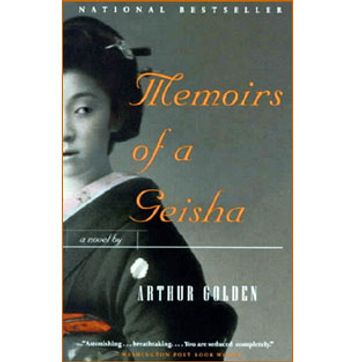
Arthur Golden's American bestseller, "Memoirs of a Geisha," gets a thumbs down from the country where it's set.

In America, everyone loves her. Through her journey from fisherman’s daughter born near the Sea of Japan to her ascent into the upper echelons of Kyoto geishahood, Arthur Golden’s Sayuri has charmed Western hearts, and his novel has leapt onto American bestseller lists. Now, more than two years after “Memoirs of a Geisha” was first published in the United States, the book is getting a big shrug from Japanese readers and a decisive thumbs down from the woman Golden credits with teaching him the most intimate aspects of geisha life.

“Sayuri” — as the novel is called in Japan — is in all the posh bookshops in central Tokyo, from Aoyama Book Center to Shibuya’s Book 1st, where browsers can find it wedged between the likes of Banana Yoshimoto’s latest novel and other recent translations, such as Melissa Bank’s “The Girls’ Guide to Hunting and Fishing.” In proper Japanese style, the book has been elegantly packaged with a traditional textile pattern cover (making it look serious and not sleazy) and an extra half-sleeve informing readers that it has been a bestseller in the United States and will be made into a movie by Steven Spielberg.

Although Bungei Shunju, the book’s publisher, says it’s satisfied with the book’s performance so far — sales have reportedly hit 50,000 since it was released in November — “Sayuri” hasn’t launched a “geisha boom” in Japan. In fact, it’s fairly rare to find someone who has read the 650-page novel (published in two volumes) from beginning to end. Bookstore managers say the book is just not that popular.

The main reason for this is that a foreigner writing about a topic like geishas seems kitschy to Japanese readers. An editor at a rival publisher, which turned down a shot at “Memoirs,” says: “Books written by foreigners that are set in Japan spend too much time explaining the exoticness of Japan, and readers here don’t need that. They’ve been exoticised before. Geisha stories just aren’t interesting to them, and furthermore, they feel like Western writers focus too much on the seedy, sexy side rather than the cultural side.”

And as Nagusa Toda, a 29-year-old artist and Web designer puts it, “In Japan, geisha is a cultural icon. It’s nothing new to write about them.” Moreover, there’s mistrust when it comes to a book written by a foreigner on a world so closed off to even the average Japanese person.

Part of the problem, according to Japanese academics, is that Japanese audiences aren’t interested in having their culture explained to them through Western eyes. “This book is tapping the image that Americans already have of Japan,” says university lecturer and translator Hiroko Hagino. “When Americans think of Japanese culture, they may think of ninja and shogun. When I went to Nobu restaurant in New York, I found that it’s not typical Japanese, but it’s exactly what Americans expect — all bamboo and lacquerware. It’s the American version of what America wants to imagine it’s like in Japan.”

Of course, in America, the book was praised for its authenticity. Certainly Golden’s nine years spent researching it add to his novel’s credibility. While most Western readers have no basis to judge its accuracy, they have pretty much accepted “Memoirs of a Geisha” as a semifictional memoir in a nonfictional setting.

The most prominent voice against the book in Japan is that of the former geisha Golden thanks most lavishly for providing him with details about life in Gion, the geisha district. Mineko Iwasaki reportedly said that Golden committed inaccuracies and slights, and she complained that he overemphasized the role of sex in the geisha world. Golden’s response to her comments was that he wasn’t concerned about the small errors, and that he was not surprised by her anger over the issue of sex (attributing it to being too close to the truth to be comfortable).

Another issue for the book in Japan is the translation, which, ironically, strikes readers as unsettlingly authentic. According to those who have read both the English and the Japanese versions, the translation has changed the book because it uses a manner of expression that was unique to geisha society in Kyoto and for which there is no English equivalent. Japanese readers have noted that the translator, Takayoshi Ogawa, appears to be a second author — there’s no way Golden could have known exactly how people in this subculture spoke to each other.

While this might seem to be a successful translation, for Japanese readers it’s confusing to read a book by a foreigner that sounds so genuine. On the one hand, they say, it uses specialized language that the original author could never have known, yet it still takes the time to explain things about the culture that are obvious to Japanese readers. As one reader put it, the charm that you feel when you read the book in English, which evokes a feeling of the exotic, is lost in the Japanese version, in which it seems as if Golden is hiding the fact that he is a foreigner.

But the reaction’s not all bad. The translator’s use of Kyoto dialect and Golden’s ability to mask his own foreignness have been the main sources of the small praise the book has garnered in Japan. Reviewers aren’t saying this is a groundbreaking novel. They are saying that while it may seem strange for a foreigner to write about this topic, the book really doesn’t come across as if it was written by a foreigner.

And like Golden’s Western audience, Japanese readers have been impressed by his detailed accounts of feminine customs and traditions. Natsuyo Yukawa, a 30-year-old Japanese teacher and student of the tea ceremony, says she was shocked by some parts of the novel — particularly an exam that establishes the virginity of two girls — and that she learned new (and, let’s hope, accurate) things from Golden’s book that she never knew about geishas. Still, she admits that the only reason she read the book was that she heard about how famous it is. Otherwise, she says, “in the bookstore, another book might have seemed more interesting.”

So for now, heaps of unsold copies of “Sayuri” are gathering dust, towering over diminishing piles of more successful books. One of these — the country’s biggest bestseller since World War II — focuses on an issue that’s much more relevant. With its simple but inspiring message, “Gotai Fumanzoku” (“Nobody’s Perfect”), the autobiography of a 24-year-old Japanese man born with no arms and legs, has sold 4.5 million copies since its release in 1998. In the words of its author, Hirotada Ototake: “You don’t have to be born perfect to be happy.” That this book is striking such a chord reflects a growing appreciation of the value of outsiders in Japan’s homogeneous society.

Meantime, plenty of gaijin (foreigners in Japan) are still lapping up the exotic angle. A trip to the Japanese-English bookstore in Roppongi revealed heaps of the Japanese translation of Golden’s novel up front, but when the clerk went looking for the English version at the back of the store, he came back empty-handed. Sold out.

Continue Reading Close
www.salon.com/writer/jennifer_hanawald/index.html