Jennifer Kornreich

I like my guys preshrunk

Men who haven't gone through therapy just aren't worth the risk.

In my romantic life, I have gravitated toward such ill-advised prospects as a narcissistic surgeon (redundant, I know), a tortured musician (again), a man whose deference to his adoptive parents belied a sadistic streak and a self-loathing Jewish guy with a WASP moniker and a yen for Latinas, which I’m not. But that was before psychotherapy transformed me into the Incredibly Shrunken Woman.

Nowadays, a man’s emotional stability is to me what net worth and penis size are to other women. When friends set me up on blind dates, I don’t ask: “Is he tall?” or “Does he have hair?” I ask: “How sane is he?” Therapeutic experience is not a prerequisite, but it is certainly a plus. It’s good to know that a professional has minimized messy internal disturbances for me before I enter the frame. I brake for guys who are, like my jeans, preshrunk.

I wasn’t always this way. A few years ago, a datable acquaintance inadvertently frightened me when he boasted that he’d been “promoted” by his shrink from three days a week to two. “Why does he need so much work?” I shuddered. What a fool I was! No doubt his years of therapy had rendered him as refined and layered as a French pastry. In touch with both his aggression and his nurturing instincts, this quirky gem was probably the sort of lefty, literate brute-in-a-suit who could cook you a fancy omelet and then push you up against a wall after having deftly elicited your implied consent. We could have raised empowered children together — the kind of kids who would, as teenagers, tell us off with cogent, nonthreatening “I feel” arguments. And I let him go! (Actually, it was the other way around. Depressive by nature, he felt I was “too cheerful” for him. But let’s give his future the benefit of the doubt, as he was still in session twice a week.)

Today, I would be more than receptive to a hardcore therapy junkie. If a man told me that his shrink helped him individuate from his overbearing mother, or that he had realized, three years into analysis, that his erstwhile Lothario complex was merely symptomatic of his fears of abandonment, I’d instantly fall halfway in love.

The converse is true, too. If a man’s craziness-to-catharsis (C:C) ratio (or trauma-to-transference ratio, or abuse-to-analysis ratio — call it what you wish) seems too great, I proceed with extreme caution, if at all. I don’t have a problem with baggage per se. After all, you’ve got baggage as soon as you’ve got one failed relationship. And yes, I also understand that some people can emerge from dysfunction and even trauma intact, without the help of professional assistance. But I won’t lie: When a new beau tells me about some remarkable pain or creepiness for which he has performed scant damage control, I start calculating the C:C ratio and considering what it would mean for me to get involved with him.

This is not easy. After all, who’s the better bet, the guy whose dad died when he was little and who endured the bitterness of his widowed, painkiller-addicted, male-bashing mother, but who at least had years of therapy as a teen, or the guy who suffered “only” his parents’ nasty divorce and subsequent badmouthing (dysfunction underestimated because of its prevalence), but who never got therapy and still clings to a brutal vision of marriage?

Some might consider the C:C ratio bunk, or a snobbish, elitist way to assess romantic prospects. But I’m just playing the odds. “There are people who are naturally resilient and don’t need therapy,” concedes Geraldine K. Piorkowski, Ph.D., clinical associate professor of psychology at the University of Illinois in Chicago and author of “Too Close for Comfort: Exploring the Risks of Intimacy.” However, she adds, “if someone with a traumatic background hasn’t had help, the chances of their being able to pursue life reasonably in terms of forming close relationships is very small. If the trauma didn’t involve interpersonal betrayal or desertion — if it had to do with hurricanes or natural disasters — that’s something someone can put into perspective on one’s own. But if it’s interpersonal trauma, that becomes the imprint in your brain of what you can expect from relationships, and so you’re always on the defensive and don’t get too close.”

Here in Manhattan, where therapy is a veritable rite of passage, people have very strong opinions about not only their own therapy but that of their partners. Therapy devotees and therapy detractors may find themselves as much at ideological odds as people in interfaith or interracial relationships. I have a male friend who, at 27, has had “more therapy than Freud and Jung combined ever gave.” Naturally, he’s rather extreme on the subject of his partners’ therapeutic risumis: He’s not interested in women who’ve never had therapy.

“How in touch can a woman be with herself if she doesn’t believe in self-analysis?” he asks. “Probably not very. People who really want to improve their relationships with others or with themselves get into therapy. And those who shun it, I shun.”

His stance is far more militant than the perspective of even those who profit literally from therapy. “This business that everybody ought to be in therapy to be emancipated is just nonsense,” scoffs Willard Gaylin, M.D., author of “Talk Is Not Enough: How Psychotherapy Really Works” and clinical professor of psychiatry at Columbia College of Physicians and Surgeons. “It’s like saying that everybody ought to have their gallbladder out. I don’t believe that therapy is a form of adult education. My wife has never gone, and she’s swell.”

And while few middle-class New Yorkers can say there are no therapy patients in their social circles, many stubbornly cling to DIY problem solving and wish their partners would do the same.

“Part of me is a rabid anti-therapy person,” says Doug, a physician who was, until recently, involved with a man who was not only undergoing psychotherapy but taking a battery of psychotropic drugs.

Interestingly, Doug was more understanding of his boyfriend’s medications (which he viewed as necessary weapons against a real, biochemical problem) than of the psychotherapy, which he felt was often his boyfriend’s “crutch.” He explains, “People often abuse therapy as a substitute for self-improvement. It’s like, ‘Help me feel less guilty about this’ rather than ‘Help me be a better person.’ When someone treats me badly, and it takes a therapist to make them realize it, there’s bound to be a problem. It shouldn’t require someone else’s insight for them to realize I’ve been hurt.”

What’s more, Doug continues, “there’s often some sort of excuse lined up, such as ‘I understand now why I did that to you,’ which is then followed by psychobabble. So whenever my boyfriend hurts me, he can simply say, ‘You know I have a problem with intimacy.’ I have no such excuse lined up, so I have to fall back on the old ‘I’m a schmuck. There’s no excuse. I’m sorry. I understand that, next time, I’m out on the street.’ Which is usually just as it should be.”

I know just what Doug’s talking about — the therapeutic couch potato who’s too lazy to use his or her new self-awareness to actually make changes. And by the same token, I believe that any shrink who hypothesizes about why you have a particular problem, without getting you to a place where you can at least minimize the problem, is a lazy one. If you’re using therapy to pass the buck, you might as well save yourself the $100-plus per session.

Gwen’s ex-boyfriend was proactive with his therapy — except that he tried using it to make her feel like the nut case. “He’d come home from therapy and say, ‘Oh, we talked about you a lot today.’ According to him, he and his shrink came up with the brilliant theory that the reason I wanted more attention from him was that my brother always got more attention from my parents, since he was retarded.”

She shakes her head. “That’s how he spent his time in therapy: convincing himself that I was the problem instead of working on his own issues. The truth is, he didn’t want to reduce the drama in his life. He just wanted to charm and seduce the shrink, who was just another extra audience to him.” I guess if you’re such a narcissist that you think that all the world’s your stage, then you’re going to think of yourself as, rather than a patient, someone who’s giving the shrink a backstage pass to your life.

In fact, sometimes therapy itself becomes a bigger source of contention in a romantic relationship than whatever the partners were feuding about before. When you enter therapy, Piorkowski explains, the other partner “feels like you’ve unbalanced the relationship. You have two people on one side and one on the other, and that’s very threatening to the person not in therapy.”

And this is not just due to the noninvolved partner’s insecurity: Often, Piorkowski observes, patients “use what’s going on in therapy against their partners.” One of the most common ways in which they do this is by using “My therapist says” as a trump card in an argument. “That’s a cheap shot, ‘My therapist says.’ People do it when they feel they need additional leverage and need to rely on some authority to lend weight to their position,” Piorkowski says. Gaylin is even more vehement: “There’s nothing more obnoxious, and it’s guaranteed to antagonize your partner.”

It’s also likely to make your partner believe you’re getting more dependent, rather than independent — a putative goal of therapy. “Any argument from my significant other that begins ‘My therapist says’ is by definition a weak one,” Doug says. “It ranks up there with ‘My mother thinks.’ I never want to hear, ‘My therapist thinks you should be more supportive.’ Believe me, kiddo, as insightful as your therapist may be, until he or she spends a whole night in bed with us, they have no idea what I actually deal with.”

And even if the shrink does have a clue, how comfortable is that for the partner who’s not in therapy? “It’s awful knowing that there’s someone sitting under your bed at night,” Gaylin says.

“My boyfriend told his shrink things I’d never let him share with his friends,” Doug says. “I understand the necessity of that in therapy, but this is why it’s especially important to keep ‘My shrink says’ statements out of the relationship. It’s the equivalent of hearing: ‘My friend Suzy thinks it’s OK that your penis is so small because we can find other ways for you to satisfy me.’ Thanks, Suzy. You’ve been a big help.”

Aside from feeling that their privacy is being violated, the partners of new patients are “often concerned, if they’ve been having difficulties, that the relationship will end, that the patient will get the strength to leave them,” Piorkowski says. “And that does happen sometimes, so the fear that the person may change, and that the change may result in the person leaving, is not groundless.”

Indeed, couples therapist Andrew Christensen, Ph.D., professor of psychology at UCLA and coauthor of “Reconcilable Differences,” has seen people drag their husbands or wives kicking and screaming into therapy, only to discover that their newly self-actualized spouses ultimately decide a divorce would make them happiest. “That’s the scary extreme,” he says, “but I’ve certainly seen it happen.”

Gaylin insists, “Therapy can only help a good relationship. It will damage a bad relationship only by opening the patient’s eyes to it.” But Christensen believes that while it’s rare, even relationships with potential can unravel under the influence of one partner’s therapy. “It’s very difficult, when you’re hearing only one side of the couple’s story, not to implicitly or explicitly support the view that your client is the victim of the partner’s bad behavior. That’s the one way in which individual therapy can undermine the couple’s relationship.”

Which is why it’s safer, he adds, if one partner’s problem is primarily a relationship problem, for the couple to go into joint counseling. Unfortunately, most people I know who’ve tried joint counseling didn’t do so until it was too late. I suspect that when one person has already reached the breaking point, and he or she definitely wants out, it’s hard to get that person to regard therapy as anything but due diligence; such people just go through the motions so they can tell themselves they’ve tried their darnedest.

And if a relationship dies after just one partner gets therapy, is it because the relationship was flawed or because the therapist was unskilled or working under the influence of a personal agenda? “My ex-girlfriend’s therapy undid our relationship,” says David, 35. “Sandy gave all of her intimacy to her therapist and had none left over for me. Her shrink never even met me, and yet she was giving Sandy advice about me.” (I firmly believe that a good, truly professional therapist almost never gives a patient direct advice but, rather, very pointed questions or, at most, various avenues to explore.)

“She told Sandy to give me lists of demands which were essentially ultimatums. She also convinced Sandy that in some ways I was an extension of her parents — with whom she had major issues — so Sandy began viewing me in that negative light. Before Sandy got into therapy, we were having fun, but later, whenever we had something to talk about, suddenly we were ‘verbalizing’ and ‘validating’ and dissecting. My mother is a shrink and, for me, the jargon of therapy is a war language: I remember my mom using it against my dad. I finally went with Sandy to meet the therapist. In a very confrontational way, using the jargon, I told the shrink that I felt that she was antagonistic toward men, that she had her own anger issues to work out, that she was fabricating problems for Sandy and that, if she kept it up, Sandy would be left alone. And that’s eventually what happened.”

Even when therapy ultimately benefits a relationship, the partners may face some short-term stress. Patients ideally get in touch with their feelings during therapy, but this can be bewildering to their partners. Patients “become aware of how deeply angry they are with some people around them, and all of a sudden they’ll start letting it out,” Gaylin explains, “and the person relating to them won’t understand where it’s coming from or what’s happened. The patient has to explain that therapy is a rocky road and he or she is getting used to some new things, some of which are their own emotions.” Likewise, Piorkowski explains, “in therapy a person often becomes more assertive about talking about what he or she needs and wants, and if they’re in a relationship with someone who’s domineering or intense, the partner may not be able to tolerate that.”

Gaylin points out another potential annoyance to the noninvolved partner: “The patient may compare his partner to the therapist: The all-knowing, understanding, forgiving therapist [whose attitude is] ‘I’ve only got ears for you, dear; you’re the most fascinating creature.’ If my therapist is prepared to hear me go on for weeks, kvetching about how my mother preferentially treats my sister, how come you, my partner, aren’t prepared to do that? And the answer is that your therapist doesn’t do that for his or her partner!”

Another potential pitfall of therapy? “You become so tuned in to your own needs and so self-absorbed with your own feelings that you lose sight of your partner,” Piorkowski warns. In most cases, she adds, the patient outgrows this, but it’s not always the case. Jack, 27, dated a woman who was in and out of therapy her entire life. It was bad enough that she’d cast aspersions on his customary easygoing, nonanalytical nature as “simplistic” and “repressed” and a sign that he needed therapy very badly.

But on the rare occasions that he actually was able to express some dismay at something she’d done, she would refuse to discuss the issue, saying that his “inappropriate” pain was just further proof that he needed help. “But of course,” Jack recalls, “any time I hurt her, we had to analyze her feelings ad nauseam.” And of course, all relationships need breathers from a partner’s analysis in order to thrive. So any therapy devotee better keep in mind that the best therapy is work, and it’s best not to become a workaholic and take it home all the time.

“Therapy is such a strange and unusual social experience. One person devotes himself to you, and it’s nonreciprocal. It’s a very unreal relationship,” notes Christensen. “It can’t be easily generalized to the real world and it can be very seductive. I can start wanting my partner to be more like my therapist — giving me that undivided attention. And no partner can be a therapist to you.”

So true. But I suspect I’d still be thrilled with a partner who saw one.

A bod for sin

Jacqueline Tellalian has spent her life in a wheelchair. And she still doesn't understand why men see it as a mechanical monster that threatens their manliness.

Until today, the hunky, struggling actor had only spoken to Jacqueline
Tellalian by phone, so he wasn’t expecting to meet a partially quadriplegic
woman in a wheelchair. That’s why “he had that deer-in-the-headlights look”
throughout their interview, Tellalian says, ushering me into her apartment
shortly after his departure.

The bewildered beefcake left tantalizing photographs of himself in his
wake; they await the eyes of someone lascivious, such as Tellalian or myself.
It probably wasn’t only Tellalian’s appearance that threw the young actor; her
home-office decor, she concedes, is “not exactly the most professional
environment.” In seeking representation from Vesta Talent Services — i.e.,
Jacqueline Tellalian, personal manager to a small stable of fledgling, unknown
or disabled actors and models — surely the newbie didn’t anticipate
multicolored walls, the kitchen floor inlaid with a giant question mark, the
collection of skull-and-skeleton-theme tchtochkes, the Jimi Hendrix
silkscreen, the autographed photo of John Wayne Gacy (among other
serial-killer memorabilia), the transparent toilet seat encasing a crown of
barbed-wire or the ceramic penis that once functioned as a bong but
presently serves as a vase.

And in interviewing her prospective client, Tellalian surely didn’t expect
to hear that her pad reminded him of the apartment on “Friends.” Still, the
galling remark won’t influence the decision she makes several days later not
to represent him. Nor, surely, will the photo of the chiseled actor in his
skivvies: “It’s a very compelling picture,” Tellalian deadpans. Indicating
his crotch, she adds, “Not bad for a white guy.”

When most people think of what the protagonist of “Working Girl”
described as a “bod for sin,” they envision a physique like the young
actor’s, not like Tellalian’s. In fact, hers is a bod that lies so far outside
conventional beauty standards that it thwarts much of the sinning she’d like
to do. A botched breech birth left Tellalian paralyzed, with a spine so curved that she leans significantly to the
left, looking as though she’s about to shift in her chair and say something
stunning, which she often does. She can move her arms, but nerves in her left hand are damaged.

At 46, Tellalian hasn’t had a nonplatonic relationship in several years —
a fact that has nothing to do with her libido (this is a woman who vacuums to
porn). Nor, she claims, does it have to do with her own body image, but with
others’ fear and prejudice.

“Because I grew up with the wheelchair, it was just there,” she says,
insisting that she’s “never had a why-me period.” Regarding the snubbing
she’s received from various men and employers, she says, “What’s their
problem? I have all these things to offer, and they don’t want it? I don’t
get it. That’s why I’ve got a question mark in the middle of my floor.”

Raised in Hialeah, Fla., Tellalian’s misadventures in the “primitive
rehab world” proved that even so-called experts had few satisfactory answers:
“They had a giant contraption that keeps people standing who can’t. Think
of an iron lung, only standing up. So there you are, fake-standing and
encased. It made me want my wheelchair. ‘I can’t walk! Why are you trying to make me walk when you know I won’t be able to?! Just sit me
down!’” One doctor told Tellalian’s mother, right in front of the child, that
she wouldn’t live past 18.

But as a teen and young adult, Tellalian managed myriad experiences that
most people didn’t expect she would. She was an avid rock concert-goer and
still boasts about seeing Jim Morrison get hauled offstage in Miami for
lewdness. She self-published a rock fanzine. She not only had sex, but
enjoyed it, thank you. (Granted, she says, partners need to be more
assiduous, “just to get the nerve endings a lot more jazzed. If you don’t
get someone who’s aggressive, it’s pointless.”)

But purely sexual fulfillment was easier when she was younger, she says,
because she wasn’t as averse to casual sex back then. Nowadays, if there’s
no emotional element, she’d “rather have a piece of cake.” Besides, during
the hippie era, “it was easier for people to not feel self-conscious about
being with someone who’s imperfect” because “there was nothing about body image … You were taken for what you were. That was the beauty of living during that time. The idea was not to conform.”

These days, she notes, image is everything, and aging hasn’t helped.
“You’re out of the marketplace after a certain age. And being in a
wheelchair just compounds the issue,” she says. Disabled women have it
tougher than disabled men, Tellalian insists: “All the disabled guys I know
are either married or have girlfriends. Whereas only one woman I know in a
wheelchair is married. I’m talking about mixed marriages,” she qualifies — i.e., relationships between able-bodied and disabled partners.

Female “walkers,” she believes, are more nurturing and less visually
oriented than male counterparts: “Able-bodied men are very conscious of how society perceives them” and often feel that a disabled partner reflects
poorly upon their own virility or ability to score a desirable babe. Also,
“they’re more afraid of what they think I can’t do [sexually] than being at
all interested in what I can. … It’s very myopic.” Tellalian plans to make a
short film in which “a bunch of guys jerk off on my empty wheelchair to
express body image and how I’m perceived sexually. In this literally seminal
film, she adds, “I wouldn’t show their faces.”

Tellalian has been making experimental short films and videos since late
adolescence. (She’s proudest of “Die-O-Rama, ” a comedically grisly meditation on the connections between sex, pornography, butchering, death and food consumption.) In fact, her filmmaking aspirations were primarily why she moved to Manhattan in 1975. She wangled an interview with New York University’s prestigious film department, but her interrogator “rejected me because I couldn’t walk,” Tellalian claims. “He said, ‘Well, how can you hold a camera?’ — while I was holding a film I’d made! He wouldn’t even look at it.” She wound up studying film history instead, which “completely altered the entire direction of my life.”

After college, Tellalian worked as a media buyer at an ad agency, and then
as a talent agent and casting consultant. In 1985, just after she founded Vesta, she located two deaf teenagers for
starring roles in a landmark, closed-captioned McDonald’s commercial. She
quickly became known among casting directors as someone who could reliably come up with whatever type of “crip” (as she calls people with disabilities) they might require. She has landed wheelchair-bound, sight-impaired and hearing-impaired actors and models guest spots on shows such as “Law & Order,” “Spin City,” “Sesame Street” and “Guiding Light” as well as TV and print ads.

“Ironically,” Tellalian says, “there’s a nondisabled criteria that applies to
disabled talent.” She adds: “Someone like me would not be acceptable. I’m
not thin and my spine is curved. … They want someone who looks like they used
to walk, someone who’s not all scrunched up and drooly. They want the
disability in name but not all the stuff that comes with it.”

One person who doesn’t shy away from physical difference is legendary
photographer Joel-Peter Witkin, who is renowned for his stylized nude
portraits of amputees, hermaphrodites, pre-op transsexuals, dwarves and
other people with bodies that are deemed freakish by most. When a mutual
acquaintance introduced Witkin to Tellalian at the 1984 Biennial at the Whitney (where some of his work was on exhibit), he was artistically smitten.
Tellalian was wearing black lipstick and a winged silver leather and velvet hat covered in blue
bunny fur from Patricia Fields. “I looked like an Edwardian nightmare,” she says cheerfully.
Witkin says that he “saw her face and lips and I’d never seen anybody like
her. She was just unique.” He asked if he could photograph her, in the same
hat.

Until now, leers from drunken men and thoughtless remarks from people who liked her face but felt it was “too bad” she was in a wheelchair were the
closest thing she’d received to compliments on her physicality. Witkin’s
aesthetic interest in her constituted the first time that Tellalian had ever
felt herself so overtly regarded as a thing of beauty. And she was impressed
with how Witkin’s work “emphasized the strength of disabled people. They’re not coming off as pathetic creatures.” She also found some of his
photographs macabre and humorous, a sensibility that appealed to her. During a follow-up conversation, Witkin remembers, he discerned that Tellalian was “an incredibly intelligent person, very sensitive. She was very exotic, with a sense of wisdom and profundity that came through pain.”

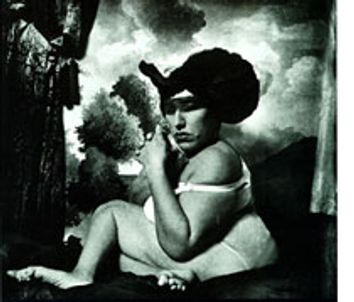
“Woman in the Blue Hat, New York City” (1985) now hangs in Tellalian’s
living room. Clad in only undergarments and the crazy hat, Tellalian sits
before a weird pastoral backdrop with her hands clasped, her legs drawn up in a way that seems at once self-protective, prayerful and tender. Her
semi-fetal pose suggests vulnerability, but also great inner calm. You can
barely see her eyes; her lips are slightly parted.

For several days after she first received the portrait, “Every time I walked by I had to look at it. I called everybody up and said, ‘You’ve got to see this,’ so I had a big parade of people coming in and out for a week. Someone once called it kind of ‘Mona Lisa’-like.”

When I ask Witkin whether he’d ever considered shooting Tellalian in her
chair, he answers emphatically in the negative. “I hate wheelchairs. Why
didn’t Frank Lloyd Wright design a wheelchair? They’re disgustingly ugly.”
Besides, he says, “when (Tellalian) thinks of herself, she thinks of herself as
a woman — not in a wheelchair, I’m sure. If you take a woman out to dinner,
you don’t look at the wheelchair.”

Unfortunately, Tellalian counters, most men do, and don’t like what they
see. “They don’t see [the wheelchair] as a nice car to drive around in.
They see it as some sort of mechanical monster that impedes their own
manliness.” She supposes that’s why the graphic artist who came to her apartment
at night for over three years never consummated their relationship or took her out in public. The two would often stay up till the wee hours of the morning talking, and the man even “swore undying love” to Tellalian (who reciprocated in feeling), but he declined sex. “He was there all the time: ‘I worship you.’ That made it that much worse. You worship me but won’t sleep with me? That’s really nice. What was the big line he gave me? ‘I don’t sleep with anyone I respect.’ That’s a copout! Why not just say, ‘I don’t want to do it with you,’ and then I could say, ‘Leave’? Instead he
perpetuated [hope] in little ways — gifts and deep glances and heartfelt
talks.” Eventually Tellalian confronted the man, saying she suspected her
disability was the true reason he didn’t want to sleep with her or go out
with her in public. He denied it.

She is sure his denial was bogus: “I can tell when the disability is an
issue and they don’t say it is. Anybody disabled gets a sixth sense about
those things.” But she says that similar evasions from others have taken
their toll: “You start questioning whether you’re even thinking straight or
not — whether anyone’s saying anything truthful or not.”

Plus, she says, many disabled women are caught in a Catch-22, since many of
the few men who aren’t turned off by the chair are just after “a freak
fuck.” Has Tellalian herself encountered any potential partners who tried to
fetishize or exploit her disability? “No, I’d like to!” she jokes. “Where
are they?!”

After the demise of her quasi-romance with the graphic artist,
after she began to work for herself as a talent manager, Tellalian began doing
phone sex for a few agencies to earn some extra cash and channel her
creativity simultaneously. “Since my self-esteem was so low, I figured it
was one way I could regain my power — pretend I had sexual power over
someone else. And it helped me tremendously,” she says. The work left her
with a residual affinity for dirty pillow talk.

It wasn’t long before she decided which calls she simply couldn’t
stomach: pedophiles, bestiality freaks, testicular-torture aficionados and
men who “got off shitting in diapers.” She liked domination calls “because
it was the easiest thing in the world, yelling at people.” Tellalian’s other
callers constantly amused her, too, although they did little to raise her
view of the other gender. “Is this what men do in their spare time? It’s
tragic!”

One of Tellalian’s regulars was a “really nebbishy” man who apparently
sounded like a deranged cross between Lucy Ricardo and a braying goat. She pinches her nose to illustrate: “‘Put the tiiiit clamps oooonnnnn. Hang
your tiiiits over the side of the beeeeeed.’ Like he had a clothespin on his
nose. You could imagine him with greasy, pockmarked skin and thick
coke-bottle glasses. It was sick. It was a beautiful thing.” To this day,
Tellalian often calls friends at work and greets them with, “Put the tiiiit
clamps oooooonnnn!” or some other phone-sex salutation.

Even the more “normal” callers placed demands on Tellalian’s imagination.
She had to play the role of not only a pneumatic bimbo but an able-bodied
one. “They always wanted a Playboy girl: ‘I just got out of the shower and
don’t have a towel on,’” she breathes, then laughs. “They had no idea I was
a chubby, olive-skinned Armenian crippled girl” who was doing jigsaw puzzles or visiting with gay male friends (which she has no shortage of) as she
moaned and cooed.

After three years, she focused on her business. While opportunities for
disabled models and actors were never exactly plentiful, Tellalian recalls the
early to mid-’90s as a boom time, in relative terms, for Vesta. “It was a
minority freak show,” she recalls. “Every few years [Hollywood] picks up a
minority and propels them into the front ranks of the mainstream — like what
they’re doing with gay people now. ‘Let’s show lesbians kissing to boost the
ratings.’ They pick a minority and make them look as next-door-neighborish
as possible.”

Now that it’s other minorities’ turn in the limelight, work for disabled
talent is pretty scarce, says Tellalian, who now represents more able-bodied
clients than disabled ones. While able-bodied actors are often cast as disabled
characters, Tellalian says that she’s never seen an instance in which a
disabled actor has been considered for a role that wasn’t specifically
written for a disabled character — say, a generic mom/office-worker/teacher.
“That’s the Holy Grail,” she says.

Tellalian will pipe up when she feels she (or a client) is being
discriminated against or mistreated, but she is hardly a “crip-diva.” She
despises politically correct terms like “handicapable” and has never joined
the ranks of disabled activists. “If I’ve needed to fight a fight,” she says,
“it’s been for me. I don’t feel the need to solve everyone’s problem. It
would be great if I had that greater concern, but I don’t think I do.”
Neither does she share the public’s reverence for Christopher Reeve.

“He’s a good example of someone who’s become disabled and really feels the need to live for the purpose of being ‘normal’ again. He’s not doing a bad thing: Spinal cord research is definitely in order … [But] I know disabled activists who are not as famous who get a lot more stuff done. They’re not necessarily campaigning for a cure. It’s more, ‘Hey, let’s get Radio City cleaned up and make sure there are accessible bathrooms and seats.’ It’s more about making our lives more like everyone else’s rather than just, ‘Yeah, make me walk again.’”

Despite its cosmopolitan sophistication, New York City is still a tough
place for a disabled person to get around on her own, Tellalian says.
Sometimes ostensibly wheelchair-accessible public bathrooms in restaurants
are so small and useless that she must go to the local emergency room to use
its facilities. Many streets have curb cuts on one side but not on the other.
Potholes are so treacherous that she’s had several “dumping-outs” which have proven nearly lethal. She’s had three surgeries for a torn rotator cuff: a
souvenir from a speeding taxi that hit her as she was crossing the
street. Taxis, by the way, don’t always stop to pick up people in wheelchairs
– a point she made in a letter to the editor of the Daily News after reading
about actor Danny Glover’s complaint that cabs bypass African-American men.

Sometimes, she observes, immigrants — many of whom are driving New York City’s cabs — harbor cultural beliefs that disabled people have evil, supernatural powers. She once attended the Easter Day Parade, and a homeless man trailed her down Fifth Avenue, screaming, “SHE’S THE DEVIL!”

Tellalian’s daily obstacles on the streets spawned her dream for a gallery
installation that will remain unrealized unless she “wins the lottery,”
because she doesn’t have the funds to execute it: “I’d like to have someone
build a small labyrinth with no lights in it. The floor would be covered
with layers of bubble wrap. Each person would get in a wheelchair and roll
over the bubble wrap through the labyrinth, which would also have steps. You might not be able to turn around; you might get tricked by mirrors; you might not be able to get out. I’d like to see how people that walk could deal with four minutes in a wheelchair. The bubble wrap (would sound) like a machine gun — like, Hey, you’re going into war, baby.”

But if the urban streets are like a combat zone, in some ways Tellalian’s
disability has made her braver. “I don’t think I’m scared of anything. A
guy with a gun, a man with a knife — imminent death, I guess … If you can’t walk, what else is there to be afraid of?”

Contemplating how life can so drastically change in a matter of seconds, I blurt out that it would be almost unimaginably frightening to have to adjust to a life like Tellalian’s. I realize what an insensitive and painfully gratuitous remark this is as soon as it’s out of my mouth.

But Tellalian’s not offended. She just looks me in the eye and replies, “It would be very frightening for me to live the way you do all of a sudden.”
She laughs, probably because she knows she’s surprised me — then reiterates, “It would be just as scary for me to be in your shoes.”

Continue Reading Close

The nymphet strikes back

In a controversial new novel told from Lolita's point of view, the girl is vicious, conniving and not very convincing.

Puberty stood me up until I was about 15 or 16. Forget the “late bloomer” rhetoric: If we’re going to use floral metaphors, I’d have to say that when I first entered the emotional fray of adolescent sexuality, I was armed without so much as a pistil. My cadaverous body rendered me sexually invisible for a long time. (Why, oh why is the waif look desirable to the opposite sex only after you’re too old to come by it naturally?) This kept me out of trouble but was agonizing nonetheless.

In particular, I recall an eighth-grade party at which none of the boys tried to kiss me or fondle my backside as they did to the other girls. By the time my mother came to drive me home, I was so overwhelmed with a hopelessly snarled mixture of rejection and relief that I burst into tears and asked why nobody wanted to touch me. My mom — who didn’t, to her credit, ban me from coed parties right then and there — offered me some kind white lie that might even have had a kernel of truth to it: The boys, she said, didn’t touch me that way because they respected me. (Mmm-hmm.) “But I don’t want them to respect me!” I wailed, and dismissed her insistence that I might change my tune in a few years.

Then an interesting thing happened: During my junior year, I developed both my long-awaited bust and a habit of bursting into hysterical and seemingly unprovoked laughter in the middle of my classes. By this time, the promise of sex seemed to carry with it an implicit threat of violence. A few boys in my school were routinely rough with their girlfriends in moments of anger. I knew a girl who’d lost her virginity at 14 to a date-rapist. And outside the local Friendly’s one night, a crowd of kids watched two boys hold a screaming girl by the arms as a third tried to lift her skirt. My yearning for someone to touch me was tempered by the fear that someone actually would. So I laughed, loudly and often, with a horribly desperate edge to my giggle. My Spanish teacher thought I was on drugs. My classmates thought I was crazy, and I was inclined to agree. It was only in college — shortly after I’d lost my virginity, and long after the laughing fits had subsided — that I realized that I was laughing because boys had begun to notice me, and I was trying to smother the impulse to scream or cry every time one looked at me or passed me a note.

Now, there are plenty of teenagers and even preadolescents who have active, happy sex lives. But I relate these anecdotes because I think that certain aspects of my experience are universal: ambivalence about sex, anxiety about the changes in one’s body and the push-pull response to adult advisors.

These complexities are largely absent from “Lo’s Diary,” a novel about a prematurely and inappropriately sexualized girl — who just happens to be Lolita. The author, Italian writer Pia Pera, ostensibly wanted to give Vladimir Nabokov’s nymphet a voice: to retell the story through the girl’s eyes. But what a disappointing voice the author has bestowed upon one of the most intriguing characters of all time. In Pera’s version, Nabokov’s mercurial, sexually precocious preteen is reduced to a caricature: a conniving, narcissistic, heartless vixen.

Much has been made in the publishing industry of the skirmish between Pera and Nabokov’s son Dmitri, executor of his father’s estate, who filed a lawsuit against her original American publisher, Farrar, Straus & Giroux, claiming that attempts to publish the novel in the States and the United Kingdom constituted copyright infringement. Farrar pulled out, and Foxrock — a publishing company founded by Barney Rossett, whose Grove Press first published “Lolita” in the United States in 1955 — took over after reaching a settlement with Dmitri Nabokov: The book could be published, but Pera would have to split royalties with Nabokov, and each would provide commentary regarding the legal issues involved. Dmitri Nabokov’s preface gets in some good insults under the guise of being generous (“I try to be a nice guy”); Pera has reneged on her promise to write an afterword, but that didn’t stop her from accusing Dmitri Nabokov, in an e-mail written to a New York Times reporter, of a second-rate imitation of his father’s grandstanding.

“Lo’s Diary” is largely contrapuntal to “Lolita.” In each, there is a foreword by fictional editor John Ray. In Lolita, Ray tells us that Humbert “died in legal captivity.” In “Lo’s Diary,” he tells us that after editing and publishing “Lolita,” he was approached by the “real” Lo: Dolores Schlegel (Schiller in “Lolita”), nee Maze (not Haze, thank you), who did not die in childbirth as Humbert Humbert would have us believe, but is rather happily pregnant with her second child by her sweet, deaf husband, Richard.

Mrs. Schlegel forks over the journal entries she scribbled on scraps of paper while on the can. (She feigned GI distress fairly often during her cross-country flight with Humbert Guibert so she could have the privacy to write.) Humbert, apparently, is not dead either, but rather living out his last days fairly peacefully in Paris with his younger wife. He never even killed Gerry Sue Filthy (Clare Quilty). Indeed, Dolly Schlegel has come a long way since meeting Humbert at 231 Grassy St. in Goatscreek (342 Lawn St. in Ramsdale), and she wants the world to know what really happened.

If these dopey names, with their strained, literal-minded, one-to-one correspondence to Nabokov’s, strike you as silly, congratulate yourself on your discerning mind. There’s much about “Lo’s Diary” that’s unsophisticated, and that’s not because of the narrator’s age. Nor is the novel’s callowness excused by the adult Dolly’s acknowledgement that her adolescent musings are “definitely less literary” than Humbert’s. (It’s never a good sign when a book apologizes for itself in the prologue.)

The book reads like it was written by a grad student who took her MFA-program exercises (“Reimagine a scene from ‘Lolita’ from another character’s POV” — yawn) way too seriously. There are so many squandered opportunities here, it’s almost criminal. Why trot out Dolly’s husband and son in the prologue if we’re never to learn how she met him (according to Pera, anyway), and how she managed to overcome years of psychic damage after fleeing the depravity of Filthy/Quilty? Didn’t it occur to Pera that we might want to know whether, in this supposedly feminist version, Dolly ever tried her hand at a career before becoming a stay-at-home mom? Or whether her experience as a pedophile’s sex slave at all invades the marital bed or taints the joy she derives from her own children?

Indeed, if anything, Pera takes too much of Humbert’s version for granted — particularly Lolita’s “nymphean evil.” Because Nabokov tells his story through an increasingly unreliable narrator, the character of Lolita is sometimes preternaturally devilish, sometimes a mere cipher. Instead of fleshing out the girl Nabokov called “the little deadly demon among the wholesome children,” Pera has made Lo even more of a cunning, vicious monster. This is a little girl who tortures animals and people with so little remorse that she’s a veritable sociopath, with the classic case history of a serial killer. The Long Island Lolita, Amy Fisher, is more sympathetic.

Not that Lo’s home life is a breeding ground for happiness. At the start of “Lo’s Diary” proper, Dolores Maze is a 12-year-old preoccupied with the A-bomb and nuclear physics. The possibility of radioactive mutation doesn’t seem to scare her as it does others, and little wonder: Most people in Lo’s world are horrible or already dead. Her mother is an abusive, man-hunting harpy who’s not above shoving her daughter’s face in the toilet; her brother died by an accidental but gruesome electrocution when she was 4; and just last year, her father — who expressed affection by hugging her in the garage as they electrocuted lizards together — dropped dead as well. Mom (whom Lo secretly calls “Plasticmom” or “the hen” or “the pig”) tells her, “In this family only the males die.”

Not that the females fare much better. The level of hatred between Isabel and Dolly Maze is not only shocking but left unexplained. Granted, many teenage girls trying to separate from their moms lash out in often unwarranted anger and disgust. But most big-mouthed teenagers also really need their mothers at times and have their tender moments, too. Lo does not. She sabotages her mother’s love life, badmouths her to Isabel’s best friend, dumps dead spiders in her mother’s bed and is convinced that “when I’m sick she’s happy.”

When Humbert later picks Lo up from camp with the bogus story that Isabel’s in the hospital, Lo explains to him, “All we can do is kill her, pull out the I.V., give her the wrong medicine, whatever, since a shit like her for sure doesn’t deserve to go on living … But maybe we don’t actually have to murder her: When I show up in all these sexy clothes that her second and last husband bought me, she’ll die in a burst of rage. She’ll choke on it. Definitely.” Nice kid.

But we’ve discovered long before this point that Lo is not only disturbed but profoundly dangerous. She tortures her pet hamster — named for her dead brother Nelson — after the hapless animal bites her on the finger. This scene is one of the book’s most harrowing: “I invent a new game: I take him by the scruff of the neck and put him on the light bulb, which is boiling hot, and he jumps. It’s fun … Nelson looks angry when he jumps: he’d bite all of me if he could, gnaw me to the bone and send me bloodless to the other world. But it so happens that I’m stronger, so he has to perform a cute comic number, because if he doesn’t get busy he’ll get burned. He pulls up his paws so fast it’s a scream — he wants to run away, but he’s stuck. My friend, I say, it’s pointless to try and escape, because … you can’t escape until I say so.” When she discovers Nelson dead in his cage the next day, covered in blisters, her remorse amounts to a shrug.

I could go on to describe how Lo psychologically brutalizes a nerdy, sensitive girl at camp, but the hamster scene is enough, I think, to illustrate how Pera hammers home that this girl’s warped attempts to counteract her feelings of powerlessness make her not just receptive to Humbert but downright predatory. She’s the antithesis of the vulnerable, too-trusting molestation victim.

Perhaps Pera believes that going to this extreme is the only way to give Lolita any autonomy. And indeed, Lo’s sexual savvy does initially give her some power over Humbert. But the result is a cartoon. Pera doesn’t create a realistic portrait of a teen’s sexuality — the volatile mixture of awkwardness and daring, fear and excitement, desire and revulsion. How much more affecting and tragic Pera’s novel would have been had she created a Lolita who was sexual, and perhaps immoral on occasion, but also a feeling creature, a girl with both a conscience and some insecurity.

Pera’s Lo cannot — will not — experience most ordinary emotions. Even when Humbert anally rapes her, Lo short-circuits her feelings: “I am plunged into such disgust that I say to myself, What difference does it make in the end, isn’t it all the same horror, and then, what do I care … maybe it’s more advantageous to know how to do even that … better to practice, to be used to everything.”

Even when Lo enjoys sex, Pera depicts her emotions as stunted. Granted, lots of people — both straight and gay — experiment with homosexuality as kids, but even those who enjoy these adventures experience some anxiety or confusion about what it “means” about them. Not Lo, even though this is 1946, some 50 years before Lesbian Chic. As long as it feels good, she does it without a second thought. When a female friend and sometime sexual playmate at her camp professes her love for Lo and begins crying about their imminent parting, Lo “comforted her a little, but at the same time, it didn’t seem like such a big deal … anyway it seems weird for her to be so in love with me.” (There’s that shrug again.)

And when Lo loses her virginity — in front of yet another fellow camper, to the girl’s own lover — she immediately likes the sex: “There’s no pain at all, only the sensation that I am made of a thousand layers that he is unfolding one after another … I only want to keep lying here.” I don’t know, even if a torn hymen isn’t enough to make a 13-year-old wince, you’d think the presence of a third person might make things a little awkward.

The kid is as preternaturally responsive as the fantasy women in pornography: Lo alludes to “the electronic atomic supersonic orgasm, that, to my extreme amazement, stunned me when I was sliding down the pole at recess.” Uh, yeah, I’m stunned too, even though I’m a bit of a Molotov cocktail myself. Considering that it takes fewer than 10 seconds to shimmy down a playground pole, I don’t see how she could possibly climax, unless her clitoris is as reflexive as a knee that’s struck by a physician’s rubber hammer.

Pera gives Lo a ridiculous, pneumatic sort of sexuality wholly unencumbered by self-doubt or shame. Lo says that sex is great for the figure and the complexion, but she’s never troubled by the changes in her body, never struggles with understanding her true desires, never worries about whether she’s “normal,” a famous preoccupation of teenagers (and adults, too, for that matter).

Pera chooses to interpret Lolita as a girl who knows how to come during intercourse at the age of 13, but is devoid of a single benevolent impulse. Can’t she be sexual and flawed and yet still more than the “vile and beloved slut” that Humbert called her in Nabokov’s version? Why would someone go to the trouble of writing from Lolita’s point of view if she’s only going to turn Lo into a cartoonish femme fatale who ridicules Humbert behind his back for being a “lousy” lover who just “lies there like a straw man”? Part of the beauty of “Lolita” is that Nabokov illustrated how closely Humbert’s profound sickness and cruelty are intertwined with his loving and nurturing impulses. There is no such three-dimensionality here.

Lo’s smug triumph in seducing Humbert is quickly dispelled when she realizes what a selfish fuck he is. Even when she’s running fever, “he’s happy as a clam, touching me where I’m burning and absorbing the heat from me as if I’m a hot-water bottle, like the … parasite he is.”

She laments, “It’s nauseating to see a grown man, with curls of white hair on his chest, thick eyebrows, and on his face that slightly doglike expression, with only one purpose in life, only one interest: to get inside me.” Well, yes. But how about some more tender moments, too?

At the risk of sounding perverse, it seems obvious that Lo might entertain some real feelings of attachment to Humbert, as contemptible and exploitative as he is. In real life, incest and other abuse survivors are often tormented by the positive feelings tangled up with their humiliation and the rage they feel for their perpetrators. On the other hand, although Lo wonders whether Humbert will “try to eliminate me” once she passes a certain age, she never seems to experience any real terror that this man might kill her, or, more likely, abandon her without a cent.

At the book’s end, ensconced in Filthy’s manse, she overhears the perverse playwright telling his merry band of hedonists, “I’m already bored by her.”

Seems that he’s deemed Lo a “foolish and whimsical girl who imagines she has the world at her feet” and Humbert “an old man so lacking in imagination that he thinks the greatest thing in life is to fuck her.” Ah, a dismissive synopsis at the novel’s end to balance the apology in the prologue. So glad I bothered to read what lay between.

Continue Reading Close

The “Blair Witch” itch

When couples see scary movies together, pulses race and hearts quicken. The subsequent biological imperative? Fight, flight or spend the night.

Seeing “The Blair Witch Project” had been my idea. I had a Sunday night date scheduled, and I’d savored the prospect of nestling into the crook of my suitor’s arm as I absorbed the pop-cultural event that had the whole country buzzing. I could relieve some sexual tension and some peer pressure simultaneously: beautiful.

For most of the film, I was fine. Bored, even. I began wondering whether my companion and I would discuss the movie afterwards, and (more pleasantly) how we might pass the remainder of the evening if we didn’t. Unfortunately, three segments — which I trust “Blair Witch” viewers will recognize as the disappearance scene, the bloody bundle scene and the final cabin scene — so unnerved me that, upon exiting the theater, my date said I was visibly shaken.

Walking back to my building, my date — a sophisticated and somewhat older man — seemed pretty calm to me, which compounded my discomfort at letting him witness my wordless freak-out. I was sufficiently spooked that I would have appreciated an overnight guest — but on the other hand, this was a second date, and I wasn’t ready for that. I couldn’t ask him to spend a chaste night with me just so he could alleviate the fallout of my fright, could I? A little nervousness on my part might’ve been kittenish, sexy, an excuse to shiver under his arm. Dazed horror, on the other hand, seemed just plain burdensome. We decided to reserve the tjte-`-tjte at my pad for a future time, when I might actually be in the mood for a little tjte.

But preserving my virtue had its consequences. That night, my empty home seemed a crime scene waiting to happen. Whatever evil had destroyed the kids in “Blair Witch” (a force not only fictional but milieu-specific) had somehow mutated into something that might invade my urban domicile. So I reverted to my childhood habit of peeking inside my closet doors and behind my shower curtain, and as I finally passed out on my living-room couch, with the lights on and the TV blaring, I cursed my lack of a live-in lover. Weren’t such indignities as dateless weddings and involuntary periods of celibacy enough of a trial? Must my single status increase the likelihood of a grisly demise as well?

That’s why, the next day, I wasn’t surprised to learn that an acquaintance of mine had invited her otherwise unappealing “Blair Witch” date to spend the night. Where are the sex researchers when you need them? I would love to know what this summer’s celluloid divertissements such as “The Blair Witch Project,” “The Sixth Sense” and “The Haunting” have done for American bedrooms. As the wave of creepy flicks continues (with “Stir of Echoes,” “Stigmata” and “The Minus Man”) are lechers everywhere getting unreasonably and unseasonably lucky? Will fear replace lust on the list of top 10 reasons to go to bed accompanied? After all, it’s not so surprising that terror would serve as an aphrodisiac. My friend Tom (whose girlfriend ridicules him for refusing to take her to her beloved horror films) believes that when couples see scary movies together, their physiological arousal — thumping heart, quicker breathing, adrenaline rush — can easily be mistaken for a heightened appreciation of the other’s alluring traits. The subsequent biological imperative? Fight, flight or spend the night.

Moreover, the trauma of seeing something horrific might well function as a bonding experience for people who survive it together, suggests Joanne Cantor, Ph.D. She’s a psychologist, professor of communication arts at University of Wisconsin-Madison and author of “Mommy, I’m Scared: How TV and Movies Frighten Children and What We Can Do to Protect Them” (Harcourt Brace, 1998). Unfortunately, the benefits of thrill-seeking don’t always outweigh the drawbacks. Cantor has spoken to many adults who have suffered, either as children or grownups, serious freak-outs from scary movies and TV shows. So if my irrational post-”Blair” reaction — which included an impromptu overnight visit to my parents’ house followed by a second night of lights-and-TV back home — seemed puerile or pathetic, at least it wasn’t uncommon.

“I see 50-year-old women who say, ‘I have this thing ever since “Psycho” about showering [alone in the house],’” Cantor says. “They know Norman Bates isn’t there, but the emotion of fear is so basic that it continues on through life.” She adds, “There’s a lot of continuity between children and adults in viewing scary movies.” I guess the difference is that traumatized kiddies typically bring teddy bears to bed instead of guys on the make. “Adults don’t want to admit [their fear] because people think they’re nuts,” says Cantor.

Tony, a friend of a friend, is a case in point: A single 35-year-old who doesn’t want anyone to know that he has trouble sleeping after seeing “really cheesy” vampire and zombie movies, he says, “I hate the lurid images in the cheesier ones. That really stupid movie “From Dusk Till Dawn” disturbed me. So did “The Evil Dead.” I hate all the blood and gore. I’m a doctor, and I’m fine if I see blood in a controlled situation — but not in a totally chaotic situation, when there’s no good reason for it.” (Interestingly, more sophisticated flicks about the undead, such as Abel Ferrara’s “The Addiction,” don’t upset him as much. This suggests that perhaps his psyche is a snob.) Tony thinks his avoidance of these movies is less than masculine, but I think it’s healthier than his erstwhile, “macho” response to his fright, i.e., sleeping with a knife under his pillow.

That would not, he concedes, go over well with the ladies.

But neither would a sniveling admission of fright. If it’s as hard for men to own up to being scared by a horror film as it is to let themselves cry at a tearjerker, women are at least partially to blame. We do not respond well to men who exhibit such ostensible weakness, notes Stuart Fischoff, Ph.D., professor of media psychology at California State University-Los Angeles. Indeed, he asserts, when heterosexual couples attend scary movies, “They’re there in part to role-play the gender stereotypes. It gives women the license to scream and seek comfort, and men to be strong.” In studying fear responses to scary movies, Fischoff has found that gender discrepancies are far more pronounced when the subjects are on dates. When people attend these movies with same-sex friends, he says, women scream less and men allow themselves to manifest their fear a bit more (although usually not by shrieking, an instinct that cultural training has practically beaten out of guys).

So it’s no wonder that some men would rather concentrate on their girlfriends’ fear than admit their own. For instance, I first saw “Seven” with my friend Gwen, an actress who routinely incurs emotional scars from scary movies but continues to see them nonetheless. Needless to say, we were both petrified by the movie and not too proud to admit it. When I saw it the second time, however, my then-boyfriend pooh-poohed the ending as “dumb” and kept pointing out how scared I’d been, and how cute it was that I’d jumped and flinched at the grotesque parts (when, truth be told, I had been a fairly sedate viewer this time around). At dinner afterwards, he actually pretended to pass out face-down in his penne alla vodka like the movie’s “gluttony” murder victim. I indulged my boyfriend’s foolishness: If he wanted to work out his fright by thumbing his nose at it and using me as a vehicle to express it, fine.

At the other extreme, I also recall a guy from grad school — a real player — who loved to seduce women by launching into indignant soliloquies about the glass ceiling. He assumed that revealing some apprehension during “The Silence of the Lambs” would earn him brownie points with his date as a sensitive quiche-eater — but she never went out with him again. He was convinced it was because she had a double-standard about emotional honesty. (He was also certain it wasn’t because he’d failed to charm her, or to convince her that his fear was genuine.)

But while male simpering might be repellent to many women, there are times when even the most he-man-loving gal would like her guy to express a modicum of disquietude. Cantor, the Wisconsin professor, recalls with horror and disbelief a blind date she had before she was married. The hapless date — obviously unsophisticated when it came to dating strategies — took Cantor to see “The Collector,” a 1965 tale about an insane creep (Terence Stamp) who graduates from collecting butterflies to abducting his love interest and stashing her in his basement before eventually killing her. The movie horrified Cantor: “I never wanted to see a man for the rest of my life!” Meanwhile, her date loved the film. “It was obvious,” Cantor laughs, “that we weren’t meant to be.”

Cal State-L.A.’s Fischoff, who felt “physiologically ravaged” for three days after seeing the original “Diabolique,” doesn’t think there’s anything “childish” in adults’ fear reactions either. “When a film obliterates our defense mechanisms, the child reemerges. What’s reemerging is in the DNA of the human species. So we keep the lights on because we don’t know what might happen in the dark. We take our clothing off our chairs at night because we don’t want them to come alive. And yes, it’s good to have someone in bed with you, to help you remember reality.”

Continue Reading Close

Kiss and tell

For a sex columnist who's crude, self-destructive and outrageous enough to make her colleagues cringe, Amy Sohn is a &*%$ good novelist.

You’re already familiar with the Poor Little Rich Girl archetype. Well, we’re far enough into the age of confessional, first-person writing that it’s time to introduce another: the loveless little sex columnist. As I — and, I’m confident, many of my colleagues — can tell you, thinking and talking and writing about sex doesn’t make getting it any easier. Or, more accurately, it doesn’t make getting sex with the partner you want easier.

If some men make an extravagant fuss over any pretty young woman who can open her mouth for something besides fellatio, they’re also likely to respond with intimidation and disgust should that same woman choose to write about the men she may or may not have fellated. And if the nubile wunderkind in question is young and giddily flexing the biceps of her still-evolving sexuality, she might not yet understand the consequences of her revelations — from the men who won’t know what to make of her to the possibility that she may lose faith in the nonsexual aspects of herself.

I write two regular columns on sex and dating and have recently retired from a third. I know firsthand that any columnist who hopes to maximize tranquility in her relationships had better understand that her life takes precedence over the needs of her column. In her debut novel, “Run Catch Kiss,” Amy Sohn — a self-described scribe of “smut” for the New York Press — has ably and wittily depicted what happens when a writer instead permits her column to dictate how she lives her life.

Every once in a while somebody will ask me if I know Sohn personally. To date, I haven’t made her acquaintance. But I can see why they might assume we’ve crossed paths. From her column, “Female Trouble,” I know that we have much in common: We are approximately the same age, Jewish and Ivy-League-educated. We’re both strangers to shyness and feel constantly stymied by the cultural disapproval leveled on women who behave like men. We’ve both logged time on the therapist’s couch.

Most conspicuously, we have both exploited our youth, our relative comeliness and our willingness to publicize, for personal and professional gain, that which is normally private. (Not that comely young women are the only writers with a knack and taste for self-exploitation, but if you can find me a successful, first-person sex columnist who is 1) fat; 2) elderly or 3) a straight male who’s not automatically branded a misogynist for excoriating past lovers with the license that women are routinely granted, let me know.)

I do not, however, write about my personal life the way Sohn does. “Female Trouble” has always made me cringe, which is impressive, since no one has ever accused me of being squeamish. Sohn renders her printed sexcapades — which, even when she’s between beaux, seem as numerous and outrageous as mine are sporadic and comparatively vanilla — in minute, nearly pornographic detail (whereas just graphic might have sufficed) and in the crudest possible terms. (Lest anyone accuse me of envying Sohn’s accomplishment, let me promise here that praise for her savvy novel, which is well-earned, will come later.)

This is a woman who has described, among other things, an instance of swallowing on the second date; bantering sexually with a boyfriend’s father; and even the exact appearance of her own excrement. She has also penned frightful accounts of her pathetic attempts to win the affection of near-strangers who clearly view Sohn as nothing more than a receptacle.

I won’t deny that I read these vignettes with fascination, but I’ve had some trouble relating to them. This is because I — like the majority of single women I know — am someone whose orifices, are, alas, not being ploughed with such enviable frequency (though potential suitors with Madonna-whore complexes have trouble believing this) and such unenviable disdain.

The explicit bawdiness of Sohn’s column wouldn’t offend me if it felt like it amounted to more than a self-conscious attempt to shock — if it signified something bigger than a provocateur’s bratty tricks masquerading as sexual honesty. Such trash-talking pyrotechnics aren’t truly honest: Nobody — not even the extremely randy and gutter-mouthed troupe I’m proud to call my friends — says things like, “[He] flipped me onto my stomach and ground my beef,” or “He was such a terrific muff muncher that it only took [a short time] to make the kitty purr,” and certainly not “[N]othing makes me grin like the sweet fresh taste of seed” (not even those for whom this sentiment is accurate!). Sohn has also alluded to her own pudendum as her “Lincoln Tunnel” and her “gleaming manhole” (although sometimes she suffices with a simple “hole”).

The aggressive showiness and utter retardation of these bon mots, coupled with Sohn’s no-details-spared narration, suggest her hell-bent determination that people know her name at whatever cost to her personal life. This is a writer’s right, of course, and I don’t object to it on moral grounds — but even as a fellow byline-loving gal, I just can’t empathize. Say what you will about a columnist’s responsibility to lay herself completely bare: I have never felt an obligation to mine every last thought, fantasy, person and tryst (replete with positions and orgasmic utterances). I don’t tell all; I tell as much as I and the people I care about most can tolerate (which is still a lot more than is the case with the average Jill).

There are other reasons why, prior to reading “Run Catch Kiss,” I had determined that I probably wouldn’t like Sohn very much if I ever did wind up meeting her. For someone who kick-boxed “The Rules” (in an admittedly funny retort called “The Drools”), she sometimes seems awfully willing to scheme for a mate, even if the prospect in question is a prodigious loser. Then there is the recent New York Post article in which Sohn described Candace Bushnell, the glamorous creator of “Sex and the City,” as “the bane of my existence,” because Sohn’s column is always being compared to the one Bushnell wrote for the New York Observer. The way Sohn then pointed out the age difference between herself and Bushnell — ostensibly to differentiate their perspectives — seemed a nasty bit of intra-gender competition to me, especially since Sohn should consider the comparison a compliment.

And yet, while Sohn’s column ain’t my cup o’ whatever bodily fluid she’s writing about, I would be guilty of professional envy if I didn’t salute her kamikaze bravery. The extent to which she is willing to risk censure is almost mind-boggling. And as self-aggrandizing and self-destructive as she is, Sohn is also self-deprecatory and self-aware. (Still, just because somebody acknowledges her narcissism, as Sohn has, doesn’t mean that the trait becomes any more palatable.)

Imagine my surprise then to discover upon reading “Run Catch Kiss” that Sohn is a helluva comic writer! This touching, funny book operates on three levels. It’s a warped story about a young woman’s doomed endeavors to empower herself through a brazen, exhibitionistic sexuality. If we can believe Simon & Schuster’s press release, it’s also a roman ` clef about Sohn’s experiences as a sex columnist at the New York Press. And, last but not least, it just might be a confession that her most wince-worthy columns were utterly bogus. On all of these levels, it works.

“Run Catch Kiss” tracks the rise and fall of Brooklyn-bred Ariel Steiner, who is — like the author herself was three years ago — 22, fresh out of Brown, a temp and an aspiring actor when she becomes a weekly columnist at an alternative downtown paper. (The way Sohn skewers her own N.Y. Press employers and colleagues by limning the Press’ fictitious counterpart, City Week, is at once affectionate and impudent).

Ariel is intellectually but not emotionally sophisticated, and even prior to landing the writing gig, she displays a masochistic penchant for horrible men — for instance, a Rogaine-using, ex-junkie musician who sends her out to forage for food while he bathes and who won’t even kiss her as she masturbates him. She rewards these cretins with physical favors and far more chances than they deserve.

Her self-abasement is partially a counter-phobic response to insecurity about her attractiveness and sexual competence (caused by belated orgasmic capacity), but it’s also fueled by a competitive brand of egotism. Indeed, on some level, these unpleasant liaisons are failed power plays: As she explains, “I have always been a sucker for guys who think they’re hot shit because I want to be the one woman to turn them into the weak fucks they really are.” And Sohn is onto something here: How often do women willingly augment a slimy Don Juan’s rap sheet because they’re seduced by the ego trip, the ostensible coup, in the prospect of playing Annette Bening to his Warren Beatty? Suckers.

The opportunity to pen sex columns seems a logical answer to Ariel’s dual longings for fame and sexual power: “I was a hopeless romantic trapped in the body of a seething hussy,” she says. “I wanted passion and companionship and deep discussion … sidewalk embraces and hand holding and hair caressing … But I didn’t know how I was supposed to get it … If I couldn’t beat the boys, wasn’t it wisest to join them? And get paid for it in the process?”

So Ariel will have her rakes and eat them too. Deep down, she knows that playing the “pomo ho” (as she calls her anti-bimbo, lowbrow-by-choice, sex-kitten persona) will come between her and a relationship based on something real. But she doesn’t have faith that dropping the slut act will help her find the love she craves either, so she’ll settle for meaningless sex and notoriety for now. (I myself must confess that one of the most seductive perks of this job is the show-stopping effect that answering “What do you do?” has at dinner parties.)

Sohn’s facility with non-four-letter words is impressive. Perhaps it’s simply that she has more room here than in her column to humanize her protagonist — to buffer Ariel’s crudity, histrionic come-ons and ridiculous columns with lots of genuine feeling and sharp insights. An understanding of Ariel’s behavior doesn’t necessarily make her likeable, but it does make her intriguing.

For example, even as she rues the way men fuck and flee her, Ariel keeps presenting herself as interested in little more than fast, easy, uncomplicated, even predatory sex. Talking about her column persona in the third person, she says:

Ariel Steiner … wasn’t looking for any relationship deeper than her own vagina. She sought quick dick and nothing more, didn’t speak to her lays in the morning, and fucked to come, even though I couldn’t. Half of me despised her and the other half wanted to be her.

All too often, the second half wins out. Telling herself it’s good for the column, she calls up a man she hasn’t seen in years and leaves what’s essentially a phone-sex monologue on his machine. Later, she has two wholly unsatisfying assignations with him (one in a porno booth). While she can tell herself it’s for the column, Sohn reveals how Ariel’s need to hook up with this cad runs deeper:

Ariel Steiner … rubbed her face in the grimiest, most low-down centers of debauchery … then came up smiling … Ariel Steiner can fuck in a porno booth and come out feeling liberated, not gross. I wanted to be able to do it. I wanted not to be afraid.

Unfortunately, Ariel is always afraid — of loneliness, of rejection, of anonymity — which is why it’s so hard for her to turn the persona off, even when she’s not writing. When one of her editors first meets her and compliments her firm handshake, she retorts, “It’s from all those hand jobs.” Ariel substitutes effrontery for charm, just as she’ll take notoriety as a consolation prize for the greater fame that eludes her, and just as she’ll settle for soulless sex — it ain’t love, but hey, it’s better than celibacy.

Ariel eventually does find love. And throughout her protagonist’s painful journey, Sohn makes trenchant observations about the ways that sex and love can disappoint. Ariel’s frustration with her partners’ dishonesty and emotional cowardice is summed up concisely: “Usually when guys stroke my hair while I’m giving head it makes me want to stop, because it feels so disingenuous. I know they’re not feeling tender and it makes me angry that they’re pretending to.” I also admired this sadly wry riff on whether her boyfriend’s inability to verbalize his love truly means anything:

I was taking the word issue too seriously anyway. Because I love you never means I love you anyway. Usually, it means, I want to hear that you love me. It’s a cue and nothing more. Sometimes it means, The sex we’re having right now is feeling incredibly animalistic and nonemotional and I’d like for it to feel warm and romantic instead. And sometimes it just means, I really want to get off the phone.

Sohn has also wisely given Ariel many opportunities to check in with her parents and brother — who are ultimately, albeit nervously, supportive of her choices. Ariel’s brother is only weirded out by the way the column’s steamiest passages get him excited (this is, after all, his sister). Her parents are torn between pride at seeing their daughter’s byline and horror at the antics described under it. One week, Ariel runs a column sans sex, and while her editors aren’t happy, her father gives it a rave review: “If my dad was happy with what I was writing,” Ariel laments, “it meant I had to find myself some action, soon.”

Due to unconsummated seductions, a man who threatens to stop dating her if he’s turned into column fodder, or something she doesn’t want to confess to her readership (like her orgasmic difficulties), Ariel spends a lot of time fretting over how to fill up her column. This pressure, largely self-inflicted, leads her to engage in acts that leave her feeling horrible and it leads her to fabricate others.

Her smaller transgressions include embellishing the porno-booth incident (as if it needed help) and taking credit for aborting a liaison that was actually ended by the man. But she also makes up, wholesale, a lesbian affair (to satiate her readers and to avoid writing about a manic-depressive boyfriend) as well as a heterosexual one. (This last is to make another boyfriend — a sweet commitment-phobe — believe that she’s cheating on him. Don’t ask.) Eventually, Ariel’s employers discover her fabrications, and she is fired amid threats of a Stephen Glass-like uproar — replete, absurdly enough, with the specter of a grim fact-checking investigation into yarns with titles like “Smutlife,” “Stench of a Woman” and “Dyke Hands.”

What are we to make of the fact that Sohn refers to and appropriates some of her own past columns and presents them as Ariel’s experiences and writings, both real and made up? After all, Sohn could easily have concocted brand new columns to serve as her fictional alter egos. For example, Ariel alludes to a few columns she’s written about a female bedmate she calls “Beat Writer,” and tells us that her trysts with the woman are a fabrication. Well, a long time ago, Sohn wrote about a lesbian affair she had with a woman she called “Beat Writer.” So does this mean that Sohn didn’t have a lesbian affair, either, or is she just trying to distance herself from true confessions she regrets having made in the past? Are Sohn’s own columns sometimes fabricated or aren’t they? And if some of her Press columns are bogus, is their incorporation into her novel a safe way for Sohn to confess to her journalistic crimes — or is she merely making excuses for the shoddy, crass writing contained therein? And even if some of her tales aren’t true, does that negate the bravery I lauded earlier — i.e., that of publishing material that is sure to wreak havoc on her social life, in the name of baring her soul? (It’s not as if Ariel’s fabrications make her appear to be a kinder or mentally healthier person: just the opposite.)

Whatever the answers, this fusion of fact and fiction is as clever as it is transparent. Now Sohn can assure her parents and future partners that her most daunting and poorly-written columns were just fiction; yet by writing “Run Catch Kiss” as a novel instead of a memoir, she can tell her editors that Ariel’s fabrication is what’s fictional. Pomo ho, indeed!

Such ingenuity bodes well for Sohn’s future as a novelist, and I understand that she has also written a screenplay for a movie. Sohn has already acknowledged in print that she doesn’t want to write “Female Trouble” forever. I think that she can resist being typecast as a sex writer if she chooses. With “Run Catch Kiss,” Sohn is beginning to write her way out of a box: her own.

Continue Reading Close
www.salon.com/writer/jennifer_kornreich/index.html