John B. Judis

The trouble with Howard Dean

As a social liberal and fiscal moderate, he's lured students, professionals and the antiwar left. But he's more George McGovern than Bill Clinton.

Former Vermont Gov. Howard Dean is the only Democratic presidential candidate who has stirred any interest beyond party regulars. He has established himself as the “straight talk” candidate in a field dominated by trimmers and positioners. He has shown Democrats that they can raise money without depending on big donors and soft money from labor unions. Yet if the Democrats nominate him as their presidential candidate, he is almost sure to lose to George W. Bush, and perhaps by a very large margin.

Much of Dean’s current support comes because he was the only one of the leading candidates to have forthrightly opposed the war with Iraq. In a Zogby poll taken on April 4, when popular support for the war was at its height, 27 percent of the Democrats “strongly opposed,” and 15 percent “somewhat opposed,” the war. Many of these antiwar Democrats, whose ranks have swelled since then, look to Dean as their candidate. Dean has also won points from Democrats because he has seemed to be speaking his mind, while John Edwards, Dick Gephardt and John Kerry appeared to be taking a safe political position in favor of the war. Of the leading candidates who favored the war, only Connecticut Sen. Joe Lieberman seemed to be expressing heartfelt convictions.

But Dean’s popularity is rooted in more than his opposition to the war in Iraq. While Gephardt or Rep. Dennis Kucinich try desperately to evoke the party’s blue-collar past, Dean is the quintessential candidate of the college-educated professionals that began coming into the Democratic Party in the late 1960s and are now one of its key voting blocs. He expresses their political outlook better than any other Democratic presidential candidate.

Professionals are college-educated workers who produce primarily ideas and services. They include engineers, doctors, nurses, teachers, fashion designers, actors, welfare workers, architects and software programmers. They make up about 15 percent of the labor force, and (since they vote in a higher proportion than any other group) about a fifth of the electorate, but they are clustered in large metropolitan areas like the San Francisco Bay Area, Chicago, Boston, New Jersey’s Bergen and Mercer counties, and the North Carolina Research Triangle. In the 1950s, they were the most Republican of occupational groups, but over the last 30 years they have swung to the Democrats, and in the last four elections, on average, they backed Democrats over Republicans 54 to 42 percent.

Their political outlook is very different from the blue-collar or minority Democrats who entered the party earlier. They retain the skepticism of “big government” that in the 1950s led them to vote Republican. They worry about budget deficits and government waste and bureaucracy. But as they have become subject to the market priorities of large insurance companies, software conglomerates and foreign-owned publishing houses, they have abandoned their support for a simple model of unfettered capitalism. They don’t like big government, but they like the idea of strong public regulations that will protect the environment and consumer safety and prevent corporate abuse. They don’t worry about their class interest, but they worry about managers and politicians acting in the public interest.

These college-educated workers are also products of the social and cultural revolution that began in the colleges during the 1960s and has steadily swept through the country. They avidly support women’s rights and civil rights and tolerance toward gays. They are fiscally moderate or conservative and socially liberal.

Howard Dean is the product of this social transformation. He graduated from Yale in 1971 and from medical school in 1978. As Vermont’s governor, he took pride in balanced budgets and his support for welfare reform. At the same time, he championed environmental protection, guaranteed health insurance for children under 18, and signed the country’s first law granting gays the right of civil union. As a presidential candidate, he has continued to blend fiscal conservatism and social liberalism. Asked at an Iowa forum how he would encourage economic growth, he said his first step would be to balance the budget. That’s not what a New Deal Democrat like Kucinich or Gephardt would say, but it is entirely consistent with the outlook of the professionals who have entered the Democratic Party.

While some of Dean’s critics call him a “populist,” he also studiously avoids what he calls “class warfare.” He’s not against the Bush tax cuts because they favor the rich, but because they squander scarce public resources that could be used to broaden access to healthcare, improve education, and get the economy going again. Like any other Democrat, Dean would like to attract the enthusiastic support of blue-collar ethnics or urban minorities, but they are not part of his base. His support is in places like Austin, the Bay Area and Seattle, and among the people who use and give money on the Internet.

As the proportion of professionals in the workforce grows — driven by the transition from an industrial to a postindustrial capitalism — a candidate like Dean may eventually command a majority of the national electorate. Positions that now seem maverick — like Dean’s support for civil unions — will eventually become mainstream, as women’s rights and support for environmental protection have become. If Dean himself can gather a modicum of support from blue-collar and minority Democrats, he might even be able to win the Democratic nomination for president and face George W. Bush in the general election. The Democratic field this year is pretty mediocre. But if that does happen, it could lead to a long and unhappy fall for Democrats. Some of the factors that make Dean attractive to Democrats will not endear him to independent and Republican voters.

Dean’s opposition to the war in Iraq may help him in the primary — and has certainly helped make him a credible candidate — but it is likely to hurt him against Bush. Even if the United States remains bogged down in Iraq, and even if popular doubts about the invasion and occupation grow, Americans are still likely to credit Bush with trying to wage a vigorous war against terror. And they will consider voting for a Democratic candidate only if they believe he can do likewise. The Republicans will argue that an antiwar candidate like Dean who has no foreign policy experience is ill-equipped to protect the country from attack. And a lot of people will believe those charges. At the least, a candidate like Dean will have to spend a vital part of his campaign defending his credentials on homeland security and the war against terror rather than attacking Bush’s economic program. Think of Massachusetts Gov. Michael Dukakis (who, unlike Dean, served in the armed forces) unsuccessfully defending his foreign policy credentials against Bush’s father in 1988.

Dean’s support of civil unions for gays would hurt his candidacy among culturally conservative voters who might otherwise back a Democrat. Another Democrat might be able to get away with supporting civil unions, but Dean is already closely identified with the issue, as Al Gore was identified with environmentalism in 2000. In general, Dean’s antiwar stance and his identification with gay rights would cause him difficulty among white working-class voters in the Midwest and the South. Democrats don’t have to win majorities among these voters, but if they can’t win at least 40 percent, they won’t be able to win traditionally Democratic states like Arkansas, Louisiana, Missouri, Ohio, Tennessee, and West Virginia. Bill Clinton was successful because he could speak to professionals in Silicon Valley and autoworkers in Fenton, Mo. Gore couldn’t win those states largely because he was too culturally identified with the Northeast, with college-educated professionals, and with postindustrial social liberalism. Dean suffers from the same political disability.

To put it in regional terms: Dean, a culturally libertarian New Englander who opposed the war, could virtually forget about winning any Southern or border states. Southerners are willing to support a Southern Democrat like Clinton with whom they can identify, but they will not vote for a Dukakis or Dean. Dean would not simply get trounced in the South: His candidacy would allow Bush to take the entire South for granted and move all his resources into states like Michigan and Pennsylvania that the Democrats have to win. In the end, Dean would be lucky to hold on to Vermont, Massachusetts, Rhode Island, New York, D.C., Maryland, Illinois, Minnesota, California, Oregon, and Washington.

Wouldn’t the other candidates do just as poorly? If Bush’s popularity remains high, they might also be trounced. If, however, the economy continues to falter, and if Americans become skeptical about the benefits of the invasion and occupation of Iraq, a Democrat could defeat Bush — though only if the election pivots on Bush’s successes and failures and not on the qualifications of his Democratic opponent. The Democrats would be much better off in that case with a blander, more faceless, less exciting Kerry, Gephardt or even Lieberman (perhaps with Edwards, Florida Sen. Bob Graham, or retired Gen. Wesley Clark as running mate) than they would be with a fiery, controversial Dean.

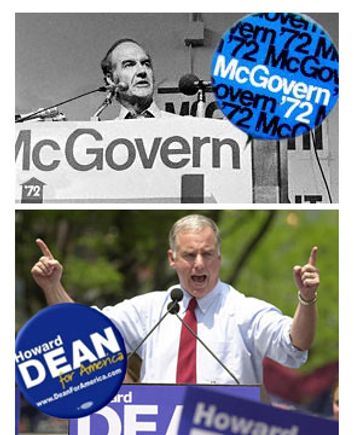
Dean’s detractors most often compare him to the 1972 Democratic nominee, George McGovern, who was routed by Richard Nixon in the general election. The comparison is apt in more ways than one. McGovern was the first Democrat to capture the imagination of the students who would become professionals and lead the social and cultural revolution of the past 30 years. He pioneered direct-mail fundraising. And many of the Democrats’ most innovative politicians and political consultants, including Gary Hart, Pat Caddell, and Bill and Hillary Clinton, got their start in the McGovern campaign. Dean enjoys this part of McGovern’s legacy. But he also, sadly, may suffer from the other side of McGovern’s legacy. Just as the country was not ready for McGovern in 1972, so it is probably not ready for Howard Dean in 2004.

Why the Republicans should be very afraid

Iraq and the "war on terror" may prevent the Democrats from seizing control of Congress, but long-term trends are all working against the GOP.

It’s now clear that the GOP peaked too soon. After a period from late August through early October when the Iraq debate was dominating headlines and preventing Democrats from gaining traction on domestic issues, momentum has now switched back to the Democrats. They appear to be in a good position to hold and possibly increase their margin in the Senate, and perhaps even take back the House, though Iraq and al-Qaida will probably protect the Republicans from losing Congress entirely. But the Democrats also stand to make substantial gains in the nation’s governorships — a little-noticed development that provides strong evidence of an unfolding political realignment.

Recent surveys illustrate how the terrain has shifted in the Democrats’ favor. The Gallup poll, for example, finds a sharp increase in negative feelings about the economy and a widening lead for the Democrats in dealing with economic conditions. And almost all polls have the economy as the No. 1 voting issue in this election.

It doesn’t stop there. The Democrats also have healthy leads on dealing with prescription drugs, healthcare, Social Security, education and the environment. Moreover, voters who say one of these issues is a key voting issue all tend to favor the Democrats for Congress. Voters who select the situation with Iraq as one of their top voting issues also favor the Democrats for Congress by a wide margin — defying the conventional belief that voters with strong feelings about Iraq tend to be hawks.

Of course, the outcome of the elections will be partly shaped by more general concerns about national security, which should help Republicans limit their losses. A projected low turnout, which favors Republicans, also could help the GOP. But the Democrats are still likely to make some important gains.

What ought to trouble Republican strategists is that these gains reflect a continuing sea change in the American electorate, one that points toward the emergence of a new Democratic majority. That majority is based in America’s most dynamic metropolitan areas and rooted in growing pro-Democratic constituencies such as professionals, women and minorities. The Democrats’ basic stance of support for necessary government spending and environmental protection, along with respect for diversity and women’s rights, is congenial to all these voters.

The fact is that the core Republican constituencies — white men, rural voters, small businessmen — are being slowly but surely overtaken by a Democratic coalition of women, minorities, service workers and a new class of college-educated professionals, one more concerned with social justice and less likely to reflexively vote by tax bracket than the old doctor-lawyer-executive elite. In the post-industrial age, demography favors Democrats: The numbers of “Reagan Democrats” — blue-collar workers who helped boost the GOP in key mid-Atlantic industrial states — are shrinking, while the new professional class and the service class, which both skew Democratic, are growing. Iraq and the war on terrorism can impede the Dems’ eventual triumph, but they can’t stop it.

This emerging majority can be seen most clearly in some of the governors’ races. In these, hopes and fears about national security and terrorism count much less than concerns about the economy and education. That should particularly favor Democrats, and there are good signs from the polls that it does.

Heading into the election, Republicans enjoy a 27 to 21 edge among governorships, with two Independents. Based on current polling data, Democrats are likely to gain six statehouses from the Republicans and it could easily be more. That means that after the election, Democrats should actually control the majority of governorships. Their biggest pickups should be in Midwestern and mid-Atlantic battleground states that have been governed recently by Republicans, including Pennsylvania, Michigan, Illinois and Wisconsin.

In Pennsylvania, Democrat and former Philadelphia mayor Ed Rendell, building on his dominance of Philadelphia and its fast-growing suburbs, is cruising to victory over Republican Mike Fisher. The socially moderate Rendell has also successfully reached out to the rest of the state with a message of economic revitalization and public school improvement. The combination has made him essentially unbeatable.

In Michigan, Democrat Jennifer Granholm is dominating her race against Republican Dick Posthumus. Granholm is just the kind of candidate who can appeal to women and professionals in upscale Detroit suburbs like Oakland County, even as she consolidates the Michigan Democrats’ traditional base among union households and blacks.

The Illinois race matches Republican Jim Ryan, a protégé of Gov. George Ryan, who decided not to seek a second term amid reports of corruption, against Democrat Rod Blagojevich. The association with ethical problems has obviously been one reason candidate Ryan has been consistently trailing Blagojevich. But another reason is that Illinois is such a strong Democratic state now that it is really just snapping back to its natural political configuration. Chicago and suburban Cook County cast about 40 percent of Illinois’ vote, and are so heavily Democratic that a Republican has to carry about two-thirds of the vote in the rest of the state just to be competitive. That’s a tall order and Jim Ryan isn’t the candidate to fill it.

In Wisconsin, the race between Democrat Jim Doyle and Republican Gov. Scott McCallum is tighter, but Doyle has been consistently ahead in the polls. He has been able to take advantage of Democrats’ strength in Milwaukee and fast-growing Dane County, home of the University of Wisconsin. A Democratic candidate who runs strong in these areas is hard to beat, provided he can reach out to the rest of the state, as Doyle has done with a message of fiscal responsibility and support for public education.

But signs of this new majority aren’t limited to the Democratic “blue” states of the 2000 election. Democrat Janet Napolitano is also favored to defeat Republican Matt Salmon in Barry Goldwater’s Arizona, which has slowly been turning Democratic under the impact of Hispanic, women and professional voters. In another intriguing indicator of change, Grant Woods, the co-chair of Salmon’s election campaign, is reported to be considering a party switch to the Democrats after the election. The reason? Woods has become increasingly upset by the Republicans’ lack of outreach to Hispanics and the conservative wing’s domination of the GOP’s agenda.

Or take Florida, where Democrat Bill McBride is locked in a tight contest with the president’s brother, Gov. Jeb Bush. McBride may not win, but if he does it will be because of the non-Cuban Hispanics and professionals who have flocked into South and much of Central Florida and helped deliver the state to Clinton in 1996 and (almost) to Al Gore in 2000.

Several of the hotly contested Senate races are also suggestive of this emerging majority. In Colorado, for example, the high-tech Denver-Boulder area has increasingly gone Democratic and could enable Democrat Tom Strickland to upset Republican incumbent Wayne Allard.

In New Hampshire, Democrat Jeanne Shaheen has an excellent chance of beating conservative Republican John Sununu. A key reason is the development of the Nashua-Portsmouth high-tech corridor, whose voters, like professionals elsewhere, are beginning to prefer moderate Democrats.

North Carolina’s race is tightening as Democrat Erskine Bowles tries to upset heavily favored Republican Elizabeth Dole. He’s trying to build on pro-Democratic trends in North Carolina’s most dynamic areas, the Research Triangle area around Raleigh and the Charlotte area in Mecklenberg County, which helped to elected North Carolina’s other senator, Democrat (and presidential hopeful) John Edwards. If he can generate enough support in these areas, he will win the election.

And if Ron Kirk beats John Cornyn in Texas, or even comes close, it will show that the burgeoning minority — particularly Hispanic — population is shifting the state Democratic. In the 1990s, Texas’ Hispanic population grew from 26 to 32 percent and is projected to continue to rise rapidly in the future. Combined with the 12 percent of Texas’ population that is black, it gives the Democrats a formidable and growing base in the president’s home state.

These contests show that, as America is changing — becoming a more diverse, post-industrial society - so are its politics. And those politics favor Democrats, not Republicans. Clear signs of this change started appearing in the early 1990s, as the Republicans began to suffer divisions within their ranks and the Democrats began to win elections. The Democrats’ new support has partly come from the return of some white working-class voters in the North who had deserted the party in the Reagan years; but it has chiefly come from the constituencies that loom so large in the races discussed above: professionals, women and minorities.

Professionals: Professionals are college-educated white-collar workers who produce ideas and services. They worry about the quality of their products and services, rather than simply whether it produces a profit, and tend to be socially liberal. They include doctors and nurses, software programmers, actors, teachers, engineers and fashion designers. In the 1950s, professionals made up about 7 percent of the working population, and were the most Republican of all the occupational groups. But as the American economy has changed — as the production of ideas or services has displaced the production of things — professionals have more than doubled to about 16 percent of the workforce. They are even more heavily represented among voters, comprising about a fifth of the national electorate and even more than that in some Northeastern and far Western states. And a majority of them have become Democrats. In the last four presidential elections, they backed Democrats over Republicans by an average of 52 to 40 percent.

Women: Women used to vote more Republican than men. But in 1964, a pro-Democratic gender gap first appeared; in 1980, it widened, and in subsequent elections, women not only voted more Democratic than men, but they began to vote Democratic in absolute terms. What made the difference was the entrance of women into the workforce and the Republican identification with the religious right’s view of women and the family. Democrats are particularly strong among working, single and highly educated women, all of whom are growing proportions of women voters.

Minorities: Blacks did not always support Democrats. As late as 1960, a Republican presidential candidate could get a third of the black vote. But after the Republicans nominated Barry Goldwater in 1964, blacks abandoned the Republicans, and now support Democrats by 9-1 margins. Hispanics — except for Cubans — Japanese-Americans and Filipinos had been Democrats since the New Deal and have remained so. But in the ’90s, Chinese-Americans, turned off by Republican opposition to immigration, also began voting Democratic. In 1972, the combined minority vote made up about 10 percent of the electorate. But in 2000, minorities made up almost a fifth of the vote and voted 75 percent Democratic overall. And by 2010, they could make up as much as a quarter of the electorate.

The support of professionals, women and minorities has transformed the Democratic electorate. The older New Deal Democrats used to be the party of Southern whites, urban ethnics and Midwestern blue-collar workers. Now the Democrats are the party of teachers, nurses and janitors.

But the change in the Democrats doesn’t end with its constituents. The New Deal Democrats used to be based primarily in the deep South and in the urban North; the new Democratic Party’s greatest strength is in post-industrial metropolitan areas, or “ideopolises.” These new communities were spawned by the transition to post-industrial capitalism. They specialize in the production of ideas and services. Their workforces are dominated by professionals and by lower-level service workers, many of whom are minorities.

Many older industrial cities like Los Angeles, Chicago and Philadelphia have become ideopolises. In 1983, Los Angeles had three times as many aerospace workers as workers in the movie industry. By 2000, the proportions were exactly reversed. Many of these areas, like Silicon Valley in California and Bergen County in New Jersey, used to be solidly Republican, but have become Democratic. They are concentrated in the Northeast, upper Midwest and Far West, but they are also found in North Carolina’s Research Triangle, Orlando’s entertainment and computer service complex, and in the Denver-Boulder area. In 2000, Gore won these areas of the country by 55 to 41 percent.

In that election, ideopolis counties accounted for 44 percent of the electorate. And they are growing much faster than the non-ideopolis counties in rural areas or in areas centered around towns like Muncie, Ind., or Charleston, W.V. Between 1990 and 2000, ideopolis counties grew by an average of over 22 percent, compared to 10 percent for the average non-ideopolis county. And they start from a larger population base — an average of 475,000 compared to 54,000 for the average non-ideopolis county. The Republicans may capture West Virginia, but the Democrats will likely have a firm hold not only on California, New York and Illinois, but also on Florida, Colorado and even, perhaps, Texas.

Democratic prospects could change, of course, if the U.S. goes to war — and if war and international turmoil last a decade, the Democratic majority could be put on hold. In the wake of Democratic divisions over the Vietnam War, voters came to see Republicans as the party of national security. Sept. 11 — and Bush’s initial success in uprooting the Taliban in Afghanistan — revived that perception and has contributed to Bush and the Republican Party’s popularity. Even now, the public’s preoccupation with national security will probably limit the Democrats’ gains in the 2002 elections. If turmoil were to continue and, especially, escalate, then the issues that favor Democrats would be of less importance, at least for a time.

In 1969, after all, Kevin Phillips predicted an “emerging Republican majority.” But Phillips couldn’t foresee that Watergate would delay the emergence of a Republican majority by six years. The same thing could happen in the coming decade. But, eventually, the party that best reflects the new post-industrial society of the 21st century should prevail. And at this point, that party is the Democrats.

Continue Reading Close

Burning Bush

Can John McCain possibly defeat the GOP's anointed candidate?

The real winner in New Hampshire Tuesday was Vice President Al Gore. He is going to have to battle former Sen. Bill Bradley through the March 14 Super Tuesday primaries, but he should be able to wrap up the nomination by then without having seriously damaged himself politically. If Bradley couldn’t win a non-union, all-white Northeastern state where independents can vote, he is going to have an impossible time in Southern states and in Northern states where union members and pro-Clinton minorities make up almost half of the primary electorate. So it’s goodbye, Bradley.

And what about Gore’s presumed opponent, Texas Gov. George W. Bush? Bush wanted to use some of his $70 million in campaign funds to start running general election ads in February. He wanted to be able to forget about Confederate flags, fetal tissue research and all the other bizarre obsessions of the Republican right, but after getting routed in New Hampshire, Bush will have to face Arizona Sen. John McCain and possibly also Steve Forbes and Alan Keyes through February and perhaps well into March. He should still win the nomination, but he will pay a price for victory.

Bush has already demonstrated serious weaknesses, and by March may have ruined his chances of beating Gore. In both the Iowa caucuses and the New Hampshire primary, Bush has had to rely on Republican regulars and right-wingers for his vote. He shows little sign of attracting any other voters. In Iowa, where none of his principal opponents had ever held any elective office, Bush got only 41 percent of the vote.

According to the election polling, he lost independent voters 41 to 29 percent to Forbes. He got only 33 percent of the vote among voters 18 to 29, and he lost decisively to Forbes among those voters who though the most important quality in a candidate was that he “stands up for beliefs,” “understands issues” or “cares about people.” Imagine! More people thought Forbes, the wealthy scion of a publishing empire and a veritable zombie on the stump, cared about them. That’s a big rebuke for a so-called “compassionate conservative” whose folksy charisma is supposed to be one of his strengths.

In New Hampshire, Bush’s results were equally telling. McCain obliterated him among independent voters (62 to 19 percent). The only groups among whom he bested McCain were those who described their ideology as “very conservative” and themselves as a member of the “religious right.” He also did almost as well as McCain among voters who supported Bob Dole in 1996. In other words, Bush showed strength only among old guard, religious right, and very conservative Republicans — a group that collectively constitutes at most a fifth of the general electorate and will win him Texas, Utah and a smattering of Depp South states in the general election.

McCain did spectacularly well in New Hampshire. He got more votes than the combined total of the two first finishers in 1996, Dole and Pat Buchanan. He got almost 40,000 more votes than Al Gore. If the two had been running against each other, McCain would have gotten 64 percent of the vote. Some conservative commentators like to attribute McCain’s appeal entirely to “character” or “biography.” McCain’s heroism does count for something, and is important as contrast with Bush’s callow background. When the two stand together, Bush’s credibility as a presidential candidate is immediately diminished.

But McCain’s heroic story is also integrally connected to his campaign promise to rid Washington of “special interests” and to convince Americans to look beyond their own “self-interest.” Most people who voted for McCain — or Bill Bradley for that matter — don’t know the details of the McCain-Feingold campaign finance bill, but they support the broader idea of political reform. In the exit polls, Republican voters backed campaign finance reform by 80 to 13 percent. Those who backed it went 56 to 26 percent for McCain, while those who opposed it favored Bush by 53 to 19 percent.

McCain also benefited by taking a centrist position on Social Security and taxes. Rather than promising to fritter away the surplus in tax cuts that would primarily benefit the wealthy, McCain called for a smaller, more progressive tax cut and for using part of the surplus to protect Medicare and Social Security. New Hampshire Republicans divided evenly on what was more important, cutting taxes or protecting Social Security, but those who cared about the latter went overwhelming for McCain.

As national polls have shown, McCain’s position on taxes and on campaign finance is far closer to the general electorate than Bush’s. Bush has positioned himself as the “conservative” candidate of the right, while McCain is nicely situated on the center-right. McCain could win the presidency running as he did in New Hampshire; Bush is in a position to replicate Dole’s finish against President Clinton in 1996. And the longer Bush conducts himself in this manner, the worse his chances of winning in November.

But can McCain win the nomination over Bush? McCain knows he cannot win a long war of attrition with Bush, so he hopes that by winning a string of primaries in New Hampshire and then South Carolina, Arizona and Michigan, and then embarrassing Bush in California on March 7, he can force Bush to withdraw from the race. It’s a strategy that depends on political trauma. The trouble with this strategy, however, is that Bush would have to withdraw in favor of McCain, and McCain is widely disliked among Republican politicians and officials because of his unstinting support for campaign-finance reform. If Bush were to suffer a string of defeats, his backers would continue to insist that he stay in the race, even if that meant fielding a weak candidate in the fall.

If Bush can stay on his feet past March 7, it is likely that he will gain the nomination. He has already raised about five times more money than McCain and will have an edge campaigning in states where most voters only get to see the candidates on television. He also has an enormous advantage in organization. All 31 Republican governors, including the governor of Arizona, back Bush, and have put their organizations at his disposal. (One of his disadvantages in Iowa and New Hampshire was that these states have Democratic governors.)

Money and organization are probably more important in the Republican than the Democratic race, because many of the largest Republican primaries are decided on a winner-take-all basis. On March 14, Bush is almost certain to win a total of 204 delegates in Texas and in Florida, where brother Jeb is the governor. That figure alone is 19 percent of the total Bush needs to win. If McCain loses California the week before, the race is virtually over.

McCain has virtually no organization outside of South Carolina, New Hampshire and Arizona. When I asked him about it, he mentioned some veterans groups in Michigan and Washington and former Reagan speechwriter Ken Khachigian in California. He also cited his Web site. That and $1.50 will get him a ride in the subway in New York, but not the Republican nomination.

McCain may not even be able to pull off the first step in his strategy by winning South Carolina on Feb. 19. He got a bounce from his New Hampshire victory: A Zogby poll released Thursday showed him virtually tied with Bush, just a point behind. But South Carolina’s Republican electorate is much more conservative than New Hampshire’s. One can compare the results of the exit polls in New Hampshire in 2000 with those in South Carolina’s Republican primary in 1996. In New Hampshire 16 percent of Republican primary voters said they were a member of the religious right. In South Carolina, 36 percent, and 59 percent said they had a “favorable opinion” of the religious right. Six percent in New Hampshire said abortion was the most important issue; 13 percent in South Carolina. Sixteen percent in New Hampshire identified themselves as “very conservative” compared to 25 percent in South Carolina.

The religious right is also far better organized in South Carolina, and the large organizations like the Christian Coalition and National Right to Life back Bush, largely because of McCain’s support for campaign-finance reform. Bush also has the support of the Republican Party establishment, Sen. Strom Thurmond and former Gov. Carroll Campbell, and they carry weight with Republican regulars. In New Hampshire, 41 percent of the Republican primary voters identified themselves as “independents,” compared to only 26 percent in South Carolina.

But McCain does have some arrows in his quiver. He is actively supported by the state’s most popular congressmen, Lindsay Graham and Mark Sanford. Graham is very well-liked because of the large part he played in Clinton’s impeachment. He is expected to challenge Campbell for the Senate when Thurmond steps down, and he is using McCain’s campaign to spread his name and message in the state. South Carolina has 400,000 veterans, whom McCain has tried to target in his campaign.

The state also has a growing number of suburban independents who work as sales agents, managers and information specialists in the new economy that is growing up around Columbia, Greenville and Charleston. These voters think like the political independents who backed McCain in New Hampshire. They value integrity, worry about the influence of special interests in Washington and are leery of the religious right. Together with veterans, they could make up a third or more of the electorate, and give McCain a chance of edging out Bush, particularly if Forbes and Keyes take votes on Bush’s right. But it’s a long shot, and McCain should probably be thinking of ways to keep his campaign going to California even if he loses in South Carolina.

Bush, on the other hand, has to worry not only about McCain, but about Al Gore. Gore has severe disabilities as a politician. He remains unsure of his public identity. He is now in the midst of an incarnation as a Democratic Jake LaMotta, a fighter for the people, which he conveys by using the verb “fight” or its cognates in every sentence. But Gore possesses a certain gravitas as a man and as a sitting vice president. He is fierce in debate, and has the nation’s prosperity on his side. And while he has occasionally tried to out-promise Bradley among Democratic constituency groups, he has still hewed carefully to the center.

As Bradley’s surge last week demonstrated, Gore is vulnerable for his role in administration campaign scandals and, more generally, for his reputation as the ultimate Washington insider. But Bush is not in a good position to exploit these weaknesses — because of who he is, and because he has ceded the issue of political reform to McCain. Is Bush, whose campaign contributors read as a who’s who of Washington’s K Street, going to hold himself up as an avatar of political virtue?

Last fall, Bush looked invulnerable. He had money, boyish charm and a cryptic message of compassionate conservatism that reassured anxious voters that he was not a tool of the Republican right or the House Republican leadership. Now, only two weeks into the actual nominating battle, he still has the most money, but his charm has transmogrified into a shallow immaturity (exemplified by the frat house smirk), and his politics, evidenced in his tax cut, have become far more conservative than compassionate. If Bush doesn’t reinvent himself quickly, Al Gore and the Democrats will enjoy another four years in the White House, and Bush will be stuck in Austin with his wife, twins and family dog.

Continue Reading Close
www.salon.com/writer/john_b_judis/index.html