Julia Wallace

You can never have too many mothers

Babies are what bring us together, according to sociobiologist Sarah Blaffer Hrdy, whose new book touts the importance of multiple caretakers.

  • more
    • All Share Services

You can never have too many mothers

For as long as she’s been a sociobiologist, Sarah Blaffer Hrdy has been playfully dismantling traditional notions of motherhood and gender relations. In 1981′s “The Woman That Never Evolved,” the newly minted Harvard Ph.D. blasted a hole in the dominant model of sexual selection, in which hypersexual males pull out all the stops to impress passive females. Despite the snickers of her male colleagues, Hrdy maintained that women are subject to sexual selection, too: Females apes, it turns out, frequently compete with each other for male attention, trick males into copulating with them, and engage in sexual activity for pure pleasure. Later, Hrdy’s monumental “Mother Nature,” published in 1999, thoroughly refuted the idea that there is any such thing as maternal instinct: Mothers in nature often abort fetuses, favor healthy babies while nudging runts away, and even commit infanticide so that they can try to breed again under better circumstances.

Now a professor emeritus at the University of California at Davis, Hrdy is back with another book, “Mothers and Others,” and another big idea. She argues that human cooperation is rooted not in war making, as sociobiologists have believed, but in baby making and baby-sitting. Hrdy’s conception of early human society is far different from the classic sociobiological view of a primeval nuclear family, with dad off hunting big game and mom tending the cave and the kids. Instead, Hrdy paints a picture of a cooperative breeding culture in which parenting duties were spread out across a network of friends and relatives. The effect on our development was profound.

Unlike ape mothers, who were fiercely protective of their little ones and rarely shared them with anyone, early human mothers needed help raising their uniquely high-maintenance babies. They found it in the form of what Hrdy calls “allomothers,” substitute caretakers of either sex who took over for a mother while she went to work scrounging up nuts and berries to feed her family. An allomother — anyone from a baby-mad 12-year-old girl to an altruistic great-aunt — would feed and comfort the child, sometimes even offering a breast. These mother’s helpers, Hrdy hypothesizes, undergirded human society. By forcing infants to solicit attention from a network of very different potential caretakers, those complex, community-wide nurseries spurred us to develop empathy, cooperation and what psychologists call “theory of mind,” an understanding that other people have feelings and beliefs that may be different from our own.

Hrdy spoke to Salon from her walnut farm in Northern California about what we have in common with marmosets, the evolutionary argument for grandmothers, and why no mom should ever go it alone.

Why did you decide to focus on cooperative breeding in this book?

In the course of writing “Mother Nature,” I realized there was no way that mothers in the Pleistocene could have reared their young without alloparental assistance. At that point, I had been working on the demographic implications of shared care, and how it meant that mothers could breed after shorter intervals and produce more young that were likely to survive. So I concluded that humans must have evolved as cooperative breeders. Although people had been thinking about various permutations of this hypothesis for a while — it started out as “mothers must have had help from their mates,” and then in the ’90s people started to say that it was help from siblings or grandmothers — “Mother Nature” was really the first book to come out and say it: We could not have evolved except as cooperative breeders.

And all of a sudden it became so obvious to me that this was how to think about Pleistocene family life. But then I started to think about another problem that was emerging, a real conundrum for sociobiology: How could humans be as other-regarding, altruistic and hypersocial as they are? It led me to say, “Whoa, could these hypersocial tendencies in humans be a byproduct of youngsters growing up having to depend on multiple caretakers, having to read their intentions, having to appeal to them?”

You offer an alternative hypothesis to one commonly cited reason for large-scale human cooperation — that we do it to make war with each other.

Yes, in the last couple of years, a particular idea to explain hypersociality has really risen to the top: that we became so cooperative because our ancestors were fighting all the time, and you needed to have in-group bonding to help fight out-group enemies. I actually don’t have a problem with the argument that an outside enemy makes people more loyal to their own group, that it increases ethnocentrism, that it makes people more interested in sacrificing for the group. Social psychologists have known that for a very long time, and Darwin talks about it in “The Descent of Man.”

My problem is that I don’t think this explains the origins of human hypersociality. If it did, we’d have to explain why chimpanzees, which also have lethal intergroup fighting, didn’t spend the last 7 million years developing hypersocial potentials to help them wipe out their neighbors. I don’t think this hypothesis helps you understand why the genus Homo became so different from the other apes. And the thing that is really different between humans and other apes is how we rear our offspring.

Another key point in your book is that many early human societies were not strictly patrilocal, as many scientists tend to assume. Instead, mothers often stayed close to their own kin, which allowed them to tap a large pool of willing allomothers.

Yes, I assume that the shift toward patrilocal residence patterns was fairly recent in human history — but remember that when I say fairly recent, I mean in the last 15,000 years. I know people are going to say that I’m a Pollyanna, that I’m denying how warlike and patrilocal humans have been. But I’m just saying that this was relatively late in history. It’s not that we weren’t potentially violent in the Pleistocene. It’s just that we had nothing that was worth fighting for. Even stealing women and fighting over them wasn’t very helpful if the groups that did were not going to be able to rear surviving offspring. Those groups were going to be at a disadvantage compared with the groups that got along with their in-laws and let them help raise the kids.

So I think being able to move bi-locally, moving to be with mother’s kin or father’s kin depending on where the resources were (including alloparental caretaking resources) was initially a big advantage. But at the end of the Pleistocene, lots of things started to happen at around the same time. You had a shift from mobile bands of hunter-gatherers to more complex bands of hunter-gatherers: larger, more sedentary, more stratified. Populations were starting to build up. And with the Neolithic, about 12,000 years ago, you get herding, domesticated animals, horticulture, agriculture. This led to massive increases in population. People had territory and livestock and stored food that they needed to protect, and of course, once you have property to fight over, you get a more patrilocal system. But I’m assuming that was relatively late in human history.

Where did the term “alloparent” to refer to the mother’s helpers come from?

I was one of the first people back in the ’70s to write about the importance of conspecifics — members of the same species other than the mothers — rearing offspring, but at the time I was using the very technical primatological term “aunties and uncles.” And I was writing a paper in a seminar for Edward O. Wilson, and he said, “You know, Sarah, this won’t do.” And so it was actually Wilson who coined the term “alloparent,” because he felt we needed something a little more dignified than calling them “monkey aunts and uncles.”

You see grandmothers as allomothers who are particularly crucial to children’s survival.

Kristen Hawkes really developed this theory in a paper she wrote called “Hardworking Hadza Grandmothers.” She found that these old hunter-gatherer women were working much more efficiently and single-mindedly at collecting berries and nuts than any other women. And there are photographs in my book of langur grandmothers and great aunts just taking tremendous risk to defend infants from aggressive males, which suggests that in some social systems, these older females have a strongly altruistic intent. The hypothesis is that selection pressure for human females to go on living for so long after menopause is because of the special help and provisions that these old women could provide to younger kin, their younger daughters and nieces who were still reproducing.

It turns out that humans and marmosets have a lot in common, breeding-wise.

Yes, they’re the only primates to engage in full-fledged cooperative breeding. I use this phrase because I want to separate out the species in which alloparents were actually providing significant food to children, in which they would actually come and volunteer this food. And it’s so impressive, because … well, if you want to get your hand bitten, try to take food away from an animal. Animals do not typically go around giving food to others, especially not somebody else’s offspring. And marmosets, they’re bringing the best food items — protein-packed lizards and little frogs that are costly to catch, very important pieces of protein — to unrelated babies.

What about what you call the “dark side” of cooperative breeding?

In other primates there has to be something really, really wrong for a mother to abandon her child. Even if her baby is dead, she’ll carry it for days. But in humans, abandonment of children after birth is actually fairly common across all societies when mothers don’t have access to birth control and when they don’t have access to allomaternal care. They bail out right after birth, in the first 72 or so hours, and the only other primates that do this, again, are marmosets and tamarins, who are also cooperative breeders sensitive to social support.

Your experiences in the field of anthropology have obviously had a strong impact on you, not just personally but also in the kind of research you have chosen to do, starting with your struggles early on to get more attention paid to sexual selection in women. Do you see yourself as a feminist scientist?

My definition of a feminist is someone who believes in equal opportunity for both sexes — or, in a scientific context, paying equal attention to both sexes. When I first started out in biology, the explanatory paradigms were so male-focused that in order to do better science, I had to become a feminist. Early evolutionary theory was totally male-centered, but you can’t understand what males are doing without also understanding the selection pressures on females, just as you can’t understand females without understanding males.

The first scientists to study motherhood were all men, and they had a big stake in what they saw as the all-encompassing charity of women, the belief that women would just give their lives to their children wholeheartedly. As a young scientist, I went to India to find out why males in one species of monkeys were committing infanticide. I started with the hypothesis — this is what people thought at the time — that this was a response to population density, that it was a pathological behavior caused by animals’ response to overcrowding.

I discovered that this was wrong and that this was an adaptive strategy for males entering the breeding group from outside, that it was their way of increasing their own opportunity to breed. I could empathize with these female langurs: Here they were, and every 27 months or so, a male would enter the breeding group and try to kill her infant. So of course I started to think: What have the selection pressures on these females been, and what were their strategies for coping with infanticide? And that just opened up a whole new area of study for me. But I’m not rejecting Darwinian theory. I’m trying to expand it.

Your book is called “Mothers and Others,” but you also discuss fatherhood quite a bit.

Absolutely — fathers are the critical “others.” Because I am identified with feminism to a certain extent, people who don’t read my book assume that I’m dissing fathers. But fathers are tremendously important. The thing about fathers isn’t that they don’t have a lot to contribute but how conditional their paternal investment is. They might not be willing or able to invest because they don’t earn a good salary or they didn’t have a good day hunting. It’s funny to compare humans to, say, titi monkeys, where fathers are so important that mothers can’t actually rear children without them, and the father’s top priority in the whole world is to be near his offspring. Given how much help human mothers need, it’s kind of a paradox that human fathers aren’t so automatically caring. And I think the reason they’re not is because we evolved as cooperative breeders, so even if a father dies or defects or has bad luck hunting, mothers can rely on alloparents for help.

What are a few concrete recommendations you can offer out of the huge amount of anthropological research contained in your book? How can we harness the power of alloparents to improve outcomes for real-life children?

You know, Publishers Weekly did a summary of “Mothers and Others,” and I was irritated because they said I was rejecting the idea of the mother’s importance. But I’m not.

What I’m saying is that human mothers are unusual in how much support they need. I’m also trying to expand the concept of what children need to include other people as well as mothers. Mothers need a lot of social support, and having more than one caretaker is very, very useful. When parents are getting divorced and the father and the mother are fighting over custody, that’s so selfish. There’s no way a child can really have too many allomothers. Even if the mother is mad at the father, she should want him involved. Children develop best in secure social environments, and security includes turning to lots of different people and knowing they are there for you. And since daycare is here to stay, we need to think a lot harder about how to make it better by incorporating attachment theory, making it small-scale and having consistent and responsive caretakers. But these aren’t brilliant points. These are just obvious.

“Why do these men want to coach little girls?”

Former national champ Jennifer Sey exposes the anorexia and sexual and mental abuse that are rampant in elite women's gymnastics.

  • more
    • All Share Services

In the years between Mary Lou Retton’s historic victory at the 1984 Olympics and Kim Zmeskal’s dominance in the early 1990s, American gymnastics was in a bad way. Most of our gymnasts lacked the finesse of their counterparts in Eastern Bloc states like Russia and Romania, where children were plucked from their homes almost as soon as they could walk, and U.S. coaches struggled to produce another breakout star. Jennifer Sey was one of their best hopes.

At 15, Sey left her New Jersey home for the Parkettes National Gymnastic Training Center in Allentown, Pa., where she boarded alone in an unheated room in exchange for a chance to become a champion. Under the tutelage of Bill and Donna Strauss, a husband-and-wife coaching team notorious for producing winners by any means necessary, she accomplished just that — nabbing the U.S. National title in 1986. But Sey was never quite talented or powerful enough to be hailed as the second coming of Retton and eventually, burned out by the pressure to stay skinny and the pain of competing on barely healed broken bones, she retired.

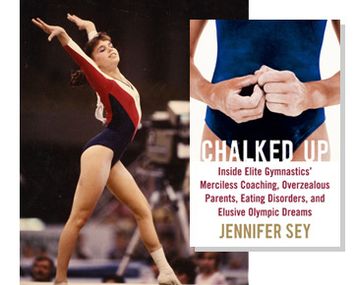
In her new memoir, “Chalked Up,” Sey recounts the casual brutality of the sport to which she devoted her childhood. There was the coach who hurled a folding chair at a girl who couldn’t perform a difficult maneuver on the uneven bars, and the one who used the gym’s loudspeaker to humiliate a 10-year-old for gaining one pound. Sey herself spent the last few years of her career on a fruit and laxative diet, working out for eight hours a day while recovering from a series of increasingly nasty injuries, including a clean break of the femur, the strongest bone in the body. Eating disorders were rampant in the sport, and physical and sexual abuse not uncommon, despite — or perhaps because of — the fact that women’s gymnastics is dominated by little girls.

Sey spoke with Salon by phone from her home in San Francisco.

What struck me when reading your book was how incredibly hard it is to protect young gymnasts when there are so many incentives for coaches and other adults not to act in the kids’ best interests.

I think this is tied to our culture as a whole and how we prioritize winning over everything else. That’s why you see steroid use. It’s even related to corporate malfeasance — winning is the most important thing, so the ends justify the means. The problem is exacerbated in gymnastics, because the girls are so young that they’re ripe to be taken advantage of. It doesn’t happen all the time — I was just writing about what my experience has been — but it is a powder keg of circumstances.

Is it possible that you were just the victim of rogue coaches? I know the Parkettes Training Center has a particularly bad reputation — it was even the subject of an unflattering CNN documentary in 2003.

[This behavior] is endemic to the sport. I think my coaches employed some tactics in my training that were pretty tough to take, pretty aggressive and harsh. They were known at the time for being incredibly tough on us about our weight, which I think has been tempered over the years. But I wouldn’t want to make any sort of judgment that they’re better or worse than anyone else. I think their perspective is, “You come to us to become champions, and this is what will be required.”

Were they actively encouraging you to develop an eating disorder?

Yes, absolutely. I don’t think they would say, “Go throw up,” or “We want you to be anorexic,” but the fact is that they were asking us to do things that were impossible without engaging in behaviors that were dangerous. People weren’t quite as sophisticated in their understanding of eating disorders then as they are now, so I don’t know if they understood that there were long-term psychological and physical effects.

Back in the early ’90s, Christy Henrich, whom I competed with, died from anorexia. She’d been told that she wasn’t a viable athlete at the weight she was competing at, and she proceeded to whittle herself down to about 55 pounds. There was sort of an outcry, and the sport came under scrutiny for that, and there has been a shift, which is great. I also think the skills [today] are so incredibly difficult that they require a lot of power, and that has prompted a change. The sport can be a bit trendy, and certain body types come in and out — I hope this one sticks, but we’ll see.

I’m fascinated by what made your coaches Bill and Donna Strauss tick — you portray them as so nasty to the young girls in their care, and so oblivious to their mental and physical health. Does it bother you that they’re still coaching kids?

I was willing to take [the abuse] because I wanted to win. So I don’t actually have a problem with them coaching. What I would like is for the methods they employ around weight to be modified — that wreaks havoc on young girls. I would like for there to be some guidelines for no training while you’re injured. I called [the Strausses] out because they were my coaches, but I don’t think they are so different from others who coach at the highest levels today. What made them tick was that they wanted girls who won, they wanted their club to be the best, and that clouded their vision.

You portray the Parkettes team doctor, Dr. Dixon, as something of a charlatan, a man who deferred to your coaches about medical decisions and sent you back to the gym to train with a concussion in one instance, a freshly broken ankle in another.

The way he would probably present himself is that he aided you in getting back to your goal. It’s easy to look back and say that as a doctor, he should have had my physical and mental health at heart, but he saw my best interests as getting me back into the gym so I could compete and win. I think that most orthopods and specialists who treat high-level athletes are probably very similar. If you talk to the doctor for the San Francisco 49ers, they probably send people into play who aren’t 100 percent. What made the situation unique is that we were children.

In one scene, you describe the indignity of getting bawled out about your weight by the National Team coach, Don Peters, when you were actually extremely tiny and suffering from an eating disorder. But in the same passage, you describe two fellow gymnasts, Pam and Yolande, as “lumber[ing],” “lumpy” and “elephantine.”

The fact is, when you have an eating disorder, you don’t see things clearly — body dysmorphia is part of the disorder. I thought of myself as not nearly as thin as I would’ve liked to be, and I saw other people in an unclear way as well. What I was trying to do is put you into the mind-set I was experiencing at the time. I looked at those girls, and I thought they were bigger than me. They weren’t big, but I was 16 years old, and I didn’t see my body clearly. I didn’t have the luxury of any kind of objectivity. I saw them as heavy, because the accepted aesthetic was thinner.

Do you still see that?

No! I’ve seen pictures since, and I think it’s horrendous that I could’ve thought that. But if I recall, I did indicate that a girl was elephantine within the sport of gymnastics, within that world. Yolande was heavy — she was 10, 15 pounds heavier than the average girl who competed at that level. I don’t think I was casting aspersions so much as providing context.

Throughout the book, you make elliptical references to male coaches who are attracted to young girls and imply that your own personal coach, John, was one of them. What did you mean when you said that he was “lewd and lascivious” and “may have liked being near all the barely dressed teens, but … never explicitly let on”?

He was never inappropriate with us, but he was a really flirty guy, and we all saw that. And sometimes the women he flirted with were very close to our age — 18, 19 years old, and we were 15 or 16. There were a lot of things he did that made me feel weird — he was a weird guy. The conditions of the sport are strange, and that was what I was trying to say. Most men that coach women gymnasts have never been gymnasts themselves. So I always wondered, even as a child: Why do these men want to coach little girls? In some instances, it’s purely financial. But I think in the minority of cases, there are men who are interested in little girls.

You repeat a rumor that Don Peters had a sexual relationship with a young gymnast in his care. That’s a pretty explosive charge — do you have any evidence for it?

I was trying to point to what our mind-set was, what it was like for us. We understood that there was a strong likelihood that there was an impropriety there. Whether or not it was true was kind of beside the point. We lived in an environment where there was some illicit behavior suspected, and none of the adults would intervene. Nobody cared enough about her to dig into it. Whether it was true or not, somebody should have said something, somebody should have done something, somebody should have asked.

Do you think it was true?

I don’t think it’s pertinent to the story I was trying to tell.

What if Don reads the book and feels that you are libeling him?

I’m sure he will read the book — I think most coaches will. It was a hot rumor, and I was trying to explain the conditions we were working under, so I don’t have a problem if he reads it. My intent has never been to write an exposé about all the tawdry things that happen in gymnastics, just to explain what it was like for me and for girls like me.

But it will be functioning as an exposé …

Absolutely, I understand that’s how people will read it.

What kind of reaction are you anticipating from coaches and others in the gymnastics community?

For people who love gymnastics, who want to see it thrive, I think they’ll say, “Yes, this exposes a dark side to our sport, but we have practices and regulations in place to try to overcome some of these things.” I think that people who feel defensive about it will be very angry. The Strausses, who have an advance copy, are already quite defensive about it. But this is what happened to me. I’m not trying to bring them down, and I’m not trying to bring their gym down. But all coaches have an obligation to realize that they’re not just raising champions, they’re raising young women. Hopefully they’ll maybe think twice about some of the practices they might employ. I love the sport — I don’t want the sport to go down. I just want people to think differently.

Continue Reading Close

The losers’ circle

From munching parties to Slim-Fast to Atkins, we've spent centuries trying to lose weight -- despite all the evidence that diets don't work.

  • more
    • All Share Services

The losers' circle

William Banting might be the most important 19th-century London coffin-maker that nobody’s ever heard of. In 1862, he was a mess: sick, unhappy and so fat that he had to heave his way downstairs facing backward. He could not tie his shoes without the aid of boot hooks. He tried everything to shed the weight: taking “the waters and climate of Leamington many times,” consulting the best doctors in England (including one who, cryptically, tried to “blister” his ears), and even vigorously rowing “a good, heavy, safe boat” for two hours a day. But he could never manage to lose more than 6 pounds. Finally, desperate, he found a doctor who advised him to abstain from foods containing starch or “saccharine matter”: bread, butter, milk, sugar, beer and potatoes.

After a year on this proto-Atkins diet, Banting had reduced his weight to 156 pounds. He was so delighted with himself that he wrote and published a pamphlet on his methods, declaring that “I hold the reins of health and comfort in my own hands … It is simply miraculous.” His “Letter on Corpulence, Addressed to the Public” was snatched up by readers eager to find their own miracle, and for the next 50 years or so, “banting” actually became a household word for dieting.

Banting’s diet was certainly not the first — people restricted food intake for cosmetic reasons even in Ancient Greece — but his success, and his success in promoting his success, opened the door for a stream of diet gurus who are still passing through: Sylvester Graham, inventor of the eponymous cracker (acolytes lost so much weight on the Graham diet that they resembled “mummies preserved in saffron,” according to one contemporary account); John Harvey Kellogg, inventor of the eponymous cornflake (he was also a proponent of cold rain douches, and yogurt enemas); and best of all, Horace Fletcher, who was known as the Great Masticator for his theory that all food — even milk — should be chewed at least 32 times. “Fletcherism” was the South Beach Diet of the 1890s — celebrity adherents like Upton Sinclair, Henry James and John D. Rockefeller helped spread the gospel. Ten years later, Fletcher Clubs had popped up throughout the country, while in England, enthusiasts organized “munching parties,” during which each mouthful of food had to be chewed for five minutes.

This all sounds grotesque to modern ears — certainly unscientific, possibly harmful — but if we tweak the details, the story could easily be our own. Early 20th-century remedies like Marjorie Hamilton’s Quadruple Combination System of Fat Reduction and Elfin Fat Reducing Gum Drops have given way to Nutrasweet and Fen-phen, but we’re still desperate to get the weight off by any means possible, even in the face of overwhelming evidence that it’s not possible to keep it off. The proliferation of fad diets, from low-fat to low-carb to grapefruit, is Exhibit A: We’ve tried everything, and nothing works. We’ve tried everything because nothing works.

In “Rethinking Thin,” Gina Kolata attempts with some success to provide a comprehensive history of the diet, a survey of 20th-century weight-loss research, and a personal saga of several determined dieters enrolled in a University of Pennsylvania study on weight loss. But the history, though fascinating, is slipshod and deplorably organized, and the Penn dieters might as well have been left out of the book: Kolata’s pale, clinical prose makes her effort to characterize these men and women feel perfunctory. At times, she seems to be going out of her way to highlight the most inane possible quotes from their counseling sessions.

Kolata, a New York Times science writer with an advanced degree in mathematics, is at heart a technician; she obviously loves to pick apart the clockwork of scientific studies, but she’s not so keen on interpreting them, on explaining what these results might mean in the context of American society. The book is also badly in need of a good editing; to resort to the inevitable metaphor, it’s distractingly flabby.

That’s too bad, because if Kolata’s ideas were more developed and polished, this would be a very important book. Even so, she manages to map out the strange disconnect in 20th-century America between our rapidly increasing social and commercial commitment to weight loss, and the rapidly increasing number of scientists who were discovering that it just didn’t work.

The first of these was Jules Hirsch, a researcher at the Rockefeller Institute in the ’50s, who noticed that the fat cells of the obese were bigger and more numerous than those of their thin counterparts. When he put a group of overweight people on a hardcore, Slim-Fast-style liquid diet, their fat cells shrunk, but the number of cells stayed the same, and the weight they had lost so painstakingly piled right back on as soon as they started eating real food again. Hirsch and his colleagues were shocked at the failure of such a sustained and scientific effort to make fat people thin — there was no “cheating” here, no lack of commitment — and they tried again and again. The result was the same every time: The subjects regained the weight; their metabolisms slowed by almost 25 percent until they did. It was as if their shrunken adipose tissue was desperate to restore itself. The conclusion of the Rockefeller paper? “It is entirely possible that weight reduction, instead of resulting in a normal state for obese patients, results in an abnormal state resembling that of starved non-obese individuals.”

In fact most of the subjects, reduced to “healthier” weights, were acting disturbingly similar to a group of young men enrolled in the famous University of Minnesota “starvation study,” in which they were asked to lose a quarter of their weight, just to see what would happen. (One of the charms of this book is seeing how few of these classic experiments would be deemed ethical today.) The men promptly fell to pieces, hoarding food and kitchenware; becoming obsessed with recipes, cookbooks and dietetics bulletins; and neglecting their non-food relationships. One man complained that “If [my girlfriend and I] see a show, the most interesting part of it is contained in scenes where people are eating.” (Could the recent rise of an obsessive national food culture, complete with celebrity chefs, pornographic cookbooks and an all-food-all-the-time TV channel, be attributed to the fact that we are collectively starving?)

A number of subsequent studies also suggest that weight is genetic and cannot be dieted away for long. A group of 540 adopted children in Denmark were found to be, with few exceptions, as fat or thin as their biological parents, no matter what they were fed, no matter how much they exercised. And a mathematical analysis of Swedish twins (apparently Scandinavian governments keep great records) found that 70 percent of body weight is genetic, which means that, as Kolata memorably puts it, “a tendency toward a certain weight is more strongly inherited than nearly any other tendency, including those that favor the development of mental illness, breast cancer, or heart disease.” It’s not surprising, then, that when a curious scientist decided to reverse the Rockefeller study by asking a group of skinny prisoners to gain weight in the name of science (again, just to see what would happen), the men struggled mightily; even shoveling in fatty foods at the rate of 10,000 calories a day barely produced an effect, and they lost the weight as soon as they quit the regimen.

So why haven’t Americans gotten the picture? Kolata blames the diet industry and public health officials: Their financial interest in keeping people fat and dieting has caused them to whip us into a “moral panic” over obesity. She doesn’t delve very far into the topic, but it’s a fascinating one: Why do we still cling to a twisted Puritanism that equates slimness with virtue? Why do dieters who “cheat” with some extra chocolate tell themselves, “I’ve been bad today”? Why do we weigh kids in gym class and plaster their BMIs on their report cards? Why do we continue to read and write vicious editorials like this one that suggests people should be charged for airplane seats by weight?

At the same time, it’s unequivocally true that more Americans are becoming obese (the most recent statistics put the figure at 65 percent), and one important question that “Rethinking Thin” does not address is how we can balance our response to anti-fat hysteria with our responsibility to ensure that all Americans have the information and the ability to maintain a weight that is healthy for them. Perhaps personal health shouldn’t be a moral issue, but it is, partly because the poorest Americans are disproportionately the fattest. Kolata is quick to discount the effect of environmental factors on obesity, pointing out that low-income kids enrolled in a school program about healthy eating didn’t lose much weight. When the program’s creator suggests that it failed because it couldn’t address larger issues within the community, Kolata turns up her nose, comparing him to a 19th-century scientist trying to justify bleeding patients with leeches.

But eating fruits and vegetables isn’t bloodletting, and getting regular exercise is sound advice, not quackery. Perhaps the way out of this muddle is to create a verbal distinction between fatness — a physical trait — and obesity — a health problem. A fat, active person is almost always healthier than a skinny sloth, and, as several scientists point out in the pages of “Rethinking Thin,” there is no evidence that a healthy adult who happens to be fat needs to diet just for the sake of losing weight. In fact, the most comprehensive study of weight and mortality ever conducted has found that overweight people die at lower rates than either “normal” or superthin people.

Meanwhile, like Kolata’s Penn dieters, we struggle on in spite of the evidence, banting, holding our breath.

Continue Reading Close