Kim Gamel
Libyans want answers over deadly NATO airstrikes
FILE - In a June 19, 2011, file photo made on a government-organized tour, Libyan doctors stand near bodies of a man and a baby found in the damaged residential building in Tripoli, Libya's, outskirts. Human Rights Watch is calling on NATO to provide compensation for Libyans who lost loved ones or had property damaged in airstrikes during the bombing campaign that helped rebels oust former leader Moammar Gadhafi. (AP Photo/Ivan Sekretarev, File)(Credit: AP) TRIPOLI, Libya (AP) — Mohammed al-Gherari lost five family members, including a young niece and nephew, when NATO accidentally struck their compound in the Libyan capital as they slept.
Nearly a year later, his grief is compounded by threats and allegations from neighbors who believe he and others who survived the attack were harboring a regime loyalist or hiding weapons for Moammar Gadhafi’s forces.
At least 72 civilians, a third of them under the age of 18, were killed by NATO airstrikes, according to a report released Monday by Human Rights Watch — one of the most extensive investigations into the issue. The New York-based advocacy group called on the Western alliance to acknowledge the casualties and compensate survivors.
The decision by the United States and its NATO allies to launch an air campaign that mainly targeted regime forces and military infrastructure marked a turning point in Libya’s civil war, giving rebels a fighting chance. But Gadhafi’s government and allies in Russia and China criticized the alliance for going beyond its U.N. mandate to protect civilians.
The number of Libyans killed or injured in airstrikes also emerged as a key issue in the war as Gadhafi’s regime frequently exaggerated figures and NATO refused to comment on most claims, insisting all targets were military.
At one point, Libya’s Health Ministry said 856 civilians had been killed in NATO’s campaign, which began in March 2011, weeks after the uprising against Gadhafi that erupted with peaceful protests evolved into a civil war.
The U.N.-appointed International Commission of Inquiry on Libya said earlier this year that at least 60 civilians had been unintentionally killed and recommended further investigation.
Based on investigations conducted in Libya from August 2011 through this April, Human Rights Watch established that 28 men, 20 women and 24 children had been killed in eight NATO bombings in Tripoli, Zlitan, Sorman, Bani Walid, Gurdabiya and Gadhafi’s hometown of Sirte.
The advocacy group acknowledged the figure was relatively low considering the extent of the seven-month campaign, which the alliance has said included 9,600 strike missions and destroyed about 5,900 military targets. It ended after Gadhafi’s death in late October.
The group said it had documented several cases in which there clearly was no military target and criticized NATO for failing to acknowledge the deaths or to examine how and why they occurred.
In Brussels, NATO said it had carried out the bombing campaign with “unprecedented care and precision” and had fulfilled the requirements of international humanitarian law.
“NATO did everything possible to minimize risks to civilians, but in a complex military campaign, that risk can never be zero,” spokeswoman Oana Lungescu said Monday. “We deeply regret any instance of civilian casualties for which NATO may have been responsible.”
She said the alliance had looked into each allegation of civilian casualties.
“We have reviewed all the information we hold as an organization and confirmed that the specific targets struck by NATO were legitimate military targets,” Lungescu said.
The alliance did not have troops on the ground during or after the conflict who could have independently checked the results of its airstrikes.
HRW recommended that NATO make public information about the intended military targets in cases where civilians were wounded or killed and provide “prompt and appropriate compensation” to families who suffered from the attacks.
The strike against al-Gherari’s compound on June 19, 2011, was a rare case in which the Brussels-based alliance admitted it had made a mistake. “It appears that one weapon did not strike the intended target and that there may have been a weapons system failure which may have caused a number of civilian casualties,” it said in a statement.
The Libyan government rushed a group of foreign journalists based in Tripoli to the site, eager to use the deaths as propaganda against the West. Children’s toys, teacups and dust-covered mattresses could be seen amid the rubble, and the journalists were shown the bodies of at least four people said to have been killed in the strike, including the two young children.
Al-Gherari said government officials disappeared shortly after the fanfare ended and the family received no compensation or financial assistance from either side. Meanwhile the NATO acknowledgment, which did not provide details, failed to satisfy neighbors who continued to accuse the family of harboring a regime figure.
“I want NATO to present a full explanation that the reason was a mistake because we’re still facing accusations that Gadhafi or a higher regime figure was there and that’s why our house was targeted,” he said in an interview with The Associated Press.
He said five people were killed, including his 2-year-old nephew and a 7-month-old niece.
Human Rights Watch said it visited the site in the Souk el-Juma neighborhood in August and December and “did not see any evidence of military activity such as weapons, ammunition or communications equipment.” It also said satellite imagery showed no signs of military activity at the home.
The deadliest attack recorded by the rights group was in the rural village of Majer, south of the former rebel stronghold of Zlitan.
The first bomb hit a large, two-story house owned by Ali Hamid Gafez, a 61-year-old farmer. It was crowded with people who had fled the fighting in nearby areas. That was followed by three more bombs that killed 34 people killed, including many who had rushed to the site to help after the earlier explosions.
Human Rights Watch said it visited the area the day after the Aug. 8, 2011, strikes and found no evidence of military activity, although it did find one military-style shirt in the rubble.
“I’m wondering why they did this, why just our houses,” one of the residents, Muammar al-Jarud, was quoted as saying in the report. “We’d accept it if we had tanks or military vehicles around, but we were completely civilians and you can’t just hit civilians.”
___
Gamel reported from Cairo. Associated Press writer Slobodan Lekic contributed to this report from Brussels.
Gadhafi’s burial delayed for further investigation
U.N. human rights office asks for more details about circumstances of strongman's death
A man holds a photo said to be the body of Moammar Gadhafi after announcement of the former leader's death in Tripoli, Libya, Thursday, Oct. 20, 2011. (Credit: AP/Abdel Magid al-Fergany) TRIPOLI, Libya (AP) — The burial of slain leader Moammar Gadhafi has been delayed until the circumstances of his death can be further examined and a decision is made about where to bury the body, Libyan officials said Friday, as the U.N. human rights office called for an investigation into his death.
The transitional leadership had said it would bury the dictator Friday in accordance with Islamic tradition. Bloody images of Gadhafi’s last moments in the hands of angry captors have raised questions over his treatment minutes before his death. One son, Muatassim, was also killed but the fate of Gadhafi’s one-time heir apparent Seif al-Islam was unclear.
Continue Reading CloseGadhafi is dead
The Libyan dictator was killed when revolutionary forces attacked his hometown of Sirte
FILE - In this Saturday, Oct. 9, 2010 file photo, Libyan leader Moammar Gadhafi chairs the Arab summit in Sirte, Libya. The Associated Press is aware of reports that Moammar Gadhafi has been captured in Sirte. The chief spokesman for the revolutionary National Transitional Council Jalal el-Gallal and the council military spokesman Abdul-Rahman Busin tell the AP that those reports are unconfirmed. (AP Photo/Amr Nabil, File) (Credit: AP) SIRTE, Libya (AP) — Moammar Gadhafi, who ruled Libya with a dictatorial grip for 42 years until he was ousted by his own people in an uprising that turned into a bloody civil war, was killed Thursday when revolutionary forces overwhelmed his hometown, Sirte, the last major bastion of resistance two months after his regime fell.
The 69-year-old Gadhafi is the first leader to be killed in the Arab Spring wave of popular uprisings that swept the Midde East, demanding the end of autocratic rulers and greater democracy. Gadhafi had been one of the world’s most mercurial leaders, dominating Libya with a regime that often seemed run by his whims and bringing international condemnation and isolation on his country for years.
Continue Reading CloseU.S. wasted billions in rebuilding Iraq
Watchdog agency says more than $5 billion of taxpayer funds have been used on abandoned or incomplete projects
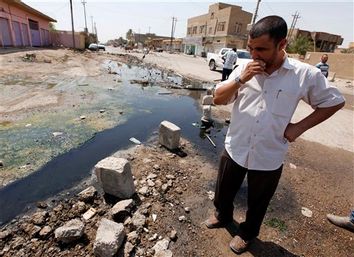
In this Sunday, Aug. 15, 2010 photo, a man stands in a sewage-filled street in Fallujah, Iraq, 40 miles (65 kilometers) west of Baghdad. The Fallujah waste water treatment system is almost finished _ at a cost of more than three times the original estimate and four years past the initial deadline. The sewage facility is among hundreds of projects funded by U.S. taxpayers that remain abandoned or incomplete, wasting more than $5 billion, according to auditors. (AP Photo/Hadi Mizban)(Credit: AP) A $40 million prison sits in the desert north of Baghdad, empty. A $165 million children’s hospital goes unused in the south. A $100 million waste water treatment system in Fallujah has cost three times more than projected, yet sewage still runs through the streets.
As the U.S. draws down in Iraq, it is leaving behind hundreds of abandoned or incomplete projects. More than $5 billion in U.S. taxpayer funds has been wasted on these projects — more than 10 percent of the $53.7 billion the US has spent on reconstruction in Iraq, according to audits from a U.S. watchdog agency.
Continue Reading CloseU.S. troops kill Afghan cleric
Despite recent efforts to decrease civilian casualties, American forces kill cleric driving with his son
U.S. soldiers shot and killed an Afghan cleric as he drove Thursday with his young son near an American base on the eastern edge of Kabul, underscoring the dangers facing civilians despite NATO efforts to minimize casualties.
The shooting occurred as Mohammad Yunus, 36, approached a four-lane highway with one of his sons, according to police and witnesses.
Yunus was struck by four bullets fired at his Toyota Corolla and died on the way to the Wazir Akbar Hospital, according to his son-in-law, Abdul Qadir. His son was not injured. Yunus left two wives and 10 children, Abdul-Qadir said.
Continue Reading CloseBrain researchers share Nobel Prize in medicine
A Swede and two U.S. researchers won the Nobel Prize in medicine Monday for discoveries about how messages are transmitted between brain cells, work that has paid off for treating Parkinson’s disease and depression.
Arvid Carlsson, Paul Greengard and Eric Kandel will share $915,000 prize for their pioneering discoveries concerning one way brain cells send messages to each other, called “slow synaptic transmission.”
These discoveries have been crucial for understanding how the brain normally works. In addition, the work laid the groundwork for developing the standard treatment for Parkinson’s disease and contributed to the development of a class of antidepressants that includes Prozac, the Nobel Assembly at Karolinska Institute said.
Continue Reading Close