Mark Follman

McCain advisor: Obama crowds just as ugly

Confronted about the rage at recent McCain rallies, Steve Schmidt cites vicious cries at Obama events — but no one seems to have heard about them.

“We’re proud of the campaign we’ve run, it’s been a positive campaign.”

These were the words of Steve Schmidt, who is chief operating officer for the McCain campaign, in an interview on NPR’s “Morning Edition” Monday. Asked about the vicious exclamations against Barack Obama by frenzied crowd members at McCain-Palin campaign rallies over the last week, Schmidt said, “of course we condemn it.”

Of course. Who would’ve thought that having Sarah Palin accuse Obama repeatedly of “palling around with terrorists” would have whipped up any blood lust?

Schmidt went on to insist that the kind of epithets and incitements to violence screamed by McCain-Palin devotees — “terrorist” and “kill him” and “off with his head!” — are par for the presidential campaign. The problem, Schmidt said, is that the media has been covering the McCain side unfairly:

“Now, both campaigns have thousands of people in their crowds, and we had one person yell something inappropriate at ours, and of course we condemn it. You see that happen at Obama rallies. The difference is, it seems that when it happens at a McCain rally it gets covered on television; when it happens at an Obama rally it doesn’t get covered.”

Unfortunately, NPR’s Renee Montagne seemed to let Schmidt’s spurious comments go unchallenged. I e-mailed Schmidt twice today asking him to provide specific examples from any Obama or Biden rally in which crowd members have shouted anything about McCain that would be equivalent to calling him a “terrorist” or promoting his violent death. We’d be glad to cover them, should they exist. Schmidt did not respond.

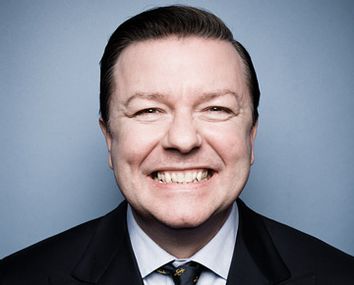
Ricky goes to Hollywood

Ricky Gervais, the comic whiz behind "The Office," aims his nervy, discomfiting humor at the stand-up stage and movie stardom.

Ricky Gervais, speechless, is gazing longingly into Leonard’s eyes. Seated in a plush armchair, his face within intimate range of Leonard’s, all he really wants is for Leonard to bark. Just once. This is a genuinely awkward moment for Gervais, the celebrated British actor-comedian who has made an art of playing characters prone to terribly awkward moments.

Leonard is being played by a pampered performer named Jazz, a Great Dane supposedly trained to deliver on cue. But the hound with the Hollywood gravy train is gazing right back at Gervais without so much as a sniff. After a moment, he lets loose a floppy tongue, pants a couple of times. He is going way off script. Everyone on the set is holding their breath. The stone-faced Gervais normally loves to improvise, but this time he’s baffled. It’s hard to decide if the impasse between the two is hilarious or weird or a fair bit of both.

It’s mid-December in Brooklyn, and Gervais is hard at work on the final day of shooting for “Ghost Town,” a romantic comedy due in theaters this September. Alongside actors Greg Kinnear and Téa Leoni, Gervais stars as a misanthropic dentist whose near-death experience leaves him with special powers of perception and caught in a wacky love triangle reaching beyond the grave. This is rather a departure from the kind of material with which the comedy whiz made his mark — two acclaimed TV series, “The Office” and “Extras,” which sent up workplace and celebrity inanity by way of brutally funny satire.

Although it’s been two months and a rare long stint away from his home in England, Gervais says he loves spending time in New York City, the world’s primo fondue pot for pop culture. He is characteristically jovial about his first lead role in a Hollywood film. But this production is a different pile of string than the TV projects that brought him international fame. The scene at hand will require several more takes and a little postproduction magic to coax the hound’s compliance.

Gervais looks anxious as he steps over to view the footage on a nearby monitor and begins suggesting how the different takes might be cobbled together. He catches himself: “Look at me. I’m such a control freak!” He seems at once excited and agitated with this attempted transition from cult phenom to movie star. His TV success has already led to side roles in several Hollywood productions, but the forthcoming movie promises to plaster his mug on full-page ads across America.

Even so, maybe it’s the pampered pooch who’s acting the prima donna here.

“Yeah, it’s tough,” Gervais muses. “He was never going to bark and I knew it. He just wasn’t going to do it.”

A bit more on this point, before we get to chatting at length about his improbable TV career and emerging Hollywood trajectory.

“Have you worked with animals much before?”

“Only in porn,” he quips. His deadpan look cracks open with that signature thousand-watt grin, the one punctuated by the pointy incisors and the high, impish guffaw.

It’s an apt moment. Gervais has long frolicked at the edges of taste, heckling what he calls “broad comedy” and insisting that he does creative work only on his own terms. He says flat out that he doesn’t want any dummies in his audience. (The misery of selling out to a mainstream audience was a central theme of “Extras.”) Yet he loves American pop culture and admits to indulging regularly in watching “reality TV.” And he is eager to make a bigger splash across the pond — here he is, wrapping work on what by all appearances is an archetypal Hollywood tale.

Indeed, as he stands at the Hollywood crossroads, Ricky Gervais also stands as something of a paradox. Shortish and rotund, he makes up in comedic charisma what he lacks in leading-man looks. He’s a genial and witty conversationalist, zinging one-liners like ammo fired from a toy gun and then giggling along with you as you duck and dodge. But can the unlikely middle-aged maverick — who favors uncomfortable humor but only jumped into comedy in his late 30s — really make the leap to Hollywood movie star? And why, exactly, does he care to try?

If it’s not so much about seeing his “big fat face” on the screen, as Gervais goes out of his way to put it, the answer may lie in his zeal for collaboration. It starts with the writing and spills into all manner of revising and tinkering, a hallmark of his carefully sculpted TV creations. Even when peppering a comedy with blatant gags, he says, “It’s not the jokes that keep you hooked. It’s the story that keeps you hooked.”

After television success delivered Hollywood scripts to his doorstep, Gervais resisted for a while. “A project really has to offer so much potential and possibility,” he says. He found the script for “Ghost Town” distinctively funny. Additionally, director David Koepp, who also co-wrote the movie, offered the kind of access Gervais craved. “We fiddled with the script together for a couple of days and then I knew I was definitely in,” Gervais says. “I feel like I was part of it from the beginning.”

The Brit’s approach impressed Koepp, who has written scripts for several Hollywood blockbusters. “You want input from your actors; they’re not really doing their job if they’re not actively involved,” Koepp says. “For someone who has written so much himself, Ricky was an interesting combination of wanting to play the part as written on the page but also paraphrasing and going off on riffs.”

As the day sprawls forward inside the cavernous Brooklyn studio, Gervais looks a little weary. It’s been 12-hour days, here and around the city, for eight weeks straight. But the gleam stays in his eye. “I love the hard work,” he says. “Winston Churchill said, ‘If you find a job you love, you’ll never work again in your life’ — and it’s true.” Gervais ponders this for a second. “He also said, ‘Give me some more brandy.’”

The laugh that bubbles up when he delivers such lines is familiar to actor Aasif Mandvi, who has a supporting role in “Ghost Town.” “We’ve had a hard time getting through the scenes because we kept cracking up,” says Mandvi, who gained notice as a correspondent on “The Daily Show With Jon Stewart,” the popular fake newscast on Comedy Central. “Ricky is a great person to bounce stuff off of because he likes to play. I love to work with people who just want to explore the possibilities like that. Sometimes you come up with crap, but sometimes you come up with gold. It makes it very alive.”

“I get very excited about creating stuff just from scratch,” Gervais says. “You’ve got to be in this work for the right reasons — being rich and famous ultimately doesn’t mean anything.”

It would be hard to overstate Gervais’ fortune and fame, both due primarily to “The Office,” which he wrote and directed with his longtime creative partner Stephen Merchant. Although the series didn’t get much attention when it first aired in the U.K. in 2001, it soon became one of the most successful television comedies in British history, winning prestigious awards, selling more than 4 million DVDs and catching fire with audiences beyond U.K. shores.

Set in the dreary town of Slough, England, the meticulous portrait of workplace tedium, insecurity and latent depravity starred Gervais as David Brent, a pitifully self-inflated middle manager of a paper company. He was a transfixing spectacle of awkward bravado and inappropriate conduct — a royal putz of a guy who, acutely aware of the faux-documentary’s camera, was desperate to impress more than just his employees with his off-color jokes and bungled truisms. The ensemble cast was equally vivid, both in their aversion to David Brent and their own moronic and degenerate behavior.

Reaching across the Atlantic, the series won two Golden Globe awards and rare critical reverence. It’s not often that you see a top TV critic gushing like this: “Nobody who has seen the BBC series ‘The Office’ has anything bad to say about it, and there’s a reason for that: It’s perfect,” wrote the New Yorker’s Nancy Franklin in October 2004. “It’s a comedy that doesn’t make you laugh, and at times it is close to unbearable; some people like it so much that they can’t watch it. That’s how good it is.”

Yet, although the show found a strong cult following here, Gervais is hardly a household name in America. Survey the pop-culturally savvy in, say, New York or San Francisco, and you’ll find devotees. But mention “The Office” to most American TV viewers and you’re likely to hear only about NBC’s hit spinoff of the same name, set in Scranton, Penn., and starring funnyman Steve Carrell. Ricky Gervais? Who the hell is he?

The man who inadvertently put Scranton on the map (he’s an executive producer of the NBC version) followed a circuitous path to stardom. Gervais, now 47, grew up in a suburb of Reading, in southern England. In the early 1980s he attended University College London, where he studied biology and philosophy and met his longtime girlfriend, TV producer Jane Fallon. He played in a pop group that blipped briefly on the U.K. charts, worked various odd jobs (including in an office, of course) and got into music and entertainment management.

By the mid-1990s Gervais landed a job at London radio station Xfm, where he and Stephen Merchant first met. The two began writing sketches together, incubating what would become the demo for “The Office.”

Gervais describes a rare creative partnership with Merchant. “Stephen and I trust each other so much. We never put anything in unless we both want it,” he says. “There’s no compromise, really. It feels like I’m always getting my own way, and maybe he feels the same.” To anyone who has ever collaborated on creating anything, this sounds far-fetched — until you rewatch “The Office,” a series so well crafted that every detail, from an actor’s glance to the grace note of a clacking copy machine, counts.

“We wanted every word and nuance to be real and to mean something,” says Gervais. “I’ve seen so much stuff that’s been ruined by writers’ getting carried away with getting a good joke in. We threw jokes on the floor if they made someone look too clever or undermined the story.”

The success of the series uncorked things for the comedy duo. Subsequent work included a weekly podcast that was downloaded by millions, and their next TV series, “Extras,” the wickedly funny torching of celebrity culture. That series, also starring Gervais, featured A-list cameos from the likes of Kate Winslet, Samuel L. Jackson, Robert De Niro and David Bowie, who delivered a particularly astonishing moment of musical degradation. Gervais also wrote and appeared in an episode of “The Simpsons,” and he delved into stand-up comedy, touring with shows across the U.K. — although in this realm he has drawn more mixed reviews. In May 2007 he did his first U.S. show, at Madison Square Garden, as part of David Bowie’s High Line Festival. He’s bringing his latest show to Los Angeles and New York for several nights starting July 11, a string of performances also to be filmed for an HBO special.

“I like the romance of doing stand-up,” he says. “It’s the last bastion of self-censorship outside the novel, and that excites me. I can go onstage and say anything I want.” He laughs at the notion. “Well, I pretty much do that on the telly as well. I guess I can get away with it because I put forward a good argument.”

Gervais admits that taking a shot at stand-up was also about feeling like he needed to earn his spurs. “I suppose I felt guilty about walking into a great job like ‘The Office,’ you know? Most comedians slog around for 20 years before they get a part in a sitcom or a chance to write something.”

Although his second effort, “Extras,” gained only a modest U.S. audience, it too raked in the accolades, including Emmys in 2006 and 2007 and a Golden Globe in early 2008, shortly after the series finale aired. In that feature-length special, Gervais’ main character (the self-absorbed actor Andy Millman) had a surprisingly dramatic turn, leading one American TV critic to suggest that an evolving Gervais could be the next Bill Murray or Jim Carrey.

Still, it’s unclear whether Gervais can carve out artistic autonomy in Hollywood. He’s been criticized for a couple of side roles that, by his own admission, he took primarily for the chance to work with some of his film heroes. The big-budget “Stardust,” for example, put him in a scene opposite Robert De Niro but implicated him in a schlocky fantasy-adventure that came off like a bad Terry Gilliam imitation for the Disney Channel.

Gervais greatly admires American film and television. “All of my favorite comedies and dramas are coming out of America,” he says. “The ‘British film industry’ is nearly an oxymoron.” As for the reality TV zeitgeist, he says, “Yeah, we’ve got too much of it in Britain as well. But I do watch a lot of the shows coming back over from here — ‘Top Chef,’ ‘Fit Club,’ ‘The Apprentice,’ ‘American Idol.’

“I think American TV has even been beating film over the past few years,” he adds, citing “The Sopranos” as a favorite. “I love the way that TV can relax now. It’s audacious to plan for an audience to get into a show after the third episode.”

His own audacity has led some in the media to treat him like an animal — a variety of them, actually. He has been compared to a hyena (his laugh), a tiger (his grin), a walrus (his shape) and a puppy dog (his disposition), among others. Sometimes it has been done in admiration, sometimes not. And some critics have accused him of being a one-trick pony, playing essentially the same character in everything he does.

Gervais appears to take it in stride. For him there is the legitimate press (“There are some wonderful journalists in Britain and America”) and there is the gutter press (“I don’t care whether Britney Spears is a good mother or not — it’s just cheap speculation”). He has made use of the latter: One memorable segment in “Extras” mocked tabloid reporters who set off fact-free frenzies across the media.

“No doubt about it: American press is nowhere near as bad as the British press with this,” Gervais laughs. “You’re amateurs. You have bitchy Internet people here … Well, they get jobs on big papers in England!”

But never mind the paparazzi and the pundits; after two months of toil in New York, what interests Gervais is tweaking the taste of American audiences. Will his sensibility come off smooth like Velveeta or pungent like so much Stilton?

Aasif Mandvi, who also grew up in England, thinks Gervais can appeal more widely here. “Just as a fan, I’m excited he’s making this leap to Hollywood comedic leading man,” Mandvi says. “He’s just so funny.”

Forecasting the next turn in Gervais’ career, however, may be no easier than deciphering his contradictions. He’s jolly and generous — no, he’s raw and uncompromising. He doles out pop culture barbs but lounges at home (mostly in his pajamas, he says) binging on reality TV. He pronounces judgment on “broad comedy” — then trades on his hard-earned renown to do a mainstream Hollywood movie.

But watch Gervais labor for a day and it’s evident he means it when he says the satisfaction of the work itself trumps all else. Like other wayward entertainers, he is driven in part by the way his chosen medium once riveted him.

“I’ll tell you what,” he says, kicking back after the final shoot of the day has wrapped. “I’ve always wanted to get this one moment back: I wish I’d never seen ‘The Godfather’ before, because I remember how good it felt the first time I watched it. I’d say the same about ‘The Sopranos.’ I want that experience again.”

It’s clear this motivates him not only as a fan. He’s got fame and fortune to spare, and has rubbed creative elbows with some of his artistic demigods. But even though he has conjured some pretty serious comedy, Ricky Gervais would probably like nothing more than to move audiences with that same kind of magic.

This article was first published in Arrive Magazine and is reprinted with permission.

Continue Reading Close

Requiem for a right-wing icon

Never mind that the Republican right is in chaos, William F. Buckley is up for sainthood -- and John McCain is in on the act.

Given that William F. Buckley, who died Wednesday, was founder of the seminal conservative magazine the National Review, one would expect to find an outpouring of sentiment for him on the publication’s Web site. Outpouring may be an understatement. Beneath a slide show lionizing Buckley in close-up and in profile, National Review Online currently features a compilation of no fewer than 22 postings delivering him into sainthood:

“It is our fervent prayer that we continue to do WFB’s life’s work justice.” (Kathryn Jean Lopez)

“He was, perhaps above all, a good and faithful servant of the Lord.” (Pete Wehner)

“A treatise could probably be written about the role those eyes played in the making of modern America.” (Ramesh Ponnuru)

“Utterly unpretentious, absorbed in whatever you had to say, he had the kind of manners that are so good that they cease being manners and become a warming aura.” (Charles Murray)

“He taught us how to live — and to die.” (Michael Knox Beran)

There may be some metaphorical value in that last statement for the movement Buckley helped spawn. With the conservative wing of the Republican Party in chaos, and with John McCain now standing atop the campaign rubble of hard-liners Mitt Romney and Rudy Giuliani, there seems to be twilight falling on the political extremism of the George W. Bush era. (As Glenn Greenwald observed Wednesday, even Buckley realized that Bush and Cheney, with their global war on terrorism and invasion of Iraq, were driving America into a seriously deep ditch.) Ever mindful of his right flank as he campaigns toward the GOP nomination, McCain himself contributed to the collective gusher: “Bill was a great American who helped change the course of history. When conservatism was a lonely cause, he bravely raised the standard of liberty and led the charge to renew the principles and values that are the foundation of our great country,” McCain offered late Wednesday. “Bill was an American giant who shall be missed.” With the axis of Bush, Cheney and Rove soon headed farther into the wilderness, the movement may indeed really begin to miss its former standard-bearer.

Continue Reading Close

An Iran bombshell for Bush

The White House knew months ago about Iran's stalled nuclear program. But Bush and Cheney have kept up the war rhetoric.

It was the brightest burst of news from the Middle East in a long time: Iran, it turned out, was nowhere near getting the bomb. But for the White House it was a political bombshell, tossed directly into the Bush-Cheney bunker.

The revelation this week of the latest National Intelligence Estimate, concluding that Iran halted its covert nuclear weapons program in 2003, upended a long-running rhetorical campaign by the president and vice president. Just six weeks prior, in a signature tag-team offensive in late October, Bush had worried out loud about a nuclear-armed Iran setting off “World War III,” while Cheney warned in a speech that America “cannot stand by as a terror-supporting state fulfills its grandest ambitions” to acquire nuclear weapons and lord over the Middle East.

But the president knew the thrust of the NIE’s conclusions about a nuke-less Iran at least as early as last August, according to Flynt Leverett, a top Middle East expert and former senior director on Bush’s National Security Council. In an interview Tuesday, Leverett said that the bellicose rhetoric in October was accompanied by a telling shift of the goal posts. It was déjà vu all over again. Bush no longer spoke of Iran’s imminent weapons of mass destruction, he spoke of its imminent plans to gain the capability for making weapons of mass destruction.

Bush knew the NIE report was going public, of course, and he has tried to spin its findings as a measure of successful policy. But the White House failed to anticipate the impact of the report, says Leverett, now a senior fellow at the New America Foundation. “Obviously,” he says, “this NIE does damage to the credibility of their representations on Iran.”

The declassified conclusions of the report read almost like a preemptive strike for political engagement with the Iranians — anathema to Bush hard-liners. “We judge with high confidence,” wrote U.S. intelligence leaders, that Iran’s decision to halt its nuclear weapons program four years ago “was directed primarily in response to increasing international scrutiny and pressure resulting from exposure of Iran’s previously undeclared nuclear work.” That directly contradicted NIE findings from 2005, which had Iran in aggressive pursuit of a bomb. The latest report also concluded: “Tehran’s decisions are guided by a cost-benefit approach rather than a rush to a weapon irrespective of the political, economic, and military costs.”

Questions are again stirring about U.S. intelligence capabilities — first there was Saddam’s phantom arsenal of WMD, and now the about-face on Iran — and Leverett expects hard-liners to use that in the weeks ahead to knock down the NIE’s less-than-hawkish findings. (The political right has already begun to do so.) Bush himself emphasized Tuesday that Iran remains dangerous. The report’s fallout may also transform the Iran issue for the 2008 presidential race, Leverett says, particularly for the Democrats. He spoke by phone from Washington.

What does the NIE report reveal about U.S. strategy on Iran?

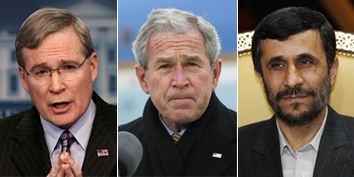
I think it shows that the Bush administration is not at all on the right course with Iran policy, contrary to what [National Security Advisor] Stephen Hadley and the president himself have said this week. They’ve said it’s international pressure and scrutiny that got Iran to suspend the military parts of its nuclear program, and that, as the NIE says, it’s going to be a combination of pressure and incentives that will ultimately produce a solution — and that they’ve been going that route and it’s the right policy.

I think that’s fundamentally misleading — in fact, this administration has never offered to negotiate with Iran on any basis that might actually be attractive to the Iranians. Hadley [and others] were spinning the report — obviously this NIE does damage to the credibility of their representations on Iran, regarding both the nature of the threat and how good their policy is. Now they’re trying to limit the damage.

Here’s what they are leaving out of the discussion: What the Iranians want ultimately is a strategic deal with the U.S. that would address their fundamental security and legitimacy as a republic, their role in the region. The NIE concludes that if Iran could actually achieve that sense of security and a regional role without building a nuclear weapon, they’d be open to a deal. But you have to put something on the table in front of them that’s really going to address those things. Not only has the administration never put an offer like that on the table, they’ve explicitly refused to do so.

Take the incentives package put together [back in 2005] by the Europeans: The section dealing with regional security had all kinds of explicit and implicit guarantees for the Islamic Republic of Iran, as part of an overall settlement talking about Iran’s role in a regional security framework. The Bush administration would not sign on to that package last year until literally all of that language was taken out. They’ve never been serious about negotiations.

Why do you think the NIE report was made public now?

Because the intelligence leadership made a judgment that basically for their own protection they needed to make it public. The letter put out by the deputy director of national intelligence with the report said that because the 2005 NIE had been cited on the record by so many people as a benchmark for U.S. understanding of Iran’s progress with its nuclear program, intelligence community leaders wanted to make sure there was a very clear presentation of current views. I suspect they were the ones who really insisted on this. They were deciding to do it for their own sake and credibility.

Are we talking on the level of Director of National Intelligence Mike McConnell?

We must be. I don’t know that for a fact, but I think we must be. National Intelligence Estimates take a long, long time to put out, and this one took longer than it was originally projected to take, by a considerable margin. I think part of that was that it was difficult to reach a consensus. I think part of it was a certain amount of political pressure to come to a certain conclusion–

You mean political pressure to make the case for going after Iran?

Yeah, exactly. And in 2005, the intelligence community succumbed to that pressure — hook, line and sinker. This time, you had some different people in charge of the process, and some of the pressures from 2005 — you had Donald Rumsfeld at the Pentagon then — were no longer there, although I think there was still some pressure applied. And after a certain point, they did have this new information turn up, that the Iranian military had suspended parts of its program in 2003.

They apparently briefed this to the president in August. And between August and now, they’ve essentially been going over it and figuring out how to take account of it in the NIE. It doesn’t surprise me that it took them from August till now to go through that — it’s a glacially slow process.

But the president has suggested this week that he only learned of the NIE’s conclusions very recently. If in August they had the essential conclusion and were briefing the White House, what does that say about some of the rhetoric we heard after that, in the fall?

Oh, I think the president knew this was coming, and I think he was deliberately shifting his rhetoric on the issue to redefine the problem. Up until the fall, Bush’s rhetoric literally for years had been that it’s unacceptable for Iran to have a nuclear weapon. All of a sudden, that shifts to it being unacceptable for Iran to have the knowledge of how to build a nuclear weapon.

I think they were trying to redefine the problem with the idea that they could kind of blunt the impact of the NIE by doing this. I think they miscalculated. The NIE has had an enormous impact on the public debate — particularly the decision to release the multipage document publicly, as opposed to just leaking [some details of] it. The White House miscalculated its ability to manage this. It has definitely made it more difficult for hard-liners like Cheney to make the case now for going down the military road.

Right, a number of people have said that this takes the military option off the table. Do you think that’s the case?

I’m not so sure it takes the military option off the table. What were going to see over the next weeks if not months is a kind of battle of intelligence estimates. The hard-liners in the administration are going to keep leaking all kinds of things that were “wrong” with this NIE — why the source wasn’t good, why the intelligence wasn’t good, why there is still a serious threat.

The Israelis have already come out publicly, at the level of the defense minister, Ehud Barak, and said they flat-out disagree with the estimate. I think you’re going to have Israel, and friends of Israel here, including the Cheney camp inside the administration, pushing to discredit the NIE in various ways.

In other words, we’ll see a battle going on over who really gets to define the intelligence assessment on which the president will make his decisions. Is it going to be the U.S. intelligence community? Or will it be some other set of actors who define it?

Iran has been notoriously opaque to U.S. intelligence over the years, and I think these developments raise some familiar questions. How good is our intel on Iran? And aren’t we dealing with another pretty powerful contradiction here in terms of the latest assessment?

The contradiction is very powerful! You know, I have to say that I continue to believe that attacking Iran would be a disaster for the U.S. position in the region, and so far as this NIE makes it harder to justify doing so, I think that’s a good thing. But the fact of the matter is that over the last two years, the U.S. intelligence community has been all over the map on this issue. And they’ve been colossally wrong on WMD issues in the past. So why should we put a high degree of confidence in any judgment they come to? Who knows if this reporting is really any good?

Not only will the hawkish elements use that to try to discredit it and knock it down, they’ll also say that even if the estimate is right, it doesn’t matter. They’ll say — as Patrick Clawson already has written for the Washington Institute for Near East Policy [where Cheney gave his speech in October] — this estimate doesn’t change by one day our understanding of when Iran will actually get a nuclear weapon. The argument will be, “Even if everything in that estimate is correct, Iran is still a big problem.”

What impact will all this have on the politics of the 2008 presidential race?

On the Republican side, I don’t see it having that much of an impact. The Republicans have all staked out pretty extreme positions on Iran and I don’t really see them backpedaling. But on the Democratic side it potentially gets very interesting. Barack Obama could really make an argument that Hillary Clinton’s vote for the resolution naming the Iranian Revolutionary Guard a terrorist organization was basically a vote for Bush’s policy — and was based on an assessment that we now know was wrong about the nature of the threat. And just like it was wrong for her to vote for the Iraq resolution and that showed bad judgment on her part, this showed the same kind of bad judgment — and gee, wouldn’t you like to have a president who got these things right the first time around? Obama is going to have to make the case for what this demonstrates about her, and I don’t know if in the end he really has the guts to do that, but this could potentially affect the race.

What about national security more broadly in the campaign? It certainly seemed Iran was going to be a key issue going into next year.

Yeah, and I definitely think that for someone like Rudy Giuliani, if he were to become the nominee for his party he would want to make this a campaign about national security and about who’s going to be more effective dealing with Iran. Depending on how the debate plays out during the next few months over what’s really going on with Iran, he may still be able to do that. But it could also become harder for him to run that kind of campaign.

Could the NIE findings cause a significant change in the Bush administration’s approach to Iran?

I don’t think so — they’re saying Iran is still a danger and they’re going to stick to that. They’re not going to say, “Oh, well we better get serious about diplomacy now.”

But at least in terms of what the world now knows, doesn’t this create more of an imperative for diplomatic engagement?

The issue in the end is: If the United States wanted to get serious about diplomacy and put a real offer on the table for Iran with security guarantees and all those things, the Europeans would be right there with us, and China and Russia would be right there with us. The problem standing in the way at this point is U.S. policy. This estimate is not going to change that.

Continue Reading Close

The U.S. attorneys scandal gets dirty

As Congress prepares to grill Alberto Gonzales, Salon has uncovered another partisan issue connected to the mass firings: Pornography.

Facing a torrent of criticism that the Department of Justice has been tainted by politics, Alberto Gonzales is poised for the defense argument of his life. The attorney general must explain to Congress an accumulation of embarrassing partisan e-mails and inaccurate statements by top Bush officials, which have helped transform the quiet firing of eight U.S. attorneys last year into an explosive Washington scandal.

Gonzales will be grilled about alleged Republican meddling on issues from corruption to cronyism, widely documented in the four months since the purge. But a Salon investigation has uncovered another partisan issue dirtying the U.S. attorneys scandal: adult pornography.

Questions remain about the real reasons behind the firings and to what degree the nation’s chief prosecutors were pressured to carry out the political agenda of the White House and its Republican allies. There is evidence that the politicization of the Justice Department has included recasting the Civil Rights Division and pushing election-fraud investigations in ways favorable to Republicans. Some U.S. attorneys were told they were being forced out of their posts so that up-and-coming Bush loyalists could have a chance to burnish their résumés for yet higher political appointments. Troubling allegations persist that some U.S. attorneys were fired to thwart corruption probes against Republican officials.

Although the prosecution of adult obscenity has long been a fixation for right-wing Republicans, since the Reagan era it has never been more than a negligible fraction of the Justice Department’s work. Yet, the alleged failure of two U.S. attorneys to go after porn prosecutions became part of a dubious set of “performance-related” reasons given by top officials for the recent firings. Meanwhile, several of the small handful of porn cases done under Gonzales were conducted by high-ranking officials close to the attorney general. Those officials were also involved in the group firing of the U.S. attorneys, and two of them recently received promotions.

Two of the fired U.S. attorneys, Dan Bogden of Nevada and Paul Charlton of Arizona, were pressured by a top Justice Department official last fall to commit resources to adult obscenity cases, even though both of their offices faced serious shortages of manpower. Each of them warned top officials that pursuing the obscenity cases would force them to pull prosecutors away from other significant criminal investigations. In Nevada, ongoing cases included gang violence and racketeering, corporate healthcare fraud, and the prosecution of a Republican official on corruption charges. In Arizona, they included multiple investigations of child exploitation, including “traveler” cases in which pedophiles arrive from elsewhere to meet children they’ve targeted online.

The U.S. attorneys’ doubts about prioritizing obscenity cases drew the ire of Brent Ward, the director of the Obscenity Prosecution Task Force in Washington, who went on to tell top Justice Department officials that the two were insubordinate over the issue. But the obscenity case that Ward pressured Bogden to pursue was “woefully deficient” according to a former senior law enforcement official who spoke to Salon last month. And Charlton’s office was in fact on the leading edge of adult obscenity prosecutions, including a recent case aimed at stopping pornography distributed via SPAM e-mail.

According to Bogden, his office was short eight of its allotted 45 criminal prosecutors when Ward paid a visit last September to present the porn case he wanted handled in Nevada.

“I would have had to take someone else off another criminal case to put them on it,” Bogden said in a recent phone interview. At the time, the Nevada U.S. attorney’s office was maxed out with several high-profile prosecutions. A public corruption trial was just beginning against Lance Malone, a Republican county commissioner accused of accepting bribes and violating the RICO act. (Several of his fellow commissioners, all Democrats, had already plea-bargained or been convicted.) A major case was under way against corporate officials for Medicare fraud and kickbacks to doctors totaling $22 million. Less than two weeks after Ward’s visit, multiple trials were set to begin involving more than 40 members of the Hell’s Angels for a violent confrontation with a rival gang inside a Harrah’s Casino, using firearms, knives, hammers and wrenches, that had resulted in three deaths.

After determining that Ward’s obscenity case was thin and would require a lot of work, Bogden suggested that the case wait until January, when two new prosecutors were slated to join Bogden’s staff. “Mr. Ward went along with that plan,” Bogden said. “He said, OK fine, we’ll wait till after the first of the year.”

Bogden said he never heard anything else about the matter from Ward or anyone else in Washington — though by then Ward had already e-mailed a superior in the deputy attorney general’s office calling Bogden a “defiant U.S. attorney” who was offering “lame excuses.”

Adult obscenity prosecutions are notoriously difficult to win, since prosecutors must show that materials involving and used by consenting adults have violated local “community standards.” In the post-9/11 era, law enforcement experts have questioned whether a focus on federal obscenity cases makes sense, given the massive resources diverted to counterterrorism and the demands of other criminal priorities like gun violence, identity theft and the proliferation via the Internet of sex crimes against children.

“With everything else going on, should they really have FBI agents and prosecutors devoted to sitting around watching dirty movies?” said a senior law enforcement official who attended a national conference on adult obscenity orchestrated by the Gonzales Justice Department in October 2006. “We’re not the policymakers,” he said. “But I guarantee you won’t find any office in any major metropolitan area that would seriously consider this a priority.”

But Gonzales apparently considered it one. After taking the helm of the Justice Department he declared the prosecution of adult obscenity a top priority, launching a new task force devoted to it in May 2005. His renewed war on porn, an agenda that had gathered dust ever since the publication of the obscenely large Meese Report in 1986, was seen by some political observers as a sop to right-wing Republicans who suspected Gonzales wasn’t authentically conservative on social issues. His answer to those doubts was a task force that would pack the punch of four full-time attorneys, a postal inspector, an IRS agent and computer and forensics experts in the Justice Department, and would coordinate with a new Adult Obscenity Squad at the FBI, 10 agents strong.

Nonetheless, obscenity cases have remained a minuscule portion of the Justice Department’s prosecutions since Gonzales launched the initiative — fewer than 10 among the more than 20,000 criminal cases carried out each year, according to Justice Department statistics and research by Salon.

Four of the obscenity cases were conducted by three high-ranking officials close to Gonzales.

Ward, who zealously went after porn as a U.S. attorney himself in Utah in the 1980s, helped argue a 2006 case in Florida against the producer of the widely advertised and sold “Girls Gone Wild” videos. Although the videos pale by comparison with explicit sexual material available all over television and the Internet, Ward found an angle with which he could score a win: The producer had failed to properly document whether a number of the young women flashing some skin for his cameras were of legal age.

After pressing Bogden and Charlton last fall to devote resources to obscenity prosecutions in each of their states, Ward disparaged the two U.S. attorneys as “unwilling to take good cases” in an e-mail to Kyle Sampson, Gonzales’ recently resigned chief of staff. Sampson was coordinating with White House lawyers on a hit list of U.S. attorneys to be replaced. “If you want to act on what I give you,” Ward wrote to Sampson, “I will be glad to provide a little more context for each of the two situations.”

Mary Beth Buchanan, a U.S. attorney in western Pennsylvania who has also served in several executive roles in the Justice Department since 2001, has led two obscenity prosecutions under Gonzales. One was a reinstated case against online purveyors of hardcore videos, a case Buchanan had first pursued in 2003 but that had been thrown out by a federal judge as unconstitutional. She also prosecuted a 2006 case against a woman who published stories about child molestation — which were fictional and contained no images — on the Internet. “I cannot imagine material more offensive,” Buchanan said about the fictional, text-only stories in the case.

Last year Buchanan reportedly consulted with Sampson as he worked on identifying U.S. attorneys to be fired. Just prior to the group firing in early December, Buchanan received another prestigious appointment, when President Bush tapped her to head the Justice Department’s Office on Violence Against Women.

William Mercer, the U.S. attorney for Montana, continued his own multiyear campaign against obscenity in 2005, prosecuting two men for conspiring to transport obscene materials. Like Buchanan, Mercer has served simultaneously in an executive role at Justice; he was first tapped by Gonzales in 2005 to be principal associate deputy attorney general. His absence for duties in Washington prompted a chief federal judge to call Mercer’s Montana office “a mess” from lack of leadership and to demand that Gonzales replace him, though Mercer still allotted time back home to convict the two men for shipping hardcore videotapes. That followed a 2004 prosecution he conducted against a purveyor of such video titles as “Ride’um Cowgirl” and “Dogs and Horses and Pigs and Chickens,” a case Mercer hailed as Montana’s first ever win on obscenity.

In September 2006, Mercer got a second promotion at Main Justice, when Bush appointed him to be associate attorney general. Now Gonzales’ third in command, Mercer was involved in various communications concerning the group firing of U.S. attorneys, including telling Bogden and Charlton that they were being forced out so that other Bush appointees could have their posts.

Bogden maintained in the recent phone interview that he was never told by superiors of any concerns they may have had with him about policy or performance, including on obscenity.

Charlton gave similar testimony to Congress in early March, as did several of Bogden and Charlton’s colleagues who were fired. In Charlton’s case, top officials offered contradictory reasons for his dismissal. He also drew criticism over drug enforcement, though a senior Justice Department official defended Charlton at length on that issue in an e-mail exchange made public last month by congressional investigators. Meanwhile, in testimony in March, Associate Deputy Attorney General William Moschella gave an entirely different set of reasons, telling lawmakers that Charlton was fired for his views on the death penalty and recording the confessions of suspects interviewed by law enforcement officials.

But Ward’s criticism of Charlton on obscenity, which later appeared on a chart of alleged performance problems circulated to top Justice Department and White House officials, is an especially curious twist. The Arizona U.S. attorney’s office in fact worked on two obscenity cases under Gonzales — as many as any other U.S. attorney’s office in the nation. Its case targeting the distribution of porn via SPAM was the first of its kind and had the potential to benefit the public much more broadly than any prior obscenity prosecution. The other case, on which Charlton’s staff was assisting one of Ward’s task force prosecutors from Washington, targeted a hardcore porn distributor called Five Star Video.

The Five Star Video case was already months under way when Ward visited in September 2006, but Ward was requesting that Charlton commit additional resources, according to an attorney knowledgeable about the staffing and caseload of the Arizona U.S. attorney’s office. Ward wanted a local prosecutor to help take the case through trial because he was concerned about getting a conviction per local community standards with only a Washington lawyer sitting at the table.

At the time, the Arizona office was 20 percent understaffed with prosecutors, according to the attorney, and had already been forced to cut back on its criminal caseload. The office would’ve had to take a prosecutor off another case to go to trial with Ward’s case. “You’re literally robbing Peter to pay Paul,” the attorney said. That concern was raised with Ward, particularly regarding cases on child exploitation. “There were enough of those cases for the Arizona office to be doing them 24/7,” the attorney said. “Nobody debates that if resources are limited, those cases should be a priority over cases involving material with consenting adults.”

The staffing shortages that forced such choices were raised with Gonzales at least as early as July 2006. That month, the attorney general received a letter from senior House Democrats Henry Waxman of California and John Conyers of Michigan detailing an investigation into budget cuts at the Justice Department. “U.S. attorneys offices across the nation are severely understaffed,” the letter warned. “Due to hiring freezes, experienced prosecutors who leave for the private sector are not being replaced. In several key offices, 20% or more of prosecutor positions remain unfilled.” The letter noted “eight to ten vacancies” in the Arizona office.

Between the strain on resources and an array of demands on criminal divisions around the country, Gonzales’ obscenity conference in October 2006 raised some eyebrows. “It was meant to rally the troops and get them excited, and they presented it as another priority that needed to be done,” said the senior law enforcement official who attended. “But people were wondering why we were having a national conference on this. For starters, what’s obscene in Dubuque won’t even bat an eye in Las Vegas. And we’ve got a lot of more serious problems out there.”

Bud Cummins, who was the U.S. attorney for the Eastern District of Arkansas from 2001 until he was forced out last year, says that adult obscenity was discussed several times in his district after Gonzales declared it a priority, but no agency ever brought his office a case. “I wouldn’t have refused, but we would have studied any case presented for any of the legitimate issues that make such prosecutions difficult,” Cummins said by phone recently. “That is what we were getting paid for. I would have certainly been cautious about pursuing obscenity cases, even here in the heart of the Bible Belt.” He said that the apparent heat on Bogden for exercising caution and discretion over obscenity prosecutions in a place like Las Vegas is “pretty ridiculous.” As with every other issue raised about the fired U.S. attorneys’ performance, he added, “nobody told Dan he wasn’t doing what they wanted on obscenity. At best, that is lousy management. At worst, it is a pretext for something else they don’t want to discuss.”

In an Op-Ed in last Sunday’s Washington Post, Gonzales gave a preview of his congressional testimony to come. He apologized for his poor handling of the U.S. attorney firings, while maintaining that none of them had been carried out for “an improper reason.”

He ended on an upbeat note, emphasizing that he looked forward to furthering “the great goals of our department” in the coming weeks and months. “During the past two years,” Gonzales wrote, “we have made great strides in securing our country from terrorism, protecting our neighborhoods from gangs and drugs, shielding our children from predators and pedophiles, and protecting the public trust by prosecuting public corruption.”

Adult obscenity did not make his list.

Additional research for this story was contributed by Salon editorial fellow Jonathan Vanian.

Continue Reading Close

Manipulating Justice to win elections

More details on how the Bush administration used the Justice Department as a partisan tool.

As we reported in Salon beginning more than a week ago, the Bush administration’s partisan grip on the Department of Justice has reached well beyond the U.S. attorneys fired en masse last year. Over the past six years, the administration maneuvered to spread voter-fraud fears and recast the Civil Rights Division — doing so in ways “that clearly were intended to influence the outcome of elections,” as Joseph Rich, the former chief of the voting section in the Civil Right Division, affirms in an Op-Ed in today’s Los Angeles Times.

Rich’s indictment is particularly damning in details exposing a thumb-on-the-scales evaluation process for career Justice Department lawyers — the same bogus process that reared its ugly face with Kyle Sampson’s hit list in the U.S. attorneys scandal. Rich, a 35-year veteran of the Justice Department who served until 2005, explains what happened to career public servants who disagreed with loyal Bush appointees: “Seven career managers were removed in the civil rights division,” he writes. “I personally was ordered to change performance evaluations of several attorneys under my supervision. I was told to include critical comments about those whose recommendations ran counter to the political will of the administration and to improve evaluations of those who were politically favored.”

Sound familiar?

“At the same time,” Rich continues, “career staff were nearly cut out of the process of hiring lawyers. Control of hiring went to political appointees, so an applicant’s fidelity to GOP interests replaced civil rights experience as the most important factor in hiring decisions.”

As Rich notes, this was an extraordinary departure from past practice. “I worked for attorneys general with dramatically different political philosophies — from John Mitchell to Ed Meese to Janet Reno. Regardless of the administration, the political appointees had respect for the experience and judgment of longtime civil servants,” Rich says. “Under the Bush administration, however, all that changed.”

Meanwhile, the damage to the public trust has been grave, says one of the fired U.S. attorneys. “Once you have given the public a reason to believe some of your decisions are improperly motivated, then they are going to question every decision you have made, or make in the future,” Bud Cummins, the U.S. attorney forced out of his post in Arkansas, told me in a recent e-mail. “You only get one chance to hold on to your credibility, and my team, who hold temporary custody of DOJ, has blown it in this case,” he said. “DOJ will be paying for it for some time to come.”

Continue Reading Close

Page 1 of 87 in Mark Follman