“Follow the money” is an elementary rule for understanding American politics, and in the case of Texas Gov. Rick Perry, the money trail leads to a case of apparent money laundering that involves his Republican presidential rival Mitt Romney and a $1 million contribution from the same Texas tycoon who bankrolled the “Swift Boat” attacks against the 2004 Democratic presidential candidate, Sen. John Kerry.
Bobby Jack “Bob” Perry, a residential construction magnate in Houston, is not related to Rick Perry by blood, only money. But there has been lots of that. As with the Swift Boaters to whom he donated $4.45 million, Bob Perry ranks as the single largest donor to Rick Perry during the latter’s 10 years as governor of Texas, according to official figures tabulated and analyzed by Texans for Public Justice, a nonprofit watchdog group in the state capital of Austin.
Bob Perry contributed $2,531,799 directly to Rick Perry from January 2001 to July 2011, TPJ reports in “Crony Capitalism: The Republican Governors Association in the Perry Years.” That puts him well ahead of such other notable donors as Koch Industries, the energy conglomerate owned by David and Charles Koch, the chief funders of the Tea Party, and Contran Corp., whose efforts to establish a nuclear waste dump in Texas have succeeded thanks to regulators appointed by Perry. (As Justin Elliott reported this week, Perry is also a leading funder of Karl Rove’s American Crossroads political action committee.)
But to truly understand Rick Perry’s “pay-to-play” approach, TPJ executive director Craig McDonald told Salon, one must also look at contributions to the Republican Governors Association, which he chaired from 2008 through August 2011.
In an apparent and possibly illegal attempt to hide the money’s true origins, Bob Perry has routed $11,450,000 — five times the amount he has contributed to Gov. Perry directly — through the Governors Association since 2006.
That same year, Perry donated $1 million to the Governors Association, which days later channeled $1 million to Gov. Perry’s troubled reelection campaign. When Chris Bell, Gov. Perry’s Democratic challenger in 2006, filed suit alleging campaign finance violations, Perry’s campaign agreed to settle the case and pay Bell $426,000, nearly half the amount of the contribution at issue.
The Governors Association, however, refused to settle. In 2010, state Judge John K. Dietz ruled that the group had violated Texas law by not registering as a political committee and not reporting the $1 million contribution until after the election. The judge awarded $2 million to Bell, a ruling the Governors Association is appealing.
“I think it was a pass-through,” Bell told Salon. “They were trying to hide the source of the contribution.”
Bell speculated that the Perry campaign wanted to avoid charges of hypocrisy after criticizing Bell for accepting a $1 million contribution from a Texas trial lawyer, a contribution that Bell announced publicly. Texas law allows individuals to contribute unlimited amounts to candidates.
“Bob Perry had contributed hundreds of thousands of dollars to Rick Perry’s campaign prior to 2006,” Bell said. “So why else would he pass it through the Republican Governors Association, if they weren’t trying to hide the source of the contribution?”
That $1 million contribution by Bob Perry could come back to bite Rick Perry during this year’s presidential campaign. Romney could also face trouble. He was the chairman of the governors group in 2006 and reportedly participated in the decision to channel money to Perry’s campaign.
As reporters Murray Waas and David Henderson of Reuters revealed on Wednesday, court documents describing Romney’s role indicate that two of Gov. Perry’s closest aides may have given “false or misleading testimony under oath” in their depositions for Chris Bell’s civil suit:
“[T]he testimony of [top Rick Perry] aides David Carney and Deirdre Delisi was directly contradicted by a sworn statement from Perry’s own gubernatorial campaign committee … which said that Delisi and Carney met with Romney in Washington DC on October 4, 2006 to discuss a last-minute contribution to [Perry's campaign] .”
Carney has long been Perry’s top political advisor. Delisi, who served as his chief of staff in the governor’s office, is now senior policy advisor to the campaign.
When asked about the Oct. 4, 2006, meeting, Mark Miner, press secretary of the Perry presidential campaign, told Salon that “due to a settlement by both sides we cannot comment on this case.” The Romney campaign did not respond to questions about the meeting.
To have the two presumed front-runners for the Republican presidential nomination and the funder of the infamous “Swift Boat” attacks implicated in a single money laundering scandal is a remarkable development in the Republican race. It raises a host of questions that other GOP candidates — and the media — may want to address.
Did two of Perry’s closes aides commit perjury? Why the divergent statements about the last-minute contribution? Did Romney endorse passing along Bob Perry’s $1 million to Gov. Perry? If so, why? And what did Rick Perry know about the source of the contribution?
In short, did the two now-bitter rivals for the Republican nomination forge a friendly backroom deal in 2006 that was possibly illegal?
An offensively low price
“Other Texas politicians have done pay-to-play before, but Rick Perry has taken it to a high art,” said Craig McDonald of TPJ. “In his 10 years as governor, he has raised $102 mil[lion], and half of that came from an inner circle of 200 mega-donors. George W. Bush never raised anything like that amount during his years as governor [1994 to 2000]. Bush raised $43 million for two election campaigns, and most of that came in the second campaign when everyone knew he was running for the president and people wanted to cozy up to him.”
At times, though, Perry’s pay-to-play proclivities have been less high art than low comedy. In the Sept. 22 candidates’ debate, Rep. Michele Bachmann, R-Minn., hammered Perry for issuing an executive order requiring Texas high school girls to get a vaccine that prevents cervical cancer. Right-wingers had previously attacked the morality of his order, saying it would encourage teenage promiscuity. Bachmann ventured a new line of attack, noting that the vaccine was manufactured by one of Perry’s campaign donors. Far from backing down, Perry took the offensive, naming the donor, the drug company, Merck, and stating — inaccurately — that the pharmaceutical giant had contributed only $5,000 to him. In point of fact, Merck has given $28,500 to Perry since 2001.
“I raise about $30 million,” Perry continued. “And if you’re saying that I can be bought for $5,000, I’m offended.”
Like many of Perry’s public comments, this one was more revealing than he seemed to realize. The Texas governor did not protest that he could not be bought; he simply joked that $5,000 was an offensively low price.
Which it may well be in Texas, a state where bragging about bigness is common.
After all, Bob Perry had to contribute 45 times that much to Gov. Perry before the state created what amounted to Perry’s own regulatory agency. To wit, the Houston home-builder gave the governor $225,000 between May of 2001 and August of 2003, according to the TPJ. Its “Crony Capitalism” report, based on contemporaneous accounts in the Texas news media, recounts what happened next:
Texas lawmakers created the Texas Residential Construction Commission in 2003. The agency ostensibly was supposed to mediate disputes between the buyers and builders of new homes. But construction defects made a lemon of this lemon-home agency. John Krugh, Bob Perry’s general counsel, helped draft legislation to create the agency. Governor Perry then skewed the agency’s foundation by only appointing housing-industry representatives — including Krugh — to the new commission. “In Texas you can buy your own state agency, then regulate yourself,” Houston Democratic Rep. Garnet Coleman quipped at the time.
The results were predictable. The de facto Bob Perry housing commission issued such egregiously one-sided rulings that public anger led the Texas Legislature to abolish it in 2009. Which, according to McDonald, “shows you that Bob Perry is not all-powerful.”
But it’s crucial to recognize, McDonald added, that beyond such direct business benefits, Bob Perry has also gotten his central ideological desires serviced by Rick Perry: “Bob Perry is for low or no taxes and regulation, no civil lawsuits. And Rick Perry has delivered on that broader ideological agenda day in and day out as governor.”
A second example of the hilariously blatant cronyism under Gov. Perry involves Harold Simmons, the billionaire CEO of Contran Corp. Contran ranks second only to Bob Perry as Gov. Perry’s most generous contributor. The company has given $1.12 million to Gov. Perry directly and $1.875 million to the Republican Governors Association for a total of $2.995 million.
Some people look at radioactive nuclear waste and recoil. Harold Simmons saw it as a profit-making opportunity. Waste Control Specialists Inc., a subsidiary of Simmon’s Contran Corp., had been operating a hazardous waste dump in west Texas since the 1990s; Simmons wanted the facility to handle nuclear waste as well.
In 2003, Simmons finally persuaded the Texas Legislature to allow a private company to store so-called low-level nuclear waste within the state’s borders. The Legislature stipulated, however, that Texas state regulators would have to approve the operating plans of any such waste site before granting a license.
The next part of the story has been well told by reporter Forest Wilder of the Texas Observer:
Three years into the review process at [the Texas Council for Environmental Quality], a team of geologists and engineers unanimously decided that the proposed dump was fatally flawed. The main problem, they wrote in a memo to superiors, was that the dump was within 14 feet of groundwater, raising the potential for radioactive contamination of water that could be part of the vast Ogallala Aquifer. Nonetheless, then-TCEQ executive director Glenn Shankle [who had been appointed by Gov. Perry] issued the license anyway and denied all the citizen protestors the right to contest the permit in an administrative court. Six months later, Shankle went to work for Waste Control Specialists as lobbyist taking in at least $100,000.
There’s more. Originally, Harold Simmons’ dump was to handle nuclear waste only from Texas, New York and Vermont. But in 2011, another set of Perry appointees at the Texas Low-Level Radioactive Waste Compact Commission voted to open the facility to nuclear waste from 36 other states.
And in another example of the shamelessness that permeates the pay-to-play culture under Gov. Perry, Simmons later publicly boasted about his achievements, telling the Dallas Business Journal:
“We first had to change the law to where a private company can own a license [to handle radioactive waste], and we did that. Then we got another law passed that said they can only issue one license. Of course, we were the only ones that applied.”
All of which recalls the old Texas political joke:
“What’s the difference between a bribe and a campaign contribution?”
“You report the contribution.”
“Who butters his biscuits?”
Few if any Texans have watched Rick Perry longer or more closely than Jim Hightower, the populist rabble-rouser and author. Perry first gained statewide office in Texas by beating Hightower, the incumbent, in the 1990 election for agriculture commissioner. The Svengali behind the scenes of Perry’s success was a political operative by the name of Karl Rove.
Perry and Hightower first crossed swords when Hightower, as agriculture commissioner, issued regulations limiting the amount of pesticides that could be applied in Texas.
“The chemical lobby was really pissed off,” Hightower told Salon, “so they wrote legislation to take pesticide authority away from my office and make my office appointed rather than elected.”
Perry, then a state legislator, carried the chemical lobby’s bill in committee, Hightower recalled, but it failed after Hightower drew hundreds of people to the hearing by inviting singer Willie Nelson as his lead witness. “When Perry called for a motion on his bill, nobody [else on the subcommittee would speak up] in front of this crowd. I remember Perry saying, “C’mon guys!’”
“That made the chemical lobby even more furious,” added Hightower. “So suddenly Karl Rove appears, recruits Perry to switch parties from Democrat to Republican and run against me.”
“Perry was a terrible campaigner back then, and Rove sent him out to attend [Texas] Farm Bureau meetings in the Panhandle to keep him away from the media. Then Rove raised millions of dollars for TV attack ads — typical stuff of a hippie burning a flag, and my face appears out of the flag.”
“What I learned from this about [Perry] is, he knows who butters his biscuits,” Hightower said. “He saw what they could do, which is to raise bucks and win him an election he probably didn’t think he could win. And that’s still who he is today: a corporate crony. You want an appointment to state office? You want a state contract? Just give him a contribution.”
“Twenty cents of every dollar he’s raised as governor has come from someone he appointed, or that someone’s spouse,” McDonald of TPJ noted. And the quid pro quo works in the other direction as well. Forty-three of Gov. Perry’s largest contributors have employed 89 people whom Perry has appointed to state boards and commissions, Crony Capitalism reports.
The “Wild West political past”
Whether Rick Perry’s apparent weakness for cronyism will hurt his chances of becoming president remains to be seen, but it does not appear to have affected his standing in Texas.
“He’s certainly been attacked on it, by both his Republican and Democratic opponents,” said McDonald. “Deborah Medina, the Tea Party candidate in the 2010 Republican primary, went after him for pay-to-play, as did [former Texas Sen. Kay Bailey] Hutchison. [Democrat] Bill White tried it in the general election too. White’s people would tell you, though, that cronyism and pay-to-play didn’t focus-group or poll very well with Texas voters. White kept pushing it, but it never did stick.”
“Why the hell not?” McDonald asked, chuckling. “Well, maybe there’s just less outrage about this stuff in Texas than in other parts of the country because of our Wild West political past and the extremely corrupt system it left us with. We have very few restrictions about how much money people can give to politicians; there’s actually no limit on what an individual can give, as long as it’s not during the legislative session. It’s outrageous, but it’s the system we’re used to.”
But in the wake of the U.S. Supreme Court’s Citizens United ruling that corporations are free to contribute unlimited amounts of money to political candidates, are the Wild West ways of Texas really so out of step with the rest of America? And if not, doesn’t that leave Rick Perry, with his abundant pay-to-play experience, better positioned than most to exploit the new rules on behalf of the rich and powerful in 2012?
Mark Hertsgaard (www.markhertsgaard.com) is an independent journalist who has covered politics, the media and the environment for 20 years for leading outlets around the world, including Vanity Fair, Time, The Nation, L’espresso and the BBC. He is the author of six books, including most recently, “HOT: Living Through the Next Fifty Years on Earth.”
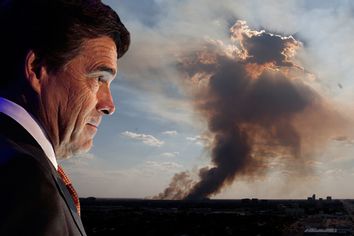
George Bush Park burst into flames on Sept. 13, one month to the day after Texas Gov. Rick Perry announced his candidacy for president of the United States. In a summer of fierce wildfires across Texas, the George Bush Park blaze was the first big fire to erupt inside the city limits of a major metropolis — in this case, Houston, the nation’s fourth largest city and the headquarters of the oil and gas industry, a major contributor to the man-made global warming that Gov. Perry famously insists does not exist.
The national media overlooked the George Bush Park fire, just as they ignored the link between climate change and the hellish summer Texas experienced, but the fire was big news in Houston. Local TV stations showed trees burning like torches, unleashing orange flames and black smoke.No evacuations were ordered, but guests at nearby hotels were spooked. “The hallways in the hotel here, you can hardly breathe,” said hotel guest Shawn Porter. “It’s in all the rooms. They’re getting filled with smoke.”
It took helicopters and fire trucks three days to get the fire 95 percent contained, according to the Texas Forest Service. By then, 1,623 acres had burned, an area the size of two Central Parks in New York City.
A week later, the park, which was named after the senior President Bush, was still recovering but back in service. Seeking relief from the 98-degree heat, a German Shepherd splashed in a pond named after Bush’s White House dog, Millie, while the pop-pop-pop of pistol shots rang out from one of the park’s practice ranges. In the burned area, however, the soil was still charred, the grass burned away. The trunks of shrubs and trees were as black and lifeless as charcoal.
Sizable though it was, the George Bush Park fire was a minor fire in the context of Texas 2011. Some 3.7 million acres of Texas have burned in the last 12 months, an area roughly equal to the state of Connecticut. Fires are still burning today, as the Texas Forest Service reports, yet Gov. Perry has offered little in the way of relief but the power of prayer and positive thinking.
“We’ll be fine,” Perry said in mid-August. “As my dad [a retired cotton farmer] says, ‘It’ll rain. It always does.’”
Perry’s followers among evangelical Christians like to talk about the “end of days,” when the Lord will return to judge the living and the dead. The ferocious heat and drought that have been punishing Texas for the last 12 months made it seem that the end of days might well be approaching, though not exactly in the way Gov. Perry and fellow evangelicals mean. As one region of the Lone Star State after another has been engulfed in flames and smoke, Texas appeared to have descended into the fires of hell.
- – - – - – - – - -
When President Obama criticized Perry on Sept. 25 as being “the governor of a state that is on fire [while he is] denying climate change,” Obama probably had in mind the fires in Bastrop, a bedroom community 25 miles east of Austin, the Texas capital. The Bastrop fires were so powerful, photogenic and devastating that they received not just statewide but national news coverage.
Responding to Obama, Perry spokesman Mark Miner told ABC News, “It’s outrageous President Obama would use the burning of 1,500 homes, the worst fires in state history, as a political attack.”
With Texas suffering the most severe one-year drought in the state’s history and the hottest summer in the entire nation’s history, firefighters were supremely challenged. In Bastrop, the heat of the fire “was so intense, our firefighters couldn’t get close enough to fight it [at first]. They had to shift to evacuation mode,” said Judge Ronnie McDonald, Bastrop’s highest-ranking local official.
“No one on the face of this Earth has ever fought fires in the face of such extreme conditions,” said the Texas Forest Service.
The Bastrop fires destroyed 1,633 homes and caused two deaths, reported Judge McDonald as he led a Salon reporter on a tour of the disaster zone on Sept. 23. Most of the homes that were destroyed had burned down to the ground, with nothing left standing but a stone foundation or chimney. Outside one house, a pickup truck had been scorched so intensely that its color had changed to a ghostly white.
In contrast to the three days required to subdue the George Bush Park fire, the Bastrop fires “burned for two weeks before we reached more than 90 percent containment,” McDonald added. As a result, more than 34,068 acres were scorched — an area larger than the entire city of San Francisco. The judge estimated that the town stands to lose 10 to 12 percent of its tax base.
Meanwhile, three other major fires had combined with the Bastrop blaze to encircle the state capital with flames and smoke. Lee Leffingwell, the mayor of Austin, was monitoring a fire in Steiner Ranch, a hilly area west of the city, when he saw a “huge cloud of black and gray smoke” in the eastern sky, coming from the Bastrop fire.
“Standing at the Steiner Ranch fire, we were surrounded by fire on all four sides,” Leffingwell told Salon. “We could see the Bastrop fire to the east, there was a fire in Leander to the north and a fire in Spicewood to the south.”
“It looked like we’d been bombed,” added Leffingwell, who served as a U.S. Navy pilot in Vietnam. “It looked like a war zone.”
- – - – - – - – - -
It was the Bastrop blaze, and the high-profile media coverage of it, that led Perry to leave the campaign trail and return to Texas on Sept. 6. The governor spent less than 24 hours in his fire-ravaged state. After a helicopter tour of the Austin area, he issued a statement calling the fires “as mean as I have ever seen” and expressing his thanks for “the brave men and women who put themselves in harm’s way to protect Texans’ lives and property.”
But Perry treated those same brave men and women quite differently three months earlier. In the name of balancing Texas’ budget, Perry and the Republican super-majority in the Legislature slashed fire protection spending, while also cutting spending for education, healthcare, parks and other state services. With a $10 billion shortfall to accommodate and revenue increases off the table thanks to Perry’s antipathy to raising taxes, the arithmetic demanded huge spending cuts. Thus a state fund that volunteer fire departments across Texas have historically drawn on to buy firefighting equipment, supplies and protective clothing was cut by a staggering 72 percent, from $25 million a year down to $7 million, according to Chris Barron, executive director the the state Firemen’s and Fire Marshal’s Association of Texas. The Texas Forest Service budget was also sharply cut, from $122 million down to $75 million.
“To cut is fine, but you can’t cut first responders — that’s a matter of life and death,” responded Texas state Sen. Mario Gallegos, a Democrat who spent 22 years as a firefighter and paramedic in Houston before entering politics. “Volunteer fire departments are the backbone of fire protection in this state, and they need heavy equipment and other resources to do their job. If they had had those resources, maybe we could have stopped those fires in Bastrop sooner and saved another 100 or 200 homes.”
“The 2012-13 appropriation for the Volunteer Firefighter Assistance Account is comparable to that in previous budgets signed by Gov. Perry,” Lucy Nashed, the governor’s deputy press secretary told Salon. “According to the Texas Forest Service, their funding level does not hinder their ability to fight fires…. The state has been and will continue to provide the Texas Forest Service and local officials with all available resources to fight these fires.”
Perry demanded these spending cuts in the spring of 2011, Gallegos added, “when there was no mystery that Texas was in the midst of a record drought and heat wave.” Indeed, it was in April that Perry convened the prayer rally where he urged fellow Texans to appeal for heavenly help against the drought. At the time, the governor was telling the Legislature that voter identification control and sanctuary cities for immigrants “were emergency issues” that required immediate attention, recalled Gallegos, who added, “I come from a public safety background, and to me, maintaining the forest service and fire protection during a time of record heat and drought is a real emergency, not this other stuff.”
Meanwhile, Perry was ignoring the findings of mainstream climate scientists in his state, whose research indicates that while climate change was not the primary cause of the hellish summer of 2011, it was undoubtedly a contributing factor. “This summer’s temperatures were about 5.4 degrees Fahrenheit above the long-term average in Texas,” John Nielsen-Gammon, the Texas state climatologist and a professor of atmospheric sciences at Texas A&M, told Salon. “My rough calculation is that about 74 percent of those 5.4 degrees was due to La Niña [the oceanic-atmospheric phenomenon that influences weather patterns across the Western Hemisphere] and about 9 percent from greenhouse gas emissions.” These higher temperatures made the impact of the drought worse, Nielsen-Gammon explained, by increasing evaporation and reducing soil moisture — thereby making trees and grasses more vulnerable to fire — while also boosting the demand for water on the part of humans and livestock.
“There are no skeptics involved in climate change science in Texas,” Nielsen-Gammon said, but public opinion is mixed. Appointed state climatologist in 2000 by Gov. George W. Bush, Nielsen-Gammon deals with skeptics by presenting the data and arguments on all sides of the issue before concluding, “Whether you believe this is what is going to happen with temperatures in the future or not, it’s a possibility you have to take seriously, because here’s the evidence.”
Nielsen-Gammon has never tried this approach on the state’s No. 1 climate skeptic, however. Gov. Perry, he says, has never asked for a briefing on climate change, nor have his top advisors.
- – - – - – - – - -
It’s no shock that a Texas governor would resist taking action against climate change; the oil and gas industry has dominated the state’s economy and politics for decades. As a state, Texas emits the most greenhouse gases in the U.S.; if it were a separate nation, it would rank as the world’s seventh largest emitter. When George W. Bush left the governor’s mansion for the White House in 2000, he quickly became the most hostile president to climate action ever to occupy the Oval Office.
But Rick Perry is well to the right of Bush on climate change, well to the right even of the oil and gas industry. Bush accepted the science of climate change for the most part, he just didn’t like the policy implications and sought, quite successfully, to torpedo them. Likewise, even Exxon-Mobil, the biggest funder of climate disinformation activities over the past 20 years, no longer publicly disputes the science of climate change; it simply refuses to do anything about it. By contrast, Perry’s rhetoric on the issue channels the paranoid extremism of the Tea Party and its corporate founders, the Koch brothers.
In his book, “Fed Up!,” Perry doesn’t engage the arguments pro or con about climate science or policy. He simply asserts that “it’s all a contrived phony mess that is falling apart under its own weight” and the economic effects of addressing it “could be absolutely devastating.”
As governor, Perry has been an enthusiastic booster of fossil fuel consumption and the corporations that profit from it. In 2005, he tried to fast-track construction of 11 new coal-fired power plants outside of Dallas that, as a complex, would have ranked as the single largest emitter of greenhouse gases in the U.S. On the very same day that Perry signed his executive order, the retired chairman of the utility company pushing the project, TXU, gave Perry a $2,000 check. TXU as a whole contributed $104,000 to Perry’s 2006 election campaign, highlighting a recurring theme in Perry’s gubernatorial career that will be the focus of Part 2 of this Salon special report: Perry’s willingness to do favors for big donors, including making Texas land available for a nuclear waste dump proposed by Dallas billionaire Harold Simmons, the second largest donor to Perry’s gubernatorial campaigns.
“Gov. Perry makes decisions in the best interest of Texas,” said deputy press secretary Nashed. “In the decade of the 2000′s Texas reduced ozone emissions by 27 percent — more than any other state — and reduced SO2 emissions by 32 percent and NOX emissions by 58 percent, all while remaining the nation’s leading energy producer and protecting jobs.”
Perry’s handling of the fires of 2011 does not appear to have hurt him politically, at least not yet. Perhaps seeking to contain the problem, Perry joined with legislative leaders on Sept. 15 to provide an additional $5 million to the volunteer fire department fund. It helps that neither the Texas nor the national media tend to connect the wildfires with climate change. The Houston Chronicle even came to Perry’s defense on his cuts to fire protection, saying he was falsely accused. Why? Well, the newspaper explained, because the cuts didn’t take effect until the new fiscal year on Sept. 1 — an odd defense to offer, considering that the Bastrop mega-fire did take place after Sept. 1, as did the George Bush Park fire.
The Texas Farm Bureau, which represents the state’s farmers and ranchers, also continues to support Perry’s budget decisions and handling of the drought, even though the drought has caused $5.2 billion of losses to Texas agriculture, according to official calculations, a figure that is expected to rise to at least $8 billion before year’s end. “Rick Perry has been a good governor, and we support elected officials making the decisions they need to make,” said Gene Hall, a genial former cattle rancher from east Texas who is the farm bureau’s director of public relations. Asked whether the bureau accepts the mainstream science view of global warming and climate change, Hall ignored the question of science in favor of condemning the policy of cap-and-trade, which the bureau vehemently opposes on the grounds that it would raise the costs of fossil fuel. “You just can’t produce a crop without putting diesel in the tractor and crossing the field a certain number of times,” explained Hall.
In the end, it is Perry’s combination of ideological fervor and his Pay-to-Play approach to politics that is most alarming about his potential ascension to president of the United States, according to critics. But friends and enemies alike agree that no one should underestimate the man.
“Rick Perry is not book smart, but he is very shrewd,” said Tom “Smitty” Smith, the executive director of Public Citizen Texas. “He’s one of the best politicians I’ve ever seen. He can connect with voters and he knows how to hire good staff and let them do what they need to do.”
But the drought and fires now afflicting Texas also illuminate the governor’s weaknesses, Smith added. “Perry is not a thinker,” Smith told Salon. “He lacks intellectual curiosity. So if he became president and faced a climate change crisis like we have today in Texas, he wouldn’t be able to get past his ideological, knee-jerk reaction and think his way out of it. Ideology and donors drive his policy decisions, so he tends to insist that his policies are right no matter what reality might say.”
Coming: Pay to Play: The greening of Rick Perry
Mark Hertsgaard (www.markhertsgaard.com) is an independent journalist who has covered politics and the environment for 20 years for leading outlets around the world, including Vanity Fair, Time, the Nation and the BBC. He is the author of six books, including most recently, “Hot: Living Through the Next Fifty Years on Earth.”
Continue Reading
Close
How long could you survive without your car? For the many Americans who think nothing of driving 10 blocks to buy a gallon of milk, the answer is obvious. But before any of you dedicated pedestrians and die-hard cyclists start feeling smug, try this question: How long could you survive without talking?
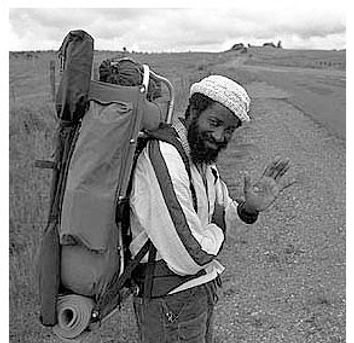
Chances are, nowhere near as long as John Francis did. After a massive oil spill polluted San Francisco Bay in 1972, Francis gave up all motorized transportation. For 22 years, he walked everywhere he went — including treks across the entire United States and much of South America — hoping to inspire others to drop out of the petroleum economy.
Soon after he stopped riding in cars, Francis, the son of working-class African-American parents in Philadelphia, also stopped speaking. For 17 years, he communicated only through improvised sign language, notes and his ever-present banjo. The environmental pilgrim says he took his vow of silence as a gift to his community “because, man, I just argued all the time.” But it may have been Francis who benefited most of all. For the first time, he found he was able to truly listen to other people and the larger world around him, transforming his approach to both personal communication and environmental activism.
Francis started speaking again on Earth Day 1990. The very next day, he was struck by a car. He refused to ride in the ambulance, insisting on walking to the hospital instead. With a Ph.D. in land resources (earned during his silence), he was later recruited by the U.S. Coast Guard to write oil spill regulations and by the United Nations Environment Program to serve as a goodwill ambassador.
Francis, the author of “Planetwalker: How to Change Your World One Step at a Time,” is preparing for a second environmental walk across America. I spoke with him about how social change happens, the decency he encountered among red-state Americans, and the importance of bridging the chasm between white and black environmentalists.
Why did you stop riding in motorized vehicles?
This was the first time I had ever been exposed to an environmental insult of such magnitude — 400,000 gallons of oil spilling into San Francisco Bay. And I couldn’t get away from it. You could close your eyes, you could turn around, but you just couldn’t get away from the impact of it. The smell was overpowering. I decided I wanted to do something, but I didn’t know exactly what. I mentioned to a friend that I wanted to stop riding in cars, and she laughed at me and I laughed at myself and that was the end of it.
It wasn’t until a neighbor died the next year that I … He had a good job as a deputy sheriff, he had a wonderful wife, lovely kids, he just had everything. And from one day to the next, he was gone. So I realized there weren’t any promises. If I was going to do anything, I had better do it now. Because now is the only time we have to do what we need to do.
But one could have that feeling and say, “OK, I’m going to join the Sierra Club. I’m going to write my senator. I’m going to carry a picket sign outside the oil companies.” Not many people would say, “I’m going to stop riding in motorized vehicles.” Did it strike you as extreme?
It did. But it struck me as the most appropriate thing I could do. I could join the Sierra Club, I could carry picket signs, and people have been doing those things. But in my life, what could I do? And that was: not ride in cars. And I thought everyone would follow. [Laughs.]
You write about this in the book, that you had an inflated sense of yourself at that time. Not long after, you took a very radical step to confront that.
As I walked along the road, people would stop and talk about what I was doing and I would argue with them. And I realized that, you know, maybe I didn’t want to do that. So, on my [27th] birthday, I decided I was going to give my community some silence because, man, I just argued all the time. I decided for one day, let’s not speak and see what happens.
I’m going to read a passage from your book about your decision to stop speaking: “Most of my adult life I have not been listening fully. I only listened long enough to determine whether the speaker’s ideas matched my own. If they didn’t, I would stop listening, and my mind would race ahead to compose an argument against what I believed the speaker’s idea or position to be.”
That was one of the tearful lessons for me. Because when I realized that I hadn’t been listening, it was as if I had locked away half of my life. I just hadn’t been living half of my life. Silence is not just not talking. It’s a void. It’s a place where all things come from. All voices, all creation comes out of this silence. So when you’re standing on the edge of silence, you hear things you’ve never heard before, and you hear things in ways you’ve never heard them before. And what I would disagree with one time, I might now agree with in another way, with another understanding.
Some people reading this interview might say, “That sounds awfully passive, if all you do is listen when ExxonMobil says there’s no global warming or when the Bush administration says we can have healthy forests by cutting them down.” Is there a danger that the philosophy you’re expounding is too passive in the face of environmental destruction?
There’s always a danger for anything to become not appropriate. But at the same time that I was listening, I was also walking. I was making a statement for other people to see and perhaps to inspire them. The most you can do is be who you are and do what you do. You’re the only person you really have a moral obligation to change. What everyone else does, you don’t have any control over that.
You began walking in the 1970s here in Northern California. Your first long walk was to Sacramento, the state capital, to testify before a Senate committee. Then you took a longer walk up the coast to the Pacific Northwest. Eventually you walked across the entire country. You were an African-American man, with a banjo and a backpack, and you were silent. Did people treat you as an oddity?
Well, you know, I did look different.
Even for the 1970s!
Even for the 1970s. [Laughs.] I realized early on that I was gonna have to not worry about how I looked. It was really good for me to let my image go, the image I had before — that I had to wear the right clothes, drive the right car, use the right cologne. All those things went out the door, and I allowed myself to be a clown.
Nowadays, many of us think about America as split between red states and blue states. Was that your experience while walking across the country?
Well, I walked across a lot of red states, and the people in those states were just as generous, or even more so, as the people in blue states. In fact, when I walked across the country, there were no red states, there were no blue states; it was just America. People you might think would not bring me into their home brought me into their home and put me down at the table with their family, with their children, and invited me to stay.
In your book you argue that the environmental crisis is really a crisis of the human spirit. Does that mean we have to wait for humans to become better people before we can solve the environmental problem?
I’m not sure I would say that humans are going to become better people, but I think humans are going to become who we are. Frankly, I look at my life and I go, “God, I have great hope for everybody!” Because I look at where I came from, and I could never have seen me walking across the country, silently going to school, and 20 years later I’m in Washington, D.C., writing federal oil-pollution regulations. Looking at my journey, which is part of all of our journeys, I have great hope.
As an environmentalist who is black, do you think the chasm between white environmentalists and nonwhites will ever be bridged?
It has to be. How we relate to one another is essential to environmentalism. If you’re not talking about human rights, economic equity, mutual respect, you’re not really dealing with the environment. Trees are wonderful. Birds and flowers are wonderful. They’re all part of the environment. But we’re part of the environment too and how we treat each other is fundamental.
The day after you began to speak again, you were hit by a car on the streets of Washington, D.C. I can imagine some people saying, “The universe was sending a message there.”
I was thinking, “The universe is sending a message.” I’m lying there, and the ambulance comes and they’re strapping me down and I said, “Where are we going?” And the ambulance person says, “We’re taking you to the hospital, you’ve been hit by a car.” And I said, “You know, I think I can walk.” They stop and look at me and say, “Walk? You can’t walk. You’ve been in an accident.” And I said, “Well, I don’t ride in automobiles. I haven’t ridden in an automobile for 17 years. In fact, I didn’t speak for 17 years. I just started speaking yesterday.” And that’s when I see ‘em start thinking, “We’re taking him to St. Elizabeth’s [psychiatric hospital] for observation.”
Finally one of the women said, “Why are you afraid of riding in cars? Is it a religious thing?” And I said, “No, it’s not religious.” “Is it a spiritual practice or something?” I said, “No.” She says, “Well, it’s principles, huh?” And I grab on to that: “Principles! Yes, it’s principles!” And she tells me, “Honey, if you can suspend your principles for five minutes, we can drive your butt to the hospital.” And I think about it, and all I come up with is, “I don’t think principles work that way. You can’t just suspend them for five minutes.” Eventually, they let me walk.
In 1994, after 22 years, you decided to ride in vehicles again. Why?
Walking had become a prison for me. While it was appropriate to stop walking when I did, over the years it had calcified, because I never revisited my decision not to ride in cars. [One day,] as I was walking, I thought about the fact that I had worked at the Coast Guard, I had worked on the Exxon oil spill. And if they had said to me, “John, we could hire you, but you have to ride in a car and fly a plane,” I would have said, “I’m sorry, I guess I can’t work for you then.” And that would have been the wrong answer. So I decided I needed to break out of the prison.
You were on the Venezuela-Brazil border when you stopped walking. How did it feel?
There were two women from the Netherlands who were walking with me. And when I got into the bus [on the border], they looked at me like, “Oh God, something’s going to happen to him. He’s gonna start crying or whatever.” But I didn’t. I just got in and I realized that I was in a VW now and I could feel the industry of transportation. I could feel the cogs of transportation. You know, the asphalt road, the gears turning, the fire, the pistons banging and the fuel exploding — I could feel all that. It was a very interesting moment for me.
No guilt?
No guilt at all. This was the decision I was going to make.
You’re about to start another long walk, and obviously you’re a little older now and you have a family. You’ve talked a little bit about how you hope walking will affect the world around you. How about the world inside you? How will this time be different?
I don’t know how I’m going to change. I don’t know how it will change me. That’s part of the mystery of walking, is that the destination is inside us and we really don’t know when we arrive until we arrive. One of the biggest epiphanies that I’ve had was that, you know, environmentalists like to look at the industrialists or at the developers and say, “They gotta change. If they would change, everything would be all right.” But really, we all have to do that. We all need to look at ourselves. We need to reimagine ourselves.
Continue Reading
Close
Florida Democrats’ decision to unanimously back Howard Dean as the new chairman of the DNC (Democratic National Committee) shows two things: first, there are still some Democrats out there — including in the supposedly hopeless South — who have brains and guts and aren’t afraid to think for themselves; and second, Dean now has a real shot at winning the DNC job and launching a much-needed makeover of the Democratic Party.
Political and media elites in Washington are at once horrified and dismissive of Dean’s quest. They insist that Democrats would be crazy to pick a raving liberal like Dean as their next party chairman. But as is so often the case, this inside-the-Beltway conventional wisdom is based on dubious “facts” and assumptions about how ordinary Americans relate to politics. Dean is exactly the leader Democrats need to become relevant again.
The Florida Democratic chairman’s statement to the New York Times reveals just how out of touch the Washington establishment is: “I’m a gun-owning pickup-truck driver and I have a bulldog named Lockjaw,” said Scott Maddox. “I am a Southern chairman of a Southern state, and I am perfectly comfortable with Howard Dean as DNC chair.”
And the reason Florida Democrats like Dean?
“What our party needs right now is energy, enthusiasm and a willingness to do things differently,” Maddox added. “I think Howard Dean brings all three of those things to the party.”
Maddox isn’t the only prominent Southern Democrat backing Dean. On Tuesday, the state chairman from Mississippi and the vice chairmen from Oklahoma and Utah announced that they too were endorsing the former Vermont governor, leading ABC News’ influential The Note to declare that Dean “is now emphatically the front-runner” for the DNC job.
A year ago, Dean was jeered off the national stage by television’s nonstop coverage of his “scream” speech. And it must be admitted that he showed some undeniable weaknesses as a presidential candidate in 2004, including a tendency to speak first and think later. But Dean is running for party chairman now, not president. The chairman’s job is to rally and organize the party faithful to do the unglamorous but vital grass-roots work that will expand the Democratic base, reach out to new and uncommitted voters, and win future elections. As Maddox said, Dean fits that job description perfectly. He inspires grass-roots enthusiasm and his time as governor of Vermont grants him the necessary executive and administrative skills.
What’s more, in the wake of the Democrats’ loss to President Bush in November, Dean’s political message, and especially the way he delivers it, looks better and better.
Dean, after all, was right about the central issue of the 2004 election — the Iraq war. Nowadays, a majority of the American public believes that attacking Iraq was a bad idea. Dean was saying this — and being criticized for it — in the fall of 2003.
Dean was also right when he said Democrats should be the party not only of urban liberals but of “guys with Confederate flags in their pickup trucks,” another comment he was derided for. But in view of how many centrist voters chose President Bush over John Kerry, even though Kerry’s economic policies would have benefited them more, Dean’s call to reach out to culturally conservative voters was prescient.
Above all, Dean was right that Democrats would win only if they told voters exactly what they stood for and why. Kerry never did that, especially on Iraq, where his reluctance to call the war (and not just its prosecution) a mistake let the president off the hook on his most vulnerable issue.
By contrast, Bush never shrank from saying what he believed. Like Dean, he understood a basic fact of American politics: voters value plain-spokenness in a politician much more than agreement on specific issues. Bush was even clever enough to steal one of Dean’s signature lines: “You may not always agree with me, but you’ll always know where I stand.”
All of the news stories reporting Dean’s decision to seek the DNC chairmanship repeated the standard rap against him: He’s too liberal. But that charge doesn’t reflect reality so much as it reflects the Washington establishment’s version of reality. Dean was labeled a liberal by the media essentially because he opposed the Iraq war. Never mind that he was also a deficit hawk who opposed gun control, gay marriage and universal healthcare, or that many conservatives later embraced his criticism of the war. In the post-Sept. 11 mood of false patriotism, the media assumed that anyone who criticized an apparently successful war had to be a liberal, and that was that.
This mischaracterization has led observers to miss the real source of Dean’s appeal to a jaded electorate: He knows what he believes and he’s not afraid to say it plainly enough for ordinary people to understand. His vision for Democrats is not about moving the party to the left; it’s about Democrats standing for something that resonates with ordinary Americans — a task that current party leaders have manifestly failed to achieve.
Dean believes the Democratic Party’s allegiance to big donors and cautious incrementalism has alienated many of its logical voters. Alone among prominent Democrats, he recognizes that the party has little future if it cannot connect in an authentic way with the extraordinary grass-roots energy that propelled his own presidential campaign (and that later nearly got Kerry elected, despite the Kerry campaign’s many shortcomings).
In 2004, Dean rewrote the rules of presidential campaigns by using the Internet and local “meet-ups” to raise small donor money. But Dean’s real secret was to give supporters real influence within his campaign and thus hook them on continued political participation. The idea of meet-ups, for example, came from the grass roots, not from campaign headquarters.
The Bush campaign tapped into similar grass-roots energy among conservatives and thereby expanded Republican turnout enough to gain the president a second term. Democrats must do more of the same in the years to come, and Dean is the leader who best understands that imperative. Dean, after all, is a populist. And his populism is not the brand espoused by President Bush — a millionaire who shills for billionaires while talking like the common man. Dean’s is the real thing. Which is why Republicans privately fear him.
Another part of the media consensus on Dean is that he only wants the DNC job to grease his run for president in 2008. For his part, Dean has declared he won’t run if he gets the DNC job. Of course, he could change his mind. But it’s worth remembering that presidential candidate Dean always said that Democrats must first reform their party and its approach to politics if they want to win the White House.
Dean is now traveling around the country telling his supporters that remaking the Democratic Party is a long-term project that could take 20 years. His first hurdle comes on Feb. 12, when 447 largely unknown party officials from around the country will vote for the next DNC chairman. The Florida and other Southern Democrats’ decision to back him will, of course, be enormously helpful to Dean’s prospects, but it also figures to call forth still more “anyone but Dean” efforts from the party establishment.
Everyone agrees the Democrats have to remake themselves; they just lost to perhaps the most vulnerable incumbent in history. The DNC vote will give the first hint of how they plan to proceed. At a time when America has never needed an effective opposition party more, let us pray Democrats can rise to the challenge.
Continue Reading
Close
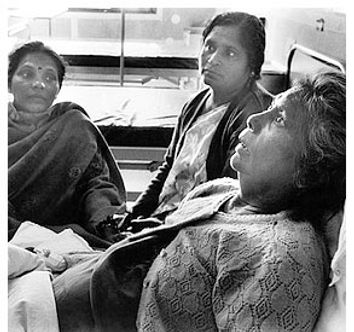
On the night her world changed forever, Rashida Bee was 28 years old and had already been married for more than half her life. Her parents, traditional Muslims, had selected her husband for her when she was 13. He worked as a tailor, and they lived together in her parents’ modest home in the industrial city of Bhopal, in central India. Bee hadn’t learned to read or write, and she ventured out of the house only when escorted by a male relative. It was nevertheless a full life; her extended family of siblings, nieces and nephews numbered 37 in all.
The fateful night came on a Sunday. Bee and her family had gone to bed after sharing a simple supper. But shortly after midnight, in the early hours of Dec. 3, 1984, Bee was awakened by the sound of violent coughing. It was coming from the children’s room. “They said they felt like they were being choked,” Bee later told the online environmental magazine Grist, “and we [adults] felt that way too. One of the children opened the door and a cloud came inside. We all started coughing violently, as if our lungs were on fire.”
From out on the street came the sound of shouting. In the light of a street lamp, Bee saw crowds of shadowy figures running past the house. “Run,” they yelled. “A warehouse of red chilies is on fire. Run!”
A few blocks away, a woman who would later become a dear friend of Bee’s was also running for her life. Champa Devi Shukla, a 32-year-old Hindu, lived down the street from the pesticide factory owned by Union Carbide. She knew better than to believe the rumors about a warehouse fire. “We knew this smell because Union Carbide often used to release these gases from the factory late at night,” Shukla later told me. “But this time it went on longer and stronger.”
Shukla was right. An explosion inside the Union Carbide factory had sent 27 tons of methyl isocyanate gas wafting over the city’s shantytowns. “The panic was so great,” said Shukla, “that as people ran, mothers were leaving their children behind to escape the gas.”
In the pandemonium, Bee too was separated from most of her family. She found herself running with her husband and father, but they didn’t get far. “Our eyes were so swollen that we could not open them,” she recalled. “After running half a kilometer we had to rest. We were too breathless to run, and my father had started vomiting blood, so we sat down.”
The scene around them was apocalyptic. There were corpses everywhere, many of them children. Those people still alive were bent over double or splayed on the ground, retching uncontrollably or frothing at the mouth. Some had lost control of their bowels, and feces streamed down their legs.
Exactly how many people died that night will never be known; many corpses were disposed of in emergency mass burials or cremations without documentation. Bee remembers that as she searched for family members in the following days, “I had to look at thousands of dead bodies to find out if they were among the dead.”
Perhaps the most extraordinary fact about Bhopal is that no one has faced trial for what happened that night. Even though Union Carbide’s own safety experts had warned two years before of a “serious potential for sizable releases of toxic materials,” the managers of the Bhopal factory had no system in place to warn and evacuate residents in the event of an emergency. Indian government officials likewise failed to insist upon such basic precautions. And as thousands of survivors streamed into local hospitals that night, Union Carbide spokesmen actively denied that methyl isocyanate was poisonous, calling it “nothing more than a potent tear gas.”
Corporate officials have never answered in a court of law for their actions. Such an evasion of legal accountability would be inconceivable if the disaster had occurred in the United States or Europe. Had the victims been affluent Westerners rather than impoverished Indians, they would have had their day in court long ago.
India’s courts have tried to pursue justice for Bhopal’s citizens, but they have been thwarted. In 1991, an Indian court ordered Union Carbide officials, including Warren Anderson, the CEO at the time of the disaster, to face criminal charges. After Anderson and the other defendants failed to appear, India’s Supreme Court named them “proclaimed absconders” — that is, fugitives from justice — and pressed for their extradition. After sitting on the extradition request for years, the U.S. State Department refused it without explanation in September 2004.
Bhopal survivors, however, have never stopped pressing their demands for a proper trial, appropriate compensation for victims, and sufficient medical, economic and environmental rehabilitation for survivors. And in this 20th anniversary of their struggle, they have gained new allies. In April, Bee and Shukla won the Goldman Prize, the biggest environmental award given in the United States. And this week, Amnesty International endorsed Bhopal activists’ demands in a report launching Amnesty’s first major campaign targeting a corporation for allegedly violating the human right to a healthy environment.
Amnesty’s report, “Clouds of Injustice,” estimates that 7,000 to 10,000 people died in the first three days of the Bhopal disaster, and that 15,000 more have died in the years since. An additional 100,000 continue to suffer chronic, largely untreatable diseases of the lungs, eyes and blood. Meanwhile, a new generation in Bhopal endures an epidemic of infertility and grotesque birth defects, including missing palates and fingers growing out of shoulders, in part because of continuing contamination of the groundwater.
Bhopal thus ranks as the single deadliest industrial disaster of the modern environmental era. With a death toll of approximately 22,000, it has killed more people than the nuclear disaster in Chernobyl, Ukraine, did. And its victims are still dying today, 20 years later.
Each Dec. 3, on the anniversary of the disaster, Bee and Shukla join other marchers who parade with an effigy of Anderson through the streets of Bhopal and then burn it. Bee and Shukla continue to hold Anderson, now 83 and retired, personally responsible for the Bhopal disaster, which they insist on labeling “a crime” rather than an “accident.” “It was Anderson’s criminal negligence and insistence on cost-cutting that led to the disaster,” Shukla said.
Internal Union Carbide documents, released in the 1990s during the discovery phase of a civil lawsuit against the company, seem to support Shukla’s contention. A 1973 document, signed by Anderson, notes that the technology that would be used in the Bhopal factory was “unproven.” A safety review conducted by Union Carbide experts in 1982 warned of a “serious potential for sizable releases of toxic materials” at the factory.
John Musser, a company spokesman, confirmed the existence of the 1982 study but asserted, “None of the issues [it] raised would have had an impact on the fatal gas leak, and all of the issues had been addressed by the plant well before the December 1984 disaster.” The real culprit, the company insists, was sabotage.
Anderson now appears to be living the life of a wealthy recluse, with luxury homes in Bridgehampton, N.Y., Manhattan and Vero Beach, Fla. Company officials declined to provide contact information for him for the purposes of this article. But when Bee and Shukla toured the United States last spring after winning the Goldman Prize, they considered trying to find Anderson and confront him face to face.
“We don’t want him hanged or anything,” Shukla said. “But he has to understand what it means to be cut off from one’s family, what it is to suffer alone.”
“If we see him,” Bee added, “we will ask: If you are innocent, why are you hiding and not answering questions about what happened in Bhopal?”
Both Bee and Shukla lost loved ones in the disaster. Seven members of Bee’s extended family died during or as a result of the disaster, and her husband was left too ill to continue his work as a tailor. Shukla lost her husband and two sons. A daughter later suffered three miscarriages, a grandson died, and a granddaughter was born with a cleft lip and a missing palate.
“The gas disaster was sudden, one night, but the last 20 years have also been miserable,” Shukla said. “People still have pain and breathlessness, and now we are seeing cancers too. There is mental and physical retardation among children. Many women are sterile or never begin menstruating, so men don’t want to marry them.” A 2002 study commissioned by Greenpeace International but conducted by independent scientists concluded that Bhopal’s groundwater contains heavy metals and levels of mercury millions of times higher than recommended. (Company spokesman Musser disputes those conclusions, citing studies in the late 1990s by government agencies in India.)
One bright spot has been the founding of the Sambhavna Trust Clinic to treat survivors of the disaster. Founded in the belief that compassion can create hope from despair, its name translates from Hindi as the Compassion Trust Clinic. Since opening its doors half a kilometer from the blast site in 1996, the clinic has treated thousands of Bhopal victims by combining the best of both Eastern and Western healthcare.
The staff biochemist, for example, doubles as a yoga teacher. Yoga is central to the clinic’s approach, as is ayurvedic medicine. Patients pay nothing for treatment, even though they get far more care than at the crowded public hospitals that India’s poor usually visit. First-time patients at Sambhavna have broken down in tears, the clinic’s Web site reports, because “in 15 years no doctor had ever listened to their chests or taken their pulse during examination.”
Yoga therapies have produced some of the most remarkable results. Chronic respiratory disorders are Bhopal gas victims’ most prevalent complaint. A two-year study Sambhavna conducted indicates that regular yoga produces significant improvement in lung function; more than half of all yoga patients were able to stop taking pharmaceutical drugs treating breathlessness.
The clinic’s staff includes community health workers who go door to door to monitor public health in Bhopal — a key task since official monitoring stopped in 1994. These surveys aid doctors by showing which diseases are increasing. More broadly, the surveys prove that, 20 years later, locals continue to fall sick and die in large numbers.
Sambhavna’s holistic approach sees both illness and healing in a social context. The clinic thus insists that the long-term solution to disasters like Bhopal is to eliminate hazardous chemicals from the environment altogether. Until then, “exemplary punishment” of corporate polluters is essential — not only to achieving justice for Bhopal but to preventing future Bhopals elsewhere.
Along with activists from around the world, Bee and Shukla are seizing upon the 20th anniversary of the disaster this week to launch a renewed campaign for justice in Bhopal and, more broadly, to demand meaningful international regulation of toxic substances and the corporations that produce them. The Web site of the International Campaign for Justice in Bhopal lists numerous planned actions and media events.
The most important development is the addition of Amnesty International to the campaign for justice in Bhopal. The human rights group’s reputation for fearless evenhandedness lends weight to the conclusions in its “Clouds of Injustice” report. The report charges Union Carbide with “serious failures” at Bhopal, including ignoring “overwhelming evidence” of safety problems before the disaster, withholding information from doctors and investigators, and trying to avoid its legal and financial responsibilities for the disaster by shifting corporate ownership and dodging court dates.
The legal case against Union Carbide is complicated by the fact that Dow Chemical purchased all shares of Union Carbide in 2001 yet denies any legal responsibility for Carbide’s past actions. “Dow remains firm in its position that in acquiring the shares of Union Carbide it acquired no new liability,” says spokesman Musser.
This novel legal theory — that one company can buy another company’s assets but not its liabilities — may soon be tested. Nitynand Jayaraman of the International Campaign for Justice in Bhopal says that activists plan to press the Indian government to include Dow Chemical in the outstanding criminal case against Union Carbide; the government could then attach Dow’s assets if it refused to appear in court. Gary Cohen, the director of the Environmental Health Fund in Washington, says, “Dow wants to expand in India, and we’re going to make that very difficult” — by raising questions about the trustworthiness of a corporation that refuses to heed a court summons.
Amnesty International has urged Dow Chemical, as Union Carbide’s new corporate parent, to take a series of actions to make amends. Those actions include paying for a full cleanup of the Bhopal site and its contaminated groundwater, standing trial as requested in India, and paying full economic, medical and environmental reparations to the victims. More broadly, Amnesty echoes activists’ call for tougher regulation of chemical production, especially in impoverished communities and countries. “Clouds of Injustice” proposes that the United Nations adopt an “international human rights framework that can be applied to companies directly” to ensure “transparency and public participation in … the operation of industries using hazardous materials.”
A further complication to this case is that Union Carbide did pay $470 million to the government of India in 1989 to settle all claims related to Bhopal. But there is much less to that settlement than meets the eye. The $470 million figure was based on now-discredited estimates that only 3,000 people died at Bhopal; the actual death toll is at least seven times that many. What’s more, says Bee, “Carbide made that settlement with the government, not with the people affected. We don’t accept it.” And $330 million of the settlement money has been tied up in legal wrangling instead of reaching victims. When India’s Supreme Court ordered in July that the $330 million be distributed forthwith, activists appealed the ruling, arguing that victims deserve four times that much.
Independent experts, including authors Arun Subramaniam and Ward Morehouse in their book “The Bhopal Tragedy,” have estimated the total damages of the disaster — including healthcare for survivors, compensation for families left without breadwinners, and restoration of local ecosystems — total anywhere from $1.3 billion to $4 billion. Activists have filed a civil suit in the United States in an effort to force Dow Chemical to pay proper compensation.
Whatever the exact amount owed, it’s clear that the people of Bhopal have been terribly mistreated. First they were left defenseless against a horrific but predictable disaster; then they were given a legal runaround for 20 years instead of just compensation for their suffering. There are many shades of gray in life, but sometimes the truth is black and white: It is shameful for Dow Chemical/Union Carbide to keep ducking its obligations in Bhopal and shameful for the U.S. State Department to help it do so. Doing the right thing — standing trial and facing a court’s judgment — may cost the company financially, but continuing to stonewall could blacken its reputation forever.
Continue Reading
Close
Foreigners say over and over that it’s George W. Bush they dislike, not all Americans. But what if Americans give Mr. Bush a second term as president on Nov. 2? Will foreigners still say it’s the man in the White House who is the problem, not the voters who put him there?
The U.S. presidential election is widely seen as too close to call, but one thing is clear: If the rest of the world could vote, Bush would lose in a landslide.
The most recent evidence came last week, when major newspapers in 10 countries released the results of a series of coordinated opinion polls. Thousands of people in Japan, Great Britain, Israel, Mexico, Spain, Russia, South Korea, France, Canada and Australia were asked their views about Bush, challenger John Kerry, the war in Iraq and the global role of the United States. By a 2-to-1 margin, foreigners opposed a second term for Bush. Only in two terror-traumatized countries, Israel and Russia, did a majority of respondents favor Bush over Kerry.
Most foreign governments seem to share their citizens’ desire for Bush’s defeat, even if diplomatic constraints keep them from saying so publicly. “Even off the record, government officials will not tell you this,” a spokesman for a major European nation told me in June, “and I am not telling you this now.” But his mischievous smile left little doubt about his true feelings.
What is striking is how foreign governments and ordinary citizens alike invariably emphasize that their antipathy toward Bush does not extend to America, or Americans, at large.
“We Like Americans, We Don’t Like Bush,” ran the headline in the British newspaper the Guardian. “Bush Is the Problem,” explained the headline in South Korea’s Joong Ang Ilbo newspaper.
The fact that foreigners make this distinction may comfort Americans, but it shouldn’t be taken for granted. After all, in a democracy — and don’t most Americans think we have the greatest democracy in the world? — the people are responsible for the government they elect.
Of course, one can argue that Americans didn’t really elect Bush the first time. Al Gore won the popular vote in 2000 by half a million votes, but Bush ended up as president with help from his brother, the governor of Florida, and a Republican-dominated Supreme Court.
But whatever the absurdities of the Electoral College that governs U.S. presidential elections, the rules are the rules, everyone knows them and each side has had plenty of time to get ready for this year’s showdown.
If Bush does win on Nov. 2, Americans will in effect be saying to the world that we endorse his bellicose, highhanded, unilateralist approach to international affairs. In that event, why should foreigners keep drawing a distinction between an American president they deplore and the American population that gave him four more years in power?
The fact is, Americans have long benefited from the world’s forgiving attitude of not blaming us for our government’s actions. It has been a recurring theme throughout the 20 years that I have traveled abroad as a journalist, and I heard it repeatedly in 2001, when I spent six months before and after the Sept. 11 attacks visiting 15 countries in Europe, Africa, Asia and Central America.
I was researching a book about why the United States fascinates and infuriates the world. As I interviewed people from all walks of life, I heard them differentiate again and again between America the country — its people, its ideals, its wealth, technology and popular culture — all of which they admired, and the American government, which often they did not.
A few days after the Sept. 11 attacks, I interviewed Ana, a middle-aged intellectual in Barcelona, Spain. She told me, “I love the music of Motown and the movies of Hollywood. After all these years, I feel that your culture is now our culture too. But we do wish our American friends would think more about their government, because we have to live with America’s policies and that is often difficult, especially when war is in the air.”
Most Americans don’t realize it, but when we elect our president, we are also electing the de facto president of the world. The U.S. government shapes basic realities for people all over the planet: Will there be war? Will interest rates rise or fall? Will universal threats like global climate change be combated or ignored?
Because the United States exercises such decisive influence over the lives of everyone else on this planet, some foreign opinion leaders have begun suggesting that non-Americans should also be able to vote for who runs the United States.
Abdel Monem Said Aly is a columnist for Al-Ahram, Egypt’s leading daily newspaper. When I interviewed him in Cairo, he said, “I have wanted to write an opinion article for the New York Times urging that American elections be opened to foreigners, because what the American government decides about economic policy, military action and cultural mores affects me and all other people around the world.”
Said Aly’s idea makes a certain sense, but it won’t happen anytime soon. For the time being, foreigners will remain at the mercy of the U.S. electorate. Today, people the world over say they like Americans despite our government. But will they still love us tomorrow, if we return that government to power on Nov. 2?
If Americans give Bush another four years as president, the popular global backlash could be intense, including not just rhetorical denunciations of American stupidity but perhaps boycotts of American products and worse. And for the first time, overseas anger may come not only from fanatical militants but ordinary citizens, and it may be directed not only at George W. Bush but also toward the ordinary Americans who put him back in office for another four years.
In that unhappy event, we Americans will have no one to blame but ourselves.
On the other hand, if Americans vote Bush out on Nov. 2, it will signal the world that its affection for us is both recognized and reciprocated. And that — to borrow a line from one of the movies that have made American culture so beloved around the world — could be the start of a beautiful friendship.
Continue Reading
Close