Martha Barnette

Field report: The “Oz” convention

Last weekend's gathering featured everything from real Munchkins to a newly authorized pillbox depicting Dorothy and Toto. (A Judy Garland pillbox? Hello?)

  • more
    • All Share Services

Field report: The

Yes, it’s true: There were reports of Munchkins unwinding with wild orgies after a hard day’s work skipping around the Yellow Brick Road during the filming of 1939′s “The Wizard of Oz.” And yes, Judy Garland once referred to the actors who depicted the denizens of Munchkinland as “drunks,” telling a national TV audience, “They got smashed every night, and the police had to pick them up in butterfly nets.”

But Jerry Maren, the original Lollipop Kid, says that reports of the Munchkins’ debauchery were greatly exaggerated. In fact, he recently told a roomful of fans, the misadventures of fewer than a dozen wild-and-crazy actors unfairly sullied the reputation of all 124 Munchkins. You’d have learned all kinds of things like that if you’d attended the International Wizard of Oz Club’s special centennial celebration at Indiana University in Bloomington last weekend.

At the “Meet a Munchkin” panel, for example, Maren, now in his 80s and sporting a salt-and-pepper beard, noted that he and his fellow little people on the set made $50 a week (less than half of Toto’s pay) during the making of the classic film. “How could you get drunk on $50 a week?” groused Maren, who presumably made more for his appearance much later in the “Yada Yada” episode of “Seinfeld.”

And while we’re at it: Despite a persistent urban legend, there is no dead Munchkin hanging from a tree in the forest where Dorothy, the Scarecrow and the Tin Woodsman first traipse off together. (Nor is there a dead stagehand, a despondent actor or, in the story’s latest incarnation, a dead Munchkin wrapped in aluminum foil hanging from a tree.) “Can you imagine that happening with 124 midgets looking?” scoffed Maren, who wrapped up his remarks with a demonstration of how he hefted the oversize lollipop from his shoulder and handed it to Dorothy — a reprise that earned him a standing ovation.

I’d come to Bloomington hoping to learn why L. Frank Baum’s classic children’s book still retains such a hold on the American imagination exactly 100 years after its publication. I also wanted to find out what had impelled nearly 400 fans from around the world to converge for four days of festivities that included the panel featuring four of the 11 remaining Munchkins.

Other events included a session examining Oz’s unique attraction for gay men, lectures by Baum descendants, a Sunday morning Oz-themed Christian worship service led by a Methodist pastor and self-described minister of the “g-Oz-pel” and a multimedia presentation about a planned $860 million Oz theme park in (where else?) Kansas.

Luring participants from as far away as Tokyo, Tel Aviv and Moscow — the “Oz” story is wildly popular in Russia — the conference threw together an oddly eclectic mix of people, from pointy-headed academics to collectors hot on the trail of “Oz” memorabilia.

Scholars in attendance included Pulitzer Prize-winning novelist Alison Lurie, who lectured on “Oz and the New Woman” — Baum’s mother-in-law, it turns out, was noted suffragist Matilda Joslyn Gage — and Michael Patrick Hearn, an authority on children’s literature. Hearn noted that many serious writers have acknowledged the influence of “Oz” on their work, including Eudora Welty, Ray Bradbury, Robert Heinlein and Gore Vidal, who, when asked to name his three greatest literary influences, replied “Montaigne, Petronius and L. Frank Baum.” Salman Rushdie has also acknowledged an intellectual debt to “Oz,” even if he also once memorably characterized Toto as “that little yapping hairpiece of a creature, that meddlesome rug, that turbulent toupee.”

At the other end of the spectrum were the “Ozzies” for whom true fandom means collecting tchotchkes and gewgaws and kitsch (oh my!). In fact, it was hard to turn around without running into “Oz” memorabilia or people scrambling to find more of it — everything from “If I Only Had a Brain” T-shirts to 1940s Oz-themed peanut butter cans to a newly authorized pillbox featuring Dorothy and Toto. (A Judy Garland pillbox? Hello?)

“Almost everybody goes through the same thing,” explained Richard Rutter, a California professor of orthodontics who has been collecting for 25 years. “The first thing you want to do is get all 40 books” in the “Oz” canon, which includes Baum’s work as well faithful sequels by other authors. “Then you realize one of your books looks a little ragged around the edges, so you want a better copy,” he told me. One thing leads to another, and before long, you’re hooked.

Since Rutter had just wowed a crowd with a 320-slide presentation of his Scarecrow memorabilia, I figured he knew what he was talking about. In fact, he recently added an extra room to his home (complete with a yellow brick road, of course) to accommodate his 1,600 “Oz” books and magazine articles, in addition to plates, figurines, nutcrackers, glasses, ornaments and mugs.

In hopes of better understanding the addictive pull of “Oz” memorabilia, I slipped into one of the officially scheduled “Show and Tell” sessions, where devotees gathered to share their treasures. One man lovingly held up an elaborate domed Oz scene that his grandmother had sculpted from tiny bits of modeling clay. Oohs and ahs all around. “If there’s ever a fire in my house, or a tornado, this is the first thing I’ll grab,” he said.

The next presenter stood up, then, with a flourish, whipped out a photocopy she’d made of the birth certificate of Margaret Hamilton, the movie’s wicked witch. “I have more copies that I’m selling for a dollar!” she announced, then unloaded several right away.

A 13-year-old named Jimmy held up a can of Baum’s Castorine he’d scored on eBay. The round red can, he told envious adults, contained a type of axle grease that Baum had invented and sold before he began writing books. (In fact, Baum’s checkered career included stints as a traveling salesman, chicken breeder, baseball team manager and publisher of a magazine for window dressers.)

The next day I attended a multimedia presentation by Dan Mapes, chief technology officer of the Oz Entertainment Co., which is spearheading an effort to break ground later this year for a massive Oz theme park in Kansas. To be located on 9,000 acres outside Kansas City, it will be at least as ambitious and technologically state-of-the-art as Disneyland.

Visitors will enter via a “tornado ride,” in which they’ll buckle themselves into chairs in Auntie Em’s farmhouse and then be tossed about while computer-generated cows and bicycles go flying by. After “landing” with a thud, they’ll open the front door to see a faithful replica of Munchkinland, and follow the proverbial road through cornfields, forests and poppies to reach the Emerald City.

“If you’re an Oz fan, this is going to be the Vatican,” gushed Mapes before he showed off an animated fly-through of the park. (I later discovered that the project has faced organized resistance from a Kansas citizens group called Taxpayers Opposed To Oz, or TOTO, but I digress.)

After Mapes’ whiz-bang presentation, an enthusiastic woman piped up with the question apparently on everybody’s mind: “Is there going to be a gift shop?” I also dropped by the session called “The Appeal of ‘Oz’ for Gay Men.” According to presenter Dee Michel, this was apparently something of a milestone: the first time the G-word had appeared in the national club’s official program.

Michel, a consultant who has taught library cataloging at the University of Wisconsin, said that although it’s rarely discussed openly, he surmises that gay men make up considerably more than 10 percent of the club’s membership.

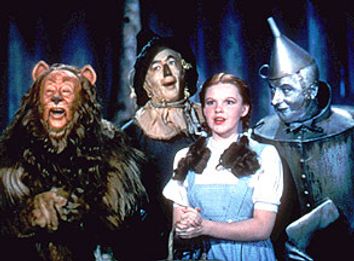
In fact, this session’s standing-room-only crowd included a large lavender contingent, as well as others like the grandmotherly Ozzie from New Jersey who sat down next to me. “I want to understand what this whole gay thing is about,” she said pleasantly. By the end of Michel’s talk about gay role models in “Oz” — the lion “born to be a sissy” and the tin woodsman (“not gay, but certainly not a macho man”) — she’d had several “Aha!” experiences.

Among other things, she heard that gay appropriation of such elements as rainbow iconography and “Friend of Dorothy” code phrases probably amounts to more than simple diva worship. As Michel observed, “Judy Garland made lots of movies, but nobody runs around naming bars after ‘Meet Me in St. Louis.’”

Michel also suggested that the Land of Oz holds a special allure for those who are different because it is, as one writer put it, a place that’s “fiercely tolerant of the outlandish” and a “community of eccentrics.”

Indeed, one of the striking things about the Oz phenomenon is the very different people it brings together, whether out of a shared love for the books, the movie or both. “Oz is too universal to belong to any one group,” John Fricke, author of “100 Years of Oz,” told me. “You can say ‘Scarlett O’Hara’ or ‘Rosebud’ to anybody under 30, and they won’t know what you’re talking about. Show a picture of Madonna to most people over 50, and they won’t know who she is. But show a picture of Dorothy to anybody over 18 months, and you’ve immediately started a conversation.”

Kenneth Reckford, a longtime classics professor at the University of North Carolina, had taken time out from translating Greek to attend the convention with his grown daughter and present a talk on images of children and childish adults in “Oz.” Although he usually lectures on the likes of Aristophanes, here he clearly relished talking about Flutterbudgets, Jack Pumpkinhead and Tik-Tok. Afterward, he too remarked on the way that the “spiritual citizens of Oz” constitute such a disparate collection of people.

“They’re all over the country, conservative and liberal, ‘respectable’ and hippie, straight and gay. There’s a tremendous variety of people in the club, people who wouldn’t normally be friends but who are all brought together by the love of this wonderful place.”

It would be tempting to try to pick out the looniest tunes here, to look for those who tend to obsess, Trekkie-like, over the finer points of Ozian cartography or the relative merits of Winkies and Quadlings. But the truth is that I really didn’t run into much of that. Mostly I kept running into lovers of literature, teachers, librarians, editors, husbands good-naturedly going along with a wife’s passion for the “Oz” books, wives gamely indulging a husband’s collecting, parents eager to introduce their children to books they’d loved as kids themselves and boomers happy to be sharing the festivities with an aging parent.

(One such pair was Tulsa, Okla., travel agent Susan Hall and her 75-year-old mother, Shirley, who won this year’s costume contest for her portrayal of a Scalawagon, a kind of self-driving Oz taxi. This involved slicing out the bottom of a purple and orange play tent, then fitting it over Shirley’s wheelchair in a way that let her slowly tool around the ballroom while wearing a plastic bowl on her head. “I run on Flabbergas,” the white-haired woman kept explaining to bystanders.)

In a summer when millions of Americans are zoning out in front of reality shows to watch “When Bad Things Happen to Boring People,” there’s something undeniably sweet about a gathering devoted to this homegrown American fairy tale that extols the virtues of, in Reckford’s words, “gentleness, humor, kindness and justice.”

Not only that, there’s a refreshing lack of self-consciousness about the way that, as Fricke put it, “‘Oz’ fans aren’t afraid to wear their hearts on their sleeves.”

And there is something heartening about the fact that, for hundreds of such fans, those four days away from home only served to confirm that, hey, come to think of it, there’s no place like Oz — with the possible exception of an “Oz” convention.

A Blackwellian nightmare

On the 40th anniversary of the worst-dressed list, a writer recalls the acerbic designer -- and a beauty magazine assignment that went terribly wrong.

  • more
    • All Share Services

And now, for the announcement that has celebrities everywhere quaking in their Manolos: Mr. Blackwell’s 40th annual worst-dressed women list.

For four decades now, the alliteratively acerbic designer and self-appointed arbiter of taste has gleefully chronicled each year’s fashion flops and tops. This is the guy, after all, who once likened Diana Ross to “a Martian meter maid,” called Elizabeth Taylor “a boutique toothpaste tube, squeezed in the middle” and dubbed Linda Tripp “a sheepdog in drag.”

When Blackwell announces his latest list of fashion victims, I’ll take a moment, as I have for four years now, to recall the surreal afternoon I spent with him on a beauty magazine assignment that went disastrously (though hilariously) wrong.

“Hey,” my editor at Allure had said, “we think it’d be funny for you to go to L.A. and hang out in a mall with Mr. Blackwell. Get him to comment on what real people are wearing! Take a few pictures, have him toss off a few quips. It’ll be fun!”

When I phoned him to suggest the idea, Blackwell gushed that he’d be honored. As it happened, he’d be signing copies of his autobiography at a mall the following week. Why didn’t I join him for a stroll and dinner beforehand?

So there we were, Friday afternoon at a Santa Monica mall: the 70-ish Blackwell; Robert Spencer, his genial partner of 40 years; a photographer and me. And things weren’t going well. Not at all.

The mall, it turned out, was a terrible shock to Blackwell’s senses. Gaping at the passersby, he suffered one Maalox moment after another. He winced, gasped, then held out his hands helplessly, as if begging for me to make it all go away. Shaking his head in disbelief, he muttered slowly: “These people … are … pigs!” Moaning “This is an army of garbage!” he threw up his hands and turned away, wailing, “I can’t do this!”

Now I was the one feeling queasy, as I pictured the big blank space in the magazine where the story was supposed to go. Mercifully, Spencer pointed to his watch and suggested we get some dinner before the book signing. I closed my quipless notebook and followed them into a deli, quietly panicking over how to explain to my editors that their swell idea had fast turned into a Blackwellian nightmare.

As soon as we were seated, Blackwell launched unbidden into an account of his bruising childhood in a Depression-era Brooklyn slum and his years as a teenage prostitute.

“How could I be ashamed of it?” he shrugged, his eyes misting over. “I was hungry, and it was a way to get a quarter.” His voice cracked. “Mother used to ask me where I had gone. I’d tell her I was out walking the rich people’s dogs, and they gave me a quarter. What was I supposed to say — that I was over in Central Park?”

I didn’t know. What I did know was that this was not exactly what I’d expected to be chatting about with a glitzy designer-to-the-stars. But then, maybe I shouldn’t have been surprised. After all, I’d just finished reading his autobiography, “From Rags to Bitches.” Now out of print, the book was at once jaw-droppingly candid and unapologetically egomaniacal. And, like the catty curmudgeon himself, it was also weirdly compelling.

It’s hard to pick a favorite passage from a book packed with gems like: “World War II had been raging for two years, and I had been so self-absorbed I’d hardly taken conscious note of it.”

Or, on the day JFK was shot (Blackwell was scheduled to host a fashion show in Tampa), “I couldn’t help but think, how could a beaded bodice possibly make a difference in these troubled, deadly times?”

Star-struck since childhood, Blackwell moved to Hollywood and landed several bit parts at Universal Studios in the 1930s. Although his on-screen talent carried him only so far, his talents on the casting couch were appreciated by some of the biggest names in the biz, including, he claimed, Tyrone Power (“the attraction between us was instantaneous, electric, unforgettable”), Cary Grant and Randolph Scott. (“Neither man was possessive, and I had wonderful relationships with both of them.”)

He once auditioned for a bit part on Broadway by performing a sultry striptease for Mae West (“I felt Mae’s eyes scan my body, sliding down my thighs”). He also moonlighted as a male escort (“I became a human vacuum, as empty as the women I slept with”).

In the 1950s, he got his start in the fashion biz with a short-lived job designing elaborate toilet-seat covers. (Customers returned them in droves when the ill-placed rhinestones proved uncomfortable.) Still craving stardom, Blackwell decided he might as well script himself a role to play in real life: the part of a flashy, loud-mouthed designer so outrageous he’d be impossible to ignore.

To that end, he began wearing tight pants and loud silk shirts unbuttoned to the waist. (He later concluded that his hairy chest projected too much “truck driver virility,” so he switched to turtlenecks with gold chains and scarves.) Blackwell began consciously modulating his speech, running words together like “warm, melting caramels” — all the better to craft a persona that would be “the ultimate mix of madness, marketing, and media attention.”

In 1960, a weekly magazine asked Blackwell for a list of the year’s top 10 couture catastrophes. He obliged with a few caustic comments and promptly forgot about it. When another magazine called to see who’d made his list the following year, Blackwell knew he’d found the gimmick that would make him a household name.

As we finished our sandwiches, Blackwell assured me that he never meant the list to be “mean,” adding that he was always careful to include only women he genuinely admired. (Just because he once dubbed Madonna the “Bare-Bottomed Bore of Babylon” and dissed Roseanne — “Clothes by Michelin, Body by Sara Lee” — doesn’t mean he doesn’t like them.)

In fact, Blackwell said, he abhorred the idea of being remembered for something “so negative.” He claimed to loathe the character he’d created for himself, which had come to overshadow his fashion career. He called it, with typical modesty, “my crown of thorns.”

At this point, Spencer suggested they’d better get going. I tagged along, thoroughly confused as to whether the character of “Mr. Blackwell” was a case of the actor becoming his role or pure typecasting.

We stepped out onto the mall where we were besieged by yet another wave of armies of garbage. To distract him from this fashion armageddon, I asked Blackwell about his own attire. The tassled loafers and plaid shirt: Armani. The suit: Hugo Boss. The neon red socks: Sears, Roebuck (“No, really, Sears, Roebuck”). In his lapel, a tacky jeweled pin spelled out “Big Mouth” — a gift from Worst-Dressed Listee Barbara Mandrell. In his left ear he sported a huge diamond. Nearing the bookstore, he cheerfully confirmed that he’d had four facelifts.

Then another letdown: The part of the bookstore where he’d be autographing books was empty except for a huge public address system. Blackwell immediately started fiddling with the mike and complaining about the sound.

Thankfully, one of his longtime models arrived wearing a Blackwell creation - a strapless, rhinestone-sprinkled black evening dress with elbow-length black gloves. He’d enlisted her to hold up a copy of his book while he addressed the as yet nonexistent crowd.

Slowly, a few fans began to appear: Two white-haired groupies, a youngish man, a large woman in a tight black pantsuit. Others straggled in as Blackwell took the mike, and in a gravelly purr, started in on his favorite subject: “I was born in a ghetto …”

Just as he had over dinner, he described hustling in Central Park and related a story about the time he was briefly imprisoned by the Persn regime for inciting a labor strike in Argentina. Hitting his stride, he relived his career as a Hollywood designer, dropping names like so many sequins from a cheap gown. More than once, gauging the lukewarm reaction of his handful of listeners, he apologized, “Well, some of you might not remember her, but …”

His soothing patter was a mesmerizing mix of stale Hollywood gossip, talk-show confessional, New Age psychobabble and the rambling reminiscences of a kindly old uncle. His book, he emoted, was about “standing naked in front of you, totally exposing myself and the truth, so that other people who have the same problems won’t believe they’re alone. I want them to know they don’t have to commit suicide.”

An attractive young woman who arrived alone piped up adoringly then. “I saw you on Howard Stern, and I just had to come and tell you I thought you were so cool!” she gushed. “You were so warm and honest and sincere. I didn’t give a hoot about the Worst Dressed List, but what you said actually gave me a lot of love as a person.”

Blackwell beamed.

Then a store employee who needed the microphone for a guitarist about to perform in the coffee shop downstairs broke up the brief lovefest. Flustered, Blackwell quickly wrapped up his talk, signed a couple of books and collapsed into a chair, still fuming about his hijacked sound system.

At last, he looked up at me wearily.

“So,” he said gently, “maybe after this you have a different viewpoint? I think you understand me now. This is the real me.”

He invited me to join them for breakfast at home the following morning (“C’mon, I’ll make you oatmeal”). Later that night, Spencer would call me to cancel. The sparse attendance had left Blackwell too despondent to bear the thought of company.

But as I asked about his long-range plans, Blackwell momentarily perked up.

“I want to tell the story about this man. You saw me,” he says, gesturing at the empty chairs around him. “I could talk three hours with no trouble! Have some screens, project pictures …”

Wait, I said. You mean you’re planning a one-man show about yourself, starring yourself?

He nodded, a faraway look in his eyes. “It will be a wonderful day,” he sighed, smiling beatifically, “the day I do this on Broadway.”

Continue Reading Close