Martin F. Downs

Can semen cure the blues?

A researcher says male ejaculate may act as an antidepressant -- but other scientists aren't swallowing his theory.

  • more
    • All Share Services

A report appearing this month in an obscure medical journal, the “Archives of Sexual Behavior,” shows that women who enjoy sex au natural are less depressed than those who use condoms. The reason: semen may be an antidepressant.

Few would associate a glob of semen with a dose of Prozac, but many will say that bare sex with a beloved partner makes them feel good.

“If that’s the truth, I must be the happiest woman on the planet,” says Wifey, the star of WifeysWorld.com, where she and her husband (yes, Hubby) open their bedroom to subscribing voyeurs. “I have probably consumed quarts of semen in my life and I can certainly attest to a heightened feeling afterwards. I suppose it makes sense. “Put me on the ‘I think it’s true’ side of the ledger,” she says.

“The act of sex is more pleasurable without condoms,” says Janice (not her real name), a fashion designer in Chicago who has struggled with depression since age 16. “The whole next day you really feel much better. There’s definitely a difference.”

Study author Gordon Gallup, a psychology professor at the State University of New York in Albany, thinks the post-coital buzz Wifey describes and the sexual healing Janice experiences may be caused by some unknown chemical in semen.

It all began with cohabiting lesbians. Two studies showed that while heterosexual women who live together often have their periods at the same time, lesbians living in close quarters do not. The phenomenon of menstrual synchrony is believed to be caused by pheromones in sweat. Gallup thought that if lesbians have the same pheromones breeders have, maybe the difference is exposure to semen, or a lack thereof. Then he happened upon a 1986 report in an out-of-the-way journal called “Medical Hypotheses.” Psychologist P.G. Ney wrote of a depressed woman who made an astounding recovery as soon as she got laid.

No surprise there. But, as its name suggests, the journal is a forum for wild speculation, so Ney put forth the idea that something in her lover’s ejaculate cured her.

Gallup says he was intrigued, and spent more time sifting through the medical literature to see if he could find any scientific basis for Ney’s report and the case of the asynchronous lesbians.

He found some compelling evidence. Semen is a nutritious medium that supports spermatozoa on their journey through a woman’s plumbing. That’s what we learned in sex ed, but it’s not the whole of it. In fact, semen is a rich chemical brine, containing testosterone, estrogen and other hormones: prostaglandins (made in the prostate gland), as well as luteinizing hormone and follicle-stimulating hormone (both trigger ovulation). Scientists know that chemicals in semen are absorbed into a woman’s bloodstream through the vagina. “There’s clear evidence that there’s transport,” Gallup says. “There’s no question about that.”

With these facts in mind, he set out to test Ney’s hypothesis. He recruited 293 undergraduate females from the Albany campus to take part in his study. The women answered questions about their sex lives, including frequency of sex, how long it had been since their last romp, and what type of birth control they used. They also took a 20-question test to rate their level of depression. Called the Beck Depression Inventory, it’s one of the standard questionnaires researchers use.

Upon seeing the results, Gallup bit the stem off his pipe.

The women who rejected rubbers were significantly happier than those using them and those having no sex at all. What’s more, those who had been getting regular injections of semen from their boyfriends felt worse the longer it had been since they stopped having sex. The same was not true of women who used condoms.

Gallup says this suggests, in the simplest terms, that semen is a drug, and that it’s addictive: Women go through a kind of withdrawal when they stop getting it. All those puerile porno cliches come to mind — “Horny babes crave your cum,” and worse.

“It’s got all kinds of implications,” Gallup says. Since completing the study, he has replicated the results in a larger group of women (about 700 volunteered for the second study). He is also beginning to test some new ideas he got as a result of doing the first study. For example, he is currently collecting data on the severity of PMS symptoms in those who use condoms and those who don’t.

PMS, postpartum depression (the “baby blues”) and menopause all bear on sexual activity. Women usually abstain when they have their period, right after giving birth, and at the onset of menopause, so Gallup wonders if the semen “withdrawal effect” may have something to do with the mood swings that often accompany these events. His follow-up research has also hinted that women who don’t use condoms get into rebound relationships quicker than condom users do. Again, this suggests something like an addict’s drug-seeking behavior.

The extent to which semen-borne testosterone gets into a woman’s bloodstream may have an effect on libido, too. Reams of research data show that testosterone is as essential to female sexuality as it is to the male urge. The most recent evidence was presented May 26 at the American Urological Association meeting, which ran for five days in the vast Orange County Convention Center in Orlando, Fla. The annual meeting is the premier event for scientists to share new information on the physiology of sex. (It’s not all about pee.)

Researchers at Boston University presented findings that low testosterone levels were linked to sexual dysfunction in pre-menopausal women. Female sexual dysfunction is an umbrella term for several specific disorders. It’s a hot field for research at the moment, owing largely to the success doctors have had treating male sexual dysfunction — impotence.

Four years into the Viagra era, scientists are exploring the use of various drugs, including male hormones, to treat women who have put themselves on the shelf due to lack of desire, pain during sex, inability to have orgasms, and what has been termed “sexual arousal disorder.”

The genitals of women with arousal disorder do not respond to sexual excitement. It is becoming more widely understood as sex becomes more medicalized that the clitoris is erectile tissue, like the penis. In a sufficiently bothered woman, the genitals should become flush with blood, resulting in an erection, so to speak, of the clitoris, and a flowering of the vulva. Of course, they’re supposed to get dewy down there, too. Women with arousal disorder want to have these responses, but they don’t.

Another study presented at the Orlando meeting looked at the use of prostaglandin E1 for arousal disorder. Women in this study basted their clitoris, labia, and vaginal opening with a prostaglandin liquid, then watched erotic videos for 30 minutes while taking notes on how aroused they became. The researchers also measured the flow of blood to the genitals. There was a significant increase in arousal levels and genital swelling in the women who used the prostaglandin liquid, compared to those who used a placebo.

Prostaglandin E1 is in semen. “It just goes on and on,” Gallup says.

Nevertheless, it’s far too soon to decide you want to take the cum cure. If your boyfriend tries to convince you to shuck condoms for your own well-being, he’s either a sneak, or he doesn’t understand science. “These data are only suggestive,” Gallup stresses. “They’re hardly conclusive.”

The study’s design rules out some other explanations for the effect on mood that semen appears to have, but it leaves much in doubt. Dr. Winifred Cutler, best known for her discovery of human pheromones in 1986, says Gallup’s study “raises more questions than it answers.”

Asked whether the glow after bare lovemaking could be from semen deposited in her reproductive tract, Janice says she thinks it has more to do with intimacy.

One young single woman in New York, who prefers to remain anonymous, feels the same way. She is in therapy for depression and has been on a litany of antidepressants. “When I was in a steady relationship, I was pretty damn happy all the time,” she says. “But I don’t know if that had anything to do with having semen in me.”

But the fact that there was no difference in the depression scores of those using condoms and those sleeping alone seems to dismiss one other explanation — what scientists call a “confounding variable.” Simply having sex cannot account for their relative happiness, Gallup says.

Another alternative explanation would be intimacy. It is a reasonable hypothesis that women whose partners do not use condoms are in more intimate relationships than those whose partners do. Gallup’s study did look at whether the women were in relationships, and for how long. He claims that intimacy did not confound the results.

Cutler disagrees. She says Gallup failed to define what a relationship is: “Is it a relationship if you’ve gone out with someone three times in a row?” She thinks the number of partners the women had would affect their mental hygiene. Were the women who claimed to be in relationships dreaming about wedding cake and babies, or were they carrying on “steady relationships” in three dorm rooms during the semester?

That’s not the only oversight, she says. The questionnaire asked women to say how many times they’d had sex in the past year. Unless they kept a detailed dairy, or unless they had one unforgettable night, they probably couldn’t remember exactly. “It’s just someone’s impression,” Cutler says.

A more glaring flaw, she says, is the use of oral contraceptives. Roughly one-half of the women were using them, and the study design didn’t take into account what type of pill they were taking. Oral contraceptives may worsen depression in some women, and relieve it in others — and there is more than one kind of pill. Some contain the hormones estrogen and progestin together, and others have only progestin. The mood-altering effects of either may vary.

Dr. Ira Sharlip, a urologist in San Francisco and president of the Sexual Medicine Society of North America, takes a dim view of Gallup’s research. “This is the kind of junk science that smears the name of honest science,” he says. His opinion shouldn’t be taken as simply that of a curmudgeon, for he cheerleads some research that sounds equally fantastic, and likewise is in its early stages — gene therapy for impotence, a prosthetic testicle that releases testosterone, and human tissue grown in a lab for lengthening the penis.

“I think that this is a huge leap in logic to assume that that the only difference between the group that used condoms and the group that didn’t is related to the properties of semen,” Sharlip says. “There are so many other possible cultural, racial and maybe national or personal characteristics that could be related to the group that did versus the group that didn’t.”

Cutler goes easier on Gallup. “He has to start somewhere,” she says. “I think it’s a creative explanation of an intriguing question.” Even so, she agrees his conclusion is an act of scientific acrobatics. “It’s too much of a leap to get to semen,” she says.

“There is something going on,” she says, but she thinks any conclusions drawn from the study should, at this point, be limited to condom use. Everyone knows that men tend to like sex better without a condom. Now we see that women probably do as well. There may or may not be a chemical in semen that relieves depression, but it isn’t too hard to believe that great sex with a great guy would make a gal feel, well, great.

Perhaps Cutler sympathizes with Gallup because it wasn’t long ago that human pheromones were thought to be a myth, or at best a curious idea that required more research to prove. Sometimes it takes a leap to grab hold of the truth; but a leap may also land you flat on your can. Gallup is in midair.

My contribution to granny lit

What big brown cigarettes you have!

  • more
    • All Share Services

My contribution to granny lit

It’s all about grandma these days. The literati can’t get enough of granny. In poems, essays and short stories, they’re eating her up. She’s sweet, she’s quirky; she’s an aproned nebula of nurturance, a big-bottomed, orthopedic-shod purveyor of wisdom. Her kitchen is awash in afternoon sunlight; a fresh-baked blackberry cobbler cools on her gold-flecked linoleum countertop. She is everything the grandchild’s parents can’t be: She provides comfort and guidance while enforcing a minimum of discipline; she is an abundant bosom to which the child can turn to escape the tyranny of the frustrated ascetics who are his parents.

Grandma, the mother of the mother, is rendered as the wellspring of all life — but then she always dies. Her demise is the memoirist’s first encounter with the reality of death, a moment offered in stark and deeply troubling contrast to the pleasures of living that her presence has always meant.

We are all familiar with these portraits of grandma. Or we probably are, and if we are not, we should be, because we, in our efforts to stay in step with the times, must each write such a portrait, if we haven’t already. (Just as we must, if we entertain thoughts of writing, write a story about a writer in a graduate writing program at a Midwestern university who has a confusing modern relationship and a worshipful regard for black coffee and a king’s ransom in compact discs and a sack of pop-culture allusions and writer’s block. Just the one, mind you, to get it out of one’s system.)

I have yet to write my writer story — it is possible that I never will — but I’ll be hanged if I miss the grandma boat.

My mother’s mother, Emma “Becky” Boyer, is 83 years old. She is a walking skeleton with a rattling cough, afflicted by various maladies of the skin, and in her youth was not beautiful. For as long as I can remember, this person has dropped into my life once every year or two for a weekend or, very rarely, a week. My mother, during one of these visits, asked Grandma if she might bake some cookies with me, as a grandmotherly bonding exercise. Grandma squarely refused, insisting that she “couldn’t be bothered with baking.”

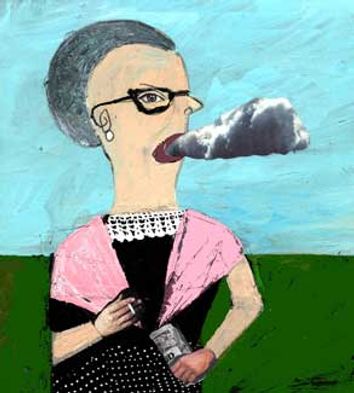
Grandma does not eat any food of her own accord, believing booze and cigarettes to be an excellent diet. She lives in a condominium in Florida, where her life is strictly regimented: At 3 o’clock in the morning she wakes up in her recliner, cracks a can of Coors and heads to the porch, where she spends the day drinking beer, smoking her More 120s and doing crossword puzzles. When evening comes, she retires to the recliner, where she watches television until she falls asleep at 5 o’clock.

This is my grandma story:

A few years ago, Grandma’s sister, Aunt Mary, a dear sweet lady by all accounts, came to live with her. Aunt Mary was 81 at the time, very nearly blind and almost totally deaf. A life of chain-smoking had given her a touch of emphysema and ravaged her larynx, so her voice was but a raspy whisper. Nevertheless, she was, as relatives liked to say, earnestly nodding their heads, “sharp as a tack.”

Now, I can’t recall what circumstances landed Aunt Mary in Grandma’s condo, but they were certainly dire; for Aunt Mary couldn’t stand going to bed at 5 o’clock in the evening and Grandma had a hard time putting up with Aunt Mary’s habit of cooking, and then eating, food.

One day, Aunt Mary needed to go to the grocery store, and Grandma begrudgingly agreed to drive her there in her little beige Citation. When they returned to the condominium complex, they found that all the parking spaces on their side of the building were taken. Since Aunt Mary could not make the walk all the way from the other side of the complex, Grandma was to drop her off by the elevator, drive around the building, find a place to park and bring the groceries up herself. No problem.

She let Aunt Mary out of the car and drove around to the other side of the building. She parked the car, rolled up the windows, locked the doors, got out, went around and opened the hatchback. As she was gathering up the groceries in her arms, she was startled by the screams and frantic gestures of a crowd of horror-stricken passersby. They were shouting things like “Oh, sweet Jesus!” “Look at her! Just look at her!” and “Somebody call an ambulance!” Thoroughly perplexed, Grandma peered around to the passenger side of the car, where she discovered the source of all the commotion.

What had happened was this: Aunt Mary had slung her purse over her shoulder before stepping from the car. The purse got caught in the door when she closed it. Grandma, quite oblivious to the situation, sped off, dragging poor Aunt Mary underneath the car by the strap of her purse across the hot asphalt.

How do you like that? The woman couldn’t even scream “Stop the car!” on account of her weak voice; and if she had, Grandma would have been too drunk to notice. So Aunt Mary was skinned, and she died a few weeks later.

That is my grandma story — the only one I’ll ever write — with apologies to the faint of heart. Perhaps it will find its way into “Best American Grandmother Essays 2000,” or maybe you’ll hear me read it on Fresh Air. In any case, I am glad to have made my humble contribution to the theme.

Continue Reading Close