Matt Haber

“Showzen” people

MTV2's "Wonder Showzen" aims to do for childhood innocence what "Chappelle's Show" did for racial sensitivity. Just don't call it "'Sesame Street' on acid."

  • more
    • All Share Services

What would you do if a microphone-toting grade-schooler in a trench coat approached you at ground zero and asked you to share your 9/11 memories — but insisted that you do so while wearing one of those Groucho Marx funny-nose-and-glasses get-ups? What if you were visiting the Statue of Liberty and a pigtailed little girl asked you — while the cameras were rolling — if she had the “freedom to smack you in the face right now”? What if she then hauled off and slapped you?

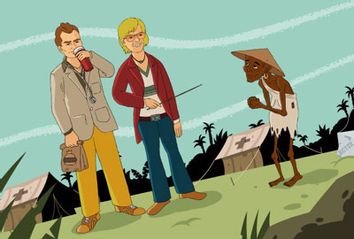
Welcome to “Wonder Showzen,” the MTV2 series that does for childhood innocence what “Chappelle’s Show” did for racial sensitivity. It’s a pitch-perfect (and pitch-black) parody of a kids show in which puppets, cartoons, industrial films and adorable child actors collide in what feels like a riot (in both senses) rippling through Mister Rogers’ Neighborhood. The result is often deeply offensive — and painfully funny.

“The idealized world of children’s television doesn’t address murder, doesn’t address racism, doesn’t address hatred,” says series co-creator John Lee. “We have to play with those things so that we’re not an actual kids show.” Driving that point home, the show’s opening credits warn, “‘Wonder Showzen’ contains offensive, despicable content that is too controversial and too awesome for actual children. The stark, ugly, profound truths ‘Wonder Showzen’ exposes may be soul crushing to the weak of spirit. If you allow a child to watch this show, you are a bad parent or guardian.” If that’s not clear enough, images of exploited children like a knife-thrower’s cherubic target and John-John Kennedy saluting his father’s casket roll under the show’s taunting theme song, which cries, “Change the channel for kids.”

The “stark, ugly, profound truths” are presented in episodes as delicious as arsenic cookies, bearing innocent titles like “Birth,” “Space” and “Nature,” yet featuring cartoons like “D.O.G. O.B.G.Y.N.,” about a dog who scratches out a living delivering babies, and live-action segments like “Beat Kids,” in which seriously cute, trench-coated child reporters buttonhole clueless adults with questions like, “When the revolution comes, where will you hide?” (This one was posed to moneyed white guys on Wall Street, who were also asked, “Who did you exploit today?” and offered a napkin to wipe the blood off their hands.)

And then there’s Clarence, a cueball-headed blue puppet interviewer whose contempt for his subjects makes Bill O’Reilly look like Byron Allen. In one episode, Clarence chases joggers demanding, “What are you running from?” and in another, he visits Harlem to ask residents about what riles them.

“Wonder Showzen” has been a hit with critics. Time and Entertainment Weekly both put it on their best of 2005 lists, and Salon critic Heather Havrilesky proclaimed: “I love the sickos who created ‘Wonder Showzen’ with all my heart, and all you sickos out there will, too.”

But for other people, the show simply hits a nerve. The Anti-Defamation League took offense at a segment featuring a little boy in a Hitler outfit. (That threw a Seattle Post-Intelligencer headline “Rejoice in Our Liberty and Heil ‘Wonder Showzen’” into a whole new light.) That bit got the “Health” episode pulled from subsequent airings. Making for some truly strange bedfellows, white supremacists have also complained about the show on various message boards, puzzling over the show’s racial humor.

Whatever you think about “Wonder Showzen” (the first season arrives on DVD on March 28; the second season begins March 31), chances are you don’t know much about its creators, a New York art collective called PFFR. “Wonder Showzen” is just the poisoned tip of the PFFR spear. The group (pronounced “Pea-Eff-Are,” the middle “F” inexplicably silent) has had gallery shows of drawings and videos, produced a documentary on Christian puppeteers called “Hands of God,” and released CDs featuring dissonant synth-heavy pop songs with names like “Japoney Appoe,” perfect for easy listening on Guantànamo. The “Showzen” creators also wrote the script for an avant-garde porn film called “Final Flesh” that features eggs, meat and a jar of neglected children’s tears.

PFFR’s arty C.V. seems more appropriate for a biennale than for Viacom’s mass-market youth culture machine, which may be why “Wonder Showzen” is anything but the usual MTV (or MTV2) show. (Full disclosure: I have worked for Viacom in the past, though never for MTV or MTV2.) Each episode feels like a puckish, conceptual prank on the viewer — not to mention on the network crazy enough to air bits like the last 15 minutes of the “Patience” episode, which consists of the show’s first half run backward. As Lee, who created and writes the show with Vernon Chatman, explains, “We’ve always said that our goal is to destroy MTV.”

Lee and Chatman, both 34, met as undergrads at San Francisco State and bonded over a shared admiration for “Sesame Street.” They had already established PFFR as a band, and in 2000, they collaborated on a precursor to “Wonder Showzen” called “Kids Show,” which USA Network green-lighted and subsequently dropped.

The “Kids Show” tape floated around for a while, shown in venues like the New York Underground Film Festival, but it seemed unlikely that it would make it onto the air. Chatman wrote for “The Chris Rock Show,” “That’s My Bush!” and “South Park.” For the latter, he created and voiced Towelie, a stoned talking towel, one of the most willfully stupid characters in that show’s history.

Lee kept busy, too. He trained his dog, Mr. Little Jeans, to do a lot of excellent tricks, like the one where Lee pretends to shoot him and the dog rolls over.

In 2002, Chatman and Lee were tapped by MTV2 development execs Michele Dix and Jesse Ignjatovic to write and produce “Doggy Fizzle Televizzle,” Snoop Dogg’s foray into sketch comedy. “They came up with amazing bits for Snoop” — like the one where he teaches English as a second language — “and put him in these situations that, now knowing the breadth of their creativity, you know why they got such range out of Snoop,” says Dix. The show was well regarded, but ran for only one season.

In March 2005, five years after they created their nightmare on “Sesame Street,” Chatman and Lee managed, with the help of Dix and Ignjatovic, to get “Kids Show” aired on MTV2 as “Wonder Showzen.” “We brought it to MTV2 because we knew MTV would totally ruin it,” Chatman jokes. “Instead of semi-ruin it, which is what MTV2 has done.” The network insisted on the name change, worried that “kids might watch something called ‘Kids Show,’” says Lee in an e-mail, adding, “‘Wonder Showzen’ was the name we cared the least about. So that over time we would neither learn to love or … to hate it. The one sad thing is that some people think it’s German.”

Writing in the New Yorker in 1972, Renata Adler called “Sesame Street” and, to a lesser extent, “The Electric Company,” “the most intelligent and important programs on television.” What Adler couldn’t have anticipated is how smart “Sesame Street’s” followers would be. A generation raised on educational programming has internalized the weirdness of child actors, multiracial adults and puppets working together to impart life lessons to latchkey kids and responded with shows and movies ranging from Peter Jackson’s “Meet the Feebles” to Comedy Central’s short-lived “TV Funhouse.”

“I would say, arguably, it’s the best show ever made,” Lee says of “Sesame Street.”

“You should reference it,” says Chatman, trying to head off hack journalistic shorthand. “But say, ‘On acid!’”

One thing a writer would be cautioned not to reference is “Avenue Q,” the Woodstock to “Wonder Showzen’s” Altamont. Comparisons are inevitable, but Chatman and Lee point out that “Kids Show” was created three years before “Avenue Q” debuted off-Broadway. While “Avenue Q” plays footsy with taboos in songs like “Everyone’s a Little Bit Racist,” “Wonder Showzen” stomps all over those same taboos, as in the swingin’ ditty that goes, “White people smile so bright/ genocide for anyone who isn’t white,” or the cartoon of a drunk anthropomorphic Bible dirty-dancing with a Quran. (Hey, it was spring break!)

Then there’s the “Beat Kids” segment with a boy dressed as Hitler asking adults, “What’s wrong with the youth of today?” which prompted the Anti-Defamation League to contact MTV.

Caryl Stern, the associate national director of the Anti-Defamation League and a self-described survivor’s kid “with a sense of humor,” was displeased particularly because the ADL was partnering with MTV on a series of anti-racism PSAs. “Here we are in partnership with MTV at the time, standing with them to fight hate and helping to produce programs and print material to support that, and here they are on their other network doing something we found offensive.”

The episode’s timing didn’t help. It aired right around Yom HaShoah, Holocaust Remembrance Day.

Sitting in his corner office at 1515 Broadway, MTV2 general manager David Cohn looks visibly dismayed at the memory. “We probably didn’t make the wisest scheduling choice, that’s for sure. That we aired it the week that we did was probably unnecessarily insensitive and in hindsight I would change that — not the fact that we aired it. I laughed, and I’m Jewish.”

The ADL’s Stern acknowledges that each person’s comedic boundaries differ but still disagrees that timing was the issue: “[The ADL] would’ve found it offensive under any circumstances. There are enough things to do in the world that one doesn’t have to dress up as Hitler for humor.”

The show’s creators are still irked by the network’s decision not to re-air the episode. “Without even talking to us, they said, ‘We’re pulling it. We’ll never show it again,’” says Lee. (The episode is on the DVD.)

“The Aryan Nation also complained about the show,” adds Alyson Levy, “Wonder Showzen’s” art director and director of “Hands of God.” (She’s also Lee’s wife.)

“The Jews, the Aryan Nation, and the NAACP,” Lee muses. “If all three got together to march on Washington…”

“If they all get together and murder us, isn’t that a step forward?” wonders Chatman.

It’s hard to imagine another show that could bring together the ADL (which everyone in “Wonder Showzen’s” downtown production office keeps referring to as the JDL), the NAACP and the white supremacists, but then the racial humor is essential to “Wonder Showzen.” The “Space” episode, for instance, is brought to you by “white people” (in the same way that an episode of “Sesame Street” can be brought to you by the “letter T”), yet shows an angry black god blowing up the earth because he doesn’t like the way “you honky-ass crackers was keepin’ the black man down.”

Lee and Chatman are both biracial, which allows for a lot of jokes and even more cover when those jokes offend.

“This show is probably more diverse than any other show,” Chatman says.

“Yeah,” Lee says, gesturing around the office, which is painted to look like “Romper Room” and populated by the show’s young, hip-looking staff. “We got wop, we got chink, we got Heeb, we got darkie.”

Maybe that’s why those delicate neo-Nazis were so upset.

“The white supremacists weren’t sure if we were pro-white or anti-white,” Lee says.

“And the Irish,” Chatman says. “The IRA is super-pissed.”

“Well, they just think it could be funnier,” Lee says.

On the “Wonder Showzen” set, which is located in a studio on a very un-”Sesame”-like street littered with import-export warehouses and chop shops in Greenpoint, in Brooklyn, N.Y., the “Showzen” team is taping a scene in which two puppets named Him and Chauncey climb into the brain of another puppet, Wordsworth. Him, who resembles a foam hunk of shwarma meat, is being operated by Lee. Lee is also doing the voice of Wordsworth, a red felt nerd with a visible cranium and Lennon-esque granny glasses. Chatman is elbow-deep in Chauncey; he’s wearing a hooded yellow sweatshirt that matches the puppet’s fur. Crew members are already preparing the next setup.

Levy, who’s wearing the “Wonder Showzen” uniform — a navy blue flight attendant sweater vest that’s part of their socialist artist-collective vibe, and which they all wore during the interview in their production office — is making sure every little detail is right. After running next door to get a prop brain in a jar, she tells one crew member to stop bouncing a ball on the set. (“Mom says don’t play ball in the house,” someone says, echoing “The Brady Bunch.”) Despite the laid-back atmosphere in which Interpol and Def Squad pump through the sound system, they’re here to work.

It’s obvious, watching the crew go through their paces, that “Wonder Showzen’s” rough look is the result of meticulous preparation. Its handmade feel — the amateurish puppetry, the carefully selected childhood photos of Lee, Chatman and Levy interspersed in the opening credits — requires effort.

Chatman and Lee are just as meticulous with the child actors they employ. “We’re totally upfront,” Lee says of their dealings with stage parents. “They see the scripts beforehand.”

“And things aren’t as creepy out of context,” Chatman explains. A look at the DVD outtakes bears this out: The kids are clearly having fun in a comfortable environment, frequently cracking up and saying innocent — but loaded — things with some friendly off-camera encouragement.

Parents are told not to let their kids watch the show, no matter how much they beg. “We tell the parents not to, but a couple of the parents have shown the kids … We had one parent who said they let their son watch the show, but during the parts when it gets weird, [the parent said] ‘I just tickle him,’” Chatman says, laughing.

“We just did a shoot where we basically sprayed fake blood on 10 kids and the parents loved it,” Lee says. “If you’re a parent, you’re like, ‘Thats great! I wanna see my kid covered in fake blood.’”

Harder to love might be that segment for Season 2 shot at ground zero in November. While they were unsure if the segment will air, Chatman and Lee both worried. “Is it possible to laugh at ground zero?” Chatman wondered about it.

“We were just totally worried, like, everything we’re doing is wrong.” Then again, as he’d said earlier, “We like to get to the point we don’t feel right, but it’s a good feeling and we try to do it anyway.”

“When we came up with the ground zero bit, we thought it would be great to do something there, but, like, we can’t just go down there and be assholes,” says Lee. But watching their “Beat Kid” reporter dance around chanting “Nine-eleven! Nine-eleven!” while making fart sounds disturbed even Lee, who recalled seeing the towers fall from his and Levy’s apartment in Brooklyn. “What could we possibly do that could justify it?”

They hit upon compounding the awkwardness by asking people on the street to share their 9/11 memories while wearing Groucho Marx glasses, a perfect metaphor for a show that consistently finds comedy in the depantsing of tragedy.

These people “had the glasses on and were just being very honest and sad and they’d forget they had the glasses on and be like, ‘Oh, my god.’”

Jewell in the rough

How did sweet Cousin Geri from "The Facts of Life" end up cleaning up after the ruffians of "Deadwood"?

  • more
    • All Share Services

Jewell in the rough

If you grew up in the ’80s and watched your daily dose of television, you might be excused for feeling like you and the characters on the shows you watched somehow formed a family. In addition to your boring biological clan, you had your raffish adopted brothers Arnold and Willis, your Reaganite brother Alex, your irrepressible kid sister Punky, and your foul-mouthed grandmother Sophia. Within this fictional family unit, one member stood out: your cousin Geri, who occasionally popped up to teach you tolerance while cracking jokes about cerebral palsy, her lifelong neurological condition. Cousin Geri was very special, just like the episodes of “The Facts of Life” that featured her.

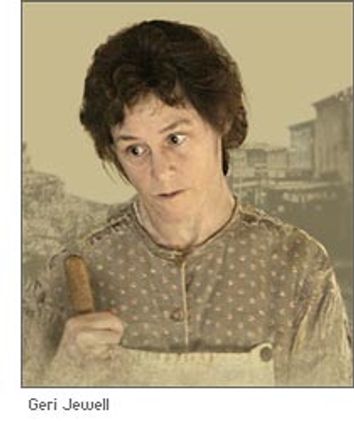
Geri Jewell, the actress and comedian who played Cousin Geri on “The Facts of Life” from 1980 to 1984, is back, costarring as Jewel on HBO’s “Deadwood.” With its harsh language and violent plot lines, “Deadwood” is as far removed from “The Facts of Life” as the HBO drama’s frontier setting is from the NBC sitcom’s genteel all-girls school. There are no lessons and hugs on “Deadwood”: There’s a lot of gunplay and hooker slapping.

“They’re from one extreme to the other,” Jewell, 48, says of the gritty revisionist western. “When I was talking to David [Milch, creator of "Deadwood"], I didn’t quite get it. I was thinking more in terms of Miss Kitty on “Gunsmoke.” And then when I saw the first script for the pilot, I was like, Whoooah!” At this she laughs. “They did curse a lot then! And I hate to make this pun, but it was a fact of life.”

Also a fact of life was Jewell’s long absence from television after her role as the shunned-then-accepted cousin of the very rich, very mean, very blond Blair Warner. “‘Facts of Life’ was groundbreaking for me … But if you remember, after ‘Facts,’ you didn’t see very much of me. Because it was like the same old thing.” Here she affects a high-pitched, patronizing voice, “‘We already did an affliction story!’ That’s what I became known for: my disability and not my ability. I had to ride that wave. I chose to take that route … I saw myself as making a conscious choice, aware of what the ‘disability card’ was and I thought, in time, I would overcome it. I just didn’t know it would take me 30 years!”

After “Facts,” Jewell returned to stand-up with occasional appearances on TV, as in her 1990 guest-star spot on Fox’s “21 Jump Street.” She played an injured cop who enlisted the baby-faced Jump Street narcs to track down a stalker with a thing for disabled people. (“A little bit far-fetched,” she concedes of the plot line she herself brought to the show’s producers.) She also had a recurring role on the CBS soap “The Young and the Restless” and has toured the country speaking about disability. This past spring, she received the Independent Living Legacy Award from the Community Resources for Independence, in honor of high visibility as a person with a disability on television.

A debilitating injury, caused by a fall in 1999, requires Jewell to get large doses of Botox injected into her back and shoulders every few months. While filling her prescription at a Santa Monica pharmacy, she met David Milch just as he was developing his HBO series about a prospecting town without pity. As Milch tells it in typically hard-boiled style in the commentary track of the “Deadwood” Season 1 DVD, “I met ‘er in a drugstore just before we started to shoot and I thought it would be an interesting thing to have a character who was handicapped or whatever the goddamned expression is supposed to be. See how a person who was physically challenged would function in an atmosphere like this.”

Milch offered her a role on the spot. “It was an amazing morning,” recalls Jewell.

Together, they developed the character that would become Jewel, the barkeep and occasional whipping girl to “Deadwood’s” resident badass Al Swearengen. “[Al] has a love/hate relationship with her,” Jewell muses. “I think the reason he’s hard on her is in part probably because he resents loving her and he doesn’t want to give his soft side away.”

Viewers may wonder if Al even has a soft side. The phrase “stop dragging that fucking leg” seems to roll off his tongue more easily than “please” and “thank you” in most episodes. “It’s probably split in half with some people who can’t handle the language or the brutality of it. But, I think if you get past that, the writing is phenomenal,” says Jewell. As is her character: “I look at Jewel in awe and think, ‘Oh, my god!’ I think Jewel is stronger than Geri.”

At some point, Jewell would like to reintroduce her own soft side. “I’m hoping that I can slip back into comedy sometime, because I don’t want to go completely drama … I miss doing funny, because I’m funny.”

For now, “Deadwood” lets her exercise her dramatic chops: “It’s very fulfilling for me, having never been taken seriously as an actress. It’s a wonderful opportunity to show what I can do besides having cerebral palsy. I can wake up in the morning and do that. That’s not something I have to work at,” she says. “I’m an adult women, and David Milch has given me the opportunity to express that part of me. Whereas, before I was just this ‘actress with a disability.’ I wasn’t a woman at all. I was just ‘The C.P. Comic.’

“It’s put me back on the map. And it’s shown people I haven’t died of cerebral palsy.” She laughs, exhibiting a bit of “Deadwood”-worthy gallows humor. “Occasionally people say, ‘Wow, she’s still alive?’ Yeah! A lot of people think that any disability is degenerative, and that’s not always the case.”

Ever the comic, Jewell starts riffing: “I’m gonna die one day, but it won’t be from cerebral palsy. It may be from losing my balance and being hit by a car…” She pauses to let that sink in for a second.

“I’m kidding! I’m teasing you,” she says, sharing the last laugh.

Continue Reading Close