Michael Easterbrook

What are we fighting for?

Colombia's civil war puts children on the front lines.

  • more
    • All Share Services

What are we fighting for?

When they came to recruit Ana, they told her she wouldn’t have to work and that she could see her mom and her grandmother whenever she wanted. Instead, leftist guerrillas taught the 13-year-old girl how to kill and marched her off to fight in the mountains of northern Colombia, where she nearly starved before surrendering.

“I was aware that on any day I could die, or that I might get hurt,” said Ana (not her real name). “But I didn’t cry once during the fighting.”

It has long been known that the numerous armed factions in the Andean nation’s 36-year civil conflict have used children to fight their battles, but the stories that Ana and others like her tell about their defeated guerrilla column — part of the Revolutionary Armed Forces of Colombia, known as FARC — reveal that the problem is worse than anyone thought.

In a series of skirmishes that began in November, 128 guerrillas enlisted in the so-called Arturo Ruiz Column have either surrendered or been captured by the Colombian army, while an additional 63 — including 27 children — have been killed. The approximately 170 insurgents who survived the pummeling are now surrounded and being worn down by at least 1,000 soldiers, who are reveling in their lopsided victory after a series of bruising defeats suffered by the army in other parts of the country.

“From the stats coming out of this event, we’ve gathered that 46 percent of the original group were children,” said Carol De Rooy, director of the UNICEF office in Colombia. “If this sample is realistic, we are grossly underestimating the number of children in this armed conflict. Either that, or they’re putting the kids out on the front lines, which is just as bad.”

The use of children in combat isn’t a problem unique to Colombia: Some 300,000 kids under age 18 are fighting in armed conflicts throughout the world. But the probability that Colombia’s factions have bumped up recruitment of children is particularly worrying here, where peace talks are on the brink of collapse and fighting is expected to intensify.

Beginning this month, Colombian counternarcotics troops — trained and equipped through a $1.3 billion aid package from the United States — are expected to push into the rebel-controlled southern state of Putumayo, which produces most of the country’s cocaine, to destroy coca crops and drug labs. Since the 15,000-strong FARC bankrolls its insurgency partly by protecting peasant-owned drug crops and labs and then charging millions of dollars a year for its services, both Colombian and U.S officials expect heavy resistance from the guerrillas.

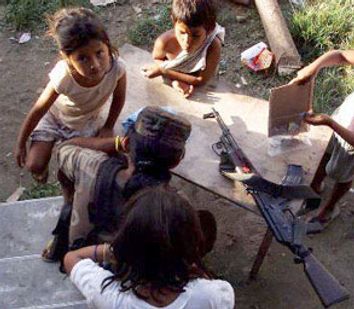
For the poor village children who constitute the majority of the youngest recruits to FARC, promises of glory, adventure and a paycheck are often irresistible. Most of them, though, end up shuttling messages between isolated rebel groups or trudging through the dense countryside, alternately attacking and running from better-trained and better-fed army and right-wing paramilitary fighters.

According to the army and human rights groups, most of the 6,000 children believed to be fighting in Colombia’s civil war are members of FARC, which has been trying to topple the Colombian government since the ’60s, under the direction of its aging founder, Manuel “Sureshot” Marulanda.

Children also are recruited by the nation’s smaller, leftist National Liberation Army, or ELN, and the right-wing paramilitary groups bent on destroying the guerrillas. The government once staffed its military offices with teenagers, but phased out the last of them in 1999. The number of children killed each year in combat here is unknown.

“The violence they see isn’t easy to forget,” said Nelson Ortiz, a psychologist with UNICEF in Colombia. “War is hard enough for adults, but imagine how it is for children, who don’t have the experience or the development to deal with what they’ve seen and done.”

Ana’s experience began in July, when she met two FARC fighters outside her school in the southern village of Puerto Concordia, part of a Switzerland-sized swath of territory ceded to the rebels two years ago by President Andrés Pastrana as an incentive to begin peace talks. Most Colombians believe the rebels are misusing this safe haven to, among other activities, recruit combatants. Based on the stories of the 57 children captured from Ana’s column, they appear to be right: All but four were recruited from FARC’s southern stronghold, said army Maj. William Ardila-Pena.

The two recruiters told Ana that if she joined, she’d have plenty of time to study and wouldn’t have to help her mom and her grandmother with housework. That sounded good, so she said yes. But after talking it over with a friend, she changed her mind.

“When they returned for me, I told them I didn’t want to go, but they said that I had already said yes and that I had to go,” said Ana during an interview on Dec. 19 in the northern city of Bucaramanga, two days after she surrendered. “So they took me, and since then I haven’t seen my mom or anyone else from my home.”

The rebels brought her to a clandestine jungle camp for training. Her commanders woke her up every morning at 4 for an hour of exercise followed by breakfast and combat training, where she learned how to ambush army soldiers and paramilitary troops and assemble and fire an AK-47. After dinner, she had to listen to an hourlong lecture on Marxist-Leninist theory, followed by bedtime at 8 p.m.

“We couldn’t make any noise,” said Ana. “I never told them I didn’t want to be a guerrilla because someone told me that saying that is dangerous. Even if you don’t want to be there, you have to show a happy face and a revolutionary spirit.”

Twenty days after her training began, Ana was sent on a long hike with hundreds of other combatants to reinforce another FARC column to the north. In late November, some 200 miles into their journey and 8,000 feet up in the mountains of North Santander state, they were unexpectedly surrounded by army soldiers who had been tipped off by a rebel deserter.

Severely outnumbered and outgunned, the column quickly unraveled. The combatants ran out of rice and salted meat and lived on water for days. Ana traded fire with soldiers and once shot at an army helicopter that was attacking her camp, but for most of the fighting she ran for cover and didn’t emerge until things quieted down.

During one skirmish, she lost the blankets she slept under and thereafter had no protection from insects and the cold. The brutal conditions left their mark: During the interview Ana’s lips were cracked and blistered and her lanky arms and legs were covered with bug bites.

While the defeat of the Arturo Ruiz Column has been a welcome victory for the army, which in October lost 22 men when rebels downed the U.S.-built Black Hawk helicopter they were being carried on, it has also further damaged FARC’s reputation among Colombians — many of whom are convinced the rebels have devolved from idealistic revolutionaries into a band of thugs.

While FARC leaders have yet to respond to charges that they’ve stepped up recruitment of children, De Rooy said that FARC commanders promised during a meeting last year to stop enlisting children younger than 15. He hopes to meet with rebel commanders soon to persuade them to demobilize children from their columns.

Hours after Ana surrendered, the army allowed a television news crew to interview her and two other kids who had deserted. With her back to the camera, Ana began to cry for perhaps the first time in months, begging her mom to forgive her for what she had done. The next day she was turned over to caseworkers at the Family Welfare Institute.

Since the guerrillas could try to recruit her again — or worse — if she returns to Puerto Concordia, Ana may have to spend the rest of her childhood under the protection of the state, which doesn’t seem to bother her. It won’t be the adventurous life the guerrillas promised her, but at least she will have food and a warm bed.

Long and short of it

The search for the "inner penis" can involve botched surgery, dangling weights and pain.

  • more
    • All Share Services

Billy’s penis plagued him for years. It wasn’t that his wife was complaining or that people teased him. Showering with the guys at the coal mine after work, he would look around discreetly and see that compared to the others, he was doing OK, about average. But he yearned for a bigger penis, and this yearning tormented him more by the day. “You know how some women want their breasts so big they need a wheelbarrow to carry them around?” says Billy, who preferred not to be identified by his real name. “I guess that is the syndrome I’m suffering from.”

The problem, as Billy came to believe, was that nearly half his penis was inside his body. This knowledge was unbearable. His erect penis measured 5 and a half inches, but he felt more hiding there beneath the skin, invisible, absolutely useless. He wasn’t completely crazy. Some doctors claim that all men have extra penis lurking beneath the skin, like roots underneath a tree trunk. One penile surgeon calls it “inner penis.” Billy concluded that his own inner penis was 4 and half inches long. “I knew I had that much penis, but the problem was how to get it out,” says Billy.

This sometimes-irrational hankering for a bigger penis is at least partly responsible for the emergence of a very peculiar corner of the cosmetic surgery industry - penile enhancement surgery. The industry was born in 1991 and currently supports about 30 surgeons. Although neither the American Board of Plastic Surgery nor the American Society of Plastic and Reconstructive Surgeons monitor the industry, it’s estimated that at least 15,000 men have had the operation, which now costs about $8,000.

Demand for the surgery soared in the early 1990s but by 1996, with news spreading that men were stumbling out of these back-street surgery centers with penises that were grossly deformed and permanently limp, business waned. Despite the early setback, demand for the surgery is increasing once again. Surgeons have formed the American Society of Phalloplasty Surgeons (ASPS) to lend their craft an air of respectability, and most have stopped running those advertisements in porno magazines that promised to fulfill men’s wildest dreams and to double their size. And while they may never escape their seedy roots, many surgeons believe the industry is on the brink of a revival. “I am convinced that this is going to be one of the most popular male cosmetic procedures in the next millennium,” says Dr. E. Douglas Whitehead, a surgeon based in New York and president of the ASPS.

The intensity of Billy’s desire is surprising, given his belief that a man is more than the size of his penis. The measure of a man, in Billy’s opinion, is in his ability to accept and hold down responsibility, to provide for his family, to fight for what’s right when the time comes. By his own standards, then, Billy was a man long before his operations, supporting himself and his family through hard work as a coal miner, a logger, a trucker and now as a Christian minister. He is 5 feet 8 inches tall, physically fit despite a paunchy midsection and has black hair that is thinning on top and turning a light shade of gray. He has been married to the same woman for 33 years, since he was 19 and she was 16. From their home in rural West Virginia they raised two children and have seen the births of six grandchildren.

A mining accident many years ago nearly killed Billy. He was crawling on his knees in a seam of coal when the roof caved, crushing him for 12 minutes before the other miners pulled him out. “It was like a car tire slowly running over a frog,” says Billy. “I felt like my guts were coming right out of me.” His back sustained severe injuries and years later a disc ruptured, causing the left sides of his butt, testicles, and penis to go numb. He still had feeling in the head of his penis and along the right side of the shaft, but to get an erection he had to inject it with a chemical stimulant. When the drug no longer worked he had a doctor give him titanium implants. Now his penis is constantly erect. (He wears very loose pants).

His wife first learned of his desire to have the operation in 1993 while they were lying in bed one evening. Billy told her that in addition to wanting a longer penis, he also hoped the operation might restore some of the sensation he had lost when his disc ruptured. Mary said fine, whatever you want. He made a few phone calls and booked an appointment with a surgeon in nearby Virginia.

The procedure to lengthen the penis, the operation that Billy underwent, was developed in the late 1980s by a surgeon in China named Long Daochao. The procedure hasn’t changed much since then. Surgeons say the operation increases length of a penis by about an inch when it’s flaccid and three-quarters of an inch when it’s erect. The surgeon cuts open the skin at the base of the shaft, exposing the suspensory ligament, which anchors the penis to the body. The ligament is cut, allowing the penis to drop down and forward. Some surgeons cut other ligaments. The gap between the shaft and the bone is then covered by pulling down skin from the lower abdomen.

Cutting ligaments requires a careful touch. If the cut is too shallow the penis will not drop and no length will be added. If the cut is too deep the penis becomes unstable, rotating around like a helicopter blade, according to one patient. Severing the suspensory ligament also affects the angle of an erection, causing it to point down instead of up, making it difficult to have sex. In the very worst cases, a cut that is too deep will damage the nerve and make the man impotent.

Besides length, there is research on width. One of the first surgeons to experiment with penis widening was Ricardo Samitier, a Miami surgeon who was doing lip enlargements before focusing his skills on penises. The earliest technique, and one still used by many surgeons, is to liposuction fat from another part of the body and inject it underneath the skin of the penis. The problem with this method is that the fat can lump together or migrate to the middle, creating a football-shaped penis that is narrow at the ends and wide in the middle. During sex, the fat can also get pushed down to the base of the shaft and sometimes into the scrotum.

Some surgeons say they can avoid the pitfalls of fat injections with dermal fat grafts. Two long, narrow steaks of flesh are removed from either the patient’s abdomen or underneath his buttocks. The two strips are sewn together. The flesh, about a half-inch thick and the color of processed meat, is then stuffed underneath the skin from an incision near the penis head. Surgeons who use fat grafts say they create a smoother penis than fat injections, but they can leave thick scars on the penis and the donor sites.

The latest method, favored by Whitehead, is to use tissue harvested from cadavers. Like dermal fat grafts, the tissue is stuffed underneath the skin of the penis. After a few days, blood cells populate the tissue and incorporate it into the body. Although the Food and Drug Administration hasn’t approved the use of this harvested tissue, called Alloderm, for penis enlargements, Whitehead says the tissue is disease-free and creates good results without the lumping and body scarring. Other surgeons won’t go near the stuff. “A piece of Alloderm is just like a piece of shoe leather,” says Dr. Robert Stubbs, a penile enhancement surgeon in Toronto, Canada. “It’s dead. Real dead.”

While Long and Samitier may have pioneered the surgery, the “penis surgery king,” in the words of an attorney who represented many of his patients, was Melvyn Rosenstein. According to records from the Medical Board of California, Rosenstein performed his first penile enhancement operation in 1991 and by 1995 had done 4,500. He ran ads in Penthouse magazine and in the sports sections of newspapers calling himself the world’s leading authority on penile surgery and saying that his patients appear as if they have doubled in length.

His surgery center was in Southern California but he had other offices throughout the country where his sales staff worked for a $4,000 fixed salary plus commission based on the number of patients they brought in. He reported revenues of $7.4 million in the first half of 1994, according to the Wall Street Journal, and for a time was performing between eight and 10 operations a day.

He profited, it appears, at the expense of his patients. His staff rarely had more than 15 minutes to clean the operating room before the next man came in. As a result, blood often remained on the floor and liposuctioned fat that had become airborne during previous operations was left sticking to the walls and cabinets. In the later part of 1994, between 90 and 95 percent of his patients developed post-operative infections, butter-colored fluid oozing from their penises. Others walked out with penises that were red and raw, blistered, bent, lumpy, scarred, painful and lifeless. Dozens of men sued. Under pressure from the California attorney general, Rosenstein voluntarily surrendered his medical license in 1996.

The surgeons say those years are over, but problems still occur. Dr. Gary Rheinschild, a penile enhancement surgeon in Anaheim, Calif., says that he operates on about two men every week whose penises have been botched by other surgeons. Another surgeon who won’t do enlargements but who will fix those who have been damaged is Dr. Jack McAninch, chief of urology at San Francisco General Hospital and a past-president of the American Urological Association, which considers enlargements unsafe and ineffective. McAninch says he also sees about two men a week whose penises have been badly disfigured by surgeons. “I must say that most of the men who I see, they’ve got substantial problems,” says McAninch. “I don’t think it’s a procedure with a predictable outcome. I think the outcome has great variability and therefore it’s an unsafe procedure.”

Like many men, Billy didn’t like the results from his first operation. So he went back again and then again. He says his length increased by an inch-and-a-half, but the operations left him severely disfigured. The surgeon had made a cut on his penis in the shape of the letter Z. This is known as a Z-plasty. Like unbuttoning a pair of tight pants, the idea behind a Z-plasty is that by opening the skin, you give the penis room to expand. But in reality thick scar tissue develops and sometimes the penis contracts. “Here I am, I’ve got this penis with a Z-plasty running down it and a great big skin flap and a great big dimple at the base of the shaft,” says Billy. “I looked worse than a stinkin’ road map. He ran zigzags down my penis and stitched me up like Frankenstein.”

He lived with this horror for four years before flying to California with his wife to visit Rheinschild, who repaired Billy’s scars, sent him home to recuperate, and told him to start hanging weights from his penis once the wounds had healed.

If you want a bigger penis you’ll have to hang weights. There’s no way around it. Without weights, surgeons say, the ligaments will reattach to the body and the surgery will have been for nothing. Typically, the weight routine begins four to six weeks after surgery. Patients attach a small vacuum cup to the head of their penis and hang the weight from a metal hook attached to the bottom of the cup. They start with a pound or two and slowly work their way up to 8 or 10 pounds. They’re advised not to exceed this limit. In addition to hanging weights, which most men do for an hour or two a day for several months after the surgery, they’re also given a 1-pound weight sleeve resembling a heavy sock that they can wear all day long.

Some guys have unusual routines. I talked to a man in Chicago (he asked to be called Adam) who cut a small hole in a plastic chair so he could sit down and watch television while using the weights. Billy also has an interesting routine: “They tell you not to go over eight pounds,” he says. “I’m using 23 pounds. I do it 15 minutes in the morning and 15 minutes in the evening. There ain’t no way I can keep that baby on for any longer. Man, it’s total pull! It’s not comfortable, but if you want the gain you kinda get used to it. Without pain, there is no gain. That’s the basic rule. Weight lifters know it. Everybody knows it. You’re not going to have any gain by hanging a 2-pound weight off the head of your penis.”

Mary says the weights make Billy turn purple. Rheinschild says that’s a bad sign. “God, I get concerned about that,” says Rheinschild. “I really get concerned about that. You’ve got to be very, very careful about hanging weights. Maybe I should talk to him.”

Billy has other tricks, too. “Sometimes, watching TV or something, I’ll be sitting there with a blanket over me, half-naked, and I will pull on the penis. I will get a hold of the penis and keep a good, hard, straight pressure on it. If you really want this bad enough, it’s in your life 24-hours a day.”

His penis now measures 9 and a half inches and his goal is to reach 10. Considering it’s always erect, that’s a lot of penis to carry around, and there are drawbacks. It has been stretched so much that the skin that once covered his lower abdomen is now on his shaft, making part of his penis hairy. He shaves it every three or four days. But he says the sex is incredible. “Between right now and the way I was, my wife wouldn’t for $100,000 go back to the way I was. She likes the difference. My wife is not what I would refer to as a sexual person. Most women aren’t, anyhow. But she tells me that there is a difference and she likes the difference. She tells me that because of the length, she excites way faster. It’s like, bam! She really excites a lot faster now. With the length I’ve got, it don’t take anything at all.”

The promise of a zesty sex life was the reason most of the men I spoke with gave for having the surgery. Take James, a serious-spoken trial attorney in his mid-30s who drives a new BMW and describes himself as highly motivated, highly competitive and mostly monogamous. He had his penis widened and lengthened in March because his girlfriend, an attorney who recently gave birth to her second child, was “a bit on the loose side.” His new penis, which he says is an inch and a half longer and considerably wider, works much better.

As for Adam, his penis is now said to measure 10 inches, 2 inches longer
than before the operation. His wife and the other women he occasionally
sleeps with love it: “The bigger the better. That always runs through your
mind. I love sex and I love women, you know, and whoa! When you got a big
johnson, then you OK.”

Neither James’ girlfriend nor Adam’s wife would talk to me, but Billy’s
wife agreed that she enjoys her husband’s new penis much more than the old one. Some sex therapists, however, believe she’s an unusual woman. According to the latest studies on the subject, the average size of an erect penis is 5 and a half inches to 6 and a half inches, and the vagina may not be designed to handle much more than that.

“I can’t think of a single woman who has come to me and said, ‘I love how long my husband’s penis is,’” says Susan Hubbard, a sex therapist in Boulder, Colo. “I would say it’s pretty unimportant. There is an occasional woman to whom it makes a difference, but it’s better to be in the range of normal. People are basically made to fit together. Many times, if a person is outside the normal range of size, it creates mechanical problems. It’s hard to fit something too big in a space too small. It makes a woman dread having sex with a man.”

Let the sex therapists say what they want: Billy is pleased with his penis and so is his wife. He would do it again, despite the risks, despite the scarring and the pain and the agony of dangling 23 pounds of lead everyday for two years. Sex is great and he only has to stretch his penis another half inch before achieving his goal. The yearning that afflicted him all those years, that voice mocking his ho-hum penis, his pedestrian 5 and a half inch penis, has finally subsided. “I will tell you this,” says Billy. “I have more of a personal peace inside, within myself. It’s not that I’m out in public humping women up, but sometimes when I’m walking around and my penis is hanging down like that and I pass a mirror, it just makes me feel good to see it hanging there.”

Continue Reading Close