Mohamed Olad Hassan

Suicide bomber attacks Somali hotel, killing 32

Six Somali parliamentarians among the dead

  • more
    • All Share Services

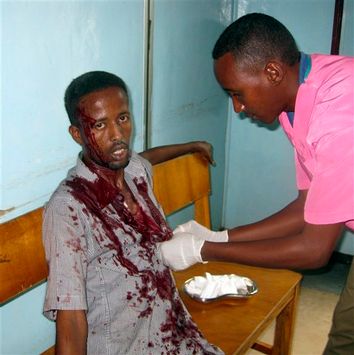
Suicide bomber attacks Somali hotel, killing 32A nurse at Medina hospital treats a wounded civilian,at Medina hospital, Mogadishu, Somalia, Tuesday, Aug. 24, 2010. after he was wounded by mortar shrapnel during fighting between Somali insurgents and African Union troops. A suicide bomber and gunmen stormed a hotel in Somalia's capital on Tuesday, killing at least 15 people including members of parliament in an attack that set off an hour-long gun battle, a military spokesman and a witness said. (AP Photo/ Mohamed Sheikh Nor)(Credit: AP)

A suicide bomber and gunmen wearing military uniforms attacked a hotel near Somalia’s presidential palace Monday, sparking a one-hour gun battle with security forces. At least 32 people were killed, including six Somali parliamentarians.

Witnesses described a horrific scene of dead bodies throughout the Muna Hotel and guests scrambling to safety by escaping out of windows.

The multi-pronged assault came less than 24 hours after the country’s most dangerous militant group — al-Shabab, a group allied with al-Qaida — threatened a “massive” war against what it labeled as invaders, a reference to the 6,000 African Union troops in Mogadishu.

The attack on the Muna Hotel raised the two-day toll to at least 70 people, a high number even by Mogadishu’s violent standards. Fighting that rocked Mogadishu on Monday killed 40 people, health officials said.

Somalia’s deputy prime minister told The Associated Press that 19 civilians, six members of parliament, five security forces and two hotel workers were killed in the attack — a total of 32. Two attackers also were killed, said Abdirahman Haji Aden Ibi, the deputy prime minister. A government statement said 31 people were killed.

An 11-year-old shoe shine boy and a woman selling tea in front of the hotel were among the dead, African Union spokesman Maj. Barigye Bahoku said.

“They have no motive other than to terrorize the Somali people. This is a deplorable act in this holy month of Ramadan. It shows their brutality and lack of respect for humanity,” said Abdirahman Omar Osman, Somalia’s information minister.

A survivor described a frenzied, one-hour battle inside the four-floor, $10-a-night hotel.

Saynab Qayad, a member of parliament staying at the hotel, said she was jolted awake by the popping sound of bullets. Three members of parliament staying on the fourth floor had drawn their guns while other guests scrambled to safety by escaping out the windows, she said.

“Smoke filled my room after bullets smashed my window. I hid myself in a corner of the room. Then a guest next door came to my door, screaming ‘Come out! Come out!’ And when I came out bullets continued to fly around.

“I went back to my room and locked my door. Shortly afterward, the hotel staff asked me to come down and put me in a room at the second floor with four other survivors,” she said. “The body of a member of parliament was lying at that small room’s door.”

Sheik Ali Mohamud Rage, a spokesman for the al-Shabab militia, said that members of the group’s “special forces” had carried out the attack against those “aiding the infidels.”

While Mogadishu has a small, government-controlled zone near the seaside airport, al-Shabab operatives frequently infiltrate the area, and the attack is only the latest proof that al-Shabab has molded itself into a full-fledged insurgent force capable of daring, complex assaults.

In a similar attack in December, a suicide bomber detonated himself at a university graduation ceremony near Tuesday’s hotel attack, killing 24 people, including three government ministers, medical students and doctors.

In its first international attack, al-Shabab last month claimed responsibility for twin bombings in Uganda’s capital during the World Cup final, explosions that killed 76 people who had gathered to watch the televised match. Al-Shabab said the attack was in retaliation for Uganda’s role in the African Union force in Mogadishu.

Militant veterans of the Iraq and Afghanistan wars are believed to be helping train members of al-Shabab, which has pledged allegiance to al-Qaida.

Somalia has not had an effective government for 19 years. Islamic insurgents led by al-Shabab have been trying to topple the government from Mogadishu since January 2007. The AU force has ensured the government stays because the force’s mandate is to protect key government officials and installations such as the air and sea port in Mogadishu.

——

Associated Press writer Malkhadir M. Muhumed contributed from Nairobi, Kenya.

21 people killed in clashes in Mogadishu

Muslim rebels battle with Somalia's ruling government forces in the capital

  • more
    • All Share Services

Fighting between the Somali government and Islamist insurgents killed 21 people in the Somali capital on Monday, said medical workers and witnesses.

Fourteen people were killed in the north of the city near the main market in the capital, said head of Mogadishu’s ambulance service, Ali Muse.

Resident Abdi Mohamed Aden said insurgents had shelled a military ceremony in the capital and then government forces had returned fire at insurgents operating from residential areas.

The president, the prime minister, the parliament speaker, the country’s chief of staff, the police chief and other senior government officials were attending the ceremony during the shelling.

A mortar killed a student and injured six others near the airport, said eyewitness Haji Dahir Igale.

“The first explosion targeted the convoy, killing two government soldiers, afterward local residents and some other government officials rushed to the scene to help the injured as they gathered the second explosion went off, killing four civilians and five others were injured,” said resident Hussein Abdulahi.

The weak U.N.-backed Somali government is battling an Islamist insurgency. The impoverished Horn of Africa country has not had a functioning government for nearly 20 years.

Continue Reading Close

Somali arrested at airport with chemicals, syringe

Seized materials could have caused explosion on Dubai-bound flight

  • more
    • All Share Services

A man tried to board a commercial airliner in Mogadishu last month carrying powdered chemicals, liquid and a syringe that could have caused an explosion in a case bearing chillingly similarities to the terrorist plot to blow up a Detroit-bound airliner, officials told The Associated Press on Wednesday.

The Somali man — whose name has not yet been released — was arrested by African Union peacekeeping troops before the Nov. 13 Daallo Airlines flight took off. It had been scheduled to travel from Mogadishu to the northern Somali city of Hargeisa, then to Djibouti and Dubai. A Somali police spokesman, Abdulahi Hassan Barise, said the suspect is in Somali custody.

“We don’t know whether he’s linked with al-Qaida or other foreign organizations, but his actions were the acts of a terrorist. We caught him red-handed,” said Barise.

A Nairobi-based diplomat said the incident in Somalia is similar to the attempted attack on the Detroit-bound airliner on Christmas Day in that the Somali man had a syringe, a bag of powdered chemicals and liquid — tools similar to those used in the Detroit attack. The diplomat spoke on condition he not be identified because he isn’t authorized to release the information.

Barigye Bahoku, the spokesman for the African Union military force in Mogadishu, said the chemicals from the Somali suspect could have caused an explosion that would have caused air decompression inside the plane. However, Bahoku said he doesn’t believe an explosion would have brought the plane down.

A second international official familiar with the incident, also speaking on condition of anonymity because he isn’t authorized to discuss the case, confirmed that the substances carried by the Somali passenger could have been used as an explosive device.

In the Detroit case, alleged attacker Umar Farouk Abdulmutallab hid explosive PETN in a condom or condom-like bag just below his torso when he traveled from Amsterdam to Detroit. Like the captured Somali, Abdulmutallab also had a syringe filled with liquid. The substances seized from the Somali passenger are being tested.

The November incident garnered little attention before the Dec. 25 attack aboard a flight on final approach to Detroit. U.S. officials have now learned of the Somali case and are hastening to investigate any possible links between it and the Detroit attack, though no officials would speak on the record about the probe.

U.S. investigators said Abdulmutallab told them he received training and instructions from al-Qaida operatives in Yemen — which lies across the Gulf of Aden from Somalia. Similarly, large swaths of Somalia are controlled by an insurgent group, al-Shabab, which has ties to al-Qaida.

Western officials say many of the hundreds of foreign jihadi fighters in Somalia come in small boats across the Gulf of Aden from Yemen. The officials also say that examination of equipment used in some Somali suicide attacks leads them to believe it was originally assembled in Yemen.

Law enforcement officials believe the suspect in the Detroit incident tried to ignite a two-part concoction of the high explosive PETN and possibly a glycol-based liquid explosive, setting off popping, smoke and some fire but no deadly detonation. Abdulmutallab, a Nigerian national, is charged with trying to destroy an aircraft.

A Somali security official involved in the capture of the suspect in Mogadishu said he had a 1-kilogram (2.2-pound) package of chemical powder and a container of liquid chemicals. The security official said the suspect was the last passenger to try to board.

Once security officials detected the powder chemicals and syringe, the suspect tried to bribe the security team that detained him, the Somali security official said. The security official said the suspect had a white shampoo bottle with a black acid-like substance in it. He also had a clear plastic bag with a light green chalky substance and a syringe containing a green liquid. The security official spoke on condition of anonymity because he wasn’t authorized to release the information.

The powdered material had the strong scent of ammonia, Bahoku said, and samples have been sent to London for testing.

The Somali security officials said the Daallo Airlines flight was scheduled to go from Mogadishu to Hargeisa, to Djibouti and then to Dubai.

A spokeswoman for Daallo Airlines said that company officials weren’t aware of the incident and would have to seek more information before commenting. Daallo Airlines is based in Dubai and has offices in Djibouti and France.

——

Associated Press reporter Katharine Houreld contributed reporting from Baghdad. Jason Straziuso contributed reporting from Nairobi, Kenya.

Continue Reading Close