Nina Power

Britain’s prime minister only makes things worse

David Cameron's authoritarian response deliberately misses the root cause of the riots -- England's grim future

  • more
    • All Share Services

Britain's prime minister only makes things worseDavid Cameron

To many looking from the outside, the recent unrest in Britain may have come as something of a surprise. Recent months have seen repeated protests, occupations, strikes and huge trade union marches, but street protests with seemingly no rhyme or reason were surely out of the question. With unfortunate timing, one British commentator, Nick Cohen, wrote a piece earlier this month titled “No riots here. Just quiet, ever-deeper misery,” arguing that “the wider public remains resigned rather than enraged; indifferent rather than incandescent.” The student protests of November and December last year were limited outbursts, no more, many agreed; the establishment consensus was that most people would grumpily carry on even in the face of huge cuts to public services, massive unemployment and more severe austerity measures to come. 

So what did happen in Britain last week? Analysis, or rather refusal to analyze, came thick and fast: This was the work of a mindless criminal underclass, of those who merely wanted expensive new sneakers but didn’t want to pay for them, and so on. The original trigger for the unrest — the fatal shooting of a black man from a deprived part of London — was quickly lost in the storm. Although many have tried to keep the backdrop of serious and long-term police racism and harassment as part of the discussion, reasonable voices have been drowned out in favor of an “act now, think later” approach. 

Of course, riots in Britain are nothing new, despite our attempt to brand ourselves as the eccentric, deferential land of Harry Potter and grandiose Royal Weddings. Over the last week, many have been reminded of the riots that took place in Brixton and Tottenham in the early to mid-1980s. Have things changed much since then? Some of the context is depressingly familiar — police brutality and racist harassment, massive unemployment, child poverty, lack of social mobility and blatant economic inequality. Many have been keen to paint the recent disorder as mere criminality, unrelated to any political issues or demands — except the desire to loot electronic goods. Indeed, over the past 20 years or so, it certainly feels like there has been a moratorium on any alternative narratives or motivations — conspicuous consumption for those that can afford it, massive debt for those who can’t, but above all the imperative to spend for the sake of an increasingly uncertain economy. 

One particular trend that has certainly increased since the unrest of the early 1980s is steady gentrification, and it has had ever-eroding effects on urban life. The inequalities of British cities, where incredibly the rich live side-by-side with the profoundly dispossessed, are the visual marker of a deeper trend: the pushing out from urban environments of anyone without money, anyone who cannot afford to own property, who cannot find a job, or can find only badly paid menial work. When millionaire politicians — many of whom have themselves been found guilty of stealing taxpayers’ money to pay for second homes and expensive consumer goods — attack people for theft and criminality, they make it clear once again that there is one rule for the rich and powerful and another for the poor. 

And now — the crackdown. In an emergency session of Parliament, Prime Minister David Cameron declared that “we will do whatever it takes to restore law and order.” His proposals were unusually concrete: more police on the street, more arrests and more prosecutions. CCTV footage will be used; no “phony human rights concerns” will stand in the way of publishing photographs of supposed offenders. Face-coverings can be removed by police whenever they feel like it, curfews are an option — “Nothing is off the table,” Cameron said. In the run-up to the Olympics next year, the government is “cracking down,” just as it has been against students and other protesters in recent months, going so far as to “pre-arrest” many suspected activists in the run-up to the Royal Wedding in April. 

As of Friday morning, around 1,600 people have been arrested, with at least 500 charged, many in makeshift overnight courts. The sentences are incredibly harsh — six months for one student with no previous criminal record for stealing water worth $5.70 (American), four months for an 18-year-old man in Manchester for swearing at the police. The majority of those sentenced so far, according to the Guardian, are “overwhelmingly young, male and unemployed.” 

The authoritarian response of the British government to the disturbances is a worrying sign of things to come. The only “context” permitted in the public discourse is the old, regressive idea that families, particularly single mothers, are to blame for “lawlessness.” This misplaced moralism is a deliberate attempt to avoid addressing the real causes of the unrest — inequality, poverty, unemployment and a lack of alternative narratives. The immediate future for Britain looks grim: increasing state repression, increased fear and suspicion of the urban poor, increased social divisions along class and racial lines, more blame and punishment and zero understanding. In other words, the very things that created the unrest in the first place.

The dirty girl

Controversial "Wetlands" author Charlotte Roche talks about bodily functions, shaving pubic hair, and why there are so few euphemisms for female masturbation.

  • more
    • All Share Services

The dirty girl

Charlotte Roche is a curious mix of old radicalism and new daring. A well-known music and talk show host in Germany, Roche has produced a minor literary scandal, not to mention a major commercial success, with her first novel, “Wetlands,” which is now being published in the United States. The first German book to make Amazon’s worldwide bestseller list, “Wetlands” is a savage, darkly humorous attempt to depict the contours of female anatomy and desire that has appalled as many as it has delighted with its graphic details.

Set in a hospital, it follows the thoughts and strange encounters of 18-year-old Helen Memel, the victim of an unfortunate attempt at intimate shaving. It is hard not to see Roche’s rebellion against the unwritten demand that women be shaven, constantly presentable and perpetually desirable as, in part, an attack on the television culture that made her name. Helen is everything a female TV host cannot be: ill, self-involved and obsessed with obscenity. But “Wetlands” is more than just a complaint against the sexual double standards of contemporary life. It points to an odd paradox: For all the hedonism of an apparently liberated culture in which women can drink and screw with the best of them (think “Sex and the City”), the language we use to describe this behavior and these unleashed desires is profoundly outdated or, more often, simply absent. For all the inventively silly and explicit ways to describe male masturbation, for example, it is hard to think of many euphemisms for the female equivalent. Choking the oyster, anyone?

Roche creates a world — a “Wetlands” indeed — in which there are new words to describe the weirdness of the female body and the ambivalence of sexual encounters. It’s a damp and claustrophobic universe, but one that reminds us of how far we have to go to overcome deep-seated embarrassments about basic biological facts. Roche is a strange poster girl for such a progressive operation, elfin and brazen in equal parts, but in person she neatly captures the contradictions of a contemporary femininity that can’t decide whether it wants to be low-down and dirty or prim and proper (or both at the same time).

In Helen, Roche has created a character that promises a certain kind of liberation — the right to be sick and sexy, the right to be damaged and confident, the right to speak about anything and everything without shame. To combine such earnestness with comedy is a tough feat, but Roche pulls it off with a rare charm: Television’s loss is literature’s gain. I caught up with Roche at her British publisher’s office in London, where she talked about female fantasies and the fun of creating an alter ego .

In Germany the book was primarily bought by women. But perhaps there wasn’t as much discussion, or the kind of discussion, about it that you wanted?

On the one hand, the reception was extremely negative. They made a big scandal out of it. They said, “We don’t want this, this is disgusting, this is not literature.” On the other hand, there were very intellectual women writing very nice things about it. It’s something to do with the sexes: Men have a laugh, or they think it’s disgusting. Women think, “Ah, this has something to do with me,” and they get into it.

It has sometimes been read in the context of chick lit — lightweight, a bit romantic, “Sex and the City”-type novels with pink covers…

The pink corner in the bookshop!

…and your book has been seen as a subversion of this genre, like you’re trying to undo “women’s literature” by pushing it to an extreme, or that you’re trying to do something pornographic. Is the book pornographic, or simply explicit?

I think “pornographic” is the wrong word. We use “pornographic” because we don’t have enough words to describe what it is. I wanted to write something original, [to] be honest, and the way I write things is explicit because that’s the way I see things. I am not a person who would say, “Oh, this is disgusting” and look away. I would look at the disgusting thing and describe it in a very detailed way. Maybe even to overcome the disgusting. You look at it as long as you can and then it’s not disgusting anymore.

You have said that at the very moment where the reader might get aroused, you deflate the desire. There’s a sense in which it could excite you, but then you go further, do something else.

I wrote it so that it would be a bit horny at some points, because I wanted it to be a realistic, honest book about the body. But it also has to have all the taboos in that we think are disgusting. Human, liquid, disgusting stuff. So I always imagine a man reading it and having an erection [raises finger] and then reading and wanting to wank and then [lowers finger]…

I wanted to write things that I have problems with, things that I am embarrassed about, like writing your heart out. The big misunderstanding is that I am so cool, so open, because I’ve written this book. It’s not at all the case. There are things in the book that are my lifetime problems, like going to the toilet in public lavatories. As soon as someone would walk in, I would stop because I feel so embarrassed. It’s all about being a woman and not being about to shit.

I think a lot of the book is about recognizing these feelings of embarrassment. Contemporary women are supposed to be liberated, hedonistic, you can go out and get drunk, sleep around. But if we don’t have the words to describe the range of experiences other than the old negative ones, then nothing has really changed.

If we don’t have the words and we don’t talk about it, and I would also suggest that we don’t even think about it. I have this theory. If you tell any man, “Today I am your sexual servant. You can tell me whatever you want and I’ll do it to you,” every man would think of 12 things to do. Men have fantasies; they have words for everything. They could tell a woman, “Lie down, do this, lick this.” But if I a man said to me, “I am your sexual servant, what do you want me to do?” I would be blank. There’s nothing even in my head to allow myself to think what I actually like.

I seem to be a modern, self-confident woman, and people would think that kind of woman would be into dirty talk, high heels, drugs, fucking around. But as soon as it comes to the secret intimacy of my own fantasies, there’s almost nothing there. So for me it was about sitting down and thinking, what does the vagina look like? What do all the little bits look like? What could you call them? It was therapy for myself to actually think about this, which I wasn’t doing before.

The contemporary woman is supposed to be sexually available, as you say, but when a women is sick, she ceases to exist as a sexual being. Which is why the illness theme in “Wetlands” is really interesting.

Very often, lately, people have come up to me and say “You look tired,” and I hate it. Women are supposed to always look fit and healthy and pretty. But everything that is sick and tired is all very human — and I think that being human is a big taboo. When people say that the book is about taboos, I ask them, what do you mean? Shit? Piss? Menstruation?

Menstruation is in many ways extremely annoying and quite disturbing, for all its normalcy. But it isn’t really spoken about that much, is it?

The problem with taboos is that you think you’re the only one. And Helen always wants to know: Does it smell the same with other women? How do other women’s vaginas look? We’re all completely isolated. It’s not a group of women that menstruate; we’re on our own. But where does that come from? Mothers still don’t think it’s a good thing to be a woman.

The mother in “Wetlands” says that you can’t ever be clean enough.

You can clean and clean, and you won’t ever stop being dirty. My mother tried to raise me in a very liberated way. I was allowed to have sex at a very early age. I was allowed to bring boys over to the house because she didn’t want me fucking around in the woods. She’s a very strong, political feminist, and she raised me in a very feminist way, teaching me that as a girl, I can do everything a boy can do, there’s no problem. But still, the sexual stuff … she never managed to teach me that masturbation is a good thing. Although my mother was liberated, I still feel that if I have dirty knickers [underpants], I have to hide them from my husband.

Mothers tend to be almost proud of their son’s sexual conquests, whereas girls have to keep quiet about it.

Exactly. I have so many arguments with people who say, “Look at ‘Sex and the City.’ Women can do everything. We can fuck around.” But look at families with young teenagers: They start making jokes about the boy age 12 or 13; they leave tissues by his bed. But what mother can manage to teach her daughter that it’s a good thing to menstruate — or nothing terrible, at least? That it’s a good thing to have sex, to have breasts? I know stories from women of my age, and the mothers would say, “Can you please hide your period from your brothers, because I don’t want to have to explain what it is.”

In the book, Helen pays for sex with other women. Why doesn’t she have sexual relationships with women without the involvement of money?

I thought it was a nice idea, because she doesn’t know who to ask. It’s like going to a psychiatrist because you can’t talk to anybody else about your problems.

In the literature of the Enlightenment, the prostitute sleeps with politicians, the clergy, so she’s cynical and clever. She understands power. She’s also a materialist, because she understands how bodies work. Helen reminds me of this type of literary heroine.

The good thing about prostitutes is that you can get to the point straightaway. They’re not shocked about anything you ask. I’ve done lots of research in brothels.

There was a novel a few years ago, “Brass,” by Helen Walsh, in which the female protagonist tries to sleep with prostitutes, and virtually no one will see her. There’s one who just doesn’t care, but generally there are all these rules — I won’t do that, I won’t sleep with women.

When I went to brothels, as a woman, all the men would think I was a prostitute. I would get offers. The brothel owners would always tell me to come at 6 in the evening, before business started. The atmosphere was so nice. They were all completely naked and had high heels, and it was so warm, everybody was sweating. And just walking in the entrance area in the bar, it’s just like paradise. People are naked and sexual and humid. And I thought, it’s a big shame that we don’t have that for women. There is such a nice range for men, they have so much opportunity — porn on the Internet, wanking booths. But women have nothing.

Helen is not a hippie, even though she celebrates her “naturalness.” She’s very modern. But do you think men who say they prefer their women totally shaved, with artificial breasts, is it because of a kind of familiarity with porn, or is it what they want?

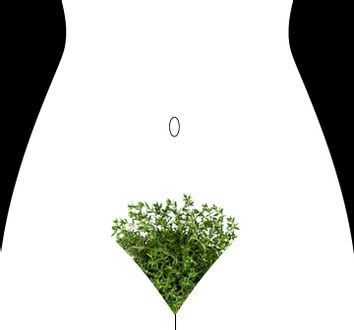
Of course all the shaving stuff comes from porn, and I think that often men don’t have enough self-confidence to admit that they would like a non-shaven woman. For example, women with pubic hair in porn would be the perverted corner, complete fetish, a niche like pregnant women or 90-year-olds.

I hate shaving, but I shave because I want to be an attractive woman and I don’t want people to throw stones at me in the street. But I think there would be a much wider range of possibilities if people talked to each other more. There are men who wouldn’t give a fuck if their wife was shaven or not, so she wouldn’t have to bother. Nearly all prostitutes are completely shaven, and men go there and think that this is the fashion, but maybe they don’t all like it. A completely shaven pussy looks really weird. I just don’t want all women to be the same. Why do we all have to shave the same way? Some women would look much nicer with a little bit of hair.

Ariel Levy has this idea of “raunch culture,” where porn and the stripper image of women has come to be seen as the only image of womanhood worth aspiring to.

Heterosexual women and men are both equally bad. Men don’t stand up for what they like, because there’s a pressure on men that they have to like these fully shaven women. A man wouldn’t dare to say in the pub, “Look, I really like women with big bushes.” But women are so hard on themselves, like, “Oh no, I can’t have sex, my tummy is too fat and my tits are too small.” And it’s not fun to have sex with women who are insecure about their bodies.

For me, it’s the same. I keep thinking I have to stop eating this, and stop drinking beer. It’s unhealthy thinking. If I’m being really honest, on the one hand I want women to be liberated, but on the other, I have terrible problems. I think I’m too fat, although I’m probably too thin. It’s really difficult, for example, to live in a society like this with small tits. I don’t even believe my husband when he says he likes the way I look. He has to tell me 10 times a day and I still don’t believe him. I think he wants to fuck a blond, big-titted lady. You run around and you have complexes about everything. It’s so difficult to keep it out of your head.

So how does Helen manage it?

That’s why she exists! She’s like my brave, freed alter ego. I can be like her sometimes, but only verbally.

I think some of the negative readings of your book argue that it can’t be a feminist novel because Helen isn’t totally strong, that she’s not fully mentally sound.

The problem with political ideas like feminism is that you are not allowed sometimes to say the truth. In Germany we have lots of older, very famous feminists. And it is not allowed for me as a young feminist to say that women are masochistic. I am and all my female friends are. We stand in front of the mirror, we are naked, and we feel ugly as fuck. We see everything as wrong. We try and fight our body to become prettier and work on it. It’s not at all free and self-confident. I don’t want it to be like that, but I see that it is.

Continue Reading Close