Paul McLeary

How we lost Iraq

If you want further confirmation that the U.S. bungled the Iraq invasion, Michael Gordon and Gen. Bernard Trainor have written the book for you.

  • more
    • All Share Services

How we lost Iraq

Just past the three-year mark of the invasion of Iraq, an already considerable literature has sprung up around the war. We’ve seen big, ambitious books like “The Assassins’ Gate,” George Packer’s history of the war’s complex genesis, the hawks’ failure to do any postwar planning and the critical missteps and squandered opportunities that plagued the Coalition Provisional Authority during the first year of the occupation. Packer wrestled with the historical implications of the war, and charted the sometimes tortured paths some of its initial supporters, including himself, have traveled in owning up to (or not) their mistakes.

There are also a bevy of less overtly political works, like Anthony Shadid’s tragic portrait of a people under siege, “Night Draws Near,” that examine the toll the war took on individual Iraqis. Perhaps the most personal, heartbreaking (and sadly overlooked) of these books is Michael Goldfarb’s “Ahmad’s War, Ahmad’s Peace,” an American reporter’s tender eulogy to his Iraqi translator and friend, Ahmad Shawkat, a frustrated intellectual and dissident who was tortured by Saddam’s henchmen for refusing to bend to the strictures of the state. Ahmad’s tragedy is endemic of the occupation as a whole: Once freed from the repression of the state, he starts a pro-democracy newspaper, only to be killed by Islamic fanatics for his liberal views, leaving behind a wife and several children.

Over the next several weeks we’ll see more: “In the Belly of the Green Bird,” by journalist Nir Rosen, who infiltrated the insurgency in Iraq, is set to be released, along with freelancer David Axe’s “War Fix,” a graphic novel exploring his experiences as an embedded reporter in Iraq. These books join those by a host of retired generals, former government officials, reporters and soldiers who have added their voices to the chorus surrounding what was at one time billed as our generation’s grand adventure, and which has instead devolved into a festering sore, tearing the nation apart.

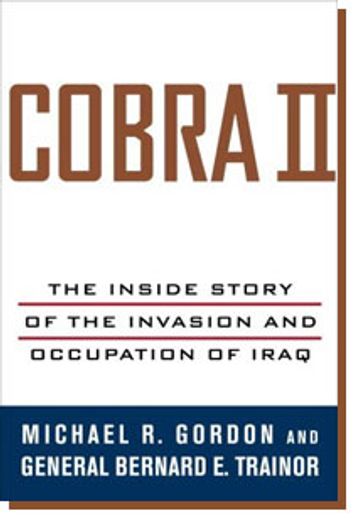
Entering the mix is “Cobra II: The Inside Story of the Invasion and Occupation of Iraq,” by the New York Times’ Michael Gordon and retired Marine Gen. Bernard Trainor. It has none of the fleshy humanity that Shadid and Goldfarb — and to a certain extent Packer — brought to the story of Iraq. Nor should it. Gordon and Trainor, well situated with a bevy of sources inside the decision-making process at the Pentagon, never avert their gaze from the often politically inspired recklessness of the Pentagon brass leading up to the invasion; nor do they neglect to notice how the grunts on the ground carried out their orders with courage and professionalism. A good portion of the book is taken up with relating the smug, detached war plans hatched at the Pentagon by civilian commanders — led, of course, by Donald Rumsfeld — convinced the war could be fought cheaply and quickly. While the outcome of the conflict was never in doubt, in Gordon and Trainor’s account, Rumsfeld, Gen. Tommy Franks and the ideological yes men they surrounded themselves with at the Pentagon often come off as almost fictional in their self-delusion.

If you thought you knew everything about the planning mistakes that allowed the American military — through no fault of its own — to charge into Iraq uncertain of the fight they would face, “Cobra II” will deepen your knowledge, and validate all of your worst fears, about what went wrong. At the very least, the book acts as a collection point for three years’ worth of stories of incompetence, hubris and delusion on a grand scale. All the things we’ve taken as conventional wisdom about what went wrong in Iraq are here proved true, with firsthand evidence to back it up: The lack of men and materiel, the aversion to “nation building,” the ignorance of local culture and customs, the underestimation of Iraqi paramilitary units and the desire to pull out quickly are here writ large. Indeed, the Pentagon, through Rumsfeld’s insistence on going into the war fast and light — ignoring the recommendation of Gen. Shinseki and other top officers that hundreds of thousands of troops would be needed to pacify the country after initial combat operations — caused the military on the ground more problems than it solved. In the end, the fighting men and women and their creative and dogged officer corps, sloshing through the mud and the sand and the grime of combat, rose above their leadership and succeeded the best they could. “Cobra II” tells their story like no other book has, honoring their courage even as it savages the arrogance of the top brass.

One of the key points made by Gordon and Trainor is that Franks and Rumsfeld ignored early evidence that the real battle for Iraq would take place after Saddam’s regular army was defeated. Just days after the invasion began, Iraqi Fedayeen forces and paramilitary fighters were harassing American convoys, staging hit-and-run assaults from pickup trucks, melting into the civilian population and engaging in other classic forms of irregular warfare. On March 27, 2003, Lt. Gen. David McKiernan, serving under CENTCOM commander Gen. Tommy Franks and tasked with running the ground war, called for a temporary halt to the push north in order to shore up the rear. With the lead units outrunning their supply lines and facing a series of unexpectedly brutal fights with an enemy often wearing civilian clothes, it was quickly becoming clear to ground commanders that the “enemy we’re fighting is a bit different than the one we war-gamed against,” as Lt. Gen. William S. Wallace, head of the Army’s V Corps, told reporters at the time.

The halt, and the fact that Wallace broke from message discipline, so infuriated Franks that McKiernan was forced to fly to CENTCOM headquarters and “eat a shit sandwich” in order to set things straight and to convince Franks not to relieve Wallace of his command. Gordon and Trainor report that Wallace’s comments “shook the Pentagon,” and led Rumsfeld to publicly disavow responsibility for the war plan, essentially shuffling any blame for missteps onto Franks and Gen. Anthony Zinni, who had been excommunicated by the Pentagon for refusing to support Rumsfeld’s fast and light approach to waging war. More important, neither Rumsfeld nor Franks concluded that the guerrilla-style attacks were a sign of things to come.

With the holdup at the front riling the Pentagon, and Rumsfeld enraged, Newt Gingrich stepped in to calm the defense boss. Gingrich asked Army Col. — and Rumsfeld favorite — Doug Macgregor to write a memo fantasizing about how the war should be going. Macgregor had earlier proposed a ridiculous plan that called for an invasion force of about 16,500 soldiers, buttressed by another 15,000 to be flown in to maintain order once the fighting was done. Rumsfeld found the memo inspired and forwarded it to Franks during the planning phase of the operation, “as an example of the creative thinking the CENTCOM commander should consider.”

Macgregor’s new memo showed much of the same bluster, and again, Rumsfeld — who was still convinced that the invasion force was too big and should be moving faster — gushed over it. Safely ensconced in Washington, Macgregor and Rumsfeld seemed to be in the dark about the fierce fighting, stretched supply lines and paramilitary action hitting the American advance from all sides. Displaying the nerve of a true armchair general, Macgregor wrote that “The advance must continue without pause. There is no reason to stop … Holding one’s nerve is fundamental … Stopping will be a betrayal.” Most important, perhaps, Macgregor finished with a nod to the political realities of the invasion: “Stopping will open the door to destructive partisan politics. Public support could well evaporate.”

“Cobra II” — which draws almost entirely on the recollections of those in Pentagon and CENTCOM meetings — savages Rumsfeld’s legacy. Many of Rumsfeld’s ideas about how to fight in Iraq were fortunately ignored. For those aspects of his plan that did make it into the final draft of the war, and for his constant meddling and micromanaging, Gordon and Trainor — and the military men they spoke to and the classified after-action reports they read — have little admiration. But Rumsfeld’s insistence that the U.S. go in fast and light, with the assumption that the military would quickly overwhelm the enemy and then withdraw, did of course prevail — with disastrous results.

One of Rumsfeld’s most destructive contributions came when he decided to dismantle the time-phased force and deployment list (TPFDL) system, the military’s computerized system for deploying and supplying forces overseas, which he regarded as an outdated way of doing things that “took decision-making out of his hands.” Instead, Rumsfeld wanted to retain the power to cut off the flow of troops as soon as the combat portion of the war was over, so as to draw the American presence in the country down to a division or two (in other words, well under 40,000 troops) by the fall of 2003. The August 2004 Schlesinger Report, which investigated the abuses at Abu Ghraib prison, found that aside from keeping vital supplies and reinforcements floating in the Mediterranean and the Persian Gulf — where they did the invading troops no good — Rumsfeld’s decision to do away with the TPFDL also fed into the abuses that occurred at Abu Ghraib, since units arrived out of order, without the proper training, and often without their equipment.

But the full extent to which Rumsfeld and his team of civilians in the Pentagon were out of touch with the realities on the ground is thrown into high relief in an anecdote Gordon and Trainor relay about Rumfeld’s long-standing plan to have troops from neighboring Muslim countries come in to guard religious sites in Iraq. This plan was greenlighted until just before the invasion, when an Army colonel pointed out that the countries bordering Iraq were predominantly Sunni, and having their soldiers guard Shiite religious sites “would be like having Fitzgerald [one of Frank's chief war planners] … go to Belfast to guard the Orange Day parade.”

Some of the most striking passages in the book come not from any backroom, fly-on-the-wall investigative reporting (though those details alone are worth the price of admission), but instead are found in the blow-by-blow accounts of the fighting during the march toward Baghdad. While these fights, and the quick action by the officer corps in the midst of the brawl, will no doubt be studied at military colleges and institutions for generations to come, they have, for whatever reason, failed to grab the attention of the American people in any meaningful way.

Who, after all, can tell you anything about the battle of Samawah, or the bloody wrestling matches at Najaf or Nasiriyah, or the critical engagement at Al Kifl, where the fighting was so fierce with Iraqi irregulars that a colonel who took part said it might have been a turning point in the war?

From the opening engagements of the war, the Army and Marines — who were advancing in parallel columns with little communication between them — noted that a disproportionate number of the enemy wore civilian clothes, and from the very first, U.S. forces were capturing groups of fighters with Syrian passports. The commanders on the ground also noted from the first salvos that, given the orders to push north as fast as possible, there were no American troops left in the south of the country to try to restore order and mop up the Fedayeen forces that had blended in with the civilian populace. This, as many of them made clear at the time, and which has been recorded in the book, was a tactical mistake that could have been corrected with more troops, or more attention from Franks at CENTCOM, who looked at the irregular and foreign fighters as little more than a distraction to his carefully choreographed war plan.

For example, at the fight for the Tallil Airfield in the opening days of the war, Maj. Jim Desjardin said in an interview that it was “The first day [he had] seen the enemy and realized we were fighting a different force. They weren’t in uniform. They were civilian individuals that were running around with weapons.” Similarly, as the fight for Nasiriyah showed, Gordon and Trainor write, it was obvious to the officers on the ground that “The enemy faced by U.S. forces would be largely amorphous, not in uniform, and rarely part of an organized military force … if the Fedayeen had disappeared into small villages and towns to regroup and fight another day and were to be hunted down, did the United States have the right strategy for that, as well as sufficient forces?”

There was never any real doubt that the overwhelming firepower, strict training and professionalism of the American forces would carry the day in Iraq, but as Gordon and Trainor bring to life in heretofore unseen detail, the commanders slugging it out on the ground had moments of genuine concern over the success of the operation, given the unexpected resistance they were facing. They write that just in the first few days of the engagement, the “3-7 Calvary had engaged in an unexpected firefight in Samawah; Rams had been infiltrated by small groups of Fedayeen; and the battle in Nasiriyah had become a bloody brawl.”

Despite all this, Franks still didn’t think the fighting in the south was bad enough to slow the advance, and refused to allocate additional troops to fill in the gaps left behind as troops rushed toward Baghdad — the Bush administration’s symbolic crown jewel. Instead of listening to his ground commanders about the fierce fighting, Franks instead blamed the Army’s lack of aggressiveness, while complaining that McKiernan was too concerned with the unfinished business in the rear. This insistence on getting to Baghdad at the expense of wiping out the resistance in the south may have allowed the insurgency that has plagued the U.S. to take deeper root.

How much are Rumsfeld and Franks to blame for the mess in Iraq? That’s something many of the books on the war have grappled with, and will continue to wrestle with for years to come. War is a complicated business, and it’s a fact of war that once the shooting starts, the original battle essentially gets thrown out. There are no guarantees that even with more troops and better planning, things would have turned out differently in Iraq. As Rumsfeld might say, it’s a “known unknown.” But the initial planning and policy failures are easier to tally, and as “Cobra II” shows in precise detail, they can be placed directly at the feet of Rumsfeld and Franks.

Channeling the right

There's mounting evidence that the man in charge of public broadcasting is on a conservative crusade.

  • more
    • All Share Services

Channeling the right

Despite his continued protestations to the contrary, it’s becoming harder and harder to believe the Corporation for Public Broadcasting’s chairman, Ken Tomlinson, when he says that his main concern is to try to bring some political “balance” to PBS’s lineup.

While polls have shown that a majority of Americans don’t see PBS as leaning one way or the other ideologically, Tomlinson seems to view programming choices in a starkly black-and-white manner; as he told NPR’s Bob Garfield on May 6, “I don’t want to achieve balance by taking programs that are the favorites of good liberals off the air. I want to make sure that when you have programs that tilt left, we also have some programs that tilt right.”

The problem is that, if his actions are any guide, administration-approved appointments, secret contracts with conservative content monitors and suppressing polls that refute his “liberal bias” charge are part and parcel of his vision of balance. In effect, Tomlinson is stacking the deck so far to the right at the CPB that what he claims to see as balance, many others view as a right-wing coup in public broadcasting.

A Republican appointee originally named to the CPB board by President Clinton in 2000 and promoted to chairman by President Bush in September 2003, Tomlinson currently heads all of the country’s publicly funded broadcasting — both domestically and internationally. In an unprecedented move, he also chairs the Broadcasting Board of Governors, which oversees U.S. government-sponsored, nonmilitary, international broadcasting, a dual role that no one has ever held before.

Recently, lawmakers on Capitol Hill have called for Tomlinson to resign from both posts because of his having spent close to $30,000, without the knowledge of CPB’s board, on consultants to monitor PBS’s content for “liberal bias” and having hired a White House staffer to write rules for two other new content monitors — possible violations of federal law.

These calls come at a critical time for the CPB, as the House Appropriations Committee just voted to cut its funding by about half (which, if it stands, would be the largest cut in its history), and the board is looking for a new president.

The past week has been a rough one for Tomlinson, with a veritable flood of evidence pointing to the hubris he has exhibited in trying to prove the “liberal bias” in public broadcasting canard. Late last week, the New York Times reported that Tomlinson had authorized, without the consent of the CPB’s board, $14,170 in payments to a consultant named Fred Mann. He tapped Mann to monitor the political leanings of guests on PBS’s “Now” program, which was then hosted by Bill Moyers, for evidence of bias. According to reports, Mann labeled segments “pro-” or “anti-” Bush, and “anti-corporation” or “anti-DeLay.”

How do we know this? Not because Tomlinson released the information to the public. Rather, Sen. Byron Dorgan, a North Dakota Democrat, demanded to be provided with the information Mann gathered, and while his office would not release the data to the public or the media, Dorgan spoke on the Senate floor Monday, outlining some of his findings.

Meanwhile, there has been quite a bit of speculation about why Tomlinson would hire a guy in Indianapolis no one had ever heard of to monitor PBS. Who is Fred Mann? On Sunday, the Indianapolis Star almost unwittingly outed him, in the process providing a glimpse of Mann’s partisan credentials. In a short item on the controversy, the paper reported tracking down someone named Fred Mann, but couldn’t find out if it had found the right one, concluding simply that “a Frederick W. Mann, 61, who has worked for the conservative National Journalism Center in Washington, has Indianapolis ties.”

Turns out they had the right Mann. And it gets even better: The National Journalism Center was founded by the American Conservative Union, which describes itself as “the nation’s oldest conservative lobbying organization.”

More recently, the NJC has been run by the conservative Young America’s Foundation. Even if these were the only indications we had of Tomlinson’s partisanship, they would still go a long way in calling into question his contention that he is merely taking an unbiased look at the political leanings of public broadcasting.

If that isn’t enough to call his credibility into question, it appears that Tomlinson also lied to a member of Congress about the contract. According to the New York Times, in a letter dated May 24, he told Sen. Dorgan that he didn’t consult with the CPB’s board about hiring Mann because it had been “approved and signed by then CPB President, Kathleen Cox.” The only problem is, the contract is dated Feb. 3, 2004 — five months before Cox became president.

These are merely the latest developments in a months-long string of deception, partisan hackery and willful malfeasance on Tomlinson’s part — moves that have unquestionably undermined the health and future of public broadcasting. But it appears that help may finally be on the way.

In May, the two top Democrats on the House Appropriations and Commerce committees, Reps. David Obey and John Dingell, delivered a letter to the inspector general of the CPB, Kenneth Konz, demanding an investigation into Tomlinson’s actions.

The one charge leveled by Obey and Dingell that has the most potential to do some damage points to what may be a potentially serious violation of the Public Broadcasting Act of 1967.

The charge has to do with Tomlinson’s hiring of Mary Catherine Andrews, former director of the Office of Global Communications at the White House, to write a set of guidelines for the two new ombudsmen Tomlinson hired to monitor political content on PBS. The problem, it seems, is that Andrews was still on staff at the White House when she wrote the rules. Legally, this violates Section 398 of the act, which bars federal employees from engaging in any “direction, supervision or control over public telecommunications.”

But Andrews is hardly the only Republican staffer Tomlinson has lobbied to join the CPB. The résumé of Tomlinson’s handpicked choice to become the next president of the CPB — Patricia Harrison — hardly burnishes his nonpartisan bona fides. She currently works as an assistant U.S. secretary of state, but she previously served as a co-chairwoman of the Republican National Committee.

And the hits just keep coming. While Tomlinson has repeatedly said that he is not beholden to the wishes of the Bush administration — despite the fact that he seems to hire only from within its ranks — the most recent disclosures deal a death blow to his contention that he runs his shop independently of 1600 Pennsylvania Ave.

On Monday, NPR’s David Folkenflik came out with a damning report on NPR’s Web site, in which he reprinted excerpts from several e-mails Tomlinson sent to colleagues — essentially hanging him with his own words.

One e-mail concerned a proposal floated by Sen. Conrad Burns, R-Mont., who wanted to give public television and radio stations more of a voice in naming board members to the CPB. On July 21, 2004, Tomlinson wrote to Kathleen Cox, the CPB’s CEO and president (who has since been forced out), that “the White House has issued guidance. WH officially opposed to the Burns amendment.”

Jeffrey Chester of the Center for Digital Democracy, a media advocacy group, says of the most recent evidence: “The Bush White House and the Republicans are behind Tomlinson, and they have no intention to drop their campaign against public broadcasting.”

“Ken Tomlinson is channeling Richard Nixon,” Chester adds. “These dirty tricks, backdoor communications with the White House, the purging of senior executives, recruiting top-level GOP operatives — all to scare public broadcasting officials” — are reminiscent of Nixon’s anti-public broadcasting crusade in the early ’70s.

In response to all this, on Tuesday, several lawmakers on Capitol Hill finally took Obey, Dingell and Dorgan’s lead and began speaking out against Tomlinson’s partisan power plays. Rep. Edward Markey, D-Mass., demanded that Tomlinson resign not only as chairman of the CPB but as chairman of the Broadcasting Board of Governors.

“My opinion,” Markey said, “is that Ken Tomlinson has facilitated the attack upon the institution that he was tasked with protecting. If PBS is saved this week, it will not be because of Ken Tomlinson, it will be in spite of Ken Tomlinson. And as a result he should resign. In my opinion, because of his ideological attack on the other, international broadcasting board, he should resign from that as well.”

Markey made his remarks at rally on Capitol Hill to oppose the $200 million in cuts in federal funding for public broadcasting approved by the House Appropriations Committee on June 16. The committee passed a spending bill that would cut CPB’s funding by 25 percent next year, slashing it from the $400 million it received in 2005 to $300 million — but with other cuts in technological spending and specific programs set up for children’s educational programming, total cuts would reach about $200 million.

What’s more, 16 senators — including Joe Lieberman and Chuck Schumer — banded together Tuesday to issue a statement calling for Tomlinson’s dismissal.

Lieberman was the most vocal of the group, saying in the statement that “Kenneth Tomlinson’s actions call into question his commitment to public broadcasting and Americans would be better served with a less partisan leader of this important national treasure.” Lieberman also sent a letter to the Senate Appropriations subcommittee that has jurisdiction over the CPB to demand that it reject the cuts it earlier proposed.

Given all this, it’s pretty clear that it’s well past time for a serious conversation about how to continue to fund public broadcasting while keeping it free from political influence, since the current system, even if it survives Tomlinson, is obviously in the sights of the Bush administration. “This is a long-term war,” Chester says, “which the Republicans have been engaged in to weaken public broadcasting. I think it’s time to be realistic and admit that in the short term, this kind of federally funded system may not be able to thrive.”

But how best to make it thrive? That’s the question many in the public and private sectors seem to be dodging. Whether Tomlinson survives the current controversy is somewhat irrelevant — what matters most is that the federal government make a serious commitment to the health of public broadcasting, and keep politics out of the equation.

Some proposals, like the one recently floated by Markey, along with Sens. Christopher Dodd and Jim Jeffords, look better on first blush than they turn out to be on closer inspection. The trio has introduced the “Digital Opportunity Investment Trust Act,” which, if passed, would generate some revenue for public broadcasting — but not nearly enough to ensure its survival. The bill relies on the windfall (estimates put it at upward of $30 billion) the government is expected to receive in 2008 from the sale of TV spectrum rights.

The problem is that under the bill, PBS stations would get only about 20 percent of the interest on the sale of some spectrum rights. What’s more, the funds would mainly be used for educational programming and “software,” and not necessarily to support journalism.

Lawmakers should be applauded for finally stepping in and denouncing Tomlinson for the partisan player he is, but without some realistic and innovative plans to keep public broadcasting a healthy, nonpartisan alternative to commercial television, these battles are likely to be fought all over again in a few years.

Continue Reading Close

“Rock ‘Til You Drop” by John Strausbaugh

A baby boomer rock critic condemns his generation's insistence on lionizing the burned-out bands of their long-lost youth.

  • more
    • All Share Services

Ah, the baby boomers. If we’re not hearing about how great their teens and early 20s were, it’s how much better, how much more important their music was than any that’s come since. They’ve even built a museum in Cleveland to house the rotting relics of that long ago era called their youth.

Granted, the ’60s were a critically important and fertile time for rock music. The only thing resembling a mainstream rock revolution we’ve had in the last 30 years are punk’s brief flirtation with fame in the late ’70s and the now-you-see-it-now-you-don’t “grunge” movement of the early ’90s that was largely a Black Sabbath rip-off anyway. Other than the success of bands such as Radiohead and Tool, the so-called n| metal movement is the only thing even resembling rock music currently on the mainstream cultural radar. Rock radio is full of bands like Limp Bizkit, Staind, Slipknot and Linkin Park, bands who look as though they’ll have the shelf life of a watermelon and seem just about as important.

But each generation of rock fans has its own cultural battles to fight. For the baby boomers, many of whom seem to think that rock died along with their youthful ideals in the early ’70s, well, they’ve been shelling out big bucks to try to relive their glory days by watching aging warhorses like the Stones; the Who; Clapton; Crosby, Stills, Nash (and, recently, Young) and Jefferson Airplane/Jefferson Starship/Starship, an ongoing joke that hasn’t been funny since the ’80s, dust themselves off and limp onstage once every couple of years for a tour or release another remastered box set with new liner notes and some old photos.

Although these bands regularly fill amphitheaters and concert halls, it would be unfair to say that all boomers are happy about the never-ending nostalgia carnival. Chief among the dissenters is John Strausbaugh, editor of the Manhattan weekly New York Press, who thinks that these acts (to paraphrase what he says about the Rolling Stones), are “Not a rock band anymore, but a handful of middle-aged men, acting as a rock band.”

The rock of the ’60s gave voice to the emerging youth culture just as much as it churned out kick-ass tunes you could dance to. As with many American social/cultural movements, however, it was only a matter of time before the marketplace learned the lingo and co-opted the rebelliousness of rock. Strausbaugh is careful to point out that the bands that made it big at the time weren’t necessarily the revolutionaries they’ve been marketed as — rather they were primarily guys who wanted to rock, make money and ingest as much as they could in the shortest amount of time. The sociopolitical ideals were there, sure, but to a large degree it was the first generation of rock critics, writers such as Greil Marcus, Stephen Holden, Robert Christgau and Peter Guralnick, along with magazines like Rolling Stone and Crawdaddy! who attached their own countercultural agendas to the music.

The funny thing about the rock journalists who wrote about the “revolution” in the late ’60s is that they are, by and large, the same guys writing the RZA and Bjvrk reviews in the mainstream media today. Since it took the contextual cultural knowledge of people in their 20s to convincingly write about the Beatles or Dylan in the ’60s, Strausbaugh contends, how can a 55-year-old pretend to know what’s necessary to offer a relevant analysis of the Beta Band? Sure, as the elder statesmen of rock journalism they’ve witnessed the unfolding of rock history, but does rock criticism really need more historians — or does it need young, fresh voices for whom the music is the soundtrack to the formation of their own identities?

Strausbaugh is at his best when he takes on the once-relevant Rolling Stone magazine, and its publisher, Jann Wenner’s, strange and wholly anti-rock offshoot, the Rock and Roll Hall of Fame. At one point, he visits the Hall for a round of induction ceremonies. Watching aging rockers suck in their bellies and play songs they wrote 30 years ago seems painful enough, but the Hall’s meaning (or lack thereof) really hits home after Strausbaugh walks out and wanders down to Cleveland’s lakefront, to an area called the Flats, where “In the middle of a Saturday afternoon, one of these [rock] clubs was housing an all-ages hardcore show. Just standing on the sidewalk at the open door I got more rock in five minutes than I had in three hours inside the Rock Hall.”

The Rock Hall has done nothing but turn old, sweaty T-shirts, mike stands and soiled napkins into cultural artifacts to gawk at before moving on to the gift shop to purchase a Rock Hall keychain for Aunt Phyllis back home. Where’s the rock in that? Does the Rock Hall diminish the cultural relevance and the sense of youthful urgency these artists exuded at their peak? Not necessarily, but it does make what was fresh and important 25 years ago seem like ancient history now.

So, who owns rock? Is the energy and innovation inherent in the best rock the sole property of the young, who are still angry, confused, chemically altered and experimental enough to take risks, or does it belong to anyone with an amp and the desire to turn it up (provided they turn their hearing aids down first)? The Rock Hall, Strausbaugh claims, props up the theory that the best rock is the rock that sells the most records and fills the most arenas; it is the rock that has been ordained by boomers like Wenner and recording industry mogul David Geffen as the most important or relevant to our lives. (We’ll see about this when some more contemporary acts come up for induction. R.E.M. and U2 are shoo-ins, but you shouldn’t hold your breath waiting for the Pixies, Fugazi or Bad Brains to make the cut.)

When it really comes down to it, though, while the Rock Hall is a silly, almost meaningless extravagance foisted on the public by the moneyed cultural elite of a bygone era, great rock music will continue to be made. The geezer critics can label, package or ignore it at their leisure, but it’s out there, and the young are making it.

Continue Reading Close