Paul Wiseman

US applications for unemployment aid dip to 367K

  • more
    • All Share Services

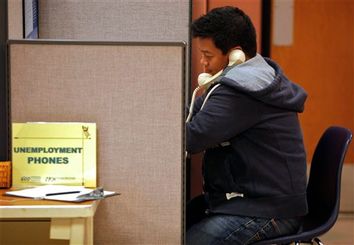
WASHINGTON (AP) — The number of people applying for U.S. unemployment benefits ticked down last week after dropping sharply the previous week, evidence hiring could pick up this month.

Weekly applications dropped 1,000 to a seasonally adjusted 367,000 in the week ending May 5, the Labor Department said Thursday. The previous week’s figure was revised up slightly.

The four-week average, a less volatile measure, fell 5,250 to 379,000.

Applications are a measure of the pace of layoffs. When they stay consistently below 375,000, it suggests job growth is strong enough to lower the unemployment rate.

Applications are falling again after rising for most of April. The spike in applications coincided with weaker hiring in March and April. That raised fears that the job market is sputtering after a strong winter.

From December through February, employers had created an average 252,000 jobs a month. That was the best three months of job growth since the recession ended in June 2009, not counting months thrown off by the hiring of temporary census workers in 2010.

The unemployment rate has dropped a full percentage point since August — to 8.1 percent in April.

The recent jobs picture has been clouded by an unseasonably warm winter. That allowed construction firms and other companies to hire earlier than usual, effectively stealing jobs from the spring. Economists are puzzling out how much of the slower hiring in March and April was weather-related payback and how much reflects economic weakness.

More than 500,000 Americans have left the work force since February. That’s one reason — and not a good one — that unemployment has continued to fall. People who are out of work but not looking for jobs aren’t counted among the unemployed.

The economy grew at a disappointing 2.2 percent from January through March, a rate consistent with less than 110,000 new jobs a month.

There’s still has a long way to go. The United States has regained only about 3.8 million, or 43 percent, of the 8.8 million jobs lost during and immediately after the recession.

The number of people receiving unemployment benefits also dropped. That is partly because extended benefit programs are winding down. More than 6.4 million people received benefits during the week that ended April 21, down nearly 175,000 from the previous week.

The government did release some good news this week: In March, employers advertised 3.74 million job openings, the most since July 2008. The increase in U.S. job openings suggests that weaker hiring gains in March and April could be temporary. It usually takes one to three months for employers to fill openings.

AP survey: Steady job gains to sustain US recovery

  • more
    • All Share Services

WASHINGTON (AP) — Hiring through the rest of 2012 will lag the brisk pace set early this year. But it will be strong enough to push the unemployment rate below 8 percent by Election Day.

That’s the view that emerges from an Associated Press survey of 32 leading economists who foresee a gradually brighter jobs picture. Despite higher gas prices, Europe’s debt crisis and a weak housing market, they think the economy has entered a “virtuous cycle” in which hiring boosts consumer spending, which fuels more hiring and spending.

The survey results come before a report Friday on hiring during April. The April report is eagerly awaited because employers added surprisingly few jobs in March. That result contributed to fears that the economy might struggle to sustain its recovery.

But the economists think the recovery will manage to reduce unemployment to 7.9 percent by Election Day from 8.2 percent in March.

Falling unemployment would boost President Barack Obama’s prospects in November. Going back to 1956, no president has lost re-election when the unemployment rate dropped in the two years before the election. And none has won when the rate rose over that time.

Unemployment was 9.8 in November 2010. If the surveyed economists prove correct, the rate will be nearly 2 percentage points lower when Americans vote on Nov. 6.

Yet the AP economists think it will be at least three more years before unemployment falls below 6 percent, which would be a sign of a healthy economy.

They predict the economy will grow 2.5 percent this year, up from 1.7 percent in 2011. In a healthy economy, 2.5 percent annual growth is usually adequate. Not so when 12.7 million people are unemployed. The economy would have to grow about 4 percent for a year to lower unemployment another percentage point.

The economists expect job growth to average 177,000 a month from April through June and 189,000 in the second half of the year. That would be down from an average 212,000 jobs added monthly from January through March. Last year, job growth averaged 158,000 a month.

“The job market is improving enough that consumer spending can grow at a moderate pace as opposed to an anemic pace,” says Phillip Swagel, a University of Maryland economist. “Businesses are finally confident enough to hire and invest.”

The AP survey collected the views late last month of private, corporate and academic economists on a range of indicators.

They expect Europe to avoid a severe downturn this year even though it’s struggling with a debt crisis and is likely in a recession. And most don’t think any European nation will default on its debt this year.

But they worry that the lingering effects of the housing bust are slowing the U.S. economy’s expansion. The AP economists say growth can’t accelerate until national home prices — which dropped for a sixth straight month in February — finally bottom.

Falling house prices can slow numerous sectors of the economy. They demoralize consumers by eroding their chief source of wealth. A 30 percent drop in housing prices has vaporized $7 trillion in home equity since 2006.

Some of the economists fear that the financial crisis and recession left lasting consequences. Among their concerns:

Growth will remain slow as consumers pare debts. The long-term unemployed will struggle to regain jobs. People will no longer see housing as a source of wealth. And many will lose faith in the idea that Americans can achieve rising living standards.

One sign of the still-tough job market is long-term unemployment: Forty-three percent of the unemployed — 5.3 million Americans — have been out of work six months or more. Most of the economists blame weak customer demand. Only about a third think the main reason is a mismatch between the skills workers have and the skills employers need.

The unemployed might not get much relief from manufacturers, despite a report this week that U.S. factory activity grew last month at the fastest pace in nearly a year. The economists think manufacturers, a key source of hiring during the recovery, will fill jobs more slowly the rest of the year. If so, that could slow overall job growth.

Another factor in the economists’ cautious view of hiring: political bickering and doubts about government policies in an election year.

“There’s still a ton of uncertainty about the future of tax and regulatory policy,” says Swagel, a Treasury Department official under President George W. Bush. “Business that might be tempted to expand say, ‘I don’t know what my taxes will be in three years.’ “

Continue Reading Close

Swing-state unemployment down, Obama’s chances up

  • more
    • All Share Services

Swing-state unemployment down, Obama's chances upFILE - In this April 18, 2012 photo, President Barack Obama speaks at Lorain County Community College in Elyria, Ohio. The improving economy is swinging the pendulum in Obama's favor in the 14 states where the presidential election will likely be decided. Polls have shown Obama gaining an edge over his likely Republican challenger, Mitt Romney, in several so-called swing states, those that are considered up for grabs. What’s made the difference is that unemployment has dropped more sharply in several swing states than in the nation as a whole. A resurgence in manufacturing is helping the economy, and Obama’s chances, in the industrial Midwestern states of Ohio and Michigan. (AP Photo/Carolyn Kaster)(Credit: AP)

WASHINGTON (AP) — The improving economy is swinging the pendulum in President Barack Obama’s favor in the 14 states where the presidential election will likely be decided.

Recent polls have shown Obama gaining an edge over his likely Republican challenger, Mitt Romney, in several so-called swing states — those that are considered up for grabs.

What’s made the difference is that unemployment has dropped more sharply in several swing states than in the nation as a whole. A resurgence in manufacturing is helping the economy — and Obama’s chances — in the industrial Midwestern states of Ohio and Michigan.

And Arizona, Nevada and Florida, where unemployment remains high, are getting some relief from an uptick in tourism.

“The biggest reason for the president’s improving prospects probably is the economy,” says Peter Brown, assistant director of the Quinnipiac University Polling Institute.

The Great Recession of 2007-2009 hit several swing states particularly hard. Unemployment peaked at 14.2 percent in Michigan, where the auto industry faced ruin. It also hit double digits in Arizona, Nevada and Florida, which were at the center of the housing bust, and in North Carolina, which lost jobs in textile and furniture plants.

In 2010, the economic misery helped Republicans retake control of the House and gain seats in the Senate. But the GOP can’t count on a repeat when voters return to the polls — with much more at stake — on Nov. 6.

After an agonizingly slow recovery, several swing-state economies are finally accelerating:

— The job market is improving in Michigan and Ohio. In Michigan, unemployment fell to 8.5 percent in March from 10.5 percent in March 2011. And in Ohio, it dropped to 7.5 percent from 8.8 percent over the same period, putting it well below the national average of 8.2 percent. A Fox News poll released Friday showed Obama leading Romney 45 percent to 39 percent among registered voters in Ohio.

Many blue-collar workers in Ohio and Michigan credit the federal bailout of General Motors and Chrysler for saving tens of thousands of auto industry jobs, says Paul Allen Beck, a political science professor at Ohio State University. The bailout began under President George W. Bush, but Obama expanded it. “There’s a feeling the administration went out of its way to protect jobs that are very important,” Beck said.

— In Florida, unemployment tumbled to 9 percent in March from 10.7 percent a year earlier. That was more than twice the nationwide drop of 0.7 percentage point (from 8.9 percent to 8.2 percent) over the same period. A rise in tourism is helping. “People who put off vacations or a trip to Disney World for two or three years got to the point where they feel safe in terms of financial security to finally take those trips,” says Sean Snaith, director of the University of Central Florida’s Institute for Economic Competitiveness.

— Even Nevada, a focal point of the real estate collapse, has seen some improvement: Unemployment dropped to 12 percent in March from 13.6 percent a year earlier.

— Unemployment is down over the past year in the 10 other states the Associated Press identifies as swing states: Arizona, Colorado, Iowa, Minnesota, New Hampshire, New Mexico, North Carolina, Pennsylvania, Virginia and Wisconsin.

Still, political analysts caution that voter sentiment — not to mention economic momentum — can turn fast. A month before the most recent polling, for instance, Obama was running behind or neck-and-neck with Romney in battleground states.

“The election is not today; it is seven months away,” Quinnipiac’s Brown says.

A jobs recovery fizzled in mid-2011, so there’s no guarantee the unemployment rate will continue to fall this year.

Indeed, Romney was quick to pounce after the government said job creation plunged in March after three strong months of growth. Romney called the numbers “weak and very troubling…. Millions of Americans are paying a high price for President Obama’s economic policies.”

Higher gasoline prices, up 60 cents this year to a national average $3.88 a gallon, could also turn voters against Obama. Still, prices have dropped over the past two weeks, and analysts say they could fall further.

Political analysts also wonder whether voters will end up holding Obama responsible for the poor state of the housing market, even if the job market has improved.

Jonathan Ketcham, a marketing professor at Arizona State University who has analyzed voting behavior, says academic studies haven’t investigated how housing trends affect voters’ decisions. Housing hasn’t been a major issue in a presidential campaign before. But since 2006, a drop in home prices has wiped out $7 trillion in home equity, the biggest source of wealth for most families.

In Nevada, more than six in 10 homes are “underwater” — they’re worth less than the mortgages on them.

In February, foreclosures surged more in Florida’s two biggest cities — Miami and Tampa — from February 2011 than anywhere else, according to RealtyTrac. Foreclosures are up partly because they were delayed last year by a legal fight over lenders that processed foreclosures without verifying documents.

Now, foreclosures are rising again in places like Florida where the housing bust did the most damage. That is worrisome for Obama, whose housing policies haven’t made much of a dent in the crisis, says Susan MacManus, a government professor at the University of South Florida.

Then again, state economic trends might not even make much difference. Political scientists who study voter behavior say most Americans tend to base their views about the economy — and their votes — more on what’s happening nationwide than on what’s happening closer to home.

The academic findings might seem to defy common sense. But reports on the ups and downs of unemployment, gross domestic product and other nationwide economic indicators appear constantly on television news, in newspapers and on the Internet.

So in some ways, ordinary Americans hear more about the national economy than they hear about economic conditions in their own communities, says Arizona State’s Ketcham. Ketcham also says it “could be that people simply understand that local conditions are beyond the reach of national politicians.”

The national economic trend favors Obama, too. Unemployment is down significantly from its 10 percent peak in October 2009. No incumbent president dating to 1956 has lost when unemployment fell over the two years leading up to his re-election contest. And none has won when the rate rose.

Unemployment was 9.8 percent in November 2010.

Last month, eight months before Election Day, the rate was 8.2 percent.

Continue Reading Close

US economy adds 120K jobs, jobless rate at 8.2 pct

  • more
    • All Share Services

WASHINGTON (AP) — Employers pulled back sharply on hiring last month, a reminder that the U.S. economy may not be growing fast enough to sustain robust job growth. The unemployment rate dipped, but mostly because more Americans stopped looking for work.

The Labor Department says the economy added 120,000 jobs in March, down from more than 200,000 in each of the previous three months.

The unemployment rate fell to 8.2 percent, the lowest since January 2009. The rate dropped because fewer people searched for jobs. The official unemployment tally only includes those seeking work.

The economy has added 858,000 jobs since December — the best four months of hiring in two years.

The mixed report was a disappointment after three months of solid job growth. The slowdown in job creation could threaten a recent rise in consumer confidence and dent investors’ enthusiasm for stocks. It also could prove a setback for President Barack Obama’s re-election hopes.

Stock markets are closed and bond markets will close early for Good Friday, so most investors won’t get to render a verdict on the report until Monday.

Federal Reserve Chairman Ben Bernanke has cautioned that the current hiring pace is unlikely to continue without more consumer spending.

Retailers shed nearly 34,000 jobs in March, and temporary help firms dropped almost 8,000 — a potentially bad sign for the job market because companies often hire temp workers before adding full timers.

Manufacturers continued to add jobs, hiring 37,000 workers in March.

A broader measure of weakness in the labor market — which adds to the officially unemployed those who have given up looking for work and those forced to settle for part-time jobs — improved last month to 14.5 percent from 14.9 percent in February.

The Bureau of Labor Statistics said the economy added 4,000 more jobs in January and February than it previously reported.

This year’s election is expected to hinge on the state of the economy; Obama’s re-election hopes may depend on continued improvement in the unemployment rate and job creation.

Former Massachusetts Gov. Mitt Romney, the likely Republican challenger, this week blamed the president’s policies for slow growth and high unemployment.

The Obama campaign has said that Romney would reinstate policies that led to the recession — lower taxes for the wealthy and less regulation for business.

For many, what matters most is the unemployment rate. It was 7.8 percent when Obama entered office in January 2009 and peaked at 10 percent nine months later. Since August, it has dropped from 9.1 percent to March’s 8.2 percent.

No incumbent since World War II has faced voters with unemployment higher than 7.8 percent.

Other data suggest the economic recovery is gaining strength. The number of Americans seeking unemployment benefits fell last week to a four-year low, the government said Thursday. Consumers are more confident and spending more.

The service sector expanded at a healthy clip in March and increased hiring, according to a private survey released Wednesday by the Institute for Supply Management. Factories are busier. Companies are investing more, ordering more machinery and other equipment.

Economists have worried all along that job growth couldn’t sustain the strong December-to-February pace.

They also worry that a 66-cent run-up in gasoline prices (to a national average $3.94 a gallon) so far this year will discourage consumer spending — though American households are more resilient financially after cutting their debts.

Most economists expect annual growth this year of just 2.5 percent. Normally, it takes annual growth of 4 percent to lower the unemployment rate 1 percentage point over a year.

The job market is improving largely because the pace of layoffs has fallen sharply. The staffing firm Challenger, Gray & Christmas reported Thursday that planned layoffs fell 27 percent from February to March. Hiring, meanwhile, is still running nearly 20 percent below pre-recession levels.

Continue Reading Close

Fourth straight month of strong US hiring expected

  • more
    • All Share Services

Fourth straight month of strong US hiring expectedIn this Feb. 27, 2012, photo, job seekers line up to speak to Trilogy's Regional Vice President Tom Elkins, far right, at a job fair in Boston. Economists expect that U.S. employers added 210,000 jobs last month and that the unemployment rate remained at 8.3 percent for the third straight month, according to a survey by FactSet. The Labor Department will release the March employment report at 8:30 a.m. EDT on Friday, April 6, 2012. (AP Photo/Elise Amendola)(Credit: AP)

WASHINGTON (AP) — The U.S. economy probably generated more than 200,000 jobs in March, capping the best four months of hiring since before the recession.

Economists expect that U.S. employers added 210,000 jobs last month and that the unemployment rate remained at 8.3 percent for the third straight month, according to a survey by FactSet.

The Labor Department will release the March employment report at 8:30 a.m. Eastern time.

If the forecast proves correct, the economy would have added an average of 236,000 jobs per month since December. That’s the most for a four-month period in almost six years. It would also mark the first time the economy has created at least 200,000 jobs in four straight months since early 2000.

“The labor market is steadily, if slowly, strengthening,” says Steven Wood, chief economist at Insight Economics.

Stock markets will be closed and bond markets will close early for Good Friday.

An improving job market could boost President Barack Obama’s chances of winning a second term. This year’s election is expected to hinge on the state of the economy.

Former Massachusetts Gov. Mitt Romney, the likely Republican challenger, this week blamed the president’s policies for slow growth and high unemployment.

The Obama campaign has said that Romney would reinstate policies that led to the recession — lower taxes for the wealthy and less regulation for business.

For many, what matters most is the unemployment rate. It was 7.8 percent when Obama entered office in January 2009 and peaked at 10 percent nine months later. Since August, it has dropped from 9.1 percent to 8.3 percent, the lowest level in three years.

No incumbent since World War II has faced voters with unemployment higher than 7.8 percent.

Other data suggest the economic recovery is gaining strength. The number of Americans seeking unemployment benefits fell last week to a four-year low, the government said Thursday. Consumers are more confident. In February, they stepped up spending by the most in seven months.

The service sector expanded at a healthy clip in March and increased hiring, according to a private survey released Wednesday by the Institute for Supply Management. A separate ISM survey of manufacturers found that factories also added jobs and boosted production last month.

Companies are investing more, boosting factory output. Businesses ordered more machinery, equipment and other capital goods in February.

Still, some economists worry that the recent job gains won’t last. “We expect some slowing from the recent pace,” says Dean Maki, chief U.S. economist at Barclays Capital.

Unseasonably warm weather in February allowed construction firms and other companies to work outdoors and hire workers ahead of schedule, potentially stealing jobs from future months. That’s one reason March job growth isn’t expected to match February’s 227,000 figure.

Others worry that a 66-cent run-up in gasoline prices (to a national average $3.94 a gallon) so far this year will discourage consumer spending — though American households are more resilient financially after cutting their debts.

Federal Reserve Chairman Ben Bernanke has cautioned that the job market remains weak despite several months of strong hiring. He and other economists don’t expect the unemployment rate to keep falling at its current pace without much stronger economic growth.

Most economists expect annual growth this year of just 2.5 percent. Normally, it takes annual growth of 4 percent to lower the unemployment rate 1 percentage point over a year.

The job market is improving largely because the pace of layoffs has fallen sharply. The staffing firm Challenger, Gray & Christmas reported Thursday that planned layoffs fell 27 percent from February to March. Hiring, meanwhile, is still running nearly 20 percent below pre-recession levels.

When the Great Recession hit, companies slashed their work forces. The employees who survived the layoffs had to pick up the slack. Squeezing more out of fewer workers, companies enjoyed a surge in productivity. But it may have reached its limit. Productivity growth has slowed, suggesting that companies may have to hire more workers, instead of working existing staffs harder, to keep up with customer orders.

“They’re at the point that if their sales grow they’re going to have to add people,” says Bruce McCain, chief investment strategist at Key Private Bank.

Continue Reading Close

Nation Adds 200,000 Jobs In December Hiring Surge

  • more
    • All Share Services

Nation Adds 200,000 Jobs In December Hiring SurgeA construction worker guides a rafter into position at a construction site, Thursday, Jan. 5, 2012, in Dayton, Ohio. A burst of hiring in December pushed the unemployment rate to its lowest level in nearly three years, giving the economy a boost at the end of 2011. (AP Photo/Al Behrman)(Credit: AP)

WASHINGTON (AP) — Four painful years after the Great Recession struck and wiped out 8.7 million jobs, the United States may finally be in an elusive pattern known as the virtuous cycle — an escalating loop of robust job growth, healthier spending and higher demand.

The nation added 200,000 jobs in December in a burst of hiring that drove the unemployment rate down two ticks to 8.5 percent, its lowest in almost three years, and led economists to conclude that the improvement in the job market might just last.

“There is more horsepower to this economy than most believe,” said Sung Won Sohn, an economics professor at California State University, Channel Islands. “The stars are aligned right for a meaningful economic recovery.”

It was the sixth month in a row that the economy added at least 100,000 jobs, the longest streak since 2006. The economy added jobs every month last year, the first time that has happened since 2005.

And the unemployment rate, which peaked at 10.1 percent in October 2009 and stood at 9.1 percent at the start of last year, has fallen four months straight.

If economics textbooks and the best hopes of millions of unemployed Americans are confirmed, the virtuous cycle may be under way, which would suggest the job market will get stronger yet.

When more Americans are hired, they have more money to spend. When more money courses through the economy, businesses can justify hiring more people. That means more jobs, more spending and more demand for businesses. Which leads to still more hiring, spending and demand.

That would be the reverse of the vicious cycle that took hold during the Great Recession. People lost jobs and spent less money, so businesses rang up less sales and were forced to lay off more people. That led to even less spending and more layoffs.

“The labor market is healing,” said Diane Swonk, chief economist at Mesirow Financial. She cautioned that “we still have a long way to go — years — to recoup the losses we have endured.”

Indeed, the economy added 1.6 million jobs for all of 2011. That is better than the 940,000 it added during 2010. In 2009, the most bruising year of the Great Recession, the nation lost more than 5 million.

But it will take 6 million more jobs to get the United States back to what it had in December 2007, when the recession began. Economists forecast the nation will add almost 2 million this year.

The unemployment report was the first to be released since Republicans across the country began voting to determine a candidate to face President Barack Obama this fall in an election that will turn on the economy.

Obama appears bound to face voters with the highest unemployment rate of any president running for re-election since World War II. Unemployment was 7.8 percent when Obama took office.

But the president’s re-election chances may hinge more on the direction of the unemployment rate than on what the rate is come Election Day. The rate was 7.2 percent when Ronald Reagan beat Walter Mondale in 1984, but it had fallen from 10.8 percent two years before the election.

Obama, visiting the new Consumer Financial Protection Bureau, said: “We have made real progress. Now is not the time to stop.” He called on Congress to extend a tax Social Security payroll tax cut that is due to expire at the end of next month.

Campaigning in New Hampshire for Obama’s job, former Pennsylvania Sen. Rick Santorum claimed credit for Republicans, suggesting the gains were tied to voter optimism that a Republican would take the White House.

“There’s a lot of concern still,” added Santorum, who finished in a virtual tie with Mitt Romney in the Iowa caucuses earlier this week. Another candidate, former House Speaker Newt Gingrich, dismissed the job gains as inadequate.

The report painted a picture of a broadly improving job market. Average hourly pay rose by 4 cents. The average workweek lengthened by six minutes, a sign that business is picking up and companies may soon need to hire.

The private sector added 212,000 jobs in December. That gain was offset by 12,000 layoffs by governments.

Hiring increased across industries. Manufacturing added 23,000 jobs, as did the health care industry. Transportation and warehousing added 50,000 jobs. Retailers added 28,000. Even the beleaguered construction industry added 17,000.

In manufacturing, the 225,000 jobs added for the year are the most since 1997, and are particularly good signs for the economy. Factory jobs tend to pay well, and plant expansions signal that businesses are gaining confidence about the future.

LL Bean is adding 125 workers at its plant in Maine to keep up with demand for its popular duck boot. In North Carolina, Baldor Electric is expanding a plant that makes wind-powered motors, adding 166 jobs outside Gastonia. And Chrysler, bouncing back from bankruptcy, just announced that it is hiring 1,250 at two Detroit factories.

Meanwhile, oil and gas companies, are struggling to find engineers willing to relocate to rural areas where most of the drilling is done, said Jack Downing, managing partner for the recruiting firm MRINetwork WorldBridge Partners in Chicago.

Telecommunications and finance companies are restoring the jobs they eliminated at the depths of the Great Recession. And human resources employees, among the first jobs slashed when the economy collapsed, are in demand.

William Dunkelberg, chief economist at the National Federation of Independent Business, said hiring is strongest in the West and Rocky Mountain states, partly because high energy prices have helped the oil and gas industry. But job creation is still “dismal” east of the Mississippi River.

Economists cautioned that some of the month’s gains reflected temporary hiring for the holiday season. The government adjusts the figures to try to account for that seasonal factor, but doesn’t always get it exactly right.

The gains in transportation and warehousing, for example, reflected a strong increase in hiring for couriers and messengers. That could be because of the jump in online shopping over the holidays, the Labor Department said.

And the economy still faces many challenges, including a likely recession in Europe exacerbated by the debt crisis there. That could drag on the U.S. stock market, making U.S. investors feel poorer and weighing on their spending.

In a reminder of the threat, U.S. stocks, which had appeared poised for a higher open, declined for the day. The Dow Jones industrial average was down 47 points. Analysts blamed a spike in borrowing costs for Italy, an ominous sign for the debt crisis.

“While December’s data represent good news, there is no guarantee that January will follow a similar path,” said Joshua Shapiro, chief economist at MFR Inc., in a note to clients.

Dow futures jumped 40 points when the unemployment report was released at 8:30 a.m. EST, but when the market opened an hour later, the Dow dropped 83 points in the first half-hour of trading. It recovered some of those losses later.

The Dow was at 12,368, still up 150 points for the first week of the year.

The government counts people as unemployed only if they are actively searching for jobs. Discouraged workers who have given up on looking are not included in the unemployment rate.

The nation’s work force, which includes both people working and those searching for jobs, shrank slightly in December and doesn’t look much different from last spring.

That is a concern because a strengthening job market normally encourages people to get out and look for work. And if more Americans are motivated to start looking for work, the unemployment rate could jump again.

There are also 8.1 million Americans working part-time who would rather be working full-time, though that number has fallen from 9.3 million in September and is the lowest since January 2009.

A measure that includes those groups, the so-called underemployment rate, was 15.2 percent in December. It has fallen three straight months but remains historically high.

A more robust hiring market coincides with data suggesting the economy ended the year with some momentum. Holiday sales were solid, and November and December were the strongest months of 2011 for U.S. auto sales.

Continue Reading Close

Page 1 of 4 in Paul Wiseman