Riaz Khan

Pakistani sets himself on fire over school uniform

PESHAWAR, Pakistan (AP) — A Pakistani boy who set himself on fire because his parents could not afford to buy him a new school uniform has died, his family and officials said Sunday.

The tragic story is a reminder of the woeful lives of Pakistan’s many dirt-poor citizens. It brings out the challenges facing those clinging to the hope that education could be the ticket to climbing up from the bottom rung of society.

Like many in Pakistan, 13-year-old Kamran Khan’s family did not have enough money to send him to school. He was such a promising student that a local private school allowed him to attend for free, said the boy’s older brother, Saleem Khan.

Even then, the family struggled. The boys’ father borrowed money from relatives to buy a work visa to Saudi Arabia four months ago, but he hasn’t yet found a job there, said the elder Khan. Their mother works as a maid.

The younger Khan used to wander the streets in Shabqadar, their town of 60,000 in northwest Khyber Pakhtunkhwa province, looking for bits of metal scrap and other items to sell to help out the family, said his brother.

He never asked for anything, his brother said, but last month he pleaded with his mother for several days to buy him a new school uniform, a white shalwar kameez, the loose-fitting pants and top worn by both men and women in Pakistan. He was embarrassed that his old one was worn out and patched up.

His mother sympathized with him but repeatedly told him the family didn’t have the money. She finally lost her patience with him on March 24 and slapped him, said his brother.

The young boy responded by saying, “If you can’t buy me a uniform, then I’m going to kill myself,” according to his brother.

He stormed out of their house, doused himself with gasoline and lit himself on fire, said his brother. The youth suffered burns on 65 percent of his body. He was taken to an army-run hospital in Punjab province. But the family could only raise one-tenth of the roughly $5,500 they needed for his treatment.

He died of his injuries on Saturday, said Zahir Shah, a police officer in Shabqadar.

Public school fees in Pakistan average only around $2 per month, but even this is often too much for poor Pakistanis, who tend to have many children.

About 30 percent of Pakistanis have received less than two years of education, according to a report issued last year by the Pakistani government.

The results are poor even for those kids who do attend school. Around 50 percent of school children aged 6-16 can’t read a sentence, said the report.

___

Associated Press writers Sebastian Abbot and Asif Shahzad contributed to this report from Islamabad.

Pakistan Welcomes Ouster Of Taliban Deputy

PESHAWAR, Pakistan (AP) — The Pakistani Taliban’s firing of its deputy chief is a sign of disarray within the militant movement brought about by army operations in its heartland along the Afghan border, a top government official said Tuesday.

The Taliban, a local ally of al-Qaida, has been behind many of the bloodiest attacks in Pakistan over the last five years. But its leadership, living along the border with Afghanistan in northwest Pakistan, has been relentlessly targeted by U.S. drones and Pakistani army operations.

The Taliban announced over the weekend that it had fired deputy Maulvi Faqir Mohammad for allegedly holding peace talks with the government. Mohammad has long been said to have had tense relations with Taliban chief Hakimullah Mahsud, who has shown no public indication of compromise with the Pakistani state.

Mian Iftikhar Hussain, information minister for the government in northwest Pakistan, denied any talks had been held with Mohammad, but said the Taliban announcement “clearly shows the differences among Taliban ranks.”

He told The Associated Press that Mohammad’s ouster was a result of the pressure on the Taliban from army operations.

“The Taliban have lost their control of the tribal areas and are now on the run,” he said.

Most analysts agree that the movement, formed in 2008 as umbrella group of militants in the northwest, has lost much of its command and control structure over the last three years. But while extremist violence is down in Pakistan from the highs of 2009, the Taliban and their offshoots are still highly dangerous and claimed responsibility for a series of bloody attacks over the last month.

In December, Mohammed announced the group was in peace talks with the government. But that was denied by other Taliban commanders, who are demanding their hardline version of Islamic law be installed in the country and have embraced an al-Qaida-inspired version of international jihad.

The group trained the Pakistani-American who tried to detonate a car bomb in New York City’s Times Square in 2010 and is also tied to a suicide bombing that killed seven CIA agents at an Afghan base in 2009.

In January, Pakistani intelligence officials claimed that Mahsud had been killed in a drone strike,

The group denied that at the time, and there has been no evidence or further suggestion that the claim was true.

Continue Reading Close

Bomb Kills 25 In Northwest Pakistan

Pakistani security personnel inspect the site of explosion in Pakistani tribal area of Khyber near Peshawar, Pakistan on Tuesday, Jan 10, 2012. A bomb targeting a militia opposed to the Pakistani Taliban exploded in a market close to the Afghan border Tuesday, killing 25 people in the deadliest blast in the country in several months, officials said. (AP Photo/Mohammad Sajjad)(Credit: AP)

PESHAWAR, Pakistan (AP) — A bomb targeting a militia opposed to the Pakistani Taliban exploded in a market close to the Afghan border Tuesday, killing 25 people in the deadliest blast in the country in several months, officials said.

The explosion, likely detonated by remote control, hit vehicles being used by the militia in the Khyber region, said local security officer Khan Dad Khan. It also wounded 24 people, said local government official Iqbal Khan.

Shopkeeper Sharif Gul said the blast ignited a huge fire.

“People were burning,” he said at a hospital in Peshawar, the main town in the northwest. “There was nothing to put out the fire.”

The army has supported the formation of anti-Taliban militias in northwest Pakistan, but the insurgents have ruthlessly attacked the groups over the last two years. Many of the country’s bloodiest bombings have been against militia members or their families.

Islamist militants with links to al-Qaida have carried out hundreds of bombings in Pakistan since 2007, killing many hundreds of soldiers, police, government officials and civilians.

The Pakistani army has carried out offensives against the militants in their strongholds in tribally administered regions like Khyber, but the insurgents have proven to be a resilient foe. There have been conflicting reports of peace talks between some insurgent factions and the government in recent months.

While the frequency of large-scale attacks outside of the northwest has decreased over the last 18 months, the violence has triggered fears in the West that nuclear-armed Pakistan may be buckling under extremism.

The last major bombing was in September close to the Swat Valley, when a suicide bomber hit a funeral of a tribal elder opposed to the Taliban, killing 31 people.

Continue Reading Close

Pakistan: Blasts kill 80 to avenge bin Laden death

Two Taliban suicide bombers attacked a paramilitary center

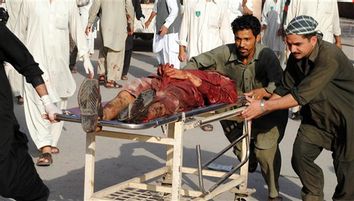
People rush a man injured in a suicide bomb attack to a local hospital in Peshawar, Pakistan Friday, May 13, 2011. Twin explosions struck a paramilitary training center in northwestern Pakistan on Friday, in the bloodiest attack in the country since a U.S. raid killed al-Qaida chief Osama bin Laden. (AP Photo/Mohammad Zubair)(Credit: AP)

A pair of suicide bombers attacked recruits leaving a paramilitary training center in Pakistan on Friday, killing 80 people in the first retaliation for the killing of Osama bin Laden by American commandos last week.

The blasts in the northwest were a reminder of the savagery of al-Qaida-linked militants in Pakistan. They occurred even as the country faces international suspicion that elements within its security forces may have been harboring bin Laden, who was killed in a raid in Abbottabad, about a three hours’ drive from the scene of the bombing.

“We have done this to avenge the Abbottabad incident,” Ahsanullah Ahsan, a spokesman for the Pakistani Taliban, told The Associated Press in a phone call. He warned that the group was also planning attacks on Americans living inside Pakistan.

The bombers blew themselves up in Shabqadar at the main gate of the facility for the Frontier Constabulary, a poorly equipped but front-line force in the battle against al-Qaida and allied Islamist groups like the Pakistani Taliban close to the Afghan border. Like other branches of Pakistan’s security forces, it has received U.S. funding to try to sharpen its skills.

At least 80 people were killed, including 66 recruits, and around 120 people were wounded, said police officer Liaqat Ali Khan.

Around 900 young men were leaving the center after spending six months of training there. They were in high spirits and looking forward to seeing their families, for which some had brought gifts, a survivor said.

Some people were sitting inside public minivans and others were loading luggage atop the vehicles when the bombers struck, witnesses said.

“We were heading toward a van when the first blast took place and we fell on the ground and then there was another blast,” said 21-year-old Rehmanullah Khan. “We enjoyed our time together, all the good and bad weather and I cannot forget the cries of my friends before they died.”

The scene was littered with shards of glass mixed with blood and flesh. The explosions destroyed at least 10 vans.

It was the first major militant attack in Pakistan since bin Laden’s death on May 2, and the deadliest this year.

Militants had pledged to avenge the killing and launch reprisal strikes in Pakistan.

The Taliban spokesman also suggested the attack was aimed as punishment against Pakistani authorities for failing to stop the unilateral U.S. raid that killed bin Laden, something that has sparked popular nationalist and Islamist anger.

“The Pakistani army has failed to protect its land,” Ahsan said.

In its communications, the Taliban often tries to tap into popular sentiments in the country, where anti-Americanism is often stronger than feelings against Islamist militants. This is despite militant attacks over the last four years claiming the lives of many hundreds, if not thousands, of civilians.

Some 350 lawyers sympathetic with Islamists attended special prayers for bin Laden on the premises of the provincial high court in the eastern city of Lahore on Friday. The lawyers cursed the May 2 raid, chanting “Down with America.”

The explosive vests used in Friday’s attacks were packed with ball bearings and nails, police said.

Police official Nisar Khan said a suicide bomber in his late teens or early 20s set off one of the blasts.

“The first blast occurred in the middle of the road, and after that there was a huge blast that was more powerful than the first,” said Abdul Wahid, a 25-year-old recruit whose legs were wounded in the blasts.

He said he was knocked to the ground by the force of the explosions.

“After falling, I just started crawling and dragging myself to a safer place … along the wall of a roadside shop,” he said.

The Sept. 11 mastermind and at least four others were killed by U.S. Navy SEALs who raided bin Laden’s compound in Abbottabad, a garrison city not far from the capital. Bin Laden is believed to have lived in the large house for up to six years.

Pakistani officials have denied knowing he was there but have criticized the American raid ordered by President Barack Obama as a violation of their country’s sovereignty. To counter allegations that Pakistan had harbored bin Laden, the officials have pointed out that many thousands of Pakistani citizens, and up to 3,000 of its security forces, have died in suicide bombings and other attacks since Sept. 11, 2001, when Islamabad became an ally of the U.S. in taking on Islamist extremists.

Many of the attacks in Pakistan have targeted security forces, but government buildings, religious minorities, public places and Western targets have also been hit.

——

Associated Press writers Ashraf Khan and Deb Riechmann in Islamabad, Babar Dogar in Lahore and Ishtiaq Mahsud in Dera Ismail Khan contributed to this report.

Continue Reading Close

Pakistani officials say U.S. drone strike kills 4

Suspected militants who were killed have yet to be identified

Pakistani intelligence officials say a U.S. drone strike has killed 4 suspected militants in northwest Pakistan.

The officials say Friday’s strike destroyed a vehicle in Mir Ali town in North Waziristan. The identity of those killed was not immediately known.

The officials spoke on condition of anonymity because they were not authorized to speak to the media.

THIS IS A BREAKING NEWS UPDATE. Check back soon for further information. AP’s earlier story is below.

PESHAWAR, Pakistan (AP) — A car bomb exploded outside a hospital for Shiite Muslims that is under construction in northwestern Pakistan on Friday, killing at least 10 people, police said.

The bomb partially damaged the hospital building in the Pass Kili area of Khyber Pakhtunkhwa province’s Hangu district. Senior government official Khalid Khan Omarzai said several people were also wounded in the explosion.

The attack comes just a day after the start of the holy month of Muharram, which is especially important for Shiites but is often marred by bomb attacks.

Hangu is especially known for attacks by extremist Sunni militant groups aimed at Shiites. The town is effectively segregated between the Muslims of the two sects, with each having their own markets, hospitals and schools.

Earlier this week, a bomb attack in nearby Kohat town killed 15 people.

Continue Reading Close

Suicide bombers kill 50 in Pakistan

Deadly attack on anti-Taliban tribesmen is carried out close to the Afghan border

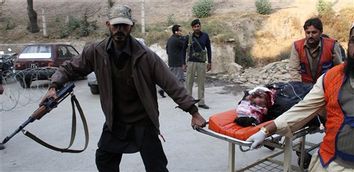
Pakistani volunteers rush a person injured by suicide attack to an emergency ward of a local hospital in Peshawar, Pakistan on Monday, Dec. 6, 2010. A pair of suicide bombers disguised as policemen killed many people in an attack targeting a tribal meeting called to discuss the formation of an anti-Taliban militia, in Pakistani tribal area of Mohmand. (AP Photo/Mohammad Iqbal)(Credit: AP)

Two militants wearing vests studded with explosives and bullets blew themselves up outside a government-backed meeting of anti-Taliban tribesmen close to the Afghan border Monday, killing 50 people and wounding 100 others.

The strike in Mohmand region underscored the tenacity of the Islamist uprising in the northwest despite Pakistani army offensives over the last 2 1/2 years. The operations have retaken areas where militants enjoyed safe haven, but authorities have struggled to hold onto the gains.

The tribally administered region is home to thousands of militants staging or supporting attacks on American troops fighting a related insurgency in Afghanistan. It also houses al-Qaida leaders and operatives from around the world plotting attacks on the West.

The United States is squeezing the insurgents with missiles fired from unmanned drones. The frequency of such attacks has surged under the Obama administration. In the most recent strike, seven people were killed Monday in a different part of the tribal area from where the suicide bombing took place, Pakistani intelligence officials said.

The Pakistani army has supported the creation of tribal militias against the militants, but the groups have been ruthlessly attacked. On three separate occasions this year suicide bombers killed more than 65 people attending meetings between officials and tribesmen, who are typically paid for attending.

Security is tight at the gatherings, with attendants frisked well away from the fortified government buildings where they take place. But local police and soldiers are poorly equipped and trained, while suicide bombers — especially when they work in pairs or more — are hard to defend against.

The attackers Monday were wearing the uniforms of local tribal police, allowing one of them to get inside the government compound and blow himself up, said regional political officer Amjad Ali Khan. Seconds later, another militant detonated his explosives at the gate, said Khan, who was attending the meeting.

The dead and wounded included tribal elders, police, political officials and civilians. Two television journalists who were at the compound reporting were also killed, said Shakirullah Jan, president of Mohmand’s journalist association.

“There was a deafening sound and it caused a cloud of dust and smoke,” said Qalandar Khan, who was being treated for his wounds at a hospital in Peshawar, the largest city in the northwest. “There were dozens on the ground like me, bleeding and crying. I saw body parts scattered in the compound.”

The blast destroyed one building, and the shrapnel left dozens of holes in the walls. Amjad Ali Khan said the explosives were wrapped with bullets rather than the usual ball bearings, nails or nuts and bolts. He said this may have made the blasts especially deadly.

Militants have killed more than 1,300 people in attacks across Pakistan this year, most of them civilians. But there have been fewer attacks than last year, perhaps because of the army operations, including one in Mohmand, and the expanded U.S. drone strikes.

“We are not scared of such attacks and will keep on taking these enemies of humanity to task until they disappear from society,” said Mian Iftikhar Hussain, information minister of the northwest Khyber Pakhtunkhwa province.

Monday’s U.S. missiles were the latest of more than 100 to hit the area this year.

They struck a shop and a vehicle close to the town of Mir Ali in the North Waziristan region, said Pakistani intelligence officials on condition of anonymity because they were not allowed to speak to the media. The identities of the dead were not immediately known.

U.S. officials do not say whom they are targeting, but some of the attacks are believed to have killed midlevel or senior Taliban and al-Qaida figures. Pakistan publicly condemns the missile strikes but secretly supports some of them. Civilians are sometimes said to be among the dead, but some locals say the strikes are very accurate in targeting militants.

Almost all the strikes this year have been in North Waziristan, which has yet to see a Pakistani army offensive.

Continue Reading Close

Page 1 of 3 in Riaz Khan

www.salon.com/writer/riaz_khan/index.html