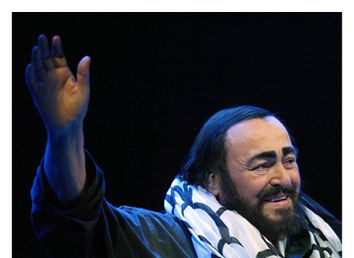
There is a tinge of irony in the affectionate tributes pouring forth for opera superstar Luciano Pavarotti, who died in Italy Thursday morning after a year-long battle with pancreatic cancer. For decades, highbrows of a certain stripe criticized the tenor for ostensibly selling out his high-operatic talents by slumming in populist schlock like the “Three Tenors” concerts and duets with pop stars such as Bono, Sting and Vanessa Williams. Pavarotti liked to characterize these forays as a chance to introduce new audiences to opera, particularly young people who might not otherwise have been exposed to it. While purists scoffed at such claims, I can offer one instance in which they were wrong and Pavarotti was right, for I was one of those young converts pulled into cultural waters by the siren song of that golden voice. Pavarotti was my gateway drug.
In my 12th year, during a visit with family in West Virginia, my great-grandmother left the TV on after her nightly dose of “The Lawrence Welk Show” on PBS. The program that followed was “Live From Lincoln Center,” and in the darkened living room I watched as a substantial man in a white tailcoat strode onto the stage, clutching an oversize white handkerchief. Apart from Elmer Fudd singing the immortal pseudo-Wagnerian “Kill the Wabbit,” I had never heard a note of opera, and when the man in the penguin suit opened his mouth, I found myself dumbstruck that such sounds could pour forth from a human throat. By the time the concert concluded an hour and a half later, the New York audience was in a frenzy, and Pavarotti was lapping it up, his smile wide, his arms flung even wider, as if to embrace the world itself. In my young eyes, this man was some kind of superhero. It was 1982, and I was hooked.
A few days later I checked five Pavarotti LPs out of the local library; the following week, three more. My new favorite song, I decided, was “La donna è mobile,” from Verdi’s “Rigoletto.” The following week, as I browsed further, I noticed that another singer had recorded the same aria on a different record. That singer’s name was Plácido Domingo, whose artistry I acquainted myself with next. Before long I had branched out to Joan Sutherland, Sherrill Milnes, Marilyn Horne and to non-vocal classical music as well: Bach’s Brandenburg concertos, Tchaikovsky’s Violin Concerto No. 1, and 20th century fare by Stravinsky, Britten and Philip Glass. Fast-forward 10 years to find me studying voice and singing (not very well) with a regional opera company, coming to the conclusion that opera, while a lifelong passion, was not to be my profession. Two years later, as a television reporter, I met Pavarotti backstage at a concert he gave in Baton Rouge, La. It is, of course, never a good idea to meet one’s heroes. The maestro was tired and more than a little churlish, but artists are allowed their temperaments, after all, and despite the disappointing encounter, my reverence remained for the man’s unimpeachable artistry.
Except that in the long run, it was not unimpeachable. In opera circles it is widely agreed that Pavarotti would have done well to retire, as had the late Beverly Sills, before his vocal resources had declined too precipitously. During his prime — roughly the late 1960s to early 1980s — he possessed not only that unmistakable, burnished voice, but also a superb sense of musicianship: a strong vocal attack and clean release; the ability to renew a note’s energy with every throb of the vibrato; and the flexibility to sing with great ardency or with the melting tenderness that Italians call “morbidezza” — the sound a great hero makes when dying of love. As the ’80s yielded to the ’90s, the singer sometimes was unable to sustain tones for their full duration, rushing through phrases that he had once wrung of every last ounce of passion and pathos. He began using cue cards to remember lyrics — in 1994 I saw him use cards for the Italian love song “Non ti scordar di me,” which is roughly the equivalent of an American needing cue cards to sing “Mary Had a Little Lamb.” He infamously cracked on a high note in a 1992 production of Verdi’s “Don Carlo” at La Scala and lip-synced a televised concert that same year, an offense for which he was sued by the BBC.
And then there were the late-career stumbles, which began feeding the tabloids around 2000, when after nearly 40 years of marriage, he divorced his wife Adua and soon thereafter married his onetime personal assistant, Nicoletta Mantovani, three years younger than the youngest of his three daughters. He canceled what was to have been his final performance at the Metropolitan Opera in 2002, forcing the Met’s then-general manager, Joseph Volpe, to make a conciliatory appearance on the house’s stage, telling disappointed audience members, “This is a hell of a way to end a beautiful career.” Channeling Gustav von Aschenbach, Pavarotti looked increasingly bizarre in TV appearances, his toupee, beard and bushy eyebrows dyed a severe shoe-polish black.
The nadir came in February of last year at the opening ceremonies of the Winter Olympics in Turin, Italy. Enveloped in a tentlike black cape, looking like a sad, oversize Count Dracula, the once-great tenor warbled his signature aria, Puccini’s “Nessun dorma,” transposed down from its original key so that the triumphant high B was only a B-flat.Watching the performance, now in my 30s and no longer the wide-eyed hero worshipper, I felt the urge to look away but could not. At the time, Pavarotti was five months away from being diagnosed with the cancer that would ultimately take his life. “All’alba vincerò!” he sang in the aria’s final phrase, “On the morn I shall win!” Pavarotti did not win his battle with cancer, but he has won a place in a pantheon to which perhaps only three other opera singers — Enrico Caruso, Jussi Björling, Maria Callas — belong. For all the young turks who have been crowned “the next Pavarotti” (Roberto Alagna, Rolando Villazón and Juan Diego Flórez, to name a few), there is no one to don the crown worn by Pavarotti in his prime. Did the “King of the High C’s” tarnish that crown with his large-scale personality and even larger-scale arena extravaganzas? History may answer in the affirmative, but I know one former 12-year-old who would beg to differ.
CNN’s announcement Wednesday that anchor Aaron Brown is leaving the network, with Anderson Cooper taking over his time slot, might just send Brown’s fans into fits of righteous rage. Or not. After all, just how passionate can devotees of the quintessentially dispassionate Brown — the Michael Dukakis of news anchors — get over his ouster? It may take several days for the rage index to fully register. But for now, armchair quarterbacks are apt to read the development as a Deborah Norville/Jane Pauley replay: an attractive up-and-comer unseats a beloved, established figure while network executives stand expectantly by, demographic dinero kerchinging in their eyeballs. Predictable as it is, the casting of Brown as victim to Cooper’s vanquishing interloper holds a certain logic that will perturb his faithful viewers, of which there are legions. Although I am not among them, hundreds of thousands of Americans have grown to love the anchor’s quirkily gem|tlich appeal.
Born in Minnesota in 1948, Brown began his career in radio, later taking his non-threatening Midwestern wryness to the Los Angeles radio market, then up to the Pacific Northwest, where he transitioned to television. Reporting and anchoring at Seattle affiliates KING-TV and KIRO-TV, something clicked in Brown. People who watched him back then say his delivery had a uniquely soothing quality, that he made you feel like you and your Labrador were cuddling up in a Pendleton blanket, listening to the foghorns on Puget Sound. But as the years went on and Brown moved up to reporting and weekend anchoring duties at ABC News, the comforting presence could seem downright lulling. It was as if he had mistaken phlegmaticism for professionalism, ponderousness for gravitas. Even Brown’s erstwhile ABC colleague Brit Hume, that droopy Eeyore of newscasters, appeared hyperkinetic by comparison. After he came to CNN in 2001, no matter how fastidiously Brown and his network handlers tried to cultivate his image as a reporter in the venerated old-school mold, the persona never quite gelled. A whiff of calculation always hung over his cozy, coffee-sipping shtick, as if he knew darn well he was playing the role of counter-programmer: a lovably, benignly bookish alternative to TV news’ armies of square-jawed hunks.
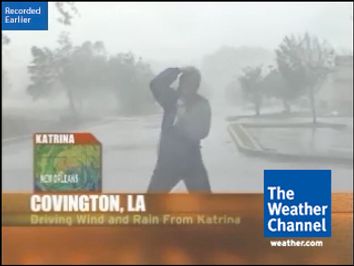
For his part, ascendant whippersnapper Anderson Cooper is cut neither from Jennings’ cloth nor Brown’s, but is a new breed of cyber-savvy on-air presence whose bearing is casual but refreshingly un-cheesy. And then there are those GQ looks: a pleasantly disorienting juxtaposition of boyish face and prematurely graying hair, capturing in a single visage the physiognomies of both youth and maturity. In the blogosphere, Web surfers who had dismissed Aaron Brown as “that whiny, Ichabod Crane-looking dude who reads newspapers at the end of his show” hailed Cooper as “hip and hot,” and even admitted, with shameless Gen X/Y flippancy: “If it wasn’t for Anderson, I probably would have slept through the war in Iraq.” As demonstrated by his widely lauded coverage of Hurricane Katrina, Cooper also proved he isn’t afraid to wear his heart on his shirtsleeve, a trait that endears him to viewers who want their newsmen sensitive as well as studly. In short, Cooper is a helluva package deal, far more palatable than NBC’s gravelly-voiced, raccoon-eyed Brian Williams, Fox News’ smarmy Shepard Smith, CBS’ kindly but tired-looking Bob Schieffer, and any of the contenders for Jennings’ vacated throne at ABC, with the possible exception of the spunky Elizabeth Vargas. True, Cooper can get a bit gushy, and he’s prone to inserting himself too prominently into stories, but he’s young, only 38, and experience will temper his excesses. In the meantime, CNN executives weighing Cooper vs. Aaron Brown apparently concluded that it’s easier to tame a spitfire than invigorate a corpse.
It is important to note, however, that whatever your loyalties, neither Cooper nor Brown is television news’ savior, nor its scourge; the dichotomy between the two is one of style and energy level, not of substance, and the choice of Cooper over Brown doesn’t address the deeper problems facing TV news. For a small — and strange — example of that, look no further than last Sunday’s “60 Minutes,” during which correspondent Steve Kroft interviewed Britain’s Prince Charles in advance of the prince’s official visit to the United States. The prince’s communications staff had explicitly forbidden Kroft to ask Charles personal questions: no “How does it feel to finally be married to Camilla?” or “Have you met Prince William’s new girlfriend?” or “What do you make of Prince Harry’s predilection for smoking pot and wearing swastika armbands?”
At first, these prohibitions seemed to presage a quid pro quo: access to the prince in exchange for a softball interview. But lo and behold, as the sit-down unfolded, it proved surprisingly, even shockingly, substantive. How many of us in America know anything of the prince beyond his standard portrayal as a kilt-wearing, slightly daft eccentric who wished to be reincarnated as a tampon? Kroft introduced us not to this caricature, but to a man who has founded 14 charities, to which he donates more than $200 million a year; who has built a village called Poundbury in the South of England, dedicated to the ideals of recyclable materials and pedestrian-friendly public spaces; who has created a company that distributes high-quality organic produce and meats; and who has grown gravely preoccupied in recent years with the ways in which technological progress has sapped our collective humanity and supplanted it with the ephemeral values of “a throwaway society.”
It is disturbing indeed that it took a kind of censorship — the restrictions placed upon what Kroft could ask the prince — to produce this thoughtful profile of a thoughtful man. Imagine how the segment might have turned out if Kroft or, God forbid, Barbara Walters had been allowed to conduct the interview carte blanche. The piece would have revolved around trying to make Charles cry, and “Despite the problems you and Diana had, do you ever miss her?” and “Your Royal Highness, what kind of tree would you be?” Certainly, I’m not advocating for censorious policing — by media handlers, the FCC, Congress or any other entity — to produce worthy journalism. Nor will Aaron Brown getting canned or Anderson Cooper getting promoted bring about the radical reexamination that must take place if we are ever to see more coverage of substance and less of pablum. What we need, desperately, is more good judgment and less bad taste; more broadcasters like the late Fred Friendly and fewer like current CBS panderer-in-chief Les Moonves. Above all, we need the people in power within media conglomerates to believe deep down that if they build it — thoughtful, quality programming — we, the viewers, will come.
Continue Reading
Close
When Peter Jennings succumbed to lung cancer on Aug. 7, the world lost more than a news anchor; it lost an archetype. Above and beyond his contributions as a journalist, Jennings held an appeal in the popular mind owing as much to the Golden Age of Hollywood as to the “Big Three” glory days of network news. The essence of that appeal, his smooth urbanity and air of cultivation, was the precise charisma that had made film stars Frederic March, Cary Grant and David Niven such icons of sophistication in their day; and it is this same appeal that now, with Jennings gone, is utterly missing from a news universe populated by smarmy Shepard Smiths and hipper-than-thou Anderson Coopers.
During his 22 years as the face of ABC News, Jennings could hardly have presented a more dramatic alternative to his two rivals, the affable, plain-spoken Tom Brokaw and the sometimes folksy, often over-serious, always slightly off-kilter Dan Rather. Perhaps Jennings’ suave manner (his detractors called him “aloof”) came from an innate Canadian politeness, or his many years as a London-based foreign correspondent, or perhaps even from an urge to overcompensate for his never having graduated from high school.
Regardless, this confidence manifested itself in a certain something he did with his eyes. When the camera zoomed in at the newscast’s outset, he’d inevitably be gazing at the monitor to his left. As the musical fanfare faded down, he’d launch into the top story, eyes still lingering momentarily on that off-screen monitor as he spoke: “We begin tonight in Beirut,” he’d say, and then pivot his gaze into the camera head-on and continue, “where the political fallout continues after…” It was subtle, this eye/text shift, but it telegraphed a casual familiarity, as if he and a few chums had been chatting about the day’s events over a snifter of cognac, and then, upon seeing you walk into the room, he’d turned to you, mid-phrase, to bring you into the conversation.
While this and other nonverbal Jennings staples complemented the stories’ content, it seems certain that, at least stylistically, Jennings will have no heir. News managers today aren’t looking to hire Cary Grant, the man of distinction; they’re looking for Matt LeBlanc, the dude next door. In fact, if young reporters in 2005 were to emulate the air of aristocracy that rocketed Peter Jennings to stardom two decades ago, they’d likely be shown the door. Q-score focus groups interpret urbanity as snobbery these days, which may be why Jennings himself lost ratings supremacy to Tom Brokaw when the glamorous 1980s gave way to the naturalistic ’90s. Once the millennium arrived, forget it: His brand of romantic persona had been supplanted by Britney Spears making pig noses and reality-TV contestants eating and vomiting up live worms.
The offshoot of this anti-elegance trend in TV news is a consultant-driven push toward a “conversational delivery” far removed from Jennings’ clipped elocution. Fox News’ Shepard Smith is the anchor of the future, and he owes not an ounce of his on-air persona to Jennings’ influence. “Shep” pushes conversational delivery to grotesque extremes, turning every “ing” into an “in’,” parroting tabloid catchphrases like “Wacko Jacko,” and committing participial atrocities à la “The president tonight, signaling he won’t budge on stem cell research…” But it’s not only Shep who’s expected to adopt dude-next-door diction and mannerisms. For other examples, see Anderson Cooper’s intricately calibrated cool, Matt Lauer’s boyish joshing, and Brian Williams’ fake-Rolex knockoff of predecessor Tom Brokaw’s phlegmy Midwestern burr. These and other male news anchors no longer exude savoir-faire (leaving Diane Sawyer to pick up the slack) because Hollywood actors no longer exude it. Yesteryear’s debonair hero has passed the torch to today’s cute goofball mensch: Jason Biggs, Seann William Scott, Ashton Kutcher.
Alas, a solid J-school background is no longer required for aspiring reporters and anchors, who are now routinely plucked from the ranks of reality shows: Neleh Dennis parlayed her runner-up status on “Survivor: Marquesas” into a reporting gig at Salt Lake City’s KUTV; “The Apprentice” candidate Erin Elmore landed a reporting job at Jacksonville, Fla.’s WTLV. Thus, in the absence of both journalistic credentials and an air of dignity among the next generation of TV journalists, discriminating viewers in recent years had but one choice if they sought an evening news presenter who would deliver the day’s stories intelligently and with a lagniappe of soul-soothing panache. That choice died along with Peter Jennings.
Continue Reading
Close