Sarah Beach

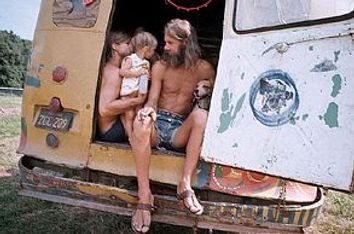
Curse of the hippie parents

Benign neglect and noodle dancing to Ravi Shankar do not a healthy childhood make.

  • more
    • All Share Services

Curse of the hippie parents

One summer when I was 10 or 11, a boy I’ll call Jackson befriended my brother and came over to our house frequently to play in our pond. After a few hours of splashing around, naked as usual, we went up to the house to dry off and have something to eat. Jackson plopped down on my mom’s platform rocker, grabbed his penis and started to masturbate.

“Hey!” I yelled, and threw a pillow at him. “Don’t do that right in front of everybody!”

“My mom says, ‘If it feels good, do it,’” he said, whacking away.

If it feels good, do it: a rallying cry of the ’60s and the root of a lot of really awful parenting. Jackson may have been admirably comfortable with his body, but like many children of hippie parents, he was in the dark about some very basic social rules, such as the one that says don’t jack off in public.

Growing up with no boundaries will do that to you. In their effort to raise children without inhibitions, my parents and their peers eschewed the teachings of Benjamin Spock and went for a more anarchic, Fellini-esque parenting approach. Sometimes this meant noodle dancing to Ravi Shankar into the wee hours of a school night, or spending whole days swimming naked and gorging on blackberries. But there was a dark side to this intoxicating rejection of rules and boundaries. With everyone embracing spontaneity and the mandates of the id, there was no one left to assume the adult role. People like my parents may have had the best of intentions, but in a wide-eyed quest for social change, they became children. And their actual children suffered as a result.

Sure, the benign neglect of hippie parenting had some side benefits. If you wanted to stay home from school, you could — as long as you had a really good excuse, such as, “I just can’t get behind school today, Mom.” Hippie kids also got to run around in the woods a lot, without being overly burdened by Establishment concepts like sunscreen or mosquito repellent. My mom took me on long walks, taught me to find wild huckleberries and to weave baskets out of sticks. She woke us up at midnight for impromptu waffle feasts. If we found something cool, like a dead dragonfly or a weird mushroom, she would be just as curious and amazed as we were. She was convinced magic existed, and since she was our mom, we absolutely believed it. That was wonderful.

However, the hippie creed of “no rules, no limits” combined with a horror of hypocrisy sent groovy parents skidding down a dangerously slippery child-rearing slope. If you smoke pot, what are you going to do when your kids ask to try it? It would be hypocritical not to let them. And if pot’s OK, why not mushrooms or acid? If you tell your kids sexual expression is great, and you yourself frequently “ball” (to use the mot juste) with abandon, how do you explain to your daughter that it’s not OK for some crusty old guy at a Grateful Dead show to feel her up in the child-care tipi? The old standby “It’s wrong because I said so” was out, because they’d taught us from birth that such a statement is fascistic. So, to avoid the hypocrisy of potentially arbitrary limits, hippie parents placed few or none.

And kids need limits. Someone in the family unit has to take the adult role, preferably the adults themselves. On the commune, I actually begged my mom for rules. “Let’s have a rule where kids have to go to bed at a certain time every night!” I said. Or, “Let’s have a rule that says children should be seen and not heard!” I think I’d read that in Dickens. It sounded like a great idea to me, not because I had some freakish desire to be silent, but because I knew I could never live up to it and then perhaps I’d be punished. I longed for discipline, for someone to tell me, “That’s quite enough of that, young lady!”

But in the hippie days, discipline was out, and wild Dionysian revelry was in. I can’t remember the first time I smoked pot, though I do remember getting a joint for my 7th birthday, all wrapped up in a pink ribbon. And the love was certainly what they called “free.” My mom tells me it was considered impolite not to sleep with someone when they asked politely. People would pair up, naturally, but relationships were strained by the constant lure of extracurricular screwing. The repression and conservatism of the ’50s were rejected with a vengeance, and people coupled and separated and regrouped like pornographic square-dancers.

This was presented to the children as the natural order of things, but we knew there was something wrong. For one thing, a dizzying number of people were always coming and going. Sometimes they’d say goodbye to the kids who had grown attached to them, sometimes not. We were terribly hurt when people we loved just up and left, and we were embarrassed by all the unfettered humping. Adults seemed so ridiculous with their balling and their toking and their weird wiggly dancing to the Grateful Dead. One evening at the commune, the grownups took Quaaludes or mescaline or something, and they all ended up in a big horny, writhing, drugged-out mass on the living room floor. At some point, my mom says, they heard an angry little throat-clearing sound. They looked up, and I was standing in the doorway, fists on my hips, glaring at them. “What exactly do you think you are all DOING?” I yelled.

Things weren’t much better when my brother and I visited our father in San Francisco. Despite fairly clear evidence of some early heterosexuality, Dad had always had homosexual leanings. Just as the hippies violently rejected social norms at least partly in response to straitlaced convention, my father exploded out of the closet like a rocket fueled by repressed yearning. With the gay sexual revolution in San Francisco, he was finally free to express that side of himself openly. This was a wonderful thing, but the effects of it were confusing and bizarre for my brother and me. With him, the Love That Dare Not Speak Its Name became the Love That Would Not Shut Up.

My father marched, he swung, he went to bars, he talked incessantly about his sexual experiences, and he left copies of Torso and Honcho strewn liberally about his Victorian house in the Haight. At first, my brother and I thought they were just some kind of new mainstream magazine. Certainly, they weren’t any more male-centric than Time or Life. Thus misled, we spent many a frustrating hour trying to figure out what was so funny about Tom of Finland cartoons.

Confusingly enough, Dad also had some straight porn as well. I can kind of track his acceptance of his gayness over time by the dwindling ratio of Penthouses to Honchos. By the time I was 9 or 10, he was full-strength, concentrated, half-a-cup-does-the-whole-load gay, and living with a really nice guy named — I’m not making this up — Randy.

On arriving at his house for a visit, after months of cultural deprivation up in the boonies, my brother and I would drop our duffel bags at the door and head for the television like patients in an obsessive/compulsive ward. We had lots of cultural reference catching-up to do, and devoured the subtleties of “The Brady Bunch” and “Speed Racer.”

The trouble really started when Dad got a VCR. He quickly amassed a large collection of movies, most of them pirated and hand-labeled, and he didn’t bother to segregate the porn. Some, like “The Young and the Hung,” were easy to avoid. Others were more worrying. My brother and I would consult each other over ambiguous titles like “12 Angry Men.” We finally got up the courage to watch that one, but no way were we going near “The 400 Blows.” We loved “Arsenic and Old Lace,” but it was kept right next to “Run, Little Sailor Boy, Run.” Once we put in the wrong tape, and were treated to the sight of a guy being fellated in an alley. “I don’t think that’s Alec Guinness,” said my brother.

The open sexuality and lack of boundaries of the hippie era, which many parents thought would encourage their children to be happy little free spirits, often had diametrically opposite results. At age 8, I had a big crush on a commune guy I’ll call Bill. That crush included sexual fantasies. I had just learned about rape, by overhearing someone tell a joke about it. They made it sound like a fun game, and I decided I wanted to try it with Bill. I went and found him, and told him I wanted to rape him. “OK,” he said.

I took him into the kids’ building. He took off all his clothes and lay down. He had an erection. I took mine off too and lay down on top of him. He kissed and fondled me. After a while, he got up, kissed me on the top of the head and thanked me. I felt confused and embarrassed.

Over the years, I had many inappropriate sexual experiences, with different partners and levels of interest on my part. The confusion and embarrassment were a constant. Even in less ambiguous situations in which I was exploited by predatory adults, I blamed myself for what happened. I had been raised to think that saying no was uncool, and that my body was up for grabs.

The worst part was that even when I was really uncomfortable with a sexual situation, I would sometimes respond sexually. This sent me into an abyss of self-loathing before I grew up and learned that children naturally have sexual feelings, and that they can arise even when the child is scared and unwilling.

My parents wanted to raise a happy, sexually liberated free spirit. I took the “free” part to heart, anyway. By the time I hit puberty I was already sexually jaded. I can’t remember not knowing what went where, complete with variations and sub-routines. From age 11 until I whipped up a new batch of self-esteem in my late 20s, I slept with so many people that I lost count at around 150. To this day, I can be standing at the sink washing a dish, woolgathering, and something will trigger a memory of a long-forgotten sexual encounter: the guy I slept with in the bathroom of a Greyhound bus, or the taxi driver I screwed for the sole reason that he had a cute Irish accent and I had no money for a tip.

I slept with my friends’ boyfriends, or their fathers, just because they asked. I alienated a lot of people, mostly women. I was lucky to dodge the scarier of the venereal diseases, but I got a lot of urinary tract infections and had a few unplanned pregnancies. Hey, man — love the one you’re with. Right. Im pretty sure that an overfamiliarity with Bactrim and cannulae is not the beautiful expression of sexuality the hippies had in mind when they rejected traditional parenting.

But all this has a happy ending. Paradoxically, the dangerous freedom I was raised with was the thing that allowed me to rebuild my self-esteem and set boundaries for myself. I had been told for so long I could be anything I wanted to be that I finally figured out I could, by that same token, get over the anger I had for my parents. They had no childraising instruction manual, and they lived through one of the most turbulent, strange times in our country’s history.

In the course of working on this, I finally found ways to shock my mother. At one point I decided to become a lawyer, and when I told Mom, she looked stricken. “Oh, no! Anything but that!” she said. “Honey, be a painter or a poet or something else instead!” I felt like a tax-payin,’ job-havin’ James Dean. All I have to do to freak out my Mom is work too hard, or mention my 401K.

Now Im 35 and happily engaged to a wonderful man I’ve been with for five years. Life is good. I impose boundaries on myself and try to stick to them despite an innate rambunctiousness that won’t quite go away. I love my mom, who lives close by, and I live right next door to my “other mom,” a woman we met on the commune, who helped raise my brother and me and is now my best friend.

People who were raised by hippies are writing books now, and I’m finding out how common my experiences were. Chelsea Cain’s excellent collection of essays, “Wild Child: Girlhoods in the Counterculture,” is full of stories similar to my own. I’ve interviewed a lot of ACHs (Adult Children of Hippies), and we all pretty much agree: Loved the God’s eyes and the baby goats; hated the lack of Lucky Charms, boundaries and discipline. We have nice traits in common, like adaptability, resourcefulness and a tendency to be more open-minded than not. But we are all a little bit control-freakish, and we have no patience for people who romanticize the hippie era uncritically. An accidental Wavy Gravy sighting can send us into a frothing rage.

Which brings me to why Im writing this. In the past few years, hippie culture has had something of a revival. Hippie music, hippie clothes, hippie politics, even hippie hairdos are big. More and more, I see VW buses with cedar peaked-roof add-ons, lumbering up Highway 1 on their way to Reggae on the River, the happy scruffy singing hippies inside dandling little newborns in tie-dyed Garanimals.

It isn’t surprising that in an era tinged with the paranoid ultraconservatism of the ’50s, people seem to want back some of the ’60s freedom and revolutionary feeling. The George W. Bush presidency is almost enough to make me sell everything and buy one of those buses myself. Almost.

Growing out of the anger I felt has allowed me to admit that I also long for some of the feeling of that age, but I don’t want nouvelle-hippie parents to make the same mistakes with their kids that the first hippies did. Once you have kids, finding yourself should never trump the goal of giving your kids a safe, thoughtfully limited environment.

So this is a cautionary tale. Go ahead, eat carob. Weave your own dashiki. Get off the grid. Open your mind to new experiences. But when your microbus pulls into the festival lot, don’t drop acid and ditch your daughter at the child-care tipi. Sometimes your mind can be so open, your brain falls out.

“House on Haunted Hill”

Where evil has a modem and looks like black calamari.

  • more
    • All Share Services

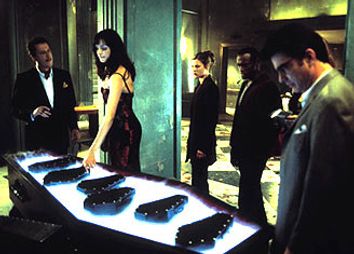
I would rather feed Jesse Helms a rancid peanut butter sandwich, and then have him slowly lick my face off, than sit through “House on Haunted Hill” again.

“House on Haunted Hill,” a remake of a 1958 William Castle movie, stars Geoffrey Rush and some other people, all of whom must have asked the Godfather for a favor years ago and had to pay him back by being in this film. I can’t forgive Rush. What the hell was he thinking? He was terrific as the piano-playing weirdo in “Shine.” As a career choice, this was a pantload of stupidity.

It would be pointless to critique the plot, which revolves around an eccentric millionaire who offers six strangers $1 million each if they can make it through the night in a scary house that used to be an insane asylum. Instead, here are some things I learned from “House on Haunted Hill.” For the full effect, print this out, put it through a shredder and read the resulting bits of paper while repeatedly trying to close a door on your head.

  • If you are a sociopathic serial-killing psychiatrist and you want to torture your inmates by cutting them open without anaesthetic, you will have no trouble finding a bunch of attractive, equally psychotic scrub nurses to hand you a rusty scalpel and film the proceedings.

  • When you’re writing a screenplay and can’t think of any sarcastic remarks for people to make, just have them clap slowly while saying “bravo” in a bored-sounding voice. Have them do this again and again and again, until the movie resembles the sarcastic clapping family sketch on “Saturday Night Live.”

  • If you are hired to design an insane asylum, make it look like a big hood ornament, and put it right on the edge of a cliff overlooking the ocean. Light it poorly. Fix it so that when people want to get from the basement to the attic they only have to use one staircase, with about 10 shallow stairs.

  • If you’re ever stuck in a haunted insane asylum that looks like a big hood ornament on a cliff, and the lights are faltering, find a random wiring junction out of thousands in the walls of the basement, stick your hand in it and wiggle it around briefly. The lights will keep faltering just like they were, but everyone around you will somehow think you’ve rewired the building.

  • Evil looks a lot like black calamari. You can keep it captive by walling it up in a basement room, but it can still mess with people’s computers. The conclusion: Evil has a modem and tentacles, and it knows your password.

  • If you want to drive someone crazy, show them a movie of a guy in a bowler hat bouncing a red ball. Brr! It freaks me out even to think of it! Also, include some underwater people, and make blood come out of their mouths. Do this over and over and over and over again, until you’ve completely numbed the audience to the effect.

    On a serious note: What ever happened to pacing in horror movies? The first “Alien” movie was scary as hell because it started off quietly, establishing a sense of “normal” life on a big spaceship. The characters were subtly developed and interesting. The tension built slowly. “The Shining” is another example of good pacing. People slowly going crazy are scary, and if they’re family members you love and trust, it’s much scarier.

    More importantly, in “Alien,” you never saw the entire monster. Things that you can’t see are scarier than the things you can. That’s why the monster lives in the closet, and not on your bedside table right next to the Snoopy lamp. In the third “Alien,” they showed every detail of the monster until it had the horrific effect of a plastic Taco Bell giveaway figurine.

    People who are crazy from the beginning of the movie aren’t scary. There’s nothing to suspect, nothing to be tense about except maybe when they will eventually crack, and these days most scary movies telegraph each moment of approaching horror so clearly that they lose their effect. If the movie never makes you feel anything for the characters, they’re even less scary. I don’t give a damn how creatively you kill them. They’re as expendable to the audience as they were to the screenwriter.

    Here’s an example of how “House on Haunted Hill,” which was directed by William Malone, defined a character. Early on while people were arriving at the haunted asylum, they started introducing themselves. One of them was a bratty blond girl with a video camera. When it was her turn, she said, “I’m so-and-so. I am a filmmaker — OK, I used to be a filmmaker. I lost my job, so now I’m going to break back into show business by filming something really freaky for ‘World’s Scariest Home Videos.’”

    Actually, I kind of wish real life were that expository. It would be great if, when meeting someone, they said things like “Hi, I’m Tina Carruthers. I am a marketing drone and my job bores the crap out of me, but I am adrift in immoral capitalism. I will pretend to like you to get your money, and then I’ll go slag you to my pals.”

    I wonder if Jesse Helms would prefer Skippy or Jif?

  • Continue Reading Close

    Blood brothers

    Cary and Steven Stayner were connected by violence. One is a murderer. The other, a victim, is remembered by a childhood friend.

    • more
      • All Share Services

    Cary Stayner has confessed to killing four women in Yosemite and may have committed many more murders, including that of his uncle.

    Cary’s brother, Steven Stayner, was abducted at the age of 7 by a stranger, Ken Parnell. Cary and Steven were very different — they didn’t even really grow up together. I doubt they knew each other very well.

    This is what happened to Steven: In 1972, he was walking in his Merced, Calif., neighborhood when a car rolled up, and Parnell abducted him. Parnell lied to Steven, telling him that the Stayners couldn’t afford to keep him anymore and had given Steven to him. He told Steven that his new name was Dennis Parnell. He took Steven to a remote trailer home up a long dirt road in the middle of the woods in Mendocino County. Parnell beat Steven, manipulated him, brainwashed him and raped him over 3,000 times, by Parnell’s own reckoning. Eventually he told Steven that the Stayners had died. Steven gave up hope, and the two of them lived alone out there in the woods.

    This morning, when I went to a coffee shop in Marin County for a latte, people were discussing the Yosemite killings. “And you know,” said the older woman behind the counter, “his brother was the one who got kidnapped by the guy who molested him for all those years. Something’s wrong with that family, for sure, because you know that kid could have walked away from the molester any time he wanted. He must have enjoyed it.” I was tempted to throw something at this woman. Instead I told her everything I know about Steven, and by the time I left she was offering to help pass out flyers.

    Steven Stayner was a friend of mine, but I knew him as Dennis Parnell.

    My family lived up behind the general store in Comptche, just a few miles from Ken Parnell’s place. My brother and Steven and I were part of a loose-knit group of local kids who sometimes hung out together on weekends and after school.

    I didn’t know Steven too well, but we bonded the summer I was 10 years old, over a ski cap and a motorcycle. I remember him mostly as a shy kid with a goofy sense of humor and a big, toothy smile. Steven’s best friend was a kid I’ll call David, who habitually wore a navy-blue ski cap. Steven, David and my brother liked each other but used to get in typical boyish fistfights from time to time, mostly over stupid stuff like who owned which G.I. Joe or whether someone had cheated in a bike race.

    Steven and I started hanging out together when one of the kids got a motorcycle and let us all take turns. Steven showed me how to ride it, but mostly I sat on the back while he drove. It was late summer. In the evenings after school, I’d hop on the springy black seat and put an arm around Steven, and we’d go buzzing around on the whiny little one-stroke bike. I think it maxed out at 35 miles per hour. Our goal was to snatch the ski cap off David’s head and drive off with it. David ran with both arms clenched over his head, but he let his guard down eventually, and Steven cut the motor. We rolled up behind David in complete silence, one of my hands clutching Steven’s corduroy jacket, the other poised in mid-air just about at the height of David’s head. He heard us when we got close, but it was too late - I grabbed the cap, Steven stomped the bike into gear and roll-started it, and we tore off laughing, leaving the capless, swearing David in a cloud of dust.

    I went to the Parnell place twice, both times on the back of the little motorcycle. It was a dingy trailer, surrounded by a chain-link fence. Steven would run in to get his coat and run back out, and we’d patch out of there down the dirt road. He wouldn’t let me come in.

    People have asked me what Steven was like, especially now that his brother is in the news for killing the women in the Yosemite area. Many people think that there must be something wrong with the entire Stayner family — somber newscasters have already started referring to the “family curse.” Maybe there were things wrong with the family, but I would guess there are worse things wrong with other families that don’t produce serial murderers.

    The abduction and molestation of their brother certainly traumatized the Stayner children, but Cary Stayner, 37, admits that his fantasies about killing women started 30 years ago, so if he’s telling the truth, these murder fantasies began in 1969, three years before Steven’s abduction. How did he get that way? How are serial killers created? Nature or nurture? Sadistic parents or a genetic aberration? Nobody really knows. But I do know that the abduction of their brother was not enough to turn the other Stayner children into killers. I feel incredibly sorry for them, and for Steven’s widow and children, for the scrutiny they will now undoubtedly have to undergo. I hope people leave them alone.

    Ken Parnell served seven years in prison - less time than he held Steven captive. He is now a free man, and I heard from a friend that a local radio station even interviewed him recently for his insights into what turned his victim’s brother into a psychopathic killer.

    For years after learning that Dennis was really Steven, I tried occasionally to find out what had happened to Ken Parnell. When the Internet came into being, I started doing searches on his name. I knew that he’d been released after serving only seven years, and I was afraid that he was living up in some other remote country area under an assumed name, abusing children again.

    One of my searches led to the Web site of Mike Echols, who wrote a “true crime” style book on Steven’s case, “I Know My First Name Is Steven.” There I found Parnell’s address. I was shocked to find out that Parnell lives in Berkeley, the same town as I. But I was even more chilled to read Parnell’s words about his life with Steven. After he was released from prison, Parnell told Echols that the only thing he regretted about sexually assaulting Steven was that when he “had anal sex with [Steven] he would bleed and it got all messy and stuff and I didn’t like that.”

    Ken Parnell lives about 10 blocks from my home. After work one day, I went looking for his house. I don’t know what I wanted. Throwing rocks at his window or yelling obscenities seemed like ridiculous understatements, and I’m not a violent person.

    But then I saw him sitting out on his stoop, enjoying the warm summer evening. He looked older, with white thinning hair, and his roundish face and weak chin were covered up now with a graying beard. But I recognized him right away. He turned to look at me and our eyes locked. My head was crowded with thoughts, some of them bizarre in retrospect. I thought of my mom telling me that all she remembered about Ken Parnell was that he had the worst breath she’d ever smelled. I thought of my friend Steven going through his days like a regular kid and going home in the darkening evenings to that rancid breath on his neck and to brutal, humiliating pain. I stopped my car and we stared at each other, and then suddenly in my mind he was pinned onto his porch with a huge red tack. There you are, I thought. I see you.

    I was shaken and angry but strangely relieved. At least he wasn’t up in the woods somewhere. It was better to know where he was. I drove to the end of his street and turned toward home. Two blocks from Ken’s house, I passed a park where children were playing in the fading light. The relief went away.

    By the age of 14, Steven was getting too old to be sexually attractive to Parnell. He planned to kill Steven and he wanted a young replacement. One night in 1980, Parnell brought home a frightened little boy whom he had abducted from a street in Ukiah, about 50 miles from Comptche. As Parnell dyed the boy’s blond hair dark brown, Steven began to think and remember. He realized that this is what had happened to him. Parnell was not his legal guardian, and it was likely that his real parents weren’t dead, either. He knew what Parnell would do to the boy.

    Parnell went out for a while and told Steven to watch the kid. Steven waited until he was sure Parnell was gone, then took the boy and began the long walk toward Ukiah. When he saw headlights, he jumped off the road, in case it was Parnell looking for them. He turned himself in at the Ukiah police station and told the police that he thought his first name was Steven.

    The little boy was reunited with his family, and Steven returned to the Stayners. He was never really able to escape from the demons that his years with Parnell had left him with, but eventually he settled down, got married and had kids. He died at age 24, nine years after he had reappeared, in a motorcycle accident.

    Steven was both a victim and a hero. His brother is neither. Lumping them together is unfair to Steven’s memory. Even worse, it gives Ken Parnell something to chuckle about on his porch as he watches the sunset
    and listens to the distant sound of children playing.

    Continue Reading Close