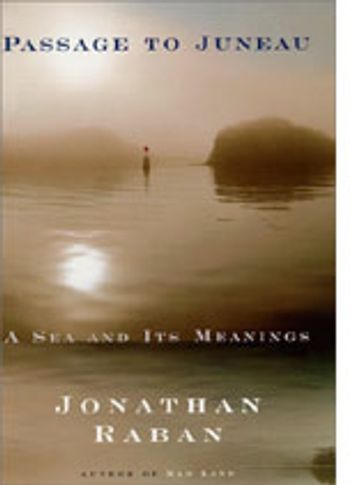
“I‘m not a natural sailor, but a timid, weedy, cerebral type, never more out of my element than when I’m at sea,” Jonathan Raban admits at the outset of “Passage to Juneau,” his multilayered and affecting account of sailing the Inside Passage from Puget Sound to Juneau. “Yet for the last fifteen years, every spare day that I could tease from the calendar has been spent afloat, in a state of undiminished fascination with the sea, its movements and meanings.”
You feel that fascination keenly throughout the book, from the breadth and depth of Raban’s voracious reading on the subject to the vividness with which he describes the treacherous waters of the Inside Passage, filled as they are with chutes, whirlpools, submerged ledges and rogue floating logs, and subject as well to extreme perturbation by wind and tides. Despite the hazards of the trip, however, “Passage to Juneau” is emphatically not an adventure-gone-wrong thriller, as we’ve lately come to expect of any work of nonfiction set outdoors. As the subtitle suggests, the book’s genesis lay, refreshingly, in contemplation, not survival. “I hoped to … come to terms, somehow, with the peculiar attraction that draws people to put themselves afloat on the deep, dark, indifferent, cold, and frightening sea,” Raban writes. “‘Meditation and water are wedded for ever,’ wrote Melville. So, for the term of a fishing season, I meant to meditate on the sea, at sea.”
Raban, who left his native England for Seattle in 1990 — in part, at least, because of the superb sailing to be had close by — won a boatload of awards for his 10th book, “Bad Land,” a tale of drought and despair in Montana and North Dakota. In “Passage,” his 11th, he packs his 35-foot boat, Whiskey November, bids farewell to his wife and young daughter and sails north, accompanied by a vast and unruly crew of books.
Despite his unrepentant bookishness and the weighty dryness of the subtitle, though, there is nothing timid or weedy about his prose; “Passage” is lively, engaging, fiercely personal and vastly well-informed, filled with history both cultural and natural, tart social observation and entertaining riffs on everything from Wordsworth to Kwakiutl Indian art to the origins of the word “nooky.”
Just as “Passage” is not a tale of adventure, neither (and just as refreshingly) is it a pristine lyric in the manner of such Northwest nature writers as Gary Snyder and Barry Lopez. “I found myself an agnostic in their church,” writes Raban, who flicks his cigarette butts into the dark, swirling waters and experiences nature largely through his formidable intellect. “But I couldn’t join their hymns, and after a few pages I grew restless and began to ache for more profane company.”
A better subtitle for the book might be “A Journey and Its Meanings” — Raban’s journey, in which the rougher seas by far are those of the family he has left behind in Seattle and England. He interrupts his project in mid-voyage to travel to England, where his father is dying of cancer, then returns to Seattle, where he detects ominous currents of trouble in his marriage. “Traveling almost always entails infidelity,” Raban writes, reflecting on the satisfaction that comes with turning one’s back on home and all it stands for — as if home were a resolute, immobile thing. But home, as he discovers, is anything but static; infidelity cuts both ways.
As vicarious participants in Raban’s journey, we have no such cause for concern. When it comes to the marriage of reader and writer, “Passage to Juneau” is true-blue.
On May 20, 1977, the government of Kenya banned big-game hunting in an attempt, the official line went, to preserve the wildlife that had become a major tourist draw. No more rifles, Nairobi said; from now on, Kenyan safaris would be conducted with binoculars and cameras.
The ’70s were an overdue period of environmental consciousness-raising throughout the Western world, and to most Americans and Europeans the edict from Kenya was welcome. But the news from Africa is rarely as clear-cut as it first appears. As Brian Herne argues in “White Hunters,” the real threat to Kenyan wildlife lay in poaching, which was widespread, indiscriminate and often conducted with the help of corrupt Kenyan game officials. The conservation-minded big game hunters were an easy target, though, and the hunting ban, still in place, abruptly ended a colorful if somewhat blood-spattered period of East African history.
The demise of big game hunting in Kenya — and in the Sudan, Uganda, Tanzania and Zaire — occupies the final chapters of Herne’s book, but it’s a shame he didn’t make it his primary subject. Herne, a second-generation Kenyan and himself a professional or “white” hunter (so called because virtually all of them were of European descent) for 30 years, might have injected his tale with a host of compelling post-Colonial story lines and told it from the perspective of an active participant — but he does not. Instead he offers an exhaustive social history of the professional (and largely Anglo) hunting fraternity, from its Victorian beginnings to its heyday in the ’50s, ’60s and ’70s. Vivid tales of cunning, bravery and foolhardiness abound, but Herne, apparently intent on historical completeness, goes on burnishing the legend long after it has achieved peak elegiac glow. Of the book’s 49 chapters, it’s the final two, with an accompanying epilogue, that resonate most deeply.
Still, many of Herne’s anecdotes of life on safari stalking the Big Five — lion, leopard, rhino, buffalo and elephant — are spellbinding, as when 1960s-era white hunter Ian MacDonald confronts a wounded leopard:
The big cat immediately went for Ian’s throat … He swore and cussed and attacked the growling cat with his bare hands, grabbing it by the throat as [the leopard's] jaws locked on his forearm … Somehow he got the cat in an armlock stranglehold, hoping to choke it, but the cat went berserk and broke free, sinking its fangs into Ian’s arm … As the battle raged, Ian punched the leopard and the two thrashed about in a bloody melee. A shredded dew claw from Ian’s first shotgun blast … hooked into the white of MacDonald’s left eye …And so forth. MacDonald’s Masai tracker eventually rushed in to dispatch the cat with a machete blow to the back; the hunter, stitched up in a Nairobi hospital, was back in the bush in less than a month.
Herne isn’t the least bit interested in analyzing his bwanas’ sense of entitlement. He prefers to pepper his tales of bloody derring-do with amusing stories of the rich and famous on safari, notably their sexual entanglements: “Even when [Edward, Prince of Wales] was on safari his attention was easily diverted by female company. At Dodoma … the prince disappeared into the night with the wife of a junior official, then turned up several hours late for a formal dinner.”
Aside from occasional nuggets, though — such as Queen Victoria’s bestowing Mount Kilimanjaro upon Kaiser Wilhelm for his birthday, the 1920s practice of treating the dreaded blackwater fever with massive ingestions of champagne, white hunters’ role in the bloody Mau Mau uprisings of the 1950s — the profiles that make up the vast midsection of Herne’s book follow a predictable pattern: A notable white hunter is introduced and his various qualities listed; he goes on safari with a rich or famous client, who inevitably botches the kill; the quarry flees into a thicket, with the white hunter hot on its tracks; the beast, wounded and royally pissed off, launches a surprise counterattack and proceeds to maul, horn, tusk, eviscerate or otherwise distress the hunter, who desires only to put it out of its misery. Most of these encounters end with the survival of the hunter. A few, in spectacularly gruesome fashion, do not.
Herne traces the history of the hunters’ conservation efforts, making a strong case at the close for the return of hunter-influenced game management in East Africa, where over the past three decades poachers armed with military assault rifles have decimated the game population. “The simple uncontrovertible fact is that in countries with a per capita income of a few hundred dollars a year, there is little hope for the rhinoceros when the current price fetched by its horn is more than $30,000 per pound,” Herne concludes. Of East Africa and the golden age of safaris, he asks, “Paradise lost? Perhaps.” After the final chapters of “White Hunters,” though, that “perhaps” seems like a vastly over-optimistic answer.
Continue Reading
Close
The suspense thriller “Toyer,” playwright Gardner McKay’s debut novel, is one of those books that is so informed by the movies — the readily identifiable “types” of its characters, its cinematic structure, its lurid violence and graphic sex, the scenes and gestures so familiar from our moviegoing that they could carry Hollywood trademarks — that you can’t help but cast it as you go.
For starters, there’s Peter Matson, aka Toyer (Vince Vaughn, Jason Patric, Luke Perry), a part-time roofer and wannabe actor who has a hobby worse than serial killing. Instead of murdering his comely young female victims, he drugs them and then neatly, meticulously, stabs them at the base of the skull, destroying the higher brain functions and leaving them in an irreparable comalike vegetative state. Caring for Toyer’s victims is the book’s troubled heroine, Dr. Maude Garance (Kristin Scott Thomas, Sharon Stone, Madeleine Stowe), a beautiful neuropsychologist who’s fiercely dedicated to her work. Toyer’s handiwork is exerting a nasty toll on Maude; she’s not only drinking enough gin to drop a posse of Hamptons socialites in its tracks, but she’s also hearing voices telling her to find Toyer and kill him.
There’s also Sara Smith (Gwyneth Paltrow, Anne Heche, Julia Roberts), a youngish newspaper reporter hot on the Toyer story, and Jim O’Land (Campbell Scott, John Cusack, George Clooney), Sara’s been-there-done-that editor who’ll do just about anything to keep the wildly popular Toyer story on his front page. Rounding out the primary characters is Telen (Neve Campbell, Claire Danes, Heather Graham) — wannabe actor, budding playwright and Toyer’s girlfriend — who wonders why her beau gets so freaky sometimes.
McKay, of course, doesn’t mention the movies as the driving force behind his handsome nutcase, but he goes out of his way in an attempt to root Toyer in real life. Toyer is “a reservoir of all those who have preceded him,” he writes in the book’s portentous preface. “Of Ted Bundy, because he has the charisma of a would-be congressman. The Nightstalker, as a beautiful Satan. The steadfast Hillside Strangler, with his plodding self-expressionism. The pathetic Son of Sam who took orders from a dog’s voice. The misguided Zodiac.” Sure enough, Toyer is young, good-looking, charismatic, charming, confused, damaged and lethal. The longer we’re around him, though, the more his contours strike us as baldly cinematic rather than literary, as when he dons a black leather jacket and rides off on his Harley-Davidson to claim his final victim — call him psycho-rebel with a diabolical cause.
One of McKay’s stylistic quirks is the frequent insertion of snippets of interior monologue, set off with italics, that serve as additional morsels of characterization. The coalescing of these bits, along with action and dialogue, into full-fledged characters is a nice trick, to a point; after that point, what we end up with is too much plodding over-characterization, when what we really want is to be carried away on a full-speed-ahead plot with characters we already know well enough. The pace of “Toyer,” as a result, is wildly uneven throughout its three sections: acceptably steady in the first part (“The Beginning”), torturous in the second (“The Middle”), enjoyably galloping in the third (“The End”). Which was why, in addition to casting the book, I also found myself playing editor while I read, snipping here, tightening there — not exactly an exercise conducive to the enjoyment of a suspense thriller.
This playwright’s obsession with character isn’t the only distraction in “Toyer.” While some characters are described to the point of bursting, others are introduced only to languish, or disappear altogether. McKay knows dialogue, but his attempts at mimicking newspaper writing are uniformly horrendous. The trauma that supposedly triggered Toyer’s dangerous instability doesn’t seem the type to make a smartass villain out of him, one who leaves a handprint at the scene of his crimes and is so media-savvy that he’s struck a deal in mid-spree to write a book detailing his foul deeds. And the juicy thematic possibilities of a psychopath loose in the city of dreams and illusions are left largely unexplored; Toyer could be a roofer/actor anywhere, and McKay’s bits of Los Angeles detail merely pile up like a heap of discarded tires.
The German word teuer (pronounced “toyer”) means “expensive” or “dear.” Like Toyer’s very expensive process of ridding himself of his demons, the effort necessary for a reader to reach the book’s entertaining climax may prove too dear. Still, though, I’m convinced that a dazzling screenplay lurks just below the surface of “Toyer,” waiting to be extracted. I can’t wait to see the movie.
Continue Reading
Close
In November 1902, a young Royal Navy officer named Robert Falcon Scott and two companions left their boat Discovery and set off across the Antarctic ice pack to explore the snowy and desolate continent, which in Edwardian England was considered the last great prize in the heady realm of global exploration. The trio bungled along through nasty weather and forbidding terrain with sled dogs they didn’t know how to use or care for. When the dogs proved incapable of pulling or simply died in their tracks, the men pulled the heavily laden sledges themselves, a practice known unglamorously as “manhauling.” Three months later, starving, frostbitten and decimated by scurvy, the trio staggered back to Discovery never having left the ice shelf, nor gotten anywhere near the South Pole, the implied goal of what was billed as a scientific voyage. It was hardly an auspicious start to what would become known as the Heroic Age of exploration.
One of Scott’s ice-shelf companions was a young Irish-born seaman named Ernest Shackleton, who suffered immensely during the excursion — at one point, no longer able to stand, he had to be hauled on a sledge — and was forced to leave the expedition to recover back in England. Far from souring him on polar adventure, the Discovery episode only served to whet Shackleton’s appetite; he became one of Scott’s chief rivals, mounting expeditions of his own in 1908 and 1914, the former nearly achieving the pole and the latter providing one of the hairiest tales of survival and derring-do known to man.
Two new books detail not only the expeditions led by Scott and Shackleton, but the distinctly different characters of the explorers as well. “A First-Rate Tragedy,” by British historian and journalist Diana Preston, is a condensed biography of Scott that focuses on his Antarctic expeditions of 1902-03 and 1911-12, the latter of which ended in the deaths of Scott and four companions after they reached the pole — a feat they achieved only to discover that the Norwegian explorer Roald Amundsen had beaten them to their destination by 34 days. “The Endurance: Shackleton’s Legendary Antarctic Expedition,” meanwhile, concentrates on the 1914-16 trip that was to have been a transcontinental crossing but became an epic struggle for survival when the expedition’s boat, the Endurance, became trapped in pack ice.
“A First-Rate Tragedy” is the pricklier of the two, since Preston has made it her mission to cast Scott as a hero of classical proportions. For most of this century, Scott’s ill-fated and ill-executed polar assault has been a model of exploratory ineptitude, British-style, and Preston’s task of manhauling Scott’s reputation over dicey critical terrain proves wearying at times. To elevate her hero, she rarely misses an opportunity to slag Shackleton — she notes that he left the 1902-03 expedition “in tears,” conjectures that Scott later found the bravery, resourcefulness and toughness of other expedition members “a relief after dealing with Shackleton” and barely mentions Shackleton’s remarkable 1908 expedition that came within 100 miles of bagging the pole — and has nothing but disdain for the “professional explorer” Amundsen, clearly casting her lot with “gifted amateurs” like Scott.
The book is most compelling when Preston simply presents Scott the man rather than trying to cast him in bronze. Self-described as “obstinate, despondent, pigheaded, dejected,” Scott could be maddeningly autocratic one minute, touchingly gallant the next. The depiction of Scott’s between-expeditions wooing of his wife-to-be, Kathleen, is chock-full of choice detail, gleaned from letters and journal entries, that shows him chafing against his middle-class, buttoned-down-navy background. Similarly, Preston’s liberal use of the extensive journals kept by Scott and other members of his final polar push lend a gripping narrative and an immense humanity to an undertaking too often characterized as merely a botched exercise in logistics. In the end, despite Preston’s best efforts at canonization, Scott comes across as neither hero nor goat, but rather as a man firmly and fully of his time.
In “The Endurance,” Caroline Alexander tells a riveting saga of high adventure, biblical suffering and almost unbelievable resourcefulness and luck. Shackleton’s 1914 expedition ended when his boat became frozen in pack ice 85 miles from his destination on the Antarctic mainland. He and his crew of 27 spent the next 20 months camping, variously, on the Endurance (which the ice eventually crushed and sank), ice floes and, after a harrowing week-long journey in 20-foot open boats in heavy seas, a storm-strafed hunk of rock called Elephant Island. Their only hope of rescue lay in dispatching a small crew to the whaling stations at South Georgia Island, 800 miles away across the world’s most tempestuous stretch of ocean, and sending help back to rescue the Elephant Island party. Alexander’s recounting of the subsequent (and miraculously successful) voyage, made by Shackleton and five of his crew, will leave you feeling cold, damp and seasick for days afterward.
Alexander, a contributor to the New Yorker, Granta and Outside, wrote “The Endurance” as part of her curatorial duties for a forthcoming American Museum of Natural History exhibition titled “Endurance: Shackleton’s Legendary Expedition.” As such, she has access to a treasure of source documents like journals and letters, which she uses as effectively as Preston, and paints Shackleton as warm, generous, wizened and extraordinarily cool-headed, a sharp contrast to Preston’s Scott. The book also features dozens of striking images by Frank Hurley, the expedition’s photographer, which capture the beauty and ferocity of Antarctica as well as the details of the crew’s daily task of survival.
But Hurley could not capture the sad epitaph that awaited Shackleton and his expedition. The England they returned to in 1917 was weary and depleted by war, its romantic notion of heroism smashed on the killing fields of Flanders. The English had already made a hero of Scott and were unable to accommodate Shackleton’s achievements, and the public’s lack of interest spelled the end of the Heroic Age of exploration. In “The Endurance,” though, Alexander gives her subject his due; 80 years on, in these weird, hero-starved millennial times, Shackleton appears to us as the genuine article, the kind of hero we secretly long for but aren’t sure we’ll ever see again.
Continue Reading
Close
On April 6, 1994, Rwanda’s longtime Hutu dictator, Juvinal Habyarimana, was assassinated in the capital city of Kigali. The clique of military men who replaced him were exponents of the extremist ideology dubbed “Hutu Power,” which held as its ultimate goal the extermination of every Tutsi in Rwanda. Within hours of Habyarimana’s death, Hutus — militias, policemen, ordinary citizens, even clergy — began indiscriminately murdering their Tutsi neighbors. Over the next 100 days, between 800,000 and 1 million Tutsis and Hutu oppositionists were killed, most by machete, while the international community stood idly by — and, in some cases, acted in a manner that allowed the Hutu ginocidaires to conduct their bloody work with even more ferocity and expediency.
The Rwandan genocide, its roots and its tangled aftermath are the subjects of Philip Gourevitch’s superb and haunting book, “We Wish to Inform You That Tomorrow We Will Be Killed With Our Families.” Gourevitch, a staff writer for the New Yorker, spent a total of nine months in Rwanda between 1995 and 1998 interviewing a broad spectrum of citizens and observers: government officials, hotel managers, doctors, army officers, relief workers, United Nations “peacekeepers,” victims, perpetrators. His compassionate and level-headed portrait captures the immense sadness and emptiness of a country that lost a tenth of its population in a single spasm of political violence, as well as the pervasive dread that Rwanda will likely experience such bloodshed again.
Gourevitch is particularly adept at systematically debunking the myths, widely circulated in the Western press, that shaped our early perceptions of what was happening in Rwanda: that the conflict was an age-old struggle between two distinct peoples bent on annihilating each other, and that this was merely another example — albeit a somewhat amplified one — of the usual “African madness.” In fact, Gourevitch writes, none of this was true. For starters, Hutus and Tutsis were sufficiently intermingled to the point that ethnographers no longer recognized them as distinct ethnic groups. In Rwanda in 1994, your identity was your politics, and the twists were many and strange; the man who coined “Hutu Power” and became one of its most rabid practitioners was born Tutsi and later acquired Hutu identity papers. Furthermore, the first incident of systematic political violence between Hutus and Tutsis wasn’t recorded until 1959, and even in the final months of Habyarimana’s rule, a chorus of moderate political voices made genocide seem anything but an inevitable outcome.
But a long history of power struggles, stoked by colonial and post-colonial meddling by the Belgians and the French, and further heated by economic ruin and the divisive identity politics of Hutu leaders, succeeded in convincing many Hutus that Tutsis were “cockroaches” to be eliminated. The subsequent killing was horrific not just for its savagery but for the matter-of-fact manner in which it was carried out. “Following the militias’ example, Hutus young and old rose to the task,” Gourevitch writes. “Neighbors hacked neighbors to death in their homes, and colleagues hacked colleagues to death in their workplaces. Doctors killed their patients, and schoolteachers killed their pupils.” Gourevitch also points out that the genocide was not the product of anarchy, but rather “of order, authoritarianism, decades of modern political theorizing and indoctrination, and one of the most meticulously administered states in history.” He sums up the slaughter in a chilling aphorism: “Genocide, after all, is an exercise in community building.”
Gourevitch saves his harshest criticisms for the United Nations and its toothless Rwandan mission; for the French, who shamelessly supported Hutu Power with arms and diplomatic clout throughout the genocide; and the Clinton administration — particularly Madeleine Albright, then the U.S. ambassador to the U.N. — which had adopted a post-Somalia hands-off policy toward Africa and engaged in a bizarre semantic tap-dance around the word “genocide.” Of Albright, Gourevitch writes, “ducking and pressuring others to duck, as the death toll leapt from thousands to tens of thousands to hundreds of thousands, was the absolute low point in her career as a stateswoman.”
In September 1997, Gen. Romio Dallaire, former commander of the U.N. mission in Rwanda and, in Gourevitch’s portrayal, the Western conscience in the country, appeared on Canadian television. “I haven’t even started my real mourning of the apathy and the absolute detachment of the international community, and particularly of the Western world, from the plight of Rwandans,” Dallaire said. “Because, fundamentally, to be very candid and soldierly, who the hell cared about Rwanda? … How much is really being done to solve the Rwandan problem? Who is grieving for Rwanda and really living it and living with the consequences?” Gourevitch’s answers are sobering: No one much cared what happened in Rwanda. Not nearly enough is being done to solve the problems of the country, where politically motivated mass killings continue. And no one except Rwandans — depleted, haunted, utterly alone in the world — is living with the consequences.
Continue Reading
Close
When Jon Krakauer’s “Into Thin Air” bagged the summit of the bestseller list last year (it continues to hang on in paperback), you knew it was only a matter of time before a host of other books came straggling along in its snowy, death-haunted tracks, eager — if not entirely capable — of bagging a few lesser peaks of their own.
Two recent nonfiction books, “Miracle on the Mountain” and “Deep Play,” are prime examples of the grisly fate that awaits most of the overeager wannabes. “Miracle on the Mountain,” the story of an American Air Force man and his young son lost for 10 days on a snowy Turkish mountain, is thinly researched and even more thinly written, devoting more space to glassy-eyed spiritual reflection than to the particulars of organizing and carrying out a large-scale search and rescue operation. “Deep Play,” a collection of essays by renowned British rock climber Paul Pritchard, comes tantalizingly close to revealing the world and psyche of a big-wall climber, but the essence of many of the pieces is lost in a haze of jargon and imprecision that could have been eliminated with a bit of disciplined editing. While the two books taken together don’t exactly comprise a literary death zone, chances are they’ll leave you sluggish and a little spacey, in need of oxygen and a nap.
By far the worse offender is “Miracle on the Mountain,” which audaciously bills itself as a survival story “in the tradition of Jon Krakauer.” Hardly; writers William and Marilyn Hoffer do a cursory job of churning out the tale of Mike and Matthew Couillard, the father-son duo that became lost while skiing on Turkey’s Kartalkaya Mountain in 1995. The Hoffers hastily dispense with the details of the search, presenting each chapter as a series of monologues by the various members of the Couillard family, including Mike’s wife, Mary, who becomes the focus of the story’s sometimes loopy religious angle. While Mike and Matthew are holed up in a tiny cave — with only five pieces of hard candy to eat and their feet slowly solidifying — Mary is busy organizing prayer vigils with her American friends in Ankara, efforts that often end with participants speaking in tongues. Whatever gets you through, I guess.
Mike has plenty of that old-time religion on his mind, too, and is a major Pollyanna — “I winced in intense pain as my hip once more popped out of joint. ‘Damn!’ I yelped. I felt a tinge of guilt as I heard my curse echo through the canyon” — which is why I so enjoyed Matthew, a natural-born skeptic who at one point combats the icy gloom of the woods by belting out not scripture, but Queen’s “Bohemian Rhapsody.” Matthew notwithstanding, “Miracle on the Mountain” is best left to languish in the Inspirational Reading section.
Pritchard, on the other hand, is the real deal, a top-flight rock climber who posted some of the hairiest routes in Britain during the 1980s, then went on to post even hairier routes on some of the world’s biggest vertical rock faces in places like Patagonia, the Himalayas and Baffin Island. So it’s a shame that, with this kind of material to draw from, so many of the 18 essays in “Deep Play” should feel as sketchy as they do. The opening chapters, “Fire-Starter” and “Rubble Merchants, Slateheads and Others,” which recount Pritchard’s hardscrabble Manchester childhood and his discovery of rock climbing as a teenager, are wonderfully vivid and full of laddish spunk — think “The Butcher Boy” clad in rock shoes and Lycra climbing tights. Other pieces, however, retain too much of the insidery style that characterizes the climbing journals where they first appeared. The jargon flies at times (“As Adam led us up a verglassed off-width on tipped out Camalot 5s”), but far more frustrating are the whats-and-wheres missing from some of the essays: where exactly the climbs are, how high they are, how long it took him to get up, a lay explanation of how the gear works and so on. Oddly, appendices at the book’s end — including a glossary of climbing terms and one called “Notes About the Essays” — include precisely the sort of contextual nuggets that should have been incorporated into the essays themselves.
Pritchard tells us up front that he’s “a climber who writes,” and you come away from “Deep Play” with the feeling he’s upheld his end of the bargain. His wry, impressionistic style is entertaining, and his love for climbing and those who practice it is infectious. What “Deep Play” didn’t get is the editing it deserves; like a belayer sleeping on the job, the wordsmith ostensibly in charge of the book isn’t around to break Pritchard’s fall when he comes unstuck from the rock. And it’s a long way down.
Continue Reading
Close