Stanley I. Kutler

Forgotten history lessons

Indefinite internment of prisoners of war is an invitation to abuse and humiliation. Why are we repeating our horrendous mistake of the past?

  • more
    • All Share Services

Will our history be a usable past, or are we destined to fall victim to George Santayana’s famous admonition that those who forget the past are condemned to relive it?

A recent Cornell University poll found that 44 percent of Americans believe the government should restrict the civil liberties of Muslims. Only a slighter higher percentage of 48 percent believe there should be no such restrictions. And nearly 30 percent responded favorably to the ideas of requiring Muslims to register with the federal government, having undercover agents infiltrate Muslim organizations, and permitting the government to engage in racial profiling.

The poll numbers reflected more substantial support for such measures by Republicans and those who call themselves “highly religious.” Republican voters supported restriction and surveillance efforts 2-to-1 over Democrats. The highly religious respondents viewed Islamic countries as violent (64 percent), fanatical (61 percent) and dangerous (64 percent). Less religious folk scored a bit lower, with 49 percent describing Islamic countries as violent, 46 percent as fanatical and 44 percent as dangerous. Small comfort.

Thomas Jefferson’s faith in knowledge and education took quite a blow, for the poll revealed that those who more avidly followed television news showed a higher percentage of support for restricting the rights of Muslim-Americans. That might surprise some — maybe. The day the poll was released (Dec. 17) also brought news of the death of 97-year-old Harry Ueno. Ueno knew firsthand about restricting the rights of ethnic minorities: He was one of more than 120,000 Japanese-Americans forcibly removed to internment camps during World War II. Most had been born in the United States, were thus citizens and, in their eagerness to “fit in,” had become Christians.

Ueno and his wife and three sons were shipped to Manzanar, near California’s Mount Whitney, along with 10,000 other men, women and children. Ueno worked in the mess hall and discovered that camp employees ran a black market, selling sugar intended for the internees but in all likelihood wanted for the operation of alcohol stills. Ueno confronted them and was promptly arrested and jailed. An uprising followed, and two Japanese-Americans were killed by guards. Ueno spent three years moving to different jails, including a year in solitary confinement. He was never charged with a crime or given a hearing. Ueno’s story puts a human face on what apparently is a mere abstraction for most Americans. Democracy and freedom always hang by the slenderest of threads.

“Internment camps” was a lame euphemism for “concentration camps.” The latter term arose from the Boer War at the turn of the 20th century, but for us today it raises images of Nazi Germany and horrifying memories of death camps, the Gestapo and the S.S. True, no ovens for humans operated in Manzanar and other internment camps, but the camps’ occupants had few rights or freedoms. (Well, they could join the Boy Scouts.)

Internment is an invitation to abuse, degradation and humiliation. We only have to note the latest horrifying reports regarding the treatment and fate of uncharged prisoners at Guantánamo and at Abu Ghraib and other U.S. prisons in Iraq. Unfortunately, a few low-level convictions have served to obscure the larger meaning and issues of the treatment of prisoners of war.

Former FBI director J. Edgar Hoover, not one to hold an abiding respect for civil rights and liberties, initially opposed the military’s evacuation of the Japanese-Americans from their homes. Typically, his position was rooted in jealousy for his bureaucratic authority. He believed — quite rightly — that he had excellent knowledge of Japanese elements (mostly aliens) with a potential for sabotage. In the days following Pearl Harbor, the FBI rounded up several hundred suspects from lists it and the military had compiled. All were Japanese nationals, most were far above military age, and among them were Buddhist and Shinto priests. No Japanese-American (citizen or resident alien) committed an act of sabotage during the war.

The Civil Liberties Act of 1988 granted $20,000 in reparations for those Japanese-Americans who survived their forcible evacuation. The amount was a pittance for their loss of nearly four years of productive life, their freedom and their dignity. The law reinforced Americans’ overwhelming sense for half a century that a wrong had been committed. An exception is the recent publication of a wholly undocumented, unfair and unbalanced defense of the policy by Michelle Malkin, a Fox News commentator — a work clearly intended to justify future internment in our current war against terror. Or is it actually against Muslims?

If our Muslim fellow Americans — whether first, second or third generation — ponder this poll, and remember the consequences of internment for Japanese citizens and noncitizens alike, then this America cannot be the land for their dreams but, rather, their nightmares. The rest of should take our cue from this horrendous mistake of the past. The bigots, the uninformed and the fearful among us are the antithesis of such dreams and aspirations, having forgotten their own foreign roots and their elementary lessons in civics. Just what is it they think we are fighting to preserve?

Nixon’s tar baby

No matter how hard revisionists try to rewrite the history of the 37th president 30 years after Watergate, the shame of that scandal is what people will remember most of all.

  • more
    • All Share Services

Nixon's tar baby

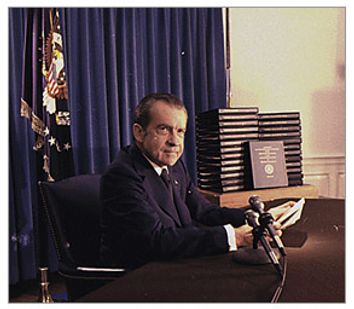
Richard Nixon’s enduring legacy is that he was the first, and thus far only, U.S. president to resign. Nixon’s motive for resignation is shrouded in typical ambiguity: Was it altruism, or desperation, or a desire to save himself from further humiliation, or was he merely anxious to preserve his retirement benefits?

Nixon and his presidency continue to command our attention. He stood at center stage in the nation’s political life for nearly five decades. Nixon, with Presidents Truman, Eisenhower, Kennedy, Johnson, Ford, Carter, Reagan and the elder Bush, contributed to the containment policies that resulted in the demise of the Soviet Union and communism. Indeed, he even went to China; but the Chinese knew his history and understood that President Nixon came to China because he did not have Richard Nixon on the outside criticizing. Some historians praise his liberalism and the importance of his domestic program. But do Americans really remember his ill-fated (and self-scuttled) Family Assistance Plan? His support for environmental legislation and his contempt for environmentalists? His bureaucracy’s forceful acceleration of Southern school desegregation and his baleful “Southern strategy”? His apologists contend that Nixon’s troubles can be explained away — even justified — by his role as a “war president,” comparable to that of Lincoln and FDR. Covering up a break-in of the opposition’s headquarters? No, Watergate in all of its meaning is the spot that will not out for Nixon.

Determined admirers have mounted a formidable campaign to redeem Nixon’s reputation. Revisionism about historical figures is as inevitable as death and taxes. Undoubtedly, Nixon’s policy efforts — some important, some problematic and some dubious — will fade into the mists of history. Fading, too, are the memories of his criminal behavior, including his fraudulent tax returns, his failure to pay his taxes, his authorization of payments to the Watergate burglars and the various strands to the official impeachment count of “abuse of power.”

History is written and taught as an ever-evolving condensation and reduction of the past to leave us the truly important and significant. American history textbooks, as they grow more distant from recent political events, basically will remember Nixon as the president who resigned because of a paralyzing scandal that impaired his ability to govern. They inevitably will have to ask, “Why?”

The Framers of the Constitution provided for the event of a presidential resignation, but since they deliberately chose a nonparliamentary form of government, their use of the term apparently related to physical or mental disability. The outcome of Nixon’s presidency was beyond anticipation or prediction. We have no example of a president who seriously contemplated resignation. Woodrow Wilson’s mental and physical state in the 1919 presidential race prompted that consideration, but largely by his political foes.

For months, Nixon privately mused about the prospect of resignation. Such talk alternately derived from self-pity and a perverse form of bravado. Publicly, he was adamant that he would not resign, notably in his State of the Union address in January 1974 and in a lengthy interview with conservative columnist James Kilpatrick in May. He maintained that resignation or impeachment would have the dramatic effect of destroying the stability so vital for American leadership in the world. “I will not be a party under any circumstances to any action which would set that kind of precedent.”

At the end of July 1974, the House Judiciary Committee approved three impeachment resolutions, with seven Republicans joining 21 Democrats. It was an extraordinary moment. Conservative Republican M. Caldwell Butler of Virginia was profoundly disappointed in the president, but he rejected any notion of resignation. He did not want to establish a precedent “for harassment out of office, which is what would be claimed.” He preferred the constitutional process of impeachment, noting that “it’s a pretty good system.”

Circumstances changed dramatically in 10 days with the revelation of the “smoking gun” tape in which Nixon and H.R. Haldeman, his chief aide, plotted to use the CIA to thwart the FBI investigation in the days following the Watergate break-in. Nixon loyalists got their wish for “specificity” on the charges; it was the end. Kilpatrick summed up the swelling mood. Had Nixon told the truth from the outset, he wrote, Watergate would have been a nine-day wonder, Nixon would have been reelected, and no more would have been heard of the affair. Now, Kilpatrick sadly concluded, “My President is a liar. I wish he were a crook instead.”

Nixon almost certainly would have been impeached, and by an overwhelming, bipartisan vote. The outcome in the Senate was more unpredictable, but his support had eroded. The ever-loyal Vice President Ford distanced himself, having concluded “that the public interest is no longer served by repetition of my previously expressed belief that on the basis of all the evidence known to me and to the American people, the President is not guilty of an impeachable offense.” Meaning that he was. Barry Goldwater joined Republican congressional leaders in a visit to the president on Aug. 7 and told him that he possibly had 10 votes in the Senate. Nixon knew how to read political tea leaves: Republicans and Southern Democrats had abandoned him; the course was clear.

Nixon’s resignation was unique. He prided himself on his “firsts,” but his resignation on Aug. 9, 1974, is his tar baby, a perpetual reminder and benchmark of who he was. Like Shakespeare’s Richard II, Nixon could only lament:

“O that I were as great
As is my grief, or lesser than my name!
Or that I could forget what I have been,
Or not remember what I must be now!”

Continue Reading Close

Henry Kissinger: The sequel

Heroic statesman or war criminal? America's most legendary living foreign-policy wonk takes another stab at molding his legacy.

  • more
    • All Share Services

Henry Kissinger, ever anxious to mold his place in history, is, as Ronald Steele has said of Richard Nixon, like the Ancient Mariner, anxious to tell his story over and over again. In his new book, “Crisis: The Anatomy of Two Major Foreign Policy Crises,” Kissinger now returns (once more) to two key moments in his career, largely using recently released documents to buttress his case. He first discusses the Yom Kippur War of 1973, arguably the Nixon-Kissinger team’s finest hour of diplomacy; and then he turns to the “peace with honor” settlement of the Vietnam War, which Adm. Elmo Zumwalt characterized as bringing neither peace nor honor.

Few men in public life have understood the importance of the documentary record better than Kissinger. Somehow, he managed to leave public office with his records, and then stashed them in the Library of Congress, closed to historical researchers, except for his selected chorus of acolytes. Kissinger made millions of dollars writing memoirs from that record, all the while successfully preventing others from using his papers for nearly three decades. Similarly, his former deputy, Alexander Haig (who was later secretary of state himself, under Ronald Reagan), managed to depart office with all his papers. Nice team.

History usually is written first with memoirs by participants, and then by disinterested historians, who uncover and explore the documentary evidence. Kissinger has given us an ample record of memoirs. But now he is anxious to provide, select and edit the documentary record himself, which he controls while he is alive. Why should we trust the completeness of these materials? Kissinger acknowledges that Condoleezza Rice herself approved and released some of these documents. Would she approve similar requests from historians? Understandably, she is busy these days; but then, historians other than Kissinger are not former national security advisors.

Kissinger first focuses on the Yom Kippur War. For Nixon watchers, this is one of the most fascinating episodes of his presidency. October 1973, when the Egyptians attacked Israel, was Nixon’s cruelest month. Watergate was approaching a decisive moment, as pressure mounted on the president to release the damning White House tapes. In the meantime, he had to deal with Vice President Spiro T. Agnew’s pending indictment for tax evasion and bribery, charges that resulted in Agnew’s plea bargain and resignation. Rep. Gerald Ford succeeded Agnew, but he was hardly Nixon’s first choice; the president’s diminished power left him no alternative. Finally, special prosecutor Archibald Cox refused to back down from his insistence that Nixon surrender his tapes. The president then dismissed Cox on Oct. 20, and Attorney General Elliot Richardson and his deputy resigned in protest. The ensuing firestorm again left Nixon with no choice, and a week later his lawyers meekly agreed to make the tapes available. Two days after Cox’s firing, the House began its impeachment inquiry (which would ultimately lead to Nixon’s resignation the following August).

Nixon’s ability to deal with the Middle East conflict was extraordinary. This book supplements other documents and materials that have revealed that role. He was in constant touch with Kissinger, sometimes personally and at other times through Haig. It is unlikely that Kissinger has given us the totality of Nixon’s role; nevertheless, there is ample material to demonstrate that the president clearly was in charge and well focused.

Nixon intuitively saw opportunity in the conflict. He would not allow either side to win a victory that would reinforce the resentments of the past. As the war proved more difficult for the Israelis, Nixon dispatched consumable military supplies despite Pentagon resistance. But Nixon had another tack: “[W]e’ve got to squeeze the Israelis when this is over and the Russians have got to know it. We’ve got to squeeze them goddamn hard.” He regularly repeated that he would save the Israelis from being overwhelmed, but consistently added that he would not rescue them again. “I don’t think it’s going to cost us a damn bit more to send in more … supplies,” the president said, “but only for the purpose of maintaining the balance, so that we can create the conditions that will lead to an equitable settlement. The point is, if you don’t say it that way, it looks as though we are sending in supplies to have the war go on indefinitely, and that is not a tenable position.”

The administration’s refusal to allow the Israelis to destroy the Egyptian Third Army resulted in a cease-fire, more or less between equals. Whatever Egyptian President Anwar Sadat’s motivations in beginning the war, events soon proved his determination to change things. There is a clear line that leads from Nixon and Kissinger’s 1973 diplomacy to Sadat’s dramatic visit to Jerusalem, and the Camp David Agreement orchestrated by Jimmy Carter in 1977. The ensuing quarter-century has not entirely fulfilled the anticipated reconciliation, but there has no been no armed conflict between the parties.

Vietnam is Kissinger’s tar baby. In this book he focuses exclusively on the last month of the war and the story of the evacuations of Americans and South Vietnamese. It is a tragic and shameful story for the U.S., and a triumphant one for the North Vietnamese. Kissinger glosses over the painful record of the peace accords, except for occasional jabs at his fellow Nobel Prize winner: “I would say anything that [chief North Vietnamese negotiator] Le Duc Tho is eligible for, there must be something wrong with it.” But the facts are inescapable: The “peace agreement” left the North Vietnamese Army intact in the South while American troops withdrew. The papier-mäché South Vietnamese government inevitably collapsed in April 1975.

Historical assessments of Kissinger’s diplomacy are increasing rapidly, thanks to the outpouring of Nixon’s papers and tapes. Such historians as Jeffrey Kimball and Larry Berman, among others, have already compiled compelling evidence of Kissinger’s miscalculation, deceit and eventual failure.

Kissinger describes the last month of the Vietnam conflict as marking the “collapse of an effort to which Americans had sacrificed 25 years of blood and treasure.” He still prefers that we believe his 1973 agreement resulted in an American victory, or at least vindication for our 25-year effort. Did he expect North Vietnam to squander its own 30-plus years of struggle for independence and unification? Congress prohibited further American involvement in June 1973, but Kissinger nevertheless huffs: “It was the first time that the United States had deprived itself of the ability to enforce an agreement for which American forces had fought and died.” In short, in his view the accords failed only because we did not defend them.

Nixon had promised the South Vietnamese he would continue to defend them despite the congressional injunction. But when the South’s government collapsed in April 1975, Ford had been president for eight months. He made a gesture toward intervention, but no more. Secretary of State Kissinger, at that moment, at least, recognized the futility of further involvement. Now he rails against the immoral course of Nixon’s successors who failed to enforce a presidential promise. Such agreements, he writes, “impose a moral, not a legal obligation on his successors.” Kennedy, Johnson and Nixon generously supported Dwight Eisenhower’s commitment to maintain an independent South Vietnam. Consider the costs. Presidential promises, like the act of a legislature, are neither sacred nor binding. While we did not necessarily lose a war, our policy had failed, and not because of our refusal to commit blood or treasure. But the North Vietnamese most assuredly had won. By April 1975, that was the reality; we had no choice.

When the Yom Kippur War erupted, Kissinger told Haig, then the White House chief of staff, that “our domestic situation [i.e., Watergate] has invited this.” Watergate so weakened Nixon and his successor, Kissinger insists, that neither could keep Nixon’s promise of retaliation if the North Vietnamese violated the truce. But Congress’ refusal to authorize any further involvement reflected a turn against the war on its merits, and had precious little to do with the president’s weakness.

No stranger to backbiting and innuendo, Kissinger blames “radical McGovernites” in Congress for the Vietnam retreat. This is a cheap shot, at best. Sen. George McGovern will be remembered for his overwhelming defeat by Nixon in 1972, however prophetic he may have been. He was no great mover and shaker in Congress. Congressional opposition to the war was molded by Senate Majority Leader Mike Mansfield, D-Mont., and Sen. J. William Fulbright, D-Ark., chair of the Senate Foreign Relations Committee, allied with many prominent Republicans, including Sens. John Sherman Cooper, R-Ky., Mark Hatfield, R-Ore., and George Aiken, R-Vt., who famously suggested that we put our troops onboard ships, withdraw and then declare victory. Nevertheless, Kissinger persists in blaming the Watergate crisis and the new Congress elected in the wake of Nixon’s resignation for the Vietnam debacle.

Make no mistake: Kissinger sees Watergate as the convenient scapegoat for his and Nixon’s failures. He urges us to assess “why good men on all sides found no way to avoid this disaster [Vietnam] and why our domestic drama first paralyzed and then overwhelmed us.” History is a ready guide. We can begin by considering whether Kissinger’s “good men,” presumably including himself, simply were wrong, misguided and frozen in rhetoric that long had outlived its relevance and reality. And why did our domestic drama paralyze and overwhelm us? That one is easy. Richard Nixon had abused power and involved himself in criminal activity, and he was found out. Or has sometime-historian Kissinger simply and conveniently forgotten the elementary facts of Watergate?

Continue Reading Close