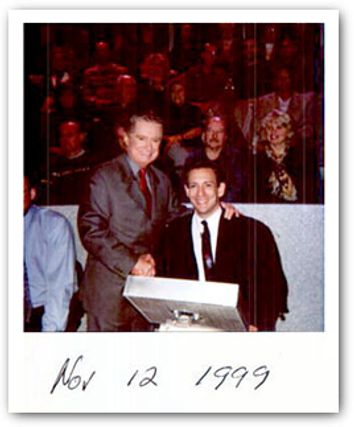
Put these types of headaches in order from least severe to most severe: a) migraine; b) sinus; c) cluster; d) tension. No matter how you rank them, I have them all after being a contestant on “Who Wants to Be a Millionaire.”
Friday, Nov. 12, 11 a.m.
Everyone gathers in a room in the Empire Hotel. The lovely and mercurial Susan, contestant greeter, informs us that we will be taking a van four blocks to the studio. We are 10 contestants, two alternates and sundry “companions.” The van ride provides some insight into how numerous clowns fit into a Volkswagen.
We arrive at the studio and are escorted through tunnels, steps and several security points en route to “the green room.” We are warned along the way not to speak to any ABC employees other than those displaying official “Who Wants to Be a Millionaire” tags. We are then sequestered in a room where J.P., a guy with a headset, welcomes us to a nice spread of donuts, coffee and bagels. A woman named T. tells us that we will be meeting our assigned producer shortly for an interview. Even their names are expedient.
My mother, whom I’ve chosen as my companion, is having a bad morning. She is coughing and feeling dizzy. I have obtained permission for my sister to be my companion’s companion. Thank God for guilt-ridden children.
I meet my producer, Lisa, while my mother and sister put a schmear on some bagels. I tell Lisa my life story in 10 minutes. My mother is treated to the life stories of the contestants to her right and left as they are drilled by their producers. I take a moment to suss out the competition.
The first guy I meet is Mike. He is the holdover from the night before. He had reached the $8,000 level when time ran out. He holds his wife’s hand as he tells me that he has only one “lifeline” left and is not very good in science and pop culture. (Lifelines are phone calls which you’re allowed to make to friends to get their help in answering Regis’ questions.) Mike wants a sports question. He is a bit edgy. It is only noon and we still have six hours to go before taping.
Next I meet Andy, who was a “Fast Fingers” contestant in August. (“Fast Fingers” is the game that gets you to the hot spot chair.) Wow! You get a second chance! He points out Bruce, who was also a “Fast Fingers” contestant in August. Back then, ABC hadn’t finalized the rules yet because they didn’t know whether the show would continue. Officially, contestants are now allowed to be in the top 10 twice in two years. These two guys, because of their appearance on the show before the rules were written in stone, get three tries. Then there’s Rick, who resembles Edward Norton and is a former “Jeopardy!” champion. My mother is impressed. She watches “Jeopardy!” religiously.
My life story is abruptly cut short when J.P. and T. inform us that we are going to watch an episode of the show to give us an idea of how what a “good ” contestant is like. They tell us to remember that “We are the show!” Watching video takes another half-hour.
As the tape ends our small army of producers return to the room. We are given our “Fast Fingers” seat numbers. I am number 10. We are to line up in order in single file and remain in formation for the rest of the day. The two alternates are side by side behind me. I jokingly tell them not to push me down the stairs (I have seen “All About Eve.”) Celeste, who has come from a town of 200 in Utah where it took five hours just to drive to the nearest airport tells me not to worry. I wonder if she has what it takes to win.
We are warned that it is very cold in the studio to keep all the lights and computer equipment from overheating. Everyone is joking, “Who wants to be in a Frigidaire!” We take our assigned “Fast Finger” seats and our companions take their seats in the audience. They weren’t kidding about it being cold. I am wearing a sweater but start to tremble. All I can think about is my mother getting pneumonia from me wanting to be a millionaire. It doesn’t seem right, somehow.
Michael Davies, the producer of the show, comes in to the studio to greet us. He gives us a 40 minute pep talk. He tells us how he created the show, and that it is going all over the world. In fact there is a gaggle of Canadian television people in the rehearsal audience who are here to see how it is done — and perhaps buy into the franchise.
I am getting colder. My teeth are chattering. It’s time for the “Fast Fingers” rehearsal. My hands are frozen into claws. My screen is hard to read. On the practice round, I tank. Andy, the guy who participated in August, gets all the ordering in lightning speed. I’m in big trouble. Oh well, time for hair and make up!
There is a locker room mentality in the changing room. We all wish each other luck. I put my hands on some light bulbs to warm them up as a producer named Brett looks on, and asks me what it is like to be a writer in New York. Not as tough as quickly and correctly punching in those “Fast Finger” answers with rigid hands and a dim screen. I hope they don’t ask geography questions. It’s my worst subject.
We are dressed. I’m looking great and the feeling has briefly returned to my hands. It is time for the show. As we are led back up to the Fridgidaire, Regis stands offstage and greets us. With his impish swagger, sharp gray suit and blood red tie, he isRegis Philbin.
And the show begins. Mike picks up from where he left off yesterday. His first question: In biology, what does the double helix structure represent? a) DNA; b) red blood cells; c) RNA; d) amniotic fluid. Mike is stumped. With his one lifeline left, he decides to call his stepfather who is a doctor. Immediately, his stepfather tells him the answer is a) DNA. Mike makes it to the S64,000 level only to be foiled by another science question, (“What animal is represented on the Caduceus?”) He opts to take his money and run. (The answer was the snake.)
Time for “Fast Fingers.” I start blowing on my hands to warm them up. But this is a one-set show, which means the computerized double chair that Regis and the contestant sit in has to be unplugged and taken off-stage to prepare it for a new contestant. It takes 15 minutes before we are ready to go.
Finally, the music starts to hum, the lights starts to sway and Regis booms, “Put these Canadian cities in order from west to east.” Damn! Geography! And Canadian to boot! I am dead in the water. I press any four buttons as fast as I can and pray. And wonder if they did this to butter up the Canadian television people. You know, make them feel included.
Andy gets it right in the second highest speed ever. I sit through his questions hoping for another shot at “Fast Fingers.”
Andy is 23 years old and attends Johns Hopkins. He has a car with a 143,000 miles on it. He is good at geography, history and sports, but bad at pop culture. This is not his lucky day. “Who won an Emmy for their performance on the last show that Johnnie Carson hosted?” (He calls a friend who tells him the answer is Bette Midler) “Which lifestyle entrepreneur went public with her company in October, earning a billion dollars?” (He opts for audience help and learns it is Martha Stewart.)
And then the killer: “Which actress did not play Rizzo in Grease on Broadway? a) Courtney Cox; b) Rosie O’Donnell, c) Lucy Lawless; d) Brooke Shields.” Andy falters. He has no clue. He has used all his lifelines. Andy is dead meat.
After 15 extra minutes due to technical difficulties, we are on the air. The lights, the music, the whole deal all over again. I focus on my stiff digits. Then Regis says, “Put these television shows in order from the cities they are set in from west to east.” Another disguised geography question. I curse large land masses.
The “Jeopardy!” champion, Rick, trots over to the hot seat. Rick is like Andy. Good in geography, history and sports but not very hip at pop culture. He reaches the $64,000 level, but uses up all his lifelines. It’s 8:30 p.m. My time is running out. I don’t wish bad things on other people, but hell, I’m on a game show. For $125,000 Regis asks Rick, “Which one of these people was a founding member of the Rolling Stones? Was it a) Brian Jones; b) Jeff Beck; c) Ron Wood; or d) Jimmy Page.
Rick is plagued by doubt. He has no lifelines left. He is almost certain that the answer is Brian Jones, but isn’t sure whether to stake it all on a guess. Then he goes for it. He takes the plunge. “A) Brian Jones,” he says. Regis fixes him with his trademark “I’m worried about you” stare. He looks extremely concerned for Rick. “Is that your final answer?” Regis asks solemnly. Unsure of his answer, Rick crumbles. He decides to stop at $64,000.
Rick gets his fake check for $64,000 as we are all informed the correct answer was — technical glitch. Producers and stagehands are in a flurry.
Rick’s humiliating defeat will have to be dramatized. The audience is told not to not overact as we reenact our disappointment. It’s all very sad for Rick.
One more “Fast Fingers” round! Yahoo!
And the question is: “Put these non-fiction books in order according to their publication dates, from earliest to most recent.” a) “Angela’s Ashes”; b) “Private Parts”; c) “In Cold Blood”; and d) “Roots.” I know this one! I punch in my answer and celebrate for one infinitesimal moment — and then I realize — I didn’t punch in OK. I didn’t punch in OK!! Punch again! OK! OK! OK! Two others beat me to it.
Tom, an international banker who is fluent in Italian, will be the next contestant. Then the horn sounded. The game was over.
What does it feel like to come so close and not go all the way? A bit of
disappointment, a bit of despair. Hard to look your companion and your companion’s companion afterward. No chance to sit opposite Regis. Time to go silently into the night.
Exhausted and coming down from an adrenaline high, I made sure my sister and my mother got their limo back to Long Island. Instead of calling ABC to get my courtesy car home, I decided to take a cab.
Was it worth it? Of course! Would I do it again? Sure — for a million bucks!
Who wants to be a millionaire. They don’t even have the decency to put a question mark at the end of the sentence. But then, it’s not really a question, is it? So … sign me up!
I tried to get on the show in August, when it first aired. To become a contestant you had to call a 900 number and demonstrate your ordering prowess by correctly putting a few writers in order of birth, a few musicals in order of when they opened and a few rulers in order of when they ruled. The questions become more difficult as you progress, and my own difficulty factor was increased by the whimsical configuration of my push-button phone — which is cunningly designed to resemble a rotary model. If, as you are attempting to qualify, you press a number other than 1 through 4 you are disqualified from the semifinals.
Back in August, it cost $1.50 per call to try out — with a two-call-per-day maximum. Due to technical difficulties (see phone configuration), the best I could do was answer the three questions correctly, but not at the breakneck speed required to progress to the semifinal round. At the end of two weeks I was out about $21 for my efforts. The only ones getting rich were the 900-number people.
So now, smack in the middle of November sweeps, the highest rated show in recent television history is back. They have discontinued the $1.50 per call fee and enacted a fail-safe method to prevent overloading the system. This time I was determined. Who wants to be a millionaire? Me! Ooh! Me!
On my first day of calling I accidentally pressed 5 instead of 4. How cute is my phone now? On the second day of calling I made it through. The taped voice of Regis Philbin congratulated me on my correct answers, but warned that next time, I would have to order like the wind to advance to the semifinals. I also had to be near a phone from noon to 3 p.m. the following day to receive information about the next round. If they called and I was not home — so long, Regis! There’d be no champagne wishes and caviar dreams for me.
At 12:03 the phone rang. A woman at the other end of the phone said she represented the “Who Wants to Be a Millionaire” show. In exchange for my date of birth and the last four digits of my Social Security number, she would give me some important information: I had advanced to the final round. I was given a special phone number and a pin number and was told to call between 5 and 6 the next day to put more things in order.
The whole next day I spent in strategy. I borrowed a friend’s speaker phone and hunkered down. At 5:07, I called in and answered the five questions. The voice of Regis came back to tell me that someone would call me between 6 and 10 that evening, if I had A) answered the questions correctly, and B) been among the 10 speediest respondents. The Regis voice reminded me that if I missed the call, I was SOL. These people were ruthless.
Suddenly, I was confronted by the first dilemma of pre-millionairedom. I am a professor at NYU and I had a class at 6:30 downtown. The phone number I’d given the show was a home phone (no cell or beeper numbers were allowed).
What should I do? Tell NYU I was sick? Tell them I want to be a millionaire? Or forget it — maybe I hadn’t answered the questions right, maybe I hadn’t answered them fast enough? Maybe, deep down, I didn’t really wantto be a millionaire?
Then a water main broke and stopped all subway service downtown. God works in mysterious ways in New York City — that or He watches the show, too.
Now there was nothing left to do but wait. Would the Regis voice call again?
At 6:48 the phone rang.
It was a friend asking to borrow my drill.
At 6:53 the phone rang again.
“Hi, this is Lisa from ‘Who Wants to Be a Millionaire.’ Is Steven Smith there?”
“Is this good news?”
After motoring through the verbal fine print, she finally murmured, “Congratulations! You’ve won a spot in the Friday, November 12th taping, to air on Saturday, November 13th.”
Yahoo!
She asked if she could arrange my flight plans, I told her that I lived 30 city blocks from the studio. So they would send a limo for me, she said. Then she asked who my companion would be. I picked my mother, who lives on Long Island. A limo would be sent for her, too. We both would be put up at the Empire Hotel on 67th Street — just blocks from my apartment.
I was then to make a list of five friends to call in case I chose to exercise my “Phone-a-friend lifeline” privileges. For the untutored, three “lifelines” are allowed on your way up the ladder. AT&T has set up a system that allows you to call friends for help in tricky categories. For sports, I chose my friend who took me to the second to last Mets game this season, and for cooking I chose my Italian aunt, who is the only one in the family who can cook. For variety I picked my Uncle Hank, who was once nominated for a Nobel Science Prize in Marine Pharmacology; a colleague at NYU who has read all the classics; and a Broadway director who writes crossword puzzles for Harper’s magazine.
My brain trust is in place. My Social Security card and 14 other documents containing the same information are packed and ready to go — lack of I.D. was not going to stop me now! After learning that shorts and jeans are not allowed on the show, I’ve decided on Armani. When I meet Reege, I want to look like a million bucks.
I am writing this on Thursday night. At this moment, I am waiting for the limo to pick me up and deliver me several city blocks to the hotel. Upon arrival, I will return home to walk my dog, after which I will rejoin my mother at the hotel. We will be sequestered there from 11 a.m. to 9 p.m. the next day.
The clock is ticking. My ordering skills will be pitted against those of
10 of the finest ordering minds in America. We all have our eyes on the prize: the chance to go face to face with Regis Philbin for a million bucks.
It feels like “The 25,000 Pyramid” on steroids.
Continue Reading
Close
I can laugh at it now because comedy equals tragedy plus time. A nervous
breakdown is highly underrated, and while I don’t recommend it for everyone,
it can be the antidote and wake-up call that you needed to set your life in
order.
I am 41 and what most people would call an overachiever: obsessive,
intellectual and part of the dreaded cultural elite. I am strong-willed,
determined, opinionated and extremely headstrong. I would never consider
asking anyone for help. And yet, it happened to me. As Zelda Fitzgerald wrote to F. Scott, “It is
ghastly losing your mind” — but sometimes that is your only
option.
If you’re going to do it, you might as well do it the right way. And you
should know that you are in good company. Susan Sarandon recently
admitted to Barbara Walters that when all her life myths were shattered,
she had a nervous breakdown and had to reinvent herself. And Otto Friedrich
in his 1976 book “Going Crazy” lists such real and imagined luminaries as Robert
Schumann, Jean Seberg, Vincent van Gogh, Edgar Allen Poe, King Lear,
Hamlet, Caligula, Sherwood Anderson, Martin Luther, Eugene and Carlotta
O’Neill, Elizabeth Taylor (both on- and off-screen), Patty Duke (both on-and off-screen), Virginia Woolf and Vaslav Nijinsky.
And there’s the dean of the disorder, William Styron, who wrote a book called
“Darkness Visible” about his experience with depression and breakdown.
Having realized that most of the characters in his own books suffered
nervous breakdowns, (think Sophie in “Sophie’s Choice”), Styron was unaware
that he was writing the blueprint for the course that his own life would
take. Trying to share a common bond with those who have experienced this
phenomenon, and understanding that there is no shame in it, Styron pinpoints
the beginning of his breakdown to the loss of his mother at an early age.
But it’s not as practical a tome as I would have needed. My experience can
serve as a handy guide to those of you out there on the verge. See, I’m
like you. I’m a hard worker. And I don’t do drugs, drink alcohol or smoke
cigarettes. I smoked marijuana three times and did inhale, but never
found it intellectually stimulating. I tried therapy three times and,
besides feeling smarter than my therapists, thought it was a waste of good
money. It was more
therapeutic to save the money. I graduated Phi Beta Kappa and have an
MFA. I have been a professor of humanities at NYU for
the past 18 years.
So when my breakdown crept up at age 35, it was the last thing I ever thought could happen to me. But in retrospect, it could have been predicted. I had lost several close
friends in the space of three months; before I could grieve for one,
another would be dying. “Multiple grieving syndrome,” psychiatrists call it.
Holocaust survivors have it. I buried myself in my work.
I acted as if their deaths didn’t affect me.
At the same time, the person I was dating decided that it was time to leave
me. Although I am fine alone, intellectually I could cope with losing
friends in death but could not understand somebody just leaving. I started
to grieve for all my friends at once. This led to an all-out collapse, or
nervous breakdown.
Dr. Clark Sugg, director of clinical services at the William Alanson
White Institute of Psychiatry, Psychoanalysis and Psychology in New York, says, “You would be hard pressed to find a definition of a nervous
breakdown because it is a term the psychiatric and medical world has not
embraced. They use terms like psychotic episode or major depressive
event, and for each person it is different, but behind closed doors of the
profession a nervous breakdown is an all-out collapse.” He
went on to quote Carl Jung’s definition: “The patient who is sick in mind in
the
highest and most complex of the mind’s functions, and these can hardly be said
to belong anymore to the province of medicine.”
The American Psychiatric Association defines a “major depressive episode”
as one that includes at least five of the following symptoms during
a two-week period:
1. Depressed mood most every day
2. Diminished interest or pleasure in almost all
activities most every day
3. Significant weight loss or weight gain
when not dieting
4. Insomnia or hypersomnia nearly every day
5. Restlessness or slowing down nearly every day
6. Fatigue or loss of energy nearly every day
7. Feelings of worthlessness or excessive
guilt nearly every
day
8. Diminished ability to think or
concentrate nearly every day
9. Recurrent thoughts of death and suicide,
with or without a
plan
How’d you do? Well I scored a perfect nine out of nine. Remember, I am an
overachiever!
A nervous breakdown paralyzed my ability to make even the smallest decision. And getting out of bed was like climbing Mount Everest. Thoughts
of suicide are not far away. And it is the paralysis that spares you: If
you do not get
out of bed and drive, you won’t swerve on the road “accidentally.” But if
action is not taken it can be a painful road to a slow death: I stopped
eating. I could not sleep at night. I started hearing voices. I would get
into bed and shake and convulse. The real world seemed surreal.
One of the things that saved me was the phone. As long as I was connected
to people in some way I was fine. Hearing about other people’s activities
– even grocery shopping — meant there was a world out there. I was
desperate to
hear about anything that didn’t involve me. The worst time was 2 to 6 in
the morning, when I felt as if there was no life, and the world was asleep.
I would pace and have panic attacks.
I didn’t care about my personal appearance. For a month I wore one pair
of khaki pants and a black turtleneck, which concealed my growing weight
loss. I had lost 30 pounds and looked like an Auschwitz survivor.
My friends were there for me, a key to my survival. My best friend got active. He
called several of my other friends and they went on a watch: all of them
taking turns being with me. I was never to be left alone. My friends
ordered the
best take-out food to encourage me to eat, but I couldn’t. They made sure
that the clothes I was wearing were clean — even if it was the same khaki
pants and black turtleneck. And although I tried to feel better to make my
friends feel good for their sacrifice, I was getting worse. Orange juice
was the only thing I could keep down. My friends could no longer take the
responsibility for my welfare.
They got me to a psychiatrist. Luckily, on the roulette wheel of therapists
I landed on one who was smarter than me and really understood my condition.
He said, “This is that rainy day: Treat yourself well. Take cabs instead
of subways, don’t deny yourself anything — it is time to take care of
yourself — and let yourself feel your pain, because it is real.” I was
taking the first step toward getting better. To help me with the physical
symptoms of my ailment he immediately prescribed Xanax, an anti-anxiety
drug, and Zoloft, an
anti-depressant. (Anti-depressants — serotonin uptake inhibitors — take
several weeks to help balance the chemical imbalance caused by depression.)
He checked me into the hospital for observation.
Once there, I was finally able to relax. It’s something I definitely recommend.
To relax. To have full-time
care. To be watched. And to put you in a situation you want to get out of
as soon as possible. (Hospital food, when you have a problem with food in
general, can be a great drug.) One night in the hospital was enough for
me. I had hit bottom with a resounding thud.
Remember, climbing out is done in baby steps. Therapy, anti-depressants
and anti-anxiety drugs can be huge safety nets, but you have to want to
take actions to make your life better and more stable.
This sometimes takes searching your past. I turned to my family — the
last place I thought I would turn in a psychological meltdown. My mother
had noted my degrading physical condition, so I explained to my parents
exactly what had happened to me. I needed answers from them about them.
The answers they had hidden for years were the touchstones to my recovery.
In their generation, depression and psychological disorders were considered
shameful and, like in most families, were covered over in organized
secrets and
lies. The aunt that I was told had a stroke had put a bag over her head
and asphyxiated herself. The cousin who had a “heart attack” had really
hanged himself as he was approaching 40. My mother had suffered a
miscarriage before she had me and because of her postpartum depression she
was put on Librium and Seconal by our family doctor. She became addicted
to them and was on them all through my infancy. My father’s father, who
died when my father was just 9, who I had been told died of an embolism,
actually wasted away slowly from melancholia (as they called it then)
because his twin died in a freak accident.
There now seemed to be a genetic or historical basis for my own depression.
In some way I felt relieved. It united me to my parents like nothing
ever had
before. At the expense of having a nervous breakdown, things I had always
wondered
about were finally revealed. I asked my parents to come with me to a therapy
session. They came, even though my father doesn’t believe in doctors and my
mother
thought that therapy was a luxury for the rich who needed to complain about
something. But it was their gift to me. They jokingly asked my
psychiatrist if they were the cause of my problems. If it isn’t one thing,
it’s your mother, right?
I made it clear to both of them, with my psychiatrist’s help, that this was
not about blame, but about getting to the truth — the answers that everyone
wants to those family questions. Some of the answers were startling: I
learned that my grandmother had two sisters I never knew existed who died
from “mysterious” illnesses. I learned that the cousin who hanged
himself did so as a reaction to my uncle’s rendezvous with a prostitute. Some of
the answers were mundane, but the wall had been cracked.
The epiphany came after about three months of therapy, family interaction,
and drug treatment. I had a moment of clarity where I really saw life as
it is. I felt great. I can’t explain the euphoria, but suddenly there was so
much to live for. Resurrected and reborn and now out to redefine my life, I
could do anything.
It has been five years since my breakdown, and life has come full circle. Guess who is the strong one again? My mother’s
health has deteriorated; I had to close down my father’s business as he
approached his 70th birthday. This, and my mother’s health problems, has
led to my father having a nervous breakdown. My father was always the
eternal optimist, and couldn’t understand what was happening to him.
Luckily, when you have been to hell and back you understand the journey.
My gift to my parents is that I am
helping them through this time as they did for me. It has brought us all
closer together. Because of my own breakdown and subsequent healing, I
have the tools and the knowledge to help ease a very stressful situation. I
gave Styron’s “Darkness Visible” to my father. Not admitting to his own
condition, he said, “Ya know a lotta people go through what he talks about
in that book.”
I said, “That’s the point dad — you don’t have to feel so alone.”
Continue Reading
Close