Tess Taylor

A gritty tale of obsession

A new novel follows an unnamed professor who becomes consumed by a stranger's secrets

In Ellen Ullman’s searing novel about storytelling and the hunt for belonging, “By Blood,” the disturbing signals come early. Our unnamed narrator, who we slowly learn is a professor under suspicion for unclear but pseudo-sexual misconduct, has been forced to take leave from a similarly nameless university. He has decided to pass out his exile in the hairy, radical and dark atmosphere of 1970s San Francisco, a setting akin to but standing in marked contrast to the Silicon Valley of a decade later, where the author set her previous novel “Bug.” This is the Bay Area before its tech-fueled transformation, caked in an uneasy mixture of grime and politics, with nary a foodie or a wine country tour in sight. The gritty gray of a Hitchcock noir is overlaid with a psychedelic smoky sheen, and our narrator — the erstwhile professor of some unnamed topic — ranges through a slightly decaying fortress that houses transient people, radical subcultures and perhaps even a serial killer.

Barnes & Noble ReviewThe professor seems to have no real human attachments. He is planning to endure the chagrin of his conscripted year off writing a few papers on something so arcane even he can barely repeat it and that anyone reading this book will immediately forget. To complete this task, he has rented an office in a part of downtown that was nice perhaps thirty or forty years before, a faded, painted-over remnant of a more golden time. Clearly unfamiliar with the weather of San Francisco, he has taken a house in the cold fog of the deceptively named Sunset District, where the ocean is a tempest, the wind always blows, and the air is never warm.

Cloaked in this unmoored and unmooring anonymity, the narrator nonetheless attaches himself to an intimate adventure. His office is adjacent to a therapist’s office, and during one particular session, he discovers that one patient has chosen to have the noise machine that would mask the sound of her and her therapist’s voice turned off. He quickly succumbs to a kind of aural voyeurism, and “By Blood” becomes the  tale of an almost obsessive desire to unravel a mystery. The patient is a lesbian who seems at first to be sorting out whether or not to stay with her radical feminist partner. The partner annoys the patient by planting every avocado pit into a recycled yogurt container, by never shaving her legs. These mild aggravations prove, however, to be only the cover for a deeper story: The patient is adopted. She has what she calls “mysterious origins.”  She decides to embark on a hunt for her birth mother.

And as the professor listens to the patient unraveling her way back to this primal knowledge, he finds himself unable to refrain from tuning in to her weekly sessions. And indeed, neither can we: The plot has thickened. The patient believes that some scant evidence she has gleaned will lead her back to a displaced persons camp — the limbo zone where Jews were kept after the concentration camps were liberated in 1945. The patient is suddenly no longer an adopted WASP but instead a displaced Jew, the child of Holocaust survivors. The professor, overhearing her anguish, decides to research the case on her behalf.

The ensuing pages nest stories inside stories — the patient making a trip to Israel, the patient recuperating and playing a tape of the incredible story she eventually does find. We read as the narrator listens to the patient listen to her own central narrative. As the patient’s origins shift, we are left to wonder if her own path back to her fascinating and traumatic birth story will help her or not. Will her discovery turn out to be a source of closure or, rather, the source of new trauma? It is fitting that as we perch, peering through the professor’s eyes, listening through his narrative, that it dawns on us that we never really see him clearly. He is an enigmatic host, an unfinished figure overhearing someone else’s unfinished and perhaps un-finishable tale.

There are one or two moments when this otherwise skillful book gets bogged down in narrating the complex history of European Jews in the period following World War II. It’s a fascinating chapter, but occasionally its mode seems a tad didactic, more tuned toward pedantry than storytelling. This is only noticeable because the rest of the book is so effortless and wholly engrossing. The narrator’s darkly refracted city is in flux, fraught and throbbing, reaching an almost hysterical tremor.

The book’s ending feels both abrupt and inevitable. And it offers a wrenching meditation on what it means to be a reader — the “hypocrite lecteur” Baudelaire once named — the grubby spy with an ear cocked to the next office, holding his breath, hanging on the next word.

The accessible Emerson

A new collection frames the seminal writer's best work in a way that's both smart and approachable

This article appears courtesy of The Barnes & Noble Review.

Yes, yes — Ralph Waldo Emerson was a brilliant and seminal American thinker, and his writing is studded with fabulous sentences, gemlike insights, and a remarkable record of mutual dialogue between self and world. But let’s be honest: for the uninitiated, it’s a dialogue that can prove frustratingly difficult to enter. It’s not that Emerson is opaque, exactly, but that he’s faceted. He’s digressive, sidewinding. (“Man is analogist,” he claims, and then proceeds to demonstrate his humanity by analogizing for pages.)

Barnes & Noble ReviewOne could go so far as to say that Emerson is just plain dense. Even though some of his phrases leap off the page and lodge in the mind, the jewels in his prose can be hard to string together. It’s not just that, in his role as the mid-nineteenth century’s foremost American public intellectual, the man was ambitious. It’s more that his writing is all-encompassing, enfolding the self and its contradiction, looking for the reflection of the reflection, proposing the corollary and also its opposite. Emerson elevates the humble, finds lofty sentiment in compost, celebrates labor, all in the service of furthering thought, which, he hopes, will lead us full circle back to action, to vision, and then to reflection once more.

Sometimes, despite himself, his meditations are unintentionally comic, as in the essay “Nature,” where he writes, “The greatest delight which the fields and woods minister is the suggestion of an occult relation between man and the vegetable. I am not alone and unacknowledged. They nod to me and I to them.” Moments like this are likely to cause the reader to do a double-take — is Emerson discussing a secret alliance with affirming turnips? Emerson’s point, of course, is far from arcane: he’s hoping to express the world’s mutuality, its correspondence, its fragmented wholeness. For him, illumination points to illumination points to illumination — and each flare is a reflection of some unseen but present centrality. Life becomes a quest to see amid facets, to “magnify the small, micrify the great,” and to record reciprocities between inner and outer worlds. These are all tall orders, to be sure, but Emerson binds small and large, inner and outer, with remarkable grace. He’s agile as well as original. He has the genius not merely to recite the commonplace that thought should lead to action, but to affirm that action should lead back to thought.

Still, if there are rewards aplenty in Emerson, there is still the problem of the slow going, the circumlocution. The revelation resists sound bite. Emerson rewards us, but he only rewards our full attention. And, as we know, full attention can be hard to come by.

What a pleasure, then, to have, in “The Annotated Emerson,” a lovely and helpful version of many of Emerson’s bests, gathered and annotated by David Mikics and introduced by Phillip Lopate. This is in no way Emerson lite. These are not shortcuts but rather a welcome frame for Emerson’s particular kind of difficulty. The book’s introductions curate the voluminous career, and the wide margins of the pages, dappled with thoughtful notes, give the meditations space to unfurl. This is a book that gives us each hope to approach the “new yet unapproachable” Emerson.

Any lay reader will find an open door here. Those who already love Emerson and know him well may find a few cherished things missing, but they may also find a few things they didn’t know they wanted to find. Both introductions by Lopate and Mikics refer already devoted Emerson fans back to the looser, more exploratory journals, but they also do us the service of quoting liberally from the journals in this book itself, right in the margins of the essays. Indeed, one of the pleasures of this book is to see, as Mikics puts it, how much “traffic” there is between the journals and the final essays. We see the sentence in draft, the illumination plucked out of the scribble. There’s also a chance to see that we’re not alone in sometimes tossing our hands up at the famed American Scholar. In “Nature,” Emerson  — not merely content to converse with carrots — refers to himself as ” a transparent eyeball.” This was too much for Emerson’s colleague Christopher Cranch, who took the occasion to sketch an enormous open eye walking on stilty pant-legs through the fields.

“Emerson is our Shakespeare,” Mikics claims, and while some may argue for Whitman, or for Thoreau, or for Dickinson, or for all four, there’s no question that Emerson is a founding father of our national literature, a bedrock of our oratory, an early capturer of our spirit. He does rise in our minds as one of the greatest American intellectuals, one of the early few to grasp and form and articulate the grain of our thought. Not, of course, that he was a narrow patriot — rather he was a quarreler, a re-maker, a rabble-rouser: “Please don’t read American,” he wrote, “thought is of no country.”

Continue Reading Close

A comic take on torture

A new graphic novel depicts a hapless fashionista who gets accused of funding terrorism

This article appears courtesy of The Barnes & Noble Review.

In this funny, sometimes sobering tale of the American Dream gone wrong, Boyet Hernandez, a fey-but-straight Filipino fashionista, arrives in the U.S. in 2002 to set his sights on the fashion world. He’s got a fresh degree from FIM, the Fashion Institute of Makati, a sewing machine, and a small stipend from his parents back home. Possessing only the proverbial dollar and a dream, he’s determined to hang his own clothing line on the gilded runway. But due to a combination of naiveté and blind ambition, Hernandez, who was raised Catholic, has the misfortune to accept funding from the wrong patron: the flamboyant and charismatic Ahmed Qureshi — an “angel” investor with some sartorial sense, mysterious millions, and a rather-too-vague global business.

Barnes & Noble ReviewThe rest is history, so to speak, recounted from prison, a no man’s land that’s easily parsed as Guantánamo or one of its ugly cousins. As “From the Memoirs of a Non-Enemy Combatant” unfolds, Boyet, or Boy, as he’s called, is charged with consorting with terrorists, perhaps more. (In the mode that’s become uncomfortably familiar, it’s not really clear what he’s there for or how long he’ll stay.) Mustering his courage and earning a pen and paper for good behavior, he gives us a tour of prison living, recounting the twists of fate that brought him to be charged with being an enemy of America. As an ingénue caught in terrorism’s ugly web, Boyet poses as the friendly, gossipy voice of all that has gone wrong with deportation and detainment.

With flashing but surely sharp scissors, Gilvarry’s plot cuts some strategic holes through the horror of the last decade. And at its best moments the absurdism produces effects as shimmery and strange as the fashion garments that Boy hungers after. We take the ride with the unfortunate kid, whose name reminds us that he could be almost anyone. What would it be like for an ambitious fashion-minded not-quite-grown-up to find himself in some dark island prison? There’s something quite remarkable about this Yves St. Laurent–loving voice narrating its own fall into the grungy uncomfortable cells, and there’s comedy — albeit sad comedy — to be gained from a suspected terrorist spending all of his imprisonment pining after a copy of W magazine. There is, of course, something dangerous, too, about this gambit: It’s simply too airy to match its subject. In the end, when the toll is exacted, Gilvarry’s project feels like a well-crafted velouté that just about evaporates. Fashion is all well and good as a way in to make light, but in the end, torture is a heavy subject for comedy.

I couldn’t help thinking of Camus’s “The Stranger,” a completely different sort of prison narrative, to be sure, and wishing for a little more of its masterful gravitas. That said, is the fact that Gilvarry is brave enough to make fun of torture a sign that our national flirtation with torture is receding or passed? As readers, we may hope so, but a return to innocence on such a subject now seems as unreal as a W photo shoot.

Continue Reading Close

The secret lives of scientists

A new book uses journals to take a fascinating look at the minds of acclaimed natural researchers

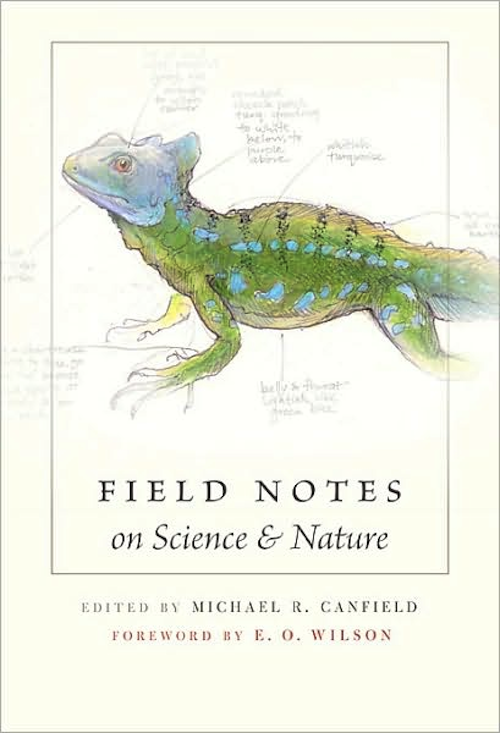
A roving look into the diaries, journals, and field notebooks of several of this generation’s most celebrated natural scientists, Michael Canfield’s “Field Notes on Science and Nature” raises the curtain on where “science happens,” allowing readers behind-the-scenes glimpses of the rough-draft places from which serious inquiry springs. Focusing on notes taken in the field — as well as the doodle, the observation-in-passing, the daydream — Canfield invites his readers to peer over the shoulders of natural historians in their first raw moments of observation.

Barnes & Noble ReviewAs such, this book of meditative essays is interspersed with lush facsimiles of just such notebooks, often accompanied by sketches of butterflies, charts of soil strata, or memories of weather and light. In the era of the laptop and iPhone, readers can see what the Moleskine can still accomplish as a place for thought to assemble, and observe how the act of careful recording can give rise to great and meaningful discovery. Ranging from etymologists to paleontologists to avian specialists, the essayists gathered in this collection share a common love of watching and writing, and a keen ability to articulate how both of these things form the first tier of human investigation. Whether we’re learning the way a passing thought about how a crane flies became a discovery of the way a species protects itself, or hearing about an expert who developed his own finely honed philosophy of list-making, or reading how journal entries about raven behavior led to a book, we’re gifted with an understanding of how note-taking becomes the first place to frame a world.

It’s highly nerdy stuff, but it’s human and humane as well. University of Vermont Emeritus Professor Bernd Heinrich describes his note-taking addiction this way: “I use any stray implement at hand. I have no system, no object or goal in mind. The notebook allows for spontaneity, a counterbalance to my ideal of orderly scientific objectivity. The process slows my thinking and serves as a first crude filter for the natural breeze of data that passes by in a continual stream.” Heinrich’s writing doesn’t record thinking; it makes thinking possible. What’s more, in each of these essays, scientists’ notebooks embody the place where the seemingly objective process of science begins in hunch, intuition, or seemingly whimsical speculation, the place where the possible asserts itself.

Although the book seems geared to Canfield’s fellow scientists, scientists aren’t the only ones who might profit from it. Looking at these well-kept journals is like looking into an artist’s sketchpad, a journalist’s reporting notes, or a composer’s first drafts. We see the activity of a mind sorting out the world and framing it, asking, “what is the question that will illuminate some part of the truth?” Or “what is the constellation of thought with which I will play?” Out of these drafts some essence reveals itself, and to each of these scientists this process still has the luster of mystery. At its base this book is about science, but it’s also about the liveliness of the human mind practicing any craft, and about the kinetic, surprising places from which any human knowledge springs.

Continue Reading Close

Lolita’s book tour

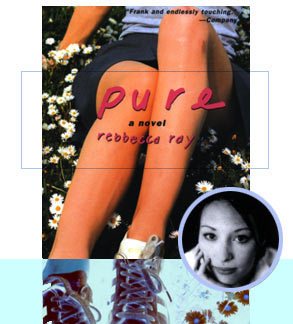
Rebbecca Ray's novel, "Pure," written when she was 16, is a raw work of sexual exposure. Is it autobiographical? "Thank God it's not," she says.

Rebbecca Ray and I are in a vintage clothing store looking at a pair of pale mauve high-heeled shoes. They’re the strappy kind, almost sandals, with crossed fluted fronts and tiny ankle straps. Their round heels pucker into tiny spikes. We are entranced. Around us, as in an overstuffed, half-dusty attic, are piles of slightly aging toys, the relics of a circa 1980s childhood. There are Go-Go’s posters, jelly bracelets, jars of glitter lipstick. And the toys are awesome things, the kind we used to love as kids, or maybe just wanted lots of: Pez dispensers, Barbie dolls and “Star Wars” action figures. Above our heads hang rows of tin lunchboxes with Raggedy Ann and He-Man on them. Ray’s face lights up as she spots one. She claps. “She-ra,” she cries, “Princess of Power!”

In a small hall, beneath Barbie and the lunchboxes, Ray is trying on the high-heeled shoes. Her toes are only halfway in. She looks up at me, quizzically. “They look like they’ll hurt,” I say. “Try these for pain,” Ray says, handing me one of the gold stilettos she has been in all day. It’s a gorgeous skinny thing; she wears it well. She gets her last toe in. She wobbles up, then turns to show me. “I don’t think they’ll be any good at the ball,” I say, “they’ve got to fit.” “They’ll stretch,” she says, peering down at her feet.

Ray is barely 20. It has been two years now since she published her first novel, which in her native U.K. is called “A Certain Age,” and in the U.S. is called “Pure.” After selling 100,000 copies worldwide, it’s being released in the U.S. this month, and she’s on her first trip to the States to do publicity, read and give some interviews. The tour has been a bit upset: She came down with the flu on the first day and hasn’t stopped throwing up since. She didn’t even get to do her reading at the Barnes & Noble here or go to her publishing dinner at Pastis.

She has taken this well, though, very graciously, and came back to the city early and still a little sick to do this interview. By the time I finally meet her, she looks somewhat worn around the eyes, but mostly sweet, and very self-possessed.

“I was puking all night,” she says, and tells the story of a man she’d barely met holding back her hair when she vomited. “I was surprised he stayed around,” she said. “I looked fucking awful.” I try to imagine this. Everything she’s wearing seems to be half-toy, half-sexy, and kind of flip. Her baggy jeans have rhinestones on them. She has on spangly heart-shaped glasses, Lolita style, a yard-sale rainbow tank top and the kind of shawl that couldn’t keep much of anything warm. She looks great.

Although there are a lot of books about teenagers, what makes Ray’s unusual is that she was 16 when she wrote it. So it reads as a raw confessional of a painful, funny phase of growing up. People always ask whether it’s autobiographical, which is exhausting, she says. “Thank God it’s not.” All authors say this, but this book is definitely the kind a writer would want to get some distance from, especially considering its intimate, first-person tone.

The book heaves off with the words “I was thirteen when I started letting boys feel me up” and ends up in the nebulous territory of its 14-year-old narrator losing her virginity to a 27-year-old radio salesman. He hits her. She does speed with him. In the meantime, she fights with her parents, cuts herself and gives blow jobs to boys whose sweaty smell and zitty skin leave her repulsed.

There is a sad apathy here:

I pushed Oliver’s trousers down to round his hips. I didn’t look at what I was doing. I just didn’t want to see. I felt his hands move from my chest. Down, over skin. My stomach and further. I felt him push my trousers down as well. The elastic of my pants was stretching. And then I felt him touch me.

It wasn’t nice. Not really. But when I thought about it, it wasn’t quite as bad as Robin. At least I didn’t hate him. And I didn’t think he’d laugh. His fingers moved in. Not gentle. Not roundabout like he had been with my tits. I guess it was do or die by now, though. I guessed he might as well.

He put his finger inside. Burning and stretching but he didn’t seem about to stop. It hurt. It hurt a lot. But it didn’t matter. I suppose that nothing ever matters, not really. I tried to think of biting and it got a little easier.

I felt his hips shift downwards and my eyelids ached from shutting them so hard. Two fingers, and the nails caught. Down further with his chest pressing hard, squashing my tits. I tried to breathe easy, I tried to breathe slow. Suck it. The feel of a handkerchief scratching on my lips. Teeth, I thought. Teeth.

But when he fucked me, there was nothing in my mind.

These are the high points, the kind of things that got her lots of English press. But in between, in small moments, her book captures the ambiguous territory of teendom with warmth and almost wistful humor. Ray wrote the book after dropping out of school. “I had to,” she says. “I was just miserable.” But then, almost hastily, she adds, “It’s a missive from adolescence. I can’t have that voice anymore: I don’t even think I could if I wanted to. Thank God,” she says again. “The voice was all about being 16.”

If, at the ripe age of 20, she has an enormous self-confidence, Ray also has a way of casting her eyes aside and sort of picking at her nails when she starts to talk. “I used to take on enormous projects when I was a kid,” she says. “I started novels even then. I guess I really stopped when I turned 14 or so.” “What did you do instead?” I ask. “Oh, you know, the usual,” she says, “took drugs and had sex. You know.” I point out that 14 is the age of her character at the beginning of the novel. “I guess they’re kind of related,” she shrugs, fingering a strand of hair that has come loose.

The novel she wrote is a raw act of exposure: not necessarily of Rebbecca proper, but more of a taut, untempered voice experiencing a hurtful time. It is not, in many ways, what might be called a good novel. It’s unpolished, and it’s very young. At times it reads, with its uncontrolled, leggy plot, rather like a journalistic pen writing faster than its thoughts come clear. But it gets all the settings right: the dilapidated bathrooms in the run-down school, the horror of letting some dumb guy finger your crotch and having him find you on your period and the feeling of coming home to parents who at best seem well-meaning and at worst are wholly unattuned.

The narrator writes about her friend Dawn: “She’d been born with a hole in her heart, which I thought sounded kind of romantic. The scar down her chest wasn’t romantic, though, it looked a bit like Frankenstein. She was allergic to every animal I’d ever bothered to ask about, but her mum didn’t seem to mind. She kept two dogs and four cats and Dawn spent her whole life walking around the edges of rooms to avoid them.”

It’s this tough, yet fragile, balance between raw exposure and extreme self-consciousness that Ray gets right. And what might be characterized as the novel’s emotional vagueness may also be its best-grasped truth. It is a voice that seems totally uncertain of how to judge what’s happening to it; it’s an act of self-exposure that seems unable to control what gets exposed.

And that is why the book is sad, honest, funny. In the eyes of its narrator, disgust seems sexy, grossness is de rigueur and pain, well, pain is part of fitting in. We’re never made certain, for example, what the 27-year-old guy sees in her or what she really wants from him, except perhaps just to be wanted. He seems to know, and that’s enough. She sleeps with him. The sex is bad. He never even fully takes his pants off, and when they’re done, he asks her to get dressed again so quickly she’s not even sure it happened.

But what has happened has opened her and it hurts, and she’s full of the kind of self-mocking, take-no-prisoners pain that makes you want to wince: “I would be in love with him, wouldn’t I? Of course I would. He’d just fucked me.” It’s like a laceration, this act of exposure, like the narrator cutting herself. You wince for this girl. But perhaps you wince for yourself, as well, because in some way you’ve been there, on some lumpy couch, fumbling toward obscure maturity.

The book is full of these awkward, somewhat unacknowledged landmarks, like rites of passage that, however hoped for, seem flat when they finally come. Flat, or worse, like bruises. If you’re not still 16 when you read it, the book can make your skin crawl.

But did Ray set out to shock people? “Absolutely not,” she says. “The odd thing to me always was that to teenagers it was a novel about people. And to more grown-up types it seems like a novel about teenagers. And I’m left wondering what the big difference is.

“They’d act like it was weird,” she says, “or scandalous, like it was weird that we were doing drugs, or shocking that we were having sex, or that characters got pregnant.”

Which brings me, there with all the toys around us, to wonder where the fine line between, say, 16 and 22 is, and to ask what those years do. “I’m happier,” she says. “I can’t say what’s come clear, but a great deal has.”

We are standing by the cupboard now, fingering a toy we both admired as kids — Cabbage Patch dolls with the Xavier signature across the butt. “I never got one,” she says. “Me neither,” I say. Too expensive, we both agree. It’s strange to at once look at things that meant so much, like the doll you thought would make you happy, and be wistful, then, not for the doll but something else — perhaps, really, for the joy in the wanting.

Ray doesn’t buy the shoes. We decide that even if they fit, they might still look too small or not be worth the pain. But she has picked out something for me, a sweater tank dress with only one hole, which she assures me will be easy to mend. I decide to buy it.

Continue Reading Close
www.salon.com/writer/tess_taylor/index.html