Thomas Ferguson

Romney’s poor state problem

Mitt's dismal primary performance in lower-income states reflects the GOP's growing class divide

  • more
    • All Share Services

Romney's poor state problemRepublican presidential candidate, former Massachusetts Gov. Mitt Romney speaks in Tunkhannock, Pa.., Thursday, April 5, 2012. (AP Photo/Steven Senne) (Credit: AP)
This article originally appeared on AlterNet.

“No one can serve two masters. Either you will hate the one and love the other, or you will be devoted to the one and despise the other. You cannot serve both God and money.” — Matthew 6:24 (NIV)

AlterNetAs Rick Santorum exits and Newt Gingrich fades out, who would have imagined that the Gospel of St. Matthew would provide the best handle on the GOP primaries this year?

Even in 2009, it was obvious that the Republican Establishment and many of America’s richest citizens were busy laying the groundwork for a very special effort to take back the White House in 2012. After the 2010 congressional elections produced the second largest swing in the two-party vote against the Democrats since 1826, the focus on 2012 became ferocious. The road, though, was bumpy. But by late last year, as one candidate after another flamed out, the hopes of most Obama opponents were settling, sometimes ruefully, on Mitt Romney.

The logic behind their choice was simple and compelling: With the American economy stuck in the mud of the Great Recession, the time was ripe for a campaign centered on economics. With his glittering track record in private equity on Wall Street at Bain Capital before he entered politics, Romney stood out from the rest of the Republican field. He was someone who could convincingly lead a campaign targeted on the economy and jobs. The rush to his standard accelerated after he dramatically embraced many neoconservative foreign policy positions and advisers.

The result was a shower of campaign money and generally favorable press. With a small army of super-rich supporters lining up to fund his super PACs (including several who tried clumsily to hide their identities behind various corporate shells) and the rest of his fundraising racing ahead, Romney’s nomination looked inevitable. He could drown the rest of the field in a shower of attack ads.

But his campaign’s single-minded focus on economics ran squarely against the grain of the “holy owned subsidiary” that GOP elites had built up over decades to shift the focus of public discussion from their elite interests in deregulation and the upward redistribution of income through an emphasis on wedge issues like abortion and gay rights. In Iowa, Romney did indeed blow away all his main campaign challengers with a volley of expensive TV ads. But evangelical and conservative Catholic opponents coalesced around the last alternative to Romney who was still standing, Rick Santorum, to deny Romney a decisive victory.

Then came Newt Gingrich, the blast from the past who changed everything. Facing elimination in South Carolina, but retaining just enough ties to really big money briefly to float a super PAC of his own, Gingrich boldly decided to breach the informal rhetorical conventions of GOP primaries.

The GOP’s “Occupy” Moment

He began to bite the hands that had fed him and so many others in the party for decades. Turning his legendary attack skills from Democrats onto Republicans, the former speaker of the House attacked private equity, bailouts, and federal largess to the super-rich. Rick Perry, and other Republicans, including some self-proclaimed Tea Party leaders, followed. Santorum, too, drifted along with the new populist current, though far more circumspectly and only after distancing himself from Gingrich’s strident attacks.

The Republican Party’s “Occupy Wall Street” moment did not last long. Thanks to a powerful documentary attacking private equity that his super PAC promoted and his willingness to throw red meat to voters in TV debates, Gingrich won in South Carolina.

But the reaction among moneyed party elites was fierce. Rush Limbaugh, the Wall Street Journal, National Review, the president of Americans for Prosperity and angry business leaders hit back. A top Perry supporter in South Carolina, Colonial Group president Barry Wynn, abandoned the Texas governor’s already fading campaign and endorsed Romney, specifically citing the disrespect for free enterprise.

Casino mogul Sheldon Adelson and his wife, Miriam Adelson, who had long been close to Gingrich, continued supporting the former speaker. But as she dispatched another $5 million for the former speaker’s super PAC, Miriam Adelson admonished the Gingrich campaign that the money was to be used to “to continue the pro-Newt message… rather than attack Mr. Romney.”

But on the campaign trail Gingrich is hardly Gingrich if he can’t attack. Forced to switch tactics, he started pushing a far-fetched plan to bring down gas prices to $2.50 a gallon. By comparison with the slashing attacks on private equity and unfair taxes, this was a very weak brew. We do not think it at all far-fetched to suggest that his dependence on his donors was a major factor in Gingrich’s subsequent tailspin.

Santorum, whose campaign was also heavily dependent on super-PAC funding from a handful of super-rich donors, walked a careful line. He attacked Romney for supporting the Wall Street bailout. The millionaire former senator also guardedly talked up an alleged affinity for blue-collar workers, while generally sticking with themes more beloved of his donors, such as attacking the Environmental Protection Agency and pushing an energy policy of “drill, baby, drill.”

After the Fires

As the campaign’s sound and fury die down, one might wonder what remains of the GOP’s “Populist Moment.”

Like the frozen lava from past volcanic eruptions, the trained eye can easily perceive traces of the great explosion. Consider the two figures below. Figure 1 relates the percentage of the Romney vote in the GOP primaries to a measure of the strength of evangelical Protestantism in states. (Our measure relies on data from a religious census released in the year 2000 used in an earlier paper rather than voter self reports from polls.) The negative relationship is clear: votes for Romney, in the aggregate, fall as the percentage of evangelicals rises in states.


That is no surprise. Yet, as we look forward to the general election, there is a second relationship that is at least equally interesting. Many have noticed that within states, Romney does better in high-income areas. Figure 2 suggests that this relationship also holds between states: Romney’s voting percentage rises directly with a state’s median income. Or in other words, poor states find Romney resistible.

Social scientists and anyone who is inquisitive will naturally ask what happens if you consider both of these measures together. The answer, alas, is that with only 19 data points, you can’t say anything definitive. There is just not enough information to parse the importance of each. (In statistics, the problem is known as “multicollinearity.”)

But stopping there misses a key point, we think. The county maps and polls testifying to the importance of income in predicting the Romney vote within states (the latter have been oddly missing in some newspaper presentations) all suggest that the Republican Party is now divided fairly sharply along class lines as well as religious ones.

In the general election, this may be important. Right now GOP adherents are trumpeting their confidence that the “flock” (as many evangelical ministers might say) will all return to the fold, united in their desire to defeat President Obama. Many of them, in fact, are likely to do this. But we are hardly alone in observing that turnout in the GOP primaries has been mediocre. In a few states, turnout rose above the levels of 2008, but overall, turnout is down.

In the general election, moreover, Romney will have to reach well beyond his base, to independents and those less predisposed toward all things Republican. By contrast with past GOP nominees Romney’s appeal looks modest, limited largely to affluent voters. One may doubt that his endorsement of the Ryan budget will do much to broaden that appeal, either. To win in November, he is likely to need a stupefying large amount of money and a really good Etch-A-Sketch.

The truth about the deficit and Social Security

Actually, it has almost nothing to with our soaring national debt. So why is there talk of cutting it?

  • more
    • All Share Services

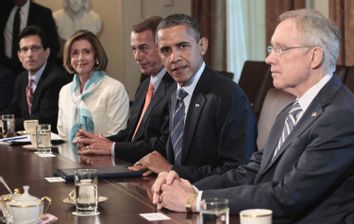
The truth about the deficit and Social SecurityPresident Barack Obama meets with Congressional leadership in the Cabinet Room of the White House in Washington, Thursday, July 7, 2011, to discuss the debt. From left are, House Majority Leader Eric Cantor of Va., House Minority Leader Nancy Pelosi of Calif., House Speaker John Boehner of Ohio, the president and Senate Majority Leader Harry Reid of Nev. (AP Photo/Pablo Martinez Monsivais)(Credit: Pablo Martinez Monsivais)

This originally appeared at New Deal 2.0

This morning the Washington Post reported that the White House is offering to cut Social Security as part of a broader budget deal with the Republicans. At last we have the answer to the question everyone has been asking about the Democrats: How far can they go?

The financial collapse of 2008 has taught us to be skeptical of economic forecasts that simply spin trends out into an indefinite future. Most central bankers, economists and business leaders failed not only to foresee, but even to imagine, the colossal dimensions of that catastrophe.

Now, however, the very people who said that there was no way for regulators to recognize financial bubbles in advance predict budget gloom and doom. Scary charts of the time path of U.S. debt-to-GDP ratios — many originating from the Peterson Foundation — fill the media, along with specious arguments about how budgets affect national income.

The strangest of these debates involve Social Security. The “arguments” here sort mostly into two groups: One rails on about how “runaway entitlements” are leading to a deficit explosion. The other advises that Social Security can be “saved” in the long run by timely changes, typically involving a mix of taxes and benefit cuts, including, notably, yet another rise in the age of eligibility for the program.

Neither point of view makes much sense. The simple fact is that the deficit did not swell tidally until the financial crisis hit. While George W. Bush’s tax cuts destroyed the Clinton budget surpluses, enough tax revenues trickled in to keep the deficit from blowing out until the economic equivalent of Hurricane Katrina hit in the fall of 2008. It was the one-two punch of the bank bailouts and the Great Recession that led to today’s giant gap between general revenues and expenditures.

But even now there is no near-term threat to Social Security’s solvency. In 1983, Congress enacted into law recommendations of the Greenspan Commission to raise Social Security taxes to cover the retirement bulge coming from baby boomers. Since then, the program has piled up enormous surpluses. These have been invested in government bonds, thus helping to finance the rest of the government.

The 2011 Report of the Trustees of the Social Security Trust Fund projects that the Trust Fund and interest earnings from it will suffice to cover all benefit payments until 2036. Even then, the fund would not be empty — the report projects that tax revenues will still cover approximately 75 percent of promised benefits until 2085. Talk of the bankruptcy of Social Security is hot air.

2036 is a long way off. The argument in 2011 is about whether there is any reason to do anything at all right now. The case pressed by self-proclaimed “rescuers” of Social Security such as Peter Orszag, the former head of the Obama administration’s Office of Management and Budget who has since accepted a position at Citigroup, is unpersuasive.

The first yellow flag is Orszag’s frank acknowledgment that Social Security features barely at all in any putative budget shortfall: “Social Security is not the key fiscal problem facing the nation. Payments to its beneficiaries amount to 5 percent of the economy now; by 2050, they’re projected to rise to about 6 percent.” A rise of 1 percent in four decades! Former Sen. Alan K. Simpson, co-chair of the president’s deficit commission, claimed that his group’s deficit report “harpooned all the whales in the ocean, and some of the minnows.” Lost in the blaze of publicity about the commission is the crucial fact that Social Security is plainly one of the minnows.

But the whole discussion is even fishier. If any shortfall ever materializes, it could easily be made up by transfers from general tax revenues, though that would breach the long-maintained fiction that Social Security is a contributory system on the model of most private insurance. (It is actually a pay-as-you-go system, where current taxes pay benefits to current beneficiaries, with the final guarantee of the whole system’s soundness being, in the last analysis, the success of the economy as a whole.) But if fears about 2036 are unbearable, plenty of ways exist that would fix the program without threatening anyone’s life support system.

Between 2002 and 2007, for example, the richest 1 percent of Americans garnered 62 percent of all income gains, while the bottom 90 percent of the population saw their incomes grow by 4 percent. At the same time, thanks to the Bush tax cuts, the rich were also paying proportionately fewer taxes. Considering that ordinary Americans fronted most of the money for the bank bailouts and have endured most of the recession’s “collateral damage,” it seems only simple justice that if the program needs fixing, the best way to do it would be to raise the ceilings on earnings subject to the Social Security tax, which is currently only $106,800. That would put the burden on people who cannot plausibly claim to be suffering.

But if, for example, productivity runs even slightly higher than in the forecasts, there may be no shortfall of any kind. Considering that the projected shortfall is still a quarter century away, there is no good reason to tinker with a program that, as the Washington Post editorialized in 2005, provides the majority of income “for nearly two-thirds of the elderly … [and] the only source of income for one-fifth of all elderly people, for 25 percent of non-married elderly women, and for 38 percent of elderly African Americans and Hispanics.”

But Orszag and others who agree that the program makes at most a minor dent in the budget, nevertheless argue for “fixing” it now. Their reason is remarkable: As Orszag frankly confesses, “even though Social Security is not a major contributor to our long-term deficits, reforming it could help the federal government establish much-needed credibility on solving out-year fiscal problems.” Cut benefits, in other words, simply to prove to financial markets that the government can do it. As Paul Krugman observes, this position is tantamount to claiming that we should cut Social Security now, because we might have to do it in the future. Polls show strong public opposition to cuts in Social Security. Considering the havoc that the financial crisis wreaked on the home values and pensions of ordinary Americans, proposals that Democrats should roll over and join Republicans and the Peterson Foundation in cutting Social Security is outlandish. As profits for the banks the American people rescued soar, it marks a new low in the Democratic Party’s long retreat from the New Deal’s glittering promise that ordinary Americans, too, deserved to share in prosperity.

This essay is adapted from Thomas Ferguson and Robert Johnson’s “A World Upside Down: Deficit Fantasies in the Great Recession,” which appears in the new issue of the International Journal of Political Economy (Vol. 40, No. 1, pp. 3-47). That essay is a revised and expanded version of their working paper for the Roosevelt Institute.

Rob Johnson is a senior fellow and the director of the Project on Global Finance at the Roosevelt Institute.

Thomas Ferguson is a professor of political science at the University of Massachusetts, Boston and senior fellow at the Roosevelt Institute.

Continue Reading Close