Wagner James Au

The year in games

Developers, critics, gamers and analysts weigh in: What they loved, what they learned, what they worried about.

  • more
    • All Share Services

The year in games

Editor’s Note: Salon’s longtime game reviewer, Wagner James Au, is now thoroughly ensconced within the industry he once covered for us. But since, as we learned recently, everyone in the gaming biz is now hopelesslessly overworked, Au could not find the time to sum up the year in gaming for Salon. So he did the next best thing: He rifled his Rolodex for a swath of experts — developers, critics, analysts — and asked them for their thoughts.

The result is below, roughly divided into three categories: a look back at the significant trends (or lack thereof) in gaming this past year, an idiosyncratic handful of mini-reviews of notable games, and a sobering look at some of the burgeoning problems in the world of computer gaming.

The trends

I think we’re firmly in the age of the blockbuster now, and I don’t know how I feel about that. Most of the biggest games of the year were “events” that cost a crazy amount of money to develop and took many, many years to polish and get right. That’s a bit of a scary trend, because I don’t see where it stops –projects will get bigger, teams will grow, tech will continue to become more important, and all the rising costs will inevitably lead to fewer risks in design. I’m a sucker for unusual and innovative games, so this worries me.

On the other hand, I am seeing a rise in interesting indie games. Stuff like “Gish, the physics platformer, and the emphasis on new control mechanisms that we see with games like “Karaoke Revolution,” “Donkey Konga,” “EyeToy” and the touch screen on the Nintendo DS sure feel like the industry pushing in some new directions.

– Raph Koster

Raph Koster is chief creative officer for Sony Online Entertainment, overseeing games such as “EverQuest II,” “Star Wars Galaxies: Jump to Lightspeed” and “PlanetSide: Aftershock.” His new book, “A Theory of Fun for Game Design,” has just been published.

The continuing and lamentable “E.A.-ization” of the conventional games industry: consolidation into a handful of publishers with developers organized into dronelike factories and teams of dozens or hundreds, and eight-figure budgets.

The more hopeful burgeoning of mobile and downloadable games, offering an alternative distribution channel for (potentially) more innovative product.

– Greg Costikyan

Greg Costikyan is a longtime game developer, currently working as a researcher for Nokia Research Center. His most recent games are the mobile-based “Alien Rush,” and “Paranoia XP,” the new edition of his award-winning tabletop role-playing game set.

Games like “Half-Life 2″ and “Halo 2″ integrated physics and complex character-animation technology — creating Hollywood-quality “entertainment” in the game space. “Fable,” “Thief 2″ and “Deus Ex 2″ tried to blend that directed, narrative action with a more open-ended simulation. “The Sims 2″ pushed simulation even further — giving its characters emotion, fears and desires.

What I’m interested in is the intersection of these three movements. How can we blend “entertainment” (where you watch stuff happen and think “wow — that was cool!”) with open-ended play (where you make stuff happen and think “wow — I did that!”). Can we take those blends and add characters that really … tug at our heartstrings — either because we directed them and they grew on us — or because we talked and adventured with them — and they impressed us?

There is a lot of work to be done here — in academia and commercial development. I am excited to see where various projects and collaborations (in graphics, A.I. and game design) take us over the next few years.

– Robin Hunicke

Robin Hunicke is finishing her Ph.D. at Northwestern University in A.I. and games. Her thesis work is on dynamic game adjustment — making games adjust in real time to individual players.

The whole idea of emergent gameplay — [player-driven "narrative gameplay," in which unique, unplanned events result from the players' interactions with the A.I. and the environment] — really seems to be taking off. I mean, it used to just be Origin and Looking Glass making (frankly) nichey games that focused on player-driven experiences. Then “Deus Ex” (if I may…), “Grand Theft Auto 3″-”Vice City”-”San Andreas,” “Fable” and others came along to take the idea to new levels of player control and mainstream acceptability. Now, emergent gameplay is popping up all over. About bloody time, if you ask me!

– Warren Spector

Warren Spector is the former studio director of Ion Storm, producers of “Deus Ex 2.” He is “working on setting up a new gig, but nothing to announce just yet.”

I think the two most significant trends in gaming in 2004 were the increased emphasis on in-game product placement and advertising, and Valve’s sale, and, perhaps more significantly, authentication, of “Half-Life 2″ over the Steam service. [Steam is Valve's broadband distribution system for delivering games via the Internet.]

The implications of the former are obvious, and as for the latter, I think there are probably some other developers in a similar strong position like Valve’s, interested in how distributing a game via a service like Steam can increase their profit margins while also allowing an added degree of control over solutions to piracy and cheating as well as an enhanced ability to distribute patches and offer technical support.

– Stephen “Blue” Heaslip

Stephen “Blue” Heaslip is editor in chief of Blue’s News, one of the Internet’s leading computer game news sites.

I’m very excited about the promise of Steam as a vehicle for online content delivery without having to saddle up the ponderous bulk of the retail behemoth for every little jaunt. As a reader and a writer, I love novels; but I also love short stories. Imagine if there were no magazines, no anthologies, and the only thing publishers were interested in printing were massive epics, blockbusters and trilogies. That’s where the game industry is right now.

– Marc Laidlaw

Marc Laidlaw was a writer-designer for “Half-Life” and “Half-Life 2,” from Valve Software.

I found it interesting that the big titles of this year (“Doom 3,” “Half-Life 2,” “Halo 2,” “Grand Theft Auto: San Andreas”) are all extensions of intellectual property originally created by independent developers in the game biz (that is, not from Hollywood or the corporate machine).

– Alex Seropian

Alex Seropian says, “My technical title is Baron of Denmark, but I usually go by President of Wideload to avoid the hordes of adoring Danes.” He is currently developing “Rebel Without a Pulse,” a PC Xbox title starring Stubbs the Zombie — hero, lover, eater of brains — for a 2005 release.

I’m not sure there were any particularly big, defining trends this year, come to think of it. My bias is that I’m interested in new styles of play, and the problem with the world of gaming is that it’s now entirely a hit-based, Hollywood-style industry; it’s very hard for even the most well-intentioned game executive to greenlight a weird new form of play, because they have no guarantee it’ll make back the multimillion-dollar cost of development. With economics like that, it’s no wonder we’re living in the land of the sequel.

Indeed, consider this year’s most anticipated and hottest-selling games. They’re all sequels: “Grand Theft Auto: San Andreas,” “Halo 2,” “Half-Life 2,” “Doom 3,” “The Sims 2,” “Metal Gear Solid 3,” the new “Metroid Prime,” etc. Now, I’m not complaining about these games; they’re all quite superb! And there’s nothing inherently wrong with sequels; indeed, you could argue that games are becoming almost like TV shows — intelligent serializations of a single premise. But still, I’d love to be surprised by some new gameplay, and nothing I saw this year offered any.

– Clive Thompson

Clive Thompson writes about science and technology for the New York Times Magazine, Wired, and New York Magazine, and is the video game columnist for Slate. He also publishes the blog Collision Detection, devoted to interesting trends in science and tech.

The games

“Halo 2″: I don’t even know why you’d need a second video game.

– Seanbaby

Seanbaby is an outrageous funnyman. He writes a regular column in Electronic Gaming Monthly called “The Rest of the Crap” and also contributes to XBN, GMR and Computer Gaming World.

“Katamari Damacy”: Like everybody else, I’ve had it about up to here with Japanese whimsy. But I gotta admit, this one worked for me. You roll all these dogs and people and chickens and cows into a ball and then shoot the writhing clump into space where they cling to each other and scream silently into the void for all eternity.

It’s some serious Clive Barker shit, but it’s colorful and the music’s real catchy so it’s easy to miss all the horror. The expanding ball of junk is the best game metaphor for escalating power since the stat bar. In fact, it’s the only game metaphor for escalating power since the stat bar. Think harder, game developers!

– Erik Wolpaw

Erik Wolpaw says, “I write about video games for money.” He is also the co-founder of the late, lamented Old Man Murray.

“City of Heroes”: The MMORPG [massively multiplayer online role-playing game] market seems to be recapitulating the history of the tabletop RPG market. One classic fantasy title (“D&D,” “EverQuest”) spawns a host of fantasy imitators, followed by licensed products, followed by attempts to take the paradigm to other fiction genres. (The next stage, it may be devoutly hoped, will, as in tabletop RPGs, be attempts to innovate with the basic paradigms of the genre, as well as to build new, original worlds better suited to gameplay.) “CoH” does it for superheroes and does it remarkably well.

– Greg Costikyan

“Half Life 2″: Utterly beautiful and immersive — because of the facial animations, I actually care about NPC [non-player character] sob stories, which helps sell the feeling of oppression and desolation. While some argue it’s too easy, I think the designers have done a good job of creating a cinematic experience but one in which I trust them to make it challenging without being frustrating and where I don’t have to quick-save every few steps or backtrack for health.

– Brian Yeung

Brian Yeung is a designer with an eclectic pedigree, currently surviving crunch time on “The Matrix Online” at Monolith Productions. He rarely updates www.crankyuser.com.

“City of Heroes”: Oh my god … someone actually made a massively multiplayer online game that I actually liked! “City of Heroes” gets so much right — intensely fun character creation and great ongoing character customization opportunities during play, instanced dungeons so there’s no waiting around for monsters to respawn, great visual effects, streamlined inventory management, easy to get into, easy to play, easy transportation and communication so teaming up with people is a piece of cake … just an all-around nice effort. Thanks to “City of Heroes” I can’t say “I hate massively multiplayer games” anymore — it’s not the game type that’s lacking; it’s most of the games. Might not have had the staying power of some other MMORPGs but, man, the first three months were thrilling to me.

– Warren Spector

“Mario and Luigi: Superstar Saga”: It took me over six months to play this game — on the train, in airports, waiting in line at the post office and grocery store. The Game Boy makes this game portable, but the game design makes it easy to leave and come back to. The familiar Mario-style gameplay has a slight role-playing gamer (RPG) twist — so you can experiment a bit with items and equipment. And when people in line (children, curious adults) express interest, it’s easy to hand over for a bit. What could be more fun than … sharing your fun?

– Robin Hunicke

“Star Wars: Jump to Light Speed”: “Star Wars Galaxies” was clearly lacking an essential game element until this add-on came out. It actually motivated me to start playing SWG again, after I gave up playing out of disgust for the ongoing nerfs that seemed to pop up every other hour [in online games, a "nerf" is software patch that degrades a preexisting feature]. It is very cool to be able to really crew a spaceship, running around to make repairs, shooting from its turrets, and yelling at each other to work as a team. Between flights, I’m waiting to see if my character finishes grinding the Village and makes it to Padawan before the developers figure out yet another nerf to piss me off. Even if they do, I will still have fun flying the ships … until they figure out a way to nerf the fun out of that.

– Maj. Jason Amerine

Amerine is a Special Forces officer who works as a technical advisor for the “America’s Army” computer game.

“Burnout 3″: This game was able to turn a lot of people who weren’t racing fans on to the genre, though not for racing’s sake. There’s something hugely satisfying about trying to rack up combos and create the most wanton destruction possible.

– Brian Yeung

“Grand Theft Auto: San Andreas”: Made me nostalgic for Dr. Dre and the early ’90s … Driving a tractor through downtown L.A. was a real treat.

– Kurt Squire

Kurt Squire is an assistant professor at the University of Wisconsin-Madison and a participant in the upcoming GAPPS initiative (games and professional practice simulations research group).

“Katamari Damacy”: This is kind of confrontationally weird — you roll a sticky ball around and pick stuff up to re-create the cosmos. You sort of forget how weird it is as you play, of course, but every now and then something like a pigeon riding a shoe with a can on its head will charge you or you’ll be knocked into a sumo wrestler by a rocket-mounted grizzly bear and it will hit you again — this is madness.

– Seanbaby

“Ninja Gaiden”: This game had a terrifically well-designed fighting system and wonderfully engineered play: Tecmo hit upon the perfect balance between being hard and being way too hard for its own good. The game continually threatens to be just too bloody difficult to be any fun but never actually crosses that threshold. That is the essence of excellent play design.

– Clive Thompson

“Crusader Kings”: The latest game from Swedish developer Paradox Plaza. Something of a prequel to its super “Europa Universalis II,” “Crusader Kings” places you in the role of a medieval monarch — anything from King of France to Count of Athenai — over the course of 400 years of history. Interestingly, most of the things you expect to do in this kind of grand strategic game, you can’t do: You can’t build up your armies, because each province can field only so many men when levied; you can’t work to improve your technology, which simply spreads from places where people know it; you can improve your economy only in modest ways. Instead, you spend most of your time dealing with the concerns of the time: marrying your children in wise ways, waging wars to extend your demesne and quite often in service to your liege.

– Greg Costikyan

“Test Drive: Eve of Destruction”: One of the dumbest things I read this year was an essay on game journalism where the following was stated for what I guess the author assumed to be the permanent record: “The goal for game journalism should be to point readers toward the truths that matter in life.” “Eve of Destruction” is a terrific demolition derby racing game that, like the best game journalism, points players toward one of life’s truths: Man, it’s cool when cars smash into each other. For some reason, it got lukewarm reviews and didn’t sell well. Just more evidence that I’m either dumber or smarter than everyone else.

– Erik Wolpaw

“JFK Reloaded”: It’s a rather creepy game, deeply offensive to many people, and the $100,000 prize for being the most accurate killer of JFK was incredibly exploitative. But for provoking interesting conversations about what games and simulations mean, “JFK Reloaded” was incredibly useful.

– Clive Thompson

“Oasis”: Winner in the Independent Game Festival’s best downloadable game category, this title, developed by veterans Marc LeBlanc and Andrew Leker, is aimed squarely at the burgeoning market for games available as downloads and not generally at retail. That market consists largely of puzzle games such as “Bejeweled,” but “Oasis” is something different, with gameplay reminiscent of the German adult board game market. It’s possibly our best hope for expanding the downloadable market into more thoughtful and innovative titles. At present, it is not available for sale — the final version is under development — but PopCap has picked up the rights, and it should be available soon.

– Greg Costikyan

“Katamari Damacy”: Beyond the unique gameplay concept and charmingly odd story — Katamari has wonderful pacing and stunning music. At the end of each level, when your ball of junk becomes a star, you’re rewarded with a deep bass choral theme. Watching your heap of earthly crap ascend into the sky, with that theme playing in the background — it just makes you feel so … happy! When was the last time a video game gave you such pleasure — and a moment to really savor it? And on top of all this — it’s only $19.99!

– Robin Hunicke

Everything in my neck of the woods was dwarfed this year by the release of “Half-Life 2″ on the PC, which raised the bar for interactive storytelling in an action game for all that follow. To my tastes, this is the best computer game of all time.

– Stephen “Blue” Heaslip

The problems

From the inception of games as a commercial medium (with the publication of “A Journey Through Europe,” by Carrington Bowles, in 1759), the history of the field has been characterized by bursts of innovation: A new game style is published, featuring a new set of mechanics and type of gameplay, spurring a host of products pushing that style in new directions, and creating a new audience of players. As budgets continue to soar, and as publishers become increasingly conservative and wary of innovation, there is a danger that the industry will become an uncreative, repetitive field, with little to no innovation to alleviate the tedium of sequels and licensed drivel.

The sad fact is that unless your last name is Wright or Miyamoto, it is virtually impossible to get an innovative product funded today. The industry is in desperate need of a parallel distribution channel for lower-budget, more innovative product with lower production values — something like the indie music and film industries, which serve as venues for the creation of new artistic styles that, when successful, can be adopted by mainstream industry.

Unfortunately, at present, there is no such indie games industry and, given the audience’s lack of acceptance of lower production values in exchange for innovative gameplay, coupled with the lack of an obvious distribution channel for such product, it is hard to see how one can be created. The rise of downloadable and mobile games is a hopeful sign in this regard, but those fields have already become quite stereotyped and resistant to innovation, with the first market dominated by “pick three” puzzle games, and the latter by arcade game retreads and inferior versions of games available on other platforms.

– Greg Costikyan

The way the fourth quarter is bulked up with all the year’s best games. Nobody in their right mind has enough time to make significant dents in “Halo 2,” “Half-Life 2,” “GTA: San Andreas,” “Knights of the Old Republic 2,” “Metal Gear Solid 3,” “Metroid Prime 2: Echoes,” “The Sims 2,” “Burnout 3,” “Need for Speed Underground 2″ … not to mention all the extraordinarily time-consuming MMORPGs — “EverQuest 2″ and “Worlds of Warcraft” and “City of Heroes.” I understand companies need to book revenue, but if the industry were better at pacing overall, I’d like to think business would boom on an even grander scale and would be less reliant on holiday sales. Plus, people would get to really enjoy their games rather than trying to squeeze them all in at once.

– Jennifer Tsao

Jennifer Tsao is the managing editor of Electronic Gaming Monthly.

Electronic Arts is not the only alleged culprit on the overworked-and-underpaid issue. I would love to see a “Norma Rae” scene at a few developers around the country but am doubtful that this will happen for fear that even more jobs will be exported. Unlike actors whose names and faces often make or break a film, these brilliant game designers, artists and programmers are virtual unknowns to the game-playing consumer. Therefore, if the developers leave in protest due to the horrific schedules, then another person will take their places and the consumer will never be the wiser. As more kids grow up playing games and learn that there actually are jobs making video games and they now have several choices of universities offering a game-development education, then there will always be someone ready to take the departing developers’ places. And I fear that if we attempt to unionize the industry in order to better regulate working conditions or hours or ensure that folks are compensated for their time and effort, then the publishers can simply look at using talent in other countries where folks will work those long hours and for less money.

– Melanie Cambron

Melanie Cambron, aka the Game Recruiting Goddess, has recruited for game industry leaders since 1997, frequently served as a moderator and panelist at GDC and E3, and has consulted for the city of Austin’s Interactive Industry Development Committee.

Games are hard to build — harder than most people realize. As with any software development project, you have to steer clear of bad ideas and useless features, and grow your tools as the underlying technology changes. And with each new trend (physics, real-time lighting) or platform (Xbox 2, PS 3), a lot of core tools must be discarded or rebuilt. It’s an expensive and time consuming process.

When faced with the realities of development (tight deadlines and ballooning budgets), the common solution has been to work harder, not smarter. As a result, people burn out (see the IGDA Quality of Life paper) and turn to other industries for stable, rewarding employment.

This churning turnover saps knowledge and expertise from the industry. Without experienced contributors, projects are more likely to slip or become “death marches” — which drives down quality (and drives away new hires). If we want to attract and keep good people, cultivate new ideas, and support innovation as an industry, process management and H.R. practices must evolve. Period.

– Robin Hunicke

John Kerry: The video game

In "Battlefield Vietnam," a new version of one of the most popular games in the U.S., you too can try to win a Silver Star saving your buddies in the jungle.

  • more
    • All Share Services

John Kerry:  The video game

The funny thing is, if John Forbes Kerry becomes the next president by winning a few key states with a few thousand votes, no one on his staff will know that the thing that helped put him over the top featured “Surfer Bird,” AK-47 gunfire, and loud blasts of Viet Cong propaganda.

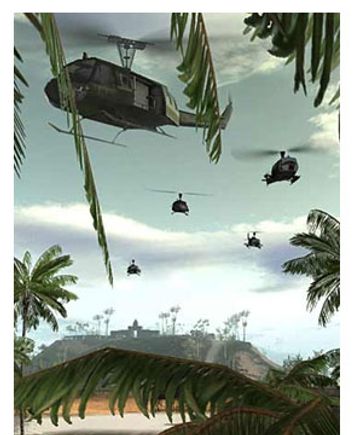
“Battlefield Vietnam,” the new multiplayer tactical shooter from Electronic Arts (and a spinoff of the mammothly popular “Battlefield 1942,” re-creates a dozen-plus decisive battles from the Southeast Asian conflict, from pitched, close-quarter combat in Hue, to fierce infantry skirmishes beneath the chopper- and fighter-infested skies of Khe San. Other shooters set in Nam will soon arrive, and maybe this is, as some have suggested, a sign that the game industry has matured, now that it is finally willing to depict divisive historical topics.

But none of the other Nam games will come with the promotion or the built-in audience of E.A.’s franchise title. So none of them will have any chance at all of potentially influencing an American presidential election.

Yes, influence the election. How? Chew on this: A marketing firm called i to i research recently completed a survey of American young people, asking them to cite the source for their favorable impression of the U.S. military. (And the young are overwhelmingly pro-military, in numbers that far outstrip their trust in any other institution, public or private — one possible reason why Kerry’s team keeps the text to his anti-military “Winter Soldier” testimony on Vietnam before Congress on the down low.) When i to i asked kids why they admired the military, 40 percent cited recent combat operations in Afghanistan and Iraq.

A full 30 percent of them, however, named the computer game “America’s Army.”

Let’s restate that, to make sure it comes across in all its head-spinning dissonance: A third of the country’s young people have an elevated view of the Army, not foremost for anything it’s actually done lately, but because of the computer game they played, which just simulates it.

So there’s that. And if we’ve already come to speculate how Howard Stern might turn the election in Kerry’s favor, it’s really not that far a leap to think that the sequel to a title that has sold over 3 million copies may do just that, as well.

Because with Iraq and Afghanistan still savagely blood-spattered and un-democratized, Vietnam really is the psychic battleground, come November. Roughly put, if you already believe Nam offers a relevant object lesson to the current war on terrorism and the occupation of Iraq, then you’re likely to vote for Kerry. If you’ve already decided that Vietnam has little to teach us on either front, you’re more likely to vote for Bush. But who wins the election really comes down to the one-third of the country who remain undecided, and here is where the Vietnam of their imagination becomes so key. Because the most prominent depiction of that war in the popular culture — the only one out now, really — is this computer game. In November, millions of undecided voters will make their own deliberation, on the role of Vietnam in our lives. And in the next few months, hundreds of thousands of them are going to be playing “Battlefield Vietnam.”

Among these undecideds would be, frankly, me. I sure don’t want four more years of Bush, if only because I don’t look forward to scrolling past four more years of anti-Bush tirades on my favorite Web magazines. Then again, I’m sure not convinced Kerry’s considerable virtues as a face-saving internationalist are justification enough to switch pugilists in mid-swing. Whom to opt for, the one who scares the hell out of everybody, or the one who’d probably wind up giving the terrorist-enabling, student-mauling mullahs in Tehran and the nuclear-powered midget back East their first good night’s sleep in a long time? The jackass you know, or the jackass you know little of? (Except, of course, that the opposing jackass served on the spear tip of American foreign policy.)

To see if playing “Battlefield Vietnam” would push me more firmly into Kerry’s camp, I decided to review the game with that question right on the table. To go the whole way, I opted to be John Kerry, when I played it. “LtJohn Kerry” was the username I selected, when I fought online. I would be LtJohn Kerry when I commanded a PBR attack boat in the Mekong Delta, or fought as a grunt in the mean streets of Quang Tri, or played a Green Beret commando wading through the jungle heat of Lang Vei. For good measure, I even enlisted an actual Green Beret, to give LtJohn Kerry expert advice on his journey into the heart of high-poly darkness.

As in “Battlefield 1942,” victory in “Vietnam” is determined not by body count, or by accomplishing a series of mission objectives. Winning the peace in Southeast Asia is all about holding territory. Each map in the game has a preset number of control points, and each side begins the battle holding a designated number of them. (Everything from a small jungle base camp, to a barbwire-lined airstrip.) The meta strategy is to move with your team (up to 25 players on each side) into the enemy control points and hold them, while also protecting your own. To get to these, you double-time it on foot and scooter, by jeep and tank, by troop transport chopper and parachute drop, or much like John Kerry, via fast patrol boats, moving up the Delta. To coordinate your team’s movements, the game comes with an online chat system. Despite this, multiplayer games almost always devolve into free-fire chaos, from the start, quickly becoming a Cuisinart of brutality where gamers keep killing and dying and respawning to kill and die some more. And the chat function is used for little more than incoherent smack talk — at least when you’re playing as the future presidential candidate from Massachusetts.

- – - – - – - – - – - -

LtJohn Kerry arms himself with an M-16 and several grenades, and joins his comrades on the rolling hills of Khe San.

LtJohn Kerry: “I, John Kerry, will lead our army on the speartip of US foreign policy, to victory!”

Someone from the Vietcong side sardonically fires back with: “just what vietnam needs– a democrat”

Kerry emerges over the hill, and kills the Vietcong who is about to destroy an oncoming APC with a rocket launcher. Meanwhile, another VC contradicts his own teammate: “john kerry all the way bush is a cockmunching warmonger”

Later on, LtJohn Kerry is trying to maneuver his PBR patrol boat away from the shore, but he keeps crashing the craft into the dock. Even when he isn’t speaking, some of his fellow teammates are annoyed to see LtJohn Kerry’s name listed on their side.

“boooo on john kerry,” someone called Lt. Cowboy Boo types. “vote GB”

LtJohn Kerry protests: “but I fought in Nam!”

Lt. Cowboy Boo: “so what? he wants nato to have discretion over our troops”

Another U.S. teammate chimes in, with a sudden realization: “wasn’t john kerry in vietnam?”

“It’s a beautiful game,” my friend Jason observes. “The details are terrific.” Jason and I are playing on opposite sides in the Khe San map, while providing color commentary over our cellphones. And he’s right: While the graphics engine looks rather hoary, compared to a next-generation shooter like “Far Cry,” the maps are rendered with elegant, painterly care. Especially in the lush jungle and river terrain, with misty valleys in the distance, and ruined temples in the hills far ahead. If it weren’t for all the bloodshed and screaming, the graphics would actually be rather soothing — sort of like how John Kerry described the countryside, writing in his journal from the deck of his gunboat: “Simplicity characterizes everything around you and because of this an unassuming peace envelopes the fatigue.”

At the moment, though, Jason is too busy barreling down on me in a Sheridan tank, to notice the unassuming peace. Since I’m Viet Cong for this round, I lob three grenades at him, and duck behind a corner. They hit their mark, and Jason curses, as his tank goes up in flames.

“I’m coming after you,” he drawls into my earpiece, laughing, “and payback’s a bitch.”

The surrealism of the moment hits me, the moment I kill him, because some of the last guys to fight Jason ended up dead outside an Afghan village. As a Green Beret captain with Fifth Special Forces group, Jason Amerine led Hamid Karzai and his freedom fighters right into Kandahar, swatting the odd Taliban convoy out of the way. Right now, though, his combat mission involves chasing down a Bay Area geek who’s hiding behind a weedy berm in the burnt-out city of Quang Tri.

While we exchange shots, I ask Jason if his training in the military has any relation to what we’re playing now.

“No,” he says, as he pops into an F-4 to launch a strafing run. “[It's] too simplistic. It’s so arcade-ish, I don’t feel there’s a whole lot of accuracy to anything you do.” Jason’s talking to me from his apartment near the West Point Military Academy, in New York, where he now teaches international relations. “There’s really no subtlety,” he continues, while trying to wing the V.C. who is comically running and jumping in circles around him. “This is one of those brute force and ignorance kind of games.”

After a few rounds of combat and 24 hours of offline R&R, Jason tells me he’s pinned his finger on the arcade quality of “Battlefield Vietnam.”

“I concluded it had to do with the movement of individual soldiers in the game … the movement was so sped up, it didn’t seem like aiming mattered at all; you just had to aim in their general direction and hop around like crazy, like it was ‘Donkey Kong.’” This in contrast to the hyper-real graphics, and the game’s soundtrack. “I really liked the music,” he adds. “[It's] one of the best games audio-wise I’ve played in a long time.”

Classic ’60s pop songs, from Jefferson Airplane, Creedence, and other summer of love stalwarts, are constantly pouring out of vehicle radios and base camp loudspeakers. Like the “Grand Theft Auto” games that evidently inspired it, the overall effect of this music is to create an aural soundscape that complements the on-screen action in interesting, discordant ways. (Dropping a barrage of napalm on the enemy takes on a kinky hue, when Edwin Starr and his backup singers keep huffing “War/ what is it good for?/ absolutely nothing/ say it again!” in the background.) For extra ambivalence, you sometimes get to hear the forced morale-boosting patter of a DJ based on Adrian Cronauer of “Good Morning Vietnam” fame, and even more effective, a loop of Viet Cong propaganda, blaring through tinny speakers that echo through the blasted streets of Quang Tri, delivered by a girl in heavily accented English. (“Imperialists made you fight this war, G.I. They lied to you, G.I. They have ordered you to die.”)

This audio counterpoint enforces the intertext that introduces each map, providing a brief summary of the war’s historical background. They read like excerpts from a bad college term paper, most times, but they also set up the ambiguities of the coming battle. They even lean a little left, politically, asserting that “The Indochina conflict was a struggle for the independence of a people … ” at one point, and “The once heroic and romantic views of war slowly became tainted by the black and white reality of it,” for “until the ’60s, war was a fight for good vs. evil … that changed, and the enemy was not necessarily in the wrong.”

Taken together, this must make “Battlefield Vietnam” the first multiplayer action title to evoke a genuine sense of irony and historical complexity. (And by acknowledging the painful ambiguities of the war, this effect goes a long way to minimize any taint of exploitation.) In gameplay, it also creates a kind of reward-punishment roller coaster effect that some of the best Hollywood movies on the war ply the audience with. In films like “Platoon” and “Apocalypse Now,” you’re allowed to enjoy the kick of intense action, but you always get snapped back to the cruel reality of the conflict.

Sly references to classic Vietnam movies abound in the game — as in Kubrick’s “Full Metal Jacket,” the soundtrack comes with Trashmen’s “Surfer Bird,” and as in Coppola’s film, with Wagner’s “Ride of the Valkyries” — but it’s the manipulation of expectations that “Battlefield Vietnam” has most in common with its Hollywood predecessors.

As a hardcore gamer in his off-duty hours, Jason tells me he’s more a fan of “Rainbow Six” and “America’s Army” for realism in multiplayer combat. But “Battlefield Vietnam” is set in a war that has haunted the U.S. military for decades, and numerous lessons at West Point are devoted to learning from its failures — and transcending them, with any luck. (“We’ve finally gotten past that whole Vietnam thing,” one high-ranking officer told me with satisfaction last year, shortly after the M1s came rolling into Baghdad — but before the brutal slog toward real peace began.)

According to Amerine, the game manages to convey some of these educational bullet points, but decisively fails, on others.

“One of the big lessons of Vietnam was that air power will only get you so far,” he says. “It was a revolution in terms of air power [but] in an insurgency, such air power isn’t everything, and won’t win you the day. [In] this game, to its credit, you can have a lot of fun flying copters and jets, but to capture points, you have to be on the ground. The air power is a support tool, but it comes down to being on the ground.”

But while Viet Cong players can plant pungi sticks and dig holes that become instant, V.C. tunnel spawn points, the unrelentingly fast-paced combat loses something, in the translation.

“[I]t’s a shame they didn’t capture some of the subtlety of a guerrilla war and an insurgency,” Jason tells me. The game also “misses the subtlety of hearts and minds … It would have been nice to have had tiny pockets of villages with civilians walking around [that have to be avoided]. The influence of civilians on the battlefield was huge. It particularly came to the forefront because the media was there showing what was happening in these villages. That was definitely a huge part of a stigma to the conflict.”

As for what lessons of Vietnam can tell us about Iraq, Amerine does not deign to comment, and despite my pleading, refuses to be drawn into the quagmire of discussing Kerry’s career in Vietnam, or his presidential campaign. “As a military officer,” Jason tells me, “my duty is to carry out the orders of the commander in chief, and to me, once the man is elected, I give him my full respect and undying service and loyalty. So I just don’t become involved in [talking about] the election.” He chuckles. “But nice try.”

LtJohn Kerry is still trying to get the hang of maneuvering his patrol boat up river, but he keeps sinking his craft, or getting killed by snipers offshore. None of the vehicles handle very well, at least in LtJohn Kerry’s hands, and the poor teammate who gets into a troop transport with him runs the risk of being trapped inside, when he tries to get it up a steep slope, and ends up turtling the unwieldy vehicle on the side of the hill.

At one point, LtJohn Kerry is attempting to fight his way into a temple complex, running point ahead of several of his Marines. But before he can reach the control point, he takes a bullet in the back.

“i killed john kerry — woot!” one of his own teammates crows.

“but you fragged me,” LtJohn Kerry protests.

“followed my gut”

“But I served in Nam!”

“so did my grandpa, he ain’t running for pres”

In another skirmish, the Americans are being vastly outnumbered and outplayed; their strategies have failed. LtJohn Kerry advises his teammates to surrender, asking, “How do you ask a man to be the last man to die for a mistake?”

“i live near beacon hill but i’ll never vote for that ballmuncher kerry,” a guy named Boston Pitbull says. “gw is the best man for the job.”

“But I served in Nam,” LtJohnKerry responds, as he creeps up on two Viet Cong “campers” — players who stay out of the action, in a way that gains them an unfair advantage — and shoots both from behind. “Doesn’t that matter to you?”

“I saw kerry toss his medals in the oceans,” seethes Pitball, “then he had some lackey go swimming to get them when everyone left.

“Ralph Nader 2004,” someone named Nate interjects, as a MIG fighter screams overhead.

- – - – - – - – - – - -

Judging by my small sample gleaned as LtJohn Kerry, I’d say the players of “Battlefield Vietnam” marginally skew, like the rest of the country, toward Bush. But as the game goes on, with all its high-speed mayhem, unleavened by any hint of quagmire, maybe even the Republican players will begin to get the subconscious impression that Bush missed out on all the fun. By choosing to spend his time during Nam endlessly circling over Houston, George W. Bush must seem like the ultimate camper. If Bush played “Battlefield Vietnam,” you get the sense he’d be the guy who unaccountably ends up as team captain, and even if he’s got a high-stakes strategy that might actually work, he pisses off so many people with bad communication and needlessly asinine maneuvers along the way that the victory you had right in your hands slips through your fingers.

A few days after I played “Battlefield Vietnam” with my Green Beret friend and I submitted my first draft of this review, the real world intervened in the most inconvenient way. In that draft, I explained how the game vividly demonstrated all the ways that Iraq bore little resemblance to Vietnam. I pointed out how the game made plain that jungle warfare with an enemy backed by tanks and air support and the supply lines of two enemy superpowers was hardly comparable to a numerically tiny insurgency armed only with light weapons in a desert nation.

Then the street-to-street fighting broke out. In Fallujah. Hawija. Najaf. Kufa. Baghdad. And making those points suddenly seemed rather beside the point. The maps set in Hue and Quang Tri, urban zones turned into rubble, where there’s no such thing as winning clean, suddenly have relevant lessons of their own to impart. And for good or ill, many players of this game will find themselves open to them, in ways they wouldn’t have been only weeks ago.

“The facts of the war were difficult for the public to understand,” goes the on-screen text as Quang Tri map loads up, “and as such, they doubted the validity of the war.”

In “Battlefield Vietnam,” the Operation Game Warden map is set on the Mekong Delta, Kerry’s old stomping grounds as a swift boat commander, and in it, the Viet Cong come equipped with B-40 rockets (though they’re here listed by their alternate designation, the RPG-2). Though my own LtJohn Kerry never got the chance to do it, tens of thousands of players will end up reenacting something very much like the action that earned him a Silver Star, in coming months. And to the extent that “Battlefield Vietnam” sustains this sense-memory of Kerry, depicted not as grainy film stock, but as an immersive, interactive reality, you have to think its power will carry over for many of those who experience it. As something that keeps flickering in the back of their minds, as we close in on November, and the ballot booth.

And as it turns out, with things being what they are, the John Kerry that I want for president is actually a lot more like my computer game version than the one who’s currently out there on the stump. I can’t say I care much for his tortured, Möbius-strip statements on the Middle East and the terror war — even when, as Iraq teeters once more on the brink, his opposite offers little more than the leadership of smirks. Neither do I care for the John Kerry who seems to think that striding through the jungles with an M-16 somehow qualifies him to make the tough decisions on tax cuts and healthcare (as some of the ads on his site imply). In the end, the only Kerry I want for president is the one who hunted down the V.C. guerrilla who was about to take out his swift boat crew with a B-40 rocket launcher and capped the bastard with that M-16. He served in-country despite his growing skepticism of the enterprise, and when the failures of foreign policy took the concrete form of a guy who was fixing to make things more miserable for his people than they’d ever imagined, he got out of the boat, and leaving all those misgivings of his behind, did what needed to be done.

Continue Reading Close

Silence of the blogs

Why did the New York Times ignore Baghdad blogger announcements and accounts of a big pro-democracy demonstration?

  • more
    • All Share Services

Silence of the blogs

Zeyad, the “gamer of Baghdad” profiled earlier this week in Salon, is famous in the international gaming community for his reports on gamer culture in Iraq. But he was also recently responsible for a furious stir online regarding the way news from Iraq is covered by the Western media.

On Dec. 10, 2003, pro-democracy, anti-terrorist demonstrators peacefully flooded the streets of Baghdad. A coalition of Iraqis of many political parties and religious affiliations, tribes and ethnicities, young and old (including many students), demanded an end to attacks on civilians. They also demanded that Arab media stop depicting the Baathist and foreign jihadi culprits as members of some kind of just “resistance.” Even the Al Jazeera network estimated them at over 10,000 strong.

I know all this, not from reading any significant coverage of the event by the mainstream Western press (There was little to none). Rather I know it because an Iraqi who’s been a computer user since childhood went out and reported on it himself. Zeyad’s entry was linked to throughout the Web. But the so-called “paper of record,” the New York Times, gave the event scarce coverage, and that enraged many leading lights of the blogosphere, especially those on the conservative or liberal hawkish end of the spectrum.

“The organizers of the demonstration failed to alert the Times in advance,” says New York Times public editor Daniel Okrent, relating to blogger Glenn Reynolds of Instapundit the Baghdad bureau’s explanation for why the march received scant coverage in his paper. (Especially when far smaller Iraqi protests often wind up on the front page of the Times Web site.) “More crucially,” added Okrent, “the responsible parties at the Times dropped the ball.”

This was perplexing, because Zeyad and other Iraqi bloggers promoted the march on their sites days in advance. But is Baghdad bureau chief Susan Sachs or her staff even aware of Iraq’s postwar blogs?

I contacted Daniel Okrent on this, and he called Sachs in Baghdad, then related her answer back to me:

“She says that the staff — including people who monitor the wires, the police radio, the military, the CPA, [Coalition Provisional Authority] the Iraqi Governing Council, the Arabic TV and Arabic Web sites — does not check blogs on a regular basis. One of the office staff sometimes run across them when doing Google or other similar searches.”

Okrent notes that Ghaith Abdul Ahad, a friend of the original Baghdad blogger Salam Pax, publishes a blog called Gee in Baghdad, and is on the Times’ Baghdad staff. (As was Salam himself, for a time.) Ahad’s blog, however, has not been updated since September.

As for Sachs, Okrent tells me by e-mail, “Susan says she personally does not refer to the blogs.”

A direct response from Sachs did not arrive by press time. Daniel Okrent did however put me in touch with acting foreign editor Alison Smale, for more background.

In the Times’ defense, Smale cites the bureau’s stretched resources on Dec. 10. While declining to speak for Sachs, she tells me by e-mail, “I can say that it is often, though not always, more effective to send an e-mail than to rely on people logging on to blogs. In general, of course, the point you make is valid — they offer important tips, if not always instantly verifiable facts.”

So it was that Dec. 10 came and went, and while the Times has given much more coverage to much smaller demonstrations (for jobs, for Saddam, for al-Sadr, and so on), the thousands of Iraqis calling for self-rule and an end to being targeted by random Baathists and other fascists rated a single photograph. Conservative press like the Murdoch-owned Weekly Standard (which triumphantly ran an excerpt of Zeyad’s account in a recent issue, were inclined to believe this disparity prima facie evidence of leftward bias. But at least for the Times, a better explanation is probably contained in the Jan. 15 New York Observer, which describes a bureau besieged by internal politics, cut off from the city by a tall fence that has garnered it “the Jail” as a nickname, and staffed by overtaxed reporters who cannot perhaps be bothered to click though a Google link. So it was that a computer literate Baghdadi dental student had the scoop on Dec. 10 over the Times and pretty much every other major Western news outlet with a local bureau.

“Here is one young man in Baghdad equipped with nothing but a camera and a keyboard who reported on news better than established media worldwide,” says blogger Jeff Jarvis. “This shows what citizens media can accomplish.” (It was Jarvis who put the digital camera in Zeyad’s hand, sending it to him via Federal Express to Baghdad at a shipping cost half as much as the $200 camera.)

“My guess is that it would take years for Westerners to understand Iraq and Iraqis,” Zeyad tells me, “but we’re working on it and that’s what my blog is mostly about.” As it turns out, the first step may be convincing Westerners that their own press isn’t always (or even usually) the best authority on the subject.

Continue Reading Close

The gamer of Baghdad

While missiles crashed around him, Zeyad struggled to keep Crash Bandicoot alive. Today, he continues to play, even as Baathist holdouts rage on and his frustrated countrymen demand a better future.

  • more
    • All Share Services

The gamer of Baghdad

While the shock-and-awe bombing raged outside, Zeyad spent a lot of time playing “Crash Bandicoot” on his Playstation. Bandicoot is a humanoid fox who must escape the dangers coming at him from all sides (polar bears, lethal blowfish and so on), and as the walls of Zeyad’s family home in Baghdad trembled from the precision-guided aftershocks, the dental student kept putting the agile mammal through his paces.

“It was really strange,” Zeyad tells me now by e-mail. “But it was better than having to listen to the bombings.” So he played it with the volume blasting. In his hands, Bandicoot died and was reborn, then died again. Meanwhile, outside, airstrikes kept ripping the sky. And so, as he recently wrote of “Crash Bandicoot” on his blog Healing Iraq, “I experience dèjá vu whenever I play it now.”

While millions of gamers have their own associations with the game, Zeyad is surely among the first to couple “Crash” to a massive military campaign. But he’s likely not the only one — during the invasion of Iraq, reporters observed American soldiers hunched in the steel wombs of Bradleys and M1s, engrossed in their own portable game consoles, as they rumbled by night toward Zeyad’s hometown.

The invasion has been a boon to the country’s high-tech consumer market, according to Zeyad. “After the war,” he says, “computer and console prices dropped drastically and became available for a larger section of Iraqis. You can get the fastest Pentium IV PC with the best components and accessories at $500, whereas it usually cost $800 before the war … As to consoles, the cheapest are the Dreamcast at around $80 (or less) and the Playstation at an average of $100. Playstation 2′s are more expensive and therefore less common (around $200-$250).”

That the PS2 is openly sold at all is actually another benefit of the war’s aftermath, for under U.N. sanctions, units of the Sony console were apparently classified “dual use” devices which Saddam’s scientists might bundle up to create a supercomputer, for use in long-range missile guidance. But Zeyad says the PS2 was still available under the dictator’s regime, despite that interdiction: “They were smuggled through Jordan and Turkey. Most of these came from Southeast Asia and the United Arab Emirates.”

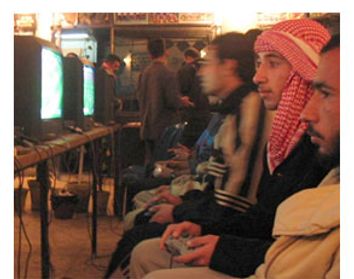
Despite postwar price drops, he continues, “Computers and consoles are not affordable for the majority of Iraqis, and that is why there are so many Internet, LAN, and console cafes opening all over Iraq for people who can’t afford them.” For as he recently wrote on Healing Iraq, “Iraqis are hardcore gamers. Almost every neighborhood in Baghdad has what you might call a ‘videogame cafe’ with several consoles where people can play for about a dollar an hour … . We have a special gamers’ district at Bab Al-Sharj at the heart of the city, where you can find hundreds of videogame vendors.” (Maybe that’s where Hans Blix should have sent his weapon inspectors, since they could have verified evidence of dual use violations by digging up copies of “Grand Theft Auto III.”)

Zeyad describes a Baghdad that few in the West know — certainly not from reports that seem only to depict a Third World city beset on all sides by anarchy, ethnic and religious conflict, and terrorist attack. When the world media reports on Iraqi anger over the Coalition Provisional Authority’s failure to restore the electric grid, for example, little is written about what Iraqis are using the power for. There is a difference between reporting that Iraqis are angry at a neighborhood power outage and reporting, say, that a lot of them are irked because the blackout interrupted a killer session of “Counter Strike” at their local LAN cafe.

So Zeyad’s insights into his country’s burgeoning digital culture provide a missing piece in the American dialog on Iraq’s reconstruction, and Iraqis’ own perception of Americans. And in his account of that subculture — and by his own efforts as a wired blogger — one perceives an Iraq that is ready and essentially equipped, despite temporary appearances, to join the interconnected tapestry of modern democracy.

Zeyad (he prefers not to publicize his family name) was born in Baghdad in 1979, and as a boy he moved to the West for a time with his Sunni parents (though Zeyad describes himself as atheist). They pursued graduate degrees in England, and voluntarily returned in 1987 to Saddam’s Iraq.

“My parents weren’t planning to stay in the U.K.,” he tells me. “They were there for study on the [Iraqi] government’s expense and they still had jobs back in Baghdad. Moreover, the situation in Iraq during the ’80s wasn’t so bad as compared to the ’90s.” (At the time, Saddam was still seen by many as a harsh but relatively progressive autocrat — certainly compared to the hostage-taking mullahs in Iran he was then waging war against.)

Zeyad’s family had a P.C., and computer games became both a hobby and a cross-cultural conduit out of a rapidly closing society. “When I was 11 or 12,” he says, “I started playing Sierra adventure games. I was a huge fan of ‘Leisure Suit Larry’ and ‘Police Quest.’ I learned a lot about American culture from these games, and I started to understand some American expressions and their usage of the English language. These games were very educational to me.”

(In “Police Quest: In Pursuit Of The Death Angel”, you’re a by-the-book cop who must track down a powerful drug dealer, and in “Leisure Suit Larry: In the Land of the Lounge Lizards,” you’re a virginal would-be swinger who must sex up three EGA babes with ’80s hair. (So as an education in Americana, perfect.) Then came the first Gulf War, and suddenly Iraq itself became a setting for U.S.-made P.C. games. “There was a game called ‘F-15 Flight Simulator’ which was about the first Gulf War,” says Zeyad. “I spent a lot of time playing that game and specifically missions in Iraq.”

Saddam’s security apparatus eventually took notice of games like this as well. “At one time we even had Mukhabarat agents rummaging through gaming stores looking for these games. As far as I know, when someone brought a military game from Jordan, it would have to stay for a few days at the Ministry of Information for checking. When we were still playing ‘Mortal Kombat’ on the Sega Megadrive, we heard rumors that there was a specific code or combo that would spawn Saddam Hussein and his bodyguards to finish the opponent, but these were just rumors.”

The Mukhabarat created what must be the strangest assignment in the history of secret police, anywhere.

“They had people,” says Zeyad, “whose jobs were to play and finish these games to find out if there was any mention of Iraq or Saddam.”

In other words, they employed totalitarian play testers.

When the country went online in the late ’90s, all Internet traffic was monitored by the Mukhabarat, who kept a watchful eye on political dissent. But Zeyad was still able to access apparently apolitical gaming sites, and these became a kind of backdoor for a limited form of self-expression. For the last three years, “I hanged around gamefaqs.com message boards and in Yahoo groups and chatted with gamers from many countries. Normally we just discuss favorite games, ask questions about plot theories, gameplay tips, puzzle solutions and similar stuff.”

But as rumors of war loomed, conversations shifted away from virtual combat to the real, imminent thing. “We had some discussions about the war,” says Zeyad. “Many people expressed incredulity or astonishment to the fact that Iraqis played P.C. or console games, or had access to the Internet. They used to ask me many embarrassing questions about the situation or about the regime, which I was a bit hesitant to respond to, given the fact that all Internet use in Iraq was under surveillance by the Mukhabarat. At one point I stopped participating in these discussions altogether, just to avoid the trouble.”

Last year, he returned to the global discourse on his country in a big way, when he joined a second wave of Iraqi bloggers. They were following the path laid by Salam Pax, the original “Baghdad blogger” who has since leveraged his notoriety into a book deal and a U.K. Guardian column. Inspired and then assisted by New York blogger Jeff Jarvis, Zeyad’s Healing Iraq blog went online shortly after the debut of Baghdad Burning, the acerbically pessimistic blog from Riverbend (who didn’t even seem very happy to see Saddam captured).

In the main, though, the Iraqi bloggers tend to be tentatively optimistic advocates of the U.S.-led invasion and the Coalition Provisional Authority. Omar’s Iraq the Model (with contributions from Ali and Mohammed) shines with blistering takedowns of the Western antiwar movement, while the dignified ruminations by Alaa of The Mesopotamian are interspersed by florid bursts of Arabic-tinged prose. (“The bones in the mass graves salute you, Avenger of the Bones,” wrote Alaa, greeting Bush after his brief Thanksgiving visit. “Hail, Friend and Ally, Hail, Sheikh of Sheikhs, GWB; Descendant of the Noble Ancient Celt.”)

But then there is Zeyad’s teenage brother Nabil, who launched his own blog last November, and even here there is something stirring, in the kid’s gusto to get his opinion out to the world, Baathist holdouts or fractured English be damned. (“This man is an American man,” writes Nabil, rudely dismissing Pentagon-backed CPA council member Ahmed Chalabi, “he gets out of Iraq when he was a kid and now he comes to Iraq and wants to be the president of the new Iraq, his age about 50-60, he is a thieve he steal a bank in JORDAN and the Jordanian police want him now.”)

While Zeyad is also a supporter of the American-led occupation, he is not, however, occupation’s apologist. In fact, his most recent entries have advocated the pleas of a relative who believes her son died after being abused by U.S. patrolmen, a claim hotly disputed in the blog’s forum by his mostly American readers. (Zeyad sought assistance for an investigation into these allegations by contacting “Chief Wiggles,” another Iraq-based blogger — who also happens to be an American Army intelligence officer and a freelance humanitarian. It may be the first instance in which blogging has aided a wartime misconduct claim.)

To his own surprise, Zeyad’s ambivalence on the occupation extended even to Saddam’s capture. “I felt humiliated,” he wrote. “I sank into an overwhelming depression and sadness, and I had a desperate need to get terribly drunk. I should have felt joy but I didn’t. And I’m still disappointed with myself.” (His brother Nabil was a lot less ambivalent: “Mr. Poll Bremer goes on TV and he said we got him,” he posted. “What a great thing the American forces arrest Saddam in a spider hole that he was hidden in, he is so loser because of why he didn’t kill him self when he heard the soldiers near him.”)

Zeyad’s forthright reflections on contemporary Iraqi politics have earned him an international following, but his accounts of the Baghdad gaming scene have perhaps garnered him about as much attention. “I should have made this a gaming blog instead of a political one!” he wrote, after his first entry on the topic was swamped by reader response. Both it and his photo log of game cafes were linked to by Slashdot.org (the ultimate URL in techie cachet) and thus disseminated throughout the global geek consortium.

None of this should come as a surprise. Computer and video games are the universal cultural referent for the young, in a way that Hollywood films were the catalyst of an earlier generation, as soldiers greeted each other across the battle lines. Nabil employs them as an icebreaker when talking with U.S. soldiers he meets (and sometimes plays basketball with): “At first the Americans were shocked to know that Iraqis had access to games and consoles and knew so much about it,” says Zeyad, “but after a while they started to discuss game strategies, exchange tips and so [on].”

The kind of games they talk about may also provide insight into the way this new generation perceives Americans. Among the most popular titles in Iraq is 2002′s “Medal of Honor: Allied Assault.”

“It’s a very popular game here,” says Zeyad. “Iraqi gamers love first-person shooter games, and this one was a hit for some time and is still being played at LAN cafes.” A painstakingly realistic depiction of the American GI during World War II, its key level is a brutal re-creation of the D-Day assault on Omaha Beach, based on the same scene from “Saving Private Ryan.” As in “Ryan,” the level is so punishing (you must die dozens of times to even reach the beachhead) it almost plays like a simulated self-flagellator, which you endure as a way of honoring the resolve of America’s soldiers, even in the face of grinding death.

“I’m not really sure if the game story itself had any effect on opinion [of Americans],” Zeyad says. “Since most Iraqi gamers don’t really pay much attention to plot or story line, and usually focus on gameplay.” Still, in the game’s Allied vs. Axis multiplayer mode, he says, “most of the gamers I notice play as Allied.” And you have to think something so vivid would work its way into the subconscious of the Iraqis who play it. (Then again, another hit game with Iraqis is the P.C. game adaptation of “Black Hawk Down.”)

Zeyad also sees gaming potential in a more recent American conflict — or rather, the one that is still playing out. “I think the operations in Iraq deserve their own game,” he says. “I would like the game to be accurate and represent the existing terrain and conditions in Iraq. Other games like ‘Conflict: Desert Storm’ are poor in this area, for example, the terrain and buildings don’t look the same as the real thing, and the voice acting was terrible — the Iraqi soldiers talked in an Egyptian accent. Also, the player should be able to choose either side, for example a Republican Guard soldier, or a foreign terrorist, in addition to coalition soldiers.”

But more than the theme of any particular title, it’s the pervasiveness of gaming itself, even well before Saddam’s fall, that strikes one as the most telling pointer of the country’s future.

Gamers know the digital age in their body. They grasp a game’s farrago of diverse stimuli, the onscreen rush of icons, meters, text, 3D visuals and audio cues, and make a cascade of split-second decisions that become, after a time, second nature, like a limbic response. Interfaces are intuitively understood, complex systems are quickly comprehended without the need of predigested orientation. For gamers, understanding other computer applications (the Internet, digital cameras, etc.) becomes a trivial effort, and this is where the growing constellation of game cafes throughout the cities of Iraq becomes so crucial. If computer literacy is a prerequisite for reaching the height of globally connected pluralism (and it is) then consoles are the stepladder, and PC games, the escalator.

For now, though, Iraqis as gamers are still trapped behind disconnected borders. “LAN cafes don’t have Internet connections,” says Zeyad. “Internet cafes don’t allow software and games to be installed on their computers.” But when the connection comes, he’ll enter the lobbies of the world’s multiplayer combat zones. “I’m looking forward to play mainly ‘Unreal Tournament’ and ‘Empire Earth,’ but it would be fun to try other games like ‘Battlefield 1942,’ ‘Quake III,’ ‘Medal of Honor,’ and ‘Counter Strike.’”

I sometimes play the odd Unreal Tournament match online myself, and so I tell Zeyad to look for a player with the username “Coriolanus,” when he can come on via the Internet.

“At local LAN cafes,” Zeyad e-mails me, “I go by the handle ‘Soul Reaper,’ so I think I’ll use the same.”

Inshallah, the Soul Reaper will hunt down Coriolanus with a rocket launcher, and kill him again and again, as a way of announcing Iraq’s arrival to the free world at play.

In my work as a journalist of the medium, I interviewed a fellow gamer who is also a Green Beret who once called down airstrikes on the Taliban in Kandahar. For an entirely unrelated assignment, a year later, I happened to meet another fellow gamer who is also an Air Force bomber pilot, and it turned out he unleashed some of those very bombs on Kandahar’s Taliban — and then last year, dropped more munitions on Saddam’s forces in Iraq. That pilot flies an F15e — the same jet that Zeyad of Iraq is more than familiar with, from his days of playing the Gulf War-era flight simulator of the same name. (Though Zeyad was more preoccupied with controlling Crash Bandicoot, when the real F15s returned over his family’s house last year.) As a gamer, I have myself played with peers living throughout the E.U., from Japan, Singapore, New Zealand and Australia. (Unsurprisingly, given the prominence of its high-tech economy, Israel is the only Middle Eastern country with a sizable gaming community; but that, it seems, will change soon.)

The brotherhood of gamers crosses all borders, ignores all cultural, political and economic distinctions, and brings together some of the most technologically savvy of every nation into the same creative commons.

I think about the play-testers of the Mukhabarat, the men who once had to play through video games in search of potential anti-regime content. (In “Conflict: Desert Storm”, for example, the end mission involves killing a general who looks suspiciously like the recently de-spider-holed leader.) I picture a middle-aged Baathist with a Playstation controller teetering on a voluminous gut, trying without success to maneuver his British commando into Saddam’s lair before the Republican Guard can get a bead on him. Instead he’s the one who keeps getting mercilessly snuffed. Maybe before this he manned Qusay’s plastic shredders, or worked shifts at what his résumé tactfully describes as “despoiler of women’s virtue.” Now here he is, fumbling with a medium where cruelty counts for nothing, and the game kids of the Bab al-Sharj can own his ass with their eyes closed. (Down the halls of the Ministry of Information, he bellows, “How do I use this ‘God mode’?!”) Because he can’t beat the game fairly, because it demands a proficiency he could never earn, and there are no means with which to torture its hard-edged causal logic into submission. In the very near future, he will be dead, or retired to the indignity of hawking diesel fuel to passing farmers and truckers outside town.

But even in the electrified neighborhoods of the Sunni Triangle, the game kids will be busy inside, applying their skills. And they will be in the game rooms and the Internet cafes springing up with just as much frequency, opening up new avenues of possibility. We will benefit from them as well, for in between death-match sessions, some of them will let us in on the news of an emerging Iraq that our own media cannot be troubled to keep pace with — clicking through to new windows of opportunity which open up slowly, but with progress meters that steadily move in the right direction.

Continue Reading Close

Deathmatch, Julia Roberts-style

America's most bankable female movie star confesses that she is a hardcore shoot-'em-up gamer. What does this mean?

  • more
    • All Share Services

Deathmatch, Julia Roberts-style

MY FAVORITE GAME

Julia Roberts: “Halo”

– Entertainment Weekly, “100 Greatest Videogames,” May 9 issue

- – - – - – - – - – - -

“We received your interview request for Julia Roberts. Unfortunately, she is not available. Thank you.”

– Julia Roberts’ publicist

- – - – - – - – - – - -

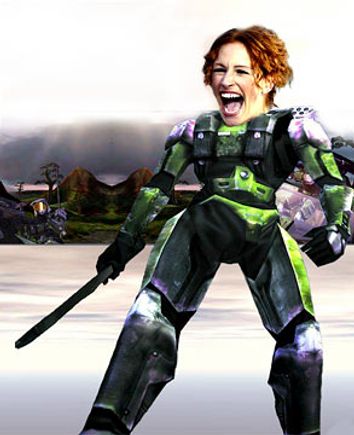
Julia Roberts’ weapon of choice is the M19 SSM rocket launcher. Not the zippiest firearm in the toolkit, sure, and does diddly in close-up melee action. But it’s got a double-barrel rocket payload, and pound for pound, it punches like a mofo. Julia Roberts’ favorite trick during multiplayer capture-the-flag matches is to camp near the team banner from a high vantage point and wait until the other side’s closing in. And at the last possible second, when they’re right about to nab it, pop out in the open with that hand cannon and…

“Dance, ya little bitches, dance!” Julia Roberts hoots, as the blast impact flings three opponent squaddies airborne. Her whole wiry body explodes off the Eames couch in the Emperor’s Suite at the Peninsula Hotel, and she jabs her middle finger at the 64-inch plasma flatscreen, as their crispy corpses hit the ground like rag dolls.

Ms. Roberts is trying to live a normal life, according to People magazine’s latest 50 Most Beautiful People issue, and in it, Denzel Washington says, amazed, “You’d be amazed how down to earth she really is.” But he’s not amazed now, because he’s been trying to get her bony ass off the couch for the last five minutes.

“One more round before lunch, Denzy!” But Denzel is all, “Girl, don’t even tell me you’ve been on this thing all day!” Denzel Washington tosses his controller on the couch so he can flick a bit of invisible dust off his Hugo Boss and roll his eyes. I mean, goddamn. Woman’s worse than my kids and their Game Boy Station, or whatever the hell they call it.

Up Sunset, Jennifer Garner huffs and then heaves her copy of Entertainment Weekly into the back wall of the Viper Room. She cannot believe her bitch publicist got her to tell the EW stringer that “Ms. Pac Man” was her favorite videogame. This article was supposed to get her in tight with her geek boy “Alias”/”Daredevil” fan base, but then here comes Miss Thing all talking about “Halo,” some intense, blowing-crap-up deal, while there she is naming some old school, girly-girl arcade game every female in the whole damn world has played.

Once again, she thinks, clenching her fists, America’s sweetheart has preempted us all. Damn Julia Roberts and her Xbox, Jennifer Garner seethes, damn her.

But over in Cambridge, Mass., a shambly professor with twinkly eyes rummages through the pile of PlayStation cartridges and an ungraded stack of term papers on Baudrillard, to fish out his own copy of Entertainment Weekly.

“It seems that Ms. Roberts’ appreciation for ‘Halo’ presages a new era in popular culture,” gaming academic Professor Henry Jenkins declaims to himself, as he peers out on the MIT quad. “Especially inasmuch as the game is a ‘hardcore’ title, in the lingua franca of the subculture: a gamer’s game, as it were. Consider what it means for a figure so unlike the entrenched stereotype of the ‘geek’ or ‘nerd,’ to be one. It is perhaps even more significant and unexpected than Vin Diesel’s recent self-outing as a Dungeons & Dragons fanatic — since, it must be said, the action star resembles a half-orc already. But returning to Ms. Roberts: Here we see a leading, beloved light of the grandfather medium, the princess of mainstream acceptability, finding herself drawn to, and to a certain extent shaped by, our nascent interactive medium. This represents a cultural shift of epic meaning.”*

“And good gracious,” Professor Jenkins adds, glancing once more at the photo on the marked page in EW, “What a hottie!”

Reese Witherspoon is still standing in the foyer of Julia Roberts’ suite, awkwardly shifting the gift-wrapped box of Jimmy Choos from hand to hand. Coming over, Reese decided that this little get-together was going to be some kind of A-list, big-sister/little-sister chat: you know, a passing of, like, the mantle. She tries to squint over Julia Roberts’ shoulder, who’s sitting on the raw silk carpet with a titanium Powerbook propped between her long legs.

Reese Witherspoon coughs chirpily. “So, is this like that ‘Hee-low’ thing again?” she asks, with a bit more edge than she intended.

Julia Roberts shushes her, and unpauses the QuickTime viewer. Onscreen, a military jeep goes twirling end over end while Sinatra sings on the soundtrack. Julia Roberts laughs the horsey, Southern girl laugh that gets her gross points. “Ain’t that Warthog jump just about the funniest dang thing you ever seen? Wait wait wait, have you watched ‘Red vs. Blue’ yet?”

No, thinks Reese Witherspoon, she has not watched “Red vs. Blue” yet.

For somehow, she imagined they’d be propped on the edge of the bed by now, cotton balls wedged between their toes, as they did each other’s nails and talked about boys they loved. But what Reese Witherspoon does not know is, even if that had been the subject, Julia Roberts would still inevitably steer the topic back to Bungie games. She’d talk about the times Lyle would stumble out of the bedroom at 3 a.m. because she was still there at her Power Mac, plowing through once last level of “Marathon.” (“You comin’ to bed, darlin?”) Or how Benjamin would grumble whenever he’d haul the CPU into the Lexus so he could drive it and her to yet one more LAN party in some China Basin warehouse, so she could retain her Emperor crown in “Myth II” multiplayer. (“Ah, Julia… again?”)

Once Reese Witherspoon is gone, Julia Roberts takes a “Halo” respite, so she can log into Xbox Live for a few rounds of “Unreal Championship.” “UC” isn’t exactly her thing, just a bit too macho Camacho for her taste. On the other hand, Julia Roberts has devised a strategy where she primes up three shells in her rocket launcher, then makes a flying leap off an elevated platform, because anyone below her when she lets rip is fricking toast.

In a suburban basement in outer Duluth, a guy in a White Wolf T-shirt screams, and smacks his forehead into the brick and plywood coffee table. It’s the fifth time in as many minutes that this same asshat with a totally gay online name has cold-cocked him. While bloody chunks of his torso fly every which way onscreen, he kicks his Xbox onto the orange plush carpet. “Damn you, ‘Brockobitch,’” he seethes at the screen. “Damn you!”

In her Beverly Hills hotel, Julia Roberts sends the taunt “Don’t h8 me cuz I rool!!!” (her standard online smackdown), then snags up a link gun to take after her next quarry, a chronic masturbator playing in tube socks from his dorm room in Champaign-Urbana.

Hours later, the limo swoops her downtown, and Julia Roberts is at E3 2003, standing in the long line of endomorphic dudes, waiting to catch the “Half Life 2″ demo. She has a baseball cap pulled over her eyes, and her mane of legendary hair tucked underneath, and she’s wearing an extra-large Blizzard T-shirt, and from a distance, she doesn’t even hold a candle to the nearby booth babes and their hydraulic T&A. No, she just looks like one more scrawny tomboy game geek, the kind of mousy industry girl who plays “Kingdom Hearts,” does 3-D modeling for Ubi Soft, and dates a producer at Shiny.

“Lookit that volumetric shadow!” Julia Roberts blurts out despite herself during the demo, elbowing the level designer in a black Neo trenchcoat sitting next to her. Onscreen, barrels are bouncing down a staircase in random, staggeringly realistic fashion. “And the physics, it’s like butter.”

“Yeah, it’s pretty cool,” he sniffs, as he tries to get a better side glimpse of her figure. And failing that, returns to the mental wank-loop that’s still screening on the back of his head, featuring the gangbang porn star who signed his jeans at the Nvidia party last night.

So she emerges from the Staples Center dragging two giant Lineage shopping bags full of game tchotchkes, Valve T-shirts, “SOCOM” key chains, Rockstar bumper stickers, all kinds of kibble.

On the way out, she’s spotted by a junior agent from CAA, who’s there to talk with some William Spectre person about Laura Ziskin’s option on “Deus Ex,” and the agent gulps and thinks to himself, “My god, the rumors are true– she really is a gamer.” Two minutes and three cell phone calls later, the head of CAA is on the phone with Julia’s publicist Marcy, warning her to nip this oncoming public relations train wreck in the bud. Do not let Julia talk about “Halo.” Do not let Julia tell Vanity Fair about how she likes to post on Shacknews. Do not let anyone know that America’s $25-million-a-picture sweetheart is a hardcore gamer. “Whole careers are riding on this!” Marcy screams so loudly that the speakerphone shudders two full inches across CAA’s black lacquer conference table. “Why the blazing hell would anyone greenlight a picture starring someone who’d rather be in her trailer playing ‘Counterstrike’?”

But in subsequent months, Julia Roberts decides to come out to the world about her gaming. At her signal, magazine covers are committed, interviews are arranged, photo ops are calendared. The turbines on Julia Roberts’ publicity dreadnaught dip below the surface, and churn the waters of the world.

“And how does it feel, Julia,” Oprah Winfrey soon purrs, “when you… what was that again? When you ‘frag’ someone?” (Rosie O’Donnell is more effusive when Julia walks her through a single-player level. “Omigawd, didja see what I did?” Rosie yells, as she waves her game pad in the air. “That was a perfect head shot!”) The half-embarrassed giggles of 50 million soccer moms answer the airing of both shows, and one by one, they sneak into their sons’ rooms, fire up the Xbox, and try the cheat code they just heard about during Oprah’s Video Game of the Month tea chat.

Word spreads everywhere: to a game cafe in a high-rise above the neon canyons of downtown Seoul, where Tack-Jin Song hosts multiplayer “Team Fortress” and types in “DM gibfest, Julia Roberts style!!!!” for the match title. To a Moscow basement, where Sergei Ivanov, a hacker working for the Russian mob, churns out a black-market knockoff of “Halo,” in which the Master Chief’s anonymous, shielded faceplate has been replaced by a skin of Julia Roberts’ head, taken from “Sleeping With the Enemy.” (She has a half-scared, half-fierce expression, because it’s scanned from the scene where she’s right about to cap Patrick Bergin’s wife-beater character with a Beretta 9 mm.)

And to a Karachi Internet cafe, where Sayyid Rahmin is ducking a salvo of Israeli bullets in the virtual Gaza, now in his sixth consecutive hour playing “Special Force,” the first-person shooter created by the jihadi gamers in the Party of God. He is still a new recruit to The Base, so they tell him nothing, but he believes this audiotape in the back pocket of his acid-wash 501s contains the next fatwa from the great Sheik himself. He will deliver it as ordered to the Karachi contact to Al-Jazeera, and when it is broadcast, the infidels will once again shudder in their homes.

But for now, he’s trying to score his 10th head shot in a row. He is about to kill his next IDF commando, when a bizarre thought occurs to him.

“Miss Julia Roberts would not like this game.” She would not like how one wages intifada on the bastard soldiers and the settlers of Israel — and besides, he realizes, you do not get any power-ups.

He scoffs to himself. Of course she would not like it, lackey that she is to the Zionist propagandists of Hollywood. And he has heard of that woman’s great love of “Halo,” a product of the high-tech infidel Mr. Bill Gates, whose “Windows” product has already consumed the computers of the entire Muslim world. (Windows for watching what? he snorts. His unholy software crusade?)

Once again, though, the voice in his head comes:

“Miss Julia Roberts would not like this game.”

But this time, he feels a sharp pang, for he also pictures his beloved late sister Yasmeen, clapping her hands before the family television.

“Look, Sayyid!” Yasmeen laughs. “Is she not quite pretty?” On the blurry screen, above a jumble of Pakistani, Urdu, and Pashto subtitles, Miss Julia Roberts stands next to the Asiatic infidel Mr. Richard Gere, and she is punching her slim fist in the air, saying “Woof! Woof! Woof!”… and she is, indeed, a pretty woman. And she would not like this Hezbollah game he is playing now, for she likes Bungie’s “Halo,” and all it represents.

And at that very moment, the hatred just slips away. He hits Escape, and stands; “Special Force” exits to desktop. He will not, he decides right then, deliver this audiotape. He hands it to a passing beggar and makes his way to his friend Mir’s place, where an Xbox awaits him, and Miss Julia Roberts is out there somewhere too, preparing for his arrival with love, forgiveness, and an air-cooled minigun.

The influence of deathmatch, Julia Roberts-style, spreads and takes new forms with each country it enters. “To Julia” becomes a verb, and the word means carnage. Within years, international disputes are resolved in multiplayer. (After some training by Dennis “Thresh” Fong — who’s also quite good at tearful reconciliations, as it turns out — Bush and Chirac bring back the old clan and become agile enough to best the remaining members in the Axis of Evil clan.) And it is as CAA had foreseen (for CAA is always right), but then it grows far beyond what even they had imagined. Millions crowd into the game servers of all the nations, waiting their turn to be slain by Her. For the reach of Julia Roberts will encompass the entire world (which is Covenant), and She will become Shiva, gibber of worlds, and we Her willing frag victims.

Bless us, O Julia Roberts. Bless us in bloody benediction, O bearer of mystic pizza, O flatliner, O briefer of pelicans, O lover of trouble. Lay your thumbs upon the game-pad button of mortality, to let your SSM missiles seek us out, their cloud-white contrails erasing all our sins. Let the rockets find us, and launch us skyward, twirling and flailing into your waiting arms.

Continue Reading Close

The real Henry Jenkins

Julia Roberts was my student, and I had to send her to the principal's office.

  • more
    • All Share Services

Professor Henry Jenkins of MIT said or did no such thing. However, when asked later to comment on this piece, he did in fact say this: “How ironic you should ask me this question. I happen to have a bit of inside data here. I began my career as a student teacher at Campbell High School in Smyrna, Georgia. Julia Roberts was a student in my American history class. Unless I have mistaken her for another student, which is always possible after all of these years, I sent her to the principal’s office for misbehaving in class. If I am right, then I was prescient in recognizing that underneath that pixielike exterior beats the heart of a hellcat!…

“Can we blame her if she slips home at night … and blasts evil minions to hell and back — something else she never gets to do in her movies? Shouldn’t we feel bad for the way our culture exploits her grace, charm and beauty in vehicles which amount to little more than shameless and gratuitous displays of niceness and appeals to our prurient interest in innocence and levity … Mr. and Mrs. America, don’t let your daughters give themselves over to the light side … the best thing to cure them of all that pent-up purity may be a really bloodthirsty video game…”

“By the way, the first part about Julia being a former student is true. The rest you can judge for yourself.”

Continue Reading Close

Page 1 of 6 in Wagner James Au