Will Menaker

Assassinating Russia’s ultimate archvillain

A compelling new graphic novel reimagines the killing of the mysterious Grigori Rasputin

This article appears courtesy of The Barnes & Noble Review.

“Murder is the emperor of political action,” says an eager conspirator in the graphic novel “Petrograd.” In this case the murder is the notorious assassination of Grigori Rasputin, and the political action is a conspiracy orchestrated by agents of the British Secret Service at the height of World War I. Author Philip Gelatt and artist Tyler Crook demythologize the killing of Rasputin — a figure so buried in legend that this task borders on the herculean — largely by substituting a not wholly implausible counter-historical fiction.

Barnes & Noble ReviewBeginning in the trenches of the Eastern Front and ending with the February Revolution, “Petrograd” is based on enough known facts and real people to credibly capture a sense of time and place, but it also employs just enough fiction to create a compelling (if conventional) spy thriller. It mines a fair amount of tension out of material that’s already, in a sense, a matter of history.

There are no real revelations here for anyone with a passing familiarity with history or the spy genre. As a novel it is good, satisfying, but as a comic it is beautiful. Crook’s gorgeous sepia-toned artwork creates a palpable atmosphere of a people and a city on the edge while crisply moving the action through carefully constructed panels.

Whether archvillain, debauched madman, or clever charlatan, Rasputin remains largely a mystery in this novel, as he has in real life. He is a cryptic center around which wind the various strands of the Russian aristocracy, the tsar’s secret police, and British intelligence. Wary, perhaps, of coming at the enigma of Rasputin too directly, the narrative follows Agent Cleary, an Irish-born agent of the British Crown stationed in St. Petersburg. Cleary’s personal and political ambivalence make him a reluctant but effective spy who uses his contacts — including nobles at the top of Russian society and Bolshevik revolutionaries at the bottom — to “facilitate communication between war efforts.” As Cleary says, spying on the Russians sometimes means spying for them.

It is to the novel’s credit that the conspiracy it invents is not needlessly complicated or baroque. The British fear the Russians will make a separate peace with Germany, and rumors of secret negotiations at the behest of the Russian royal family’s “mystic advisor” are seen as the decisive factor. Thus, a comment made as a hypothetical jest by the right person is reported up the chain of command, and Cleary finds himself pressed into making sure that one nobleman’s fantasy becomes a reality.

Despite the inherently grandiose and seductive nature of conspiracy theory as a basis for fiction, “Petrograd” never indulges the assumption that the machinations of empire are by definition omnipotent or all-encompassing. Neither the men who orchestrate events from afar nor those who carry out their plans are ever truly in control of their own actions or their outcomes. This is best captured in the depiction of the killing of Rasputin. As written by Gelatt and vividly illustrated by Crook, the infamously excessive assault that unfolded — the victim was shot, stabbed, poisoned, and thrown into an icy river — was due not to any supernatural hardiness of Rasputin, nor extraordinary malevolence on the part of his killers, but rather the assassins’ naiveté and inexperience. The romantic notion of changing history by means of some brilliant scheme is quickly replaced by the sordid work of actually killing someone. In the end, the murder accomplishes nothing, as the tide of revolution sweeps away the Romanov dynasty and ends the Russian involvement in the war. In a pattern often repeated throughout history, the only political action that really matters manages to take all the relevant “intelligence” completely by surprise.

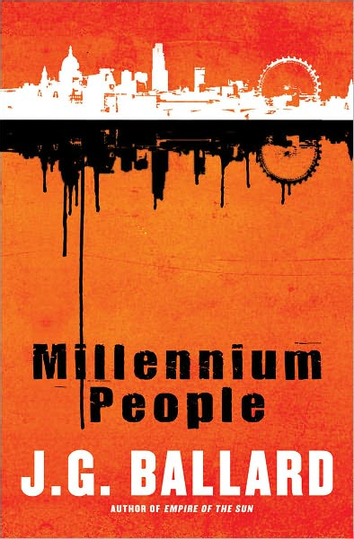
“Millennium People”: J.G. Ballard’s last hurrah

The dystopian author's final novel gives us a prescient reflection of modern horrors

In this, his last novel, the darkly comic “Millennium People,” J.G. Ballard returns to many of the themes that have established him as one of the 20th century’s principal chroniclers of modernity as dystopia. Throughout his career Ballard, who died in 2009, wrote many different variations on the same theme: A random act of violence propels a somewhat affectless protagonist into a violent pathology lurking just under the tissue-thin layer of postmodern civilization. As in “Crash” (1973) and “Concrete Island” (1974), the car parks, housing estates, motorways and suburban sprawl of London in “Millennium People” form a psychological geography. At its center, Heathrow Airport — a recurrent setting for Ballard — exerts its subtly malevolent pull on the bored lives and violent dreams of the alienated middle class.

Barnes & Noble Review“Millennium People” begins with the explosion of a bomb at Heathrow, which kills the ex-wife of David Markham, an industrial psychologist. The normally passive Markham sets out to investigate the anonymous bombing and the gated community of Chelsea Marina, a middle-class neighborhood that has become ground zero for a terrorist group and a burgeoning rebellion of London’s seemingly docile middle class. Exploited not so much for their labor as for their deeply ingrained and self-policing sense of social responsibility and good manners, the educated and professional residents of Chelsea Marina regard themselves as the “new proletariat,” with their exorbitant maintenance and parking fees as the new form of oppression, their careers, cultured tastes and education the new gulag.

In the company of a down-and-out priest and a film professor turned Che Guevara of the Volvo set, Markham quickly discovers that the line between amateur detective and amateur terrorist is not so clear, as he is drawn deeper into acts of sabotage and violence against the symbols and institutions of his own safe and sensible life. Targets include travel agencies, video stores, the Tate Modern, the BBC and National Film Theater — all “soporifics” designed to con people into believing their lives are interesting or going somewhere.

Like “Crash” — in the person of Vaughn, the deranged prophet of auto-Armageddon — “Millennium People” features a messianic and charismatic leader who acts as Virgil to the protagonist’s Dante. Here, the psychotic pediatrician Dr. Richard Gould emerges as the dangerous mind behind the Chelsea Marina rebellion and its parallel bombing and vandalism campaign, a new form of terrorist violence that draws its power from the absence of any real motive. Rather than shocking the middle classes out of their complacency, with these attacks Gould desires nothing less than the destruction of the 20th century itself, which he sees as a black hole in history pulling Western civilization ever closer to absolute zero. Culminating with a senseless killing that that closely mirrors the real-life murder of British TV presenter Jill Dando, these spasmodic destructions are emblematic of a perverse collaboration of terrorist and victim, in which “the most pointless acts” are the only way to “challenge the universe at its own game.”

In his work Ballard has depicted a future — and now a present — with disturbing prescience and clarity. Posthumously released in America, “Millennium People” arrives at a time when the foundations that support our own middle classes feel more unsettled than ever, and the specters of apocalyptic obsession and the nihilism of consumer culture all bear an increasing resemblance to the world Ballard has been creating in one fiction after another — or perhaps warning us about.

Continue Reading Close
www.salon.com/writer/will_menaker/index.html