Flavor

The flavorist conversations: Wylie Dufresne

The irrepressibly creative chef of wd-50 talks about pairing ingredients and life after culinary bomb throwing

  • more
    • All Share Services

Topics: , ,

The flavorist conversations: Wylie DufresneWylie Dufresne

If writing about music is like dancing about architecture, then how do you talk about flavor? Inspired by “The Taste Makers,” Raffi Khatchadourian’s fascinating story in the New Yorker on the highly creative people who invent the flavors in your soda and candy, we’re chatting with chefs on how they think about flavor in their work.

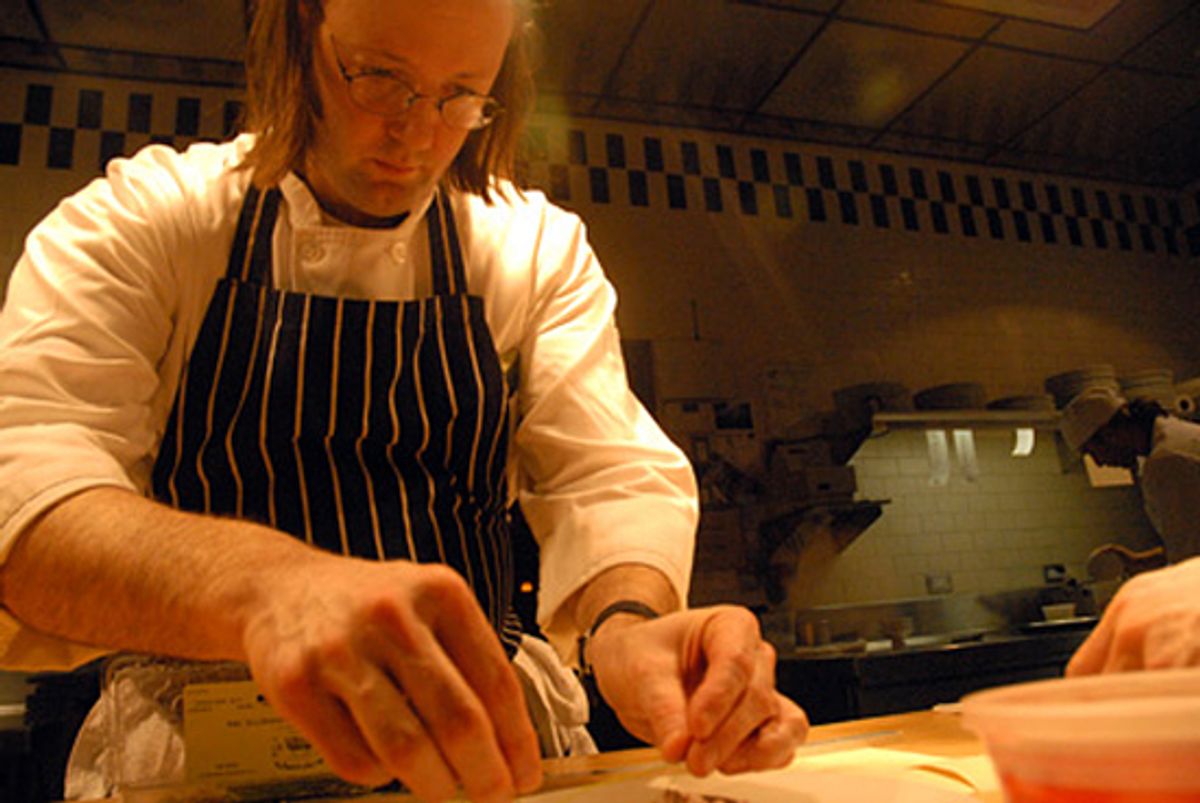
This installment: Wylie Dufresne of New York’s wd-50, who years ago became known for serving oysters pounded flat into sheets and pairing venison tartare with soybean ice cream, talks to us about how he constructs the flavors of his dishes, the way novelty and memory taste, and growing out of his younger, rasher phase.

“The manufacture of flavors demands a childlike openness.” That’s a line from Khatchadourian’s story, a paraphrase of Willy Wonka. Does that relate to how you think of your flavor combinations? Is there a process you go through when designing them?

I’m not always sure where inspiration comes from. My mother, who is very creative, always says, “Creativity isn’t linear. You can’t just sit down and decide to be creative.” It can come from so many angles: what I had for dinner last night, the book I read, going to the museum. It might start with a technique. It can start with Alex [Stupak, wd-50's pastry chef] asking what fruit or vegetable would be good with a dessert he’s working on.

There is a part that’s calculated. There’s a framework we use. We always have to balance the dish: sweetness, saltiness, bitterness, umami, sourness. Especially sourness. I got that from [working under] Jean-Georges Vongerichten, without a doubt. You always notice laser-sharp balance with acidity in his food. He’s always preached that, so that’s always one of our first questions. How do we give the dish some acidity?

For example, something we’re working on now is langoustine with bay leaf granola and a preserved-lemon dust — no, that’s too precious sounding — but like a cookie crumbled up into sand. This sand has all the complexities of the fruit. But the plate needs some juiciness or a sauce. We got a little stuck there.

To relax at home one night, I opened a Chinese cookbook I like, and it fell on a page on sesame seeds. So then I start thinking about tahini, maybe a black sesame tahini for the dish? There’s a randomness there. I didn’t open the book looking for inspiration, but now sesame is on my radar. That’s how it works; sometimes you can’t force it. But I tell all my cooks to jot down their ideas all the time, and to be open to them when you’re away from work.

Rachel Hagen, the flavorist profiled in the story, talks about her plans to try slipping menthol into butterscotch, something she describes as being “interesting, that makes you think.’” What do you think qualifies a flavor as “interesting”? What flavor combinations make a person think?

We have inherent curiosity for the new. Granted, we’re not necessarily going to create new flavors, we’re not finding many new ingredients. The pantry doesn’t really change, but the pairings and arrangements can change.

What we like to do is either something like eggs Benedict and present it in a way that turns it on its ear, [slow-cooked egg yolks with deep-fried hollandaise and Canadian-bacon crisps –Ed.] or we take seemingly disparate flavors and put them together.

In the article, they were tasting a citrus fruit and talking about finding notes of clove, Gouda cheese, yeast. Oh my god, that sounds great. Yeast, citrus and clove? That’s a beginning of a dish right there. To me, that sounds very disparate, but to them, those are closely related elements, tied together by this fruit. Sometimes these flavors just need some contextualizing.

So what connects quails to bananas to tartar sauce?

You didn’t like that dish? That’s OK. We shouldn’t always agree on everything; that would be no fun. It all seemed logical when I tried it. You know, sometimes one’s ego gets in the way and you go, “I don’t care when people tell me I don’t like it,” but then you look back and see that it was a dog. But with that dish, I mean, David Chang liked it and that’s all I need to know. [Laughs.]

There are a couple of things that Rachel Hagen does that intrigue me: She keeps paint chips in her office to help her memorize flavors, using the colors to symbolize a particular aroma. She also describes a scene while camping, and talks about wanting to “paint” that scene as a flavor combination. Do you translate flavor into other forms? Does flavor symbolize things to you?

That didn’t seem weird to me. She was talking about pine and cedar for the woods, lemon for the sun, and vanilla for the fog. I don’t know that I would be going to Gatlinburg, Tennessee, when I eat that, but could think of a walk in the woods or something.

We can eat something and trigger a memory. Heston [Blumental, of The Fat Duck, outside London] has a dish inspired by sweet shops of his youth, licorice and coconut. Those were not the flavors of my candy store, but it can still be transporting.

But you have to be a diner who wants to be transported, to bring that childlike openness to the table. You have to want to submit to the illusion. Think of when Grant [Achatz, of Alinea, in Chicago] burns leaves for his dishes. Some people might think of campfires, which is nice, and others might think of their neighbors burning their leaves on their lawn all the time, and it pisses them off.

People come up to me and say, “I know what you’re trying to do! That was supposed to be like a hot dog!” And I think, “No, that’s not what I was doing,” but I don’t want to squash what they’re thinking. I like that I can’t control that. It’s great to have people have their own interpretation.

So how do you push people to have an interpretation? As you said earlier, your dishes are familiar things presented unconventionally, and unfamiliar things presented more approachably. Would you ever make a dish that was totally off the wall, with nothing normal to hold on to?

We’ve done that. We’ve done dishes that take all reference points away from people, sometimes to greater effect than others. But I hesitate to use the word “challenge,” because I don’t want to engage the diner too aggressively. In my youth, I did that too much. I hope I’ve matured in my approach to that. We’ve grown more comfortable, less showy for the sake of being showy. I like to be eating out of my comfort zone, but not everyone is like that. Not everyone wants to think about their food that way. Recognizing that is part of being a responsible restaurant.

I spent three hours at the Matthew Barney show at the Guggenheim Museum. I walked around really confused and dismayed, not sure what he was trying to tell me. I didn’t feel like I could evaluate it, because I just didn’t get it. And I guess that’s something that some people experience at my restaurant.

I wasn’t upset that I didn’t get it. I was disappointed in myself. I think some people are prepared for that for certain art forms. But you don’t have to go to a museum if you don’t want to; you do have to eat.

I like the idea of having a couple dishes that are like, “Whoa, this doesn’t make sense to me.” But how does it taste? It’s fun to go hog wild, but at the end, it has to taste good.

Continue Reading Close

Francis Lam is Features Editor at Gilt Taste, provides color commentary for the Cooking Channel show Food(ography), and tweets at @francis_lam.

“This American Life” reveals original Coca-Cola recipe

The radio program found the recipe in an old issue of the Atlanta Constitution-Journal. So, what's in it?

  • more
    • All Share Services

Topics: , ,

Chicago-based radio program “This American Life” cracked the Coca-Cola code. The show apparently unearthed the soft drink’s recipe — which is guarded in a massive vault in the Coke’s corporate headquarters in Georgia — in a 1979 edition of the Atlanta Constitution-Journal. The recipe dates back to 1886.

So what’s in it, then? To start: the eponymous coca extract, plus citric acid, lime juice vanilla, caramel, caffeine, sugar and water. More important, though is “7X” — which includes orange oil, alcohol, nutmeg oil, lemon oil, coriander, neroli and cinnamon — and constitutes the drink’s backbone.

You can read more about the recipe and listen to This American Life’s broadcast at their website here

How to be a food snob

You don't have to be a jerk to have a palate like one. Plus: A slide show to train the tongue and master your mouth

  • more
    • All Share Services

Topics: , , ,

How to be a food snobView a slide show

There’s no more insufferable supper companion than a food snob: You know, one of those folks who sit around and complain that the sauce is too bright and the roux too bitter, or that the onions should have been allowed to sweat rather than brown.

But hey, there’s something to be said for the power of their palates, their ability to pick up cues and vocalize what they’re tasting from the muddle of flavors in the mouth. (Even if, as I sometimes suspect, they just think they can.) I’m not talking about “super tasters” — those few who physically have more taste buds than the rest of us — but the eaters and cooks who always seem to know just what it is they’re eating.

How do they do it? And more importantly, other than spending $60,000 on a culinary degree, could I train myself to do it, too? I put the question to experts who should know: a tongue doctor, a chef or two, a sommelier and a flavor chemist.

Breathe, Damn It!
I start with the doc, naturally: Andrew P. Lane, an otolaryngologist — he studies the head and neck, that is — who directs the Johns Hopkins University Sinus Center.

On a daily basis, says Lane, patients complain to him that they’ve lost their ability to taste, which, sad to say, does indeed decline with age and the influence of a growing number of prescription drugs. Those very real problems aside, Lane often starts by telling clients just what he tells me: There’s the technical ability to taste, and then there’s what we perceive as flavor.

Our tongues are equipped to experience only salty, bitter, sour and sweet flavors, plus umami, a newish term we borrowed from the Japanese to define a savory tasting sensation.

“But that’s not really the flavor of food,” Lane says. Flavor — the citrusy essence of lemongrass, that lusty smokiness of chipotle peppers — comes mainly via our nose, he says, and largely through what’s known as retronasal or orthonasal smelling.

In other words, when you take a bite of food and chew, some aromatic compounds go into your mouth and back up into your nasal passages: “You may not even think you’re smelling,” says Lane, “but you are.”

Ever seen a wine taster — olive oil, beer and cheese geeks do it too — swish their wine around in their mouths and suck in air over their tongues? It’s all about getting those aromatics back up into their noses.

Obviously, smoking and sinus problems hamper your retronasal capabilities, but by the same token you can potentially boost your skills by going whole hog with your breathing and slurping … though you might look super-silly at the Olive Garden in the process.

Develop a Pantry of the Mind
But if your brain doesn’t recognize what it is your schnoz is sniffing, no amount of inappropriate gurgling noises will do you any good, so I ask Mark Ainsworth, a chef who teaches continuing education classes on the physiology of taste for professionals at the Culinary Institute of America, how to develop a mental flavor bank.

Ainsworth’s approach is to train chefs on basic ingredients and key flavor foundations by making the poor things taste them. So his students spend a day sampling a pile of herbs, both fresh and dried; they go through the spices, the oils and the vinegars; they try onions browned, caramelized, sweated and sautéed, and nuts toasted versus roasted. They also taste these components in basic culinary combinations and cooking methods: the classic French flavor base of sautéd celery, carrots and onions called mirepoix, the rich blend of coconut milk, fresh herbs and chiles that start so many Thai dishes.

“Another way to get better at it,” Ainsworth says of tasting, “is to understand those ingredients that are common to a specific country, to its flavor profile … If you were to eat your food with your eyes closed,” he asks, “do you know where you are?”

Comparing Korean and Thai and Cantonese or Ukrainian and Polish and Bukharian is tricky for most folks — though it could be the start of a killer potluck supper club — but mastering the basic ingredients is easy: Buy 10 fresh herbs or five oils or cheeses or spices and taste them side by side, Ainsworth says.

And get in the habit of tasting all the ingredients that go into a dish you’re cooking before it’s made, he says, so you can see what they’re like raw and cooked in certain ways and with certain components. Although cooking techniques require practice, we have a remarkable memory for flavors once we’re told what they are, Ainsworth notes, meaning you have to taste pure marjoram only once to get it.

His colleague, associate professor Lani Raider — she teaches a class for culinary students called “Introduction to Gastronomy” — offers yet another suggestion for nailing down a flavor: Taste ingredients as fresh as you can get ‘em, straight from soil if possible.

“I take them out to the farm,” she says of her students, “and I pull the beet out of the ground.”

“What most people get in this country are hues of things,” Raider says, referring to the fact that unless you’re reading this in California, your supermarket asparagus probably sat for at least a week before you tasted it.

I’m tempted to brush this off as farm-to-table political posturing, but Raider proves her point when she reminds me that fresher ingredients — be they spices or strawberries — will naturally be more intensely flavored and more intensely aromatic … and smell, we now know, is mainly what we’re sensing anyway.

Get a Grip on Your Adjectives
Raider also offers another suggestion, one she lumps under the broader category of “expanding your consciousness.” Keep a food diary not of what you eat but what you experience. She says, “There’s a pretty big difference between eating and tasting.”

What she means is considering and taking note of the entire experience of tasting: The way the food feels in your mouth, what your beer smells like cold and if it’s different when it’s lukewarm, what you notice with the first piping-hot bite of sauce compared with the last chilled streaks you scrape up before the server takes the plate. Do you feel one sensation more than others as you chew, a citrusy tingle at first, followed by rush of sweet?

That’s a concept I hear again from Andrew Bell, a co-founder and the president of the American Sommelier Association, who trains wine snobs to be. “I tell my classes, ‘Your drinking days are over,’” he says. “Drinking does not require cognition; taste requires cognition.”

Wine tasting, you might have noticed, is big on cognition of a certain kind: a vocabulary of comparison, all that jazz about wine tasting like oak and petroleum and passion fruit and cat pee. Having “the balls,” as Bell puts it, to put what you’re tasting into new adjectives is what makes great tasters, great tasters.

But the rest of us usually just learn the old adjectives that turn into jargon, usually by tasting something that is already agreed-upon to be apple-y or citrusy or whatever — Merlot and plums, Riesling and petroleum — rather than trying to pick it out ourselves.

Bell’s tasting diary is different from Raider’s in one key respect, since with wine the goal is really the get — meaning, when you finally make the connection between what you’re tasting and what you’re supposed to be tasting. Getting to know wine — or other specific foodstuffs with their own jargon, like cheese or beer — often requires that you take a nip either in front of an expert or an open book.

Bell, like any other expert, will tell you that you haven’t failed if you haven’t sussed out a certain fruit in the aroma or flavor at the tail end of your guzzle — Hey! it’s all about enjoying the wine, right? — but it’s pretty damn satisfying when you nail them. (And if you can’t get any of them at all, well, maybe developing a wine cave shouldn’t your primary investment strategy.)

Then there are defects: Calling them out by name is important to fine tasters of wine, too. An admission: For years I’ve been hoping to be out to dinner with somebody who angrily declares the bottle of Beaujolais or whatever we’re drinking to be corked — so I can finally know what “corked” tastes like.

If I’d studied flavor chemistry at the University of Minnesota in Minneapolis, it turns out, I’d already know. Budding flavor experts there, says Gary Reineccius, the head of the department of food science and chemistry, take a class on common defects. “We spend three days making the worst foods you’ve ever tasted,” he says.

That way, the class can see what rancid olive oil (leave a near-empty bottle in the back of a warm cabinet for six months and try it next to a new one) or oxidized milk (put a bottle in the sun for a few hours) really tastes like in a recipe. Just by tasting, Reineccius says, he students can save a company with a returned product the $20,000 that two months of lab testing will cost it.

Though Reineccius, like Bell, is especially impressed by those bold enough to create their own tasting terms. He recalls a flavor production company he used to work for in New York City, where he and other chemists would gather to sniff new flavors each morning. “What these guys do is just be extremely conscious, not only of what they’re eating, but the world around them,” Reineccius says, “and that’s where they get a vocabulary.”

One of his all-time favorites, in fact, is a descriptor you probably won’t get to use at your next four-star dinner function: “That smells,” Reineccius recalls a colleague remarking, “just like the fire hydrant at 42nd Street.”

Slide show: Learn the seven steps

Continue Reading Close

Do spices really only keep for six months?

No, you don't have to replace them twice a year. Even better news: Here's how to make them always taste amazing

  • more
    • All Share Services

Topics: , ,

Do spices really only keep for six months?(Credit: Emrah Turudu)

Dear Salon Food:

How many times have you heard that spices lose their potency “after 6 months”? It’s repeated so often, but it seems absurd to me that all spices would behave exactly the same and I know that most processes of deterioration graphically resemble that of Newton’s law of cooling (\[\frac{dT}{dt} = -k (T - T_a).\]) with the fastest deterioration occurring initially.

Paul

Dear Paul:

Do you have any idea how awkward it is to get on the phone with some poor spice company representative and subject them to the sentence, “Yes, but is the deterioration of the spices anything like Newton’s law of cooling? You know, like, slash-bracket-slash-frac-whatever that squiggly bracket is called…”

But hey, I did it for you. And even better, I also called Jane Daniels Lear, who wrote the superb cookbook “One Spice, Two Spice” with chef Floyd Cardoz of Tabla, the most influential Indian-inflected restaurant in America, and I learned more than I ever thought I would about the buying, storing and fading of spices. Here’s what you should know.

How to buy and store spices:

“Six months?” Lear said, with a genteel indignation. “Some food Nazi probably made that rule up. Or someone from a spice company who just wants you to throw out all your spices twice a year.”

She continued: “To me, that rule is irrelevant, because it really depends on how old the spices are when you buy them, how they’ve been taken care of, and how you store them. So many people have them in clear bottles on a spice rack in the kitchen. There’s heat from the stove, and sunlight causes a reaction, like bleaching. Both of these are terrible for spices. But if you buy spices from a place with high turnover so their stock is fresh, and store them cool, dark, and dry, they will keep much longer than six months.

Some other things to keep in mind when storing spices: It’s not just the stove and oven that are hot — the back of the fridge throws off a lot of heat, the toaster oven, your coffee machine, even the part of the kitchen where the sun streams in in the afternoons. So keep heat in mind when you decide where to let your spices live. And, Lear says, the freezer is a good option for spices that have a high oil content — like mustard seeds — so the oils don’t go rancid.

Well, OK, fine. But there’s still a reason for the six-month rule. Sort of:

When I started asking Nick Ciotti, V.P. of operations for the excellent Vann’s Spices about whether spices lose their flavor like Newton’s law of cooling, he thankfully interrupted with, “The short answer is yes,” saving me from completely displaying my ignorance of basic science.

“Once the spices are ground, right away there’s a sharp drop in their flavor. Spices are filled with volatile oils, which are what give them their flavor and complexity. When you grind them, you release those oils, and they begin to dissipate. In two weeks to a month after grinding, you have the sharpest drop in flavor, a rapid loss of those oils. But then it plateaus, losing its flavor at a more gradual rate. For the next few months, they’re pretty much the same, but by six months, you’ve really lost their complexity. It’s not just about potency and strength — for that, you can just add more of the faded spice. But you can’t ever get back the complexity. Black pepper from a year ago might still smell like pepper, but it won’t smell like orange and clove, the interesting aromas that a really fresh pepper has. After six months, it’s still totally usable, but it’s just a matter of what you want out of it.

But here’s the real key, what every pro will say about spices — buy them whole and grind them yourself:

Whole spices, well-stored in the way Lear suggests, will easily keep for a year. Ciotti explained it this way: “When they’re whole, they have this nice shell for all the volatile oils inside. When you grind spices fresh, you’re getting that first initial burst of all those oils, those flavors. They’re all there. But when you’re buying pre-ground spices in the grocery store, there’s no way to tell how long they’ve been sitting there. Most companies pull in ground spices that have been ground, warehoused, flown over to the U.S., warehoused here, then packaged and sold. It might be a year or two old already by the time you get them.”

Grinding your own spices requires hardly any work. Just drop your spices, toasted or raw, into a cheap coffee grinder and whirl them around, shaking the grinder a bit to get them moving into the blades, until you get a powder — whether you prefer course or fine is up to you. (Keep that coffee grinder expressly for spices. Really, don’t use it for coffee afterward. No matter how much you clean it, your coffee will taste totally weird.) A good rule of thumb is that you will end up with a half to a third of fine powder for the volume of whole spices you grind.

But, Lear says, “If I end up grinding a little extra than I use in a dish, I’m not worried about it. I throw everything left over into this little bottle we call ‘Sam’s spice rub’ that my husband uses on pork ribs. And it’s just wonderful. Or, the other day I had some extra ground coriander and I mixed it with salt. I’ve been using it on everything, and it made someone say my potato salad was the best they’ve ever had. Just adding a little bit of spice gives this extra mysterious something.”

Sometimes small amounts of a spice can be a problem, since you need a certain quantity in the grinder to reach up to the blades. When a recipe calls for a really tiny amount of a spice, Ciotti recommends a few options: You can also get a cheap little mortar and pestle and give them a really quick pound. Or see if there are other spices in the recipe and grind them all at once. Or you can add a little bit of salt to the spices in the grinder to bulk them out, and just use that as your salt for the dish.

And do different spices keep differently?:

Technically, yes. Ciotti points out both size and chemical factors. “Look at nutmeg — it’s rather large, very dense. It’s a really good encasement for all those oils. You can shave off a little at a time. But when you grind fennel, it’s extremely volatile. You lose a lot of that complexity even with a week.” But that is just stuff to argue about for purists and geeks. “Most people,” he says, “are still buying their spices pre-ground, so talking about complexity is a moot point. It almost doesn’t exist, until you put it up against something fresh and freshly ground. A really fresh black peppercorn smells like orange. It’s amazing. And something like that you’d never realize unless you experience it.”

If you have any food questions we can sleuth out for you, ask us! E-mail us at food[at]salon[dot]com. 

Continue Reading Close

Francis Lam is Features Editor at Gilt Taste, provides color commentary for the Cooking Channel show Food(ography), and tweets at @francis_lam.